Human milk storage & Banking
Dr Abbas
Associate Professor, Pediatrics
Career Institute of medical sciences ,
Lucknow
Expression & storage of breast milk
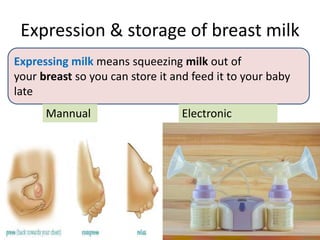
Expressing milk means squeezing milk out of
your breast so you can store it and feed it to your baby
late
Mannual Electronic
Storage of human milk
Why expressed breast milk?
working mothers
Sick babies
Preterm/low birth weight
Congenital defects in babies (cleft palate)
Safe Storage of Expressed Breast Milk
Safe expression:
• Wash your hands or , use an alcohol-based hand
sanitizer
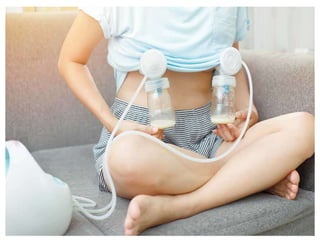
• Mothers can express breast milk by hand or with
a manual or electric pump.
• Use clean pump.
• If using a shared pump kit, clean with
disinfectant wipe.
Safe storage:
• Use breast milk storage bags or clean food-grade
containers
– Avoid bottles with the recycle symbol number 7.
• Never store breast milk in disposable bottle liners or
plastic bags.
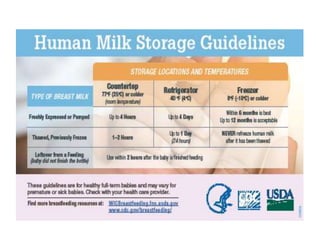
• Clearly label the breast milk with the date
• Do not store breast milk in the door of the
refrigerator or freezer.
• If expressed breast milk required storage for
more than 4 days, freeze it right away.
• Freeze breast milk in small amounts of 2 to 4
ounces.
Safe Storage tips:
• When freezing breast milk, leave about an inch of space
at the top of the container.
• Clearly label the container with the child’s name.
• Breast milk can be stored in an insulated cooler bag with
frozen ice packs for up to 24 hours.
• Always thaw the oldest breast milk first.
• There are several ways to thaw your breast milk:
– In the refrigerator overnight.
– Set in a container of warm or lukewarm water.
– Under lukewarm running water.
• Never thaw or heat breast milk in a microwave.
Safe Thawing of Breast Milk
• Use breast milk within 24 hours of thawing in the
refrigerator.
• Once breast milk is brought to room temperature it
should be used within 2 hours.
• Never refreeze breast milk once it has been thawed.
Human Milk Banking
• A human milk bank or breast milk bank is a
service which collects, screens, processes, and
dispenses by prescription human milk
donated by nursing mothers who are not
biologically related to the recipient infant
• ,.,
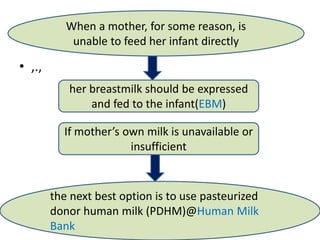
When a mother, for some reason, is
unable to feed her infant directly
her breastmilk should be expressed
and fed to the infant(EBM)
If mother’s own milk is unavailable or
insufficient
the next best option is to use pasteurized
donor human milk (PDHM)@Human Milk
Bank
HISTORY
• Donating breast milk can be traced back to the
practice of wet nursing.
• The first record breastmilk donation are found in
the Babylonian Code of Hammurabi (1800 BC).
• The practice of wet nursing declined by the 19th
century
• Theodor Escherich of the University of Vienna
conducted studies from 1902 to 1911 to find out
different sources of nutrition and their effect on
neonates.
• His studies demonstrated that breastfed neonate's
intestinal bacteria was significantly different
compared to neonates fed by other means.
• In 1909, Escherich opened the first human milk
bank in Vienna , Austria .
• The following year, another milk bank opened in the
Boston Floating Hospital, the first milk bank in the
US.
• The first milk bank in Asia under the name of Sneha,
founded by Dr. Armeda Fernandez, was started in
Dharavi, Mumbai on November 27, 1989.
• Currently, the number of human milk banks (HMB)
has grown to nearly 14 all over India
• The International Milk Banking Initiative (IMBI),
was founded at the International HMBANA
Congress in 2005.
• It lists 33 countries with milk bank programs.[6]
• Mothers' Milk Bank (MMB) says, this service
provides mothers with an alternative to infant
formula
• The World Health Organization (WHO) states
that the first alternative to a biological mother
not being able to breast feed is the use of
human milk from other sources.
Primary Recipient/consumer
• The primary and largest group of consumers of
human breast milk are premature & sick babies.
• The babies of mothers with postpartum illnesses,
and babies whose mothers have lactation failure,
till their milk output improves
• Infants with gastrointestinal disorders or metabolic
disorders may also consume this form of milk as
well.
• Human breast milk acts as a substitute, instead of
formula, when a mother cannot provide her own
milk.
Donor requirement
The donor population is formed by healthy
lactating mothers with healthy babies,
who are voluntarily willing to give their extra breast
milk for other babies without compromising the
nutritional needs of their own baby
Donor………………
A donor must:
• Be healthy
• Be in the process of lactation
• Undertake a chest x-ray or Tyne test
• Have a negative VDRL
• Have no evidence of hepatitis
• Be HIV negative
.
LOCATION OF HUMAN MILK BANKS
• The Human milk banks are primarily focused
to provide donor milk to high risk newborns.
• The human milk banks in the neonatal units is
associated with elevated rates of exclusive
breastfeeding rates in VLBW babies.
• The Postnatal wards or Well Baby clinics of
large hospitals are most suited place.
Equipment & staff
• Breast milk pumps
• Container
• Generator/Uninterrupted power supply
• Milk analyzer:
• Pasteurizer/Shaker-water bath
• Deep freezer
• Refrigerators
• Hot air oven/Autoclave
• STAFF
COLLECTION OF BREASTMILK
• ,
• .
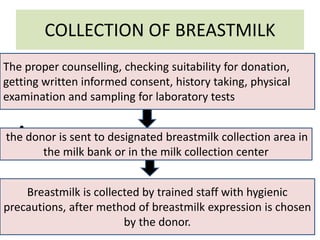
The proper counselling, checking suitability for donation,
getting written informed consent, history taking, physical
examination and sampling for laboratory tests
the donor is sent to designated breastmilk collection area in
the milk bank or in the milk collection center
Breastmilk is collected by trained staff with hygienic
precautions, after method of breastmilk expression is chosen
by the donor.
Processing
• All batches of collected raw breast milk should be
refrigerated
• Fresh raw milk should not be added to the frozen milk
• While mixing fresh raw breast milk to frozen raw breast
milk previously collected from same donor, it should be
chilled before adding to frozen milk [18].
• For sick or preterm babies, it is advisable to use a new
container for each pumping.
• Before pasteurization, pooling and mixing may be carried
out from multiple donors to ease the process of processing
and storage.
• Pasteurization is carried out by Holder’s method.
• Microbiological screening of donor milk is done before
and as soon as possible after pasteurization.
• Pre-pasteurization microbiology can result in wastage of
milk
• A bacterial count of 105 CFU/ mL or more in raw breast
milk can be considered as an indicator of the poor quality
of milk.
• Based on this and on the theoretical concern that heavily
contaminated milk with specific bacteria (e.g. S. aureus,
E.coli)
Storage
• Pasteurized milk awaiting culture report should be
kept in dedicated freezer/freezer
• Storage should be done in the same container that is
used for pasteurization.
• It is advisable not to transfer processed milk in other
containers as it has risk of contamination.
• Culture negative processed milk should be kept at -
20°C in tightly sealed container with clear mention
of expiry date and other relevant data on the label.
• It can be preserved for 3 to 6 months
Disbursal
• PDHM should be disbursed at physician’s requisition
from NICU physician after informed consent from the
parents of the recipient.
• Preterm baby should preferably get PDHM from preterm
donor.
• Transport of PDHM should be done under cold storage
in the same pasteurized container till its use.
• Frozen PDHM should be thawed by either defrosting the
milk rapidly in a water bath at a temperature not
exceeding 370C, or under running lukewarm water .
Labeling and record keeping
• HNB should have an operational objective of ensuring
full traceability from individual donation to recipient,
• maintaining a record of all storage and processing
conditions.
• Written standard operating procedures should be
followed.
• Confidentiality of records should be maintained by the
milk bank.
• Proper labeling at all levels is mandatory; from sterile
container for collection of donation, pooling vessel and
pasteurization container to storage containers.
• Labels should be water resistant and names and
identifying details of donors, dates of pasteurization,
batch numbers and expiry date should be clearly
readable.
• Record keeping at all levels should be meticulous for
Donor Record File containing consent form, donor’s and
her child’s data, screening reports, pasteurization batch
files, and for PDHM Disbursal Record File containing
relevant data, including recipient consent form..
Thank you

Human milk storage & banking

  • 1.
    Human milk storage& Banking Dr Abbas Associate Professor, Pediatrics Career Institute of medical sciences , Lucknow
  • 2.
    Expression & storageof breast milk Expressing milk means squeezing milk out of your breast so you can store it and feed it to your baby late Mannual Electronic
  • 4.
    Storage of humanmilk Why expressed breast milk? working mothers Sick babies Preterm/low birth weight Congenital defects in babies (cleft palate)
  • 5.
    Safe Storage ofExpressed Breast Milk Safe expression: • Wash your hands or , use an alcohol-based hand sanitizer • Mothers can express breast milk by hand or with a manual or electric pump. • Use clean pump. • If using a shared pump kit, clean with disinfectant wipe.
  • 6.
    Safe storage: • Usebreast milk storage bags or clean food-grade containers – Avoid bottles with the recycle symbol number 7. • Never store breast milk in disposable bottle liners or plastic bags.
  • 8.
    • Clearly labelthe breast milk with the date • Do not store breast milk in the door of the refrigerator or freezer. • If expressed breast milk required storage for more than 4 days, freeze it right away. • Freeze breast milk in small amounts of 2 to 4 ounces. Safe Storage tips:
  • 9.
    • When freezingbreast milk, leave about an inch of space at the top of the container. • Clearly label the container with the child’s name. • Breast milk can be stored in an insulated cooler bag with frozen ice packs for up to 24 hours.
  • 10.
    • Always thawthe oldest breast milk first. • There are several ways to thaw your breast milk: – In the refrigerator overnight. – Set in a container of warm or lukewarm water. – Under lukewarm running water. • Never thaw or heat breast milk in a microwave. Safe Thawing of Breast Milk
  • 11.
    • Use breastmilk within 24 hours of thawing in the refrigerator. • Once breast milk is brought to room temperature it should be used within 2 hours. • Never refreeze breast milk once it has been thawed.
  • 12.
    Human Milk Banking •A human milk bank or breast milk bank is a service which collects, screens, processes, and dispenses by prescription human milk donated by nursing mothers who are not biologically related to the recipient infant
  • 13.
    • ,., When amother, for some reason, is unable to feed her infant directly her breastmilk should be expressed and fed to the infant(EBM) If mother’s own milk is unavailable or insufficient the next best option is to use pasteurized donor human milk (PDHM)@Human Milk Bank
  • 14.
    HISTORY • Donating breastmilk can be traced back to the practice of wet nursing. • The first record breastmilk donation are found in the Babylonian Code of Hammurabi (1800 BC). • The practice of wet nursing declined by the 19th century • Theodor Escherich of the University of Vienna conducted studies from 1902 to 1911 to find out different sources of nutrition and their effect on neonates.
  • 15.
    • His studiesdemonstrated that breastfed neonate's intestinal bacteria was significantly different compared to neonates fed by other means. • In 1909, Escherich opened the first human milk bank in Vienna , Austria . • The following year, another milk bank opened in the Boston Floating Hospital, the first milk bank in the US. • The first milk bank in Asia under the name of Sneha, founded by Dr. Armeda Fernandez, was started in Dharavi, Mumbai on November 27, 1989. • Currently, the number of human milk banks (HMB) has grown to nearly 14 all over India
  • 16.
    • The InternationalMilk Banking Initiative (IMBI), was founded at the International HMBANA Congress in 2005. • It lists 33 countries with milk bank programs.[6] • Mothers' Milk Bank (MMB) says, this service provides mothers with an alternative to infant formula • The World Health Organization (WHO) states that the first alternative to a biological mother not being able to breast feed is the use of human milk from other sources.
  • 17.
    Primary Recipient/consumer • Theprimary and largest group of consumers of human breast milk are premature & sick babies. • The babies of mothers with postpartum illnesses, and babies whose mothers have lactation failure, till their milk output improves • Infants with gastrointestinal disorders or metabolic disorders may also consume this form of milk as well. • Human breast milk acts as a substitute, instead of formula, when a mother cannot provide her own milk.
  • 18.
    Donor requirement The donorpopulation is formed by healthy lactating mothers with healthy babies, who are voluntarily willing to give their extra breast milk for other babies without compromising the nutritional needs of their own baby
  • 19.
    Donor……………… A donor must: •Be healthy • Be in the process of lactation • Undertake a chest x-ray or Tyne test • Have a negative VDRL • Have no evidence of hepatitis • Be HIV negative .
  • 20.
    LOCATION OF HUMANMILK BANKS • The Human milk banks are primarily focused to provide donor milk to high risk newborns. • The human milk banks in the neonatal units is associated with elevated rates of exclusive breastfeeding rates in VLBW babies. • The Postnatal wards or Well Baby clinics of large hospitals are most suited place.
  • 21.
    Equipment & staff •Breast milk pumps • Container • Generator/Uninterrupted power supply • Milk analyzer: • Pasteurizer/Shaker-water bath • Deep freezer • Refrigerators • Hot air oven/Autoclave • STAFF
  • 22.
    COLLECTION OF BREASTMILK •, • . The proper counselling, checking suitability for donation, getting written informed consent, history taking, physical examination and sampling for laboratory tests the donor is sent to designated breastmilk collection area in the milk bank or in the milk collection center Breastmilk is collected by trained staff with hygienic precautions, after method of breastmilk expression is chosen by the donor.
  • 23.
    Processing • All batchesof collected raw breast milk should be refrigerated • Fresh raw milk should not be added to the frozen milk • While mixing fresh raw breast milk to frozen raw breast milk previously collected from same donor, it should be chilled before adding to frozen milk [18]. • For sick or preterm babies, it is advisable to use a new container for each pumping. • Before pasteurization, pooling and mixing may be carried out from multiple donors to ease the process of processing and storage.
  • 24.
    • Pasteurization iscarried out by Holder’s method. • Microbiological screening of donor milk is done before and as soon as possible after pasteurization. • Pre-pasteurization microbiology can result in wastage of milk • A bacterial count of 105 CFU/ mL or more in raw breast milk can be considered as an indicator of the poor quality of milk. • Based on this and on the theoretical concern that heavily contaminated milk with specific bacteria (e.g. S. aureus, E.coli)
  • 25.
    Storage • Pasteurized milkawaiting culture report should be kept in dedicated freezer/freezer • Storage should be done in the same container that is used for pasteurization. • It is advisable not to transfer processed milk in other containers as it has risk of contamination. • Culture negative processed milk should be kept at - 20°C in tightly sealed container with clear mention of expiry date and other relevant data on the label. • It can be preserved for 3 to 6 months
  • 26.
    Disbursal • PDHM shouldbe disbursed at physician’s requisition from NICU physician after informed consent from the parents of the recipient. • Preterm baby should preferably get PDHM from preterm donor. • Transport of PDHM should be done under cold storage in the same pasteurized container till its use. • Frozen PDHM should be thawed by either defrosting the milk rapidly in a water bath at a temperature not exceeding 370C, or under running lukewarm water .
  • 27.
    Labeling and recordkeeping • HNB should have an operational objective of ensuring full traceability from individual donation to recipient, • maintaining a record of all storage and processing conditions. • Written standard operating procedures should be followed. • Confidentiality of records should be maintained by the milk bank.
  • 28.
    • Proper labelingat all levels is mandatory; from sterile container for collection of donation, pooling vessel and pasteurization container to storage containers. • Labels should be water resistant and names and identifying details of donors, dates of pasteurization, batch numbers and expiry date should be clearly readable. • Record keeping at all levels should be meticulous for Donor Record File containing consent form, donor’s and her child’s data, screening reports, pasteurization batch files, and for PDHM Disbursal Record File containing relevant data, including recipient consent form..
  • 29.

Editor's Notes

  • #7 *with tight fitting lids made of glass or plastic to store expressed breast milk. **which indicates that the container may be made of a BPA-containing plastic. ***that are not intended for storing breast milk.
  • #9 it was expressed. This will help protect the breast milk from temperature changes from the door opening and closing. This will help to protect the quality of the breast milk (or the amount that will be offered at one feeding) to avoid wasting breast milk that might not be finished because breast milk expands as it freezes.
  • #10 If you will be delivering breast milk to a childcare provider, and talk to your childcare provider about other requirements they might have for labeling and storing breast milk. when you are traveling. Once you arrive at your destination, milk should be used right away, stored in the refrigerator, or frozen.
  • #11 Remember first in, first out. Over time, the quality of breast milk can decrease. Microwaving can destroy nutrients in breast milk and create hot spots, which can burn a baby’s mouth. (this means from the time it is no longer frozen or completely thawed, not from the time when you took it out of the freezer).
  • #12 or warmed after storing in the refrigerator or freezer,
  • #15 of regulations regarding the sharing of due to concerns regarding unhealthy lifestyles among nurses.[8]
  • #17 and allows the mother to give their newborn the nutrition it needs for healthy growth.[5] 
  • #21 admitted in the neonatal unit Therefore, a location in close proximity or even inside the boundaries of neonatal unit is desirable. This also helps in administrative supervision by medical staff. for the purpose as donors are likely to be found in large numbers where medical and nursing staffs can encourage them to donate milk
  • #24 immediately till the serological report comes negative. since this can result in defreezing with hydrolysis of triglycerides [17].
  • #25 in some cases but they have not been found to have any clinical effect on the baby. may contain enterotoxins and thermostable enzymes even after pasteurization, expert pa
  • #26 area taking precaution not to disburse it till the culture is negative.