Observations and Developmental Domains EDUU325 Child Development Review  Prepared by Dr. Piper
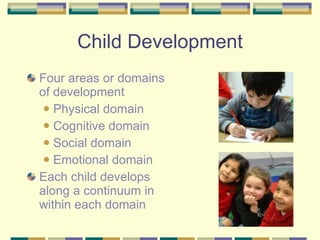
Child Development Four areas or domains of development Physical domain Cognitive domain Social domain Emotional domain Each child develops along a continuum in within each domain
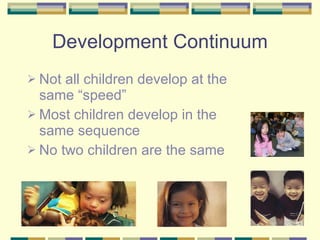
Development Continuum Not all children develop at the same “speed” Most children develop in the same sequence No two children are the same
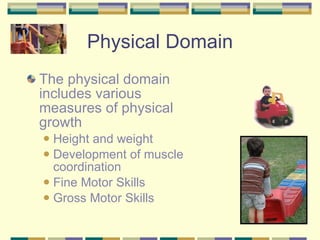
Physical Domain The physical domain includes various measures of physical growth Height and weight Development of muscle coordination Fine Motor Skills Gross Motor Skills
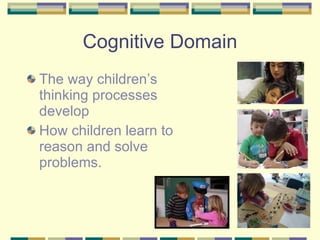
Cognitive Domain The way children’s thinking processes develop How children learn to reason and solve problems.
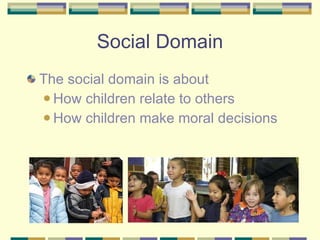
Social Domain The social domain is about How children relate to others How children make moral decisions
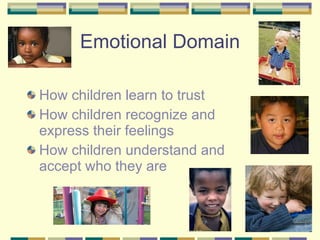
Emotional Domain H ow children learn to trust How children recognize and express their feelings How children understand and accept who they are
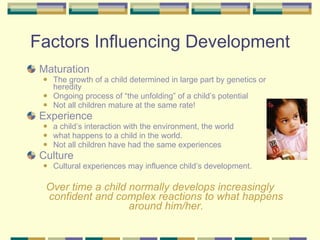
Factors Influencing Development Maturation The growth of a child determined in large part by genetics or heredity  Ongoing process of “the unfolding” of a child’s potential Not all children mature at the same rate! Experience a child’s interaction with the environment, the world what happens to a child in the world. Not all children have had the same experiences Culture Cultural experiences may influence child’s development. Over time a child normally develops increasingly confident and complex reactions to what happens around him/her.
Experiences S ome experiences can inhibit, delay, damage, or stop a child’s development Poor nutrition Serious illness Lack of opportunity to explore Abusiveness We have to observe children to find out where they are before we plan activities for them.
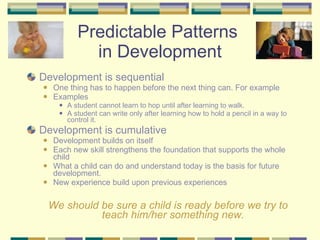
Predictable Patterns  in Development Development is sequential  One thing has to happen before the next thing can. For example Examples A student cannot learn to hop until after learning to walk. A student can write only after learning how to hold a pencil in a way to control it. Development is cumulative  Development builds on itself Each new skill strengthens the foundation that supports the whole child What a child can do and understand today is the basis for future development. New experience build upon previous experiences We should be sure a child is ready before we try to teach him/her something new.
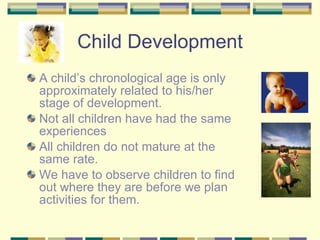
Child Development A child’s chronological age is only approximately related to his/her stage of development. Not all children have had the same experiences All children do not mature at the same rate. We have to observe children to find out where they are before we plan activities for them.
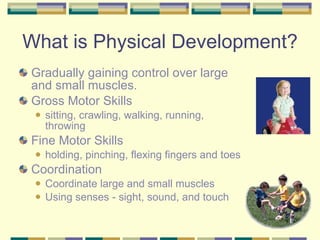
What is Physical Development? Gradually gaining control over large and small muscles. Gross Motor Skills  sitting, crawling, walking, running, throwing Fine Motor Skills  holding, pinching, flexing fingers and toes Coordination Coordinate large and small muscles Using senses - sight, sound, and touch
A Child’s First Three Years Learn to control body muscles Practice physical skills they will use for the rest of their lives Need opportunities to learn and practice Use senses to understand the world around them – sight, sound, touch Important for developing self-esteem.
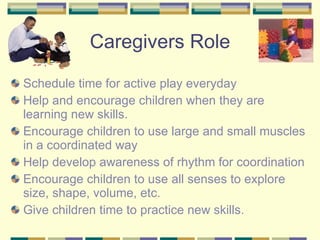
Caregivers Role Schedule time for active play everyday Help and encourage children when they are learning new skills. Encourage children to use large and small muscles in a coordinated way Help develop awareness of rhythm for coordination Encourage children to use all senses to explore size, shape, volume, etc. Give children time to practice new skills.
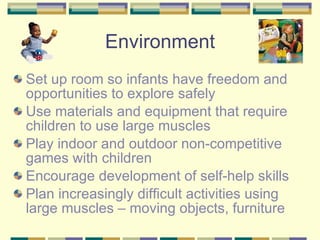
Set up room so infants have freedom and opportunities to explore safely Use materials and equipment that require  children to use large muscles Play indoor and outdoor non-competitive games with children Encourage development of self-help skills Plan increasingly difficult activities using large muscles – moving objects, furniture Environment
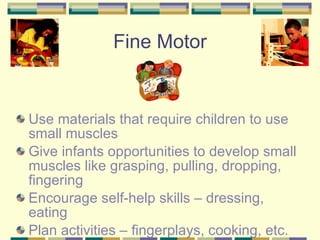
Use materials that require children to use small muscles Give infants opportunities to develop small muscles like grasping, pulling, dropping, fingering Encourage self-help skills – dressing, eating Plan activities – fingerplays, cooking, etc. Fine Motor
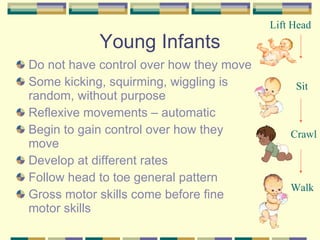
Young Infants Do not have control over how they move Some kicking, squirming, wiggling is random, without purpose Reflexive movements – automatic Begin to gain control over how they move Develop at different rates Follow head to toe general pattern Gross motor skills come before fine motor skills Lift Head Sit Crawl Walk
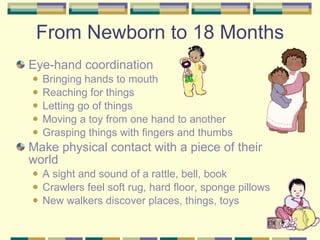
From Newborn to 18 Months Eye-hand coordination  Bringing hands to mouth Reaching for things Letting go of things Moving a toy from one hand to another Grasping things with fingers and thumbs Make physical contact with a piece of their world A sight and sound of a rattle, bell, book Crawlers feel soft rug, hard floor, sponge pillows New walkers discover places, things, toys
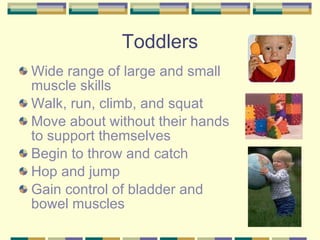
Toddlers Wide range of large and small muscle skills Walk, run, climb, and squat  Move about without their hands to support themselves Begin to throw and catch Hop and jump Gain control of bladder and bowel muscles
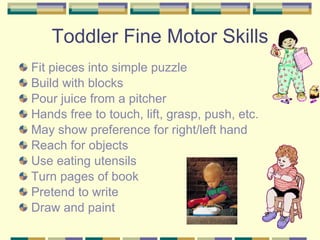
Toddler Fine Motor Skills Fit pieces into simple puzzle  Build with blocks Pour juice from a pitcher Hands free to touch, lift, grasp, push, etc. May show preference for right/left hand Reach for objects  Use eating utensils  Turn pages of book  Pretend to write  Draw and paint
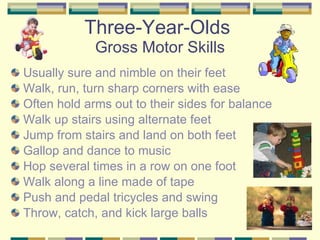
Three-Year-Olds  Gross Motor Skills Usually sure and nimble on their feet Walk, run, turn sharp corners with ease Often hold arms out to their sides for balance Walk up stairs using alternate feet Jump from stairs and land on both feet Gallop and dance to music Hop several times in a row on one foot Walk along a line made of tape Push and pedal tricycles and swing Throw, catch, and kick large balls
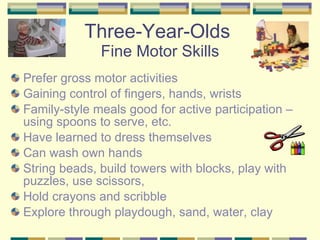
Three-Year-Olds  Fine Motor Skills Prefer gross motor activities Gaining control of fingers, hands, wrists Family-style meals good for active participation – using spoons to serve, etc. Have learned to dress themselves Can wash own hands String beads, build towers with blocks, play with puzzles, use scissors, Hold crayons and scribble Explore through playdough, sand, water, clay
Four-Year Olds   Gross Motor Skills Greater control over their large muscles Able to start and stop suddenly Hopping which leads to skipping Balancing on a walking board Throwing balls overhand Climbing ladders and play equipment Can pedal, steer, and turn corners on tricycles
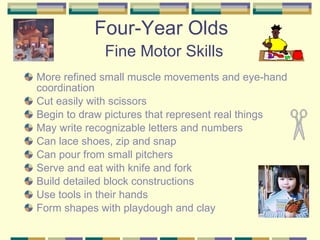
Four-Year Olds   Fine Motor Skills More refined small muscle movements and eye-hand coordination Cut easily with scissors Begin to draw pictures that represent real things May write recognizable letters and numbers Can lace shoes, zip and snap Can pour from small pitchers Serve and eat with knife and fork Build detailed block constructions Use tools in their hands Form shapes with playdough and clay
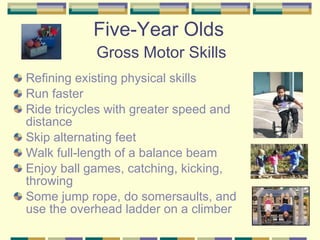
Five-Year Olds   Gross Motor Skills Refining existing physical skills Run faster Ride tricycles with greater speed and distance Skip alternating feet Walk full-length of a balance beam Enjoy ball games, catching, kicking, throwing Some jump rope, do somersaults, and use the overhead ladder on a climber
Five-Year Olds   Fine Motor Skills Most have well-developed fine motor skills Drawings and paintings represent real objects and include detail Use utensils properly in eating Have little difficulty with dressing and undressing themselves Can handle buttons, snaps, zippers, and buckles Learning to tie shoes Most can draw some letters and   numbers and possibly name
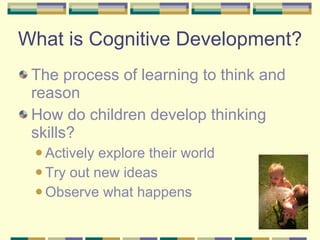
What is Cognitive Development? The process of learning to think and reason How do children develop thinking skills? Actively explore their world Try out new ideas Observe what happens
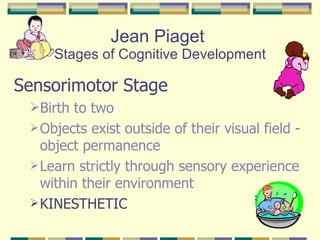
Jean Piaget  Stages of Cognitive Development Sensorimotor Stage   Birth to two Objects exist outside of their visual field - object permanence Learn strictly through sensory experience within their environment KINESTHETIC
Jean Piaget  Pre-operational Stage Ages 2 - 7 Period of language development Egocentrism - only see self perceptions Categorize by single obvious feature
Concrete Operational Stage Develop ability to handle complex logic and make comparisons Hypothesize and reason ONLY about things they’ve experienced themselves Ages 7 - 12
Formal Operational Stage  Age 12 – Adult Abstract thinking ability Offer interpretations Draw conclusions Formulate hypotheses
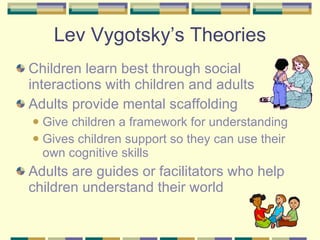
Lev Vygotsky’s Theories Children learn best through social interactions with children and adults Adults provide mental scaffolding  Give children a framework for understanding Gives children support so they can use their own cognitive skills  Adults are guides or facilitators who help children understand their world
Fostering Cognitive Growth What do children need? Self-confidence and skills to explore their world To try out new ideas To make mistakes To solve problems on their own Take on new challenges What can the teacher do? Build on child’s natural curiosity Create an environment for exploration Ask questions and talk with children Give children a chance to construct their own knowledge
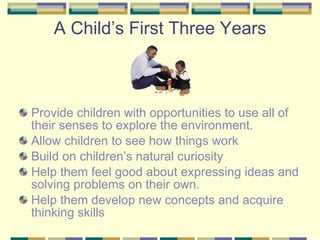
A Child’s First Three Years Provide children with opportunities to use all of their senses to explore the environment. Allow children to see how things work Build on children’s natural curiosity Help them feel good about expressing ideas and solving problems on their own. Help them develop new concepts and acquire thinking skills
Learn through everyday experiences Think through daily routines Explore through mouthing, dropping, banging, squeezing, etc. Learn “object permanence” – Object exists even when it’s out of sight Begin to understand cause and effect Learn how to use one object to get another Infants
Toddlers Learning all the time! As they develop, the same experiences take on new meanings Just beginning to understand how things and events relate to each other – in, out, under Think concretely and understand words very literally Can anticipate what will happen next and learn order in daily routines and schedules Beginning to understand cause and effect.
Active participants in the learning process Like detectives – trying to make sense of their experiences Constructivism Learning takes place within the child Child’s mind is not an empty slate that we fill with knowledge Children construct their own knowledge They apply what they already know  Actively explore through the senses Build on prior experiences Preschool Children
How do Preschool Children Learn? Interact and teach each other Playing with water Building with blocks Finger painting Engaging in dramatic play Talking and sharing information Giving advice and correcting one another Learn by doing – not by sitting and listening Learn by observing, hearing, and putting their own ideas into word
Learning through play! Functional play Examine physical properties of materials and objects Handling, experimenting, observing, etc. Constructive play Use materials to create a representation of something Build a farm with blocks, paint a picture, make something Socio-dramatic play Make believe and pretend Re-enact experiences, use props, role play Games with rules Board games or active games Learn to understand rules and control their behavior
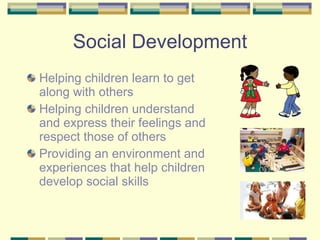
Social Development Helping children learn to get along with others   Helping children understand and express their feelings and respect those of others Providing an environment and experiences that help children develop social skills
Influences Increased knowledge about self and others Influenced by  Experiences and relationships that child have with significant adults in their lives Cognitive development
Cognition Effects Social Development Move from being egocentric – seeing the world from one’s one perspective Growing ability to understand how other people think and feel Increased understanding of cause and effect – connections between actions and consequences Change from concrete thinking to abstract thinking Understanding complex concepts like multiple relationships (mother is wife, daughter, aunt, etc.)
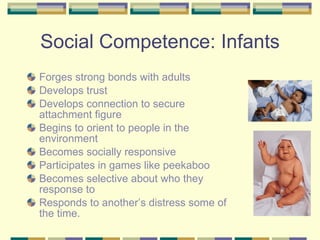
Social Competence: Infants Forges strong bonds with adults Develops trust Develops connection to secure attachment figure Begins to orient to people in the environment Becomes socially responsive Participates in games like peekaboo Becomes selective about who they response to Responds to another’s distress some of the time.
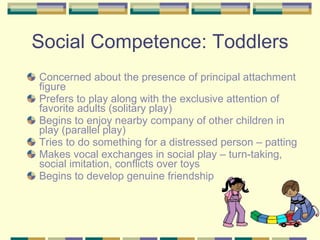
Social Competence: Toddlers Concerned about the presence of principal attachment figure Prefers to play along with the exclusive attention of favorite adults (solitary play) Begins to enjoy nearby company of other children in play (parallel play) Tries to do something for a distressed person – patting Makes vocal exchanges in social play – turn-taking, social imitation, conflicts over toys Begins to develop genuine friendship
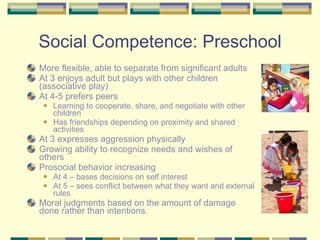
Social Competence: Preschool More flexible, able to separate from significant adults At 3 enjoys adult but plays with other children (associative play) At 4-5 prefers peers Learning to cooperate, share, and negotiate with other children Has friendships depending on proximity and shared activities At 3 expresses aggression physically Growing ability to recognize needs and wishes of others Prosocial behavior increasing At 4 – bases decisions on self interest At 5 – sees conflict between what they want and external rules Moral judgments based on the amount of damage done rather than intentions.
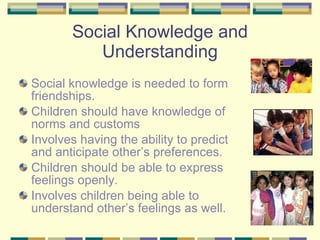
Social Knowledge and Understanding Social knowledge is needed to form friendships. Children should have knowledge of norms and customs Involves having the ability to predict and anticipate other’s preferences.  Children should be able to express feelings openly. Involves children being able to understand other’s feelings as well.
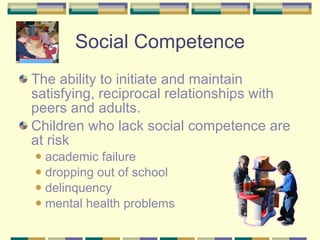
Social Competence The ability to initiate and maintain satisfying, reciprocal relationships with peers and adults.  Children who lack social competence are at risk academic failure  dropping out of school  delinquency mental health problems
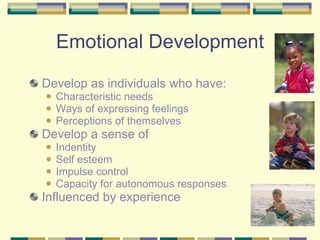
Emotional Development Develop as individuals who have: Characteristic needs Ways of expressing feelings Perceptions of themselves Develop a sense of  Indentity Self esteem Impulse control Capacity for autonomous responses Influenced by experience
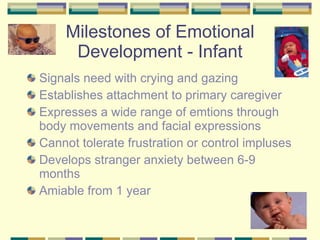
Milestones of Emotional Development - Infant Signals need with crying and gazing Establishes attachment to primary caregiver Expresses a wide range of emtions through body movements and facial expressions Cannot tolerate frustration or control impluses Develops stranger anxiety between 6-9 months Amiable from 1 year
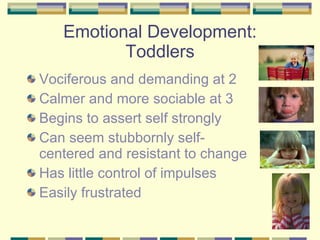
Emotional Development: Toddlers Vociferous and demanding at 2 Calmer and more sociable at 3 Begins to assert self strongly Can seem stubbornly self-centered and resistant to change Has little control of impulses Easily frustrated
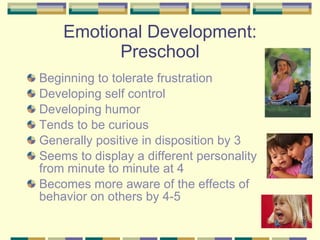
Emotional Development: Preschool Beginning to tolerate frustration Developing self control Developing humor Tends to be curious Generally positive in disposition by 3 Seems to display a different personality from minute to minute at 4 Becomes more aware of the effects of behavior on others by 4-5
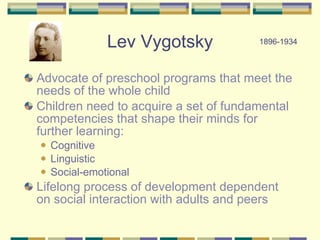
Lev Vygotsky Advocate of preschool programs that meet the needs of the whole child Children need to acquire a set of fundamental competencies that shape their minds for further learning: Cognitive Linguistic Social-emotional Lifelong process of development dependent on social interaction with adults and peers 1896-1934
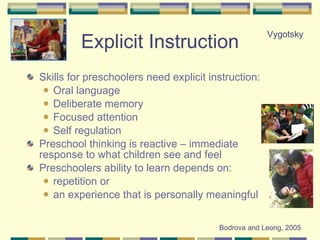
Explicit Instruction Skills for preschoolers need explicit instruction: Oral language Deliberate memory Focused attention Self regulation Preschool thinking is reactive – immediate response to what children see and feel Preschoolers ability to learn depends on: repetition or  an experience that is personally meaningful Bodrova and Leong, 2005 Vygotsky
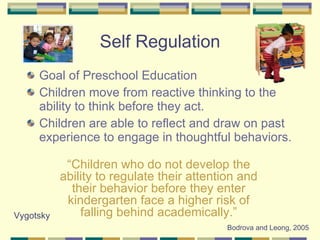
Self Regulation Goal of Preschool Education Children move from reactive thinking to the ability to think before they act. Children are able to reflect and draw on past experience to engage in thoughtful behaviors. Bodrova and Leong, 2005 Vygotsky “ Children who do not develop the ability to regulate their attention and their behavior before they enter kindergarten face a higher risk of falling behind academically.”
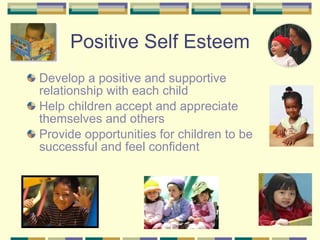
Positive Self Esteem Develop a positive and supportive relationship with each child Help children accept and appreciate themselves and others Provide opportunities for children to be successful and feel confident
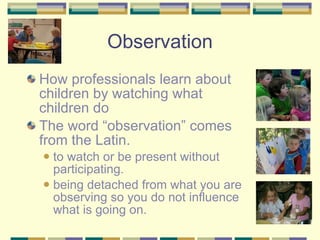
Observation How professionals learn about children by watching what children do The word “observation” comes from the Latin. to watch or be present without participating. being detached from what you are observing so you do not influence what is going on.
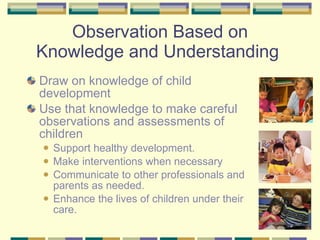
Observation Based on Knowledge and Understanding  Draw on knowledge of child development  Use that knowledge to make careful observations and assessments of children Support healthy development. Make interventions when necessary Communicate to other professionals and parents as needed. Enhance the lives of children under their care.
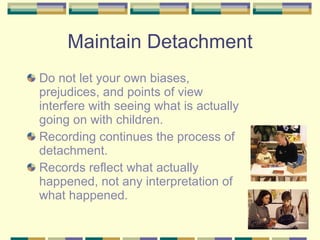
Maintain Detachment Do not let your own biases, prejudices, and points of view interfere with seeing what is actually going on with children. Recording continues the process of detachment. Records reflect what actually happened, not any interpretation of what happened.
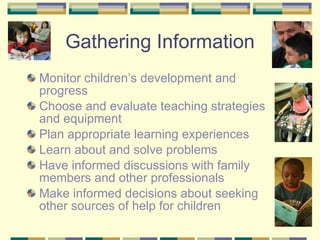
Gathering Information Monitor children’s development and progress Choose and evaluate teaching strategies and equipment Plan appropriate learning experiences Learn about and solve problems Have informed discussions with family members and other professionals Make informed decisions about seeking other sources of help for children
Interpreting Observations Key to good judgments about what is best for children Judgments should be based on documented evidence. Judgments should reflect your professionalism
Three Stages of Observation Observing The detached process of watching without participating Recording Making reproducible records of what you have seen Interpreting Final step after observing and recording Based on professional knowledge and expertise
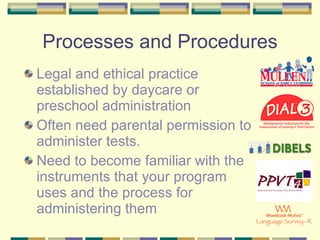
Processes and Procedures Legal and ethical practice established by daycare or preschool administration Often need parental permission to administer tests. Need to become familiar with the instruments that your program uses and the process for administering them
Reporting Information How do you working with parents share information about their children  Focus on the facts (observations) and your common concern about the well-being of the children  Review this information and make decisions about children with your director and childhood study team. Maintain professional focus
Confidentiality Maintain confidentiality of the information about children and families  Use “Need to know” criteria whenever telling anyone something about children and/or families Legal and ethical considerations Review the confidentiality policies of your program

Development

  • 1.
    Observations and DevelopmentalDomains EDUU325 Child Development Review Prepared by Dr. Piper
  • 2.
    Child Development Fourareas or domains of development Physical domain Cognitive domain Social domain Emotional domain Each child develops along a continuum in within each domain
  • 3.
    Development Continuum Notall children develop at the same “speed” Most children develop in the same sequence No two children are the same
  • 4.
    Physical Domain Thephysical domain includes various measures of physical growth Height and weight Development of muscle coordination Fine Motor Skills Gross Motor Skills
  • 5.
    Cognitive Domain Theway children’s thinking processes develop How children learn to reason and solve problems.
  • 6.
    Social Domain Thesocial domain is about How children relate to others How children make moral decisions
  • 7.
    Emotional Domain How children learn to trust How children recognize and express their feelings How children understand and accept who they are
  • 8.
    Factors Influencing DevelopmentMaturation The growth of a child determined in large part by genetics or heredity Ongoing process of “the unfolding” of a child’s potential Not all children mature at the same rate! Experience a child’s interaction with the environment, the world what happens to a child in the world. Not all children have had the same experiences Culture Cultural experiences may influence child’s development. Over time a child normally develops increasingly confident and complex reactions to what happens around him/her.
  • 9.
    Experiences S omeexperiences can inhibit, delay, damage, or stop a child’s development Poor nutrition Serious illness Lack of opportunity to explore Abusiveness We have to observe children to find out where they are before we plan activities for them.
  • 10.
    Predictable Patterns in Development Development is sequential One thing has to happen before the next thing can. For example Examples A student cannot learn to hop until after learning to walk. A student can write only after learning how to hold a pencil in a way to control it. Development is cumulative Development builds on itself Each new skill strengthens the foundation that supports the whole child What a child can do and understand today is the basis for future development. New experience build upon previous experiences We should be sure a child is ready before we try to teach him/her something new.
  • 11.
    Child Development Achild’s chronological age is only approximately related to his/her stage of development. Not all children have had the same experiences All children do not mature at the same rate. We have to observe children to find out where they are before we plan activities for them.
  • 12.
    What is PhysicalDevelopment? Gradually gaining control over large and small muscles. Gross Motor Skills sitting, crawling, walking, running, throwing Fine Motor Skills holding, pinching, flexing fingers and toes Coordination Coordinate large and small muscles Using senses - sight, sound, and touch
  • 13.
    A Child’s FirstThree Years Learn to control body muscles Practice physical skills they will use for the rest of their lives Need opportunities to learn and practice Use senses to understand the world around them – sight, sound, touch Important for developing self-esteem.
  • 14.
    Caregivers Role Scheduletime for active play everyday Help and encourage children when they are learning new skills. Encourage children to use large and small muscles in a coordinated way Help develop awareness of rhythm for coordination Encourage children to use all senses to explore size, shape, volume, etc. Give children time to practice new skills.
  • 15.
    Set up roomso infants have freedom and opportunities to explore safely Use materials and equipment that require children to use large muscles Play indoor and outdoor non-competitive games with children Encourage development of self-help skills Plan increasingly difficult activities using large muscles – moving objects, furniture Environment
  • 16.
    Use materials thatrequire children to use small muscles Give infants opportunities to develop small muscles like grasping, pulling, dropping, fingering Encourage self-help skills – dressing, eating Plan activities – fingerplays, cooking, etc. Fine Motor
  • 17.
    Young Infants Donot have control over how they move Some kicking, squirming, wiggling is random, without purpose Reflexive movements – automatic Begin to gain control over how they move Develop at different rates Follow head to toe general pattern Gross motor skills come before fine motor skills Lift Head Sit Crawl Walk
  • 18.
    From Newborn to18 Months Eye-hand coordination Bringing hands to mouth Reaching for things Letting go of things Moving a toy from one hand to another Grasping things with fingers and thumbs Make physical contact with a piece of their world A sight and sound of a rattle, bell, book Crawlers feel soft rug, hard floor, sponge pillows New walkers discover places, things, toys
  • 19.
    Toddlers Wide rangeof large and small muscle skills Walk, run, climb, and squat Move about without their hands to support themselves Begin to throw and catch Hop and jump Gain control of bladder and bowel muscles
  • 20.
    Toddler Fine MotorSkills Fit pieces into simple puzzle Build with blocks Pour juice from a pitcher Hands free to touch, lift, grasp, push, etc. May show preference for right/left hand Reach for objects Use eating utensils Turn pages of book Pretend to write Draw and paint
  • 21.
    Three-Year-Olds GrossMotor Skills Usually sure and nimble on their feet Walk, run, turn sharp corners with ease Often hold arms out to their sides for balance Walk up stairs using alternate feet Jump from stairs and land on both feet Gallop and dance to music Hop several times in a row on one foot Walk along a line made of tape Push and pedal tricycles and swing Throw, catch, and kick large balls
  • 22.
    Three-Year-Olds FineMotor Skills Prefer gross motor activities Gaining control of fingers, hands, wrists Family-style meals good for active participation – using spoons to serve, etc. Have learned to dress themselves Can wash own hands String beads, build towers with blocks, play with puzzles, use scissors, Hold crayons and scribble Explore through playdough, sand, water, clay
  • 23.
    Four-Year Olds Gross Motor Skills Greater control over their large muscles Able to start and stop suddenly Hopping which leads to skipping Balancing on a walking board Throwing balls overhand Climbing ladders and play equipment Can pedal, steer, and turn corners on tricycles
  • 24.
    Four-Year Olds Fine Motor Skills More refined small muscle movements and eye-hand coordination Cut easily with scissors Begin to draw pictures that represent real things May write recognizable letters and numbers Can lace shoes, zip and snap Can pour from small pitchers Serve and eat with knife and fork Build detailed block constructions Use tools in their hands Form shapes with playdough and clay
  • 25.
    Five-Year Olds Gross Motor Skills Refining existing physical skills Run faster Ride tricycles with greater speed and distance Skip alternating feet Walk full-length of a balance beam Enjoy ball games, catching, kicking, throwing Some jump rope, do somersaults, and use the overhead ladder on a climber
  • 26.
    Five-Year Olds Fine Motor Skills Most have well-developed fine motor skills Drawings and paintings represent real objects and include detail Use utensils properly in eating Have little difficulty with dressing and undressing themselves Can handle buttons, snaps, zippers, and buckles Learning to tie shoes Most can draw some letters and numbers and possibly name
  • 27.
    What is CognitiveDevelopment? The process of learning to think and reason How do children develop thinking skills? Actively explore their world Try out new ideas Observe what happens
  • 28.
    Jean Piaget Stages of Cognitive Development Sensorimotor Stage Birth to two Objects exist outside of their visual field - object permanence Learn strictly through sensory experience within their environment KINESTHETIC
  • 29.
    Jean Piaget Pre-operational Stage Ages 2 - 7 Period of language development Egocentrism - only see self perceptions Categorize by single obvious feature
  • 30.
    Concrete Operational StageDevelop ability to handle complex logic and make comparisons Hypothesize and reason ONLY about things they’ve experienced themselves Ages 7 - 12
  • 31.
    Formal Operational Stage Age 12 – Adult Abstract thinking ability Offer interpretations Draw conclusions Formulate hypotheses
  • 32.
    Lev Vygotsky’s TheoriesChildren learn best through social interactions with children and adults Adults provide mental scaffolding Give children a framework for understanding Gives children support so they can use their own cognitive skills Adults are guides or facilitators who help children understand their world
  • 33.
    Fostering Cognitive GrowthWhat do children need? Self-confidence and skills to explore their world To try out new ideas To make mistakes To solve problems on their own Take on new challenges What can the teacher do? Build on child’s natural curiosity Create an environment for exploration Ask questions and talk with children Give children a chance to construct their own knowledge
  • 34.
    A Child’s FirstThree Years Provide children with opportunities to use all of their senses to explore the environment. Allow children to see how things work Build on children’s natural curiosity Help them feel good about expressing ideas and solving problems on their own. Help them develop new concepts and acquire thinking skills
  • 35.
    Learn through everydayexperiences Think through daily routines Explore through mouthing, dropping, banging, squeezing, etc. Learn “object permanence” – Object exists even when it’s out of sight Begin to understand cause and effect Learn how to use one object to get another Infants
  • 36.
    Toddlers Learning allthe time! As they develop, the same experiences take on new meanings Just beginning to understand how things and events relate to each other – in, out, under Think concretely and understand words very literally Can anticipate what will happen next and learn order in daily routines and schedules Beginning to understand cause and effect.
  • 37.
    Active participants inthe learning process Like detectives – trying to make sense of their experiences Constructivism Learning takes place within the child Child’s mind is not an empty slate that we fill with knowledge Children construct their own knowledge They apply what they already know Actively explore through the senses Build on prior experiences Preschool Children
  • 38.
    How do PreschoolChildren Learn? Interact and teach each other Playing with water Building with blocks Finger painting Engaging in dramatic play Talking and sharing information Giving advice and correcting one another Learn by doing – not by sitting and listening Learn by observing, hearing, and putting their own ideas into word
  • 39.
    Learning through play!Functional play Examine physical properties of materials and objects Handling, experimenting, observing, etc. Constructive play Use materials to create a representation of something Build a farm with blocks, paint a picture, make something Socio-dramatic play Make believe and pretend Re-enact experiences, use props, role play Games with rules Board games or active games Learn to understand rules and control their behavior
  • 40.
    Social Development Helpingchildren learn to get along with others Helping children understand and express their feelings and respect those of others Providing an environment and experiences that help children develop social skills
  • 41.
    Influences Increased knowledgeabout self and others Influenced by Experiences and relationships that child have with significant adults in their lives Cognitive development
  • 42.
    Cognition Effects SocialDevelopment Move from being egocentric – seeing the world from one’s one perspective Growing ability to understand how other people think and feel Increased understanding of cause and effect – connections between actions and consequences Change from concrete thinking to abstract thinking Understanding complex concepts like multiple relationships (mother is wife, daughter, aunt, etc.)
  • 43.
    Social Competence: InfantsForges strong bonds with adults Develops trust Develops connection to secure attachment figure Begins to orient to people in the environment Becomes socially responsive Participates in games like peekaboo Becomes selective about who they response to Responds to another’s distress some of the time.
  • 44.
    Social Competence: ToddlersConcerned about the presence of principal attachment figure Prefers to play along with the exclusive attention of favorite adults (solitary play) Begins to enjoy nearby company of other children in play (parallel play) Tries to do something for a distressed person – patting Makes vocal exchanges in social play – turn-taking, social imitation, conflicts over toys Begins to develop genuine friendship
  • 45.
    Social Competence: PreschoolMore flexible, able to separate from significant adults At 3 enjoys adult but plays with other children (associative play) At 4-5 prefers peers Learning to cooperate, share, and negotiate with other children Has friendships depending on proximity and shared activities At 3 expresses aggression physically Growing ability to recognize needs and wishes of others Prosocial behavior increasing At 4 – bases decisions on self interest At 5 – sees conflict between what they want and external rules Moral judgments based on the amount of damage done rather than intentions.
  • 46.
    Social Knowledge andUnderstanding Social knowledge is needed to form friendships. Children should have knowledge of norms and customs Involves having the ability to predict and anticipate other’s preferences. Children should be able to express feelings openly. Involves children being able to understand other’s feelings as well.
  • 47.
    Social Competence Theability to initiate and maintain satisfying, reciprocal relationships with peers and adults. Children who lack social competence are at risk academic failure dropping out of school delinquency mental health problems
  • 48.
    Emotional Development Developas individuals who have: Characteristic needs Ways of expressing feelings Perceptions of themselves Develop a sense of Indentity Self esteem Impulse control Capacity for autonomous responses Influenced by experience
  • 49.
    Milestones of EmotionalDevelopment - Infant Signals need with crying and gazing Establishes attachment to primary caregiver Expresses a wide range of emtions through body movements and facial expressions Cannot tolerate frustration or control impluses Develops stranger anxiety between 6-9 months Amiable from 1 year
  • 50.
    Emotional Development: ToddlersVociferous and demanding at 2 Calmer and more sociable at 3 Begins to assert self strongly Can seem stubbornly self-centered and resistant to change Has little control of impulses Easily frustrated
  • 51.
    Emotional Development: PreschoolBeginning to tolerate frustration Developing self control Developing humor Tends to be curious Generally positive in disposition by 3 Seems to display a different personality from minute to minute at 4 Becomes more aware of the effects of behavior on others by 4-5
  • 52.
    Lev Vygotsky Advocateof preschool programs that meet the needs of the whole child Children need to acquire a set of fundamental competencies that shape their minds for further learning: Cognitive Linguistic Social-emotional Lifelong process of development dependent on social interaction with adults and peers 1896-1934
  • 53.
    Explicit Instruction Skillsfor preschoolers need explicit instruction: Oral language Deliberate memory Focused attention Self regulation Preschool thinking is reactive – immediate response to what children see and feel Preschoolers ability to learn depends on: repetition or an experience that is personally meaningful Bodrova and Leong, 2005 Vygotsky
  • 54.
    Self Regulation Goalof Preschool Education Children move from reactive thinking to the ability to think before they act. Children are able to reflect and draw on past experience to engage in thoughtful behaviors. Bodrova and Leong, 2005 Vygotsky “ Children who do not develop the ability to regulate their attention and their behavior before they enter kindergarten face a higher risk of falling behind academically.”
  • 55.
    Positive Self EsteemDevelop a positive and supportive relationship with each child Help children accept and appreciate themselves and others Provide opportunities for children to be successful and feel confident
  • 56.
    Observation How professionalslearn about children by watching what children do The word “observation” comes from the Latin. to watch or be present without participating. being detached from what you are observing so you do not influence what is going on.
  • 57.
    Observation Based onKnowledge and Understanding Draw on knowledge of child development Use that knowledge to make careful observations and assessments of children Support healthy development. Make interventions when necessary Communicate to other professionals and parents as needed. Enhance the lives of children under their care.
  • 58.
    Maintain Detachment Donot let your own biases, prejudices, and points of view interfere with seeing what is actually going on with children. Recording continues the process of detachment. Records reflect what actually happened, not any interpretation of what happened.
  • 59.
    Gathering Information Monitorchildren’s development and progress Choose and evaluate teaching strategies and equipment Plan appropriate learning experiences Learn about and solve problems Have informed discussions with family members and other professionals Make informed decisions about seeking other sources of help for children
  • 60.
    Interpreting Observations Keyto good judgments about what is best for children Judgments should be based on documented evidence. Judgments should reflect your professionalism
  • 61.
    Three Stages ofObservation Observing The detached process of watching without participating Recording Making reproducible records of what you have seen Interpreting Final step after observing and recording Based on professional knowledge and expertise
  • 62.
    Processes and ProceduresLegal and ethical practice established by daycare or preschool administration Often need parental permission to administer tests. Need to become familiar with the instruments that your program uses and the process for administering them
  • 63.
    Reporting Information Howdo you working with parents share information about their children Focus on the facts (observations) and your common concern about the well-being of the children Review this information and make decisions about children with your director and childhood study team. Maintain professional focus
  • 64.
    Confidentiality Maintain confidentialityof the information about children and families Use “Need to know” criteria whenever telling anyone something about children and/or families Legal and ethical considerations Review the confidentiality policies of your program