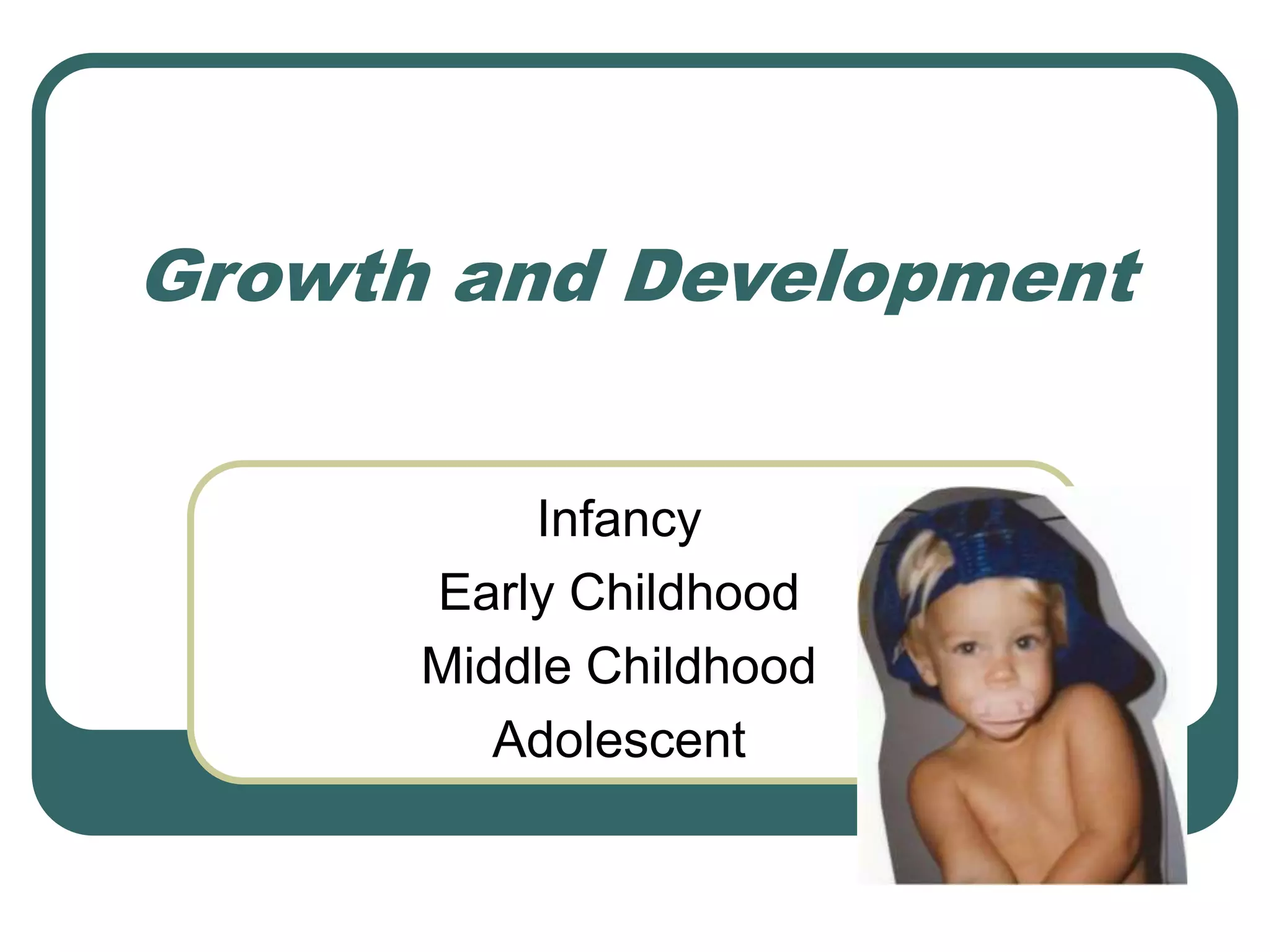
Growth and Development
Infancy
Early Childhood
Middle Childhood
Adolescent
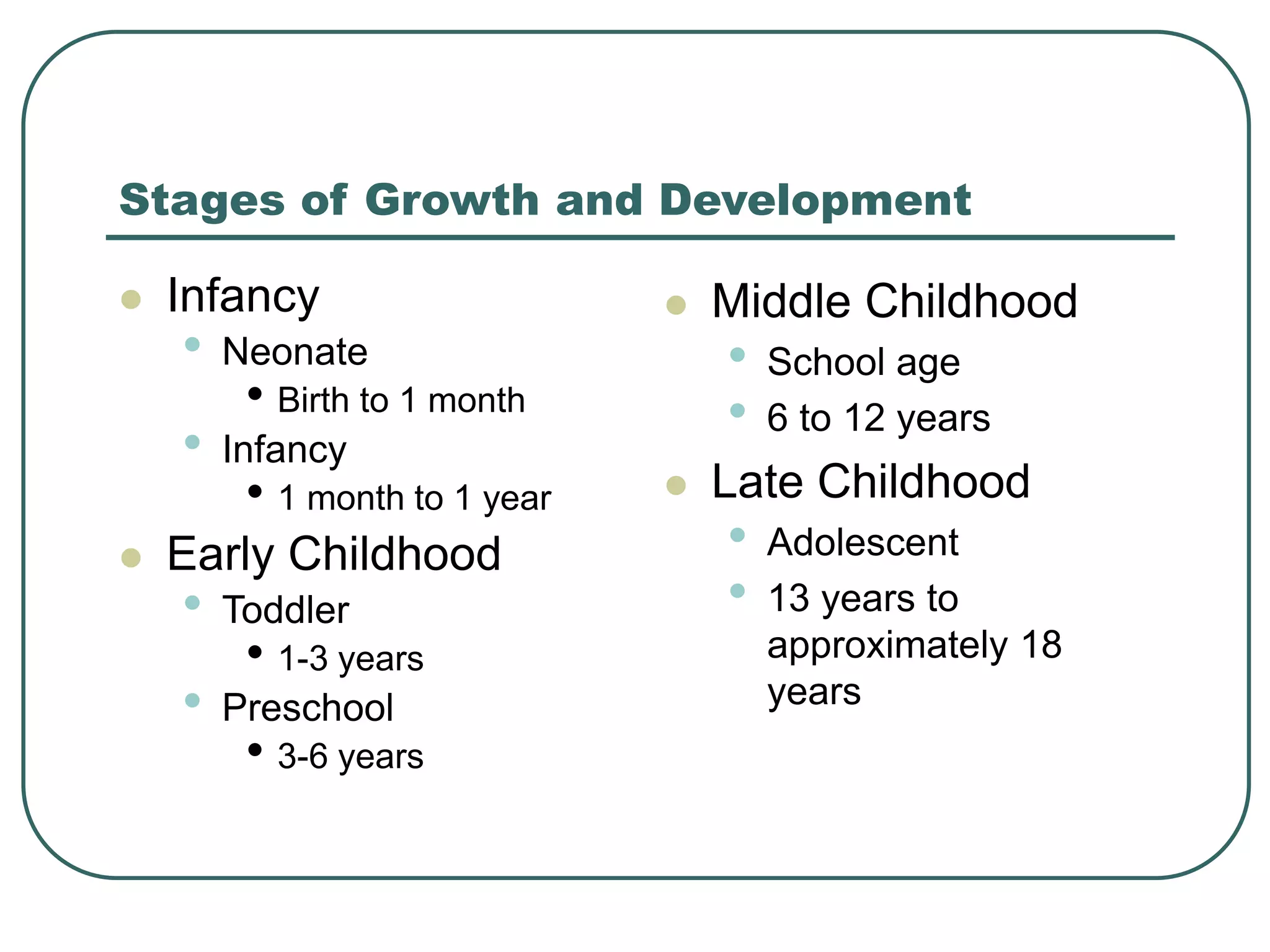
Stages of Growth and Development
 Infancy
• Neonate
• Birth to 1 month
• Infancy
• 1 month to 1 year
 Early Childhood
• Toddler
• 1-3 years
• Preschool
• 3-6 years
 Middle Childhood
• School age
• 6 to 12 years
 Late Childhood
• Adolescent
• 13 years to
approximately 18
years
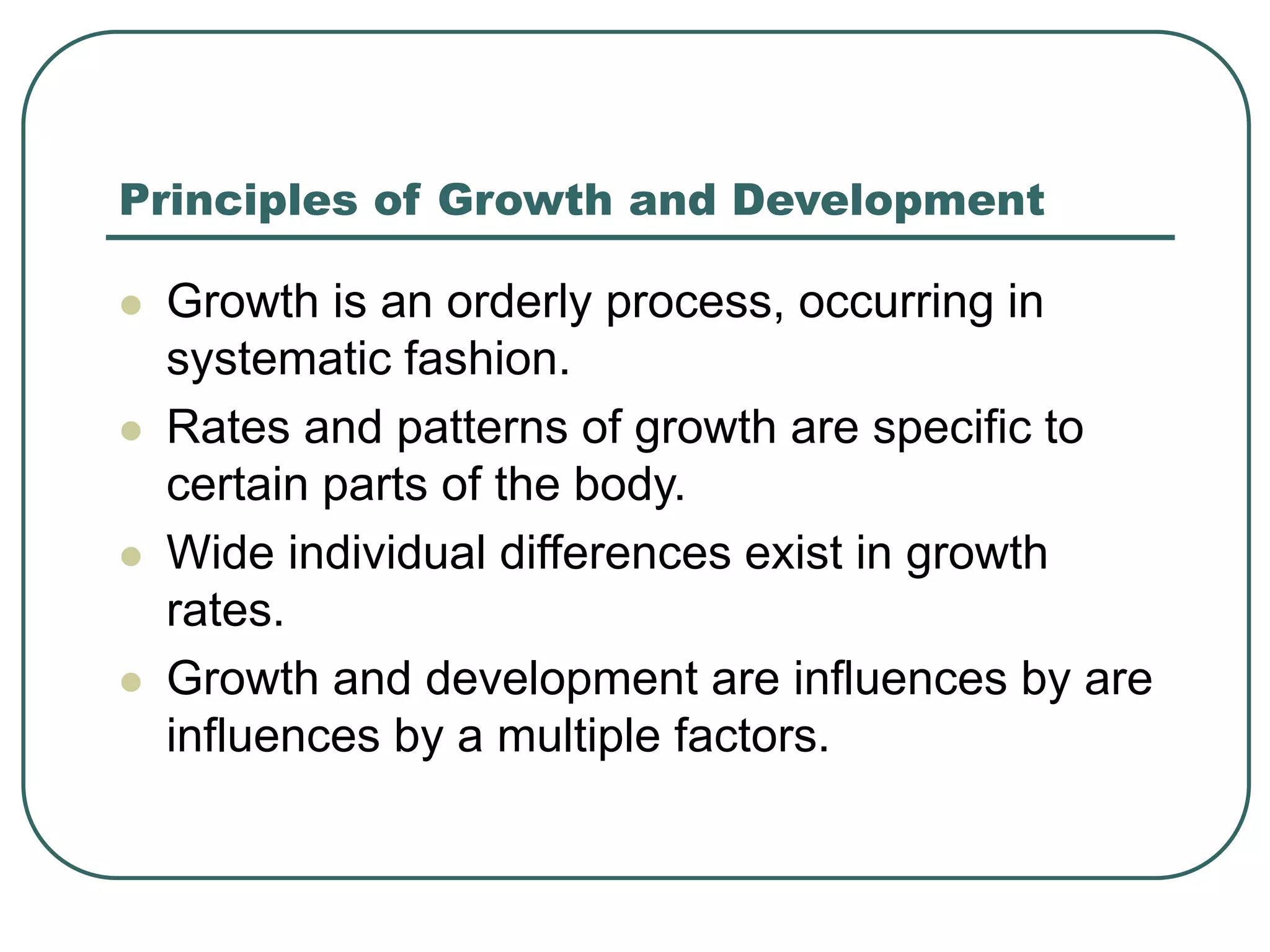
Principles of Growth and Development
 Growth is an orderly process, occurring in
systematic fashion.
 Rates and patterns of growth are specific to
certain parts of the body.
 Wide individual differences exist in growth
rates.
 Growth and development are influences by are
influences by a multiple factors.
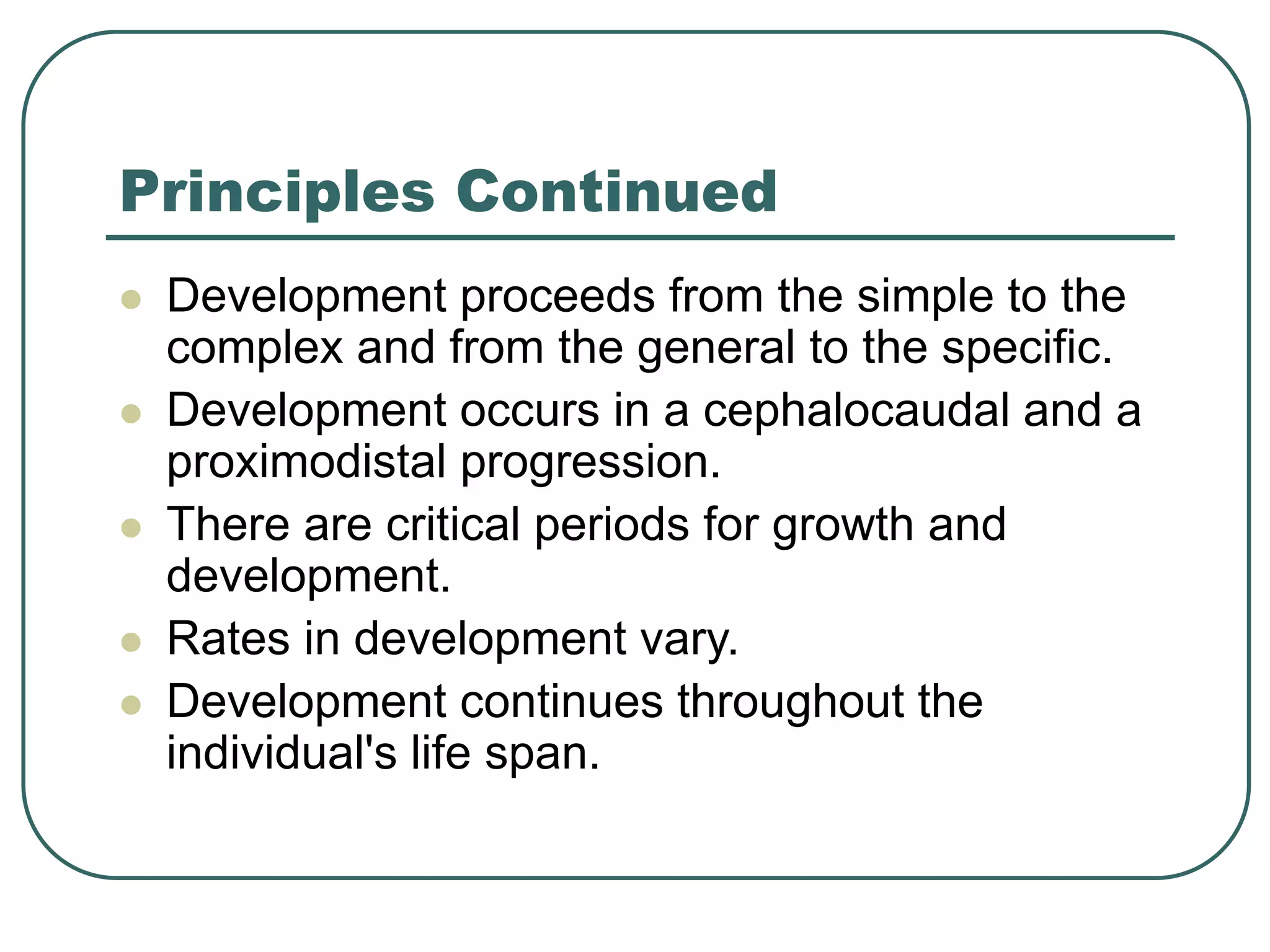
Principles Continued
 Development proceeds from the simple to the
complex and from the general to the specific.
 Development occurs in a cephalocaudal and a
proximodistal progression.
 There are critical periods for growth and
development.
 Rates in development vary.
 Development continues throughout the
individual's life span.
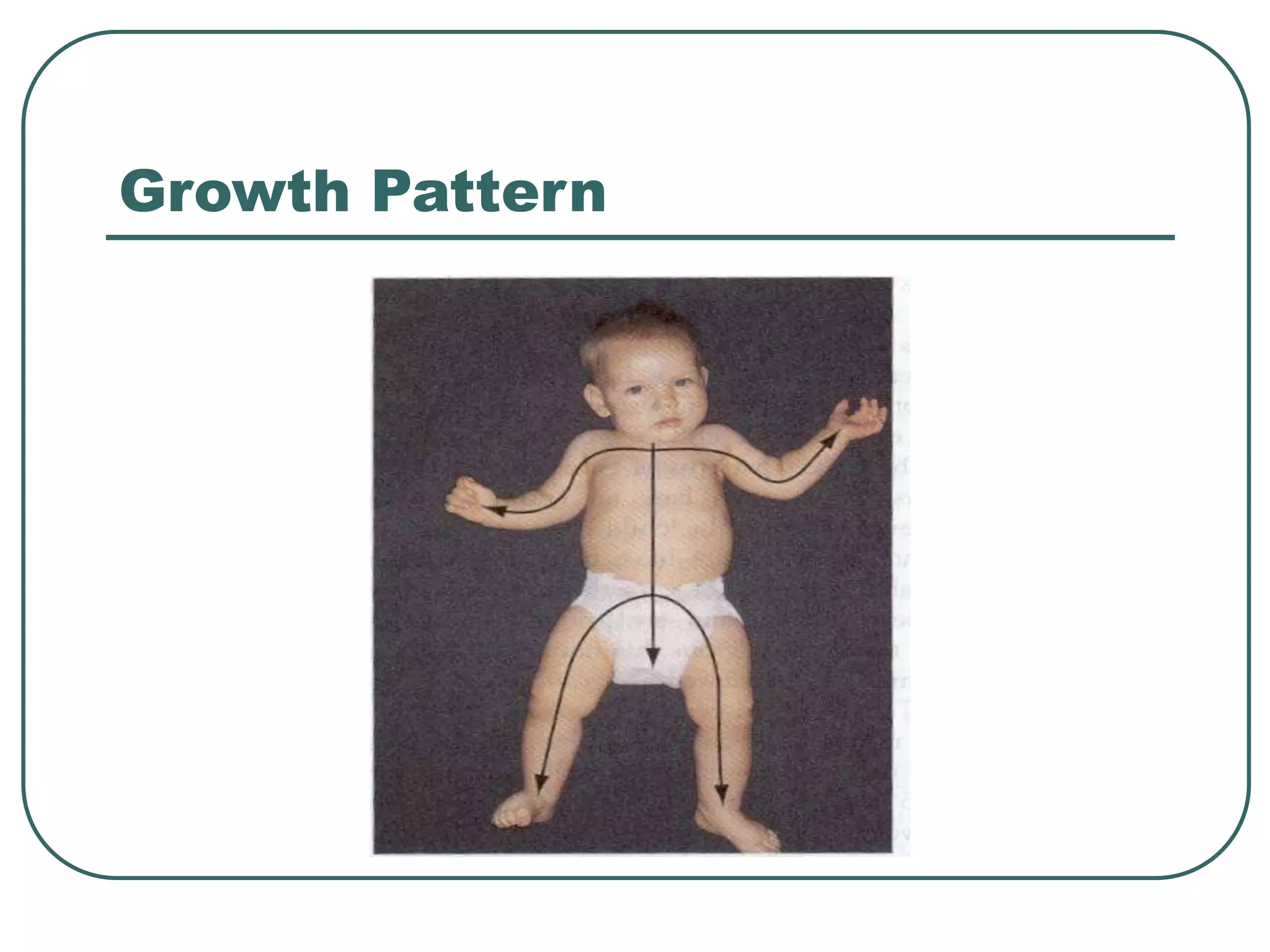
Growth Pattern
Growth Patterns
 The child’s pattern of growth is in a
head-to-toe direction, or
cephalocaudal, and in an inward to
outward pattern called proximodistal.
Why developmental
assessment?
 Early detection of deviation in child’s
pattern of development
 Simple and time efficient mechanism to
ensure adequate surveillance of
developmental progress
 Domains assessed: cognitive, motor,
language, social / behavioral and
adaptive
Gross Motor Skills
 The acquisition of gross motor skill
precedes the development of fine motor
skills.
 Both processes occur in a
cephalocaudal fashion
• Head control preceding arm and hand control
• Followed by leg and foot control.
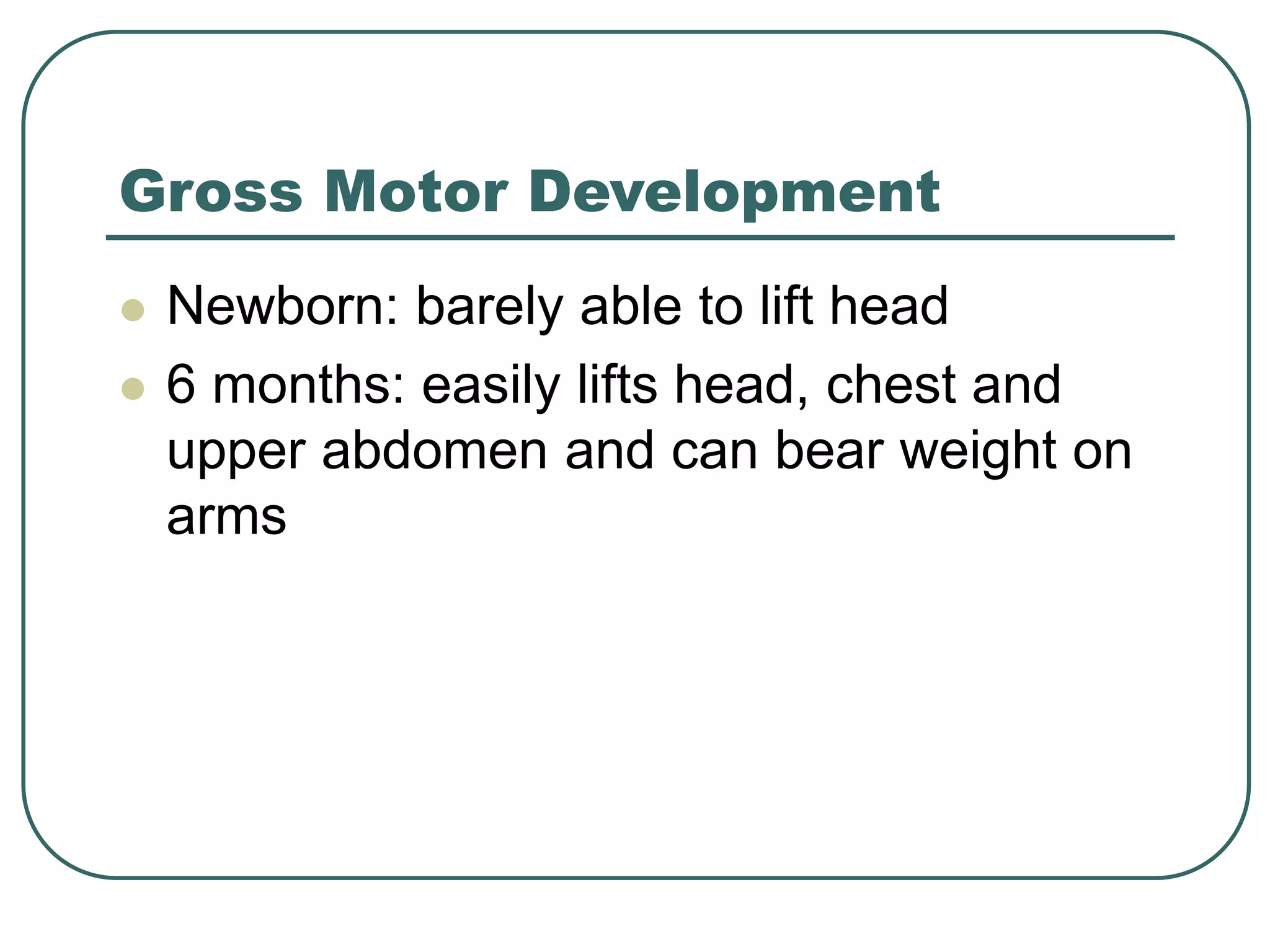
Gross Motor Development
 Newborn: barely able to lift head
 6 months: easily lifts head, chest and
upper abdomen and can bear weight on
arms
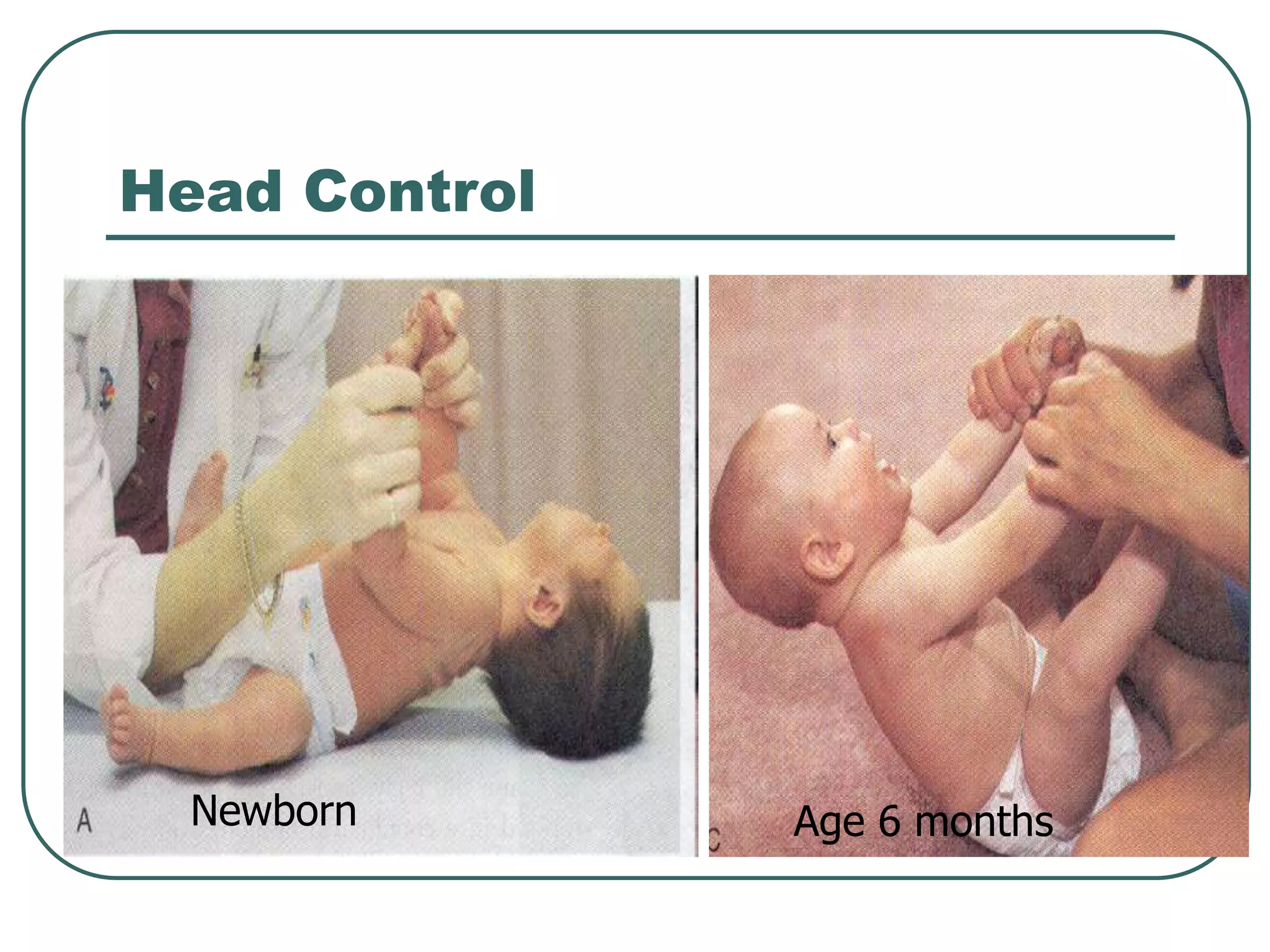
Head Control
Newborn Age 6 months
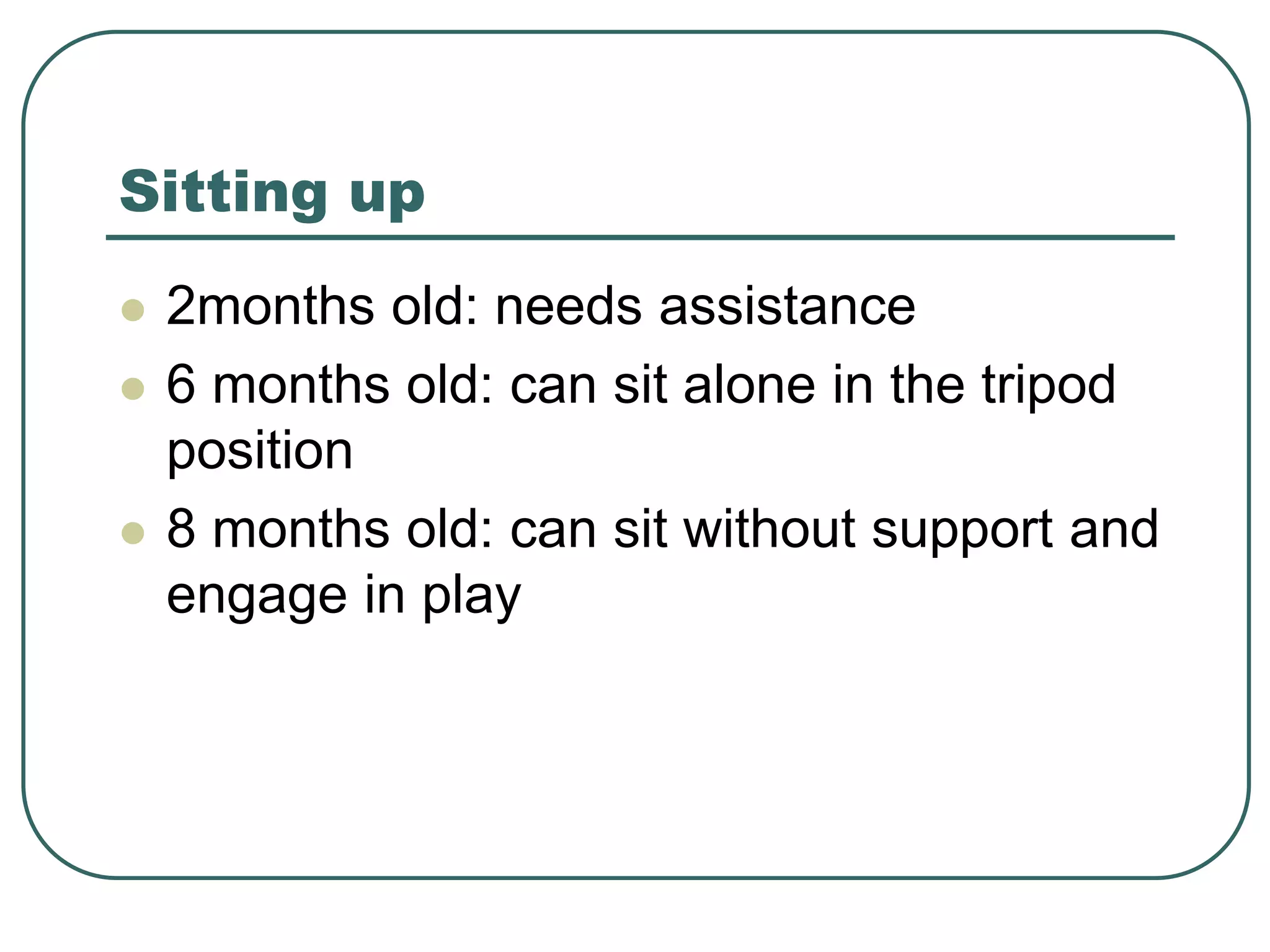
Sitting up
 2months old: needs assistance
 6 months old: can sit alone in the tripod
position
 8 months old: can sit without support and
engage in play
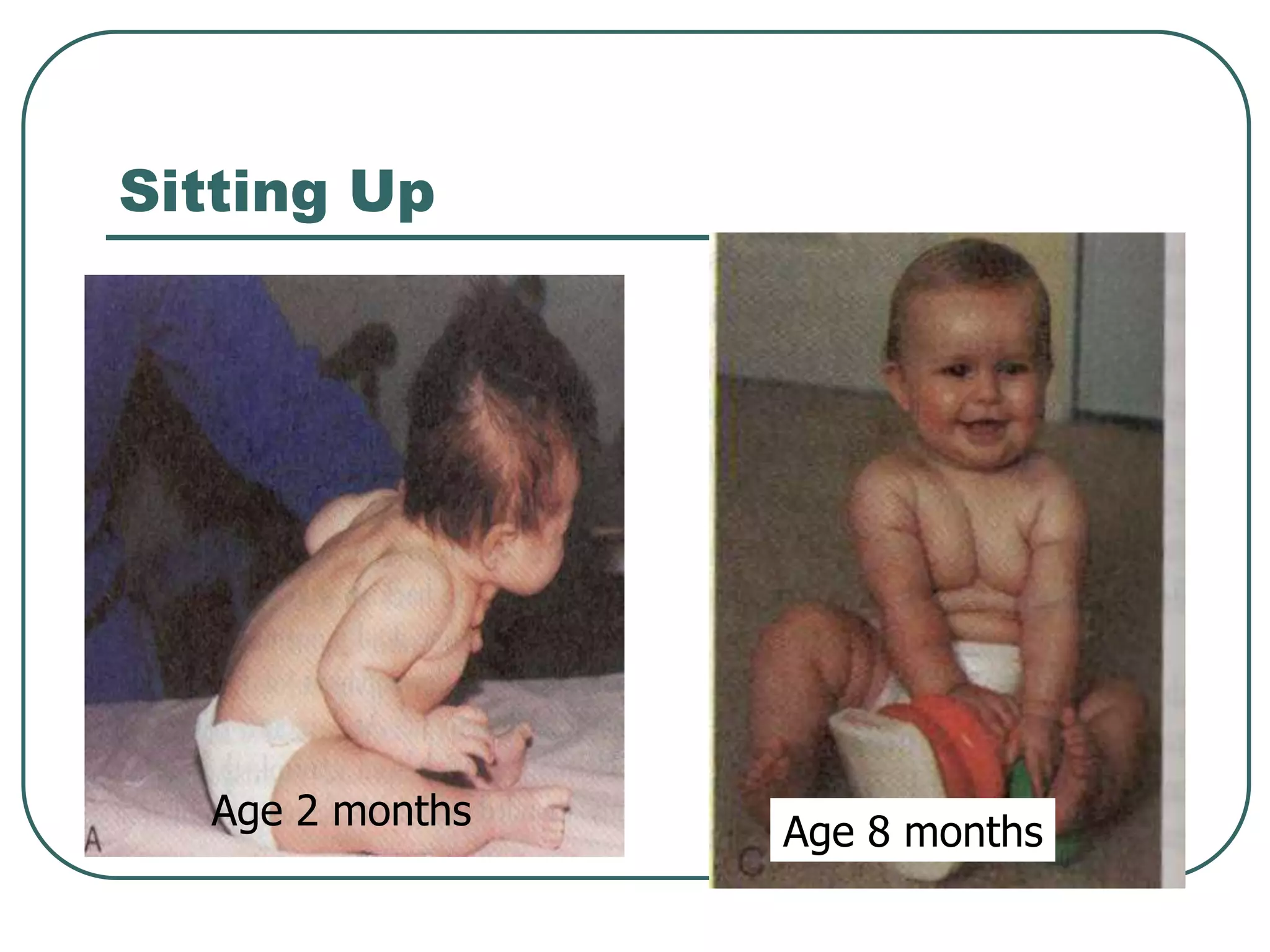
Sitting Up
Age 2 months
Age 8 months
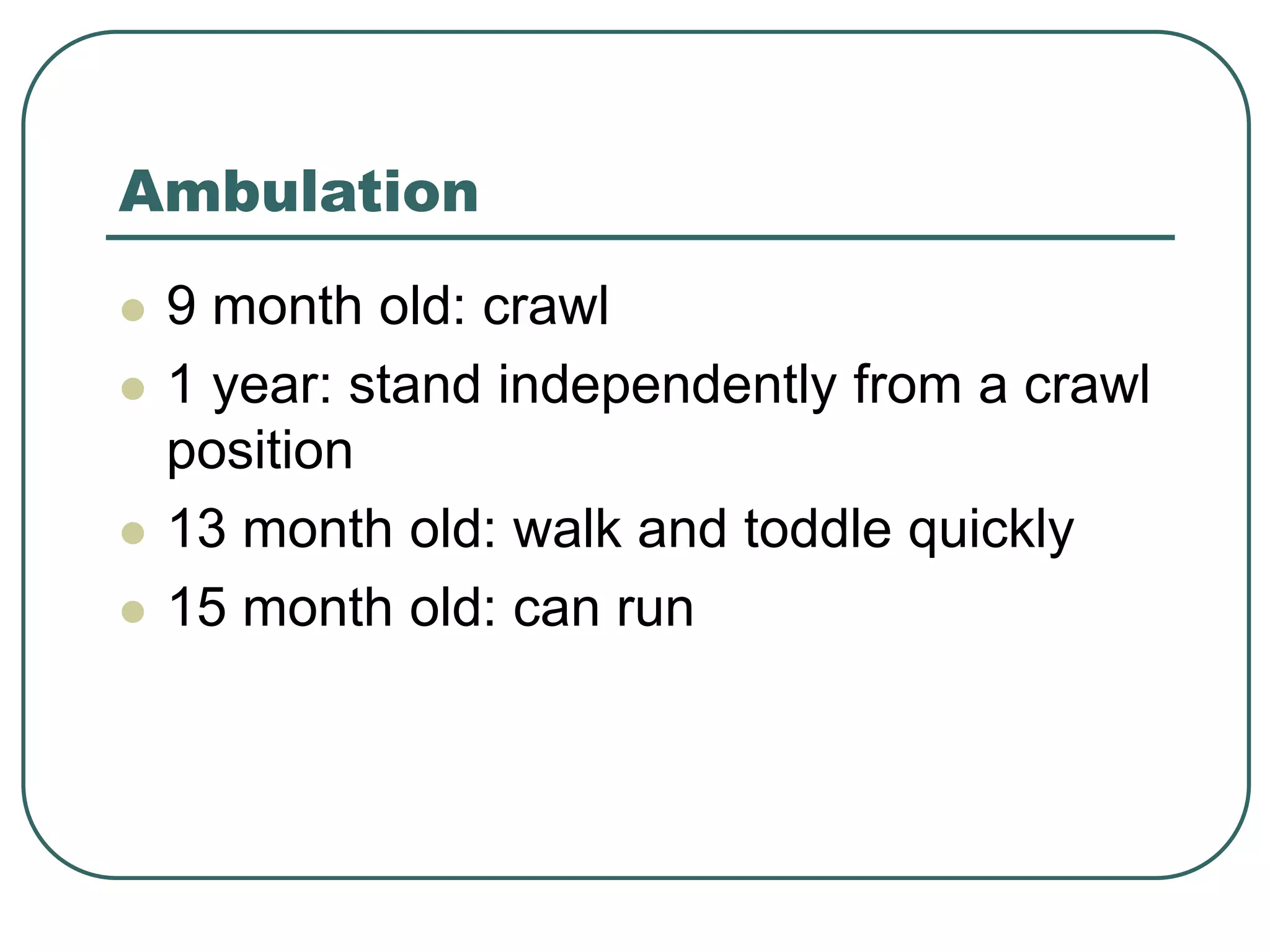
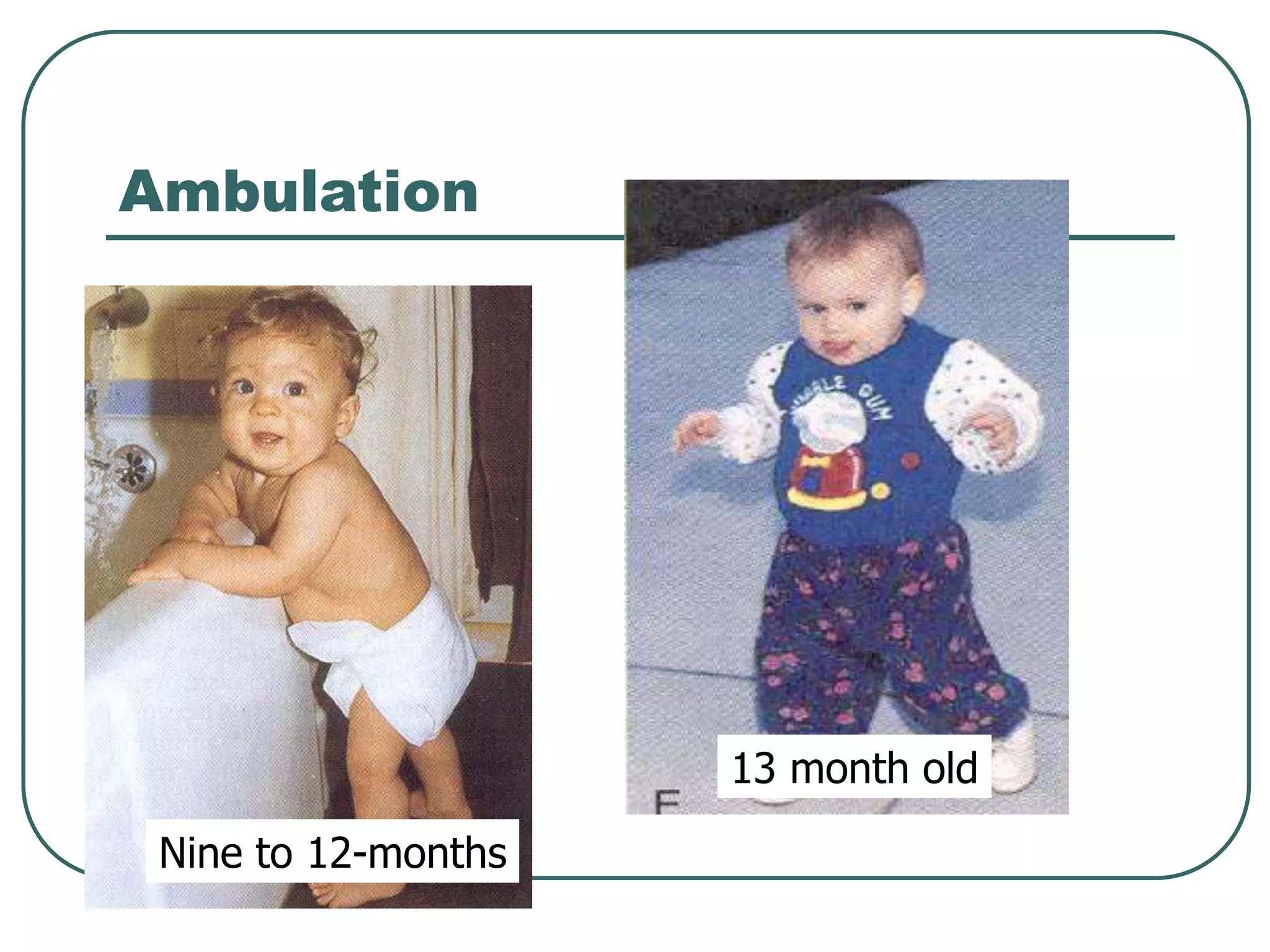
Ambulation
 9 month old: crawl
 1 year: stand independently from a crawl
position
 13 month old: walk and toddle quickly
 15 month old: can run
Ambulation
13 month old
Nine to 12-months
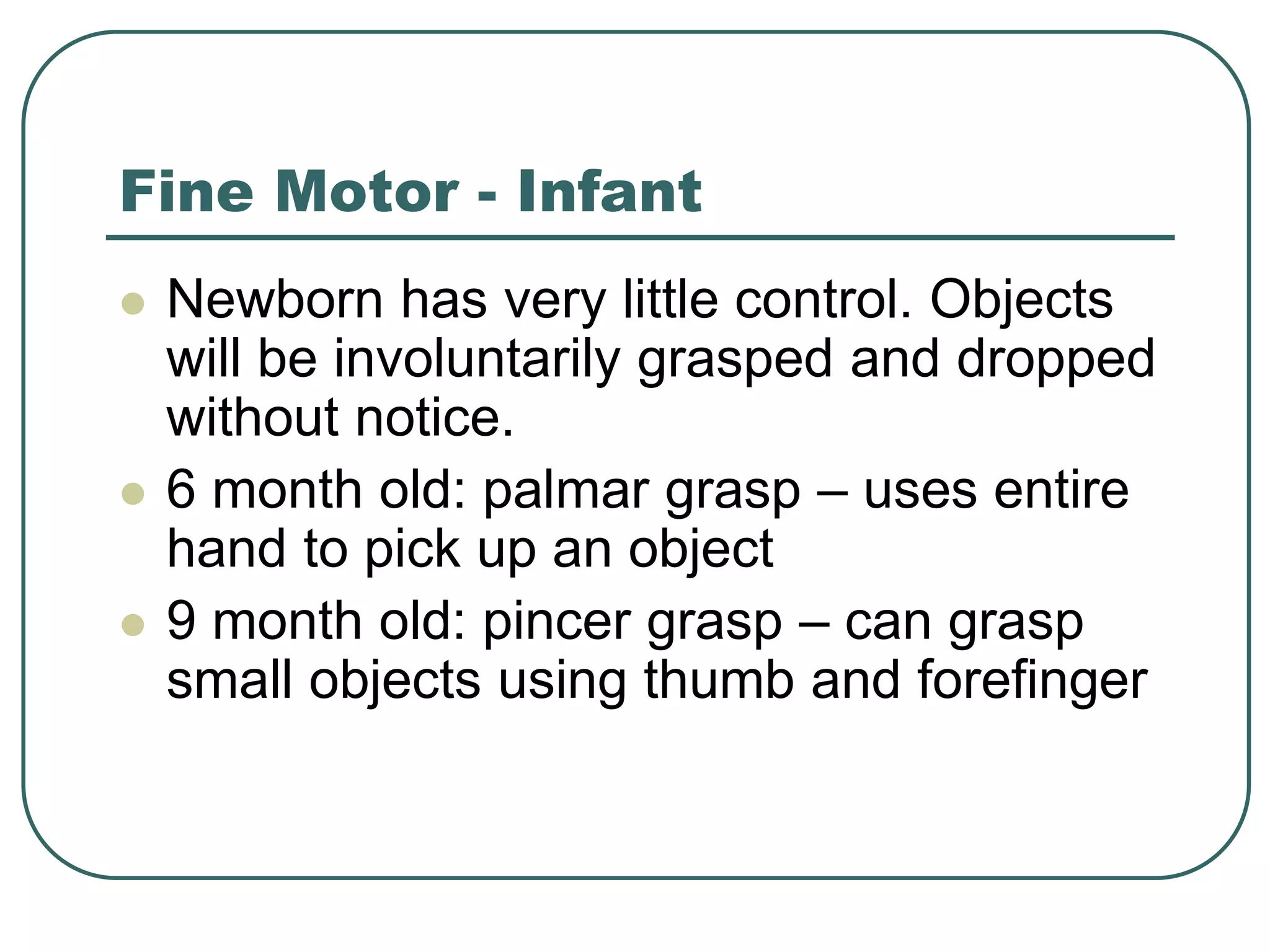
Fine Motor - Infant
 Newborn has very little control. Objects
will be involuntarily grasped and dropped
without notice.
 6 month old: palmar grasp – uses entire
hand to pick up an object
 9 month old: pincer grasp – can grasp
small objects using thumb and forefinger
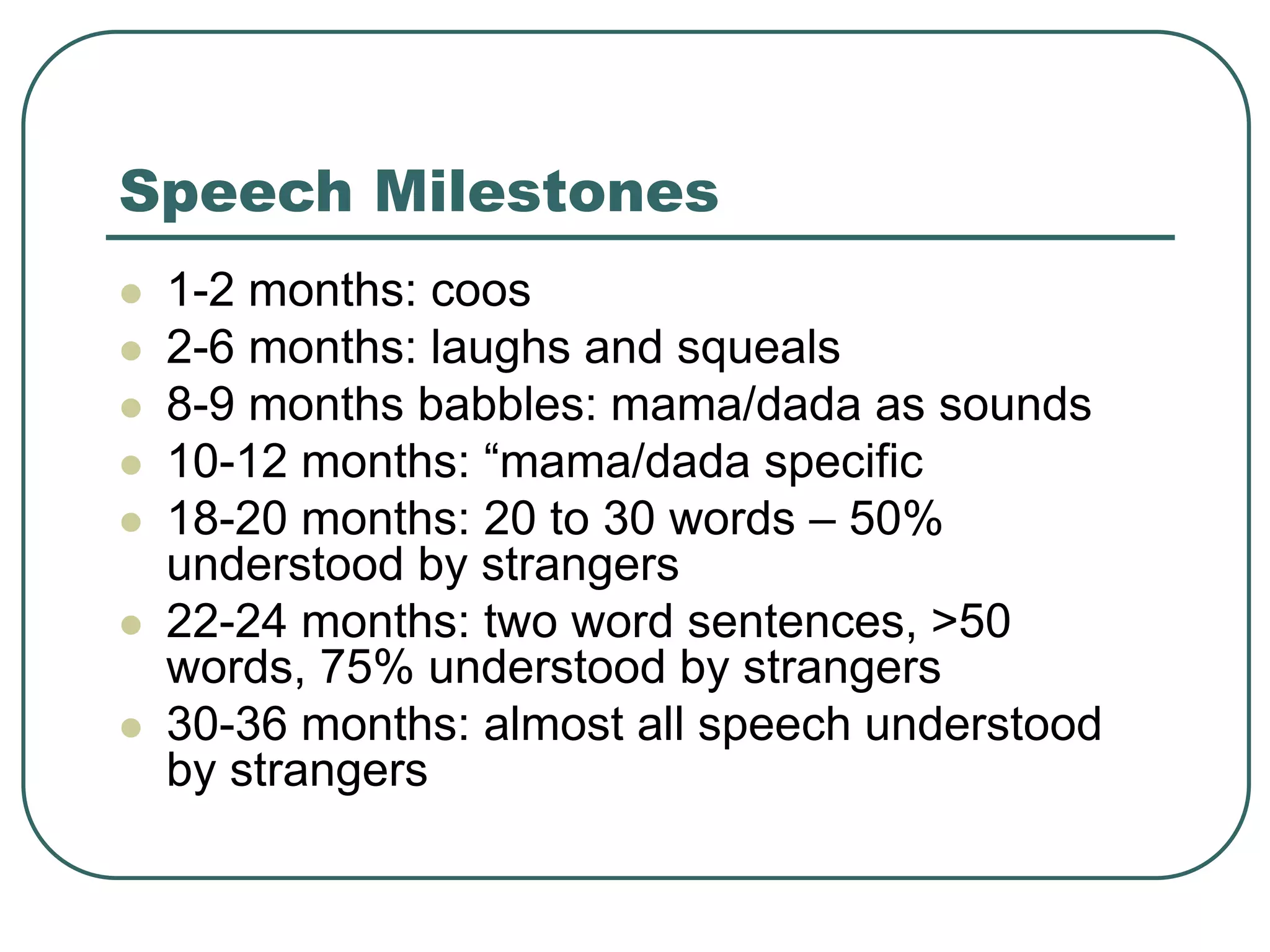
Speech Milestones
 1-2 months: coos
 2-6 months: laughs and squeals
 8-9 months babbles: mama/dada as sounds
 10-12 months: “mama/dada specific
 18-20 months: 20 to 30 words – 50%
understood by strangers
 22-24 months: two word sentences, >50
words, 75% understood by strangers
 30-36 months: almost all speech understood
by strangers
Hearing
 BAER hearing test done at birth
 Ability to hear correlates with ability enunciate
words properly
 Always ask about history of otitis media – ear
infection, placement of PET – tubes in ear
 Early referral to MD to assess for possible fluid
in ears (effusion)
 Repeat hearing screening test
 Speech therapist as needed
Fine Motor Development
6-month-old
12-month-old
Red Flags in infant development
 Unable to sit alone by age 9 months
 Unable to transfer objects from hand to
hand by age 1 year
 Abnormal pincer grip or grasp by age 15
months
 Unable to walk alone by 18 months
 Failure to speak recognizable words by 2
years.
Fine Motor - toddler
 1 year old: transfer objects from hand to
hand
 2 year old: can hold a crayon and color
vertical strokes
• Turn the page of a book
• Build a tower of six blocks
Fine Motor – Older Toddler
 3 year old: copy a circle and a cross –
build using small blocks
 4 year old: use scissors, color within the
borders
 5 year old: write some letters and draw a
person with body parts
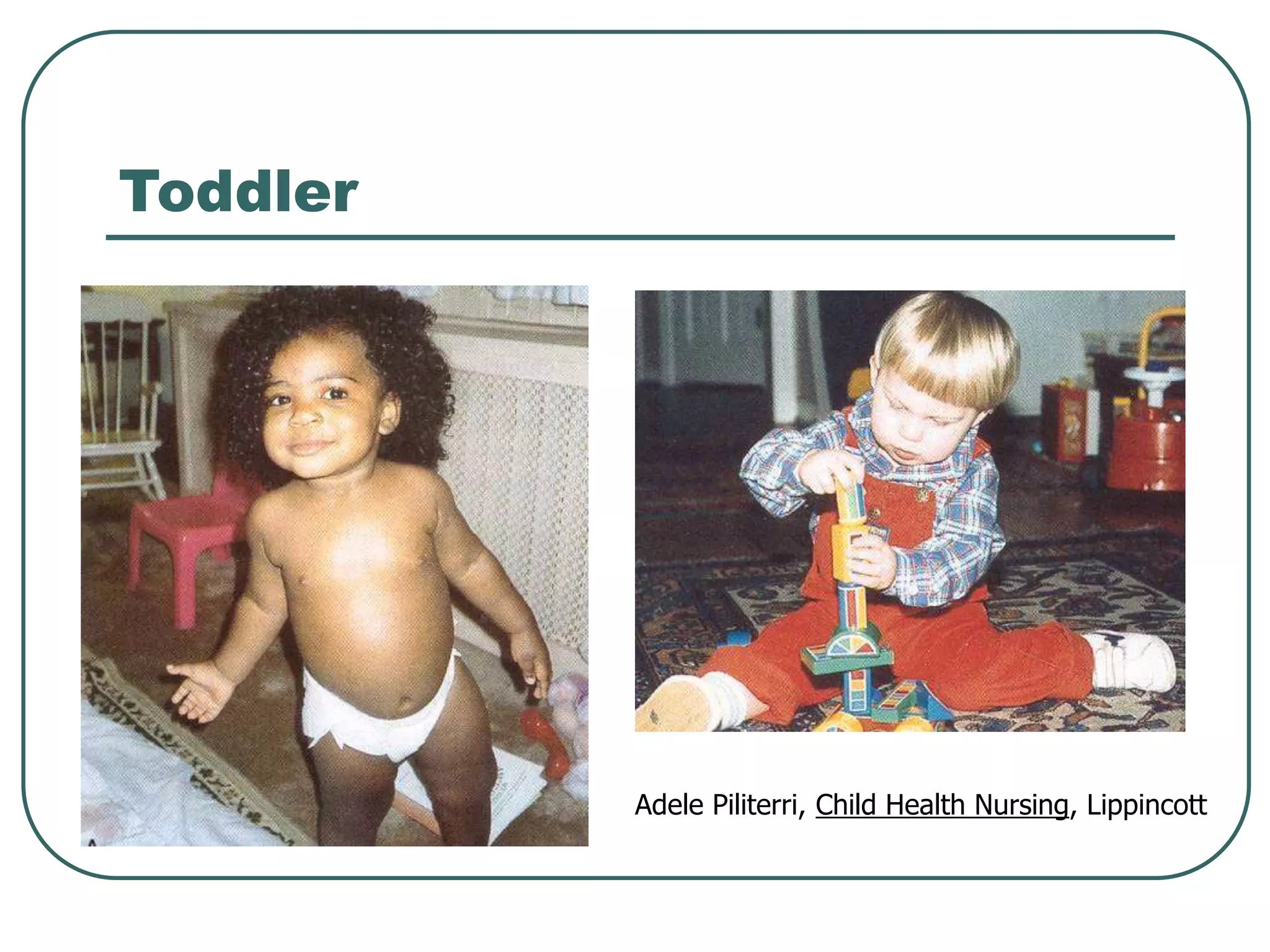
Toddler
Adele Piliterri, Child Health Nursing, Lippincott
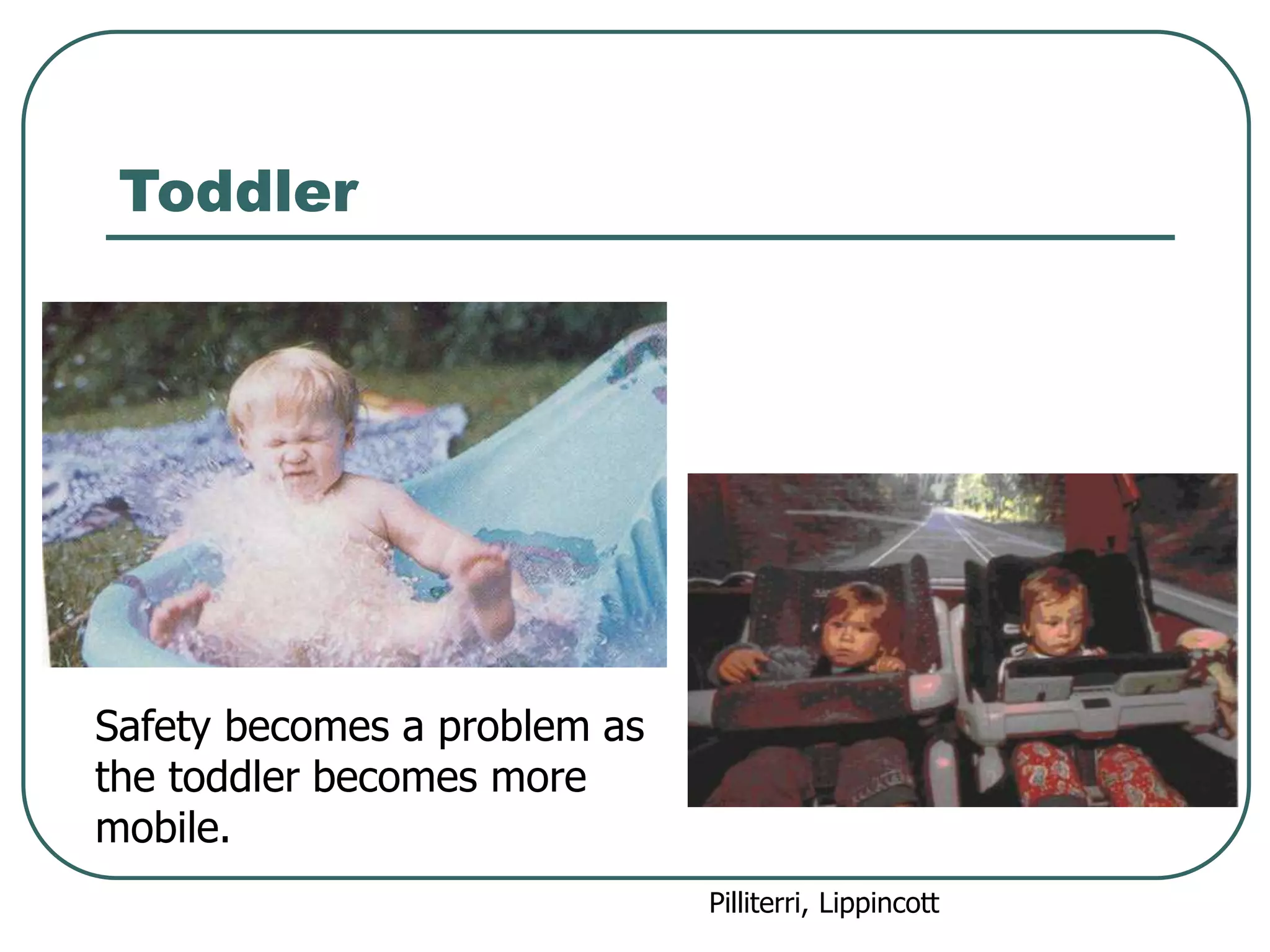
Toddler
Safety becomes a problem as
the toddler becomes more
mobile.
Pilliterri, Lippincott
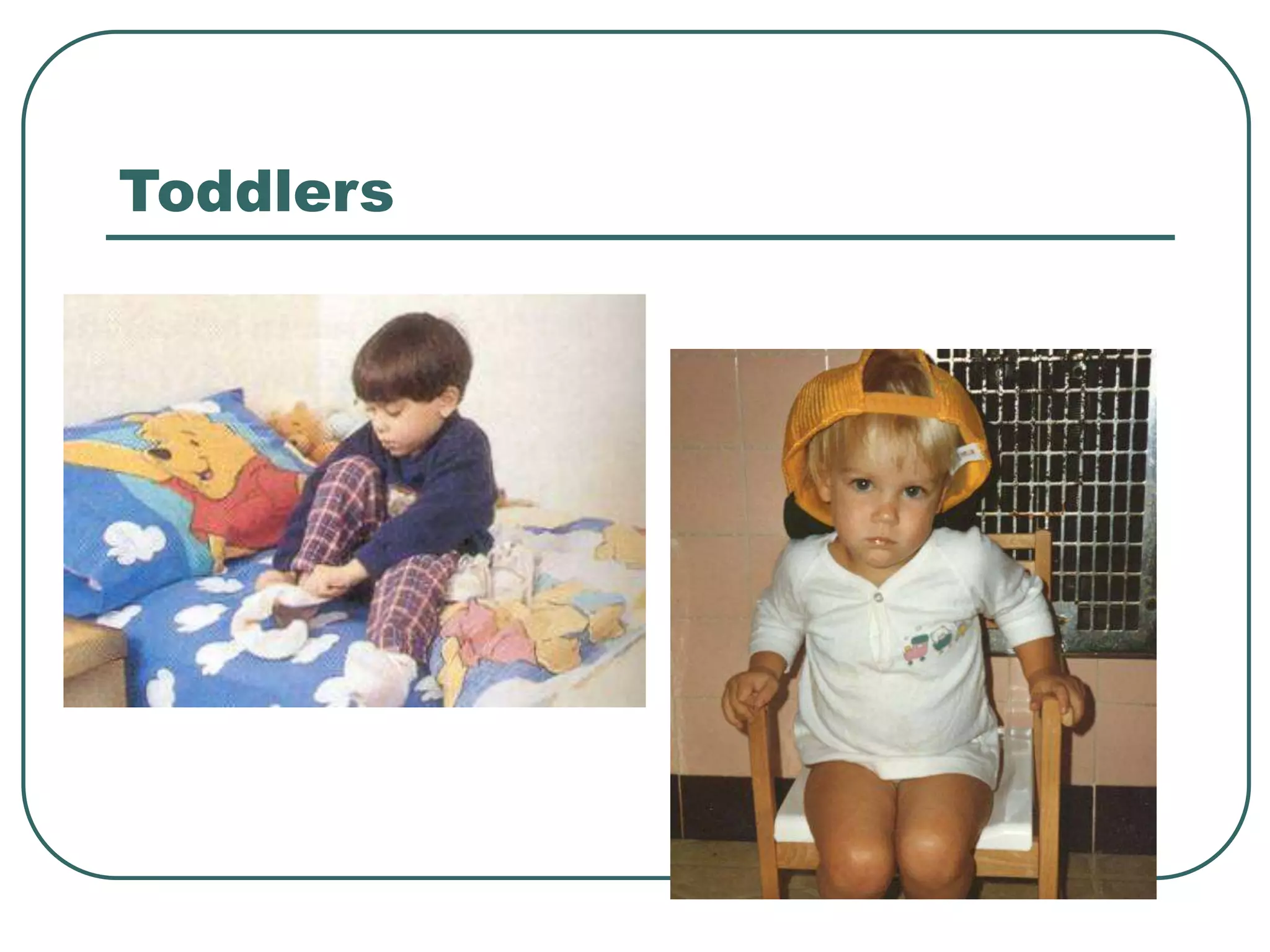
Toddlers
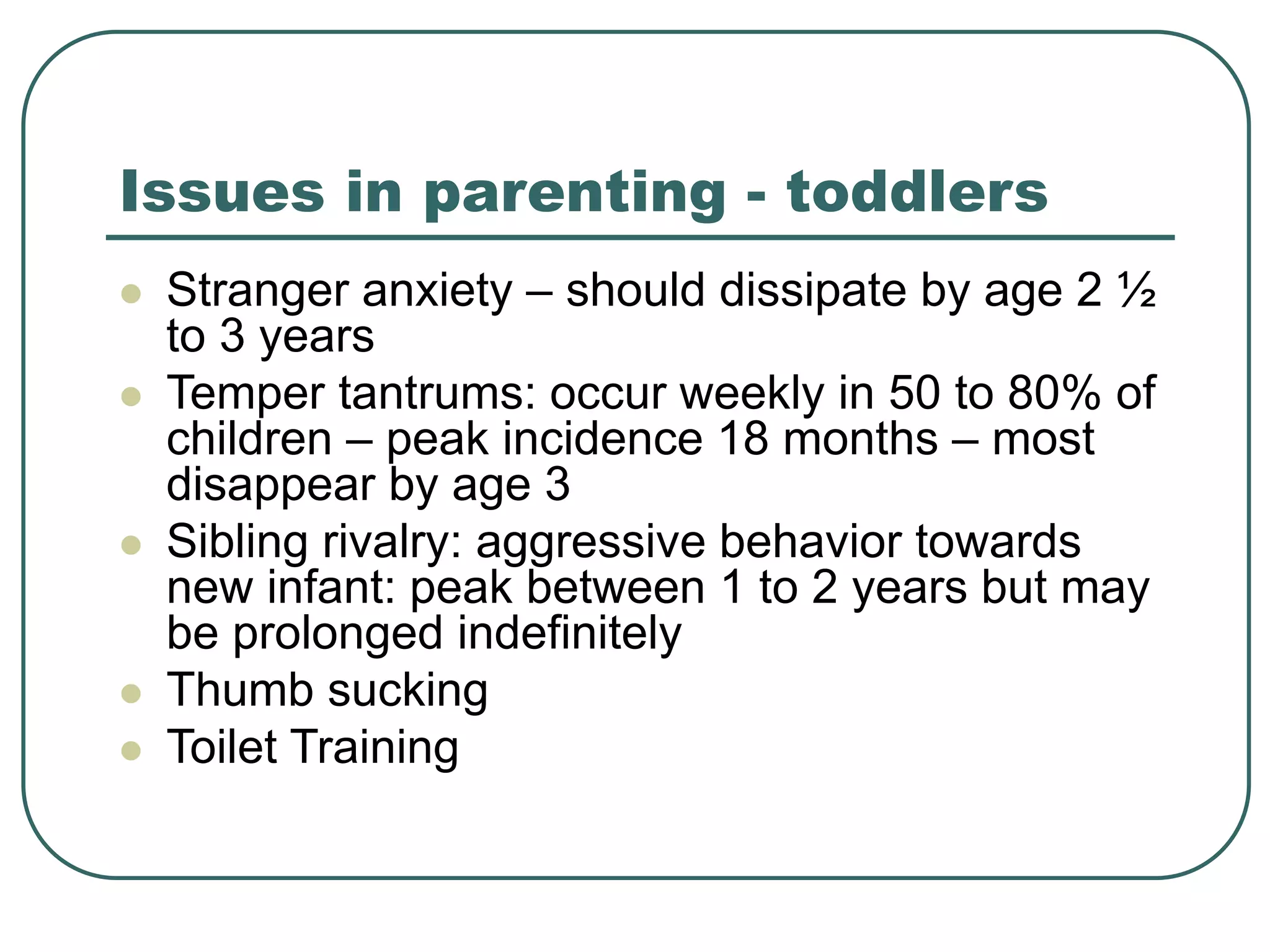
Issues in parenting - toddlers
 Stranger anxiety – should dissipate by age 2 ½
to 3 years
 Temper tantrums: occur weekly in 50 to 80% of
children – peak incidence 18 months – most
disappear by age 3
 Sibling rivalry: aggressive behavior towards
new infant: peak between 1 to 2 years but may
be prolonged indefinitely
 Thumb sucking
 Toilet Training
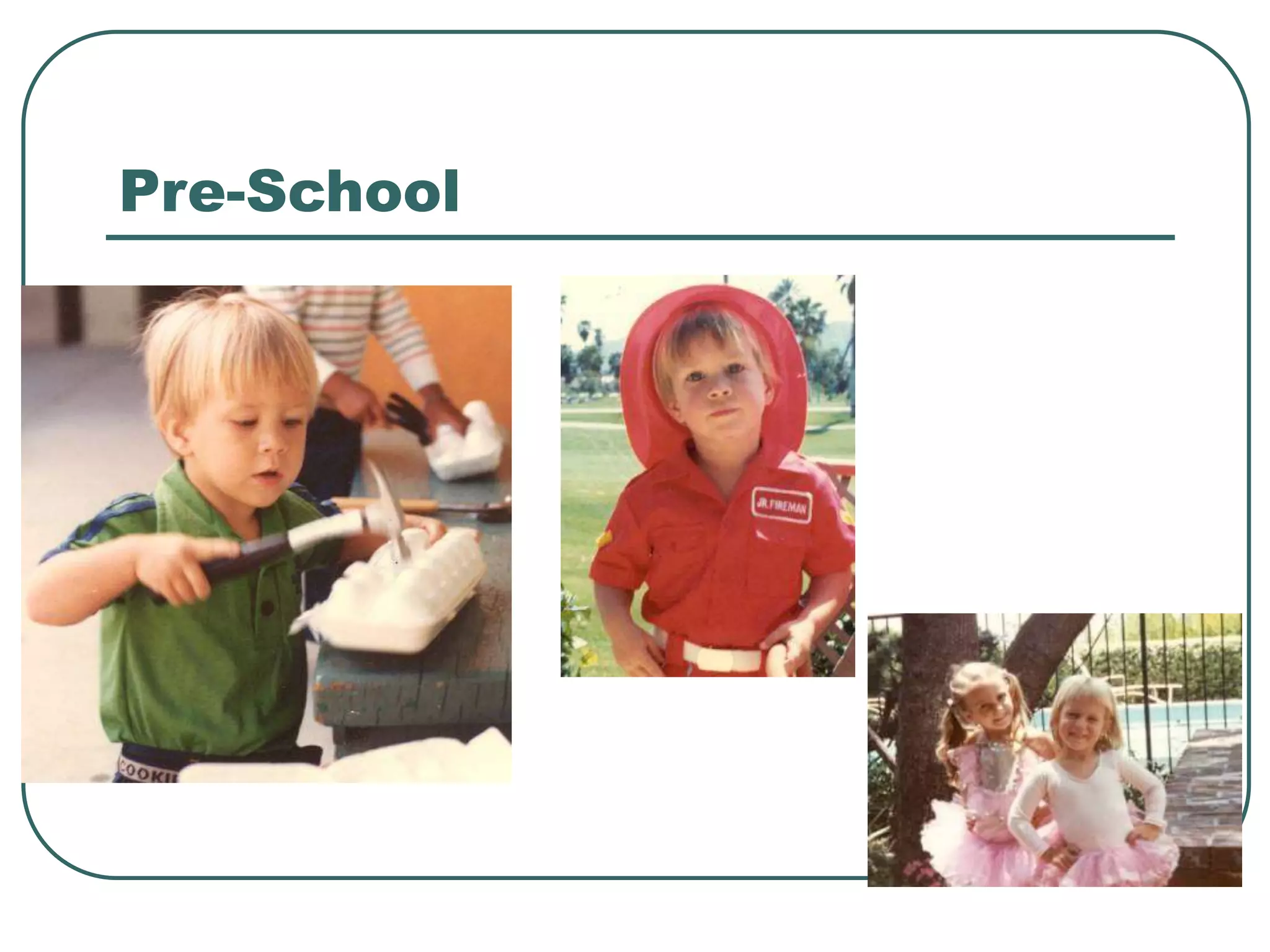
Pre-School
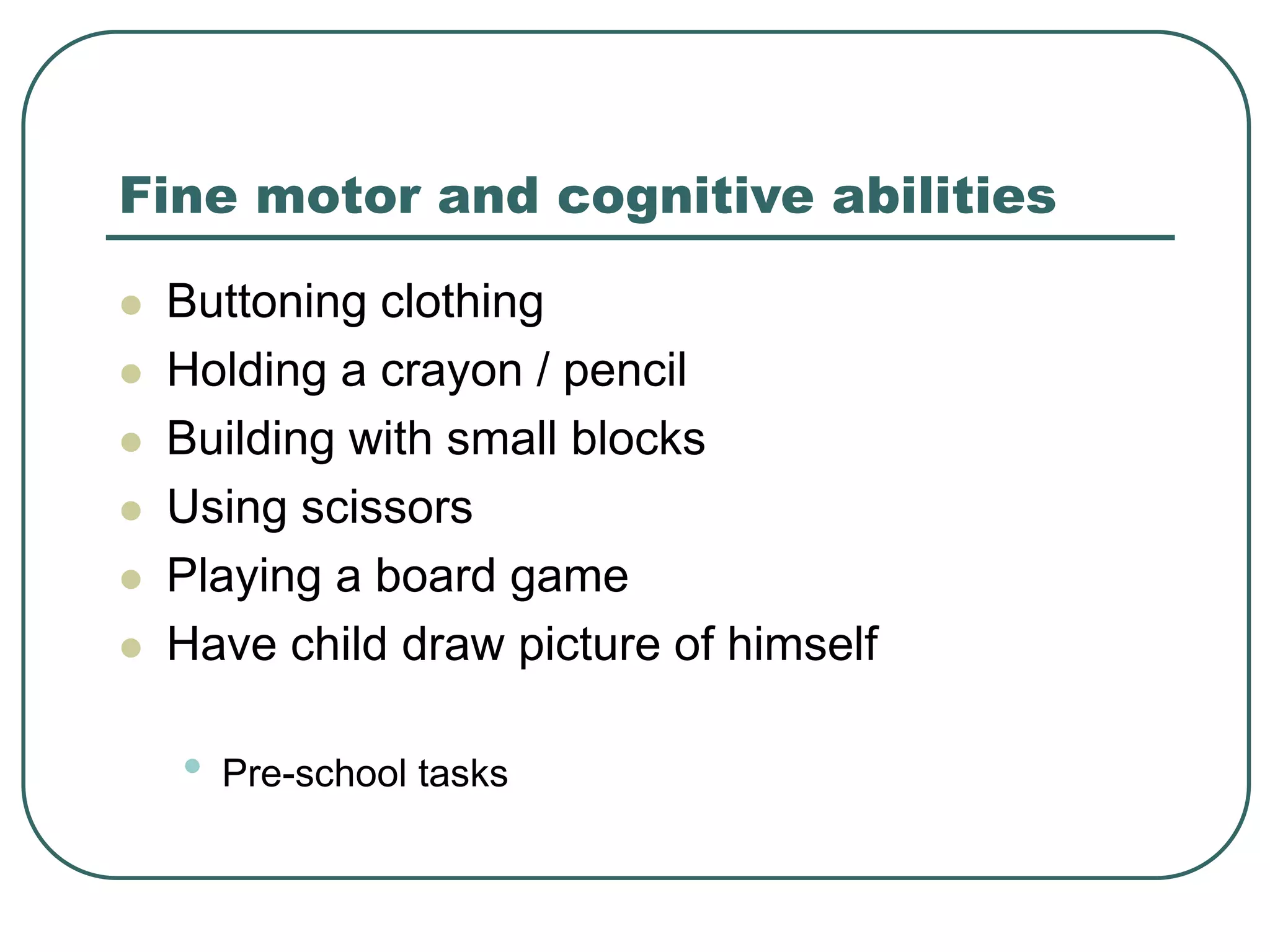
Fine motor and cognitive abilities
 Buttoning clothing
 Holding a crayon / pencil
 Building with small blocks
 Using scissors
 Playing a board game
 Have child draw picture of himself
• Pre-school tasks
Red flags: preschool
 Inability to perform self-care tasks, hand
washing simple dressing, daytime
toileting
 Lack of socialization
 Unable to play with other children
 Able to follow directions during exam
 Performance evaluation of pre-school
teacher for kindergarten readiness
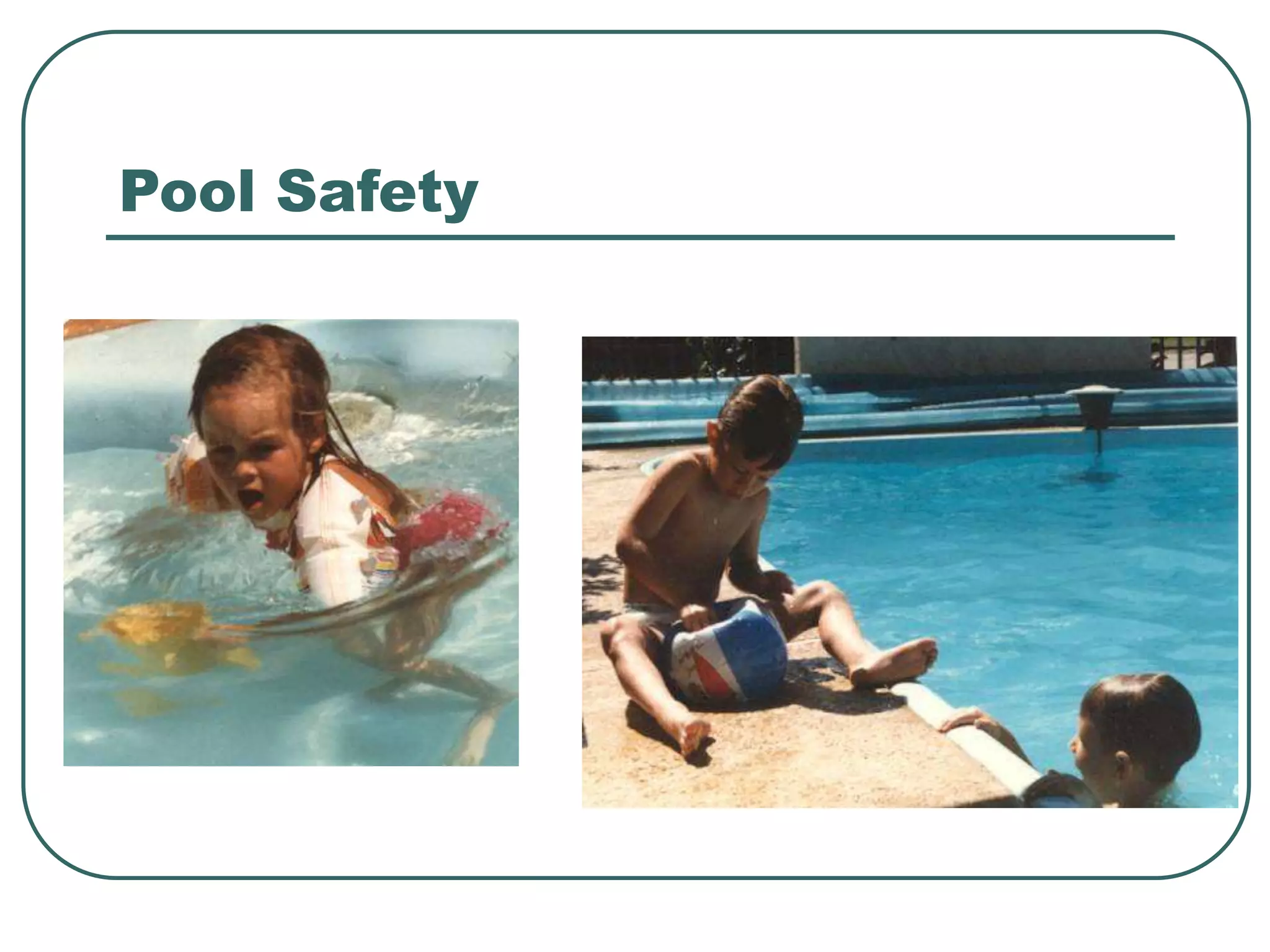
Pool Safety
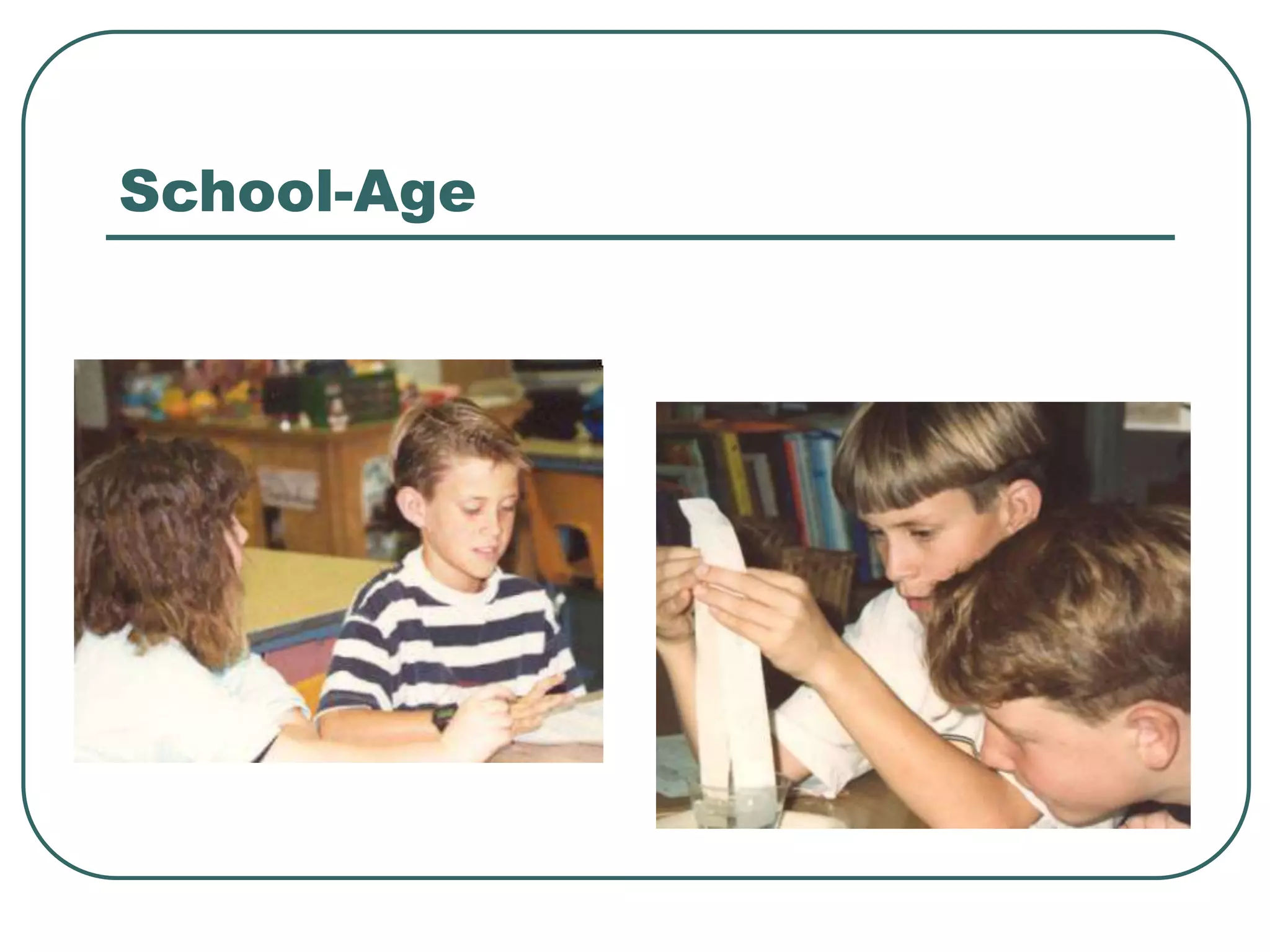
School-Age
School Years: fine motor
 Writing skills improve
 Fine motor is refined
 Fine motor with more focus
• Building: models – legos
• Sewing
• Musical instrument
• Painting
• Typing skills
• Technology: computers
School performance
• Ask about favorite subject
• How they are doing in school
• Do they like school
• By parent report: any learning difficulties,
attention problems, homework
• Parental expectations
Red flags: school age
 School failure
 Lack of friends
 Social isolation
 Aggressive behavior: fights, fire setting,
animal abuse
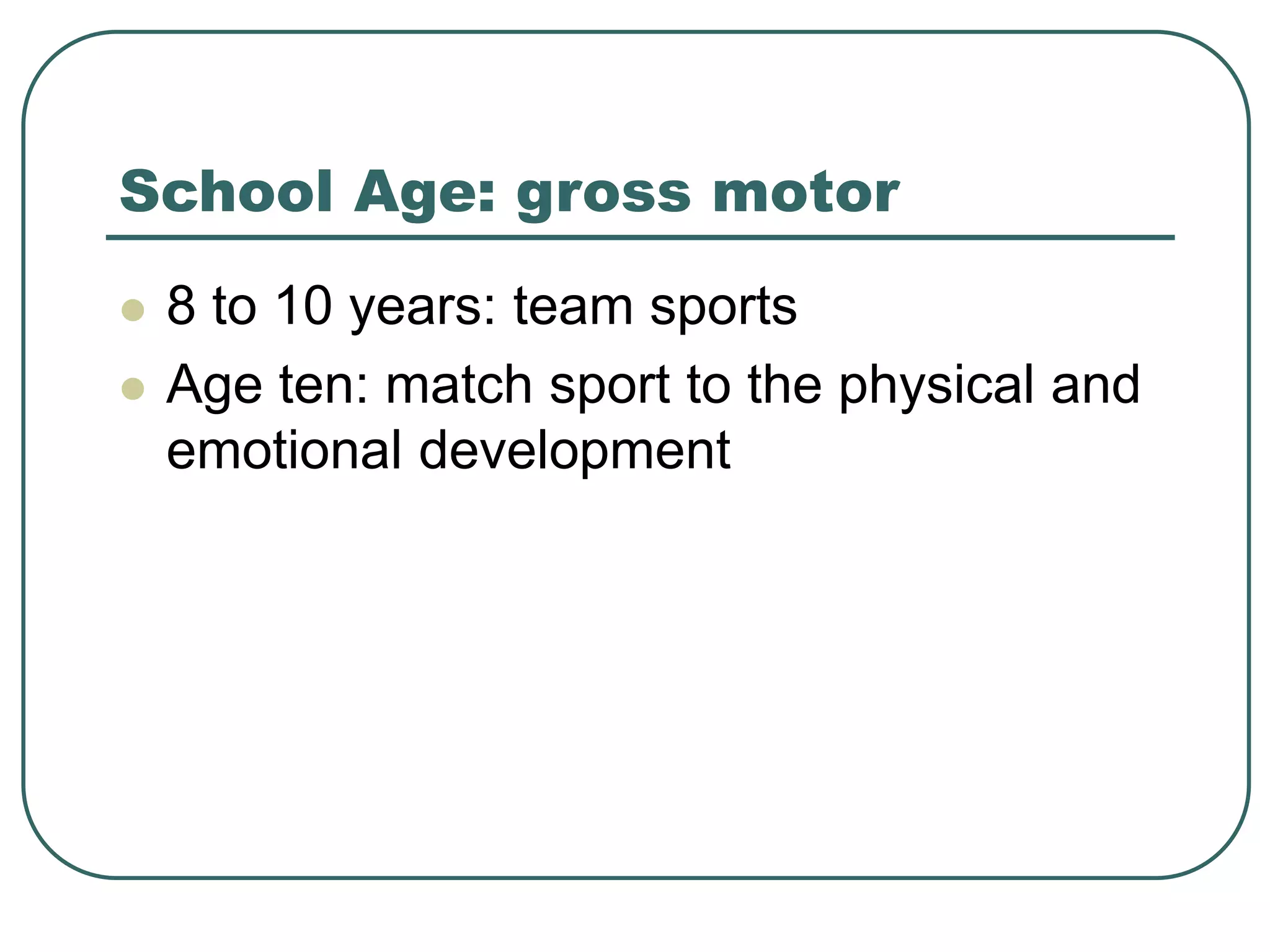
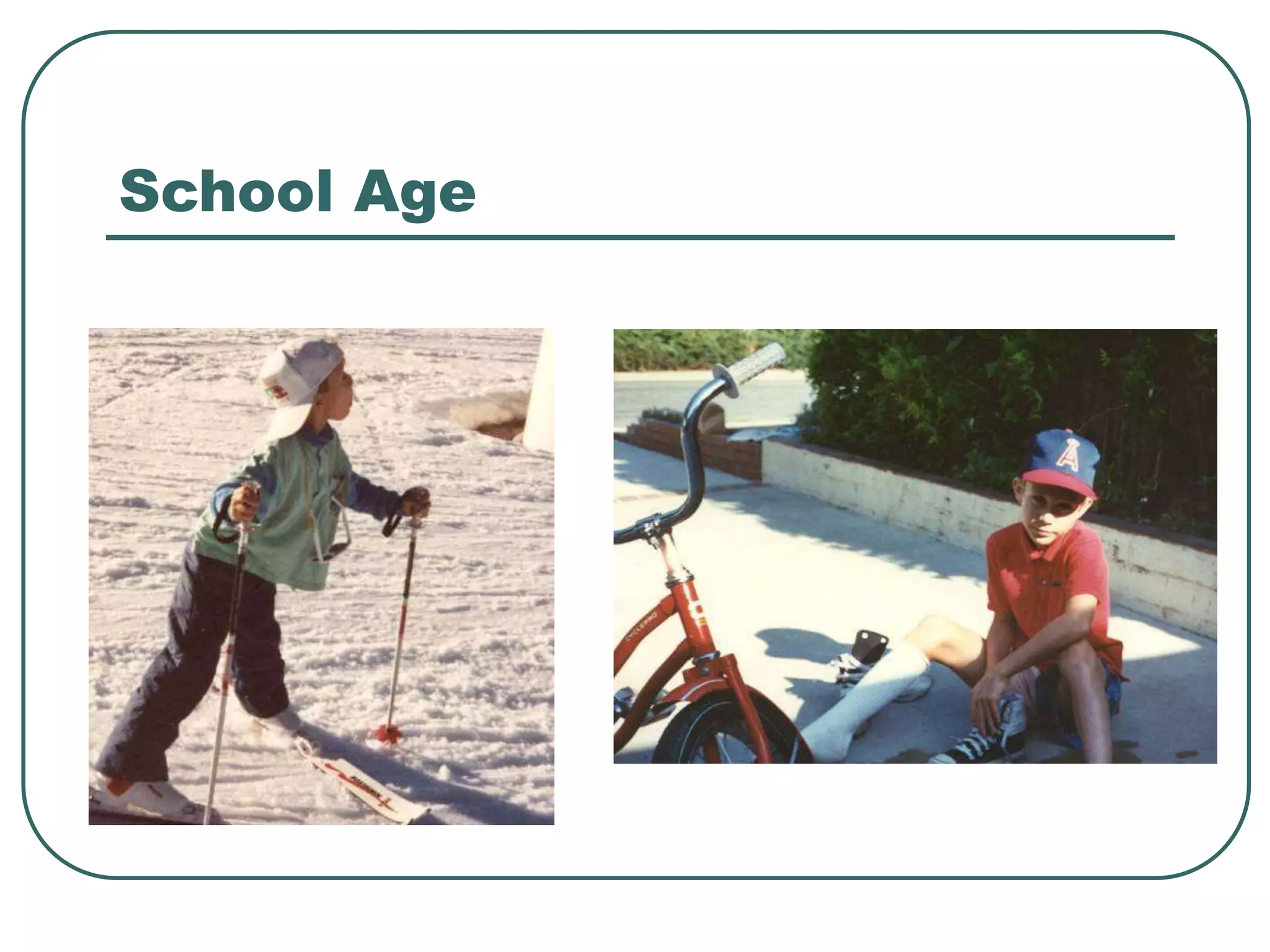
School Age: gross motor
 8 to 10 years: team sports
 Age ten: match sport to the physical and
emotional development
School Age
School Age: cognitive
 Greater ability to concentrate and
participate in self-initiating quiet activities
that challenge cognitive skills, such as
reading, playing computer and board
games.
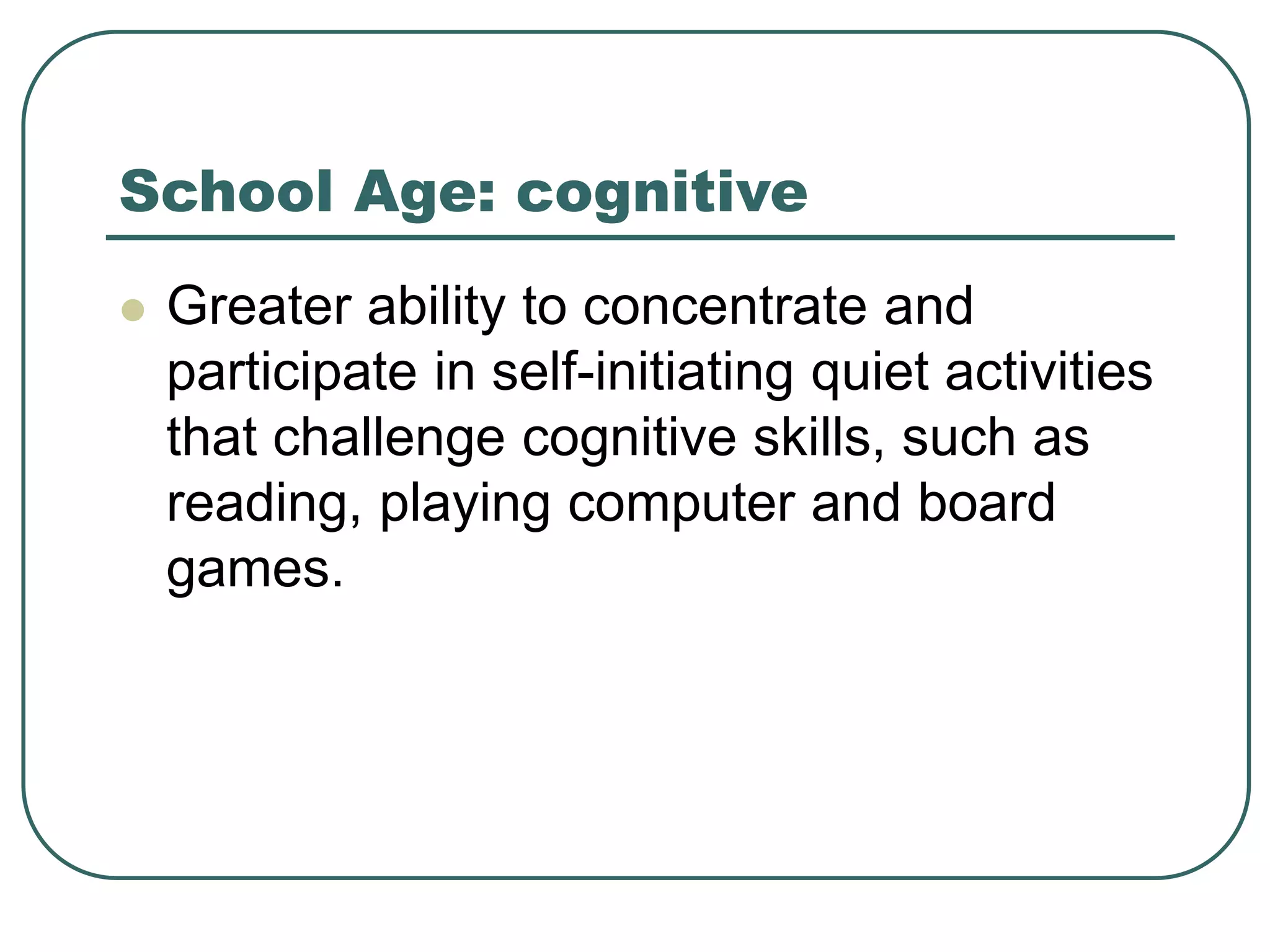
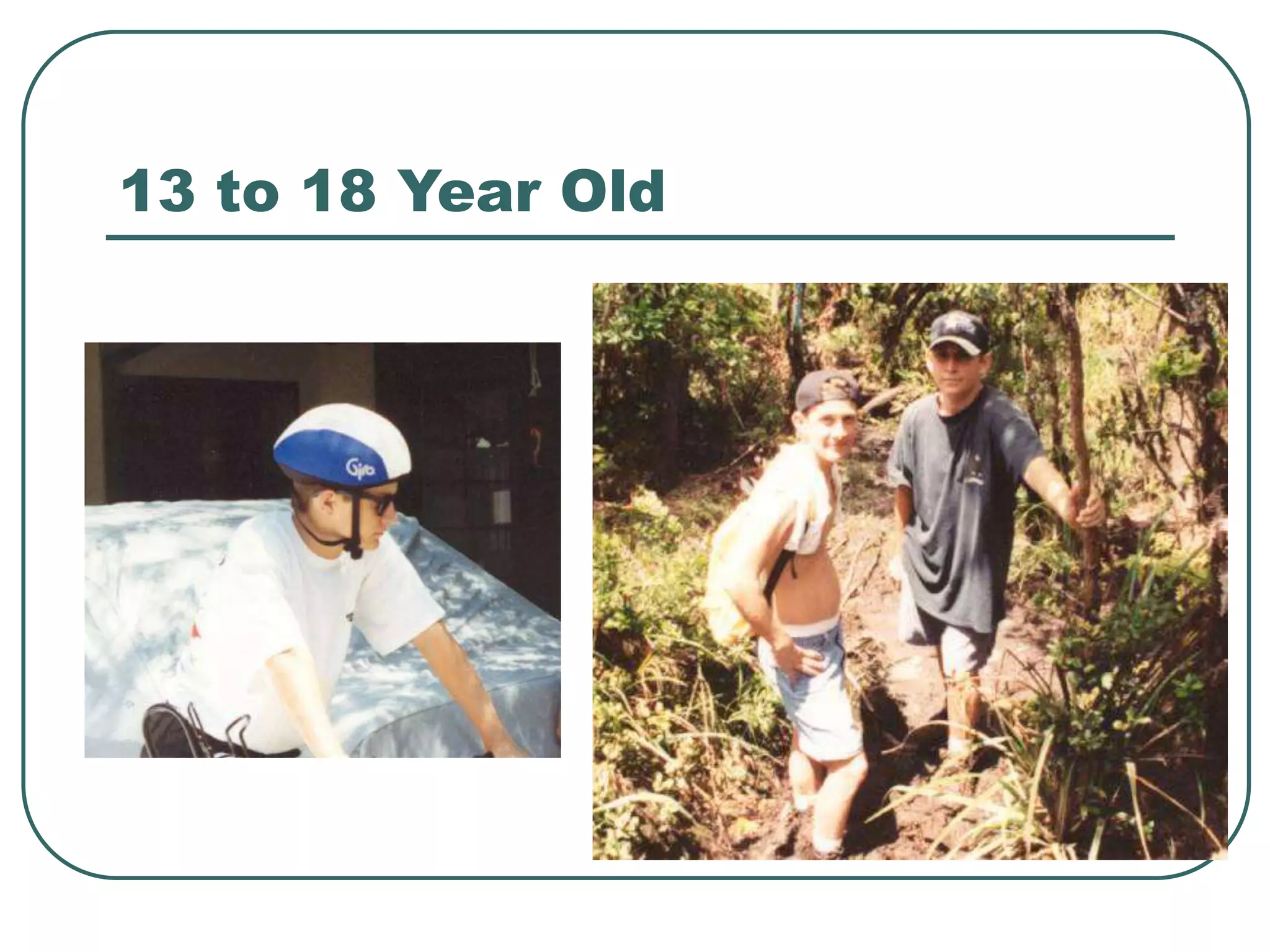
13 to 18 Year Old
Adolescent
 As teenagers gain independence they
begin to challenge values
 Critical of adult authority
 Relies on peer relationship
 Mood swings especially in early
adolescents
Adolescent behavioral problems
 Anorexia
 Attention deficit
 Anger issues
 Suicide
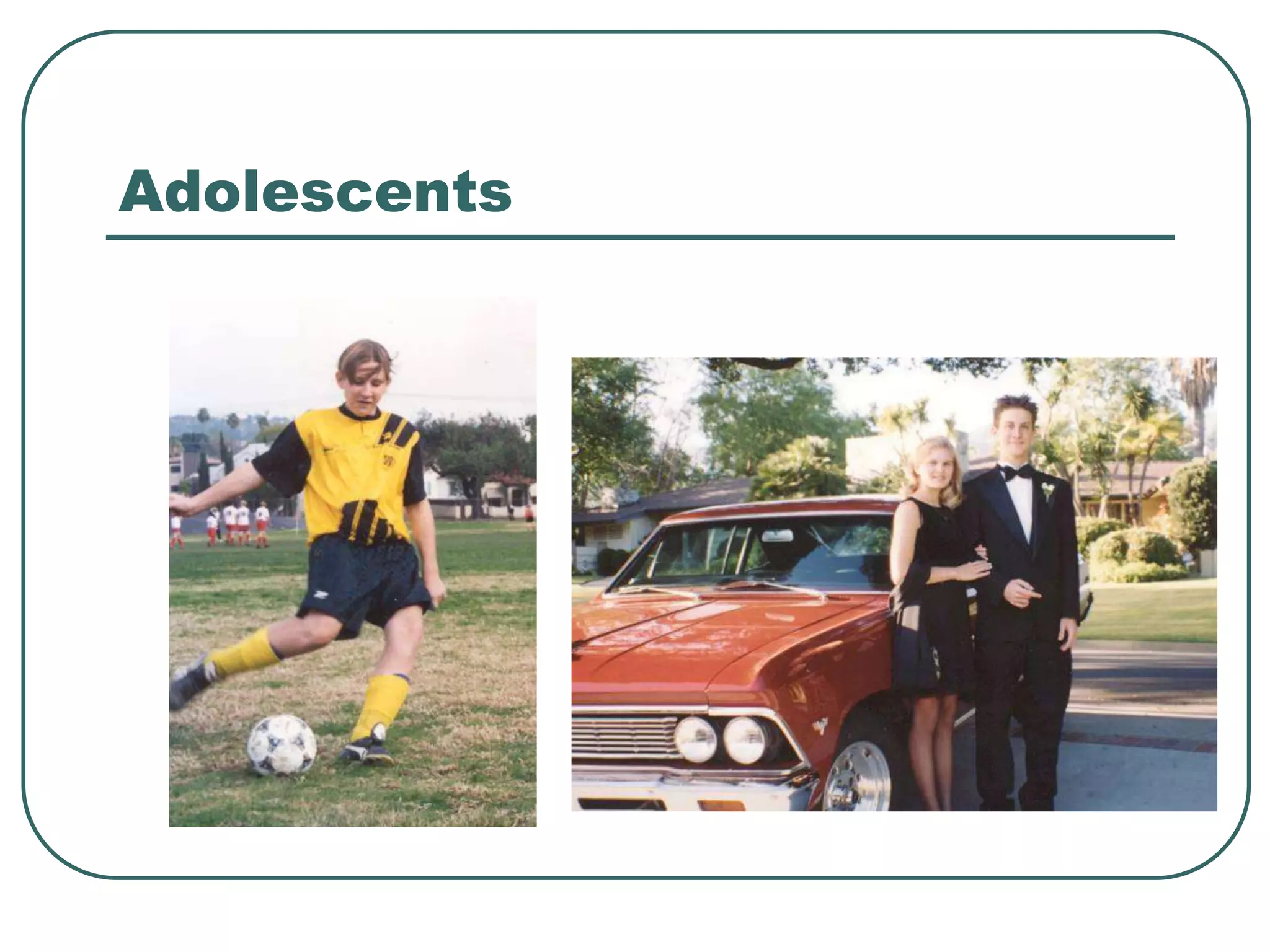
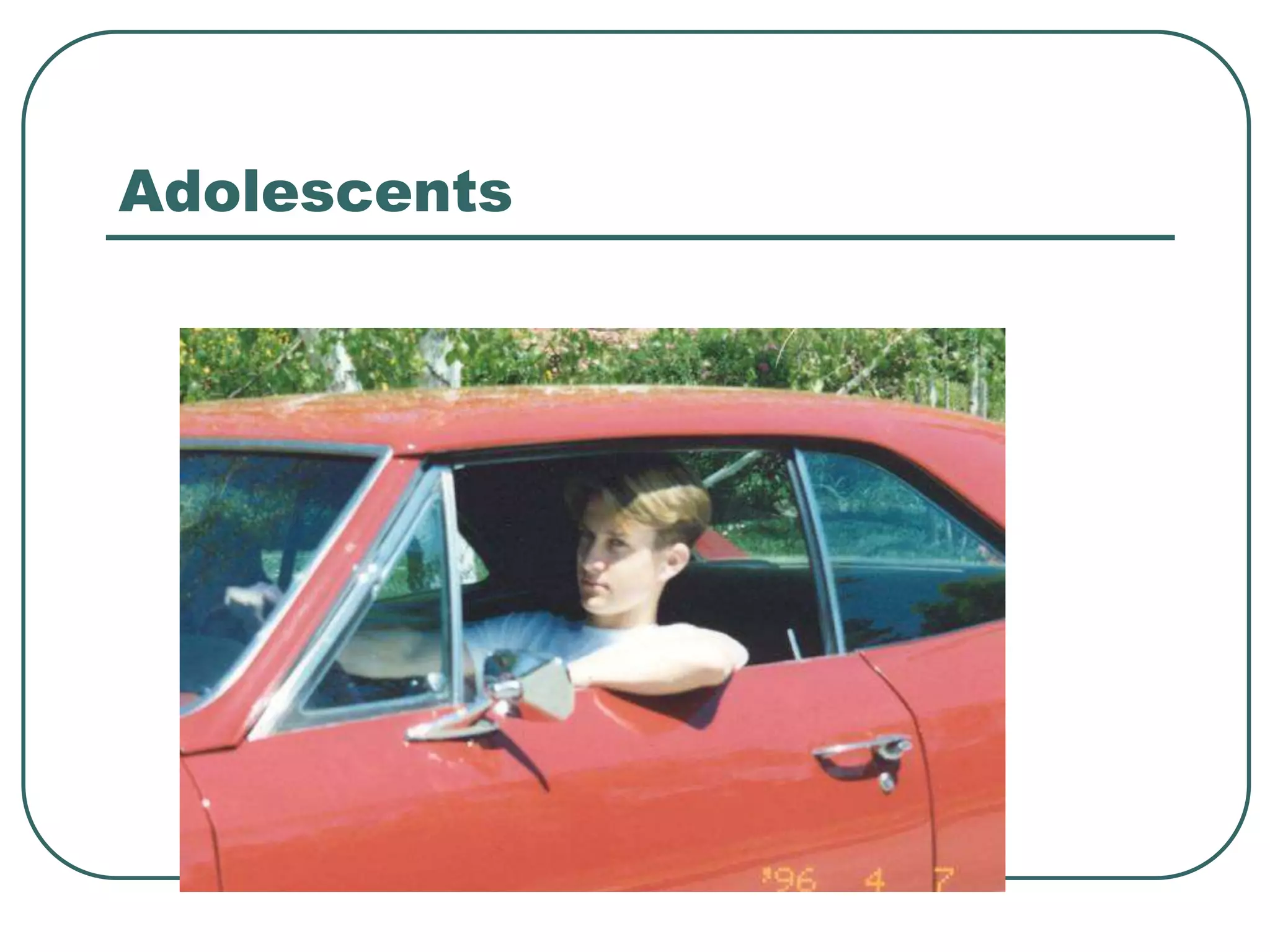
Adolescents
Adolescent Teaching
 Relationships
 Sexuality – STD’s / AIDS
 Substance use and abuse
 Gang activity
 Driving
 Access to weapons
Adolescents

Growth and development

  • 1.
    Growth and Development Infancy EarlyChildhood Middle Childhood Adolescent
  • 2.
    Stages of Growthand Development  Infancy • Neonate • Birth to 1 month • Infancy • 1 month to 1 year  Early Childhood • Toddler • 1-3 years • Preschool • 3-6 years  Middle Childhood • School age • 6 to 12 years  Late Childhood • Adolescent • 13 years to approximately 18 years
  • 3.
    Principles of Growthand Development  Growth is an orderly process, occurring in systematic fashion.  Rates and patterns of growth are specific to certain parts of the body.  Wide individual differences exist in growth rates.  Growth and development are influences by are influences by a multiple factors.
  • 4.
    Principles Continued  Developmentproceeds from the simple to the complex and from the general to the specific.  Development occurs in a cephalocaudal and a proximodistal progression.  There are critical periods for growth and development.  Rates in development vary.  Development continues throughout the individual's life span.
  • 5.
  • 6.
    Growth Patterns  Thechild’s pattern of growth is in a head-to-toe direction, or cephalocaudal, and in an inward to outward pattern called proximodistal.
  • 7.
    Why developmental assessment?  Earlydetection of deviation in child’s pattern of development  Simple and time efficient mechanism to ensure adequate surveillance of developmental progress  Domains assessed: cognitive, motor, language, social / behavioral and adaptive
  • 8.
    Gross Motor Skills The acquisition of gross motor skill precedes the development of fine motor skills.  Both processes occur in a cephalocaudal fashion • Head control preceding arm and hand control • Followed by leg and foot control.
  • 9.
    Gross Motor Development Newborn: barely able to lift head  6 months: easily lifts head, chest and upper abdomen and can bear weight on arms
  • 10.
  • 11.
    Sitting up  2monthsold: needs assistance  6 months old: can sit alone in the tripod position  8 months old: can sit without support and engage in play
  • 12.
    Sitting Up Age 2months Age 8 months
  • 13.
    Ambulation  9 monthold: crawl  1 year: stand independently from a crawl position  13 month old: walk and toddle quickly  15 month old: can run
  • 14.
  • 15.
    Fine Motor -Infant  Newborn has very little control. Objects will be involuntarily grasped and dropped without notice.  6 month old: palmar grasp – uses entire hand to pick up an object  9 month old: pincer grasp – can grasp small objects using thumb and forefinger
  • 16.
    Speech Milestones  1-2months: coos  2-6 months: laughs and squeals  8-9 months babbles: mama/dada as sounds  10-12 months: “mama/dada specific  18-20 months: 20 to 30 words – 50% understood by strangers  22-24 months: two word sentences, >50 words, 75% understood by strangers  30-36 months: almost all speech understood by strangers
  • 17.
    Hearing  BAER hearingtest done at birth  Ability to hear correlates with ability enunciate words properly  Always ask about history of otitis media – ear infection, placement of PET – tubes in ear  Early referral to MD to assess for possible fluid in ears (effusion)  Repeat hearing screening test  Speech therapist as needed
  • 18.
  • 19.
    Red Flags ininfant development  Unable to sit alone by age 9 months  Unable to transfer objects from hand to hand by age 1 year  Abnormal pincer grip or grasp by age 15 months  Unable to walk alone by 18 months  Failure to speak recognizable words by 2 years.
  • 20.
    Fine Motor -toddler  1 year old: transfer objects from hand to hand  2 year old: can hold a crayon and color vertical strokes • Turn the page of a book • Build a tower of six blocks
  • 21.
    Fine Motor –Older Toddler  3 year old: copy a circle and a cross – build using small blocks  4 year old: use scissors, color within the borders  5 year old: write some letters and draw a person with body parts
  • 22.
    Toddler Adele Piliterri, ChildHealth Nursing, Lippincott
  • 23.
    Toddler Safety becomes aproblem as the toddler becomes more mobile. Pilliterri, Lippincott
  • 24.
  • 25.
    Issues in parenting- toddlers  Stranger anxiety – should dissipate by age 2 ½ to 3 years  Temper tantrums: occur weekly in 50 to 80% of children – peak incidence 18 months – most disappear by age 3  Sibling rivalry: aggressive behavior towards new infant: peak between 1 to 2 years but may be prolonged indefinitely  Thumb sucking  Toilet Training
  • 26.
  • 27.
    Fine motor andcognitive abilities  Buttoning clothing  Holding a crayon / pencil  Building with small blocks  Using scissors  Playing a board game  Have child draw picture of himself • Pre-school tasks
  • 28.
    Red flags: preschool Inability to perform self-care tasks, hand washing simple dressing, daytime toileting  Lack of socialization  Unable to play with other children  Able to follow directions during exam  Performance evaluation of pre-school teacher for kindergarten readiness
  • 29.
  • 30.
  • 31.
    School Years: finemotor  Writing skills improve  Fine motor is refined  Fine motor with more focus • Building: models – legos • Sewing • Musical instrument • Painting • Typing skills • Technology: computers
  • 32.
    School performance • Askabout favorite subject • How they are doing in school • Do they like school • By parent report: any learning difficulties, attention problems, homework • Parental expectations
  • 33.
    Red flags: schoolage  School failure  Lack of friends  Social isolation  Aggressive behavior: fights, fire setting, animal abuse
  • 34.
    School Age: grossmotor  8 to 10 years: team sports  Age ten: match sport to the physical and emotional development
  • 35.
  • 36.
    School Age: cognitive Greater ability to concentrate and participate in self-initiating quiet activities that challenge cognitive skills, such as reading, playing computer and board games.
  • 37.
    13 to 18Year Old
  • 38.
    Adolescent  As teenagersgain independence they begin to challenge values  Critical of adult authority  Relies on peer relationship  Mood swings especially in early adolescents
  • 39.
    Adolescent behavioral problems Anorexia  Attention deficit  Anger issues  Suicide
  • 40.
  • 41.
    Adolescent Teaching  Relationships Sexuality – STD’s / AIDS  Substance use and abuse  Gang activity  Driving  Access to weapons
  • 42.