Learning objectives
Toidentify the importance of development
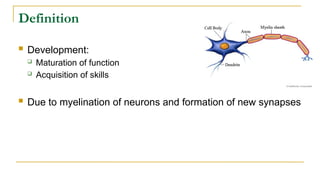
Definition of development
Principles of growth and development
Factors affecting growth and development
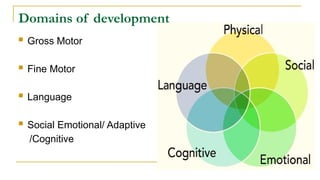
Domains of development
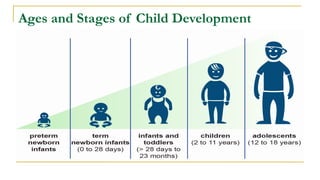
Stages of development
Assessment of development
Principles of development
Development is a lifelong process
Its similar for each individual
But proceeds at an individual rate
Different areas of development are interrelated
Early primitive reflexes are lost first
Prerequisite for proper development of a child are
Intact neurological system
Appropriate exposure
5.
Pattern of development
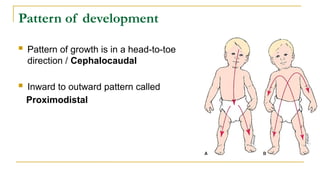
Pattern of growth is in a head-to-toe
direction / Cephalocaudal
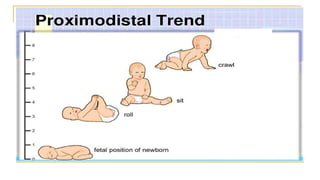
Inward to outward pattern called
Proximodistal
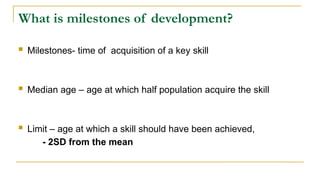
What is milestonesof development?
Milestones- time of acquisition of a key skill
Median age – age at which half population acquire the skill
Limit – age at which a skill should have been achieved,
- 2SD from the mean
11.
Domains of development
Gross Motor
Fine Motor
Language
Social Emotional/ Adaptive
/Cognitive
12.
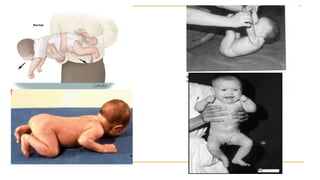
Gross motor development
Involves control of child over his body
Evaluated by- Observation in supine position
Pull to sit
Ventral suspension
Axillary suspension
Prone position
15.
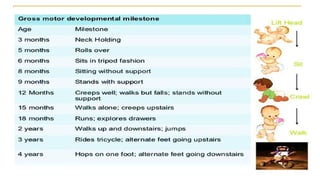
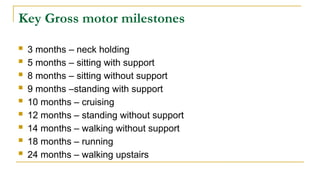
Key Gross motormilestones
3 months – neck holding
5 months – sitting with support
8 months – sitting without support
9 months –standing with support
10 months – cruising
12 months – standing without support
14 months – walking without support
18 months – running
24 months – walking upstairs
16.
FINE MOTOR ORADAPTIVE MILESTONES
Includes
Eye coordination
Hand eye coordination
Hand mouth coordination
Manipulation with hands
17.
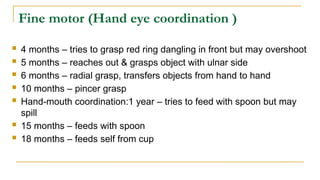
Fine motor (Handeye coordination )
4 months – tries to grasp red ring dangling in front but may overshoot
5 months – reaches out & grasps object with ulnar side
6 months – radial grasp, transfers objects from hand to hand
10 months – pincer grasp
Hand-mouth coordination:1 year – tries to feed with spoon but may
spill
15 months – feeds with spoon
18 months – feeds self from cup
19.
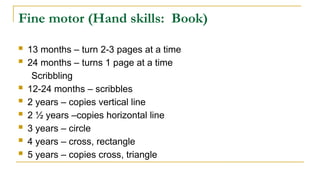
Fine motor (Handskills: Book)
13 months – turn 2-3 pages at a time
24 months – turns 1 page at a time
Scribbling
12-24 months – scribbles
2 years – copies vertical line
2 ½ years –copies horizontal line
3 years – circle
4 years – cross, rectangle
5 years – copies cross, triangle
20.
Language
Language development involves
Ability to produce words
Articulation, pronunciation
Motor production of sounds
Language
Expression with appropriate emotion
Ability to understand spoken words
21.
Language milestones
1month - turns head towards sound
3 months – coos, vowel sounds
4 months- laughs loud
6 months - monosyllables
9 months – bisyllables, mama/dada as sounds
22.
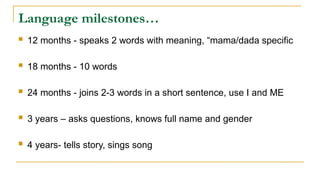
Language milestones…
12months - speaks 2 words with meaning, “mama/dada specific
18 months - 10 words
24 months - joins 2-3 words in a short sentence, use I and ME
3 years – asks questions, knows full name and gender
4 years- tells story, sings song
23.
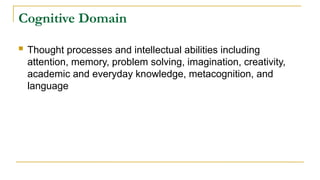
Cognitive Domain
Thoughtprocesses and intellectual abilities including
attention, memory, problem solving, imagination, creativity,
academic and everyday knowledge, metacognition, and
language
24.
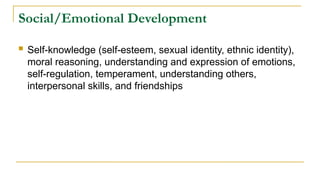
Social/Emotional Development
Self-knowledge(self-esteem, sexual identity, ethnic identity),
moral reasoning, understanding and expression of emotions,
self-regulation, temperament, understanding others,
interpersonal skills, and friendships
25.
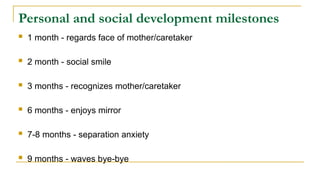
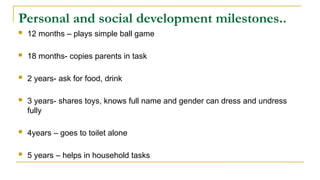
Personal and socialdevelopment milestones
1 month - regards face of mother/caretaker
2 month - social smile
3 months - recognizes mother/caretaker
6 months - enjoys mirror
7-8 months - separation anxiety
9 months - waves bye-bye
26.
Personal and socialdevelopment milestones..
12 months – plays simple ball game
18 months- copies parents in task
2 years- ask for food, drink
3 years- shares toys, knows full name and gender can dress and undress
fully
4years – goes to toilet alone
5 years – helps in household tasks
27.
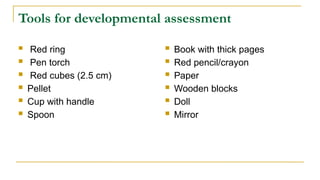
Tools for developmentalassessment
Red ring
Pen torch
Red cubes (2.5 cm)
Pellet
Cup with handle
Spoon
Book with thick pages
Red pencil/crayon
Paper
Wooden blocks
Doll
Mirror
29.
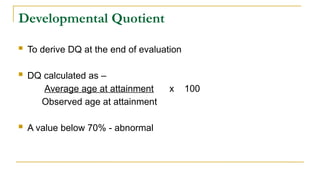
Developmental Quotient
Toderive DQ at the end of evaluation
DQ calculated as –
Average age at attainment x 100
Observed age at attainment
A value below 70% - abnormal







![CTEV [ clubfoot] DR ARUN LAL ,DR MOHAMED ASHRAF travancore medical college k...](https://cdn.slidesharecdn.com/ss_thumbnails/ctevclubfootdrarunlaldrmohamedashraftravancoremedicalcollegekollamkeralaindia-260208063247-18fc466c-thumbnail.jpg?width=640&height=640&fit=bounds)


