Joefayca Yvette C. Baja, MD
2nd Yr Pedia Resident, RMC
Developmental
Milestones
Developmental Milestones
• Sets of goals or markers that a child is expected to achieve during
maturation
• Understanding and identifying the developmental milestones can help
recognize delayed development, facilitating earlier interventions and
improving outcomes
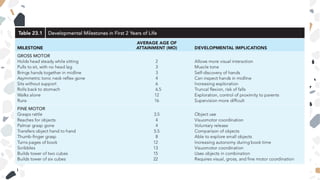
• Five domains
• Gross motor
• Fine motor
• Language
• Cognitive
• Social-emotional and behavioral
Misirliyan SS, Boehning AP, Shah M. Development Milestones. Nih.gov. Published March 16, 2023. Accessed September 18,
2024. https://www.ncbi.nlm.nih.gov/books/NBK557518/
‌
THE FIRST YEAR
Emotional Development
•Dependent on the
environment to meet
his/her needs
• Crying in response to
stimuli
• Consistent availability of
a
trusted adult – secure
attachment
Cognitive Development
• Recognize facial
expressions (smiles)
• Match abstract
properties of stimuli:
countour, intensity,
temporal pattern
• Habituate to familiar
stimuli and increase
attention to novel stimuli
Physical Development
•Weight: decreases 10%
below birthweight in the
1st week; Regained by 2
weeks
• First month: period of
fastest postnatal growth
•Limb movements –
uncontrolled writhing
The First Year (0-2 months)
Emotional Development
• Discriminate and imitate
facial expressions
• Gains ability to share
emotional states
Cognitive Development
• Hatching socially:
interested in a wider world
• Social smiles
• Increasing eye contact
• Explores their own
bodies
• Emergence of a sense of
self (1st stage of
personality
development)
Physical Development
• 2 months: voluntary
smiles and increasing eye
contact
• Waning of primitive
reflexes
• Examine objects in
midline
• Hold object and let go
voluntarily
• Fidgety movements
• Control of truncal flexion:
rolling to side
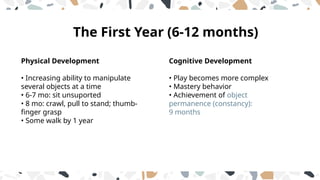
The First Year (2-6 months)
Cognitive Development
• Play becomes more complex
• Mastery behavior
• Achievement of object
permanence (constancy):
9 months
Physical Development
• Increasing ability to manipulate
several objects at a time
• 6-7 mo: sit unsuported
• 8 mo: crawl, pull to stand; thumb-
finger grasp
• Some walk by 1 year
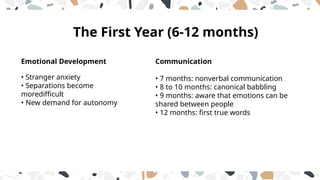
The First Year (6-12 months)
Communication
• 7 months: nonverbal communication
• 8 to 10 months: canonical babbling
• 9 months: aware that emotions can be
shared between people
• 12 months: first true words
Emotional Development
• Stranger anxiety
• Separations become
moredifficult
• New demand for autonomy
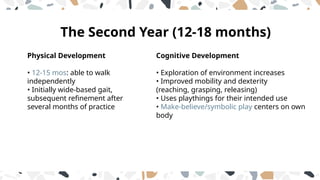
THE SECOND YEAR
Cognitive Development
• Exploration of environment increases
• Improved mobility and dexterity
(reaching, grasping, releasing)
• Uses playthings for their intended use
• Make-believe/symbolic play centers on own
body
Physical Development
• 12-15 mos: able to walk
independently
• Initially wide-based gait,
subsequent refinement after
several months of practice
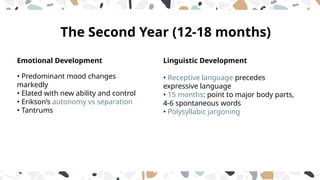
The Second Year (12-18 months)
Emotional Development
• Predominant mood changes
markedly
• Elated with new ability and control
• Erikson’s autonomy vs separation
• Tantrums
Linguistic Development
• Receptive language precedes
expressive language
• 15 months: point to major body parts,
4-6 spontaneous words
• Polysyllabic jargoning
Cognitive Development
• Object permanence firmly
established
• Flexibility in problem solving
Physical Development
• Improvement in balance and
agility
• Emergence of running and stair
climbing
• 24 months: half of adult height
and 85% of adult HC
The Second Year (18-24 months)
Linguistic Development
• Symbolic thought - labeling of objects
• Vocabulary grows from 10-15 words
(18 mos) to 50-100 words (2 years)
• Beginning of grammar
• Understand two-step commands, such
as “give me the ball and then get your
shoes”
Emotional Development
• 18 months: rapprochement
• Separation anxiety at bed time
• Transitional objects: symbol of
absent parent
• Self-conscious awareness
• Formation of conscience but
with relatively weak internalized
inhibitions
The Second Year (18-24 months)
DEVELOPMENTAL DOMAINS
● Gross motor
● Fine motor - adaptive
● Communication and language
● Personal-social
● Cognitive
PRESCHOOL YEARS
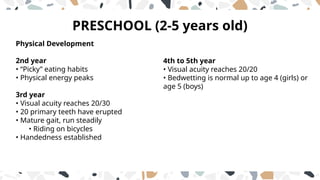
PRESCHOOL (2-5 years old)
4th to 5th year
• Visual acuity reaches 20/20
• Bedwetting is normal up to age 4 (girls) or
age 5 (boys)
Physical Development
2nd year
• “Picky” eating habits
• Physical energy peaks
3rd year
• Visual acuity reaches 20/30
• 20 primary teeth have erupted
• Mature gait, run steadily
• Riding on bicycles
• Handedness established
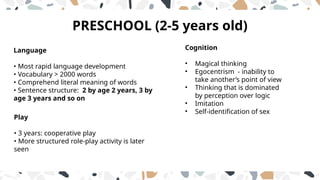
PRESCHOOL (2-5 years old)
Language
• Most rapid language development
• Vocabulary > 2000 words
• Comprehend literal meaning of words
• Sentence structure: 2 by age 2 years, 3 by
age 3 years and so on
Play
• 3 years: cooperative play
• More structured role-play activity is later
seen
Cognition
• Magical thinking
• Egocentrism - inability to
take another’s point of view
• Thinking that is dominated
by perception over logic
• Imitation
• Self-identification of sex
MIDDLE CHILDHOOD
Middle Childhood (6-11 years old)
● Physical Development
○ Growth occurs discontinuously
○ Slowing of brain growth (+ 2 cm in HC)
○ Dental maturation
○ Increased ability to perform complex movements
○ Perception of body image develops
○ Interest in gender differences and sexual behavior increases
progressively until puberty
○ period when sexual drives are limited
Middle Childhood (6-11 years old)
● Cognitive Development
○ shift from preoperational to concrete logical operations.
○ concept of “school readiness” has evolved
○ The first 2-3 years- acquiring the fundamentals: reading, writing, and
basic mathematics skills
○ 3rd or 4th grade - exercise their growing cognitive and linguistic
mastery
Middle Childhood (6-11 years old)
● Social and Emotional Development
○ energy is directed toward creativity and productivity
○ Changes occurs in three spheres: home, school and neighborhood
○ Social groups tend to be same-sex
○ Conform to peer norms
○ Social success and deficits affects child’s self-image, personality,
and school performance
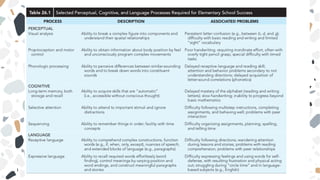
DEVELOPMENTAL RED FLAGS
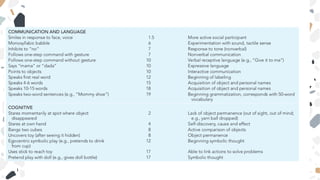
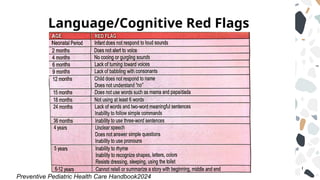
Language/Cognitive Red Flags
Preventive Pediatric Health Care Handbook2024
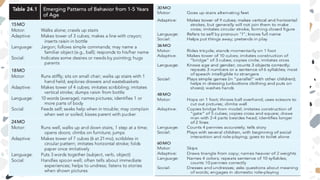
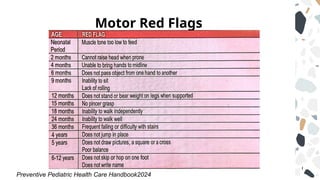
Motor Red Flags
Preventive Pediatric Health Care Handbook2024
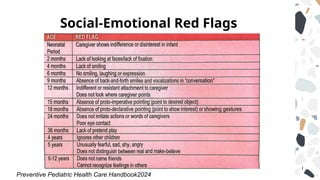
Social-Emotional Red Flags
Preventive Pediatric Health Care Handbook2024
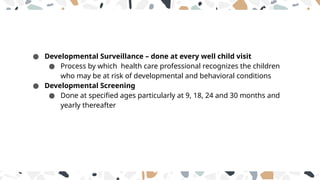
● Developmental Surveillance – done at every well child visit
● Process by which health care professional recognizes the children
who may be at risk of developmental and behavioral conditions
● Developmental Screening
● Done at specified ages particularly at 9, 18, 24 and 30 months and
yearly thereafter
ADOLESCENCE
References
• Nelsons Textbook of Pediatrics 22nd
Edition
• Preventive Pediatric Health Care Handbook 2024
• Misirliyan SS, Boehning AP, Shah M. Development Milestones. Nih.gov. Published
March 16, 2023. Accessed September 18, 2024.
https://www.ncbi.nlm.nih.gov/books/NBK557518/
CREDITS: This presentation template was
created by Slidesgo, including icons by Flaticon
, and infographics & images by Freepik
THANKS! Does anyone have any questions?

DEVELOPMENTAL MILESTONES POWERPOINT PRES

  • 1.
    Joefayca Yvette C.Baja, MD 2nd Yr Pedia Resident, RMC Developmental Milestones
  • 2.
    Developmental Milestones • Setsof goals or markers that a child is expected to achieve during maturation • Understanding and identifying the developmental milestones can help recognize delayed development, facilitating earlier interventions and improving outcomes • Five domains • Gross motor • Fine motor • Language • Cognitive • Social-emotional and behavioral Misirliyan SS, Boehning AP, Shah M. Development Milestones. Nih.gov. Published March 16, 2023. Accessed September 18, 2024. https://www.ncbi.nlm.nih.gov/books/NBK557518/ ‌
  • 3.
  • 4.
    Emotional Development •Dependent onthe environment to meet his/her needs • Crying in response to stimuli • Consistent availability of a trusted adult – secure attachment Cognitive Development • Recognize facial expressions (smiles) • Match abstract properties of stimuli: countour, intensity, temporal pattern • Habituate to familiar stimuli and increase attention to novel stimuli Physical Development •Weight: decreases 10% below birthweight in the 1st week; Regained by 2 weeks • First month: period of fastest postnatal growth •Limb movements – uncontrolled writhing The First Year (0-2 months)
  • 5.
    Emotional Development • Discriminateand imitate facial expressions • Gains ability to share emotional states Cognitive Development • Hatching socially: interested in a wider world • Social smiles • Increasing eye contact • Explores their own bodies • Emergence of a sense of self (1st stage of personality development) Physical Development • 2 months: voluntary smiles and increasing eye contact • Waning of primitive reflexes • Examine objects in midline • Hold object and let go voluntarily • Fidgety movements • Control of truncal flexion: rolling to side The First Year (2-6 months)
  • 6.
    Cognitive Development • Playbecomes more complex • Mastery behavior • Achievement of object permanence (constancy): 9 months Physical Development • Increasing ability to manipulate several objects at a time • 6-7 mo: sit unsuported • 8 mo: crawl, pull to stand; thumb- finger grasp • Some walk by 1 year The First Year (6-12 months)
  • 7.
    The First Year(6-12 months) Communication • 7 months: nonverbal communication • 8 to 10 months: canonical babbling • 9 months: aware that emotions can be shared between people • 12 months: first true words Emotional Development • Stranger anxiety • Separations become moredifficult • New demand for autonomy
  • 8.
  • 9.
    Cognitive Development • Explorationof environment increases • Improved mobility and dexterity (reaching, grasping, releasing) • Uses playthings for their intended use • Make-believe/symbolic play centers on own body Physical Development • 12-15 mos: able to walk independently • Initially wide-based gait, subsequent refinement after several months of practice The Second Year (12-18 months)
  • 10.
    The Second Year(12-18 months) Emotional Development • Predominant mood changes markedly • Elated with new ability and control • Erikson’s autonomy vs separation • Tantrums Linguistic Development • Receptive language precedes expressive language • 15 months: point to major body parts, 4-6 spontaneous words • Polysyllabic jargoning
  • 11.
    Cognitive Development • Objectpermanence firmly established • Flexibility in problem solving Physical Development • Improvement in balance and agility • Emergence of running and stair climbing • 24 months: half of adult height and 85% of adult HC The Second Year (18-24 months)
  • 12.
    Linguistic Development • Symbolicthought - labeling of objects • Vocabulary grows from 10-15 words (18 mos) to 50-100 words (2 years) • Beginning of grammar • Understand two-step commands, such as “give me the ball and then get your shoes” Emotional Development • 18 months: rapprochement • Separation anxiety at bed time • Transitional objects: symbol of absent parent • Self-conscious awareness • Formation of conscience but with relatively weak internalized inhibitions The Second Year (18-24 months)
  • 13.
    DEVELOPMENTAL DOMAINS ● Grossmotor ● Fine motor - adaptive ● Communication and language ● Personal-social ● Cognitive
  • 16.
  • 17.
    PRESCHOOL (2-5 yearsold) 4th to 5th year • Visual acuity reaches 20/20 • Bedwetting is normal up to age 4 (girls) or age 5 (boys) Physical Development 2nd year • “Picky” eating habits • Physical energy peaks 3rd year • Visual acuity reaches 20/30 • 20 primary teeth have erupted • Mature gait, run steadily • Riding on bicycles • Handedness established
  • 18.
    PRESCHOOL (2-5 yearsold) Language • Most rapid language development • Vocabulary > 2000 words • Comprehend literal meaning of words • Sentence structure: 2 by age 2 years, 3 by age 3 years and so on Play • 3 years: cooperative play • More structured role-play activity is later seen Cognition • Magical thinking • Egocentrism - inability to take another’s point of view • Thinking that is dominated by perception over logic • Imitation • Self-identification of sex
  • 20.
  • 21.
    Middle Childhood (6-11years old) ● Physical Development ○ Growth occurs discontinuously ○ Slowing of brain growth (+ 2 cm in HC) ○ Dental maturation ○ Increased ability to perform complex movements ○ Perception of body image develops ○ Interest in gender differences and sexual behavior increases progressively until puberty ○ period when sexual drives are limited
  • 22.
    Middle Childhood (6-11years old) ● Cognitive Development ○ shift from preoperational to concrete logical operations. ○ concept of “school readiness” has evolved ○ The first 2-3 years- acquiring the fundamentals: reading, writing, and basic mathematics skills ○ 3rd or 4th grade - exercise their growing cognitive and linguistic mastery
  • 23.
    Middle Childhood (6-11years old) ● Social and Emotional Development ○ energy is directed toward creativity and productivity ○ Changes occurs in three spheres: home, school and neighborhood ○ Social groups tend to be same-sex ○ Conform to peer norms ○ Social success and deficits affects child’s self-image, personality, and school performance
  • 25.
  • 26.
    Language/Cognitive Red Flags PreventivePediatric Health Care Handbook2024
  • 27.
    Motor Red Flags PreventivePediatric Health Care Handbook2024
  • 28.
    Social-Emotional Red Flags PreventivePediatric Health Care Handbook2024
  • 29.
    ● Developmental Surveillance– done at every well child visit ● Process by which health care professional recognizes the children who may be at risk of developmental and behavioral conditions ● Developmental Screening ● Done at specified ages particularly at 9, 18, 24 and 30 months and yearly thereafter
  • 30.
  • 35.
    References • Nelsons Textbookof Pediatrics 22nd Edition • Preventive Pediatric Health Care Handbook 2024 • Misirliyan SS, Boehning AP, Shah M. Development Milestones. Nih.gov. Published March 16, 2023. Accessed September 18, 2024. https://www.ncbi.nlm.nih.gov/books/NBK557518/
  • 36.
    CREDITS: This presentationtemplate was created by Slidesgo, including icons by Flaticon , and infographics & images by Freepik THANKS! Does anyone have any questions?

Editor's Notes

  • #2 3rd and 4th – strategy games and wordplay
  • #4 Grow 30g per day during 1st month Limb movements – large uncontrolled writhing, involuntary smiles Cognitive 2months- discriminate rhythmic patterns in native vs non native language Seek stimuli actively, satisfying innate need to make sens of the world Emotional The infant is dependent on the environment to meet its needs. The consistent availability of a trusted adult to meet the infant’s urgent needs creates the conditions for secure attachment.
  • #5 Physical Waning of primitive reflexes – allowing to hold object Disappearance of asymmetric tonic neck reflex - Begin to examine objects in midline . The quality of spontaneous movements also changes, from larger (proximal) writhing to smaller, circular (distal) movements that have been described as “fidgety.” Abnormal or absent fidgety movements may constitute a risk factor for later neurologic abnormalities Cognitive Explore their own bodies – stare at hand, vocalize, blow bubbles Emotional Able to express emotions(anger, joy, interest, fear, disgust, surprise)
  • #6 BW tripled, length inc by 50% With achievement of the sitting position, increased mobility, and new skills to explore the world around them, 6-12 month old infants show advances in cognitive understanding and communication, and new tensions arise in regard to attachment and separation. Infants develop will and intentions, characteristics that most parents welcome but still find challenging to manage. Cognitive The complexity of an infant’s play, how many different schemata are brought to bear, is a useful index of cognitive development at this age The pleasure, persistence, and energy with which infants tackle these challenges suggest the existence of an intrinsic drive or mastery motivation Mastery behavior occurs when infants feel secure; those with less secure attachments show limited experimentation and less competence.
  • #7 BW tripled, length inc by 50% Autonomy: struggle between infants emerging independence and parent’s control of feeding situation, emergence of tantrums Communication Nonverbal communication – express range of emotions and resond to vocal tone and facial expressions Babbling – multisyllabic sounds: ba-da-ma 12 mo: appears in concert with discovery of object permanence
  • #9 • Brain growth and myelination Play things: combs for hair, cups for drinking
  • #10 Illustrates Erikson’s stage of autonomy and separation The toddler who is overly controlled and discouraged from active exploration may feel doubt, shame, anger, and insecurity. Linguistic they already respond appropriately to several simple statements, such as “no,” “bye-bye, Jargoning- do not seem upset that no one understands
  • #11 e flexibility in problem solving (e.g., using a stick to obtain a toy that is out of reach, figuring out how to wind a mechanical toy)
  • #12 Rapproachement: reestablishment of relationship, increased clinginess to parents Internalized inhibitions Most dramatic development – linguistic Realizing words can stand for objects or ideas, bocabulary grows
  • #17 2nd yr – knock knees and flatfoot 3rd yr – toe walking should not persist
  • #18 Developmental dysfuency and stuttering most like to emerge Cognition Piaget’s preoperational stage – Magical thingking – confusing coincidence with causality – unrealistic beliefs about power of wishes, animism: believe that people cause it to rain by carrying umbrellas Egocentrism – does not connote selfishness Perception over logic – water is more on tall vase than low
  • #21 3rd and 4th – strategy games and wordplay
  • #22 Cognitive – understands that ball of clay being rolled into snake has the same weight 3rd and 4th – strategy games and wordplay
  • #23 3rd and 4th – strategy games and wordplay
  • #25 Absolute indicators often referred to as red flags identify developmental markers suggesting the need for further evaluation. It should be emphasized that loss of previously acquired skill is a red flag at any age
  • #29 PEDS MCHAT