Leukemias in children
Dr.K.V.Giridhar
Associate Prof. of Pediatrics
GMC. Ananthapuramu, A.P.,
India.
4/28/2014 1
Objectives
Definition & Classification of leukemias
The pathophysiology and epidemiology
of Acute lymphoblasticleukemia (ALL)
Review the different drugs, & therapy
strategies in ALL treatment.
Describe some of the newer agents for
the treatment of ALL
4/28/2014 2
Definition
• Leukemia is a type of cancer of blood
or bonemarrow
• Characterized by an abnormal increase
of immature white blood cells called
"blasts".
• Leukemia is a broad term covering a
spectrum of diseases.
• Leuka = white, emia = blood
4/28/2014 3
The History of Leukemia
1845- Craig and Bennett described a case as
suppuration of the blood
–Virchow discovered this as well, named it “leukemia”
1855- Ernst Neumann discovered that the bone
marrow was the likely origin of leukemia
–
4/28/2014 4
The History of Leukemia


1946- Sidney Farber used antifolate agents to
treat leukemia in children
1960s- Addition of vincristine and steroid to
regimens,
– Survival rates increased to over 50%
 1970- Beginning of classification, discovery of
cytogenetics and risk based treatment
4/28/2014 5
Epidemiology
 Most common childhood cancer
– 3,000 new cases each year
 Demographics:
–
–
–
Males more commonly than females
Whites more than blacks
More commonly in patients with Down’s
4/28/2014 6
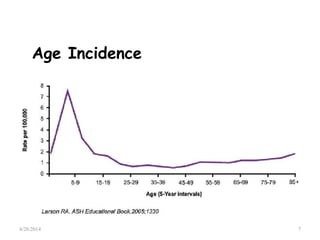
Age Incidence
4/28/2014 7
Classification of leukemias
Cell type Acute Chronic
Lymphocytic
leukemia
(or
"lymphoblastic")
Acute
lymphoblastic
leukemia(ALL)
Chronic
lymphocytic
leukemia(CLL)
Myelogenous
leukemia
(also "myeloid" or
"nonlymphocytic")
Acute
myelogenous
leukemia(AML)
(or myeloblastic)
Chronic
myelogenous
leukemia(CML)
4/28/2014 8
Acute
LymphoblasticLeukaemia
4/28/2014 9
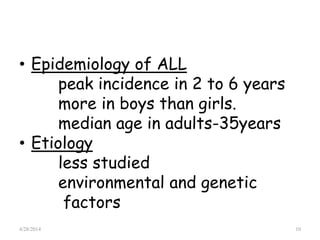
• Epidemiology of ALL
peak incidence in 2 to 6 years
more in boys than girls.
median age in adults-35years
• Etiology
less studied
environmental and genetic
factors
4/28/2014 10
4/28/2014 11
Factors predisposing ALL
GENETIC ENVRONMENTAL
Down’s Ionising radiation
Fanconi,diamond blackfan Drugs
NF Type1 alkylating agents
Ataxia telengiectasia nitrosourea
turner epipodophyllotoxin
klinefelter benzene exposure
Li-fraumeni syndrome advanced maternal age
Blooms syndrome paternal smoking
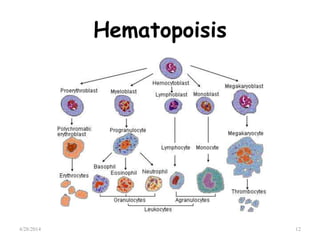
Hematopoisis
4/28/2014 12
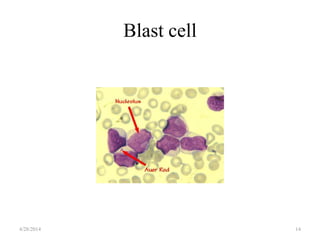
Blast cell
• Blast cells are immature precursors of either
lymphocytes (lymphoblasts), or granulocytes
(myeloblasts).
• They do not normally appear in peripheral
blood. they can be recognized by their large
size, and primitive nuclei (i.e. the nucleus
contain nucleoli).
• Presence of BS in blood, signify ACUTE
LEUKEMIA.
• Presence of an Auer Rod, is pathognomonic
for Acute Myeloid Leukemia.
4/28/2014 13
Blast cell
4/28/2014 14
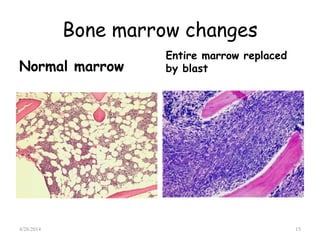
Bone marrow changes
Normal marrow
Entire marrow replaced
by blast
4/28/2014 15
Marrow showing blasts
4/28/2014 16
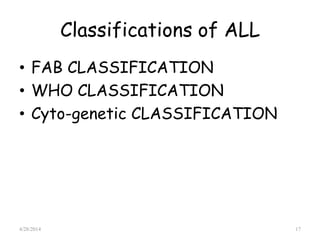
Classifications of ALL
• FAB CLASSIFICATION
• WHO CLASSIFICATION
• Cyto-genetic CLASSIFICATION
4/28/2014 17
FAB CLASSIFICATION OF ALL
CYTOLOGIC
FEATURES
L1 L2 L3
Cell size Small cells
predominate,homo
genous
Large,heterogenou
s in size
Large homogenous
cytoplasm Scanty Variable,often
moderately
abundant
Moderately
abundant
nucleoli Small One or more,often
large
One or
more,prominent
Nuclear size Homogenous Variable,
heterogenous
Stippled,
homogenous
Nuclear shape Regular Irregular clefts regular
Cyt.basophilia variable variable Intensely
basophilic
Cyt.vacuolation variable variable prominent4/28/2014 18
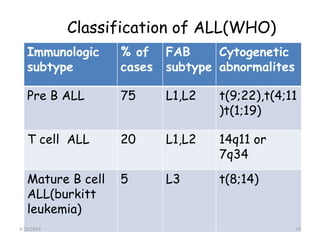
Immunologic
subtype
% of
cases
FAB
subtype
Cytogenetic
abnormalites
Pre B ALL 75 L1,L2 t(9;22),t(4;11
)t(1;19)
T cell ALL 20 L1,L2 14q11 or
7q34
Mature B cell
ALL(burkitt
leukemia)
5 L3 t(8;14)
Classification of ALL(WHO)
4/28/2014 19
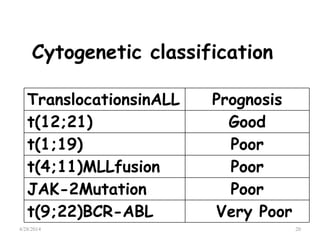
TranslocationsinALL Prognosis
t(12;21) Good
t(1;19) Poor
t(4;11)MLLfusion Poor
JAK-2Mutation Poor
t(9;22)BCR-ABL Very Poor
Cytogenetic classification
4/28/2014 20
ALL presentation





Anemia
Bleeding and bruising
Bone and joint pain
Fever
Weight loss
4/28/2014 21
Etiology and Pathophysiology
 ALL results from mutations of genes
–
–
–
Radiation
Chemicals
Viruses & Other
 Malignant immature white blood cells i.e.
–
–
Lymphoblasts crowd out the bone marrow
This includes crowding out of platelets, RBCs,
and mature WBCs
4/28/2014 22
CLINICAL FEATURES
Due to infiltration of marrow
• SYMPTOMS
Due to decreased production of
normal marrow elements
4/28/2014 23
Symptoms
symptoms percentage
fatigue 92
Bone or joint pain 79
fever 71
Weight loss 66
Abnormal masses 62
purpura 51
hemorrhage 27
infection 174/28/2014 24
Physical Signs
Physical Signs percentage
splenomegaly 86
lymphadenopathy 76
hepatomegaly 74
Sternal tenderness 69
purpura 50
Fundus changes 14
4/28/2014 25
Clinical features
• Generalized weakness and fatigue
• Anemia
• Frequent or unexplained fever and infection
• Weight loss and/or loss of appetite
• Excessive and unexplained bruising
• Bone pain, joint pain (caused by the spread of
"blast" cells from the marrow cavity)
• Breathlessness
• Enlarged lymph nodes, liver and/or spleen
• Petechiae, which are tiny red spots or lines in
the skin due to low platelet levels
4/28/2014 26
Diagnosis
• Confirmative tests
• Supportive tests
4/28/2014 27
Investigation (supportive)
• LDH,Serum uric acid
• Coagulation profile
• LFT,RFT
• Chest x-ray,
• CT scan of chest & brain
• Blood culture
• Baseline Echo,ECG
4/28/2014 28
Investigation (confirmative)
• CBC
• Bone marrow aspiration/biopsy
• Cyto genetics.
4/28/2014 29
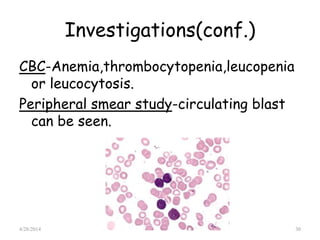
Investigations(conf.)
CBC-Anemia,thrombocytopenia,leucopenia
or leucocytosis.
Peripheral smear study-circulating blast
can be seen.
4/28/2014 30
Confirmatory
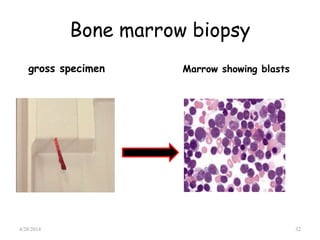
Bone marrow aspiration/biopsy
4/28/2014 31
Bone marrow biopsy
gross specimen Marrow showing blasts
4/28/2014 32
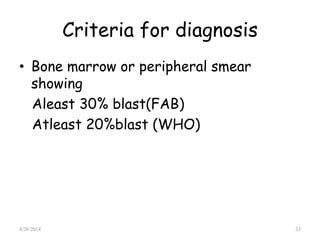
Criteria for diagnosis
• Bone marrow or peripheral smear
showing
Aleast 30% blast(FAB)
Atleast 20%blast (WHO)
4/28/2014 33
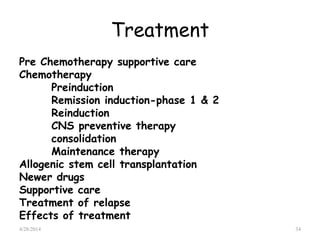
Treatment
Pre Chemotherapy supportive care
Chemotherapy
Preinduction
Remission induction-phase 1 & 2
Reinduction
CNS preventive therapy
consolidation
Maintenance therapy
Allogenic stem cell transplantation
Newer drugs
Supportive care
Treatment of relapse
Effects of treatment
4/28/2014 34
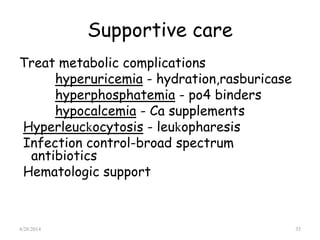
Supportive care
Treat metabolic complications
hyperuricemia - hydration,rasburicase
hyperphosphatemia - po4 binders
hypocalcemia - Ca supplements
Hyperleuckocytosis - leukopharesis
Infection control-broad spectrum
antibiotics
Hematologic support
4/28/2014 35
Preinduction
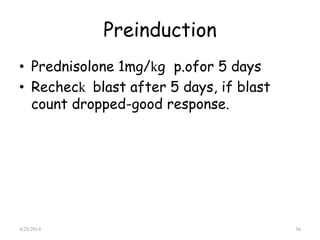
• Prednisolone 1mg/kg p.ofor 5 days
• Recheck blast after 5 days, if blast
count dropped-good response.
4/28/2014 36
Treatment of ALL
Induction 1
cycle chemotherap
y
Dose and schedule
Induction Prednisolon or 1mg/kg p.o days 1-28 days
vincristine 1.5mg/m2 i.v weekly once
x 4 weeks
doxorubicin 30mg/m2 i.v weekly once
x 4 weeks
L-Asparginase 1,00,000 u/m2(total dose)
in divided doses of 10,000
u daily for 10 days
CNS Proph. methotrexate 12mg IT days 1,8,15,22
4/28/2014 37
Reassess
• After 4 weeks of phase 1 induction
assess marrow for remission.
• If there is remission taper prednisolone
and after 1 week, start phase2
induction,
• If there is no remission give 2 more
weekly doses of vincristine and doxo and
then assess, if still no remission go for
alternate regimen.
4/28/2014 38
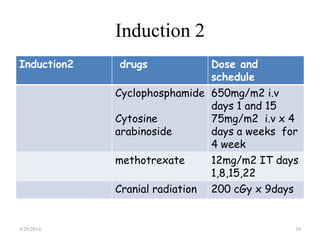
Induction 2
Induction2 drugs Dose and
schedule
Cyclophosphamide
Cytosine
arabinoside
650mg/m2 i.v
days 1 and 15
75mg/m2 i.v x 4
days a weeks for
4 week
methotrexate 12mg/m2 IT days
1,8,15,22
Cranial radiation 200 cGy x 9days
4/28/2014 39
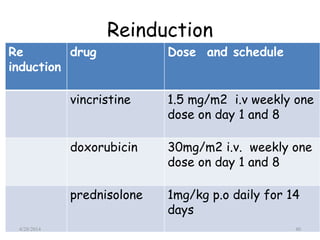
Reinduction
Re
induction
drug Dose and schedule
vincristine 1.5 mg/m2 i.v weekly one
dose on day 1 and 8
doxorubicin 30mg/m2 i.v. weekly one
dose on day 1 and 8
prednisolone 1mg/kg p.o daily for 14
days
4/28/2014 40
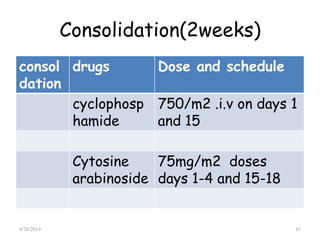
Consolidation(2weeks)
consol
dation
drugs Dose and schedule
cyclophosp
hamide
750/m2 .i.v on days 1
and 15
Cytosine
arabinoside
75mg/m2 doses
days 1-4 and 15-18
4/28/2014 41
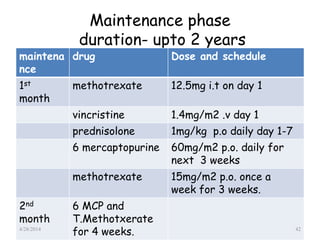
Maintenance phase
duration- upto 2 years
maintena
nce
drug Dose and schedule
1st
month
methotrexate 12.5mg i.t on day 1
vincristine 1.4mg/m2 .v day 1
prednisolone 1mg/kg p.o daily day 1-7
6 mercaptopurine 60mg/m2 p.o. daily for
next 3 weeks
methotrexate 15mg/m2 p.o. once a
week for 3 weeks.
2nd
month
6 MCP and
T.Methotxerate
for 4 weeks.4/28/2014 42
Follow up
If the patient completes chemotherapy
for 2 years without relapse-stop chemo
and follow up.
No relapse within 5 years-can be declared
as cured.
4/28/2014 43
Allogenic stem cell transpantation
• Usually done in second remission.
• Can be done in first remission in high
risk patients
WBC>25000,
philadelphia chromosome positive,
poor initial response to remission
induction.
4/28/2014 44
Newer drugs
Monoclonal antibodies
rituximab(CD20),epratuzumab(CD22)
alemtuzumab(CD52),gemtuzumab(CD33)
Antimetabolites
clofarabine,nelarabine
Tyrosine kinase inhibitor
imatinib, nilotinib, dasatinib,
Vornistat, sirolimus,everolimus,oblimersen.
4/28/2014 45
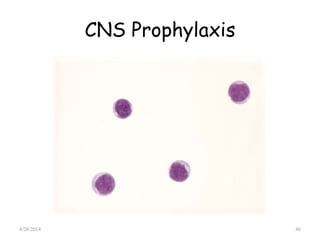
CNS Prophylaxis
4/28/2014 46
CNS Prophylaxis
 CNS involvement at diagnosis <5%
–
–
Without prophylaxis, over 80% of patients in CR
will relapse in the CNS
With prophylaxis, less than 5% have CNS relapse
 Intrathecal chemotherapy is now the
mainstay
– Sample intermediate risk regimen: IT MTX alone
or “triple therapy”: IT cytarabine Day 1 of CR
followed by MTX/hydrocortisone/cytarabine
Pui CH, Howard SC. Lancet Oncol 9 (3): 257-68, 2008
4/28/2014 47
Prognostic factors in ALL
Determinants Favourable unfavourable
WBC Counts <10,000 >2,00,000
Age 2-10 years <1yr,>10yr
Gender female male
Ethnicity white black
Node,liver,splenomegaly absent massive
Testicular enlargement absent present
CNS involvement absent Csf blast and pleocytosis
FAB Type L1 L2
Cytogenetics T(12;21)(TEL-AML1)
Trsomies 4,10,17
t(9;22)(bcr-abl)
t(4;11)(MLL-AF4)
Ploidy hyperdipoidy hypodiploidy
Time to remission <14days >28days4/28/2014 48
4/28/2014 49
THANK
YOU

Leukemias in children

  • 1.
    Leukemias in children Dr.K.V.Giridhar AssociateProf. of Pediatrics GMC. Ananthapuramu, A.P., India. 4/28/2014 1
  • 2.
    Objectives Definition & Classificationof leukemias The pathophysiology and epidemiology of Acute lymphoblasticleukemia (ALL) Review the different drugs, & therapy strategies in ALL treatment. Describe some of the newer agents for the treatment of ALL 4/28/2014 2
  • 3.
    Definition • Leukemia isa type of cancer of blood or bonemarrow • Characterized by an abnormal increase of immature white blood cells called "blasts". • Leukemia is a broad term covering a spectrum of diseases. • Leuka = white, emia = blood 4/28/2014 3
  • 4.
    The History ofLeukemia 1845- Craig and Bennett described a case as suppuration of the blood –Virchow discovered this as well, named it “leukemia” 1855- Ernst Neumann discovered that the bone marrow was the likely origin of leukemia – 4/28/2014 4
  • 5.
    The History ofLeukemia   1946- Sidney Farber used antifolate agents to treat leukemia in children 1960s- Addition of vincristine and steroid to regimens, – Survival rates increased to over 50%  1970- Beginning of classification, discovery of cytogenetics and risk based treatment 4/28/2014 5
  • 6.
    Epidemiology  Most commonchildhood cancer – 3,000 new cases each year  Demographics: – – – Males more commonly than females Whites more than blacks More commonly in patients with Down’s 4/28/2014 6
  • 7.
  • 8.
    Classification of leukemias Celltype Acute Chronic Lymphocytic leukemia (or "lymphoblastic") Acute lymphoblastic leukemia(ALL) Chronic lymphocytic leukemia(CLL) Myelogenous leukemia (also "myeloid" or "nonlymphocytic") Acute myelogenous leukemia(AML) (or myeloblastic) Chronic myelogenous leukemia(CML) 4/28/2014 8
  • 9.
  • 10.
    • Epidemiology ofALL peak incidence in 2 to 6 years more in boys than girls. median age in adults-35years • Etiology less studied environmental and genetic factors 4/28/2014 10
  • 11.
    4/28/2014 11 Factors predisposingALL GENETIC ENVRONMENTAL Down’s Ionising radiation Fanconi,diamond blackfan Drugs NF Type1 alkylating agents Ataxia telengiectasia nitrosourea turner epipodophyllotoxin klinefelter benzene exposure Li-fraumeni syndrome advanced maternal age Blooms syndrome paternal smoking
  • 12.
  • 13.
    Blast cell • Blastcells are immature precursors of either lymphocytes (lymphoblasts), or granulocytes (myeloblasts). • They do not normally appear in peripheral blood. they can be recognized by their large size, and primitive nuclei (i.e. the nucleus contain nucleoli). • Presence of BS in blood, signify ACUTE LEUKEMIA. • Presence of an Auer Rod, is pathognomonic for Acute Myeloid Leukemia. 4/28/2014 13
  • 14.
  • 15.
    Bone marrow changes Normalmarrow Entire marrow replaced by blast 4/28/2014 15
  • 16.
  • 17.
    Classifications of ALL •FAB CLASSIFICATION • WHO CLASSIFICATION • Cyto-genetic CLASSIFICATION 4/28/2014 17
  • 18.
    FAB CLASSIFICATION OFALL CYTOLOGIC FEATURES L1 L2 L3 Cell size Small cells predominate,homo genous Large,heterogenou s in size Large homogenous cytoplasm Scanty Variable,often moderately abundant Moderately abundant nucleoli Small One or more,often large One or more,prominent Nuclear size Homogenous Variable, heterogenous Stippled, homogenous Nuclear shape Regular Irregular clefts regular Cyt.basophilia variable variable Intensely basophilic Cyt.vacuolation variable variable prominent4/28/2014 18
  • 19.
    Immunologic subtype % of cases FAB subtype Cytogenetic abnormalites Pre BALL 75 L1,L2 t(9;22),t(4;11 )t(1;19) T cell ALL 20 L1,L2 14q11 or 7q34 Mature B cell ALL(burkitt leukemia) 5 L3 t(8;14) Classification of ALL(WHO) 4/28/2014 19
  • 20.
    TranslocationsinALL Prognosis t(12;21) Good t(1;19)Poor t(4;11)MLLfusion Poor JAK-2Mutation Poor t(9;22)BCR-ABL Very Poor Cytogenetic classification 4/28/2014 20
  • 21.
    ALL presentation      Anemia Bleeding andbruising Bone and joint pain Fever Weight loss 4/28/2014 21
  • 22.
    Etiology and Pathophysiology ALL results from mutations of genes – – – Radiation Chemicals Viruses & Other  Malignant immature white blood cells i.e. – – Lymphoblasts crowd out the bone marrow This includes crowding out of platelets, RBCs, and mature WBCs 4/28/2014 22
  • 23.
    CLINICAL FEATURES Due toinfiltration of marrow • SYMPTOMS Due to decreased production of normal marrow elements 4/28/2014 23
  • 24.
    Symptoms symptoms percentage fatigue 92 Boneor joint pain 79 fever 71 Weight loss 66 Abnormal masses 62 purpura 51 hemorrhage 27 infection 174/28/2014 24
  • 25.
    Physical Signs Physical Signspercentage splenomegaly 86 lymphadenopathy 76 hepatomegaly 74 Sternal tenderness 69 purpura 50 Fundus changes 14 4/28/2014 25
  • 26.
    Clinical features • Generalizedweakness and fatigue • Anemia • Frequent or unexplained fever and infection • Weight loss and/or loss of appetite • Excessive and unexplained bruising • Bone pain, joint pain (caused by the spread of "blast" cells from the marrow cavity) • Breathlessness • Enlarged lymph nodes, liver and/or spleen • Petechiae, which are tiny red spots or lines in the skin due to low platelet levels 4/28/2014 26
  • 27.
    Diagnosis • Confirmative tests •Supportive tests 4/28/2014 27
  • 28.
    Investigation (supportive) • LDH,Serumuric acid • Coagulation profile • LFT,RFT • Chest x-ray, • CT scan of chest & brain • Blood culture • Baseline Echo,ECG 4/28/2014 28
  • 29.
    Investigation (confirmative) • CBC •Bone marrow aspiration/biopsy • Cyto genetics. 4/28/2014 29
  • 30.
  • 31.
  • 32.
    Bone marrow biopsy grossspecimen Marrow showing blasts 4/28/2014 32
  • 33.
    Criteria for diagnosis •Bone marrow or peripheral smear showing Aleast 30% blast(FAB) Atleast 20%blast (WHO) 4/28/2014 33
  • 34.
    Treatment Pre Chemotherapy supportivecare Chemotherapy Preinduction Remission induction-phase 1 & 2 Reinduction CNS preventive therapy consolidation Maintenance therapy Allogenic stem cell transplantation Newer drugs Supportive care Treatment of relapse Effects of treatment 4/28/2014 34
  • 35.
    Supportive care Treat metaboliccomplications hyperuricemia - hydration,rasburicase hyperphosphatemia - po4 binders hypocalcemia - Ca supplements Hyperleuckocytosis - leukopharesis Infection control-broad spectrum antibiotics Hematologic support 4/28/2014 35
  • 36.
    Preinduction • Prednisolone 1mg/kgp.ofor 5 days • Recheck blast after 5 days, if blast count dropped-good response. 4/28/2014 36
  • 37.
    Treatment of ALL Induction1 cycle chemotherap y Dose and schedule Induction Prednisolon or 1mg/kg p.o days 1-28 days vincristine 1.5mg/m2 i.v weekly once x 4 weeks doxorubicin 30mg/m2 i.v weekly once x 4 weeks L-Asparginase 1,00,000 u/m2(total dose) in divided doses of 10,000 u daily for 10 days CNS Proph. methotrexate 12mg IT days 1,8,15,22 4/28/2014 37
  • 38.
    Reassess • After 4weeks of phase 1 induction assess marrow for remission. • If there is remission taper prednisolone and after 1 week, start phase2 induction, • If there is no remission give 2 more weekly doses of vincristine and doxo and then assess, if still no remission go for alternate regimen. 4/28/2014 38
  • 39.
    Induction 2 Induction2 drugsDose and schedule Cyclophosphamide Cytosine arabinoside 650mg/m2 i.v days 1 and 15 75mg/m2 i.v x 4 days a weeks for 4 week methotrexate 12mg/m2 IT days 1,8,15,22 Cranial radiation 200 cGy x 9days 4/28/2014 39
  • 40.
    Reinduction Re induction drug Dose andschedule vincristine 1.5 mg/m2 i.v weekly one dose on day 1 and 8 doxorubicin 30mg/m2 i.v. weekly one dose on day 1 and 8 prednisolone 1mg/kg p.o daily for 14 days 4/28/2014 40
  • 41.
    Consolidation(2weeks) consol dation drugs Dose andschedule cyclophosp hamide 750/m2 .i.v on days 1 and 15 Cytosine arabinoside 75mg/m2 doses days 1-4 and 15-18 4/28/2014 41
  • 42.
    Maintenance phase duration- upto2 years maintena nce drug Dose and schedule 1st month methotrexate 12.5mg i.t on day 1 vincristine 1.4mg/m2 .v day 1 prednisolone 1mg/kg p.o daily day 1-7 6 mercaptopurine 60mg/m2 p.o. daily for next 3 weeks methotrexate 15mg/m2 p.o. once a week for 3 weeks. 2nd month 6 MCP and T.Methotxerate for 4 weeks.4/28/2014 42
  • 43.
    Follow up If thepatient completes chemotherapy for 2 years without relapse-stop chemo and follow up. No relapse within 5 years-can be declared as cured. 4/28/2014 43
  • 44.
    Allogenic stem celltranspantation • Usually done in second remission. • Can be done in first remission in high risk patients WBC>25000, philadelphia chromosome positive, poor initial response to remission induction. 4/28/2014 44
  • 45.
    Newer drugs Monoclonal antibodies rituximab(CD20),epratuzumab(CD22) alemtuzumab(CD52),gemtuzumab(CD33) Antimetabolites clofarabine,nelarabine Tyrosinekinase inhibitor imatinib, nilotinib, dasatinib, Vornistat, sirolimus,everolimus,oblimersen. 4/28/2014 45
  • 46.
  • 47.
    CNS Prophylaxis  CNSinvolvement at diagnosis <5% – – Without prophylaxis, over 80% of patients in CR will relapse in the CNS With prophylaxis, less than 5% have CNS relapse  Intrathecal chemotherapy is now the mainstay – Sample intermediate risk regimen: IT MTX alone or “triple therapy”: IT cytarabine Day 1 of CR followed by MTX/hydrocortisone/cytarabine Pui CH, Howard SC. Lancet Oncol 9 (3): 257-68, 2008 4/28/2014 47
  • 48.
    Prognostic factors inALL Determinants Favourable unfavourable WBC Counts <10,000 >2,00,000 Age 2-10 years <1yr,>10yr Gender female male Ethnicity white black Node,liver,splenomegaly absent massive Testicular enlargement absent present CNS involvement absent Csf blast and pleocytosis FAB Type L1 L2 Cytogenetics T(12;21)(TEL-AML1) Trsomies 4,10,17 t(9;22)(bcr-abl) t(4;11)(MLL-AF4) Ploidy hyperdipoidy hypodiploidy Time to remission <14days >28days4/28/2014 48
  • 49.