Toddlers
 18-36 Month Development

   Social
            Emotional
                        Physical
                                   Cognitive
                                               Language
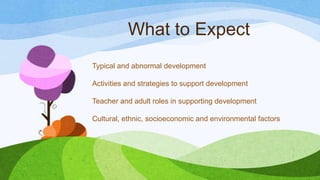
What to Expect
Typical and abnormal development

Activities and strategies to support development

Teacher and adult roles in supporting development

Cultural, ethnic, socioeconomic and environmental factors
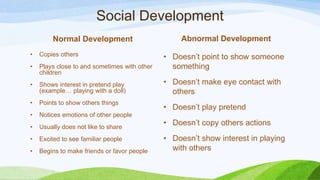
Social Development
        Normal Development                        Abnormal Development
•   Copies others                             • Doesn’t point to show someone
•   Plays close to and sometimes with other     something
    children
•   Shows interest in pretend play            • Doesn’t make eye contact with
    (example… playing with a doll)              others
•   Points to show others things
                                              • Doesn’t play pretend
•   Notices emotions of other people
•   Usually does not like to share
                                              • Doesn’t copy others actions
•   Excited to see familiar people            • Doesn’t show interest in playing
•   Begins to make friends or favor people      with others
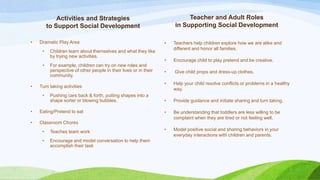
Activities and Strategies                                      Teacher and Adult Roles
         to Support Social Development                                 in Supporting Social Development

•   Dramatic Play Area                                             •   Teachers help children explore how we are alike and
                                                                       different and honor all families.
     •    Children learn about themselves and what they like
          by trying new activities.
                                                                   •   Encourage child to play pretend and be creative.
     •    For example, children can try on new roles and
          perspective of other people in their lives or in their   •   Give child props and dress-up clothes.
          community.
                                                                   •   Help your child resolve conflicts or problems in a healthy
•   Turn taking activities
                                                                       way.
     •    Pushing cars back & forth, putting shapes into a
          shape sorter or blowing bubbles.                         •   Provide guidance and initiate sharing and turn taking.

•   Eating/Pretend to eat                                          •   Be understanding that toddlers are less willing to be
                                                                       complaint when they are tired or not feeling well.
•   Classroom Chores
     •    Teaches team work                                        •   Model positive social and sharing behaviors in your
                                                                       everyday interactions with children and parents.
     •    Encourage and model conversation to help them
          accomplish their task
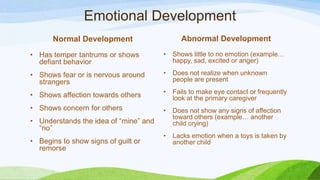
Emotional Development
      Normal Development                     Abnormal Development
• Has temper tantrums or shows         •   Shows little to no emotion (example…
  defiant behavior                         happy, sad, excited or anger)

• Shows fear or is nervous around      •   Does not realize when unknown
  strangers                                people are present
                                       •   Fails to make eye contact or frequently
• Shows affection towards others           look at the primary caregiver
• Shows concern for others             •   Does not show any signs of affection
                                           toward others (example… another
• Understands the idea of “mine” and       child crying)
  “no”
                                       •   Lacks emotion when a toys is taken by
• Begins to show signs of guilt or         another child
  remorse
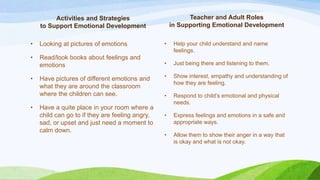
Activities and Strategies                         Teacher and Adult Roles
    to Support Emotional Development                 in Supporting Emotional Development

•   Looking at pictures of emotions              •    Help your child understand and name
                                                      feelings.
•   Read/look books about feelings and
    emotions                                     •    Just being there and listening to them.

•   Have pictures of different emotions and      •    Show interest, empathy and understanding of
                                                      how they are feeling.
    what they are around the classroom
    where the children can see.                  •    Respond to child’s emotional and physical
                                                      needs.
•   Have a quite place in your room where a
    child can go to if they are feeling angry,   •    Express feelings and emotions in a safe and
    sad, or upset and just need a moment to           appropriate ways.
    calm down.
                                                 •    Allow them to show their anger in a way that
                                                      is okay and what is not okay.
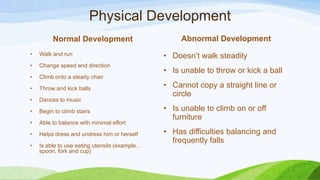
Physical Development
         Normal Development                         Abnormal Development
•   Walk and run                               • Doesn’t walk steadily
•   Change speed and direction
                                               • Is unable to throw or kick a ball
•   Climb onto a steady chair

•   Throw and kick balls                       • Cannot copy a straight line or
                                                 circle
•   Dances to music

•   Begin to climb stairs                      • Is unable to climb on or off
                                                 furniture
•   Able to balance with minimal effort

•   Helps dress and undress him or herself     • Has difficulties balancing and
                                                 frequently falls
•   Is able to use eating utensils (example…
    spoon, fork and cup)
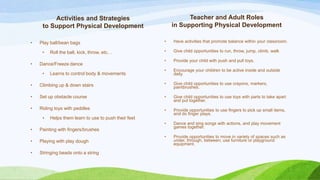
Activities and Strategies                              Teacher and Adult Roles
     to Support Physical Development                      in Supporting Physical Development

•   Play ball/bean bags                               •   Have activities that promote balance within your classroom.

     •   Roll the ball, kick, throw, etc…             •   Give child opportunities to run, throw, jump, climb, walk

                                                      •   Provide your child with push and pull toys.
•   Dance/Freeze dance
                                                      •   Encourage your children to be active inside and outside
     •   Learns to control body & movements               daily.

•   Climbing up & down stairs                         •   Give child opportunities to use crayons, markers,
                                                          paintbrushes.

•   Set up obstacle course                            •   Give child opportunities to use toys with parts to take apart
                                                          and put together.
•   Riding toys with peddles                          •   Provide opportunities to use fingers to pick up small items,
                                                          and do finger plays.
     •   Helps them learn to use to push their feet
                                                      •   Dance and sing songs with actions, and play movement
                                                          games together.
•   Painting with fingers/brushes
                                                      •   Provide opportunities to move in variety of spaces such as
•   Playing with play dough                               under, through, between; use furniture or playground
                                                          equipment.

•   Stringing beads onto a string
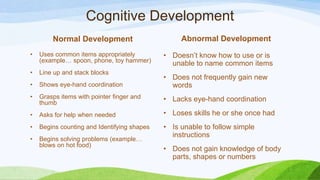
Cognitive Development
        Normal Development                        Abnormal Development
•   Uses common items appropriately          • Doesn’t know how to use or is
    (example… spoon, phone, toy hammer)        unable to name common items
•   Line up and stack blocks
                                             • Does not frequently gain new
•   Shows eye-hand coordination                words
•   Grasps items with pointer finger and     • Lacks eye-hand coordination
    thumb
•   Asks for help when needed                • Loses skills he or she once had
•   Begins counting and Identifying shapes   • Is unable to follow simple
                                               instructions
•   Begins solving problems (example…
    blows on hot food)
                                             • Does not gain knowledge of body
                                               parts, shapes or numbers
Activities and Strategies                                              Teacher and Adult Roles
    to Support Cognitive Development                                      in Supporting Cognitive Development

•   Reading books
                                                                      •    Allow them to try & figure out problems and
     •    Encourage vocabulary building and verbal development.
                                                                           suggest possible solutions to them.
•   Playing with blocks
     •    Learn balancing concepts                                    •    Provide different shapes, colors or sizes, of
                                                                           blocks.
•   Puzzles & shape sorters
     •    Allows them to problem-solve, increases memorization,
          understand the relationship between objects as they match   •    Help them sort from smallest to largest, or
          shapes and figure out how things fit.
                                                                           longest to shortest, or by color.
•   Sensory table
     •    Sense of touch to learn                                     •    Describe what your child is doing during this
                                                                           process.
•   Identify noise

•   Give them choices to choose from                                  •    Explore outdoors with your child, and look for
•   Sing/practice the ABC’s                                                patterns, size, number and shapes in nature and
                                                                           in the community.
•   Counting everything/anything

•   Point out shapes & colors                                         •    Use numerical concepts in everyday routines.
Language Development
        Normal Development                       Abnormal Development
•   Incorporate plurals on simple words      • Doesn’t copy others words
•   Recognizes things or pictures when
    they are named                           • Does not speak in sentences
•   Repeats words                            • Produces an unusual amount of
                                               drool
•   Can say first name and age
•   Follows instructions                     • Speech is unclear
•   Shows interest in reading and writing    • Doesn’t understand simple
•   Creates sounds while playing with toys     instructions
    (example… animal noises)
                                             • Does not communicate feelings
Activities and Strategies                             Teacher and Adult Roles
    to Support Language Development                      in Supporting Language Development

•   Listening to music, doing things with music,     •    Encourage your child to use sounds and actions to communicate
                                                          with you.
    singing songs, playing with instruments
                                                     •    Talk together
•   Learning about rhymes
                                                     •    Pay attention when your child talks
•   Going to the grocery store/library/field trip…   •    Make stories & books part of your everyday routine

•   Talking about food/outside/what you are doing    •    Adapt schedules and activities to meet needs of a certain child

•   Learning how to use a book                       •    Labels & objects with print and pictures

                                                     •    Speak in complete sentences
•   Discovery print
                                                     •    respond with the correct pronunciation when your child
•   Learning my name                                      mispronounces something.

                                                     •    Use props, such as puppets or dolls, with the stories.

                                                     •    Give your child the chance to communicate with other children.
Opportunity to learn about others
                                               Cultural and
                                              Ethnic Factors

                                             • Language

                                             • Diet

                                             • Parents Approach

                                             • Education
                                    Indian   • Values

                                             • Beliefs

                                             • Spirit

                                             • Personality

                                             • Religion

                                             • Clothing

                                             • Traditions
         Chinese
                                    Eskimo
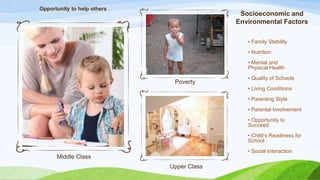
Opportunity to help others
                                            Socioeconomic and
                                           Environmental Factors

                                              • Family Stability
                                              • Nutrition
                                              • Mental and
                                              Physical Health
                                              • Quality of Schools
                              Poverty
                                              • Living Conditions
                                              • Parenting Style
                                              • Parental Involvement
                                              • Opportunity to
                                              Succeed
                                              • Child’s Readiness for
                                              School
                                              • Social Interaction
      Middle Class
                             Upper Class
Sources
• Center for Disease Control and Prevention Learn the Signs Act Early
    •http://www.cdc.gov/ncbddd/actearly/milestones/


• Washington State Early Learning and Development Guidelines
    •http://www.del.wa.gov/publications/development/docs/guidelines.pdf


• Washington State Department of Early Learning Growth and Development
    •http://www.del.wa.gov/publications/esit/docs/PrescreenChart_English.pdf


• National Center for Infants, Toddlers and Families Behavior and Development
    •http://www.zerotothree.org/child-development/

    •http://www.zerotothree.org/about-us/areas-of-expertise/free-parent-brochures-and-guides/age-based-
    handouts.html

Toddler Development PowerPoint

  • 1.
    Toddlers 18-36 MonthDevelopment Social Emotional Physical Cognitive Language
  • 2.
    What to Expect Typicaland abnormal development Activities and strategies to support development Teacher and adult roles in supporting development Cultural, ethnic, socioeconomic and environmental factors
  • 3.
    Social Development Normal Development Abnormal Development • Copies others • Doesn’t point to show someone • Plays close to and sometimes with other something children • Shows interest in pretend play • Doesn’t make eye contact with (example… playing with a doll) others • Points to show others things • Doesn’t play pretend • Notices emotions of other people • Usually does not like to share • Doesn’t copy others actions • Excited to see familiar people • Doesn’t show interest in playing • Begins to make friends or favor people with others
  • 4.
    Activities and Strategies Teacher and Adult Roles to Support Social Development in Supporting Social Development • Dramatic Play Area • Teachers help children explore how we are alike and different and honor all families. • Children learn about themselves and what they like by trying new activities. • Encourage child to play pretend and be creative. • For example, children can try on new roles and perspective of other people in their lives or in their • Give child props and dress-up clothes. community. • Help your child resolve conflicts or problems in a healthy • Turn taking activities way. • Pushing cars back & forth, putting shapes into a shape sorter or blowing bubbles. • Provide guidance and initiate sharing and turn taking. • Eating/Pretend to eat • Be understanding that toddlers are less willing to be complaint when they are tired or not feeling well. • Classroom Chores • Teaches team work • Model positive social and sharing behaviors in your everyday interactions with children and parents. • Encourage and model conversation to help them accomplish their task
  • 5.
    Emotional Development Normal Development Abnormal Development • Has temper tantrums or shows • Shows little to no emotion (example… defiant behavior happy, sad, excited or anger) • Shows fear or is nervous around • Does not realize when unknown strangers people are present • Fails to make eye contact or frequently • Shows affection towards others look at the primary caregiver • Shows concern for others • Does not show any signs of affection toward others (example… another • Understands the idea of “mine” and child crying) “no” • Lacks emotion when a toys is taken by • Begins to show signs of guilt or another child remorse
  • 6.
    Activities and Strategies Teacher and Adult Roles to Support Emotional Development in Supporting Emotional Development • Looking at pictures of emotions • Help your child understand and name feelings. • Read/look books about feelings and emotions • Just being there and listening to them. • Have pictures of different emotions and • Show interest, empathy and understanding of how they are feeling. what they are around the classroom where the children can see. • Respond to child’s emotional and physical needs. • Have a quite place in your room where a child can go to if they are feeling angry, • Express feelings and emotions in a safe and sad, or upset and just need a moment to appropriate ways. calm down. • Allow them to show their anger in a way that is okay and what is not okay.
  • 7.
    Physical Development Normal Development Abnormal Development • Walk and run • Doesn’t walk steadily • Change speed and direction • Is unable to throw or kick a ball • Climb onto a steady chair • Throw and kick balls • Cannot copy a straight line or circle • Dances to music • Begin to climb stairs • Is unable to climb on or off furniture • Able to balance with minimal effort • Helps dress and undress him or herself • Has difficulties balancing and frequently falls • Is able to use eating utensils (example… spoon, fork and cup)
  • 8.
    Activities and Strategies Teacher and Adult Roles to Support Physical Development in Supporting Physical Development • Play ball/bean bags • Have activities that promote balance within your classroom. • Roll the ball, kick, throw, etc… • Give child opportunities to run, throw, jump, climb, walk • Provide your child with push and pull toys. • Dance/Freeze dance • Encourage your children to be active inside and outside • Learns to control body & movements daily. • Climbing up & down stairs • Give child opportunities to use crayons, markers, paintbrushes. • Set up obstacle course • Give child opportunities to use toys with parts to take apart and put together. • Riding toys with peddles • Provide opportunities to use fingers to pick up small items, and do finger plays. • Helps them learn to use to push their feet • Dance and sing songs with actions, and play movement games together. • Painting with fingers/brushes • Provide opportunities to move in variety of spaces such as • Playing with play dough under, through, between; use furniture or playground equipment. • Stringing beads onto a string
  • 9.
    Cognitive Development Normal Development Abnormal Development • Uses common items appropriately • Doesn’t know how to use or is (example… spoon, phone, toy hammer) unable to name common items • Line up and stack blocks • Does not frequently gain new • Shows eye-hand coordination words • Grasps items with pointer finger and • Lacks eye-hand coordination thumb • Asks for help when needed • Loses skills he or she once had • Begins counting and Identifying shapes • Is unable to follow simple instructions • Begins solving problems (example… blows on hot food) • Does not gain knowledge of body parts, shapes or numbers
  • 10.
    Activities and Strategies Teacher and Adult Roles to Support Cognitive Development in Supporting Cognitive Development • Reading books • Allow them to try & figure out problems and • Encourage vocabulary building and verbal development. suggest possible solutions to them. • Playing with blocks • Learn balancing concepts • Provide different shapes, colors or sizes, of blocks. • Puzzles & shape sorters • Allows them to problem-solve, increases memorization, understand the relationship between objects as they match • Help them sort from smallest to largest, or shapes and figure out how things fit. longest to shortest, or by color. • Sensory table • Sense of touch to learn • Describe what your child is doing during this process. • Identify noise • Give them choices to choose from • Explore outdoors with your child, and look for • Sing/practice the ABC’s patterns, size, number and shapes in nature and in the community. • Counting everything/anything • Point out shapes & colors • Use numerical concepts in everyday routines.
  • 11.
    Language Development Normal Development Abnormal Development • Incorporate plurals on simple words • Doesn’t copy others words • Recognizes things or pictures when they are named • Does not speak in sentences • Repeats words • Produces an unusual amount of drool • Can say first name and age • Follows instructions • Speech is unclear • Shows interest in reading and writing • Doesn’t understand simple • Creates sounds while playing with toys instructions (example… animal noises) • Does not communicate feelings
  • 12.
    Activities and Strategies Teacher and Adult Roles to Support Language Development in Supporting Language Development • Listening to music, doing things with music, • Encourage your child to use sounds and actions to communicate with you. singing songs, playing with instruments • Talk together • Learning about rhymes • Pay attention when your child talks • Going to the grocery store/library/field trip… • Make stories & books part of your everyday routine • Talking about food/outside/what you are doing • Adapt schedules and activities to meet needs of a certain child • Learning how to use a book • Labels & objects with print and pictures • Speak in complete sentences • Discovery print • respond with the correct pronunciation when your child • Learning my name mispronounces something. • Use props, such as puppets or dolls, with the stories. • Give your child the chance to communicate with other children.
  • 13.
    Opportunity to learnabout others Cultural and Ethnic Factors • Language • Diet • Parents Approach • Education Indian • Values • Beliefs • Spirit • Personality • Religion • Clothing • Traditions Chinese Eskimo
  • 14.
    Opportunity to helpothers Socioeconomic and Environmental Factors • Family Stability • Nutrition • Mental and Physical Health • Quality of Schools Poverty • Living Conditions • Parenting Style • Parental Involvement • Opportunity to Succeed • Child’s Readiness for School • Social Interaction Middle Class Upper Class
  • 15.
    Sources • Center forDisease Control and Prevention Learn the Signs Act Early •http://www.cdc.gov/ncbddd/actearly/milestones/ • Washington State Early Learning and Development Guidelines •http://www.del.wa.gov/publications/development/docs/guidelines.pdf • Washington State Department of Early Learning Growth and Development •http://www.del.wa.gov/publications/esit/docs/PrescreenChart_English.pdf • National Center for Infants, Toddlers and Families Behavior and Development •http://www.zerotothree.org/child-development/ •http://www.zerotothree.org/about-us/areas-of-expertise/free-parent-brochures-and-guides/age-based- handouts.html