Neonatal Sepsis
1R Dhaker, Lecturer, PCNMS
Introduction
• Neonatal Sepsis or sepsis neonatrum occurs
when pathogenic bacteria gain access into the
blood stream.
• They may cause overwhelming infection or
localize into lungs causing pneumonia or into
meaning causing meningitis.
• Neonatal Septicemia occurs in infants less than
90 days of age.
R Dhaker, Lecturer, PCNMS 2
Etiology
• A number of different bacteria including E. coli,
listeria and certain strains of streptococcus may
cause neonatal sepsis.
• Early onset neonatal sepsis most often appears
within 24 hours of birth.
R Dhaker, Lecturer, PCNMS 3
Cont… Etiology
• The following increase an infant’s risk of early
onset sepsis:-
– Group B streptococcus infection during pregnancy
– Preterm delivery and LBW baby
– Infection of placental tissue and amniotic fluid
– Multiple pervaginal examination
– Maternal fever and infection
• Babies with late neonatal sepsis get infected after
delivery by the organism thriving in the external
environment of the home or hospital.
R Dhaker, Lecturer, PCNMS 4
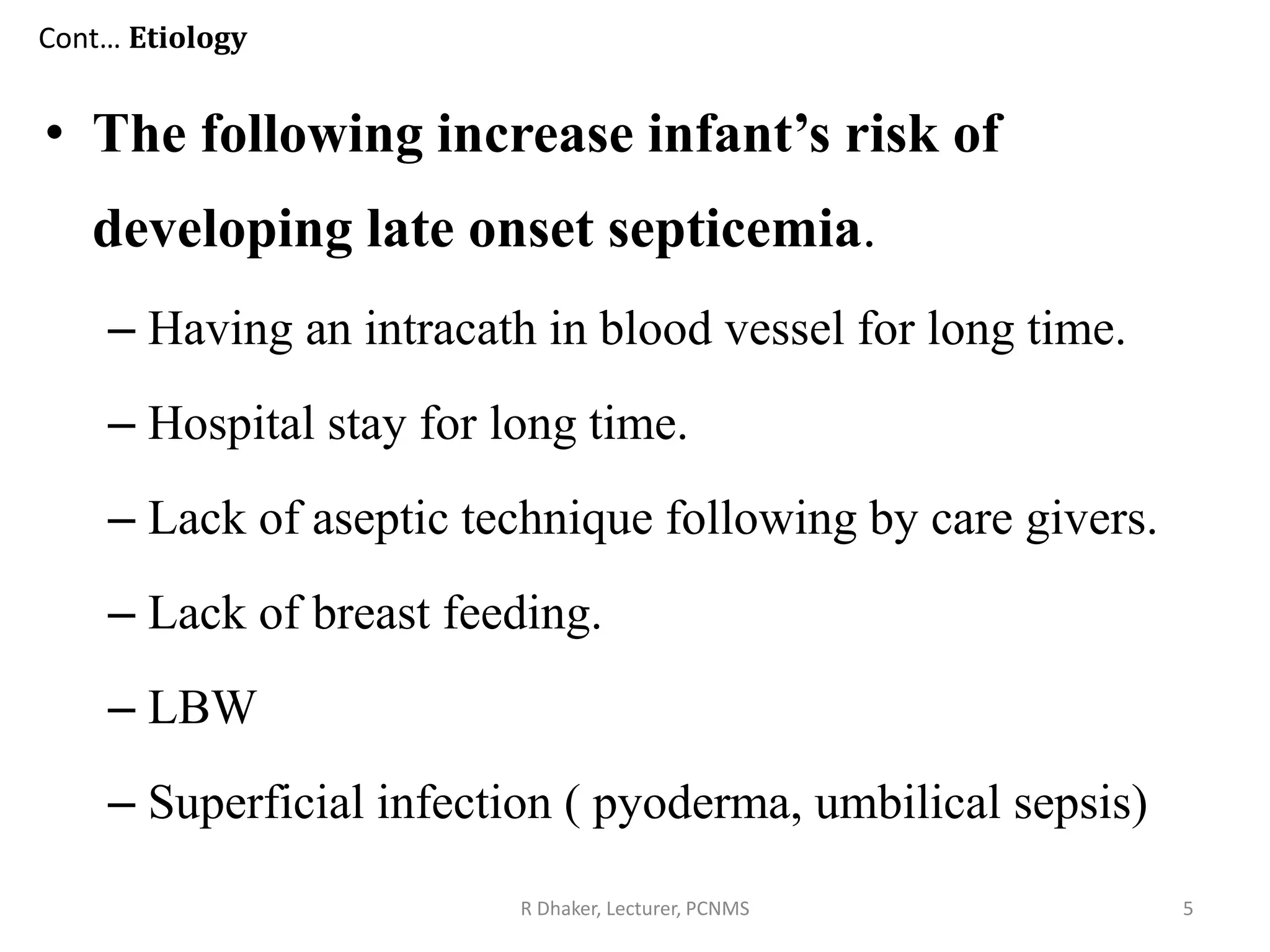
• The following increase infant’s risk of
developing late onset septicemia.
– Having an intracath in blood vessel for long time.
– Hospital stay for long time.
– Lack of aseptic technique following by care givers.
– Lack of breast feeding.
– LBW
– Superficial infection ( pyoderma, umbilical sepsis)
R Dhaker, Lecturer, PCNMS 5
Cont… Etiology
• Organisms that have been implicated in causing late-
onset sepsis include the following:
– Coagulase-negative Staphylococcus
– Staphylococcus aureus
– E coli
– Klebsiella
– Pseudomonas
– Enterobacter
– Candida
– GBS
– Serratia
– Acinetobacter
– Anaerobes
R Dhaker, Lecturer, PCNMS 6
Risk factors
• generally well-appearing
• previously healthy
– full term (at ≥37 weeks gestation)
– no antibiotics perinatally
– no unexplained hyperbilirubinemia that required treatment
– no antibiotics since discharge
– no hospitalizations
– no chronic illness
– discharged at the same time or before the mother
• no evidence of skin, soft tissue, bone, joint, or ear
infection
R Dhaker, Lecturer, PCNMS 7
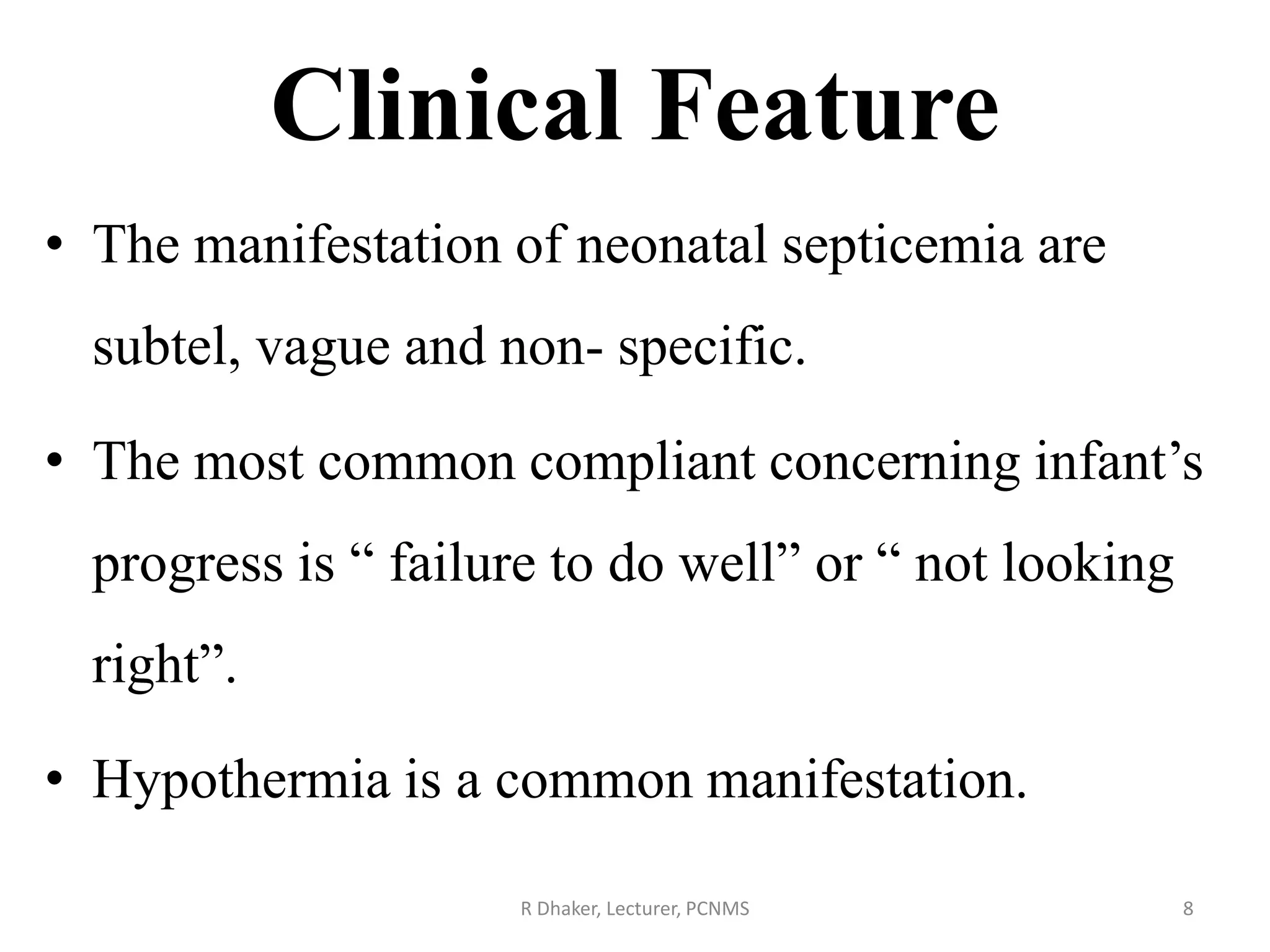
Clinical Feature
• The manifestation of neonatal septicemia are
subtel, vague and non- specific.
• The most common compliant concerning infant’s
progress is “ failure to do well” or “ not looking
right”.
• Hypothermia is a common manifestation.
R Dhaker, Lecturer, PCNMS 8
The signs of sepsis are
non-specific and
include:
• Body temperature
changes
• Breathing problems
• Diarrhea
• Low blood sugar
• Reduced movements
• Reduced sucking
R Dhaker, Lecturer, PCNMS 9
• Seizures
• Bradycardia
• Swollen belly area
• Vomiting
• Yellow skin and whites
of the eyes (jaundice)
Cont… Clinical Feature
• Circulator system
– Pallor, cyanosis
– Cold, clammy skin
– Hypotension and
shock
– Edema
– Bradycardia or
tachycardia
R Dhaker, Lecturer, PCNMS 10
• Respiratory system
 Irregular
respiration , apnea,
 Cyanosis
 Grunting
 Dyspnea
 Retraction
Cont… Clinical Feature
• Central Nervous
System –
– Reduced activity
( lethargy , coma, poor
cry)
– Irritability , tremors
– Full fontanel
– Abnormal eye
movement
R Dhaker, Lecturer, PCNMS 11
• GI system-
• Poor feeding
• Vomiting
• Diarrhea or decreased
stool pass
• Abdominal distension
• Hepatomegaly
Cont… Clinical Feature
• Hematopoietic
system-
– Jaundice
– Pallor
– Ecchymosis
– Spleenomegaly
– Bleeding
R Dhaker, Lecturer, PCNMS 12
• Feature suggestive of
pneumonia include-
• Tachycardia
• Chest retractions
• Early cyanosis
• Poor feeding
• Lethargy
Diagnostic Evaluation
• Blood Culture
• Urine examination
• CSF study
• CBC
• C- reactive protein
• ESR may be elevated ( >15 mm 1st hour)
R Dhaker, Lecturer, PCNMS 13
Management
• For babies with neonatal sepsis,
–Supportive care and
–Antibiotic therapy
R Dhaker, Lecturer, PCNMS 14
Supportive care
• Provide warmth
• Start IV line. Infuse normal saline 10ml/kg over 5
to 10 minute.
• Infuse 10%glucose, 2ml/kg stat to manage
hypoglycemia.
• Administer injection vitamin K, 1mg IM to
prevent bleeding.
• If the baby is cyanosed or grunting provide
oxygen via hood or mask.
R Dhaker, Lecturer, PCNMS 15
Cont… Supportive care
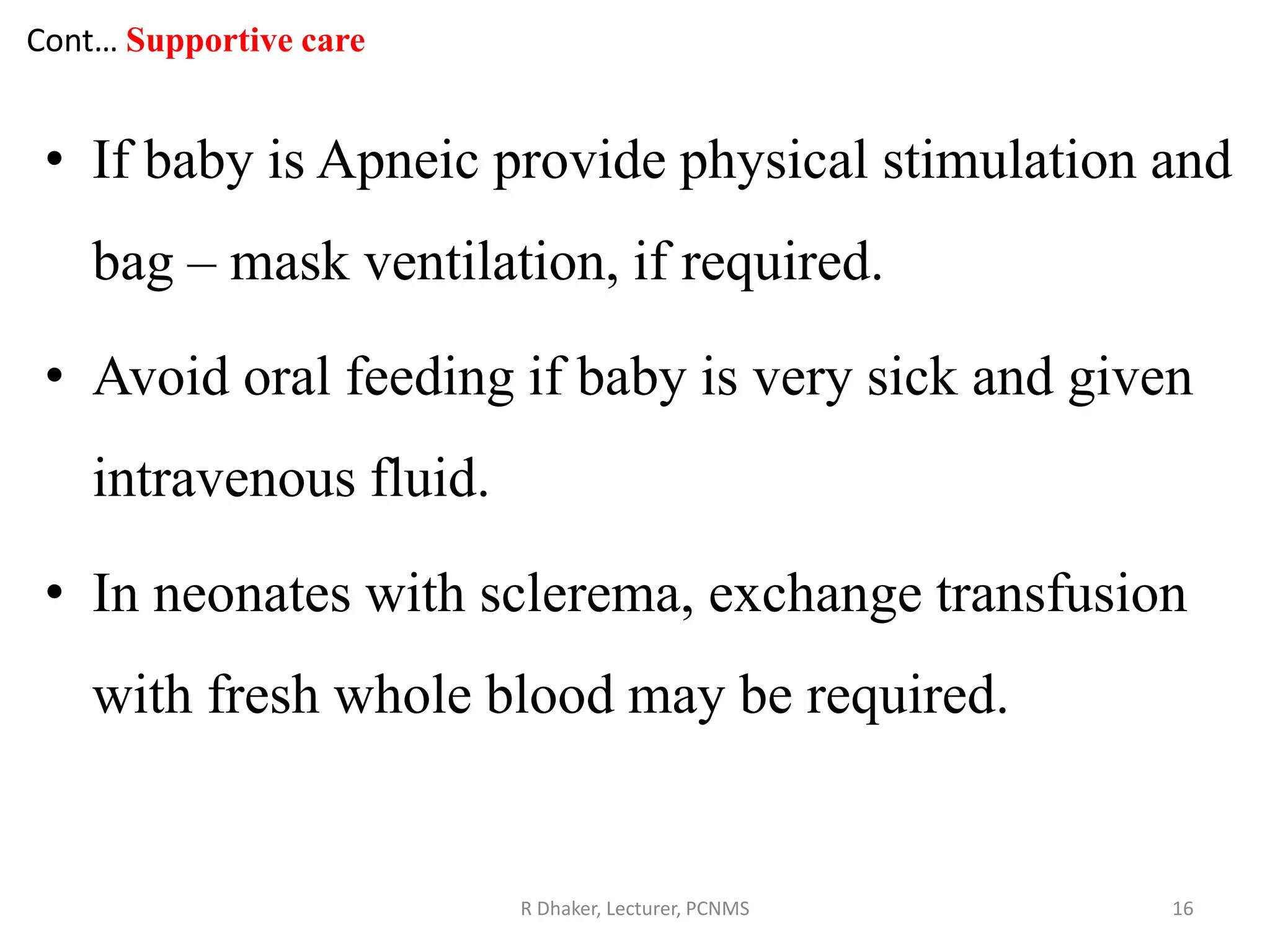
• If baby is Apneic provide physical stimulation and
bag – mask ventilation, if required.
• Avoid oral feeding if baby is very sick and given
intravenous fluid.
• In neonates with sclerema, exchange transfusion
with fresh whole blood may be required.
R Dhaker, Lecturer, PCNMS 16
Antibiotic therapy
• Antibiotic therapy should cover common
causative bacteria like E.coli, staphylococcus
aureus and klebsiella pneumoniae.
• A combination of ampicillin and gentamycian is
recommended for treatment of sepsis and
pneumonia.
R Dhaker, Lecturer, PCNMS
17
Cont…Antibiotic therapy
IN Septicemia and Pneumonia
• Injection Ampicillin 50 mg/kg/dose 12 hourly IV or
IM 7 to 10 days
• Injection Gentamicin 2.5mg/kg/dose BD IV/IM, 7 to
10 days
In Meningitis
• Injection Ampicillin 100 mg/kg/dose 12 hourly IV 3
weeks
• Injection Gentamicin 2.5mg/kg/dose BD IV, 3Weeks
or
• Injection Chloramphenicol 12mg/kg/dose BD IV,
3weeks
R Dhaker, Lecturer, PCNMS 18
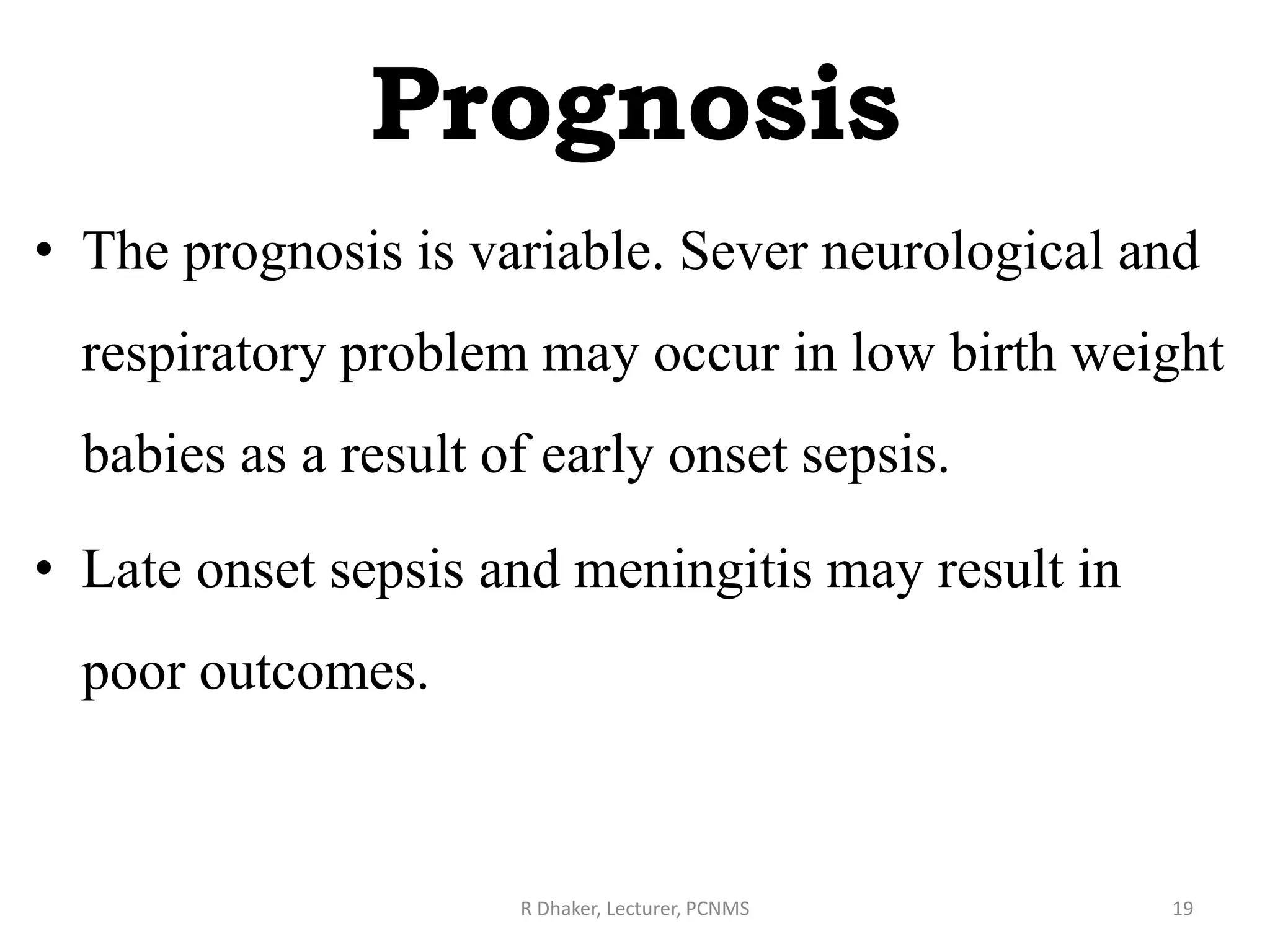
Prognosis
• The prognosis is variable. Sever neurological and
respiratory problem may occur in low birth weight
babies as a result of early onset sepsis.
• Late onset sepsis and meningitis may result in
poor outcomes.
R Dhaker, Lecturer, PCNMS 19

Neonatal sepsis...ppt

  • 1.
  • 2.
    Introduction • Neonatal Sepsisor sepsis neonatrum occurs when pathogenic bacteria gain access into the blood stream. • They may cause overwhelming infection or localize into lungs causing pneumonia or into meaning causing meningitis. • Neonatal Septicemia occurs in infants less than 90 days of age. R Dhaker, Lecturer, PCNMS 2
  • 3.
    Etiology • A numberof different bacteria including E. coli, listeria and certain strains of streptococcus may cause neonatal sepsis. • Early onset neonatal sepsis most often appears within 24 hours of birth. R Dhaker, Lecturer, PCNMS 3
  • 4.
    Cont… Etiology • Thefollowing increase an infant’s risk of early onset sepsis:- – Group B streptococcus infection during pregnancy – Preterm delivery and LBW baby – Infection of placental tissue and amniotic fluid – Multiple pervaginal examination – Maternal fever and infection • Babies with late neonatal sepsis get infected after delivery by the organism thriving in the external environment of the home or hospital. R Dhaker, Lecturer, PCNMS 4
  • 5.
    • The followingincrease infant’s risk of developing late onset septicemia. – Having an intracath in blood vessel for long time. – Hospital stay for long time. – Lack of aseptic technique following by care givers. – Lack of breast feeding. – LBW – Superficial infection ( pyoderma, umbilical sepsis) R Dhaker, Lecturer, PCNMS 5 Cont… Etiology
  • 6.
    • Organisms thathave been implicated in causing late- onset sepsis include the following: – Coagulase-negative Staphylococcus – Staphylococcus aureus – E coli – Klebsiella – Pseudomonas – Enterobacter – Candida – GBS – Serratia – Acinetobacter – Anaerobes R Dhaker, Lecturer, PCNMS 6
  • 7.
    Risk factors • generallywell-appearing • previously healthy – full term (at ≥37 weeks gestation) – no antibiotics perinatally – no unexplained hyperbilirubinemia that required treatment – no antibiotics since discharge – no hospitalizations – no chronic illness – discharged at the same time or before the mother • no evidence of skin, soft tissue, bone, joint, or ear infection R Dhaker, Lecturer, PCNMS 7
  • 8.
    Clinical Feature • Themanifestation of neonatal septicemia are subtel, vague and non- specific. • The most common compliant concerning infant’s progress is “ failure to do well” or “ not looking right”. • Hypothermia is a common manifestation. R Dhaker, Lecturer, PCNMS 8
  • 9.
    The signs ofsepsis are non-specific and include: • Body temperature changes • Breathing problems • Diarrhea • Low blood sugar • Reduced movements • Reduced sucking R Dhaker, Lecturer, PCNMS 9 • Seizures • Bradycardia • Swollen belly area • Vomiting • Yellow skin and whites of the eyes (jaundice)
  • 10.
    Cont… Clinical Feature •Circulator system – Pallor, cyanosis – Cold, clammy skin – Hypotension and shock – Edema – Bradycardia or tachycardia R Dhaker, Lecturer, PCNMS 10 • Respiratory system  Irregular respiration , apnea,  Cyanosis  Grunting  Dyspnea  Retraction
  • 11.
    Cont… Clinical Feature •Central Nervous System – – Reduced activity ( lethargy , coma, poor cry) – Irritability , tremors – Full fontanel – Abnormal eye movement R Dhaker, Lecturer, PCNMS 11 • GI system- • Poor feeding • Vomiting • Diarrhea or decreased stool pass • Abdominal distension • Hepatomegaly
  • 12.
    Cont… Clinical Feature •Hematopoietic system- – Jaundice – Pallor – Ecchymosis – Spleenomegaly – Bleeding R Dhaker, Lecturer, PCNMS 12 • Feature suggestive of pneumonia include- • Tachycardia • Chest retractions • Early cyanosis • Poor feeding • Lethargy
  • 13.
    Diagnostic Evaluation • BloodCulture • Urine examination • CSF study • CBC • C- reactive protein • ESR may be elevated ( >15 mm 1st hour) R Dhaker, Lecturer, PCNMS 13
  • 14.
    Management • For babieswith neonatal sepsis, –Supportive care and –Antibiotic therapy R Dhaker, Lecturer, PCNMS 14
  • 15.
    Supportive care • Providewarmth • Start IV line. Infuse normal saline 10ml/kg over 5 to 10 minute. • Infuse 10%glucose, 2ml/kg stat to manage hypoglycemia. • Administer injection vitamin K, 1mg IM to prevent bleeding. • If the baby is cyanosed or grunting provide oxygen via hood or mask. R Dhaker, Lecturer, PCNMS 15
  • 16.
    Cont… Supportive care •If baby is Apneic provide physical stimulation and bag – mask ventilation, if required. • Avoid oral feeding if baby is very sick and given intravenous fluid. • In neonates with sclerema, exchange transfusion with fresh whole blood may be required. R Dhaker, Lecturer, PCNMS 16
  • 17.
    Antibiotic therapy • Antibiotictherapy should cover common causative bacteria like E.coli, staphylococcus aureus and klebsiella pneumoniae. • A combination of ampicillin and gentamycian is recommended for treatment of sepsis and pneumonia. R Dhaker, Lecturer, PCNMS 17
  • 18.
    Cont…Antibiotic therapy IN Septicemiaand Pneumonia • Injection Ampicillin 50 mg/kg/dose 12 hourly IV or IM 7 to 10 days • Injection Gentamicin 2.5mg/kg/dose BD IV/IM, 7 to 10 days In Meningitis • Injection Ampicillin 100 mg/kg/dose 12 hourly IV 3 weeks • Injection Gentamicin 2.5mg/kg/dose BD IV, 3Weeks or • Injection Chloramphenicol 12mg/kg/dose BD IV, 3weeks R Dhaker, Lecturer, PCNMS 18
  • 19.
    Prognosis • The prognosisis variable. Sever neurological and respiratory problem may occur in low birth weight babies as a result of early onset sepsis. • Late onset sepsis and meningitis may result in poor outcomes. R Dhaker, Lecturer, PCNMS 19