Growth and Development of
Children
Adele Piliterri, Child Health Nursing, Lippincott
Growth and Development
of Children
Prepared
By
Dr: Magda Abd El Aziz
General Objective:
By the end of this lecture, the student will be able
to discuss growth and development of children.
Specific Objectives:
By the end of this lecture, the student will be able to:
• Identify the importance of growth and development.
• Define growth and development.
• Mention the principles of growth and development.

• List factors affecting growth and development.
• Mention types of growth and development.
• Identify the stages of development.
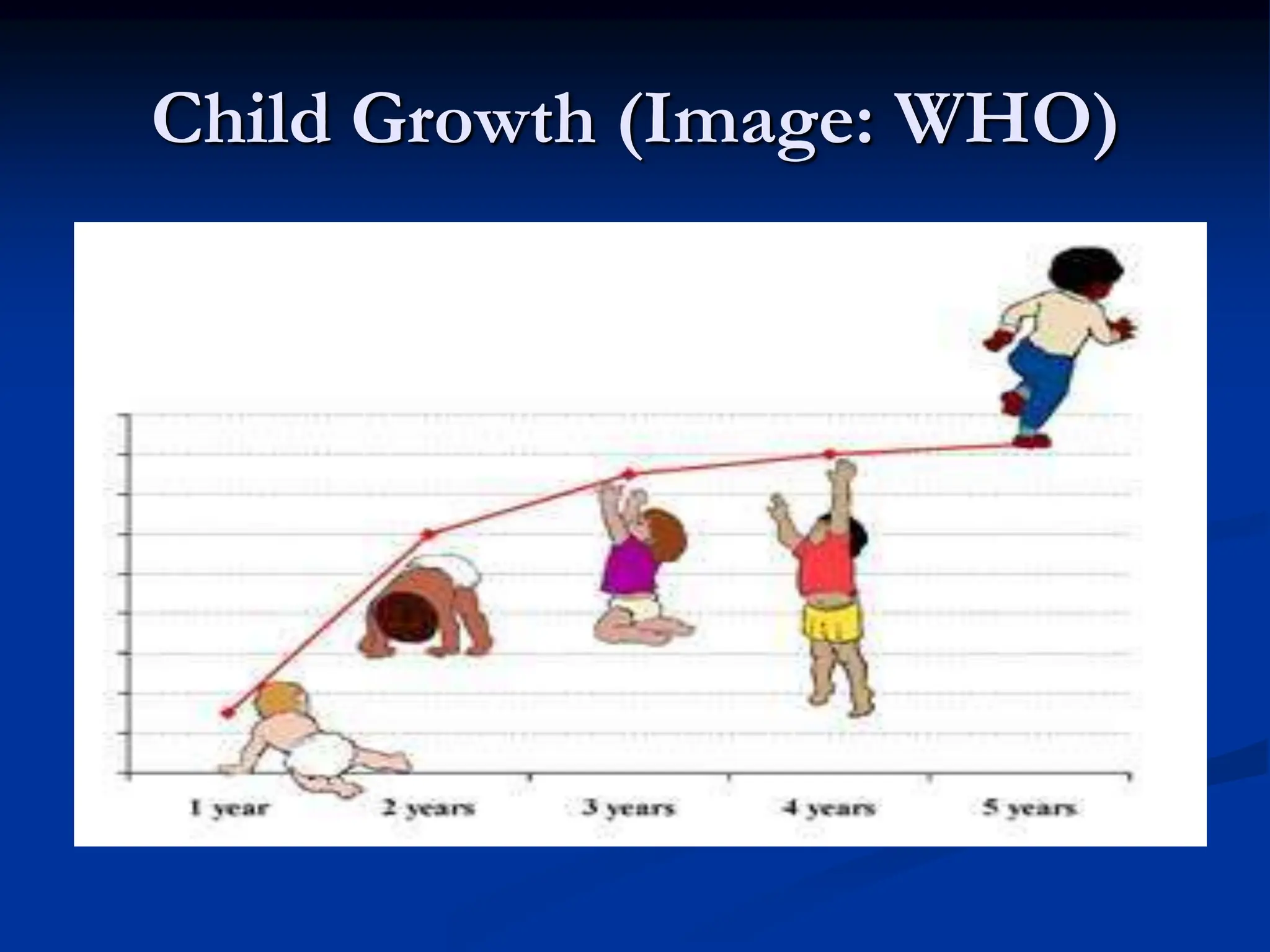
Growth
Growth refers to an increase in physical size of the
whole body or any of its parts.
It is simply a quantitative change in the child’s
body.
It can be measured in Kg, pounds, meters, inches,
….. etc
Child Growth (Image: WHO)
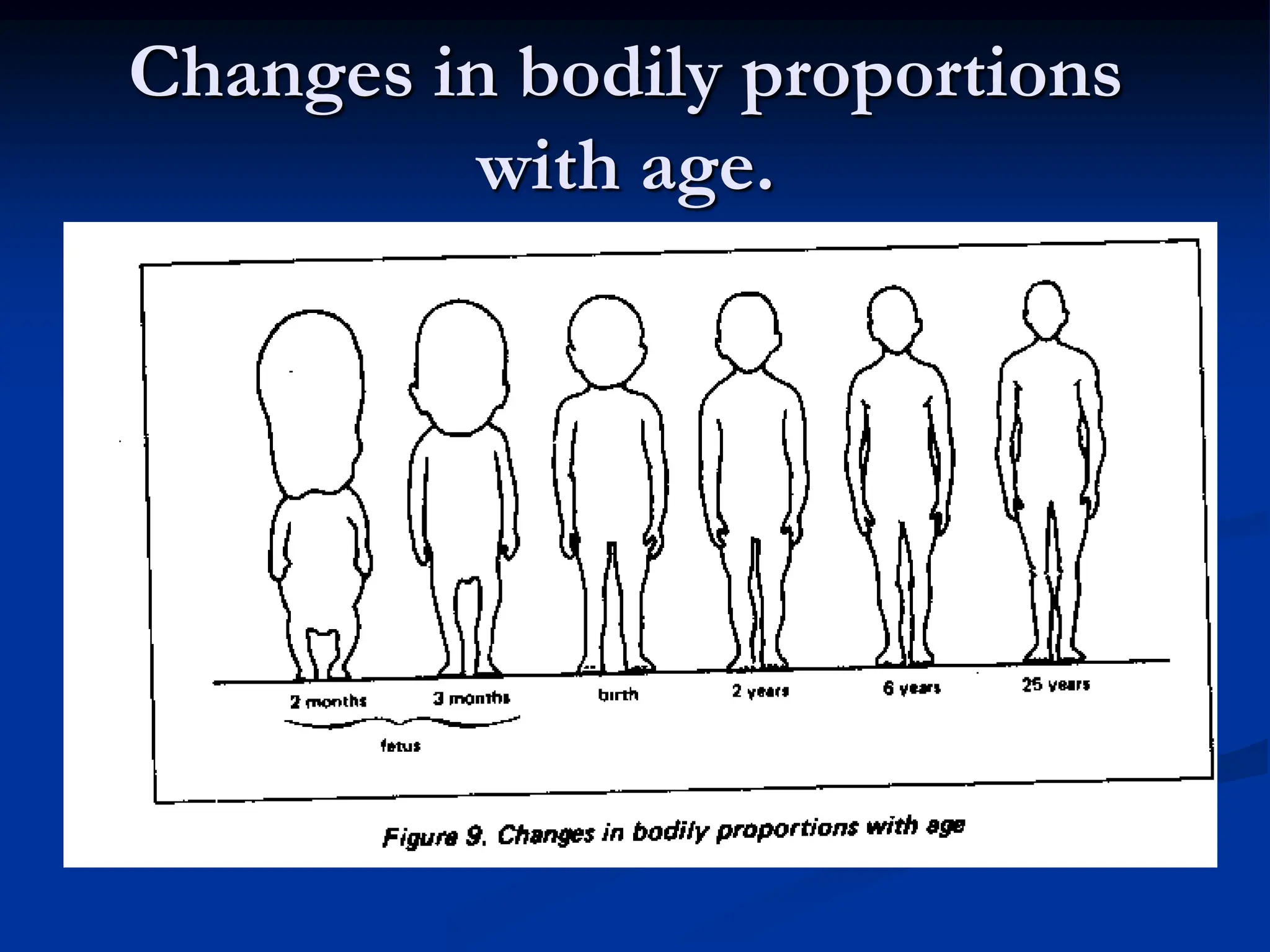
Changes in bodily proportions
with age.
Development
• Development refers to a progressive increase in
skill and capacity of function.
• It is a qualitative change in the child’s
functioning.
• It can be measured through observation.
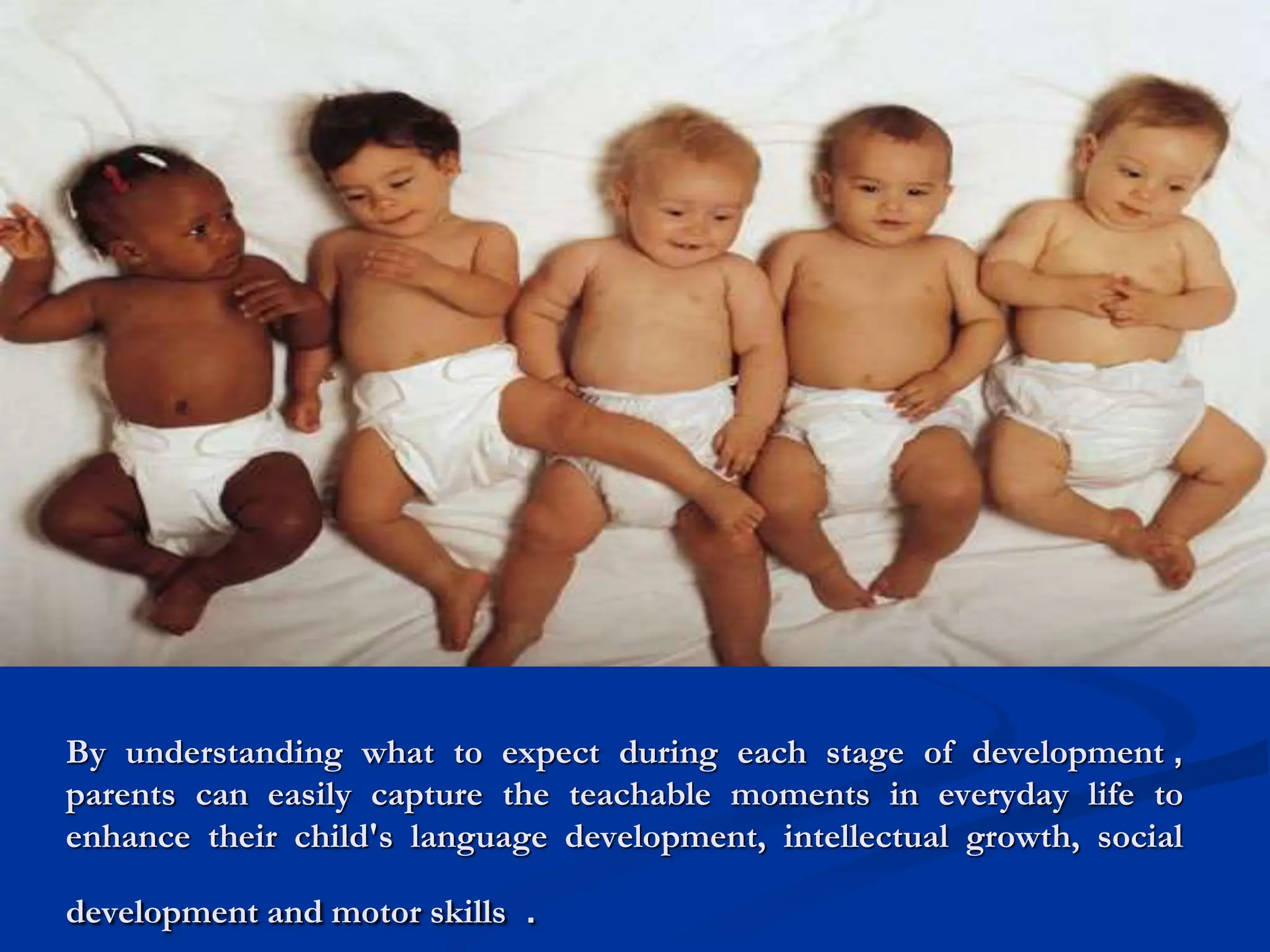
By understanding what to expect during each stage of development ,
parents can easily capture the teachable moments in everyday life to
enhance their child's language development, intellectual growth, social
development and motor skills .
Maturation
• Increase in child’s competence and adaptability.
• It is describing the qualitative change in a
structure.
• The level of maturation depends on child’s
heredity.
Importance of Growth and Development for Nurses:
• Knowing what to expect of a particular child at any
given age.
• Gaining better understanding of the reasons behind
illnesses.
• Helping in formulating the plan of care.
• Helping in parents’ education in order to achieve
optimal growth & development at each stage.
Principles of Growth & Development
• Continuous process
• Predictable Sequence
• Don’t progress at the same rate (↑ periods of GR in early childhood and
adolescents & ↓ periods of GR in middle childhood)
• Not all body parts grow in the same rate at the same time.
• Each child grows in his/her own unique way.
• Each stage of G&D is affected by the preceding types of development.
Principles of Growth & Development
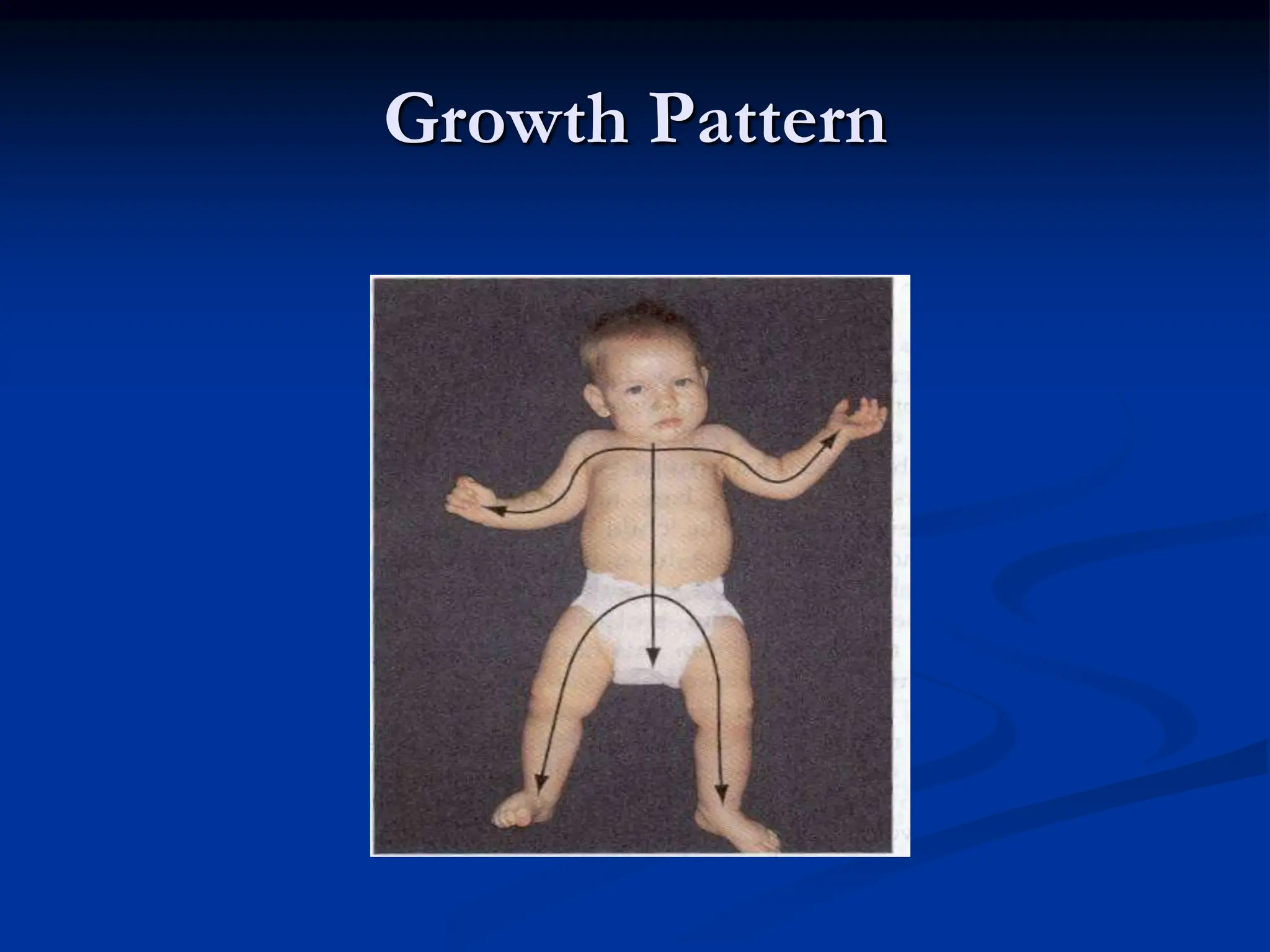
G & D proceed in regular related directions :
- Cephalo-caudal(head down to toes)
- Proximodistal (center of the body to the
peripheral)
- General to specific
Growth Pattern
Growth Patterns
The child’s pattern of growth is in a head-to-toe
direction, or cephalocaudal, and in an inward
to outward pattern called proximodistal.
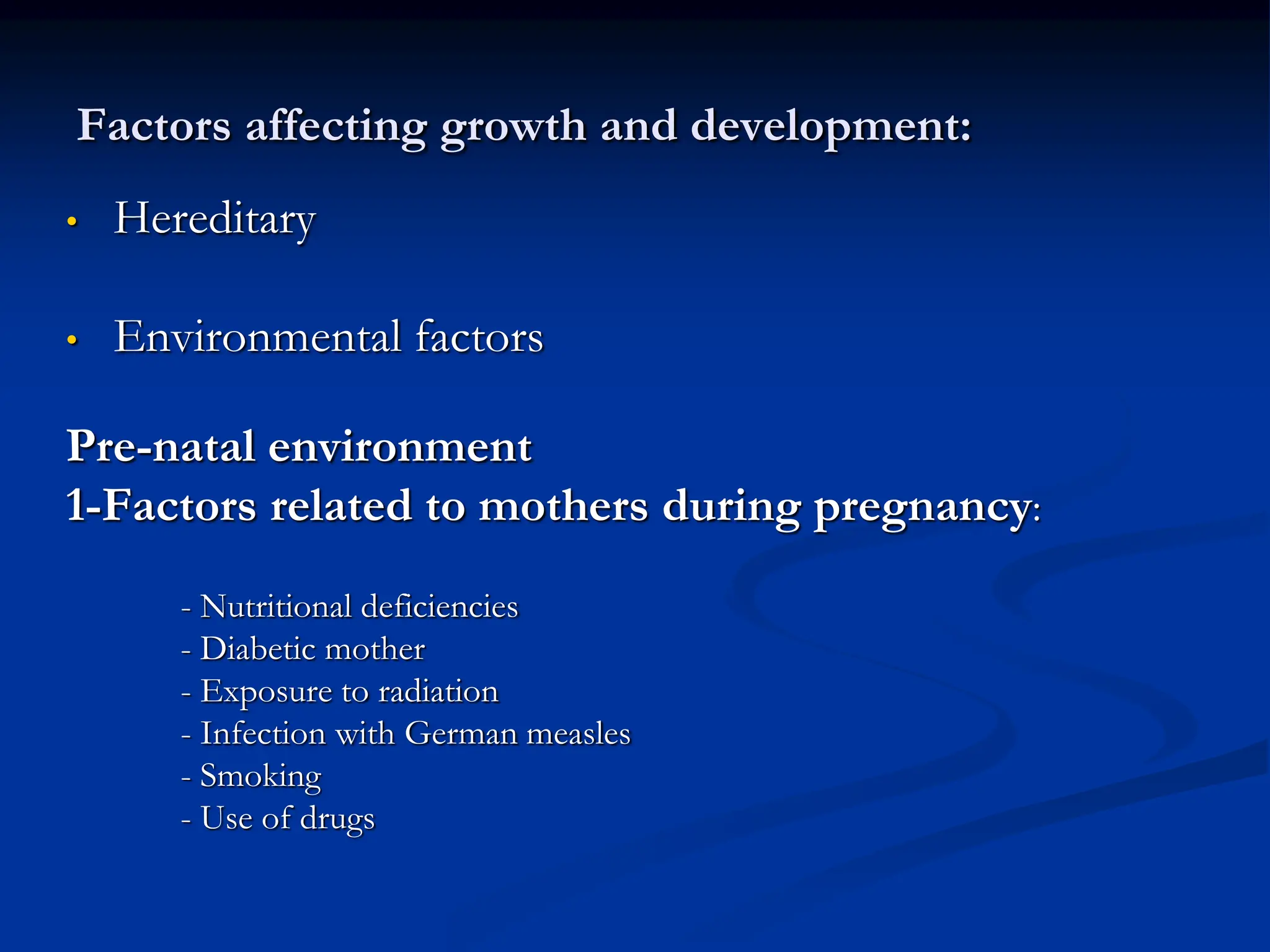
Factors affecting growth and development:
• Hereditary
• Environmental factors
Pre-natal environment
1-Factors related to mothers during pregnancy:
- Nutritional deficiencies
- Diabetic mother
- Exposure to radiation
- Infection with German measles
- Smoking
- Use of drugs
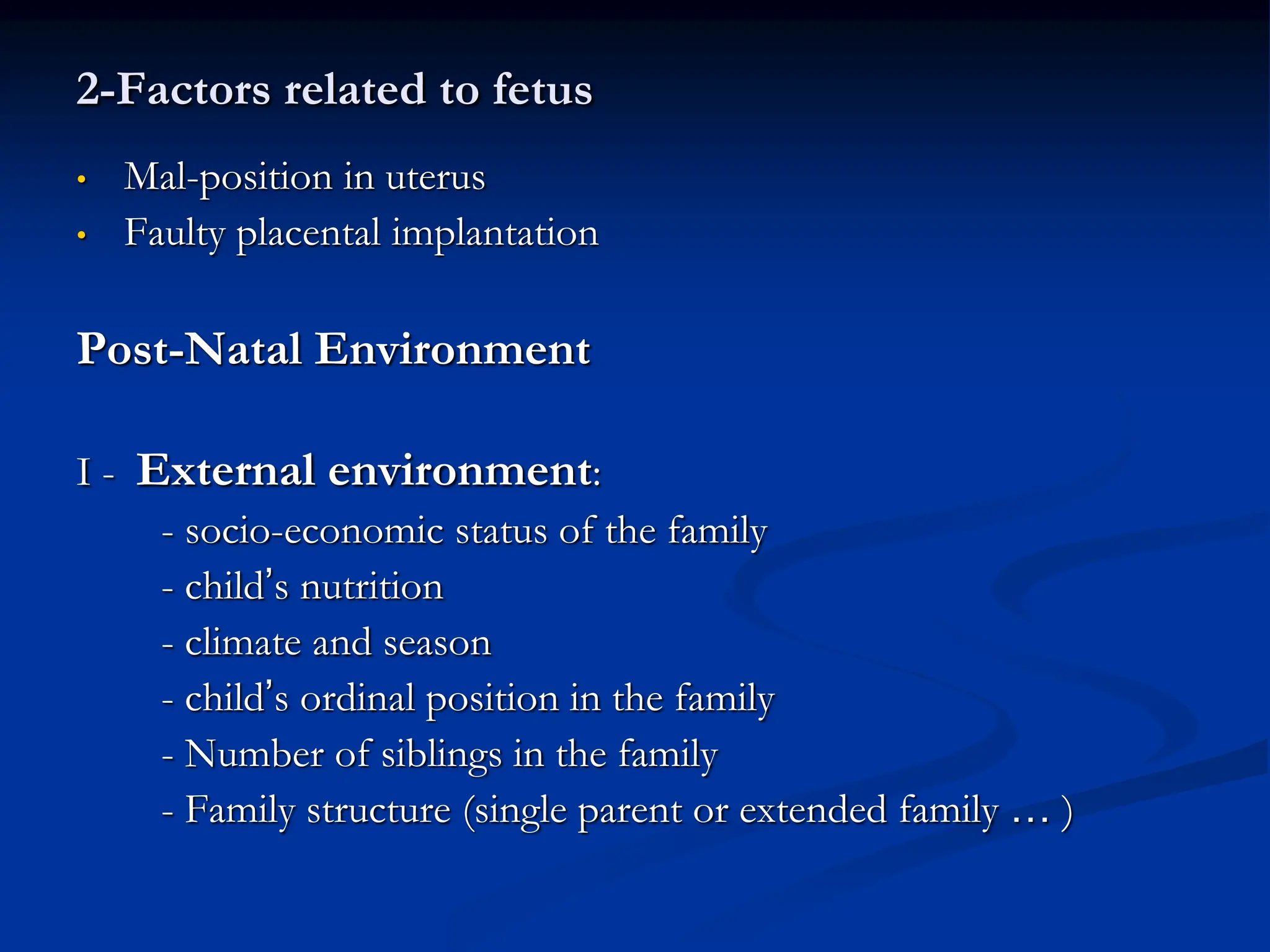
2-Factors related to fetus
• Mal-position in uterus
• Faulty placental implantation
Post-Natal Environment
I - External environment:
- socio-economic status of the family
- child’s nutrition
- climate and season
- child’s ordinal position in the family
- Number of siblings in the family
- Family structure (single parent or extended family … )
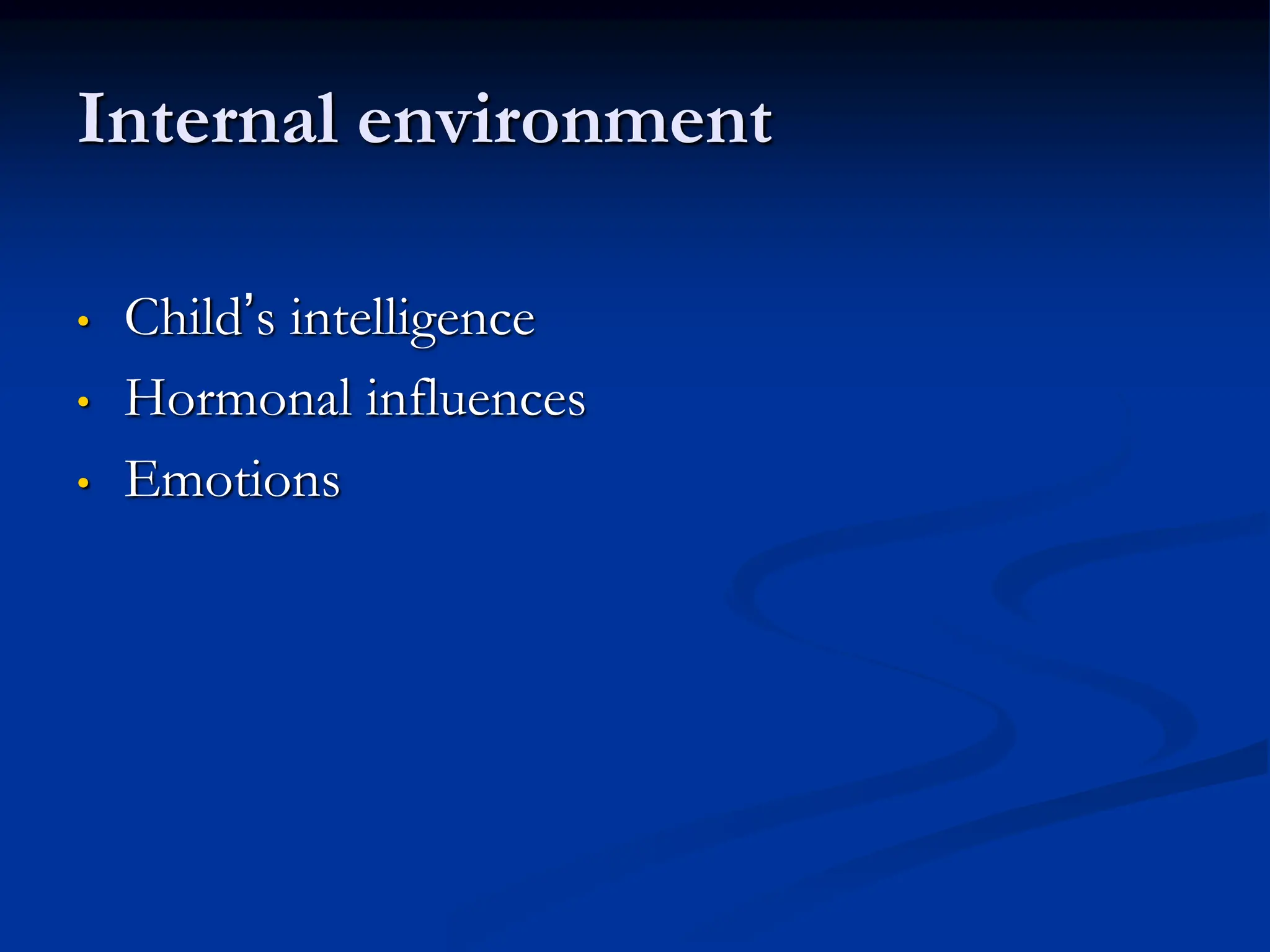
Internal environment
• Child’s intelligence
• Hormonal influences
• Emotions
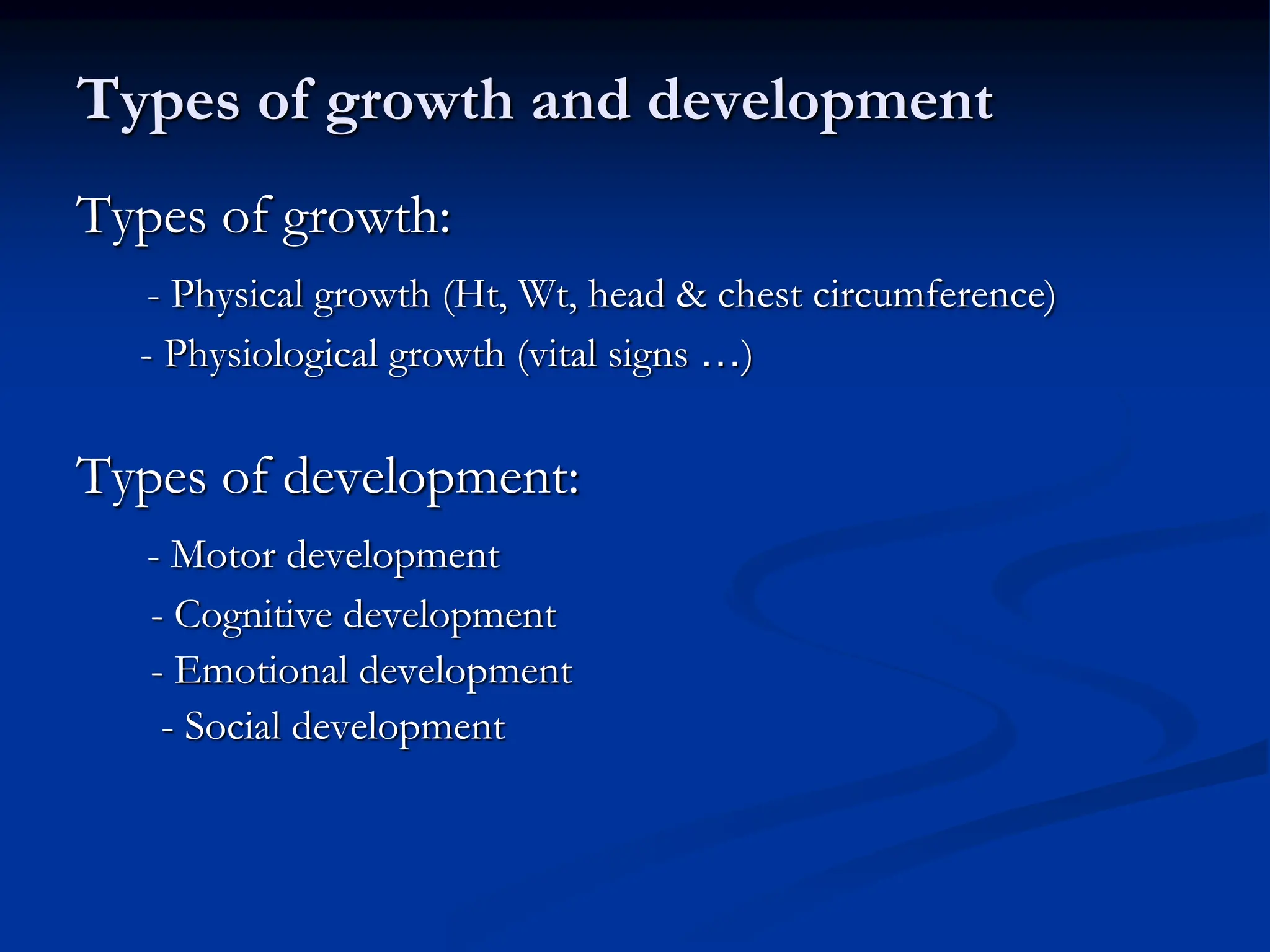
Types of growth and development
Types of growth:
- Physical growth (Ht, Wt, head & chest circumference)
- Physiological growth (vital signs …)
Types of development:
- Motor development
- Cognitive development
- Emotional development
- Social development
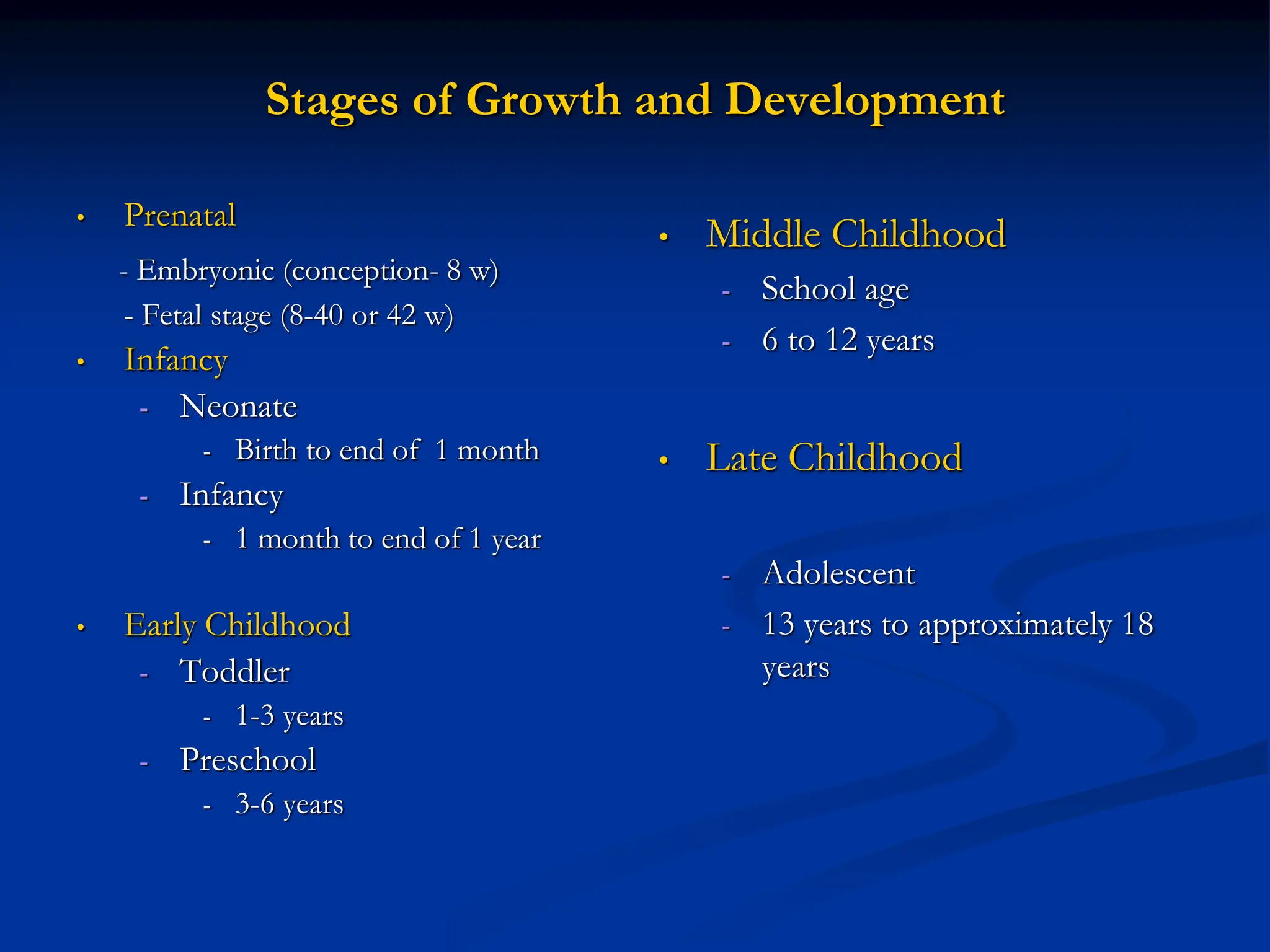
Stages of Growth and Development
• Prenatal
- Embryonic (conception- 8 w)
- Fetal stage (8-40 or 42 w)
• Infancy
- Neonate
- Birth to end of 1 month
- Infancy
- 1 month to end of 1 year
• Early Childhood
- Toddler
- 1-3 years
- Preschool
- 3-6 years
• Middle Childhood
- School age
- 6 to 12 years
• Late Childhood
- Adolescent
- 13 years to approximately 18
years
1- Newborn stage
Newborn stage is the first 4 weeks or
first month of life. It is a transitional
period from intrauterine life to extra
uterine environment.
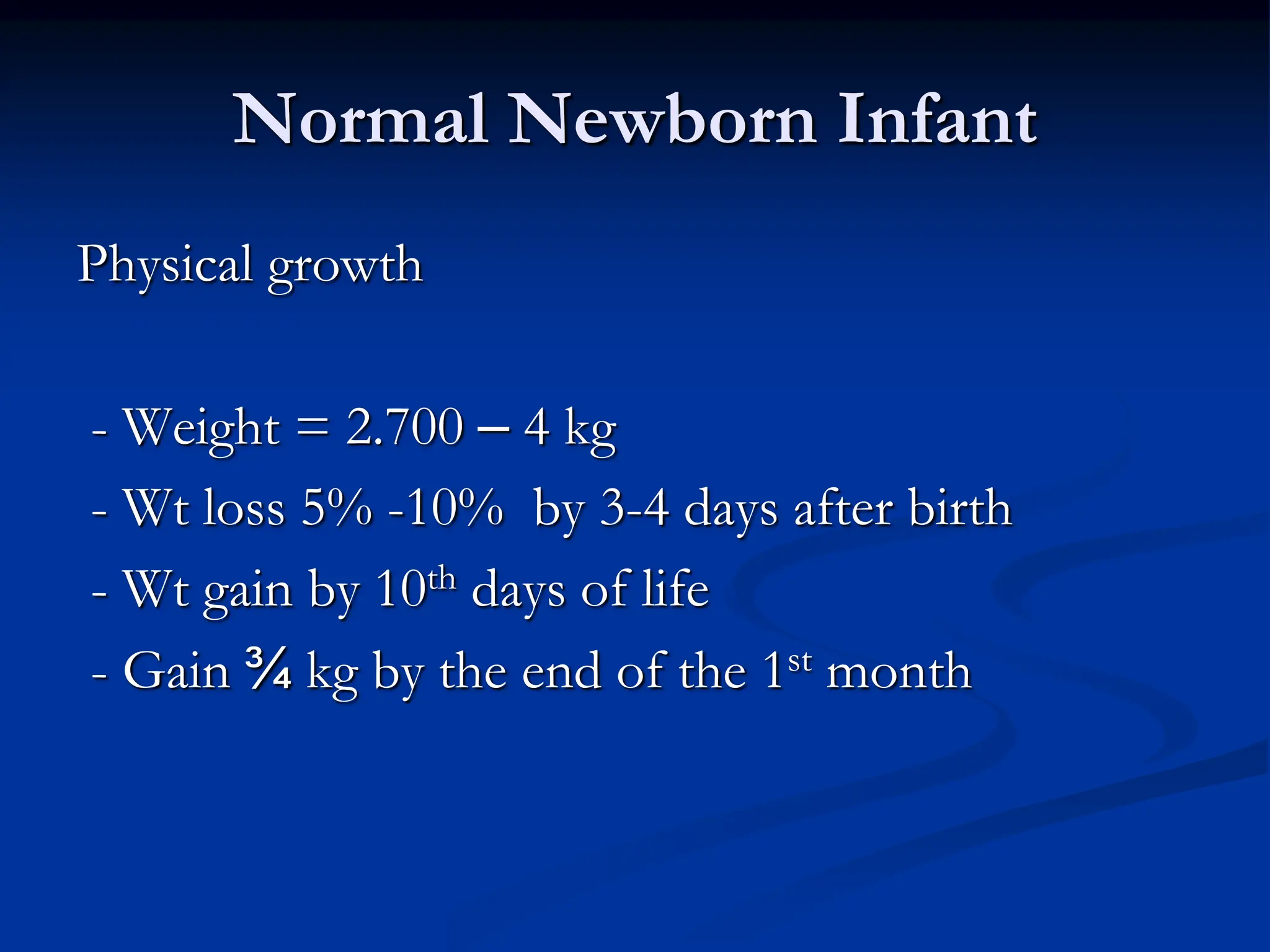
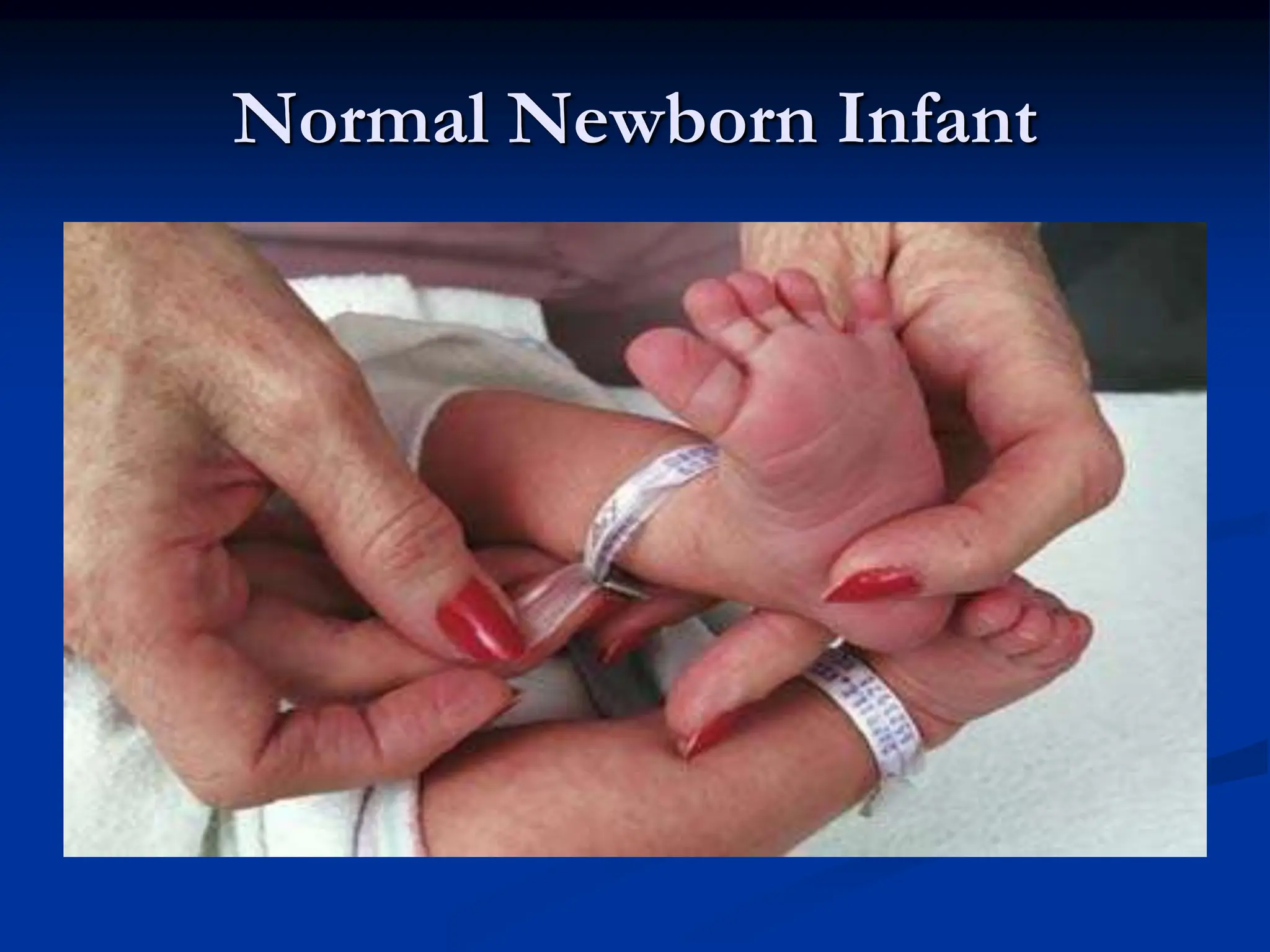
Normal Newborn Infant
Physical growth
- Weight = 2.700 – 4 kg
- Wt loss 5% -10% by 3-4 days after birth
- Wt gain by 10th days of life
- Gain ¾ kg by the end of the 1st month
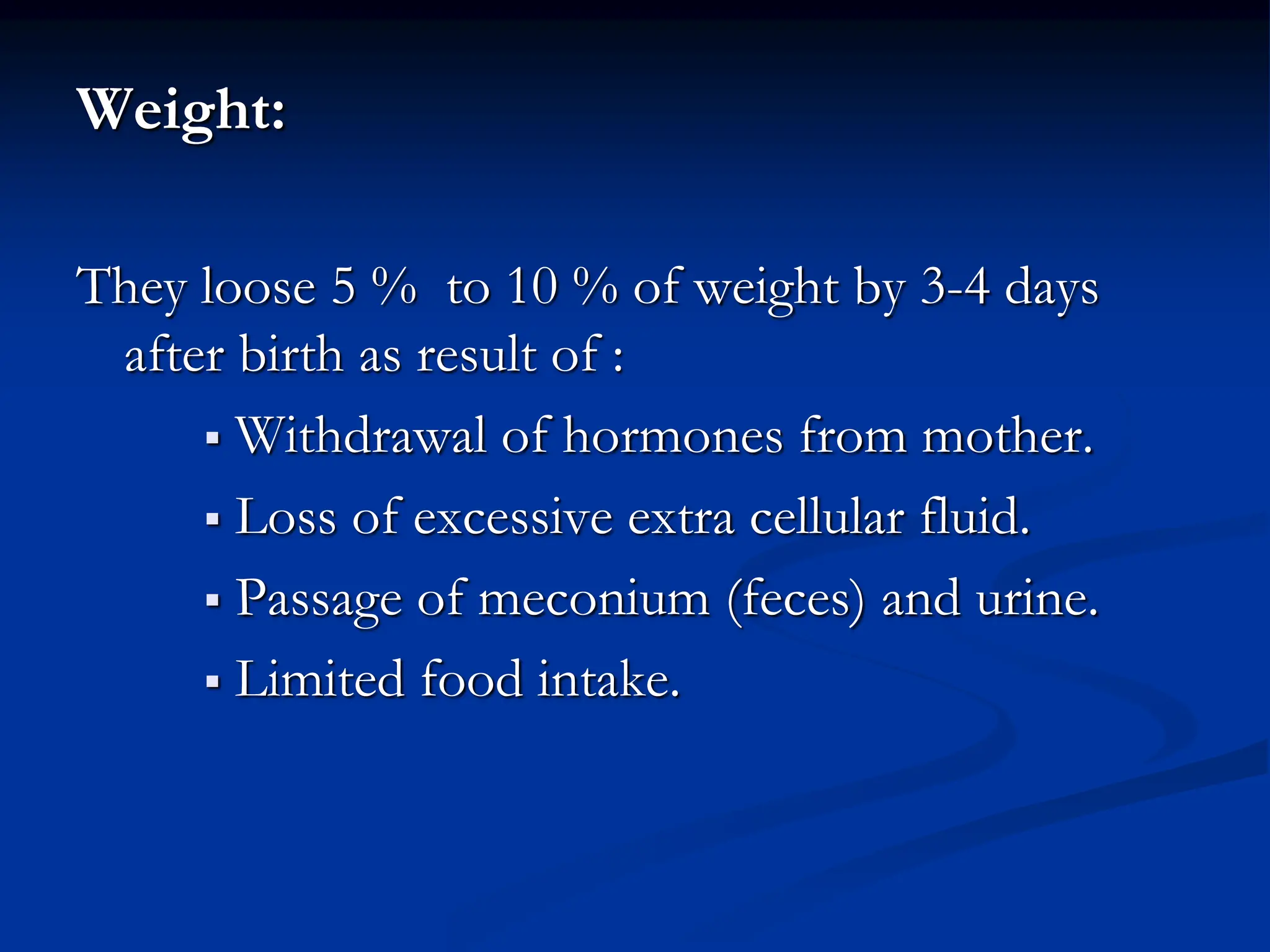
Weight:
They loose 5 % to 10 % of weight by 3-4 days
after birth as result of :
 Withdrawal of hormones from mother.
 Loss of excessive extra cellular fluid.
 Passage of meconium (feces) and urine.
 Limited food intake.
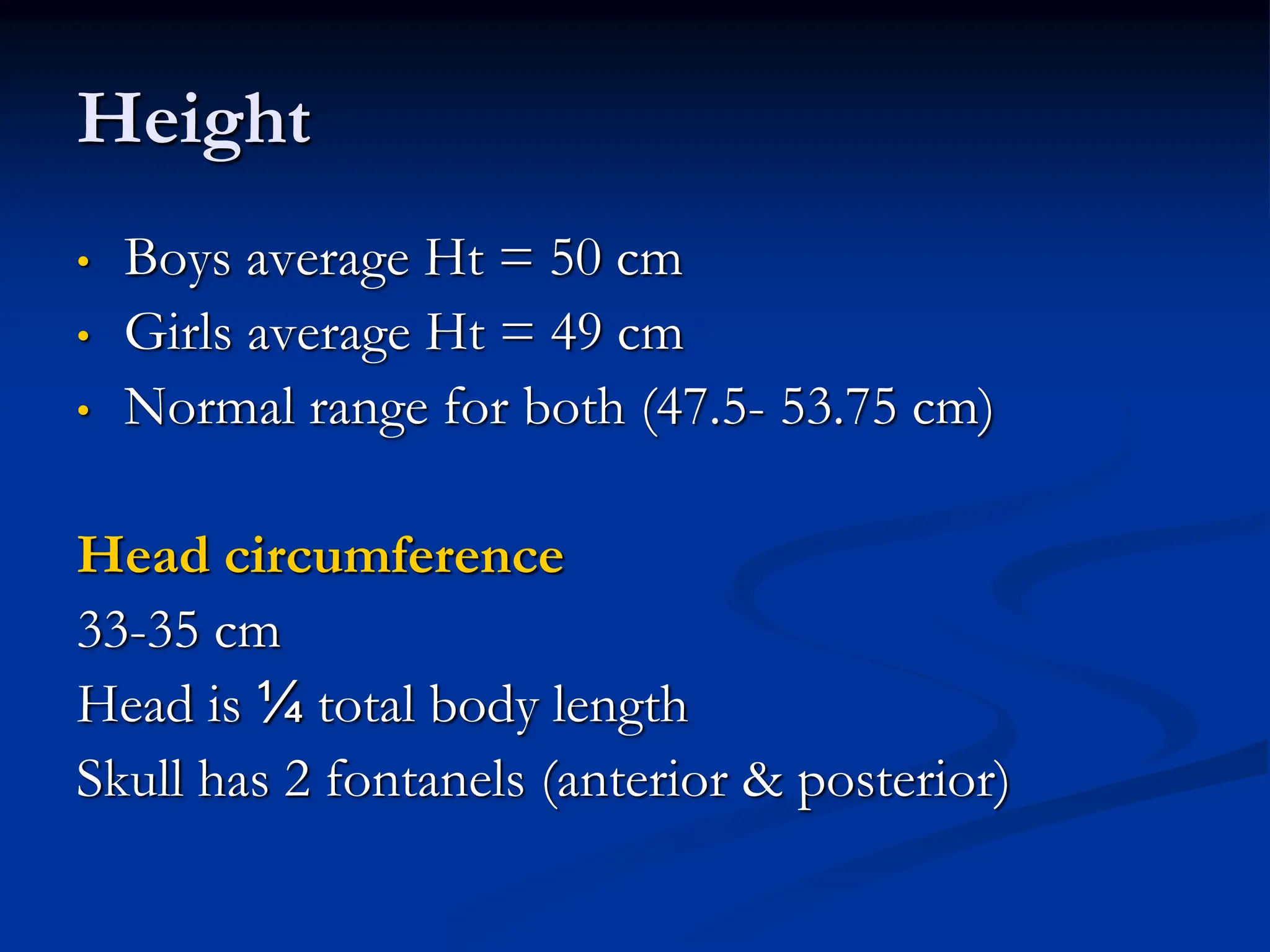
Height
• Boys average Ht = 50 cm
• Girls average Ht = 49 cm
• Normal range for both (47.5- 53.75 cm)
Head circumference
33-35 cm
Head is ¼ total body length
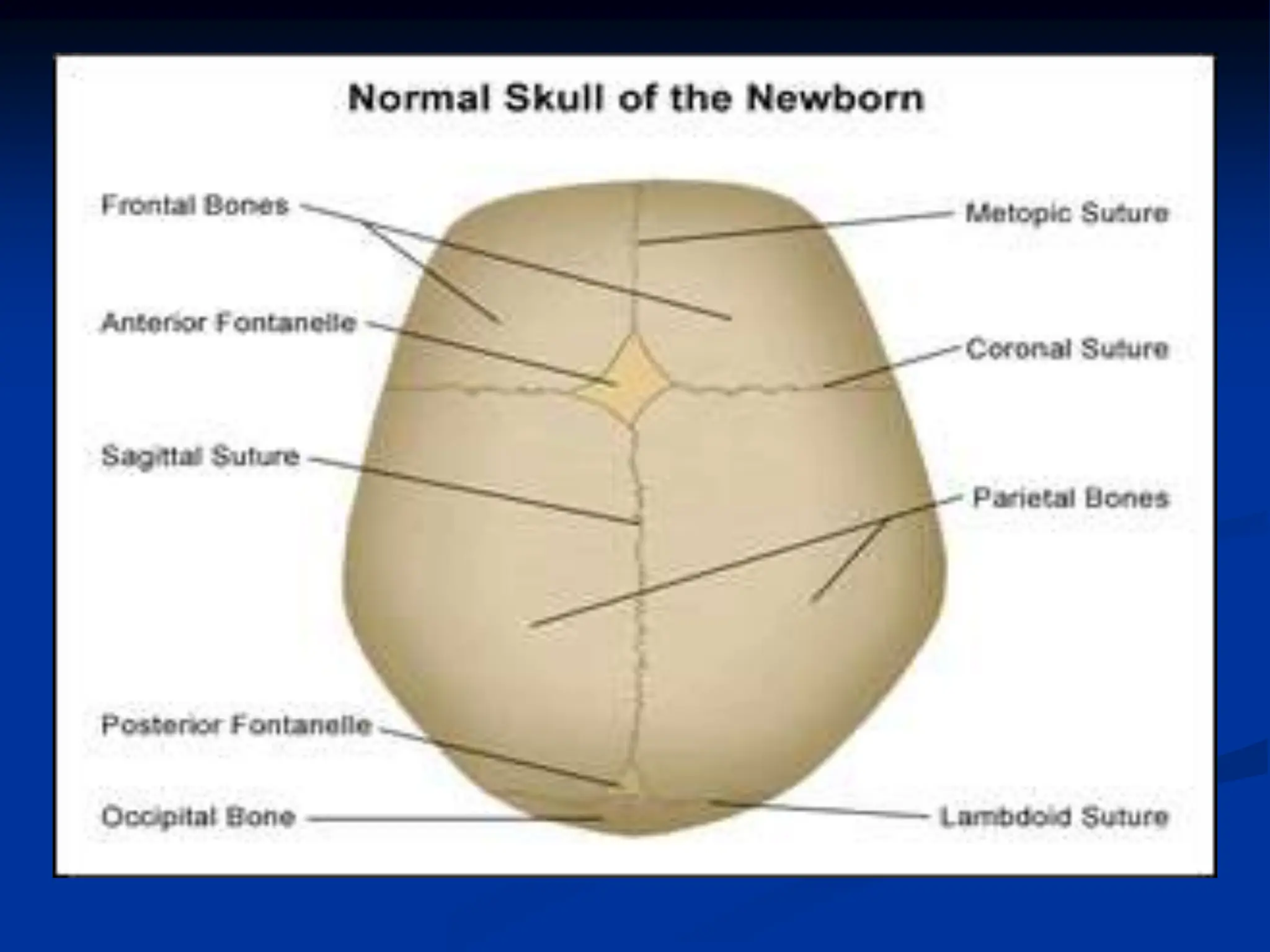
Skull has 2 fontanels (anterior & posterior)
Anterior fontanel
• Diamond in shape
• The junction of the sagittal, corneal and frontal
sutures forms it
• Between 2 frontal & 2 parietal bones
• 3-4 cm in length and 2-3 cm width
• It closes at 12-18 months of age
Posterior fontanel
• Triangular
• Located between occipital & 2 parietal bones
• Closes by the end of the 1st month of age
Chest circumference
It is 30.5 to 33cm (usually 2–3cm less than
head circumference).
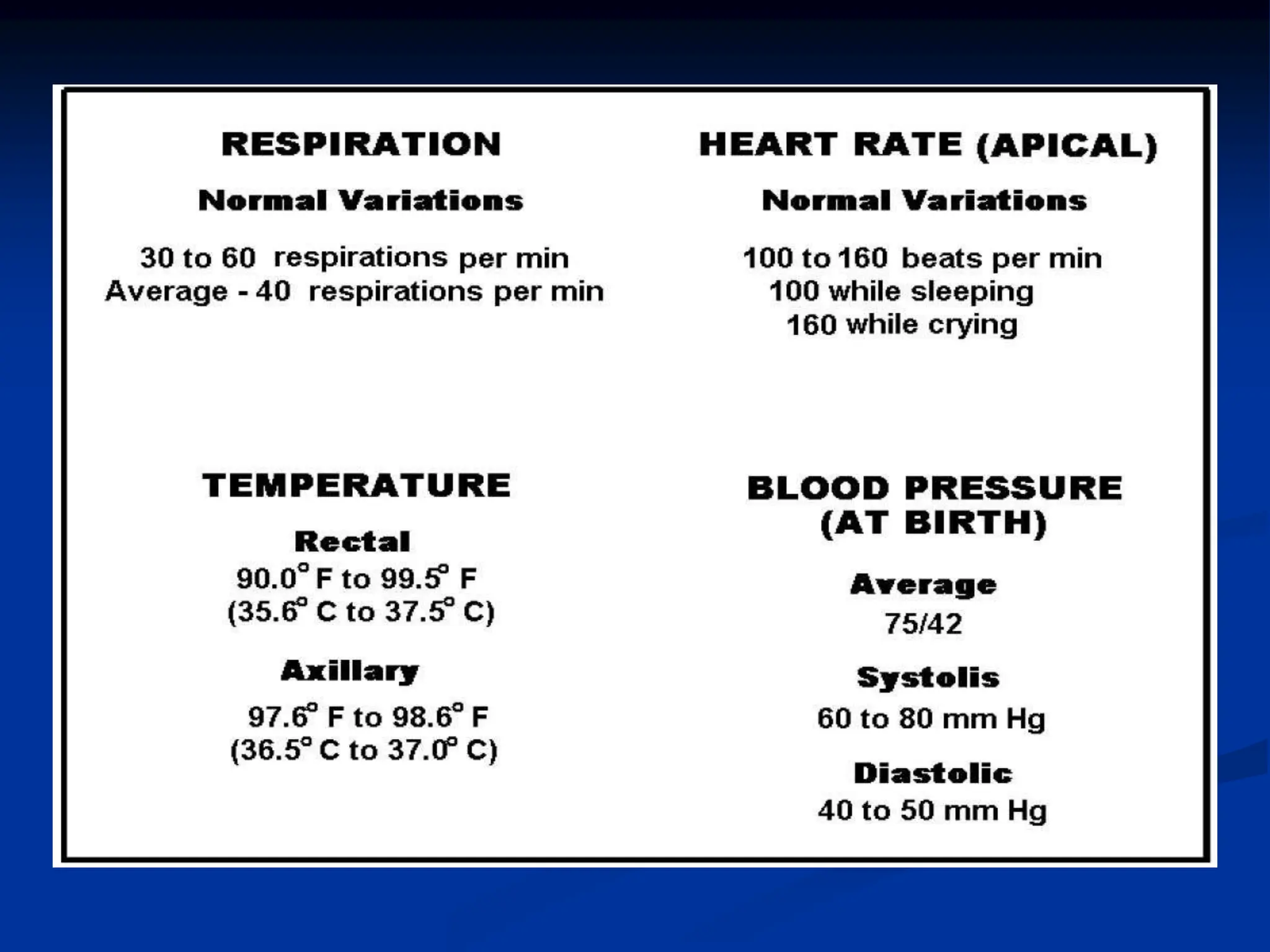
Physiological growth
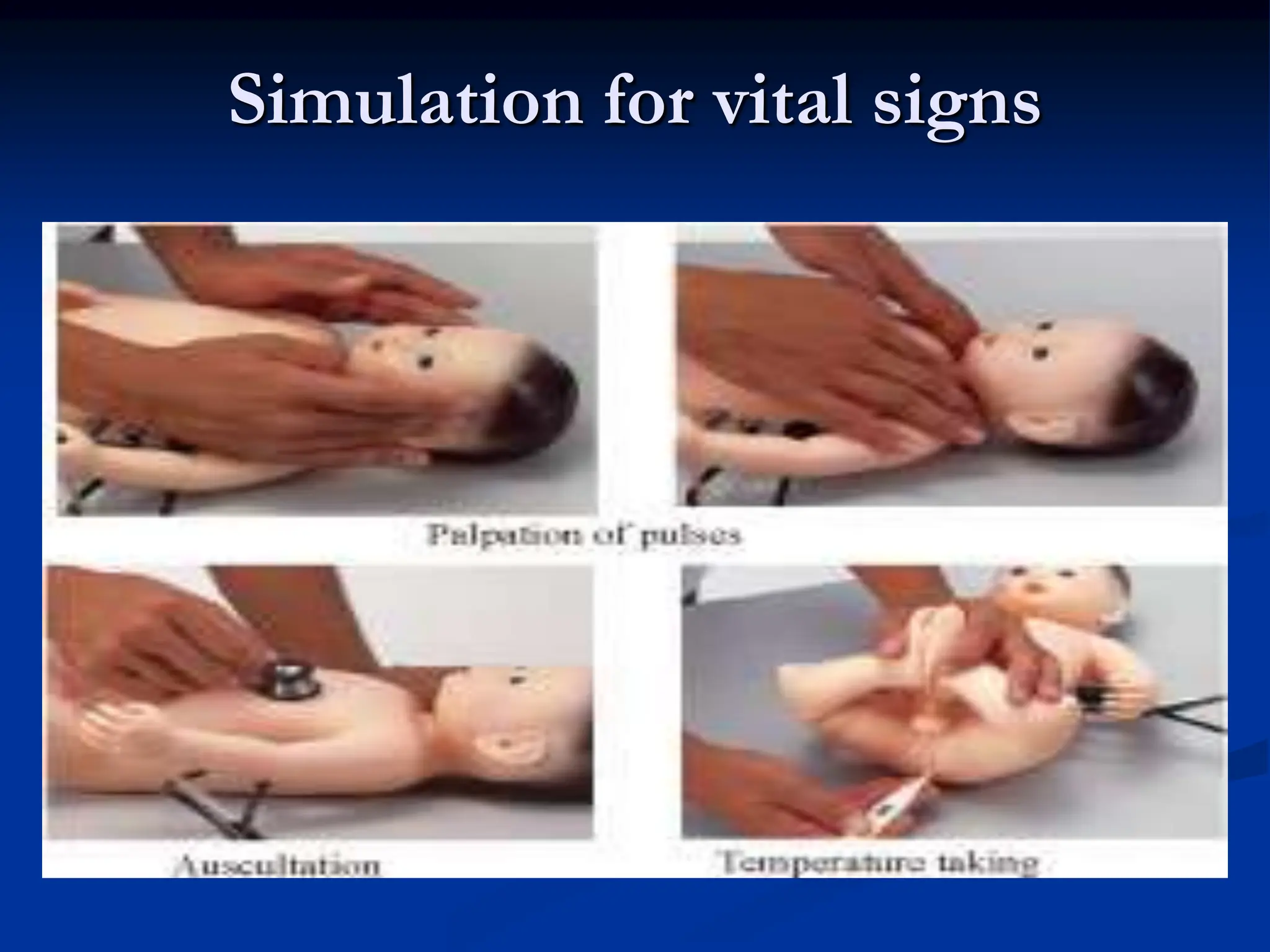
• Vital signs
- Temperature (36.3 to37.2C ).
- Pulse ( 120 to 160 b/min ).
- Respiration ( 35 to 50C/min) .
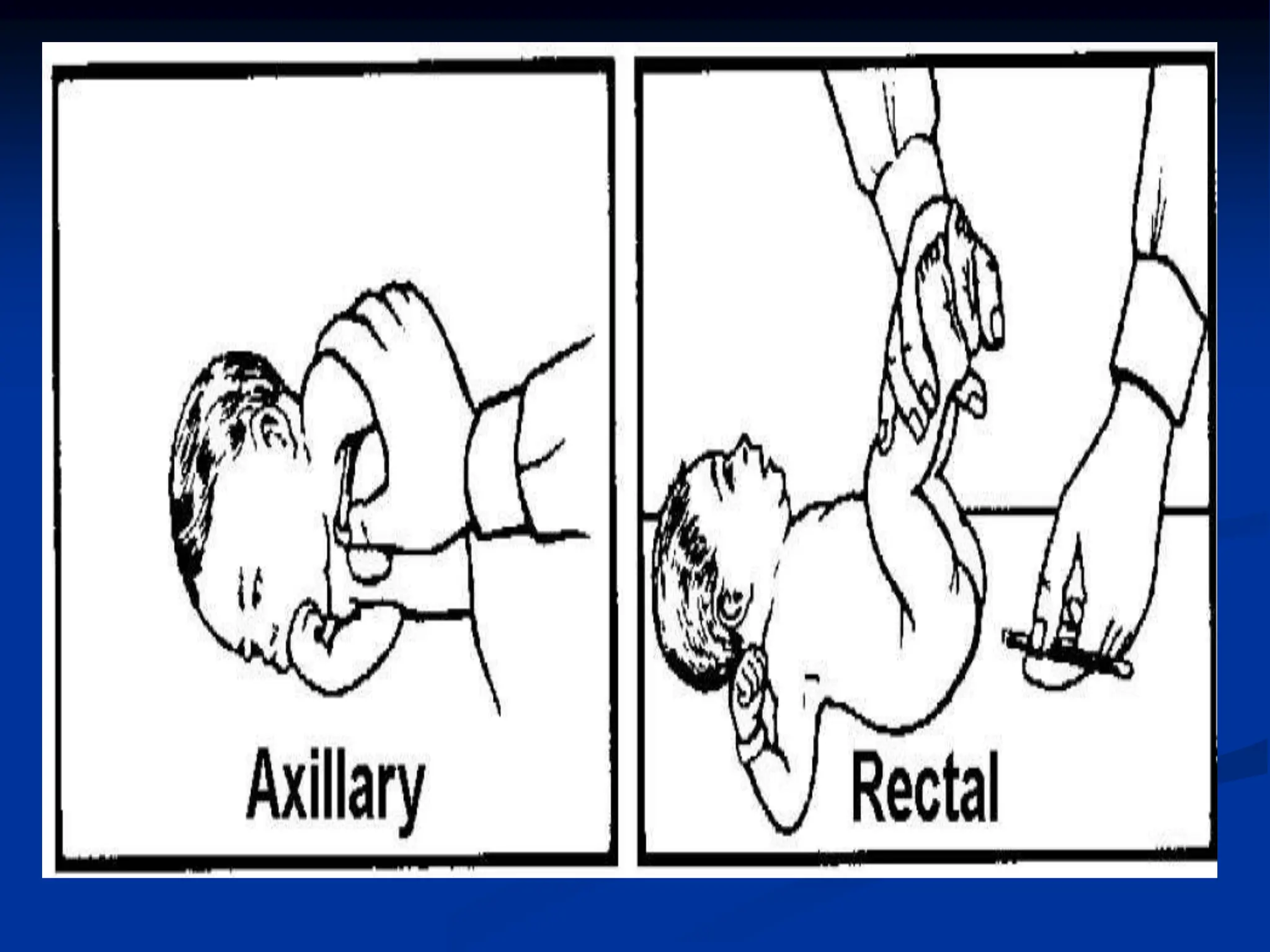
Simulation for vital signs
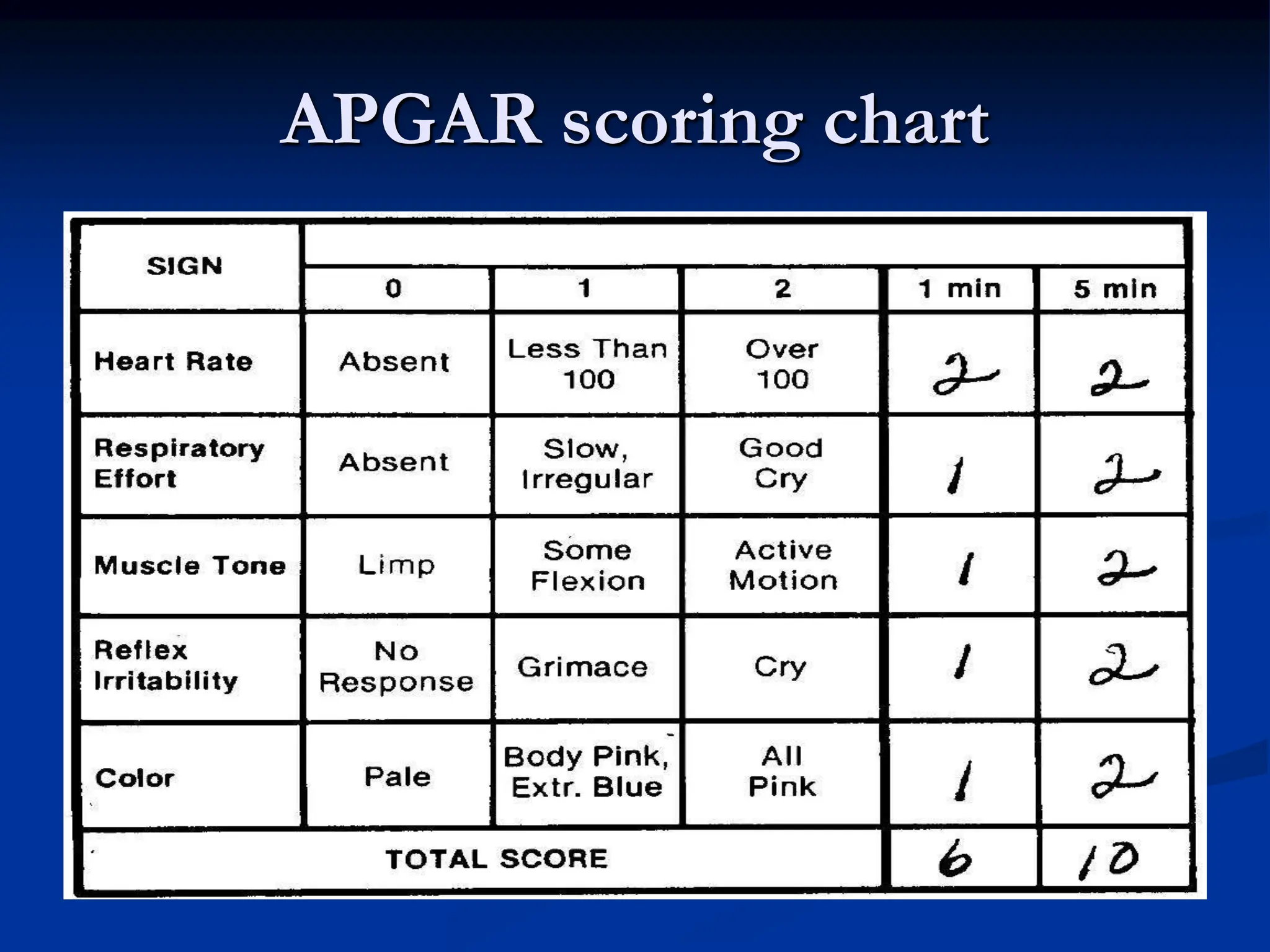
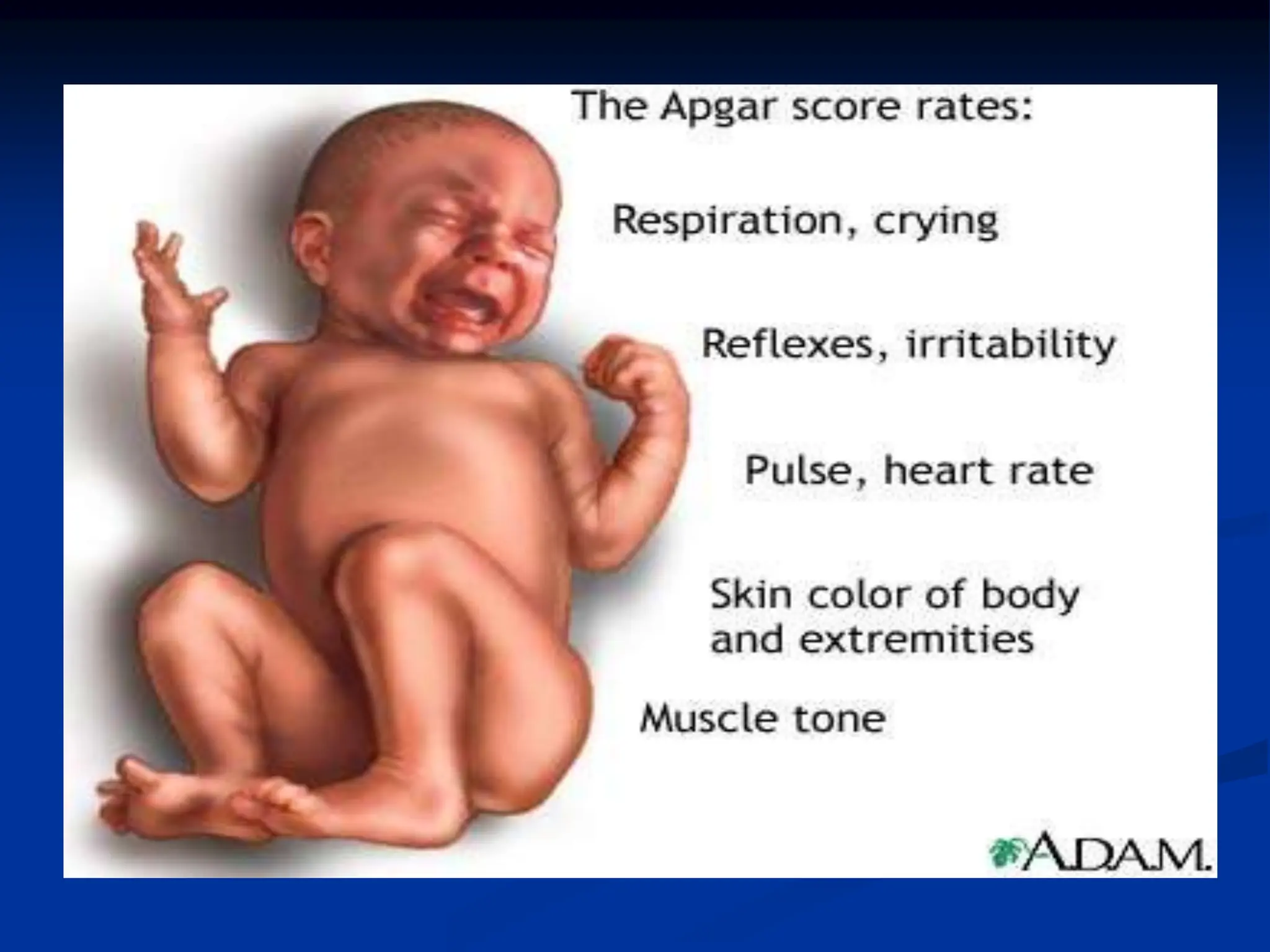
APGAR scoring chart
Newborn Senses
• Senses
- Touch
- Vision
- Hearing
- Taste
- Smell
Vision
• Pupils react to light
• Bright lights appear to be unpleasant to
newborn infant.
• Follow objects in line of vision
Hearing
• The newborn infant usually makes some
response to sound from birth.
• Ordinary sounds are heard well before 10 days
of life.
• The newborn infant responds to sounds with
either cry or eye movement, cessation of activity
and / or startle reaction.
Touch
• It is the most highly developed sense.
• It is mostly at lips, tongue, ears, and forehead.
• The newborn is usually comfortable with touch.
Taste
Well developed as bitter and sour fluids are
resisted while sweet fluids are accepted.
Smell
Only evidence in newborn infant’s search for the
nipple, as he smell breast milk.
Normal Newborn Infant
Gross Motor Development
Motor development:
The newborn's movement are random,
diffuse and uncoordinated. Reflexes carry
out bodily functions and responses to
external stimuli.
Fine motor development
• Holds hand in fist
• When crying, he draws arms and legs to body
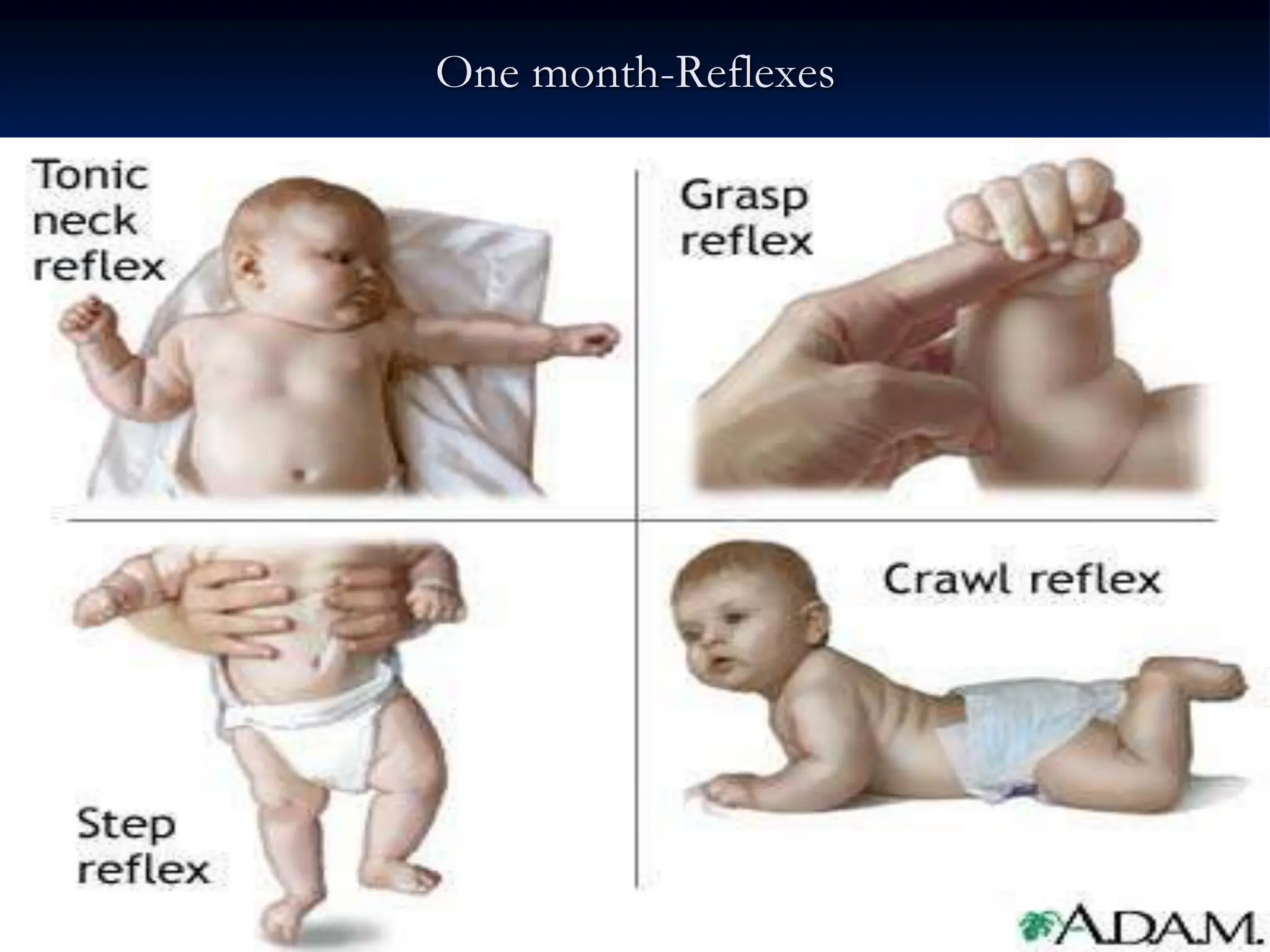
Reflexes
• Swallowing
• Gagging
• Sucking
• Grasp
• Tonic-neck
One month-Reflexes
Cognitive development
The cognitive development of newborn
infant is difficult to understand or
observe it.
Emotional development
The newborn infant expresses his
emotion just through cry for hunger,
pain or discomfort sensation
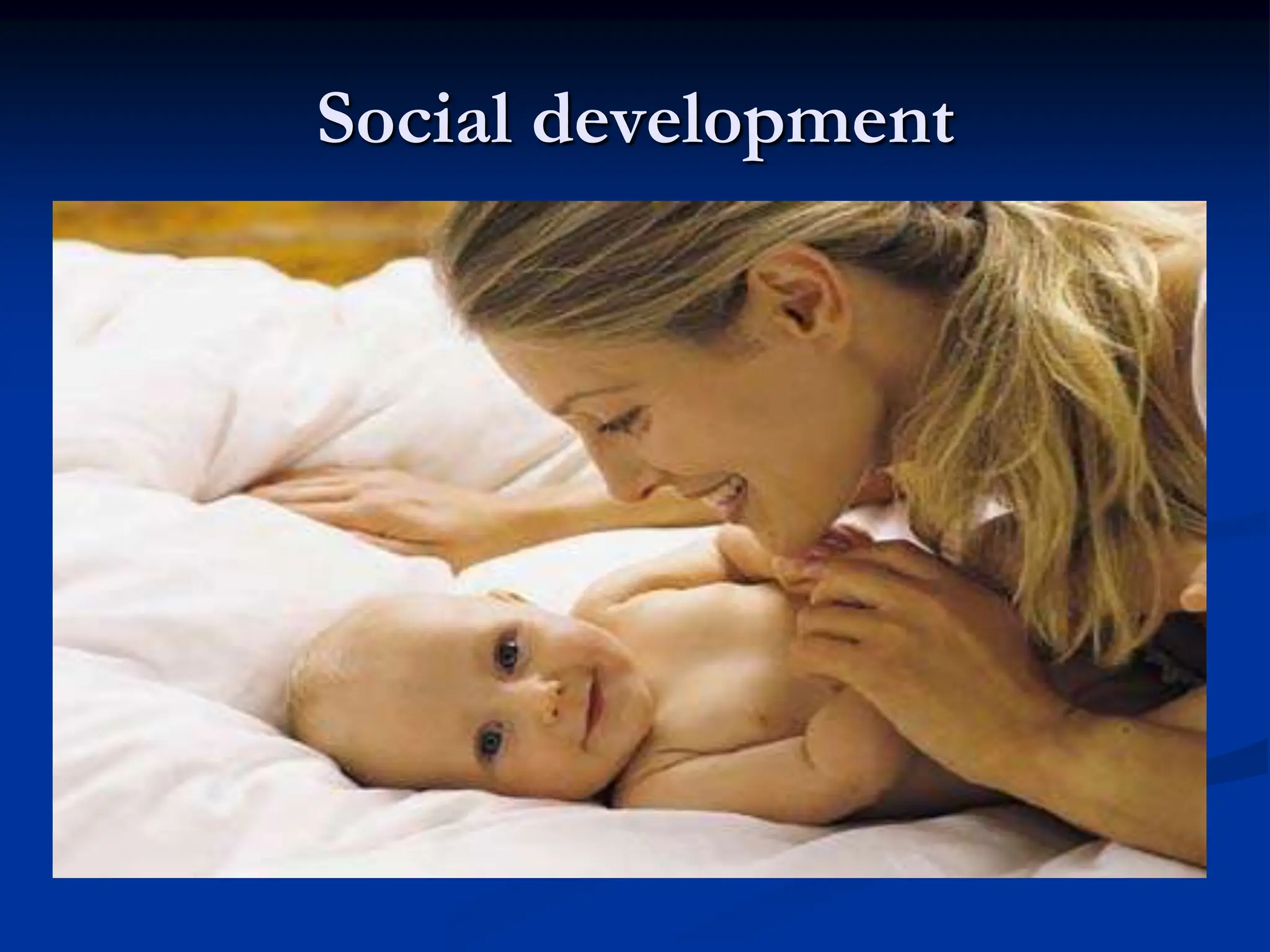
Social development
Infancy
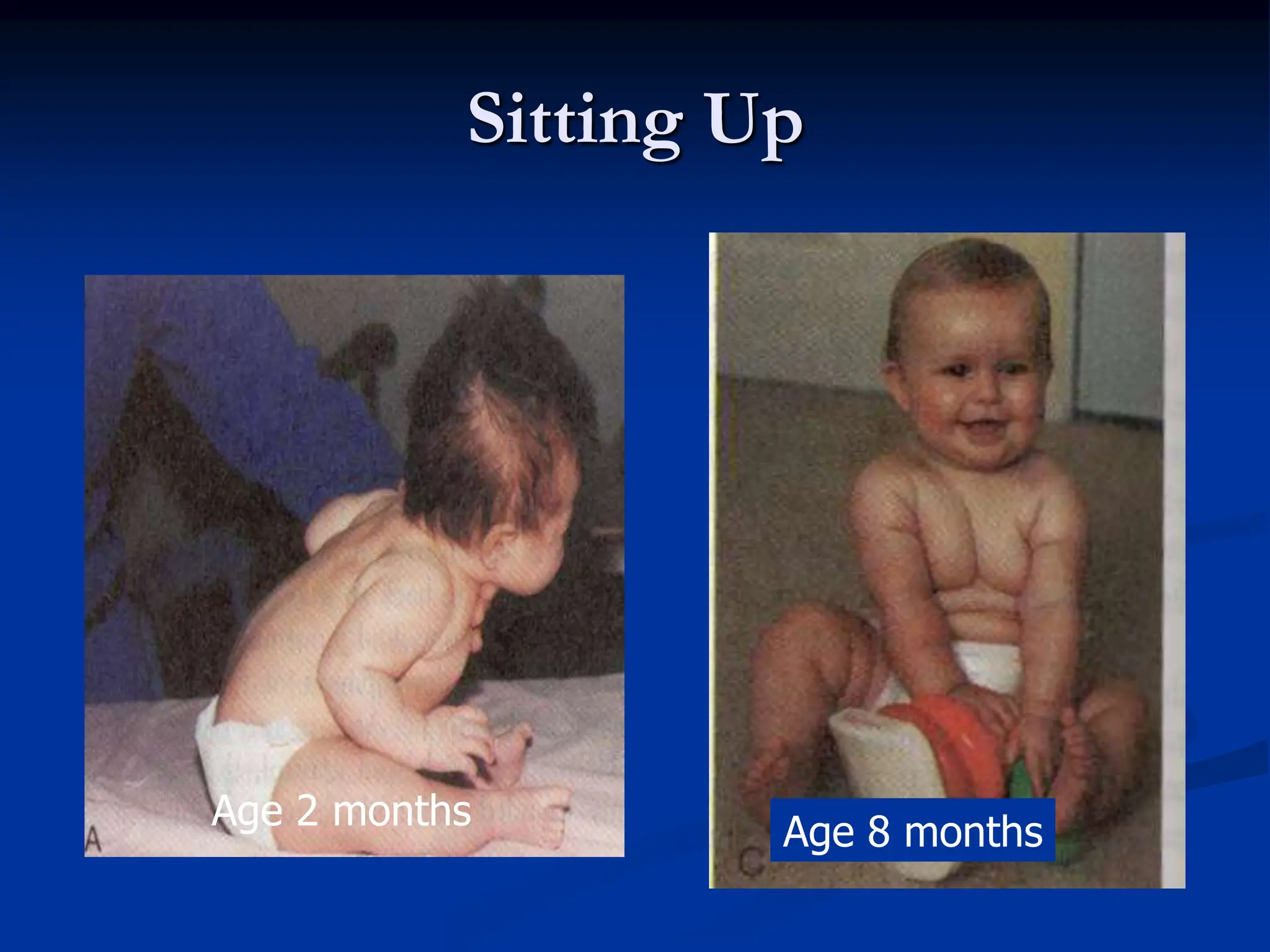
Sitting Up
Age 2 months
Age 8 months
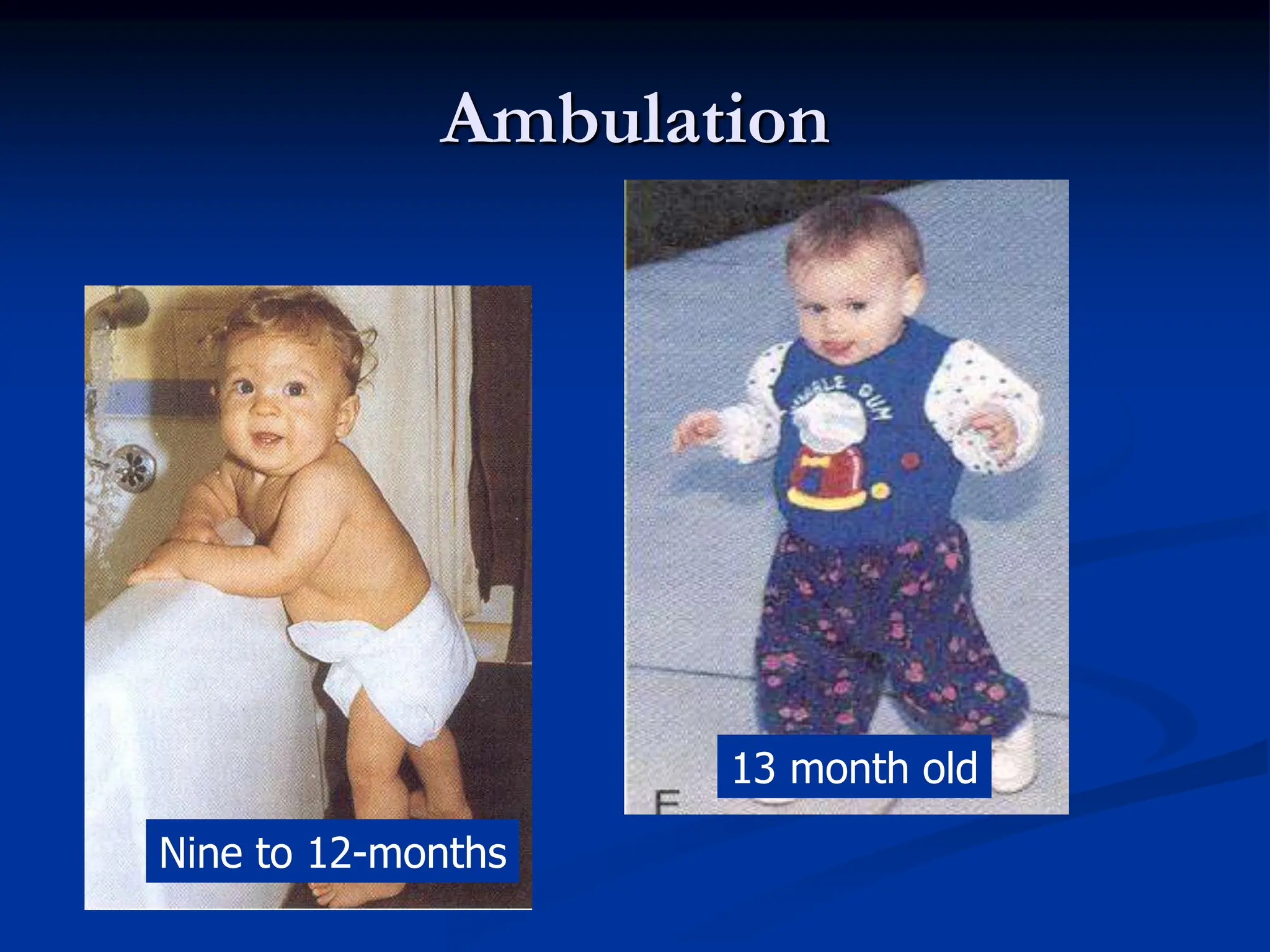
Ambulation
13 month old
Nine to 12-months
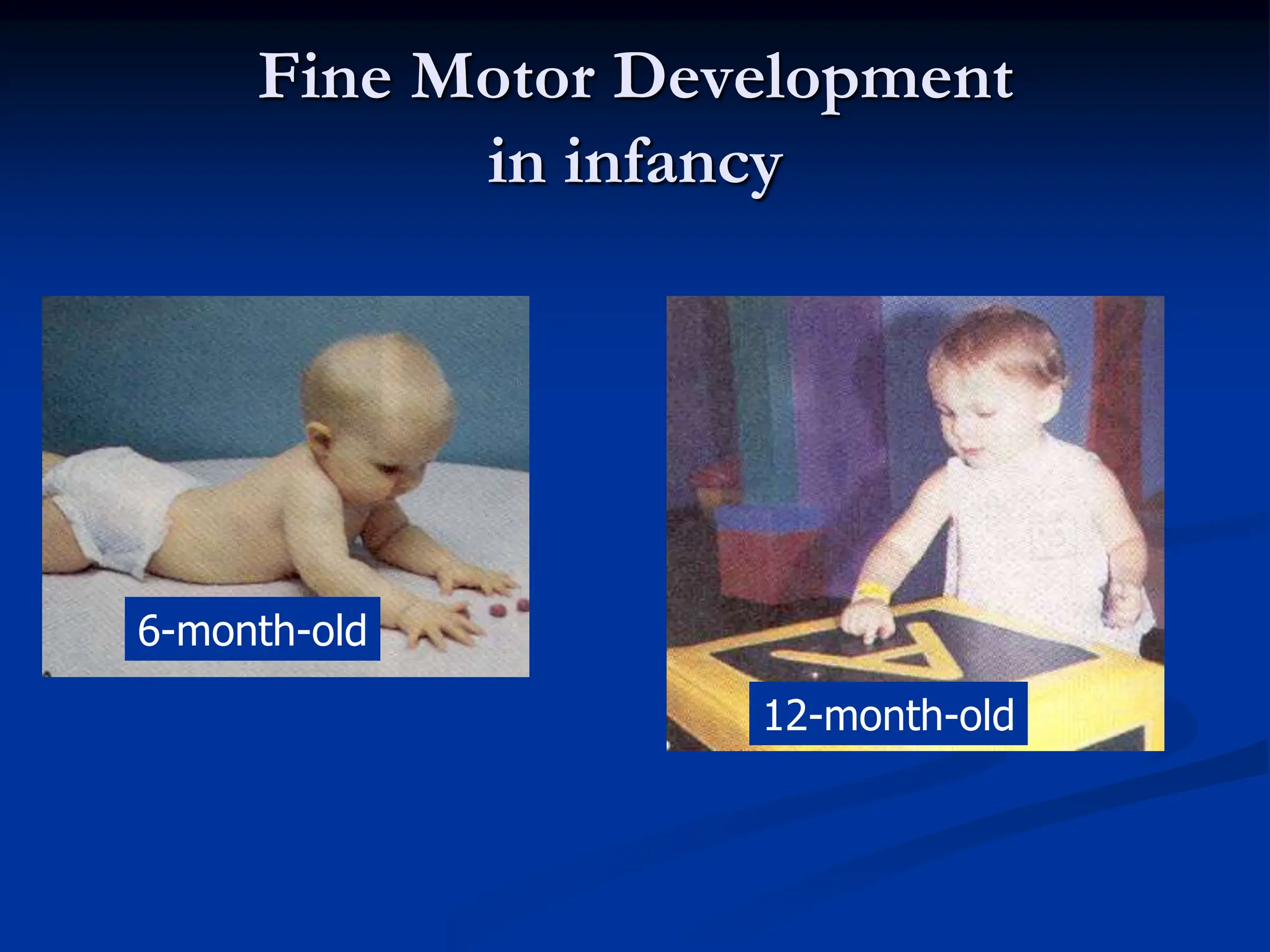
Fine Motor Development
in infancy
6-month-old
12-month-old
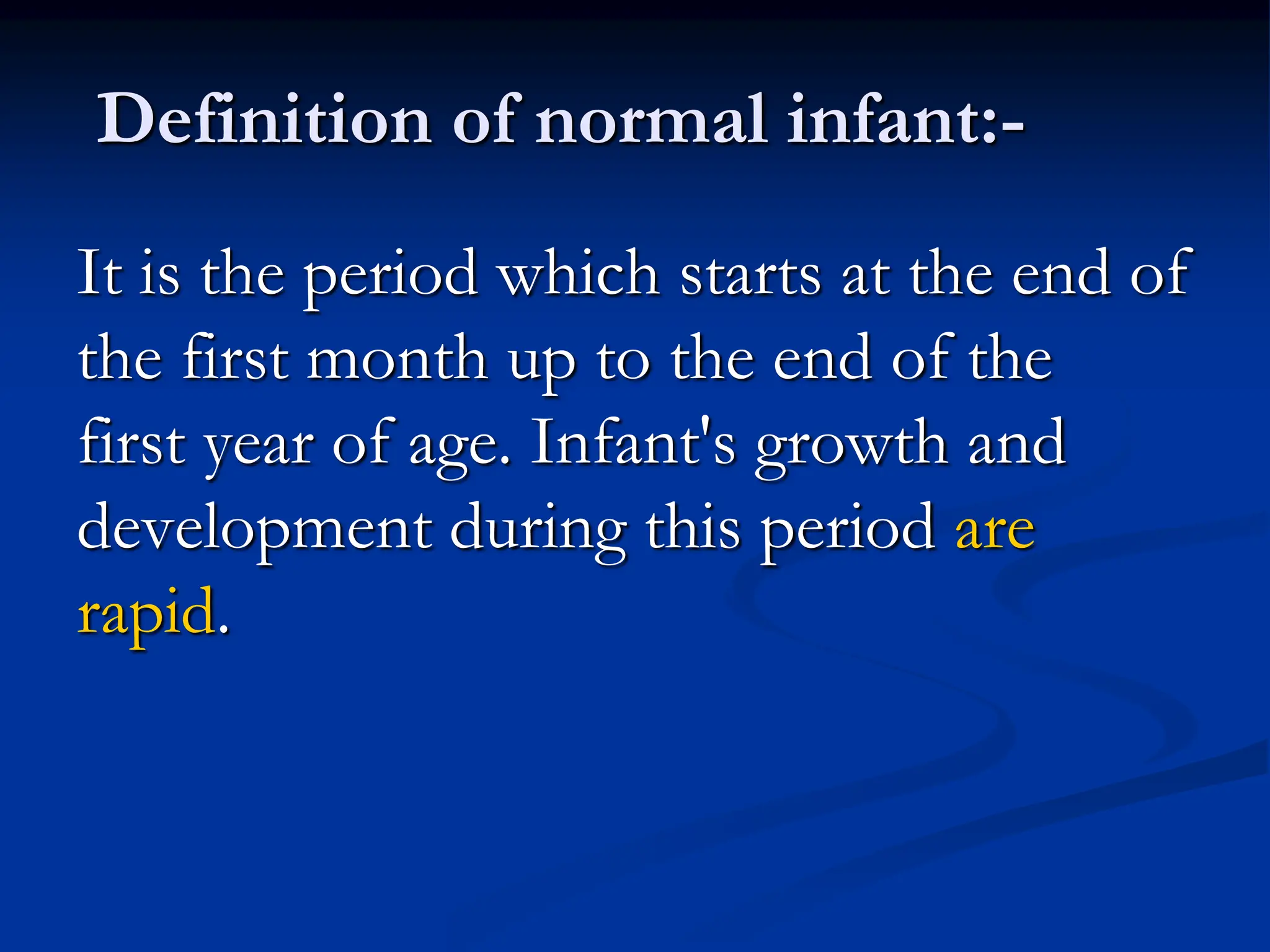
Definition of normal infant:-
It is the period which starts at the end of
the first month up to the end of the
first year of age. Infant's growth and
development during this period are
rapid.
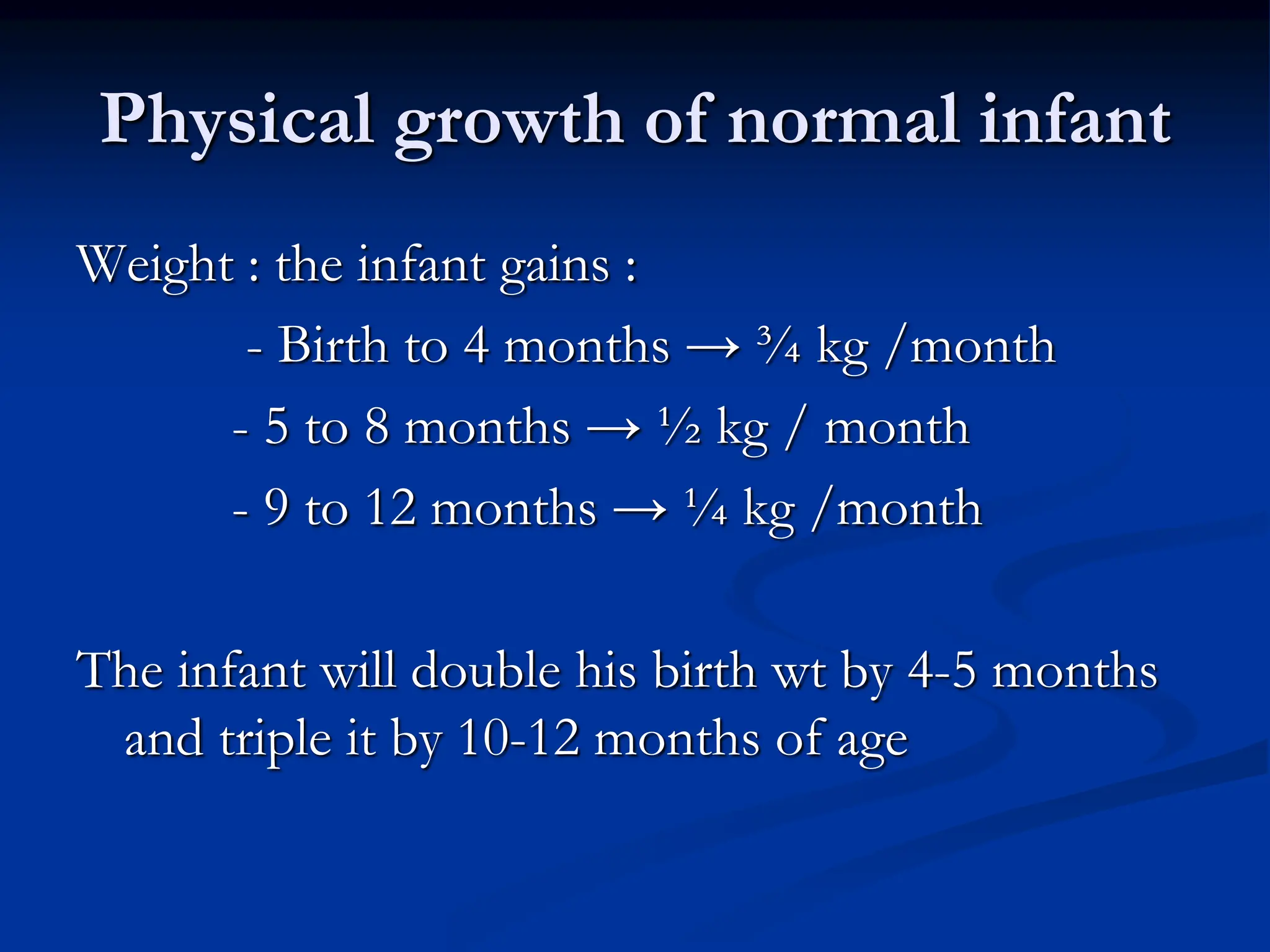
Physical growth of normal infant
Weight : the infant gains :
- Birth to 4 months → ¾ kg /month
- 5 to 8 months → ½ kg / month
- 9 to 12 months → ¼ kg /month
The infant will double his birth wt by 4-5 months
and triple it by 10-12 months of age
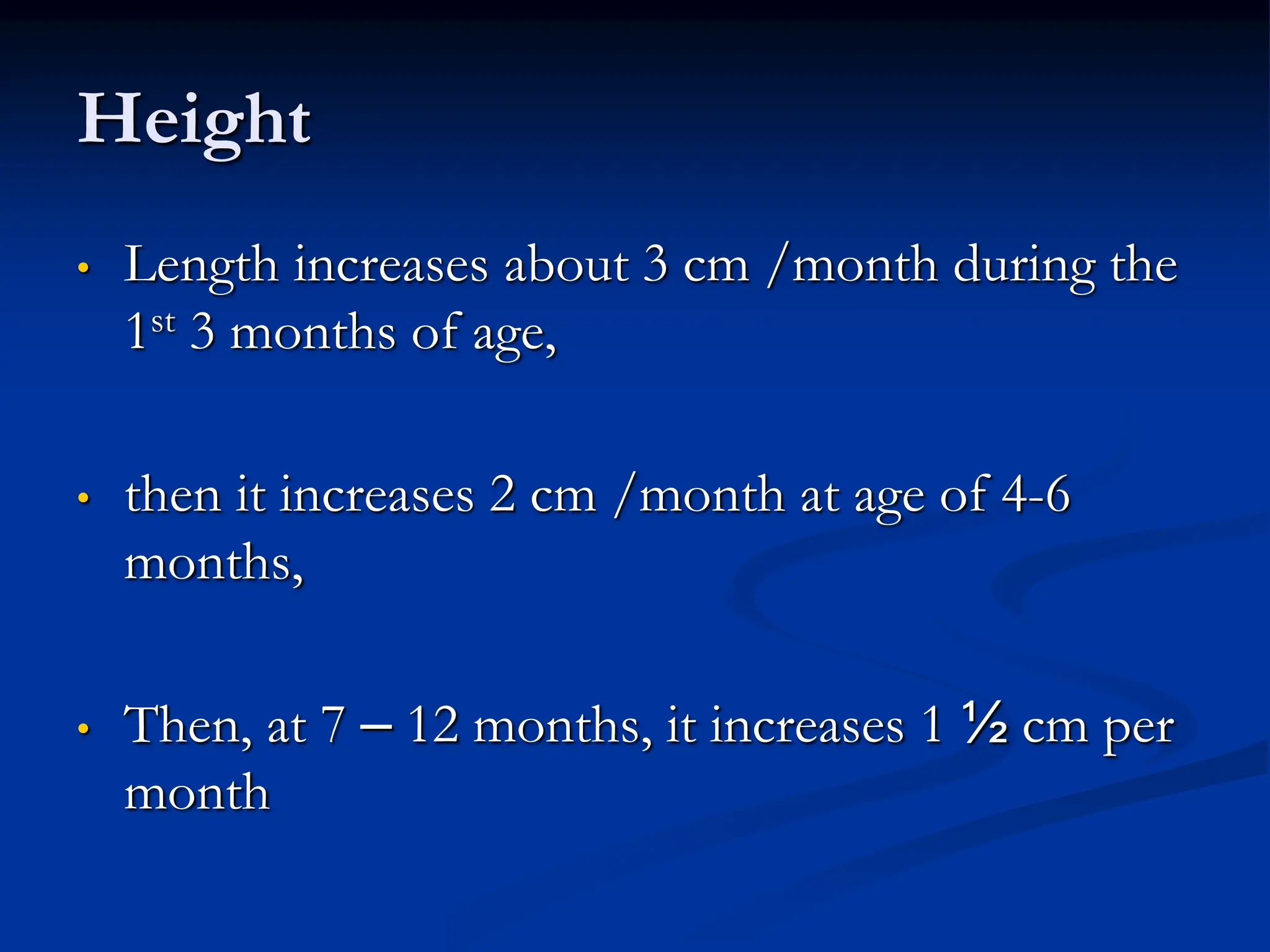
Height
• Length increases about 3 cm /month during the
1st 3 months of age,
• then it increases 2 cm /month at age of 4-6
months,
• Then, at 7 – 12 months, it increases 1 ½ cm per
month
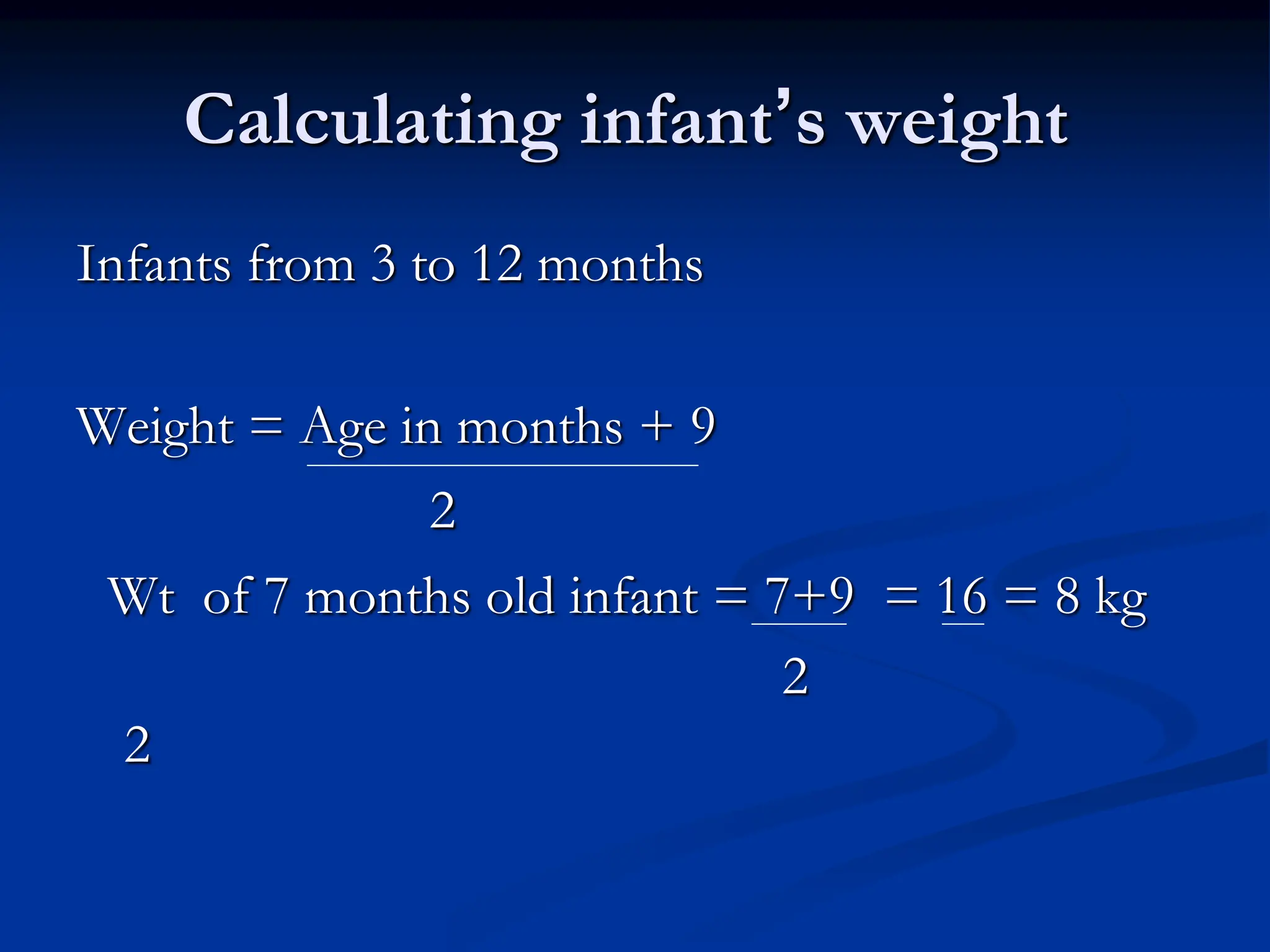
Calculating infant’s weight
Infants from 3 to 12 months
Weight = Age in months + 9
2
Wt of 7 months old infant = 7+9 = 16 = 8 kg
2
2
Head circumference
• It increases about 2 cm /month during the 1st 3
months,
• Then, ½ cm/month during the 2nd 9 months of
age.
• Posterior fontanel closes by 6-8 w of age.
• Anterior fontanel closes by 12-18 months of
age.
Chest circumference
By the end of the 1st year, it will be equal to head
circumference.
Physiological growth of infants:-
Pulse 110-150 b/min
Resp 35 ± 10 c/min
Breath through nose.
Blood pressure 80/50 ± 20/10 mmHg
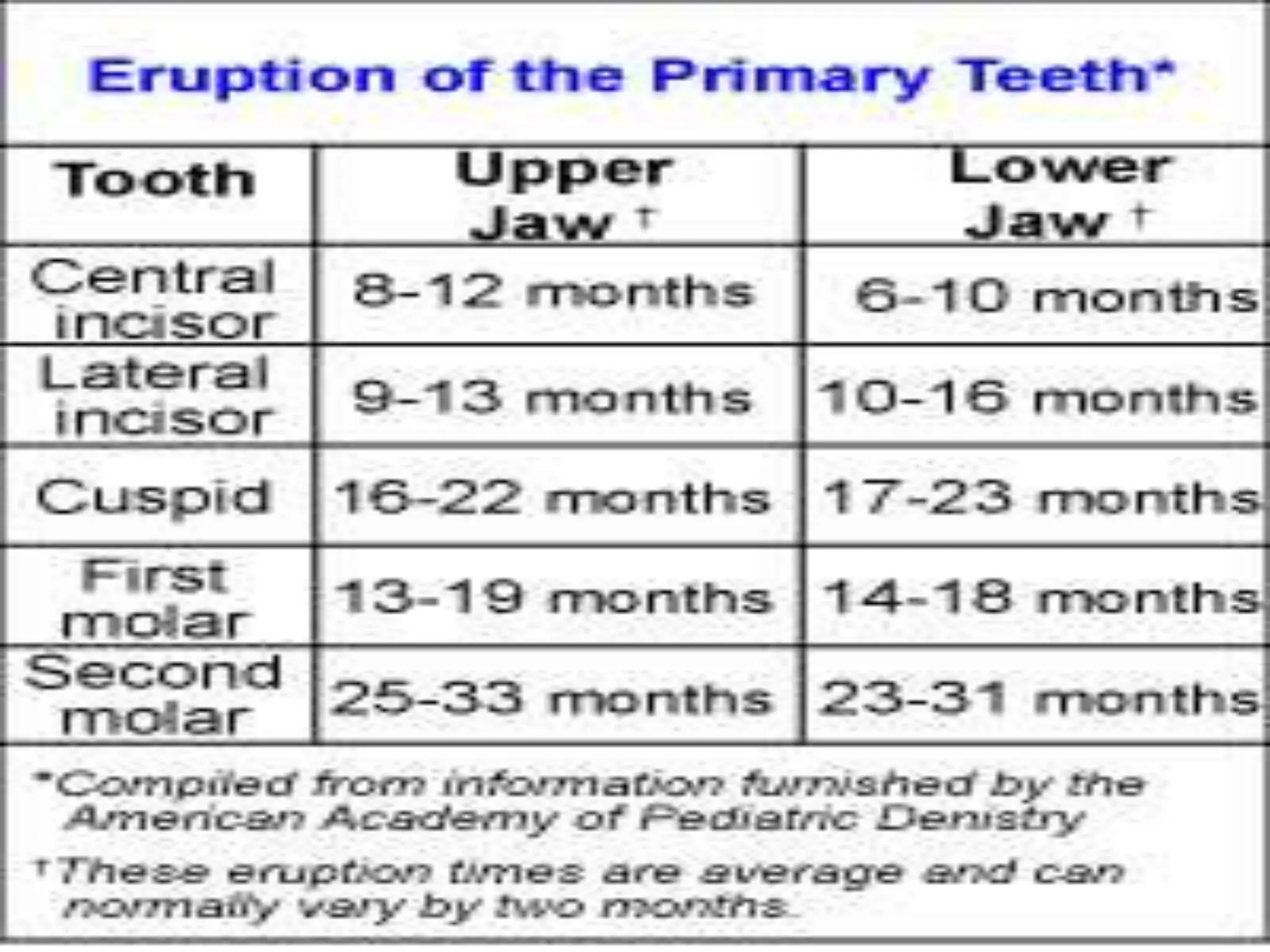
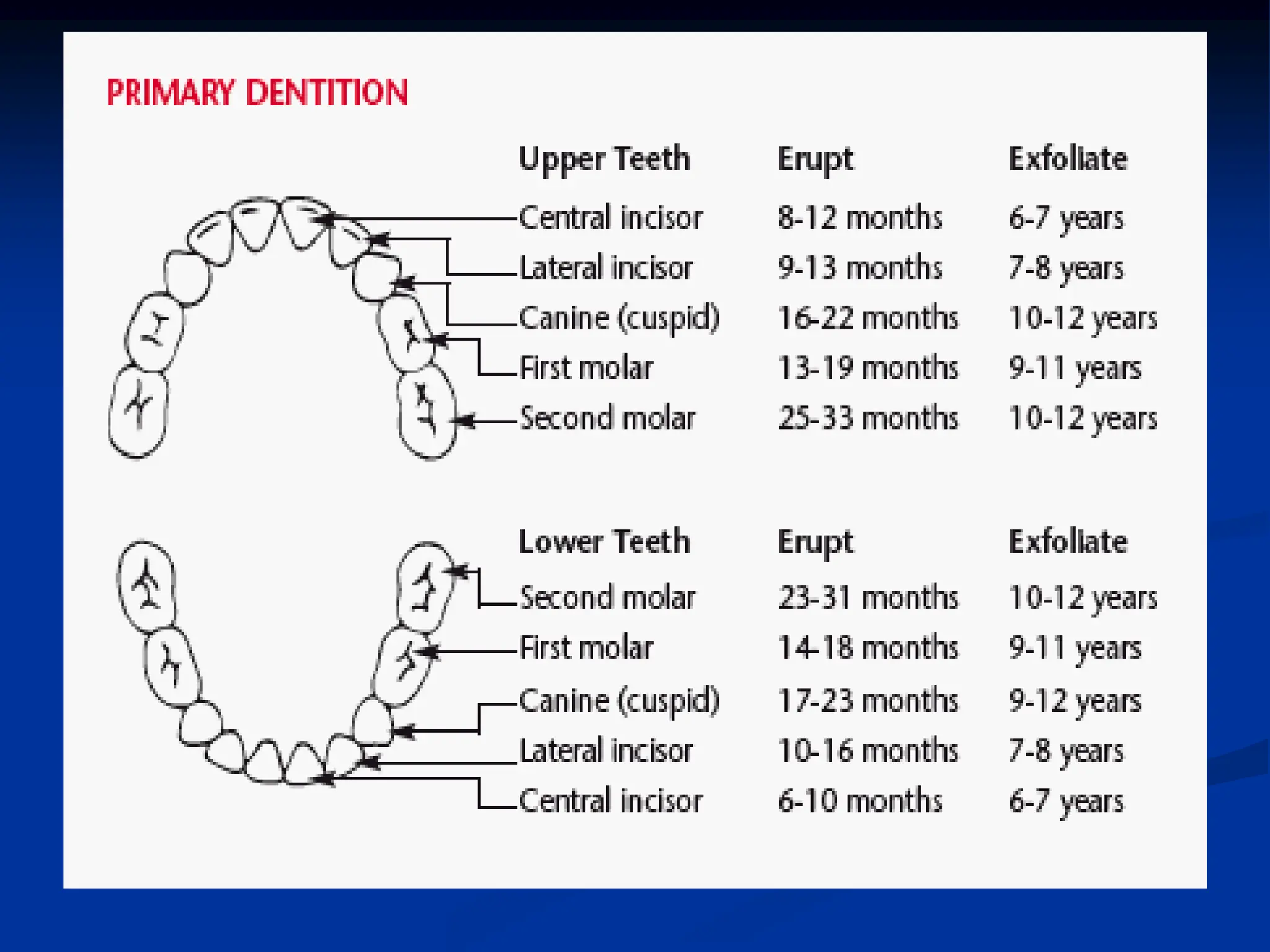
Dentition:
Eruption of teeth starts by 5–6 months of
age. It is called "Milky teeth" or
"Deciduous teeth" or "Temporary teeth".
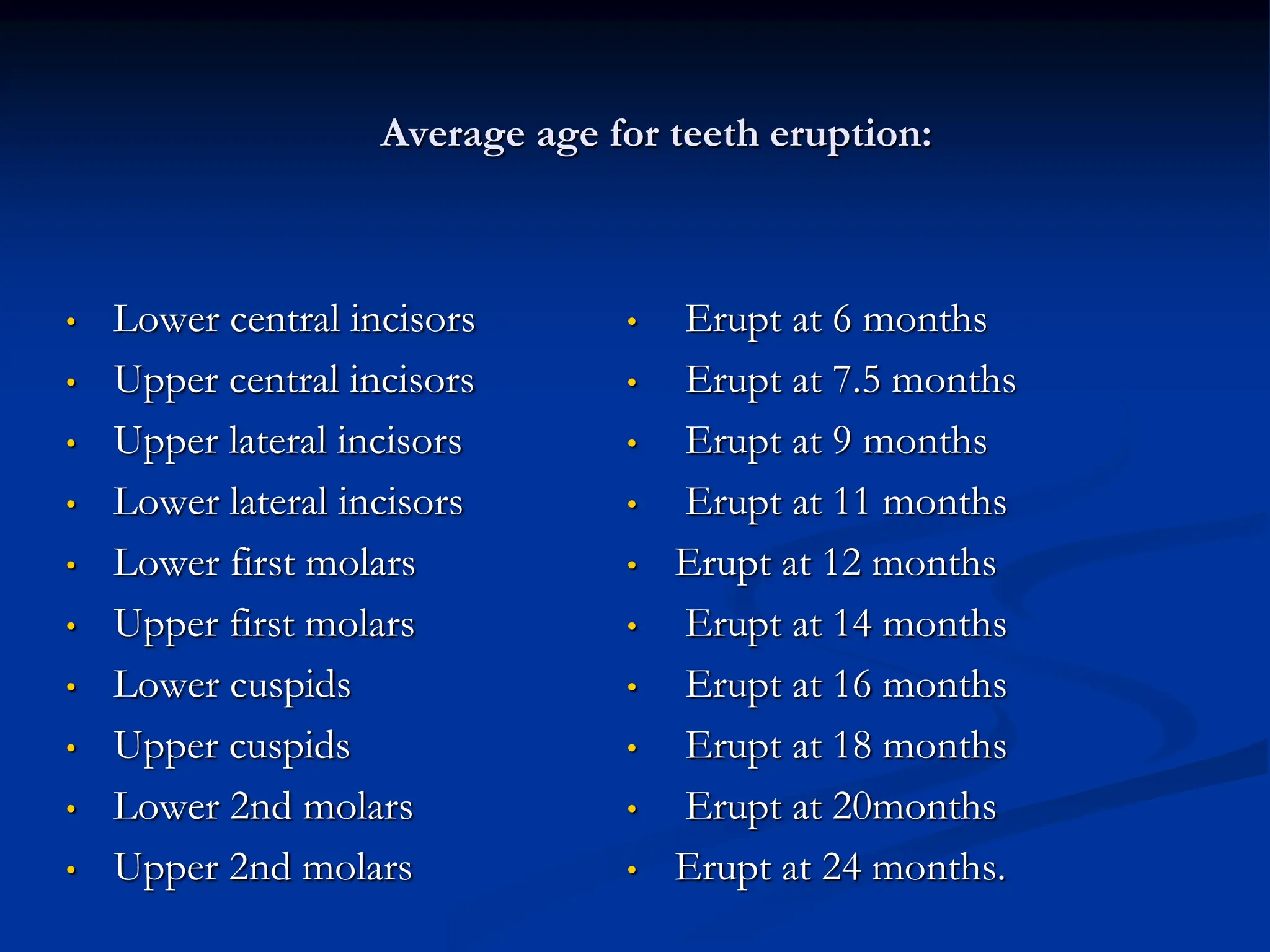
Average age for teeth eruption:
• Lower central incisors
• Upper central incisors
• Upper lateral incisors
• Lower lateral incisors
• Lower first molars
• Upper first molars
• Lower cuspids
• Upper cuspids
• Lower 2nd molars
• Upper 2nd molars
• Erupt at 6 months
• Erupt at 7.5 months
• Erupt at 9 months
• Erupt at 11 months
• Erupt at 12 months
• Erupt at 14 months
• Erupt at 16 months
• Erupt at 18 months
• Erupt at 20months
• Erupt at 24 months.
Motor Development
• At 2 months
• Hold head erects in mid-position.
• Turn from side back.
• At 3 months, the infant can
• Hold head erects and steady.
• Open or close hand loosely.
• Hold object put in hand
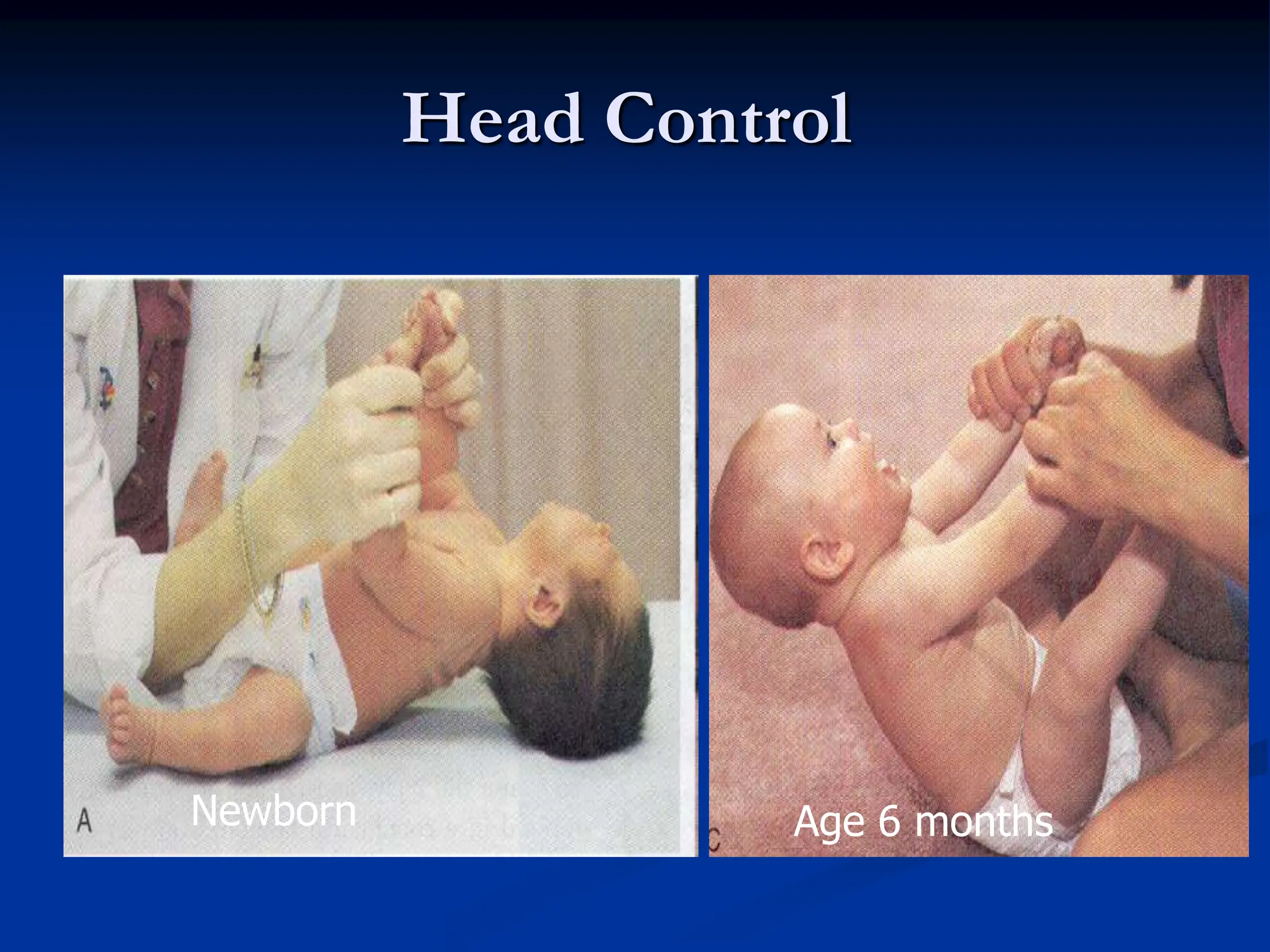
Head Control
Newborn Age 6 months
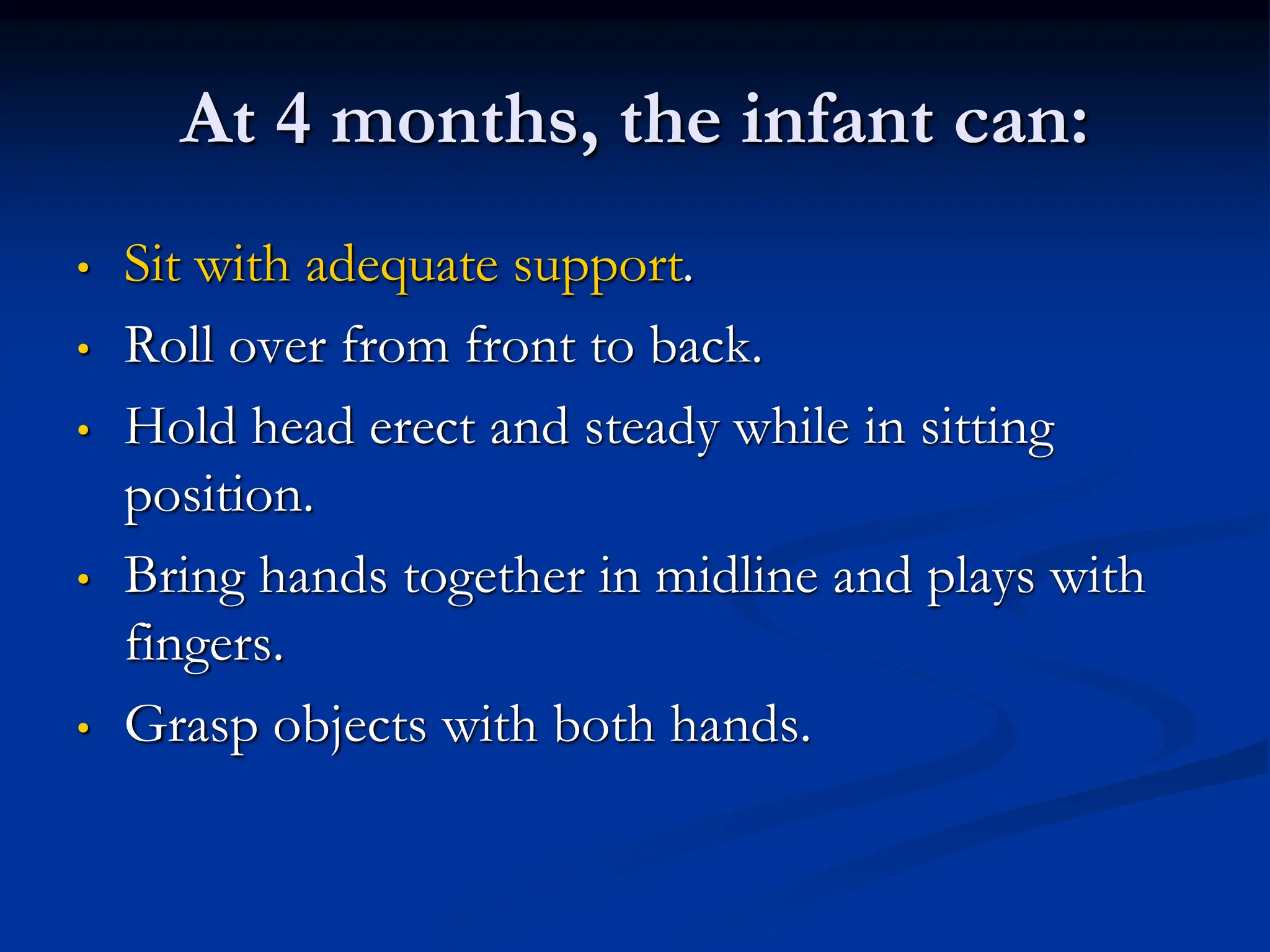
At 4 months, the infant can:
• Sit with adequate support.
• Roll over from front to back.
• Hold head erect and steady while in sitting
position.
• Bring hands together in midline and plays with
fingers.
• Grasp objects with both hands.
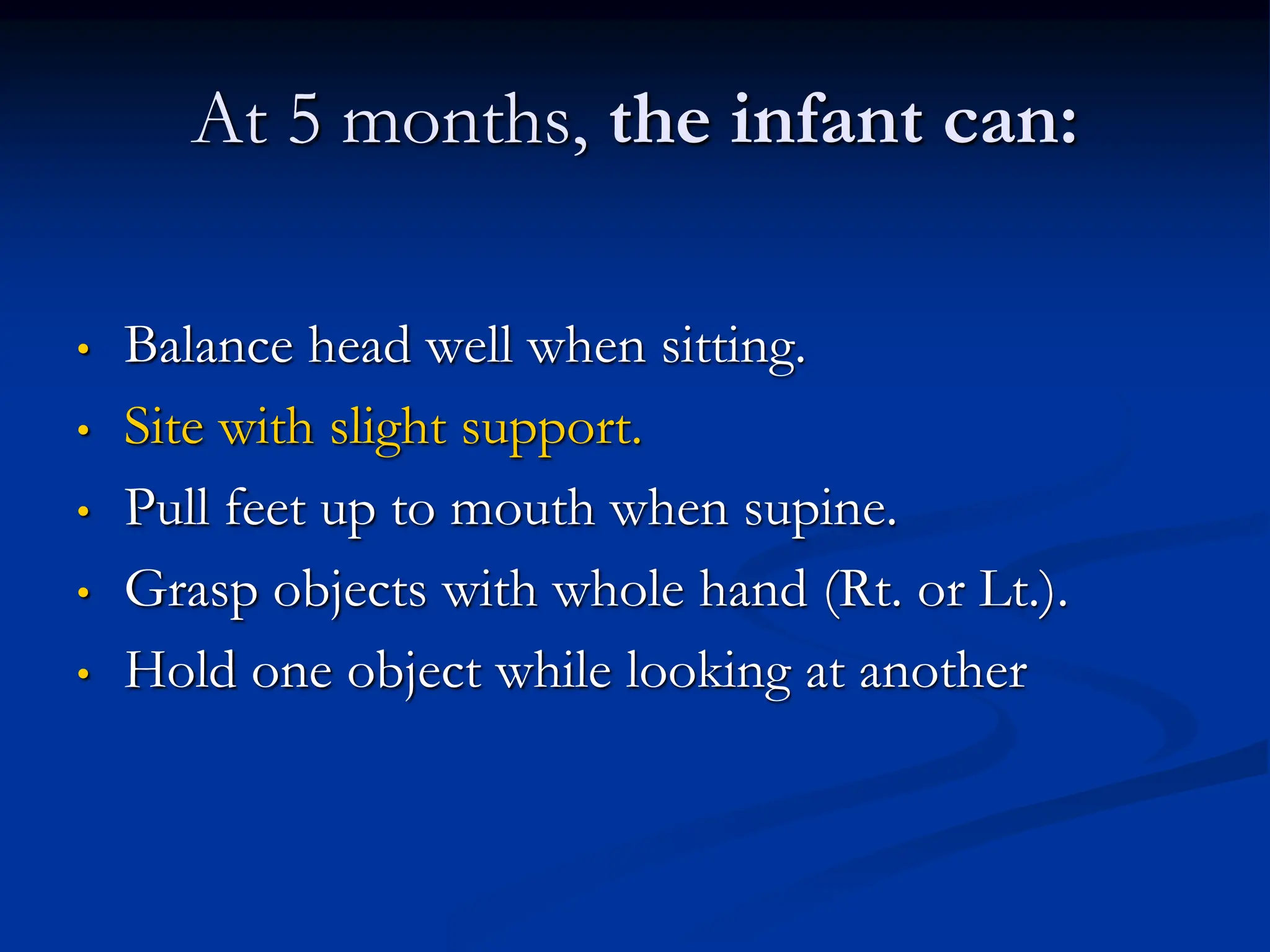
At 5 months, the infant can:
• Balance head well when sitting.
• Site with slight support.
• Pull feet up to mouth when supine.
• Grasp objects with whole hand (Rt. or Lt.).
• Hold one object while looking at another
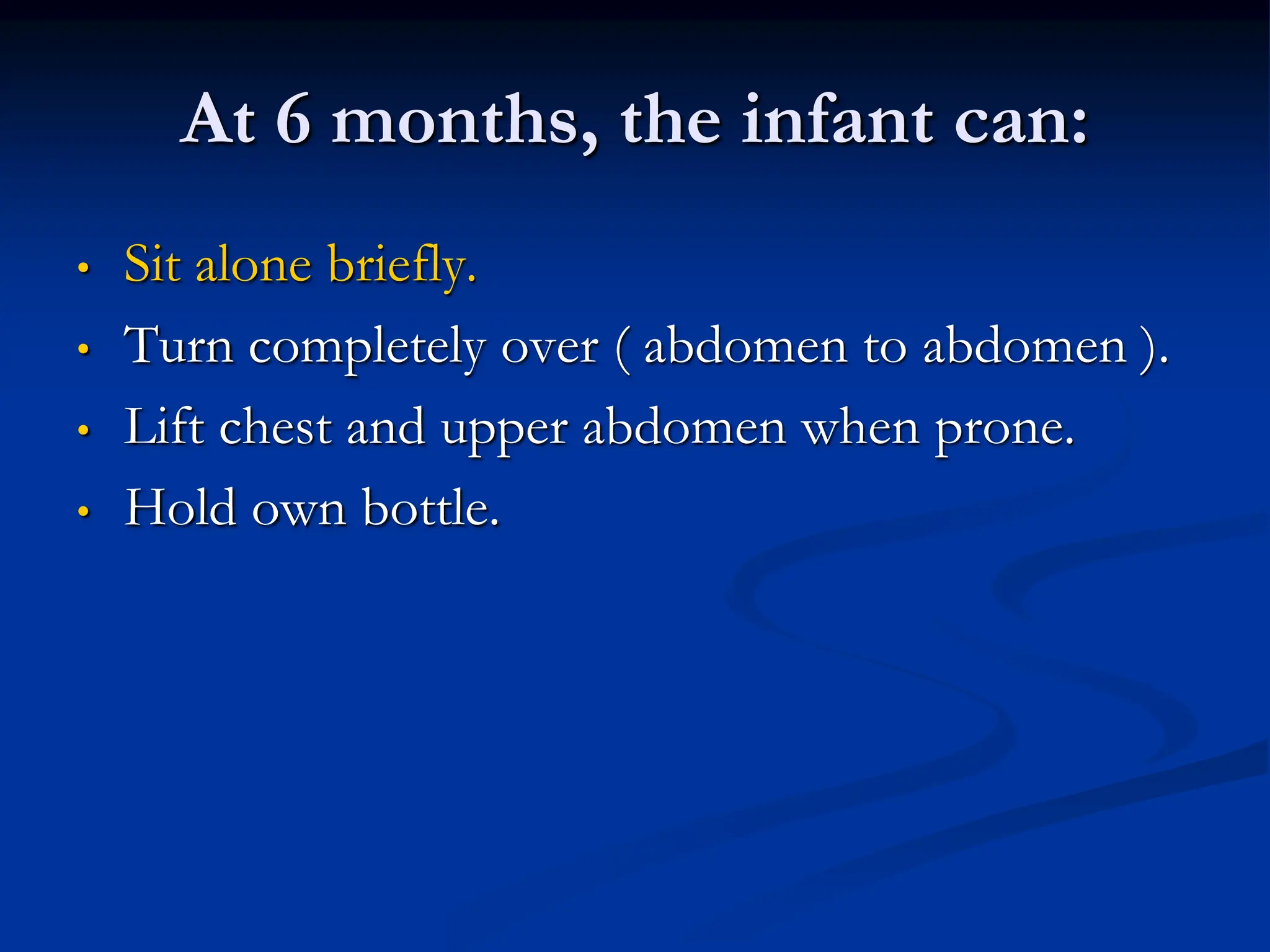
At 6 months, the infant can:
• Sit alone briefly.
• Turn completely over ( abdomen to abdomen ).
• Lift chest and upper abdomen when prone.
• Hold own bottle.
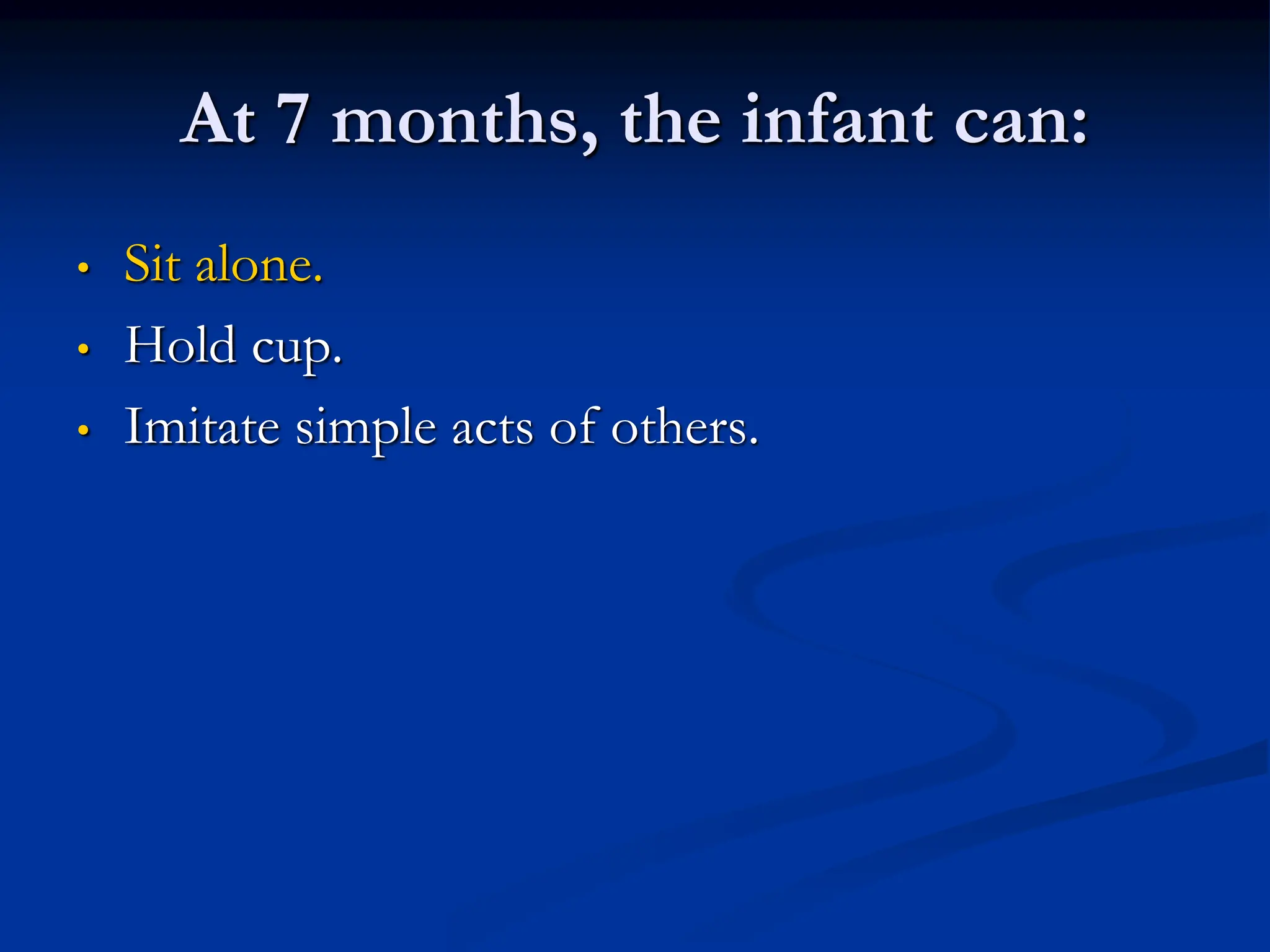
At 7 months, the infant can:
• Sit alone.
• Hold cup.
• Imitate simple acts of others.
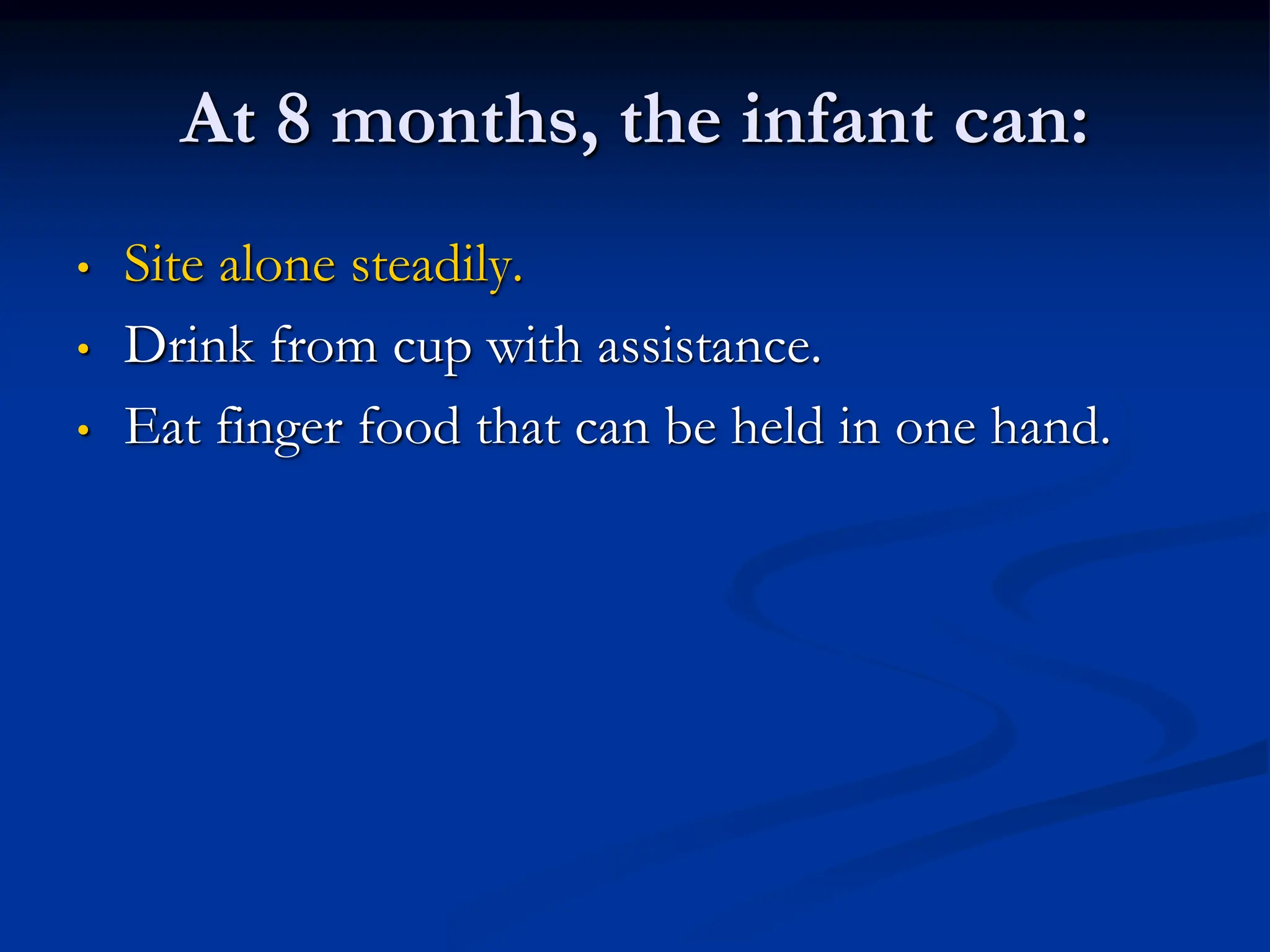
At 8 months, the infant can:
• Site alone steadily.
• Drink from cup with assistance.
• Eat finger food that can be held in one hand.
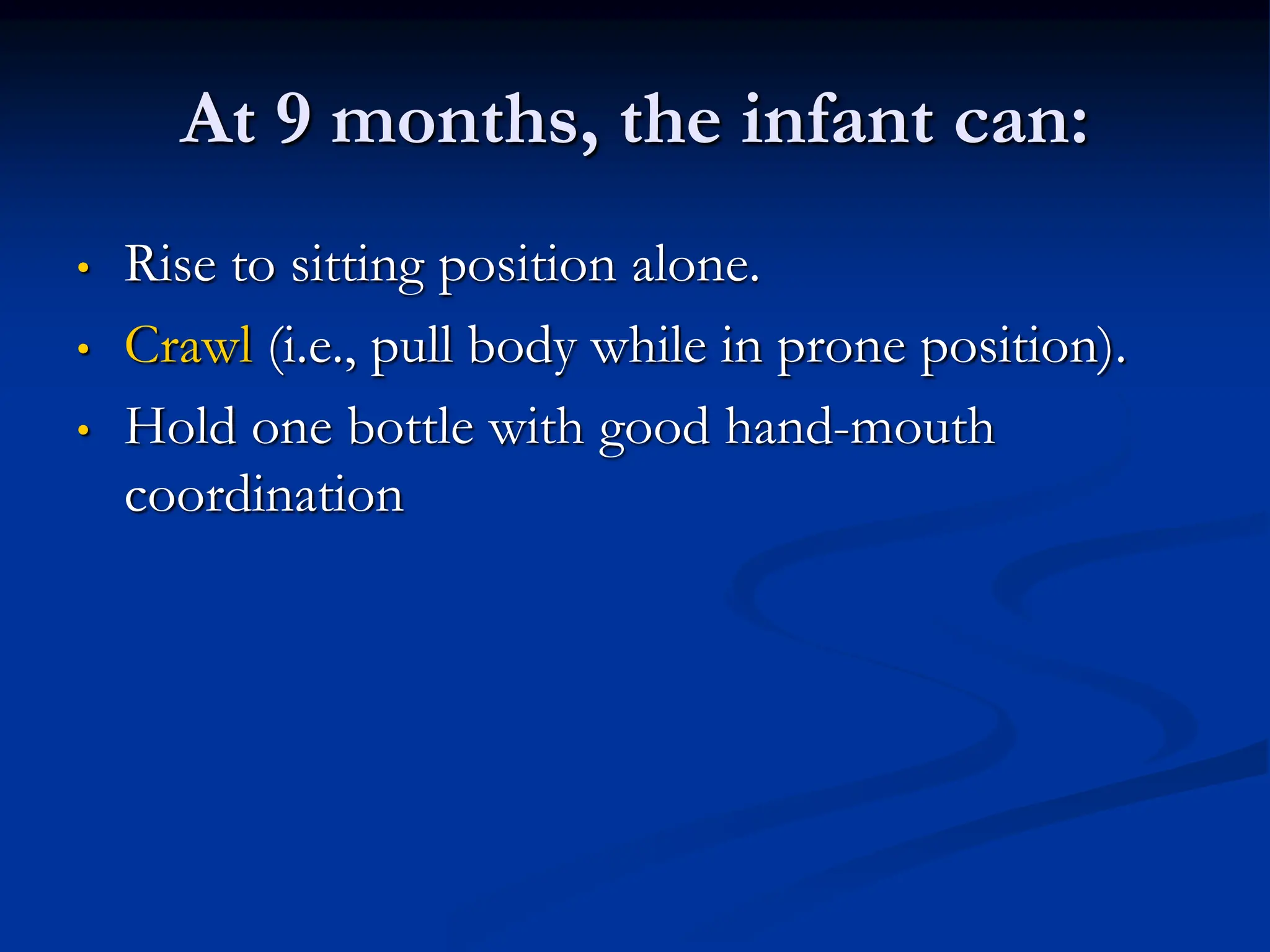
At 9 months, the infant can:
• Rise to sitting position alone.
• Crawl (i.e., pull body while in prone position).
• Hold one bottle with good hand-mouth
coordination
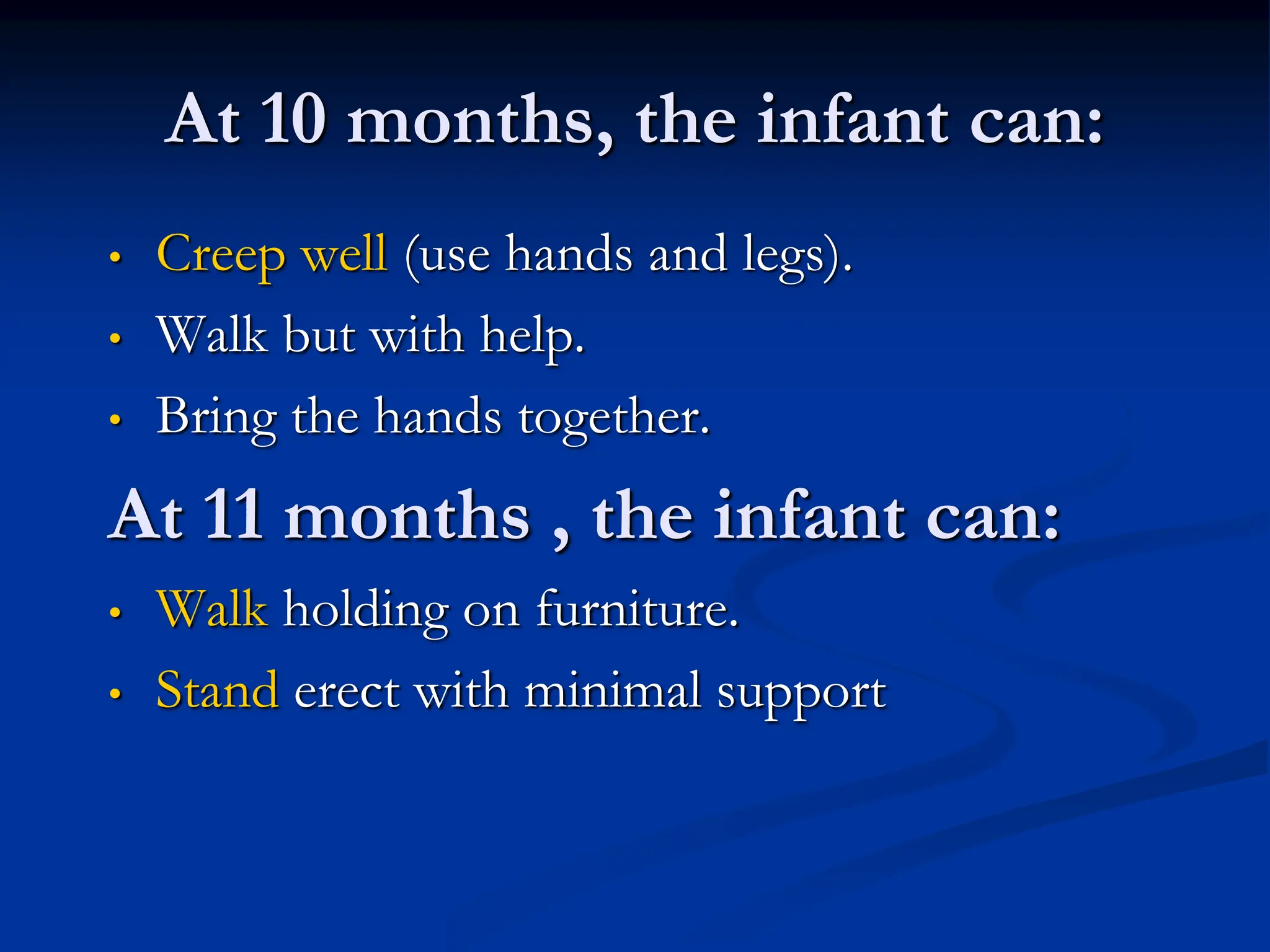
At 10 months, the infant can:
• Creep well (use hands and legs).
• Walk but with help.
• Bring the hands together.
At 11 months , the infant can:
• Walk holding on furniture.
• Stand erect with minimal support
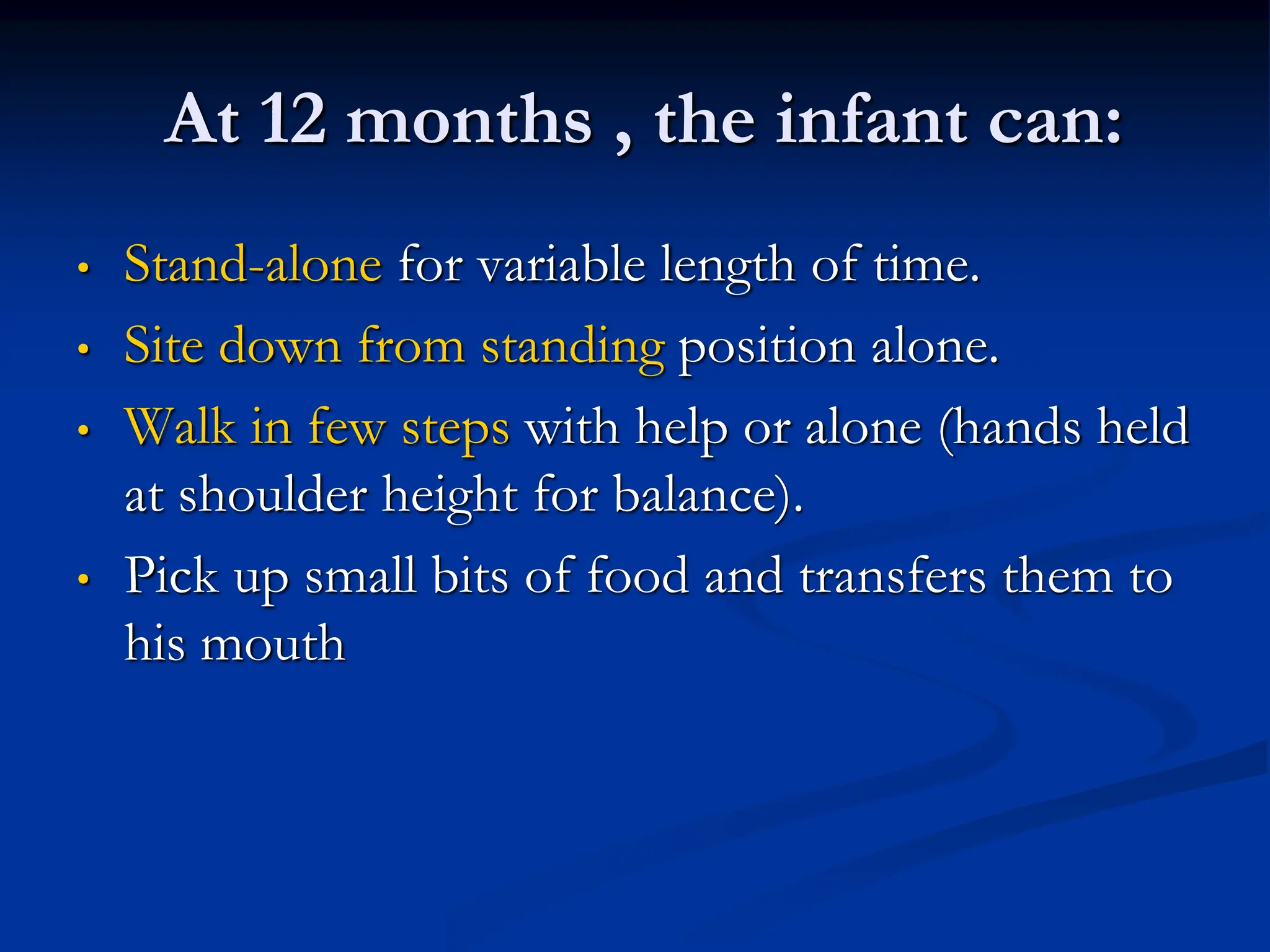
At 12 months , the infant can:
• Stand-alone for variable length of time.
• Site down from standing position alone.
• Walk in few steps with help or alone (hands held
at shoulder height for balance).
• Pick up small bits of food and transfers them to
his mouth
Ambulation(motor growth)
• 9 month old: crawl
• 10 month old: creep
• 1 year: stand independently from a crawl &
creep position
• 13 month old: walk and toddle quickly
• 15 month old: can run
Emotional development:
• His emotions are instable, where it is rapidly
changes from crying to laughter.
• His affection for or love family members
appears.
• By 10 months, he expresses several beginning
recognizable emotions, such as anger, sadness,
pleasure, jealousy, anxiety and affection.
• By 12 months of age, these emotions are clearly
distinguishable.
Social development
• He learns that crying brings attention.
• The infant smiles in response to smile of others.
• The infant shows fear of stranger (stranger anxiety).
• He responds socially to his name.
• According to Erikson, the infant develops
sense of trust. Through the infant's interaction with
caregiver (mainly the mother), especially during feeding,
he learns to trust others through the relief of basic
needs.
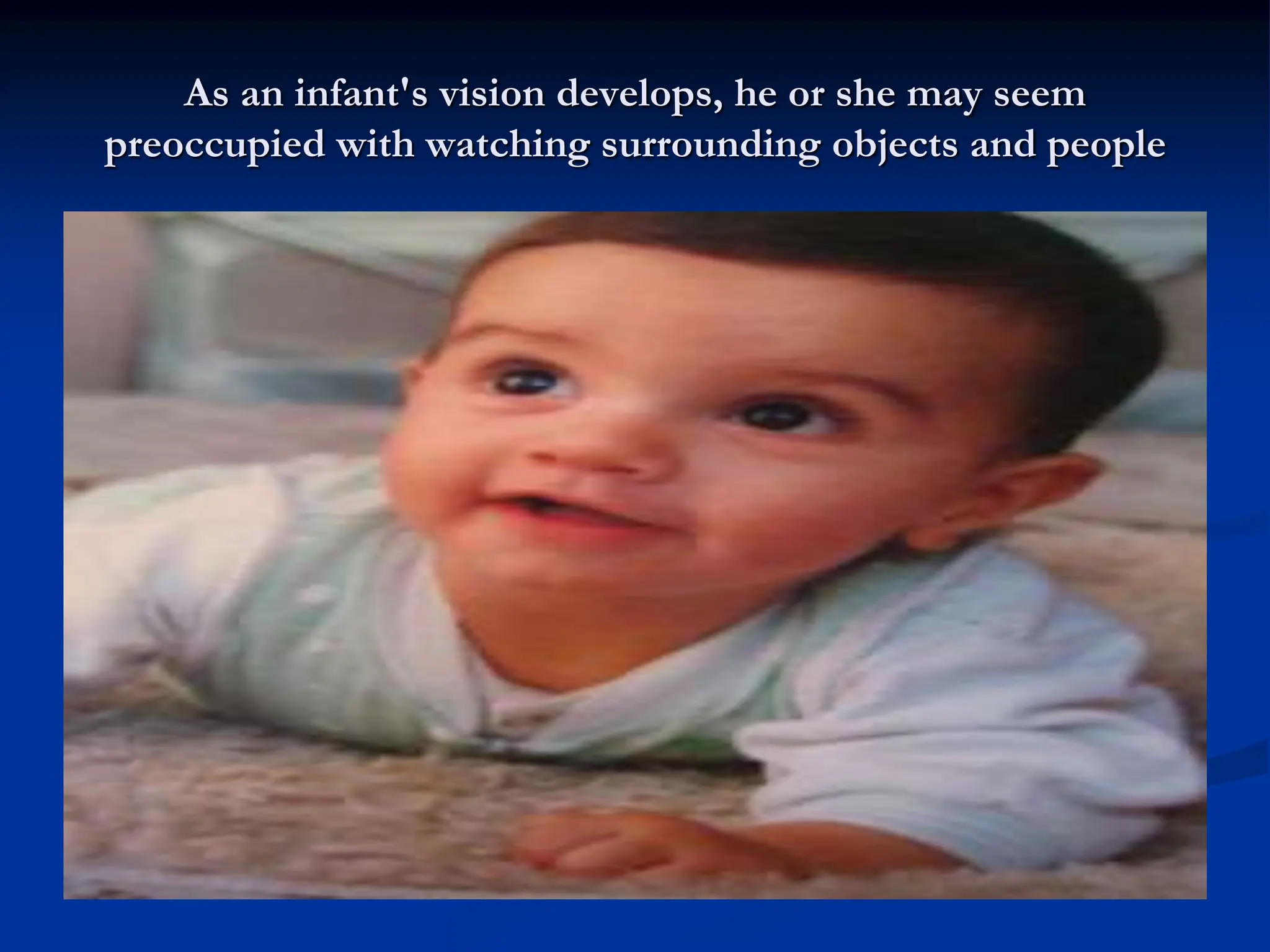
As an infant's vision develops, he or she may seem
preoccupied with watching surrounding objects and people
Speech Milestones
• 1-2 months: coos
• 2-6 months: laughs and squeals
• 8-9 months babbles: mama/dada as sounds
• 10-12 months: “mama/dada specific
• 18-20 months: 20 to 30 words – 50% understood by
strangers
• 22-24 months: two word sentences, >50 words, 75%
understood by strangers
• 30-36 months: almost all speech understood by
strangers
Hearing
• BAER hearing test done at birth
• Ability to hear correlates with ability enunciate words
properly
• Always ask about history of otitis media – ear aiding
devices.
• Early referral to MD to assess for possible fluid in ears
(effusion)
• Repeat hearing screening test
• Speech therapist as needed
Red Flags in infant development
• Unable to sit alone by age 9 months
• Unable to transfer objects from hand to hand by
age 1 year
• Abnormal pincer grip or grasp by age 15 months
• Unable to walk alone by 18 months
• Failure to speak recognizable words by 2 years.
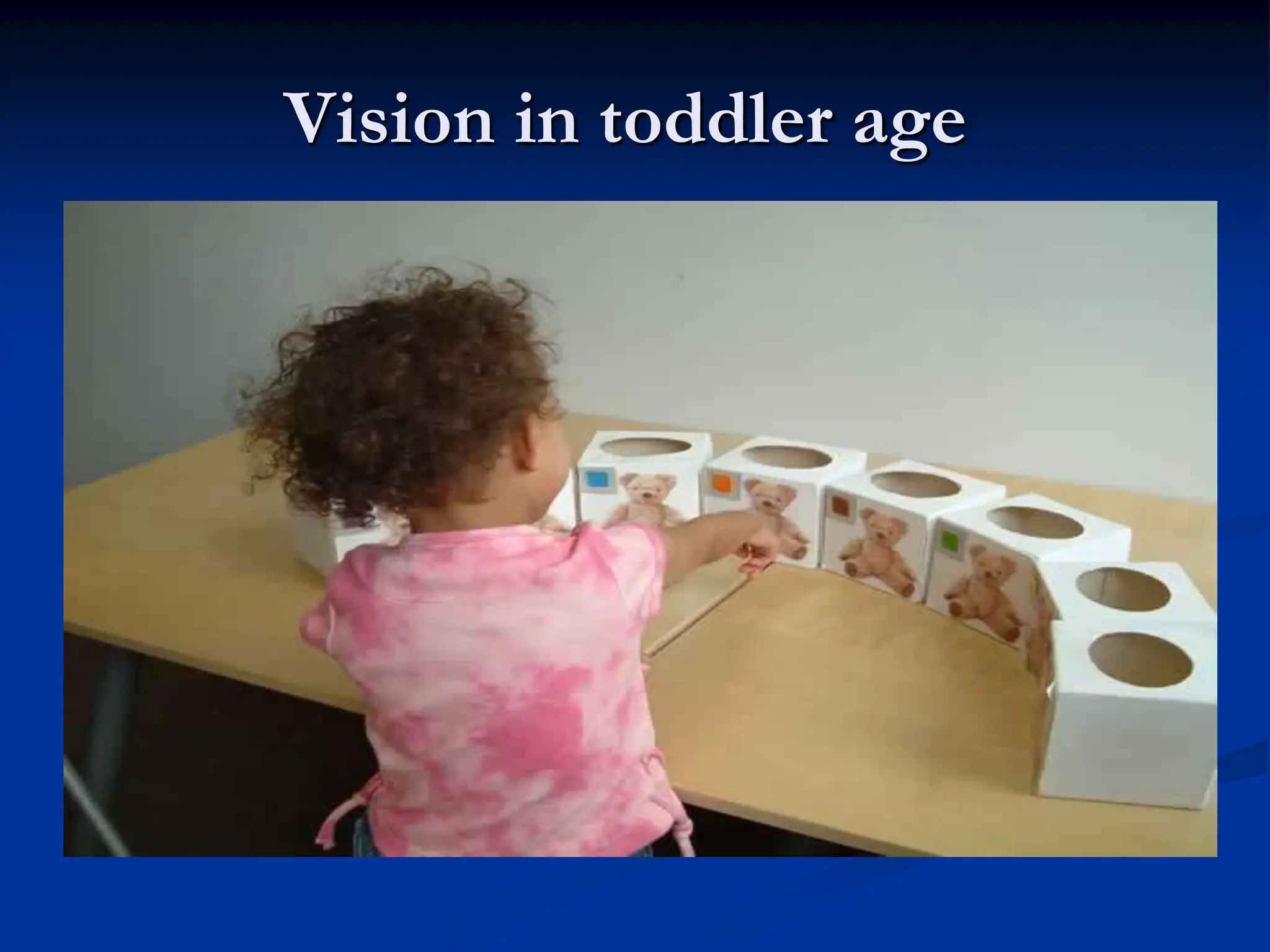
Vision in toddler age
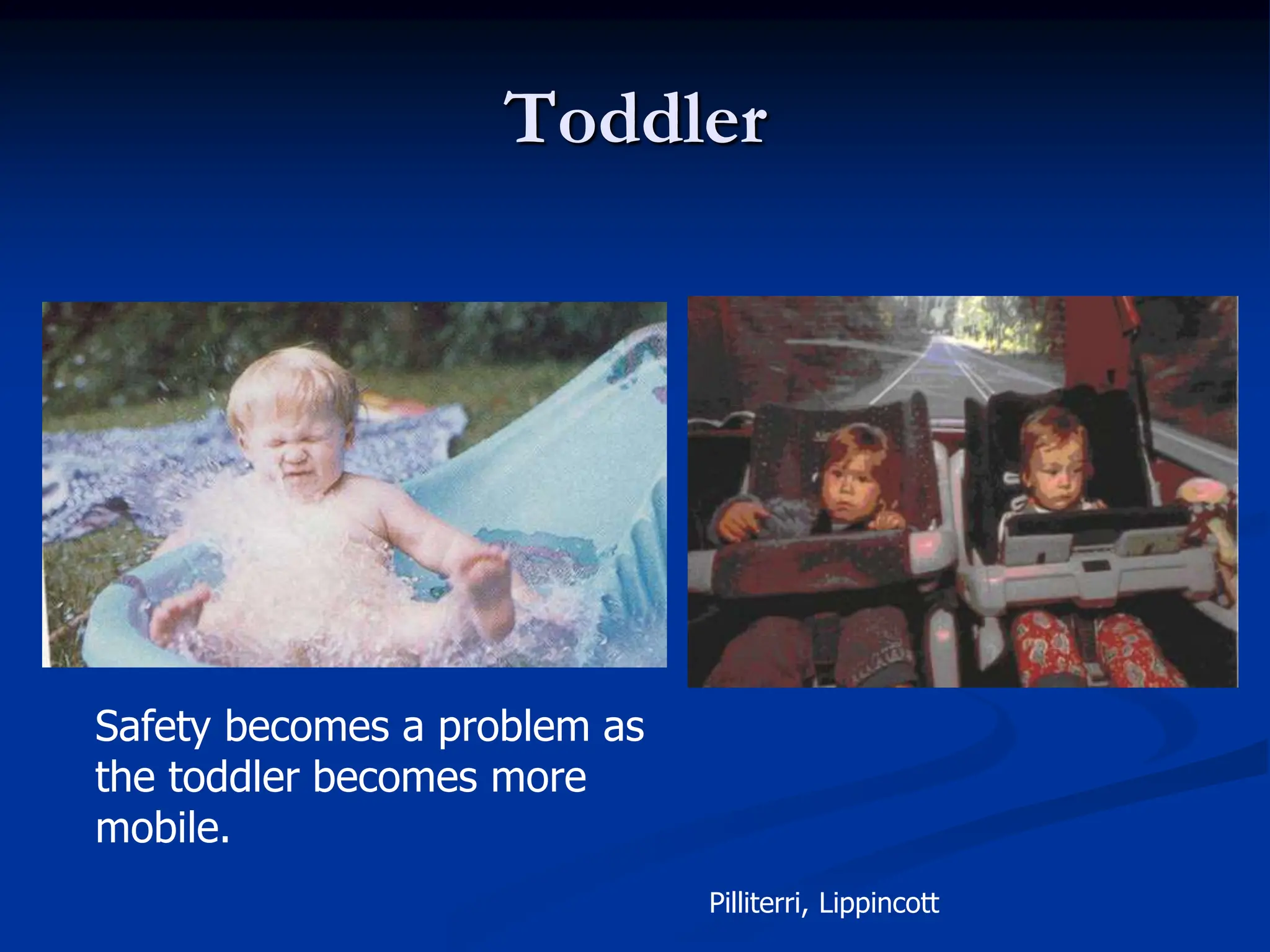
Toddler
Safety becomes a problem as
the toddler becomes more
mobile.
Pilliterri, Lippincott
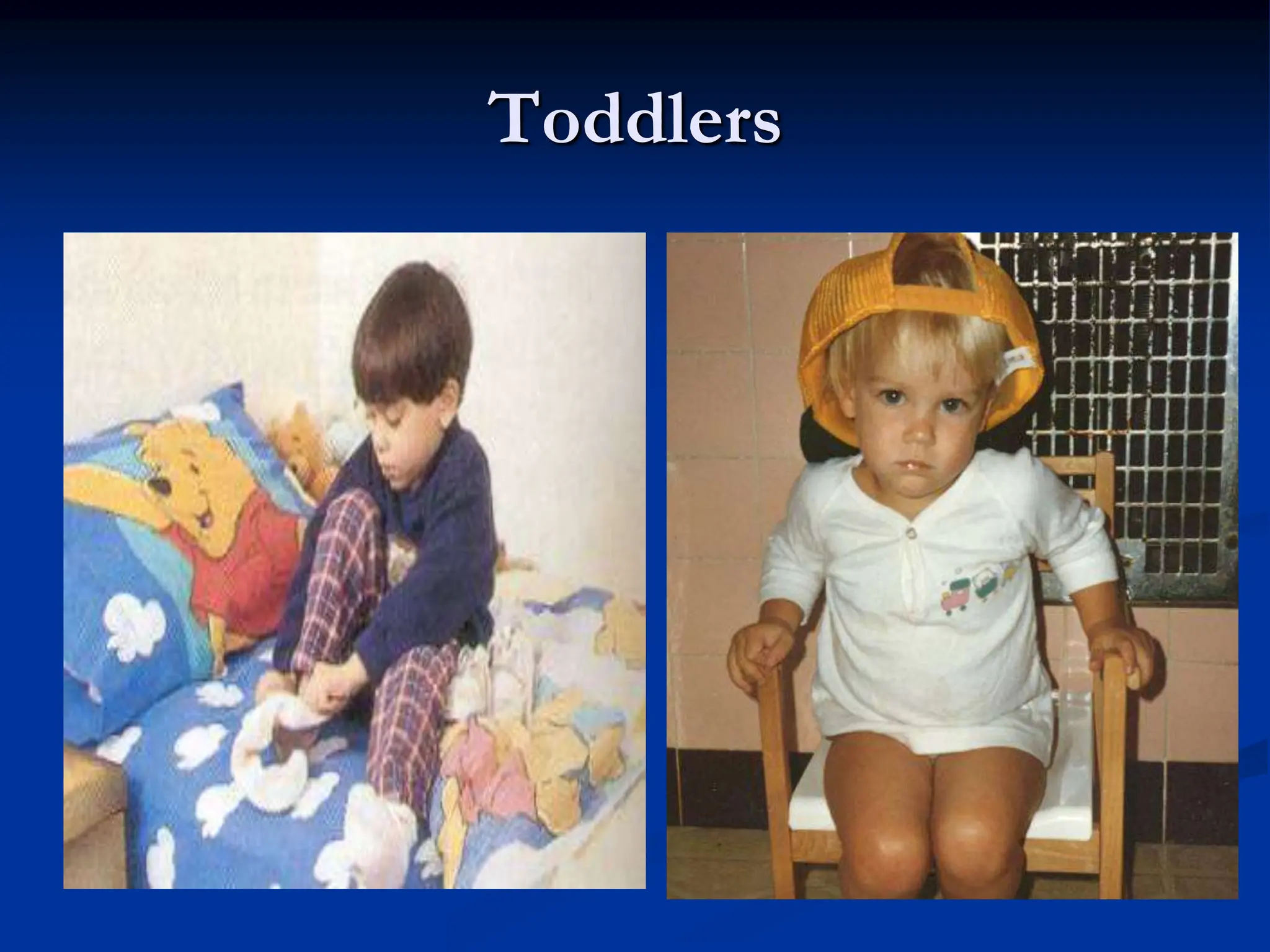
Toddlers
Normal toddler:
Toddler stage is between 1 to 3
years of age. During this period,
growth slows considerably.
Social development:
• The toddler is very social being but still
egocentric.
• He imitates parents.
• Notice sex differences and know own sex.
• According to Erikson,
• The development of autonomy during this
period is centered around toddlers increasing
abilities to control their bodies, themselves and
their environment i.e., "I can do it myself".
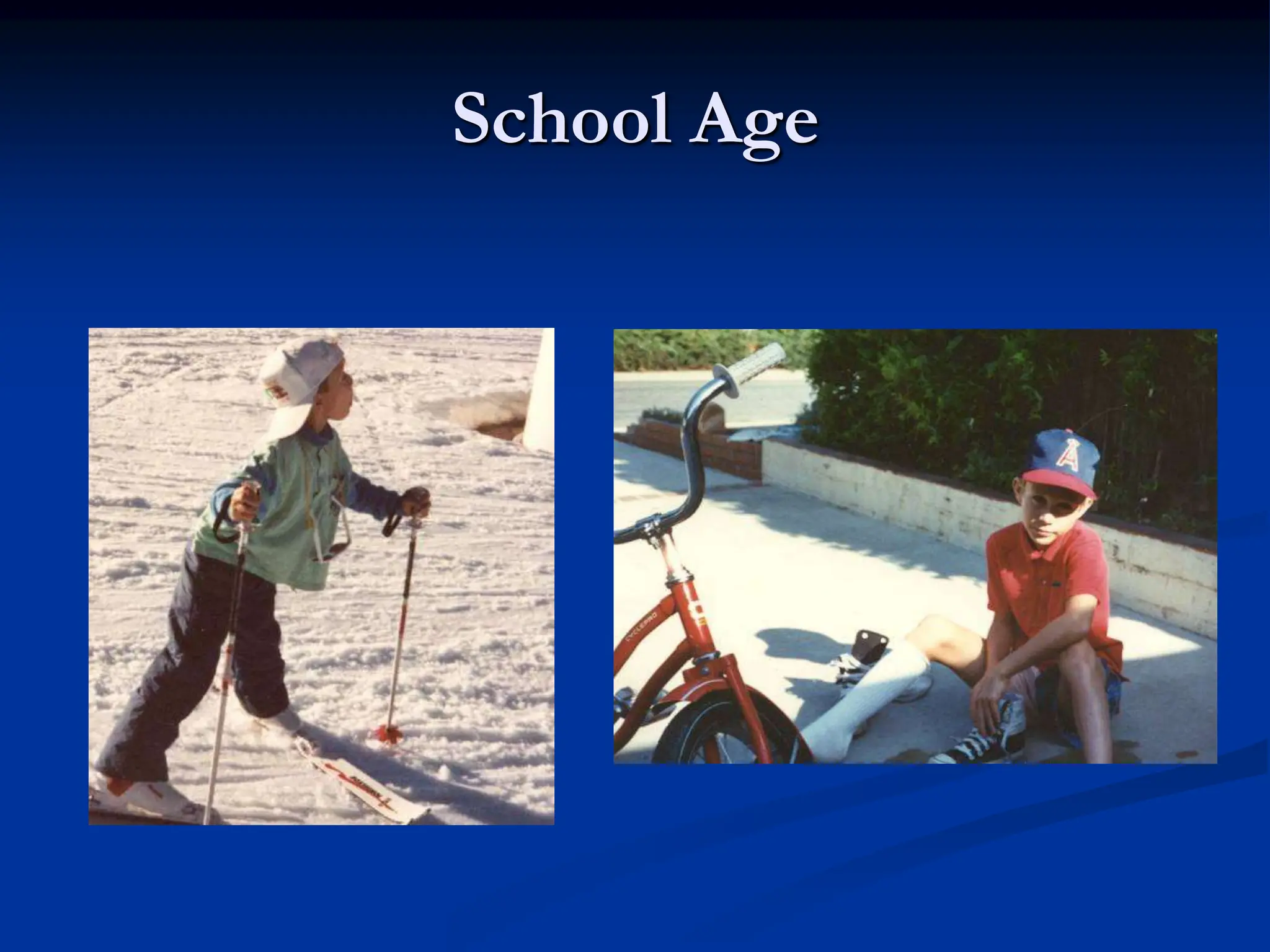
School Age: gross motor
• 8 to 10 years: team sports
• Age ten: match sport to the
physical and emotional
development
School performance
• Ask about favorite subject
• How they are doing in school
• Do they like school
• By parent report: any learning difficulties,
attention problems, homework
• Parental expectations
School Age
School Age: cognitive development
At 7-11 years, the child now is in the
concrete operational stage of cognitive
development. He is able to function on a
higher level in his mental ability.
Greater ability to concentrate and participate
in self-initiating quiet activities that challenge
cognitive skills, such as reading, playing
computer and board games.
Emotional development
The school–age child:
• Fears injury to body and fear of dark.
• Jealous of siblings (especially 6–8 years old
child).
• Curious about everything.
• Has short bursts of anger by age of 10 years
but able to control anger by 12 years.
Social development
The school–age child is :
• Continues to be egocentric.
• Wants other children to play with him.
• Insists on being first in every thing
• Becomes peer oriented.
• Improves relationship with siblings.
• Has greater self–control, confident, sincere.
• Respects parents and their role.
• Joints group (formal and informal).
• Engage in tasks in the real world.
Red flags: school age
• School failure
• Lack of friends
• Social isolation
• Aggressive behavior: fights, fire setting,
animal abuse
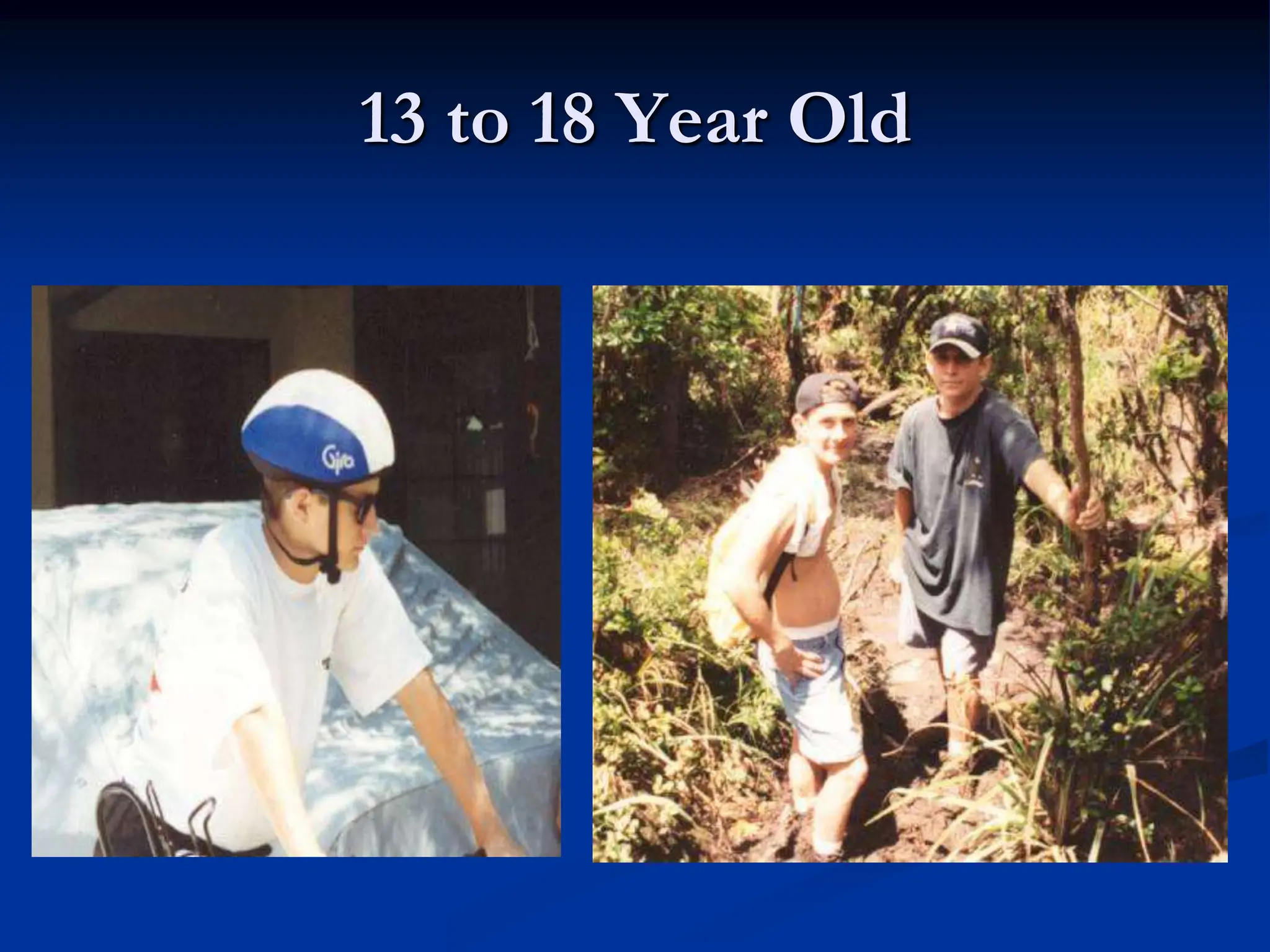
13 to 18 Year Old
Adolescent age
• Physical growth
• Physiological growth
• Secondary sex characteristics
• Cognitive development
• Emotional development
• Social development
Definition of adolescent:
Adolescence is a transition period from
childhood to adulthood. Its is based on
childhood experiences and
accomplishments.
It begins with the appearance of secondary
sex characteristics and ends when somatic
growth is completed and the individual is
psychological mature.
Physical growth:
Weight:
• Growth spurt begins earlier in girls (10–14 years, while
it is 12–16 in boys).
• Males gains 7 to 30kg, while female gains 7 to 25kg.
Height:
• By the age of 13, the adolescent triples his birth length.
• Males gains 10 to 30cm in height.
• Females gains less height than males as they gain 5 to
20cm.
• Growth in height ceases at 16 or 17 years in females
and 18 to 20in males
Physiological growth:
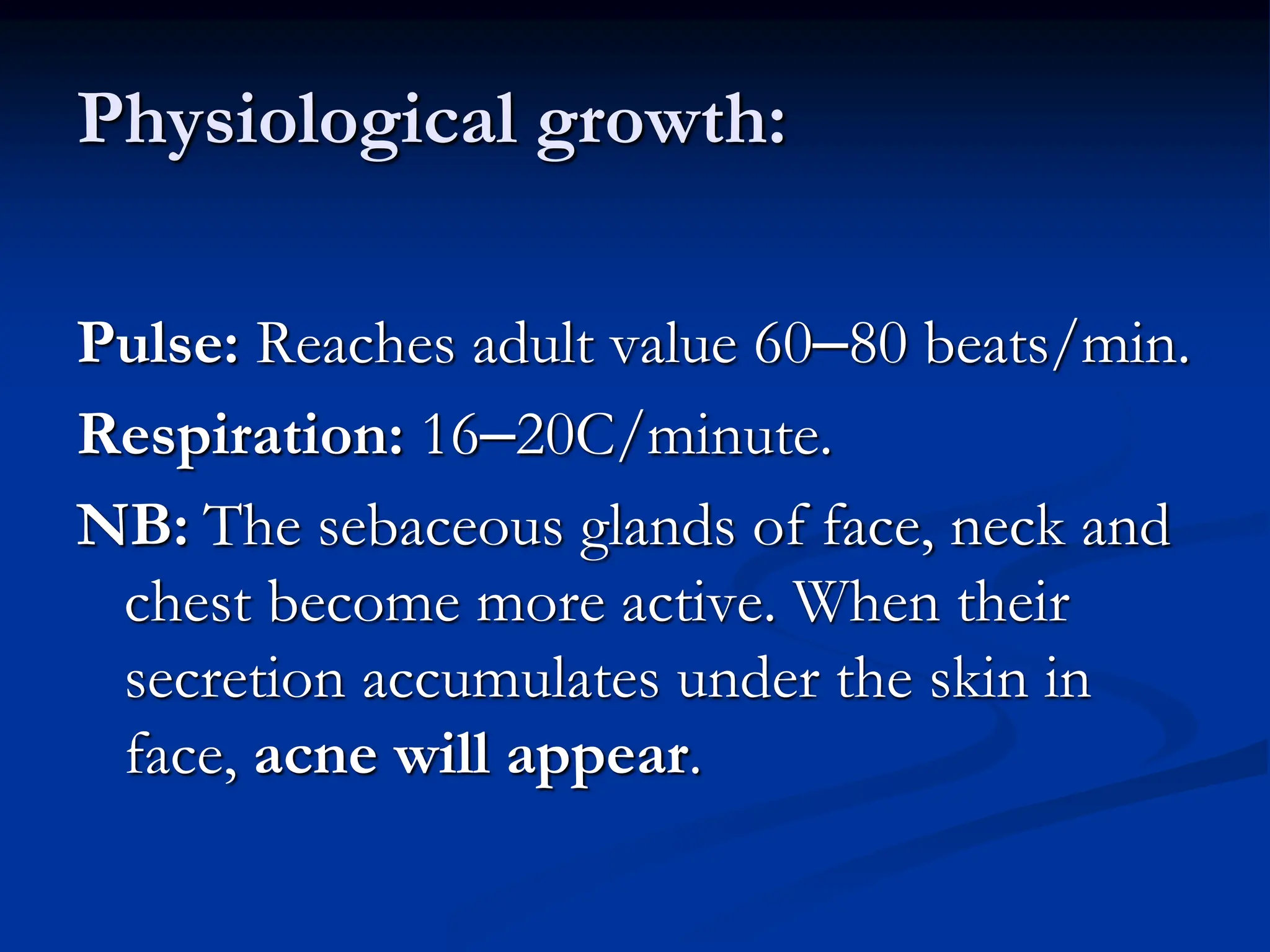
Pulse: Reaches adult value 60–80 beats/min.
Respiration: 16–20C/minute.
NB: The sebaceous glands of face, neck and
chest become more active. When their
secretion accumulates under the skin in
face, acne will appear.
Appearance of secondary sex characteristics
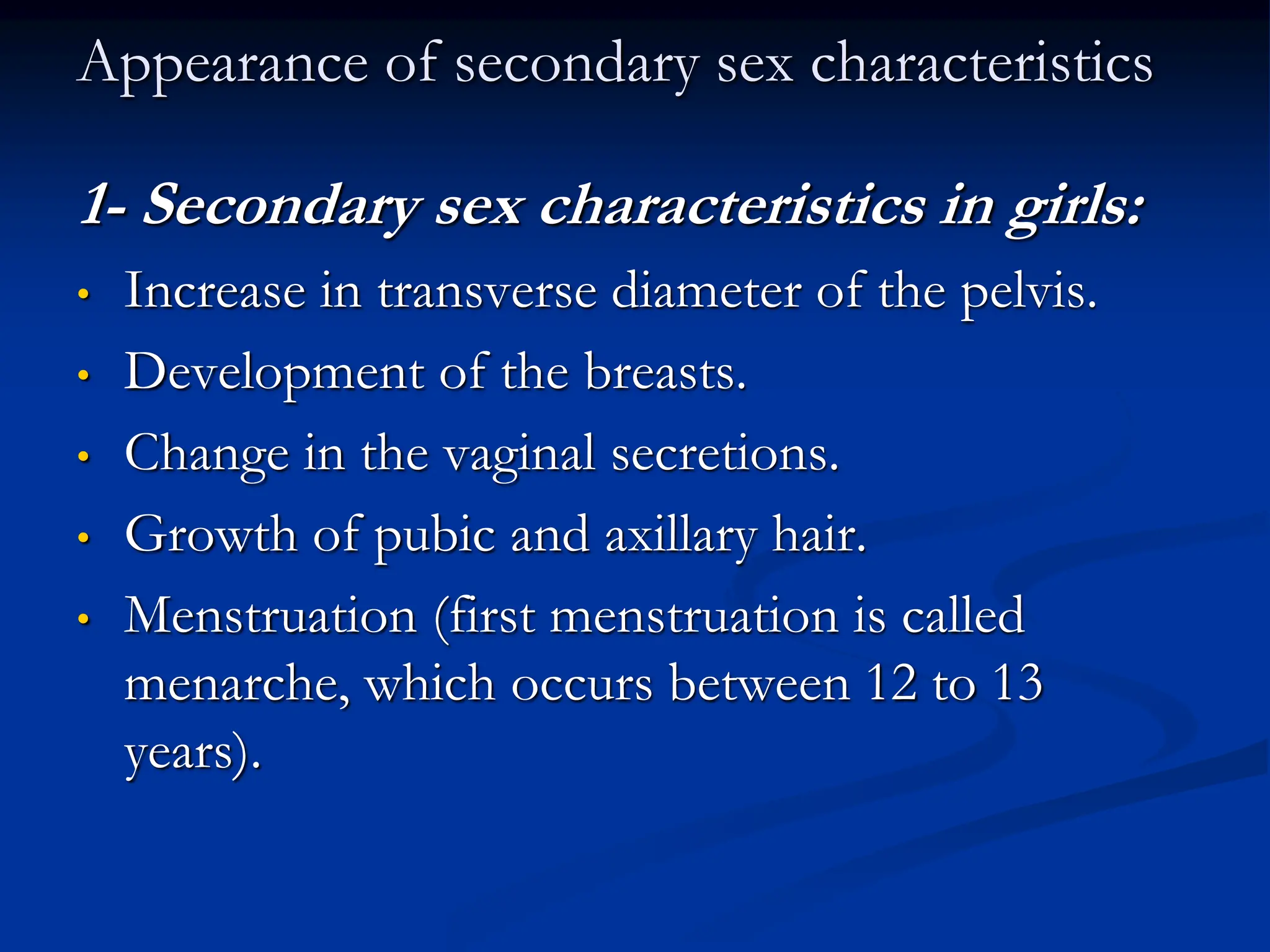
1- Secondary sex characteristics in girls:
• Increase in transverse diameter of the pelvis.
• Development of the breasts.
• Change in the vaginal secretions.
• Growth of pubic and axillary hair.
• Menstruation (first menstruation is called
menarche, which occurs between 12 to 13
years).
Body image
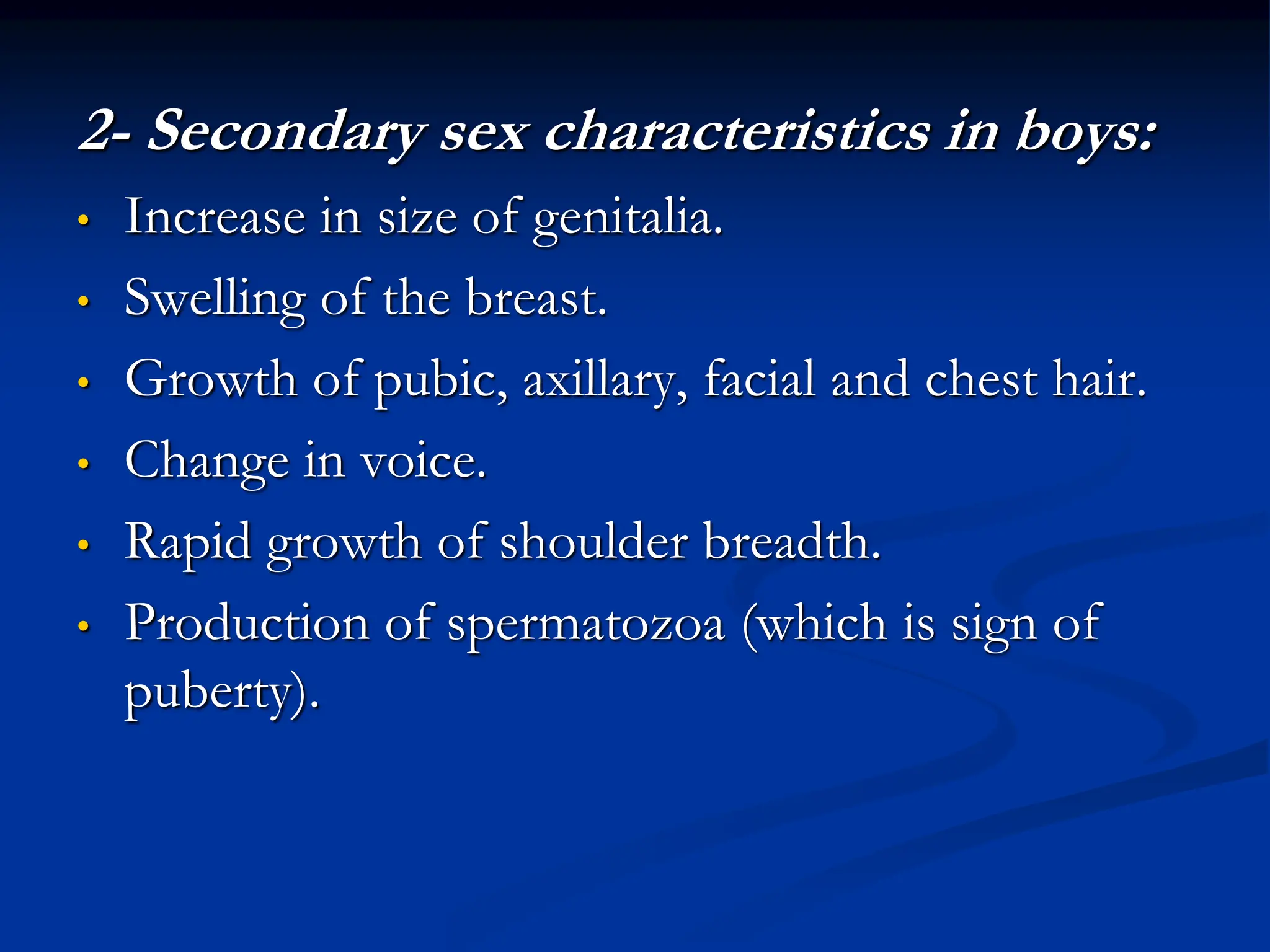
2- Secondary sex characteristics in boys:
• Increase in size of genitalia.
• Swelling of the breast.
• Growth of pubic, axillary, facial and chest hair.
• Change in voice.
• Rapid growth of shoulder breadth.
• Production of spermatozoa (which is sign of
puberty).
Adolescent
• As teenagers gain independence they begin to
challenge values
• Critical of adult authority
• Relies on peer relationship
• Mood swings especially in early adolescents
Cognitive development:
Through formal operational thinking, adolescent can deal with a
problem.
Emotional development:
This period is accompanied usually by changes in emotional
control. Adolescent exhibits alternating and recurrent episodes
of disturbed behavior with periods of quite one. He may become
hostile or ready to fight, complain or resist every thing.
Social development:
He needs to know "who he is" in relation to family and society, i.e.,
he develops a sense of identity. If the adolescent is unable to
formulate a satisfactory identity from the multi-identifications,
sense of self-confusion will be developed according to Erikson:-
Adolescent shows interest in other sex.
He looks for close friendships.
Adolescent behavioral problems
• Anorexia
• Attention deficit
• Anger issues
• Suicide
Adolescent Teaching
• Relationships
• Sexuality – STD’s / AIDS
• Substance use and abuse
• Gang activity
• Driving
• Access to weapons
Developmental theory
 Freud theory
(sexual development).
 Piaget theory
(cognitive development ).
 Erikson theory
(psychosocial development).
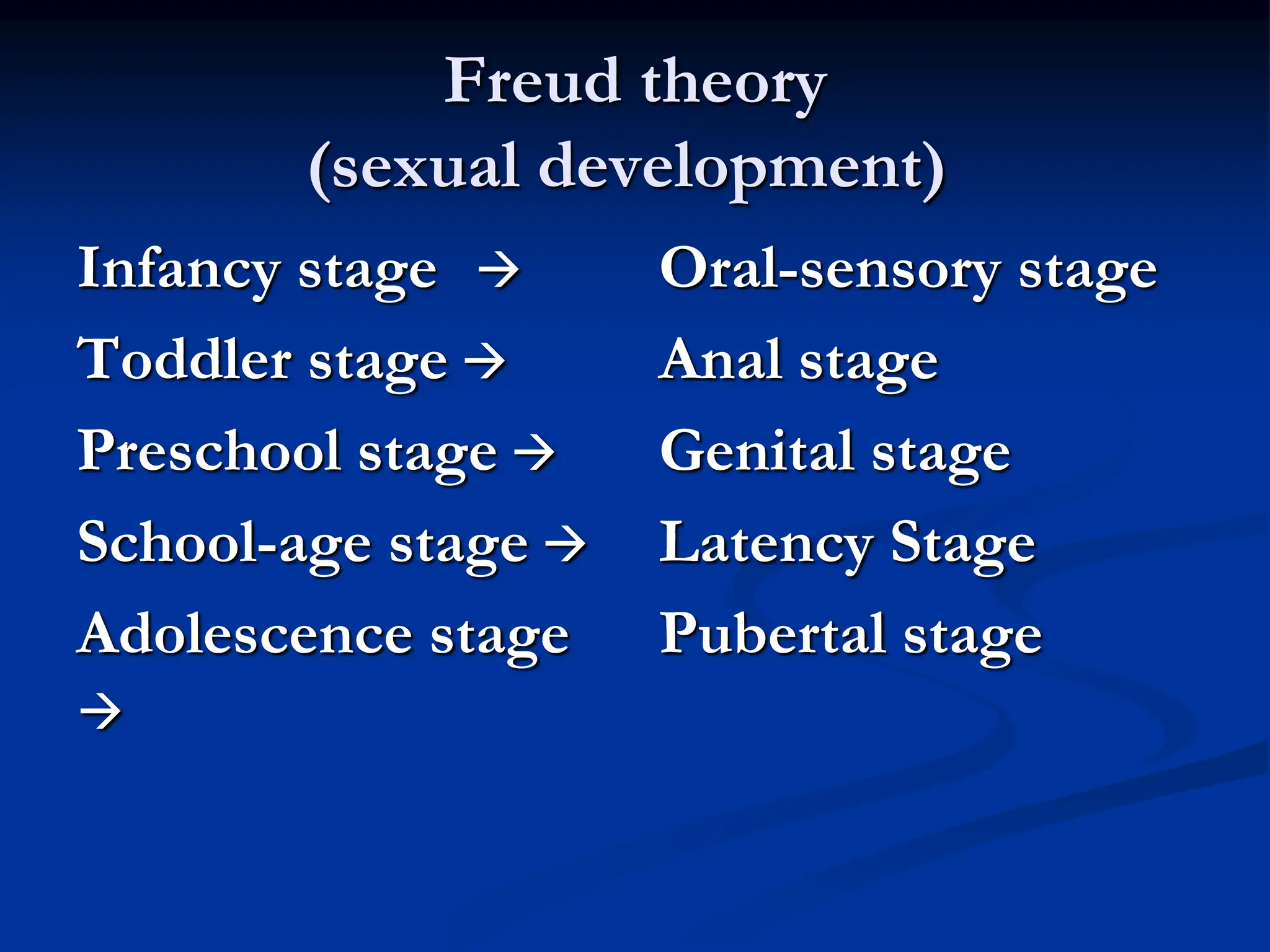
Freud theory
(sexual development)
Infancy stage 
Toddler stage 
Preschool stage 
School-age stage 
Adolescence stage

Oral-sensory stage
Anal stage
Genital stage
Latency Stage
Pubertal stage
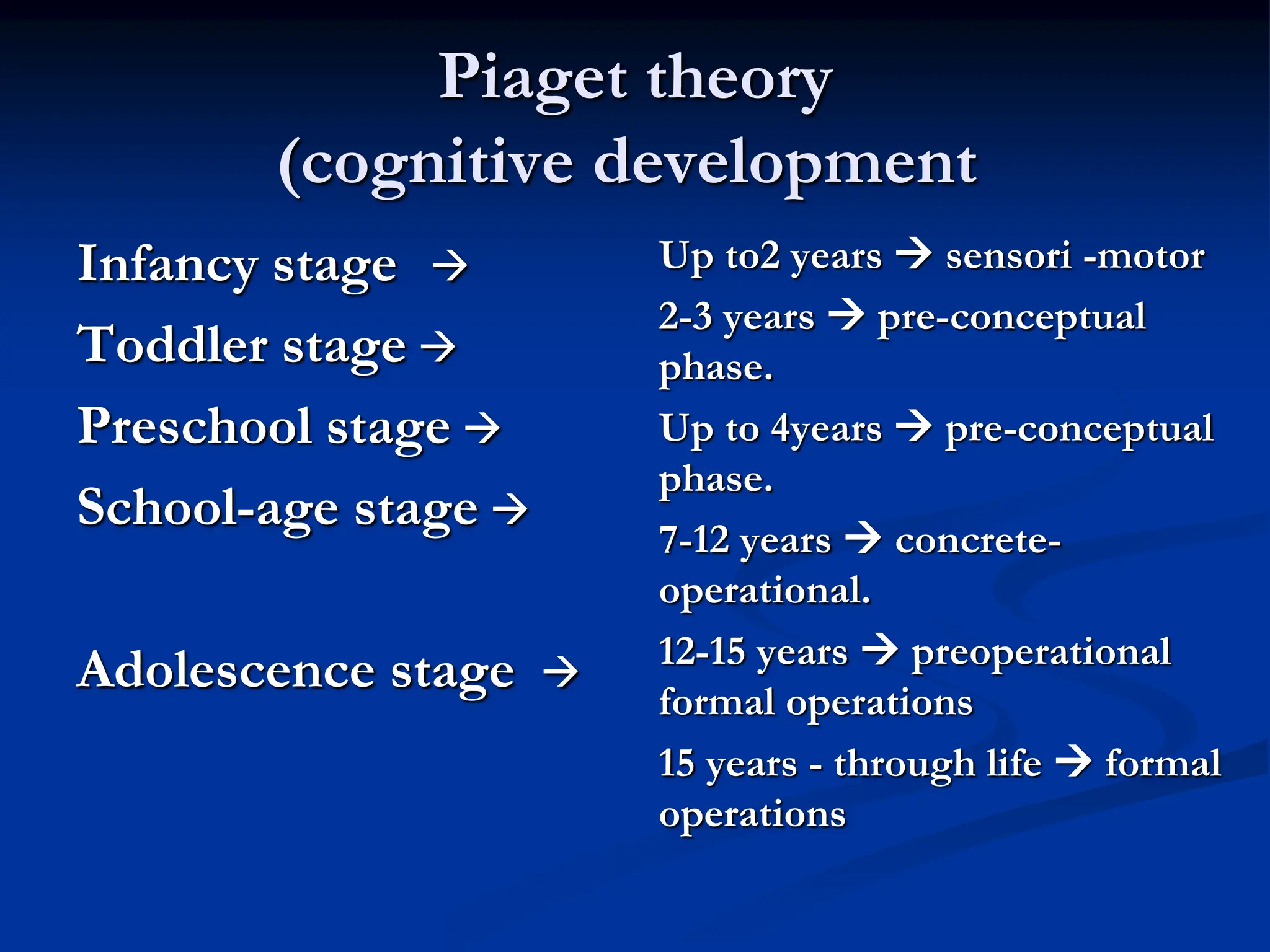
Piaget theory
(cognitive development
Infancy stage 
Toddler stage 
Preschool stage 
School-age stage 
Adolescence stage 
Up to2 years  sensori -motor
2-3 years  pre-conceptual
phase.
Up to 4years  pre-conceptual
phase.
7-12 years  concrete-
operational.
12-15 years  preoperational
formal operations
15 years - through life  formal
operations
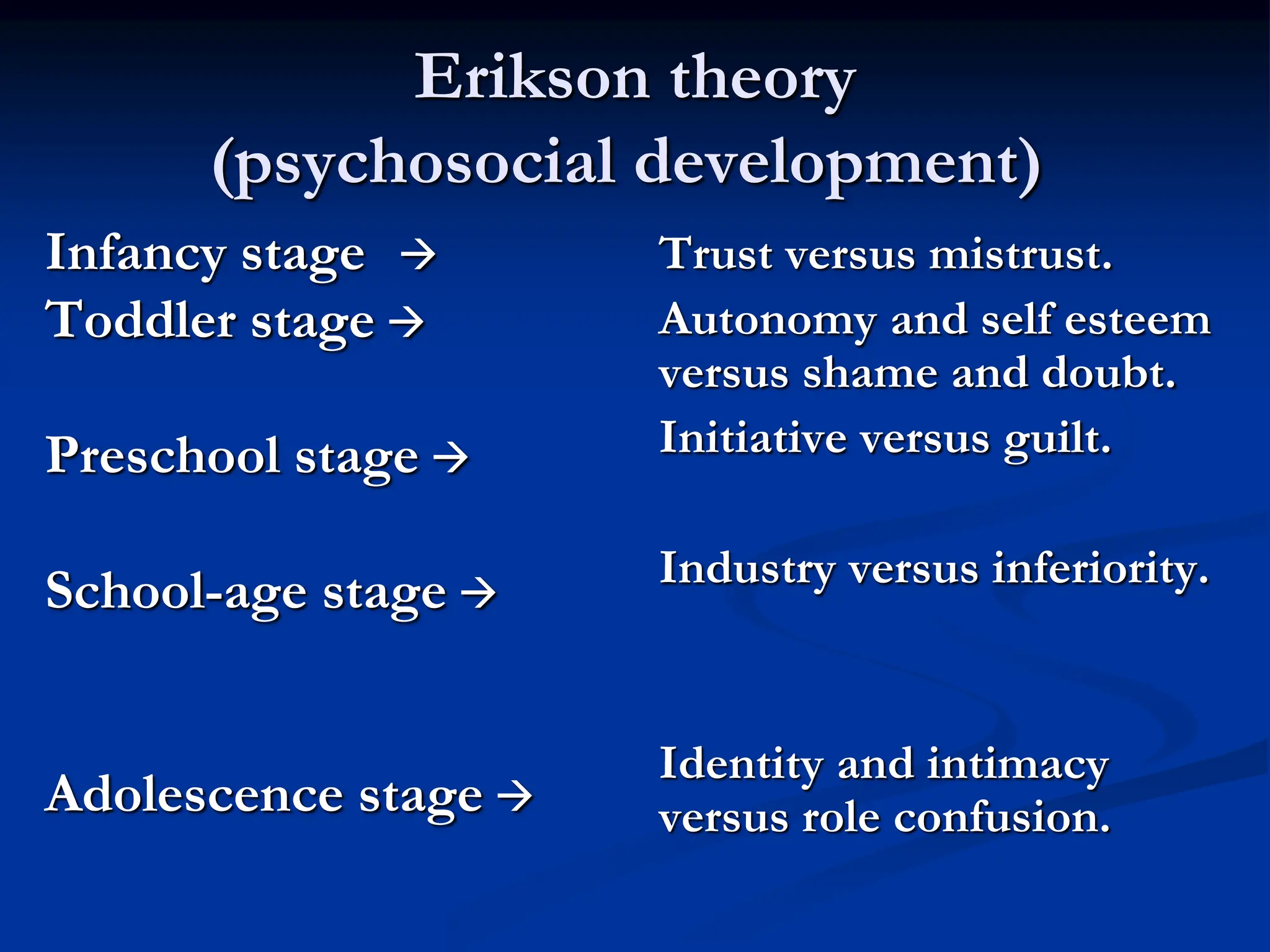
Erikson theory
(psychosocial development)
Infancy stage 
Toddler stage 
Preschool stage 
School-age stage 
Adolescence stage 
Trust versus mistrust.
Autonomy and self esteem
versus shame and doubt.
Initiative versus guilt.
Industry versus inferiority.
Identity and intimacy
versus role confusion.
Thank you
Magda Abd-El Aziz

1. Growth and Development, from being a neonate to an infant, child...

  • 1.
    Growth and Developmentof Children Adele Piliterri, Child Health Nursing, Lippincott
  • 2.
    Growth and Development ofChildren Prepared By Dr: Magda Abd El Aziz
  • 3.
    General Objective: By theend of this lecture, the student will be able to discuss growth and development of children.
  • 4.
    Specific Objectives: By theend of this lecture, the student will be able to: • Identify the importance of growth and development. • Define growth and development. • Mention the principles of growth and development. • List factors affecting growth and development. • Mention types of growth and development. • Identify the stages of development.



  • 5.
    Growth Growth refers toan increase in physical size of the whole body or any of its parts. It is simply a quantitative change in the child’s body. It can be measured in Kg, pounds, meters, inches, ….. etc
  • 6.
  • 7.
    Changes in bodilyproportions with age.
  • 8.
    Development • Development refersto a progressive increase in skill and capacity of function. • It is a qualitative change in the child’s functioning. • It can be measured through observation.
  • 9.
    By understanding whatto expect during each stage of development , parents can easily capture the teachable moments in everyday life to enhance their child's language development, intellectual growth, social development and motor skills .
  • 10.
    Maturation • Increase inchild’s competence and adaptability. • It is describing the qualitative change in a structure. • The level of maturation depends on child’s heredity.
  • 11.
    Importance of Growthand Development for Nurses: • Knowing what to expect of a particular child at any given age. • Gaining better understanding of the reasons behind illnesses. • Helping in formulating the plan of care. • Helping in parents’ education in order to achieve optimal growth & development at each stage.
  • 12.
    Principles of Growth& Development • Continuous process • Predictable Sequence • Don’t progress at the same rate (↑ periods of GR in early childhood and adolescents & ↓ periods of GR in middle childhood) • Not all body parts grow in the same rate at the same time. • Each child grows in his/her own unique way. • Each stage of G&D is affected by the preceding types of development.

  • 13.
    Principles of Growth& Development G & D proceed in regular related directions : - Cephalo-caudal(head down to toes) - Proximodistal (center of the body to the peripheral) - General to specific
  • 14.
  • 15.
    Growth Patterns The child’spattern of growth is in a head-to-toe direction, or cephalocaudal, and in an inward to outward pattern called proximodistal.
  • 16.
    Factors affecting growthand development: • Hereditary • Environmental factors Pre-natal environment 1-Factors related to mothers during pregnancy: - Nutritional deficiencies - Diabetic mother - Exposure to radiation - Infection with German measles - Smoking - Use of drugs
  • 17.
    2-Factors related tofetus • Mal-position in uterus • Faulty placental implantation Post-Natal Environment I - External environment: - socio-economic status of the family - child’s nutrition - climate and season - child’s ordinal position in the family - Number of siblings in the family - Family structure (single parent or extended family … )
  • 18.
    Internal environment • Child’sintelligence • Hormonal influences • Emotions
  • 19.
    Types of growthand development Types of growth: - Physical growth (Ht, Wt, head & chest circumference) - Physiological growth (vital signs …) Types of development: - Motor development - Cognitive development - Emotional development - Social development
  • 20.
    Stages of Growthand Development • Prenatal - Embryonic (conception- 8 w) - Fetal stage (8-40 or 42 w) • Infancy - Neonate - Birth to end of 1 month - Infancy - 1 month to end of 1 year • Early Childhood - Toddler - 1-3 years - Preschool - 3-6 years • Middle Childhood - School age - 6 to 12 years • Late Childhood - Adolescent - 13 years to approximately 18 years
  • 22.
    1- Newborn stage Newbornstage is the first 4 weeks or first month of life. It is a transitional period from intrauterine life to extra uterine environment.
  • 23.
    Normal Newborn Infant Physicalgrowth - Weight = 2.700 – 4 kg - Wt loss 5% -10% by 3-4 days after birth - Wt gain by 10th days of life - Gain ¾ kg by the end of the 1st month
  • 24.
    Weight: They loose 5% to 10 % of weight by 3-4 days after birth as result of :  Withdrawal of hormones from mother.  Loss of excessive extra cellular fluid.  Passage of meconium (feces) and urine.  Limited food intake.
  • 25.
    Height • Boys averageHt = 50 cm • Girls average Ht = 49 cm • Normal range for both (47.5- 53.75 cm) Head circumference 33-35 cm Head is ¼ total body length Skull has 2 fontanels (anterior & posterior)
  • 26.
    Anterior fontanel • Diamondin shape • The junction of the sagittal, corneal and frontal sutures forms it • Between 2 frontal & 2 parietal bones • 3-4 cm in length and 2-3 cm width • It closes at 12-18 months of age
  • 28.
    Posterior fontanel • Triangular •Located between occipital & 2 parietal bones • Closes by the end of the 1st month of age
  • 29.
    Chest circumference It is30.5 to 33cm (usually 2–3cm less than head circumference).
  • 30.
    Physiological growth • Vitalsigns - Temperature (36.3 to37.2C ). - Pulse ( 120 to 160 b/min ). - Respiration ( 35 to 50C/min) .
  • 33.
  • 34.
  • 36.
  • 37.
    • Senses - Touch -Vision - Hearing - Taste - Smell
  • 38.
    Vision • Pupils reactto light • Bright lights appear to be unpleasant to newborn infant. • Follow objects in line of vision
  • 39.
    Hearing • The newborninfant usually makes some response to sound from birth. • Ordinary sounds are heard well before 10 days of life. • The newborn infant responds to sounds with either cry or eye movement, cessation of activity and / or startle reaction.
  • 40.
    Touch • It isthe most highly developed sense. • It is mostly at lips, tongue, ears, and forehead. • The newborn is usually comfortable with touch.
  • 41.
    Taste Well developed asbitter and sour fluids are resisted while sweet fluids are accepted. Smell Only evidence in newborn infant’s search for the nipple, as he smell breast milk.
  • 42.
  • 43.
    Gross Motor Development Motordevelopment: The newborn's movement are random, diffuse and uncoordinated. Reflexes carry out bodily functions and responses to external stimuli.
  • 44.
    Fine motor development •Holds hand in fist • When crying, he draws arms and legs to body
  • 45.
    Reflexes • Swallowing • Gagging •Sucking • Grasp • Tonic-neck
  • 46.
  • 47.
    Cognitive development The cognitivedevelopment of newborn infant is difficult to understand or observe it.
  • 48.
    Emotional development The newborninfant expresses his emotion just through cry for hunger, pain or discomfort sensation
  • 49.
  • 50.
  • 51.
    Sitting Up Age 2months Age 8 months
  • 52.
  • 53.
    Fine Motor Development ininfancy 6-month-old 12-month-old
  • 54.
    Definition of normalinfant:- It is the period which starts at the end of the first month up to the end of the first year of age. Infant's growth and development during this period are rapid.
  • 55.
    Physical growth ofnormal infant Weight : the infant gains : - Birth to 4 months → ¾ kg /month - 5 to 8 months → ½ kg / month - 9 to 12 months → ¼ kg /month The infant will double his birth wt by 4-5 months and triple it by 10-12 months of age
  • 56.
    Height • Length increasesabout 3 cm /month during the 1st 3 months of age, • then it increases 2 cm /month at age of 4-6 months, • Then, at 7 – 12 months, it increases 1 ½ cm per month
  • 57.
    Calculating infant’s weight Infantsfrom 3 to 12 months Weight = Age in months + 9 2 Wt of 7 months old infant = 7+9 = 16 = 8 kg 2 2
  • 58.
    Head circumference • Itincreases about 2 cm /month during the 1st 3 months, • Then, ½ cm/month during the 2nd 9 months of age. • Posterior fontanel closes by 6-8 w of age. • Anterior fontanel closes by 12-18 months of age.
  • 59.
    Chest circumference By theend of the 1st year, it will be equal to head circumference. Physiological growth of infants:- Pulse 110-150 b/min Resp 35 ± 10 c/min Breath through nose. Blood pressure 80/50 ± 20/10 mmHg
  • 62.
    Dentition: Eruption of teethstarts by 5–6 months of age. It is called "Milky teeth" or "Deciduous teeth" or "Temporary teeth".
  • 63.
    Average age forteeth eruption: • Lower central incisors • Upper central incisors • Upper lateral incisors • Lower lateral incisors • Lower first molars • Upper first molars • Lower cuspids • Upper cuspids • Lower 2nd molars • Upper 2nd molars • Erupt at 6 months • Erupt at 7.5 months • Erupt at 9 months • Erupt at 11 months • Erupt at 12 months • Erupt at 14 months • Erupt at 16 months • Erupt at 18 months • Erupt at 20months • Erupt at 24 months.
  • 64.
    Motor Development • At2 months • Hold head erects in mid-position. • Turn from side back. • At 3 months, the infant can • Hold head erects and steady. • Open or close hand loosely. • Hold object put in hand
  • 65.
  • 66.
    At 4 months,the infant can: • Sit with adequate support. • Roll over from front to back. • Hold head erect and steady while in sitting position. • Bring hands together in midline and plays with fingers. • Grasp objects with both hands.
  • 67.
    At 5 months,the infant can: • Balance head well when sitting. • Site with slight support. • Pull feet up to mouth when supine. • Grasp objects with whole hand (Rt. or Lt.). • Hold one object while looking at another
  • 68.
    At 6 months,the infant can: • Sit alone briefly. • Turn completely over ( abdomen to abdomen ). • Lift chest and upper abdomen when prone. • Hold own bottle.
  • 69.
    At 7 months,the infant can: • Sit alone. • Hold cup. • Imitate simple acts of others.
  • 70.
    At 8 months,the infant can: • Site alone steadily. • Drink from cup with assistance. • Eat finger food that can be held in one hand.
  • 71.
    At 9 months,the infant can: • Rise to sitting position alone. • Crawl (i.e., pull body while in prone position). • Hold one bottle with good hand-mouth coordination
  • 72.
    At 10 months,the infant can: • Creep well (use hands and legs). • Walk but with help. • Bring the hands together. At 11 months , the infant can: • Walk holding on furniture. • Stand erect with minimal support
  • 73.
    At 12 months, the infant can: • Stand-alone for variable length of time. • Site down from standing position alone. • Walk in few steps with help or alone (hands held at shoulder height for balance). • Pick up small bits of food and transfers them to his mouth
  • 74.
    Ambulation(motor growth) • 9month old: crawl • 10 month old: creep • 1 year: stand independently from a crawl & creep position • 13 month old: walk and toddle quickly • 15 month old: can run
  • 75.
    Emotional development: • Hisemotions are instable, where it is rapidly changes from crying to laughter. • His affection for or love family members appears. • By 10 months, he expresses several beginning recognizable emotions, such as anger, sadness, pleasure, jealousy, anxiety and affection. • By 12 months of age, these emotions are clearly distinguishable.
  • 76.
    Social development • Helearns that crying brings attention. • The infant smiles in response to smile of others. • The infant shows fear of stranger (stranger anxiety). • He responds socially to his name. • According to Erikson, the infant develops sense of trust. Through the infant's interaction with caregiver (mainly the mother), especially during feeding, he learns to trust others through the relief of basic needs.
  • 77.
    As an infant'svision develops, he or she may seem preoccupied with watching surrounding objects and people
  • 78.
    Speech Milestones • 1-2months: coos • 2-6 months: laughs and squeals • 8-9 months babbles: mama/dada as sounds • 10-12 months: “mama/dada specific • 18-20 months: 20 to 30 words – 50% understood by strangers • 22-24 months: two word sentences, >50 words, 75% understood by strangers • 30-36 months: almost all speech understood by strangers
  • 79.
    Hearing • BAER hearingtest done at birth • Ability to hear correlates with ability enunciate words properly • Always ask about history of otitis media – ear aiding devices. • Early referral to MD to assess for possible fluid in ears (effusion) • Repeat hearing screening test • Speech therapist as needed
  • 80.
    Red Flags ininfant development • Unable to sit alone by age 9 months • Unable to transfer objects from hand to hand by age 1 year • Abnormal pincer grip or grasp by age 15 months • Unable to walk alone by 18 months • Failure to speak recognizable words by 2 years.
  • 82.
  • 83.
    Toddler Safety becomes aproblem as the toddler becomes more mobile. Pilliterri, Lippincott
  • 84.
  • 85.
    Normal toddler: Toddler stageis between 1 to 3 years of age. During this period, growth slows considerably.
  • 86.
    Social development: • Thetoddler is very social being but still egocentric. • He imitates parents. • Notice sex differences and know own sex. • According to Erikson, • The development of autonomy during this period is centered around toddlers increasing abilities to control their bodies, themselves and their environment i.e., "I can do it myself".
  • 90.
    School Age: grossmotor • 8 to 10 years: team sports • Age ten: match sport to the physical and emotional development
  • 91.
    School performance • Askabout favorite subject • How they are doing in school • Do they like school • By parent report: any learning difficulties, attention problems, homework • Parental expectations
  • 92.
  • 93.
    School Age: cognitivedevelopment At 7-11 years, the child now is in the concrete operational stage of cognitive development. He is able to function on a higher level in his mental ability. Greater ability to concentrate and participate in self-initiating quiet activities that challenge cognitive skills, such as reading, playing computer and board games.

  • 94.
    Emotional development The school–agechild: • Fears injury to body and fear of dark. • Jealous of siblings (especially 6–8 years old child). • Curious about everything. • Has short bursts of anger by age of 10 years but able to control anger by 12 years.
  • 95.
    Social development The school–agechild is : • Continues to be egocentric. • Wants other children to play with him. • Insists on being first in every thing • Becomes peer oriented. • Improves relationship with siblings. • Has greater self–control, confident, sincere. • Respects parents and their role. • Joints group (formal and informal). • Engage in tasks in the real world.
  • 96.
    Red flags: schoolage • School failure • Lack of friends • Social isolation • Aggressive behavior: fights, fire setting, animal abuse
  • 97.
    13 to 18Year Old
  • 98.
    Adolescent age • Physicalgrowth • Physiological growth • Secondary sex characteristics • Cognitive development • Emotional development • Social development
  • 99.
    Definition of adolescent: Adolescenceis a transition period from childhood to adulthood. Its is based on childhood experiences and accomplishments. It begins with the appearance of secondary sex characteristics and ends when somatic growth is completed and the individual is psychological mature.
  • 100.
    Physical growth: Weight: • Growthspurt begins earlier in girls (10–14 years, while it is 12–16 in boys). • Males gains 7 to 30kg, while female gains 7 to 25kg. Height: • By the age of 13, the adolescent triples his birth length. • Males gains 10 to 30cm in height. • Females gains less height than males as they gain 5 to 20cm. • Growth in height ceases at 16 or 17 years in females and 18 to 20in males
  • 101.
    Physiological growth: Pulse: Reachesadult value 60–80 beats/min. Respiration: 16–20C/minute. NB: The sebaceous glands of face, neck and chest become more active. When their secretion accumulates under the skin in face, acne will appear.
  • 102.
    Appearance of secondarysex characteristics 1- Secondary sex characteristics in girls: • Increase in transverse diameter of the pelvis. • Development of the breasts. • Change in the vaginal secretions. • Growth of pubic and axillary hair. • Menstruation (first menstruation is called menarche, which occurs between 12 to 13 years).
  • 103.
  • 104.
    2- Secondary sexcharacteristics in boys: • Increase in size of genitalia. • Swelling of the breast. • Growth of pubic, axillary, facial and chest hair. • Change in voice. • Rapid growth of shoulder breadth. • Production of spermatozoa (which is sign of puberty).
  • 105.
    Adolescent • As teenagersgain independence they begin to challenge values • Critical of adult authority • Relies on peer relationship • Mood swings especially in early adolescents
  • 106.
    Cognitive development: Through formaloperational thinking, adolescent can deal with a problem. Emotional development: This period is accompanied usually by changes in emotional control. Adolescent exhibits alternating and recurrent episodes of disturbed behavior with periods of quite one. He may become hostile or ready to fight, complain or resist every thing. Social development: He needs to know "who he is" in relation to family and society, i.e., he develops a sense of identity. If the adolescent is unable to formulate a satisfactory identity from the multi-identifications, sense of self-confusion will be developed according to Erikson:- Adolescent shows interest in other sex. He looks for close friendships.
  • 107.
    Adolescent behavioral problems •Anorexia • Attention deficit • Anger issues • Suicide
  • 108.
    Adolescent Teaching • Relationships •Sexuality – STD’s / AIDS • Substance use and abuse • Gang activity • Driving • Access to weapons
  • 110.
    Developmental theory  Freudtheory (sexual development).  Piaget theory (cognitive development ).  Erikson theory (psychosocial development).
  • 111.
    Freud theory (sexual development) Infancystage  Toddler stage  Preschool stage  School-age stage  Adolescence stage  Oral-sensory stage Anal stage Genital stage Latency Stage Pubertal stage
  • 112.
    Piaget theory (cognitive development Infancystage  Toddler stage  Preschool stage  School-age stage  Adolescence stage  Up to2 years  sensori -motor 2-3 years  pre-conceptual phase. Up to 4years  pre-conceptual phase. 7-12 years  concrete- operational. 12-15 years  preoperational formal operations 15 years - through life  formal operations
  • 113.
    Erikson theory (psychosocial development) Infancystage  Toddler stage  Preschool stage  School-age stage  Adolescence stage  Trust versus mistrust. Autonomy and self esteem versus shame and doubt. Initiative versus guilt. Industry versus inferiority. Identity and intimacy versus role confusion.
  • 115.