GROUP 6:
JOHN MARK MURILLO
JERICK BUSA
SIDLYN SANTAYANA
JONATHAN UCHAYAN
INTRODUCTION
 Fire burns because three elements are present – heat,
fuel and oxygen, fire is a chemical reaction: It happens
when a material unites with oxygen so rapidly that it
produces flame. Think of fire as a triangle. If any one
of three sides – heat, fuel or oxygen – is taken away, the
fire goes out. This is the basis for fire extinguishment.
Heat can be taken away by cooling, oxygen can be
taken away by excluding air, fuel can be removed to a
place where there is no flame, chemical reaction can
be stopped by inhibiting the oxidation of the fuel.
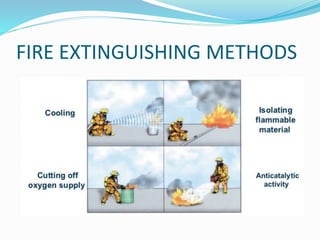
FIRE EXTINGUISHING METHODS
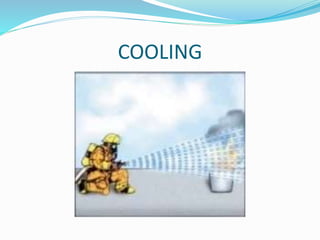
COOLING
COOLING
 -Removal of HEAT. (by water. generally for Class "A" )
 -Cooling the burning material is the most common
method used to extinguish fire. Water is widely
available and the best cooling agent to use specially in
fires involving solid materials. By evaporating in
contact with fire, water also blankets the fire, cutting
off the oxygen supply. However, you should never
apply water to fires involving hot cooking oil or fat;
water can cause the fire to spread.
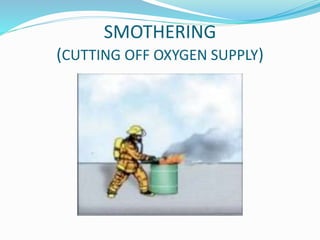
SMOTHERING
(CUTTING OFF OXYGEN SUPPLY)
SMOTHERING
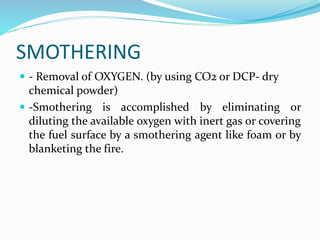
 - Removal of OXYGEN. (by using CO2 or DCP- dry
chemical powder)
 -Smothering is accomplished by eliminating or
diluting the available oxygen with inert gas or covering
the fuel surface by a smothering agent like foam or by
blanketing the fire.
STARVATION
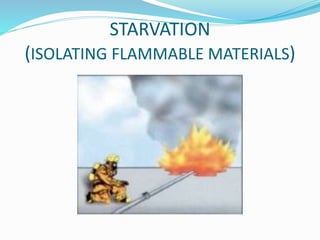
(ISOLATING FLAMMABLE MATERIALS)
STARVATION
 -Removal of FUEL (by cutting fuel supply)
 -Another method of extinguishing a fire is to remove
the fuel supply by switching off the electrical power,
isolating the flow of flammable liquids or removing
the solid fuel, such as wood or textiles. In woodland
fires, a firebreak cut around the fire helps to isolated
further fuel. In the case of gas fire, closing the main
valve and cutting off the gas supply is the best way of
extinguishing the fire.
INHIBITING
(ANTICATALYTICAL ACTIVITY)
INHIBITING
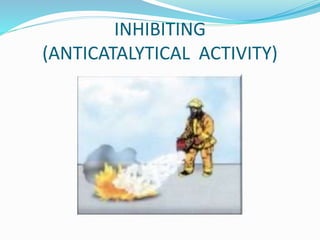
 -Disrupting or breaking chain reaction
 -Using flame inhibitors which are substances that
chemically react with the burning material, thus
extinguishing the flames. Dry-chemical fire
extinguishers work in this way, and can contain mono-
ammonium phosphate, sodium and potassium
bicarbonate and potassium chloride. Vaporizing
liquids, such as Halon, also have a flame inhibiting
action. However, most of these substances have been
phased out due to high levels of toxicity.
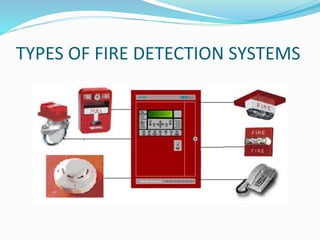
TYPES OF FIRE DETECTION SYSTEMS
INTRODUCTION
 “Early detection of FIRE is very essential”
 In order to prevent fire or detect fire before it gets
bigger we have devices that are designed to detect the
fire and gives out warning and some automatically
activates fire extinguishing equipment.
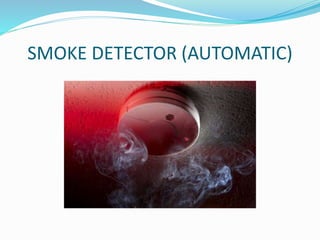
SMOKE DETECTOR (AUTOMATIC)
SMOKE DETECTOR
 -all fire emit smoke and gases often long before open
flames are visible
 -the smoke detector can therefore be activated before
the actual outbreak of fire
 -activated when flammable gasses and particles are
present in the air
 -can initiate alarm much quicker than a heat detector
because it responds to smoke generated very early in a
fire’s development
 Types: Photoelectric and Ionization
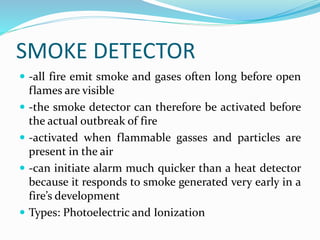
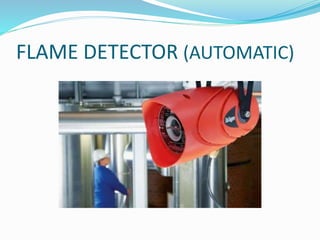
FLAME DETECTOR (AUTOMATIC)
FLAME DETECTOR
 Activated when it is hit by the varying infrared or
ultraviolet rays from the flames
 Consequently suitable for installation in places where
there is risk of fire with rapid development of flames
 3 basic types:
 -Ultraviolet light (UV)
 -Infrared (IR)
 -Can detect both lights (combination)
HEAT DETECTOR (AUTOMATIC)
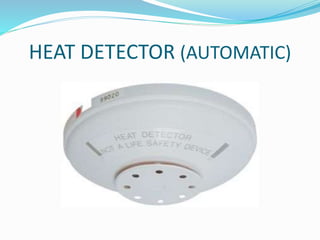
HEAT DETECTOR
 Usually activate when the room temperature rises to
about 70 degrees Celsius
 Such detectors are also available for activation at other
temperatures (adjustable)
 Types:
 -Thermoelectric
 -Rate compensated
 -Pneumatic rate of rise (line or spot)
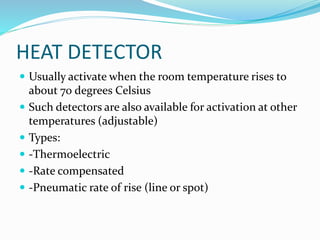
FIRE CONTROL PANEL BOARD
 (FACP) or Fire Alarm Control Unit (FACU), is the
controlling component of a Fire Alarm System. The panel
receives information from environmental sensors designed
to detect changes associated with fire, monitors their
operational integrity and provides for automatic control of
equipment, and transmission of information necessary to
prepare the facility for fire based on a predetermined
sequence. The panel may also supply electrical energy to
operate any associated sensor, control, transmitter, or relay.
There are four basic types of panels: coded panels,
conventional panels, addressable panels, and multiplex
systems.
 This device that gives you the location of the fire in case the
alarm sounded.
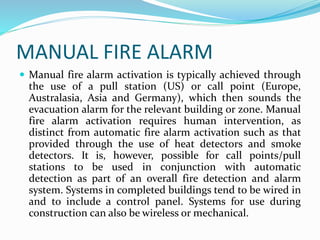
MANUAL FIRE ALARM
MANUAL FIRE ALARM
 Manual fire alarm activation is typically achieved through
the use of a pull station (US) or call point (Europe,
Australasia, Asia and Germany), which then sounds the
evacuation alarm for the relevant building or zone. Manual
fire alarm activation requires human intervention, as
distinct from automatic fire alarm activation such as that
provided through the use of heat detectors and smoke
detectors. It is, however, possible for call points/pull
stations to be used in conjunction with automatic
detection as part of an overall fire detection and alarm
system. Systems in completed buildings tend to be wired in
and to include a control panel. Systems for use during
construction can also be wireless or mechanical.
REFERENCES
 http://safety108.blogspot.com/2011/09/20-fire-
extingusing-methods.html
 http://ccs.shmtu.edu.cn/en/safe/803.htm
 http://www.slideshare.net/J.T.A.JONES/fire-
detection-and-alarm-systems
 https://en.wikipedia.org/wiki/Fire_alarm_control_pan
el
 https://en.wikipedia.org/wiki/Manual_fire_alarm_acti
vation

Group6

  • 1.
    GROUP 6: JOHN MARKMURILLO JERICK BUSA SIDLYN SANTAYANA JONATHAN UCHAYAN
  • 2.
    INTRODUCTION  Fire burnsbecause three elements are present – heat, fuel and oxygen, fire is a chemical reaction: It happens when a material unites with oxygen so rapidly that it produces flame. Think of fire as a triangle. If any one of three sides – heat, fuel or oxygen – is taken away, the fire goes out. This is the basis for fire extinguishment. Heat can be taken away by cooling, oxygen can be taken away by excluding air, fuel can be removed to a place where there is no flame, chemical reaction can be stopped by inhibiting the oxidation of the fuel.
  • 3.
  • 4.
  • 5.
    COOLING  -Removal ofHEAT. (by water. generally for Class "A" )  -Cooling the burning material is the most common method used to extinguish fire. Water is widely available and the best cooling agent to use specially in fires involving solid materials. By evaporating in contact with fire, water also blankets the fire, cutting off the oxygen supply. However, you should never apply water to fires involving hot cooking oil or fat; water can cause the fire to spread.
  • 6.
  • 7.
    SMOTHERING  - Removalof OXYGEN. (by using CO2 or DCP- dry chemical powder)  -Smothering is accomplished by eliminating or diluting the available oxygen with inert gas or covering the fuel surface by a smothering agent like foam or by blanketing the fire.
  • 8.
  • 9.
    STARVATION  -Removal ofFUEL (by cutting fuel supply)  -Another method of extinguishing a fire is to remove the fuel supply by switching off the electrical power, isolating the flow of flammable liquids or removing the solid fuel, such as wood or textiles. In woodland fires, a firebreak cut around the fire helps to isolated further fuel. In the case of gas fire, closing the main valve and cutting off the gas supply is the best way of extinguishing the fire.
  • 10.
  • 11.
    INHIBITING  -Disrupting orbreaking chain reaction  -Using flame inhibitors which are substances that chemically react with the burning material, thus extinguishing the flames. Dry-chemical fire extinguishers work in this way, and can contain mono- ammonium phosphate, sodium and potassium bicarbonate and potassium chloride. Vaporizing liquids, such as Halon, also have a flame inhibiting action. However, most of these substances have been phased out due to high levels of toxicity.
  • 12.
    TYPES OF FIREDETECTION SYSTEMS
  • 13.
    INTRODUCTION  “Early detectionof FIRE is very essential”  In order to prevent fire or detect fire before it gets bigger we have devices that are designed to detect the fire and gives out warning and some automatically activates fire extinguishing equipment.
  • 14.
  • 15.
    SMOKE DETECTOR  -allfire emit smoke and gases often long before open flames are visible  -the smoke detector can therefore be activated before the actual outbreak of fire  -activated when flammable gasses and particles are present in the air  -can initiate alarm much quicker than a heat detector because it responds to smoke generated very early in a fire’s development  Types: Photoelectric and Ionization
  • 16.
  • 17.
    FLAME DETECTOR  Activatedwhen it is hit by the varying infrared or ultraviolet rays from the flames  Consequently suitable for installation in places where there is risk of fire with rapid development of flames  3 basic types:  -Ultraviolet light (UV)  -Infrared (IR)  -Can detect both lights (combination)
  • 18.
  • 19.
    HEAT DETECTOR  Usuallyactivate when the room temperature rises to about 70 degrees Celsius  Such detectors are also available for activation at other temperatures (adjustable)  Types:  -Thermoelectric  -Rate compensated  -Pneumatic rate of rise (line or spot)
  • 20.
  • 21.
    FIRE CONTROL PANELBOARD  (FACP) or Fire Alarm Control Unit (FACU), is the controlling component of a Fire Alarm System. The panel receives information from environmental sensors designed to detect changes associated with fire, monitors their operational integrity and provides for automatic control of equipment, and transmission of information necessary to prepare the facility for fire based on a predetermined sequence. The panel may also supply electrical energy to operate any associated sensor, control, transmitter, or relay. There are four basic types of panels: coded panels, conventional panels, addressable panels, and multiplex systems.  This device that gives you the location of the fire in case the alarm sounded.
  • 22.
  • 23.
    MANUAL FIRE ALARM Manual fire alarm activation is typically achieved through the use of a pull station (US) or call point (Europe, Australasia, Asia and Germany), which then sounds the evacuation alarm for the relevant building or zone. Manual fire alarm activation requires human intervention, as distinct from automatic fire alarm activation such as that provided through the use of heat detectors and smoke detectors. It is, however, possible for call points/pull stations to be used in conjunction with automatic detection as part of an overall fire detection and alarm system. Systems in completed buildings tend to be wired in and to include a control panel. Systems for use during construction can also be wireless or mechanical.
  • 24.
    REFERENCES  http://safety108.blogspot.com/2011/09/20-fire- extingusing-methods.html  http://ccs.shmtu.edu.cn/en/safe/803.htm http://www.slideshare.net/J.T.A.JONES/fire- detection-and-alarm-systems  https://en.wikipedia.org/wiki/Fire_alarm_control_pan el  https://en.wikipedia.org/wiki/Manual_fire_alarm_acti vation