Basic Fire Alarm Systems I Introduction to Office Buildings (B or S-1 Occupancy) Fire Sprinkler Alarm Monitoring Systems
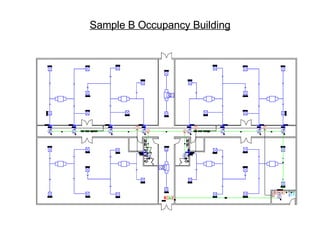
Sample B Occupancy Building
Basic Waterflow Systems What is to be monitored? Fire sprinkler riser with flow switch and tamper and/or PIV? A main office or lobby? Duct smoke detectors? What is required? Basic connections to each of these devices must be provided. A horn strobe, manual pull station and an annunciator/keypad. Any HVAC unit exceeding 2000cfm requires a duct smoke detector and a connection to it.
Special Circumstances Be sure to look at the mechanical plans of a B occupancy (office building). Check and see if it has a 1-Hour rated corridor.  It is usually labeled as such.  However when this occurs, fire/smoke dampers (FSD) will more than likely will be present. These may require additional smoke detectors (if there are no duct detectors), relay modules and a few extra connections. If an office is two or more floors, it will certainly have an elevator/s. Each elevator will require relays, a smoke detector per lobby, a smoke and heat detector in the equipment room as well as the top of the shaft (unless a retrofit). Any building that is three floors or more may be subject to additional requirements such as smoke control, atriums and additional notification. Also, some AHJ’s and insurance companies require more than what is required by code.  Insurance companies are usually the parties who require extra devices.
High-Rise Buildings Any building that has seven floors or is over 75 ft. in height is considered a high-rise. These building have their own set of requirements. Full voice evacuation is they key in this situation.  Though strobes are okay to use, horn strobes are now replaced by speaker strobes. All common areas (open office areas, corridors, conference rooms, restrooms, break rooms and lobbies) are to receive full smoke detection and notification devices. At each stairwell and elevator lobby on every floor, there is to be a manual pull station and a firefighters phone. If the pull stations are more than 150 ft. apart, and additional pull will be required so that the travel distance is less than 150 ft. If a high-rise has subterranean parking levels, they are subject to full voice notification also. High-rises are very particular and should be carefully bid between the salesperson, operations and engineering.
In Review B and S-1 occupancies are usually very simple systems that can quickly become quite complicated. Mechanical drawings are an exceptionally important part of any bid. Know if the customer has any plan of expanding, this may cost them a little more upfront, but eliminates a lot of hassle down the road. Elevators  usually  require automatic recall from the fire alarm system. Those functions are primary and secondary floor recall and shunt trip.

Basic Fire Alarm Systems

  • 1.
    Basic Fire AlarmSystems I Introduction to Office Buildings (B or S-1 Occupancy) Fire Sprinkler Alarm Monitoring Systems
  • 2.
  • 3.
    Basic Waterflow SystemsWhat is to be monitored? Fire sprinkler riser with flow switch and tamper and/or PIV? A main office or lobby? Duct smoke detectors? What is required? Basic connections to each of these devices must be provided. A horn strobe, manual pull station and an annunciator/keypad. Any HVAC unit exceeding 2000cfm requires a duct smoke detector and a connection to it.
  • 4.
    Special Circumstances Besure to look at the mechanical plans of a B occupancy (office building). Check and see if it has a 1-Hour rated corridor. It is usually labeled as such. However when this occurs, fire/smoke dampers (FSD) will more than likely will be present. These may require additional smoke detectors (if there are no duct detectors), relay modules and a few extra connections. If an office is two or more floors, it will certainly have an elevator/s. Each elevator will require relays, a smoke detector per lobby, a smoke and heat detector in the equipment room as well as the top of the shaft (unless a retrofit). Any building that is three floors or more may be subject to additional requirements such as smoke control, atriums and additional notification. Also, some AHJ’s and insurance companies require more than what is required by code. Insurance companies are usually the parties who require extra devices.
  • 5.
    High-Rise Buildings Anybuilding that has seven floors or is over 75 ft. in height is considered a high-rise. These building have their own set of requirements. Full voice evacuation is they key in this situation. Though strobes are okay to use, horn strobes are now replaced by speaker strobes. All common areas (open office areas, corridors, conference rooms, restrooms, break rooms and lobbies) are to receive full smoke detection and notification devices. At each stairwell and elevator lobby on every floor, there is to be a manual pull station and a firefighters phone. If the pull stations are more than 150 ft. apart, and additional pull will be required so that the travel distance is less than 150 ft. If a high-rise has subterranean parking levels, they are subject to full voice notification also. High-rises are very particular and should be carefully bid between the salesperson, operations and engineering.
  • 6.
    In Review Band S-1 occupancies are usually very simple systems that can quickly become quite complicated. Mechanical drawings are an exceptionally important part of any bid. Know if the customer has any plan of expanding, this may cost them a little more upfront, but eliminates a lot of hassle down the road. Elevators usually require automatic recall from the fire alarm system. Those functions are primary and secondary floor recall and shunt trip.