Fire safety
What is fire?
Fire is the rapid oxidation of a material
in the exothermic chemical process
of combustion, releasing heat, light,
and various reaction products
Chemistry Of Fire
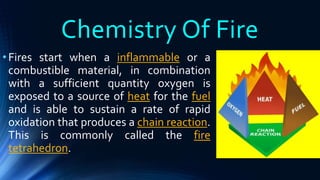
•Fires start when a inflammable or a
combustible material, in combination
with a sufficient quantity oxygen is
exposed to a source of heat for the fuel
and is able to sustain a rate of rapid
oxidation that produces a chain reaction.
This is commonly called the fire
tetrahedron.
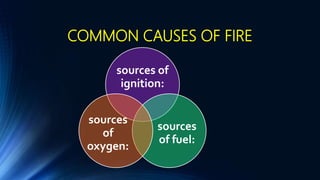
COMMON CAUSES OF FIRE
sources of
ignition:
sources
of fuel:
sources
of
oxygen:
Sources Of Ignition
Defective
electrical
fittings and
defective or
misuse of
electrical
apparatus
Matches,
Lighters,
Candles and
Smoking
materials.
Flame or
sparks from
a work
process such
as welding,
cutting,
grinding or
the use of a
hot air gun.
Sources of
frictional
heat.
Electrostatic
discharges.
Ovens,
kilns, open
hearths,
furnaces or
incinerators.
Boilers,
engines and
other oil
burning
equipment.
Portable
heaters.
Cooking
equipment,
including
deep fat
fryers.
Arson
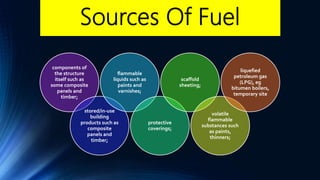
Sources Of Fuel
components of
the structure
itself such as
some composite
panels and
timber;
stored/in-use
building
products such as
composite
panels and
timber;
flammable
liquids such as
paints and
varnishes;
protective
coverings;
scaffold
sheeting;
volatile
flammable
substances such
as paints,
thinners;
liquefied
petroleum gas
(LPG), eg
bitumen boilers,
temporary site
sources of oxygen
The main source of oxygen for a
fire is in the air around us.
oxygen used in welding processes;
oxidising agents
Identify people most at risk
1. those who work alone, eg security staff;
2. people who are in isolated areas, eg maintenance staff, staff on cranes and
reach trucks;
3. people who are unfamiliar with the site, eg new sub-contractors or visitors;
4. people with language difficulties;
5. young people;
6. pregnant women;
7. disabled people;
8. other people in the vicinity of the premises; and
9. those occupying adjacent buildings who may be at risk from radiated heat/fire
spread
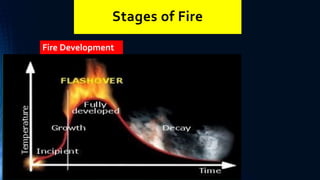
Stages of Fire
Fire Development
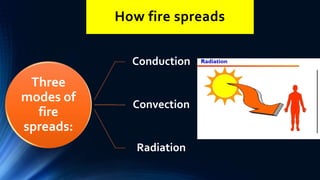
How fire spreads
Three
modes of
fire
spreads:
Conduction
Convection
Radiation
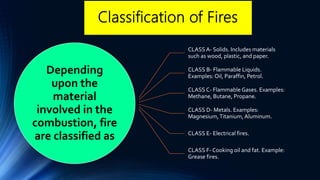
Classification of Fires
Depending
upon the
material
involved in the
combustion, fire
are classified as
CLASS A- Solids. Includes materials
such as wood, plastic, and paper.
CLASS B- Flammable Liquids.
Examples: Oil, Paraffin, Petrol.
CLASS C- Flammable Gases. Examples:
Methane, Butane, Propane.
CLASS D- Metals. Examples:
Magnesium,Titanium, Aluminum.
CLASS E- Electrical fires.
CLASS F- Cooking oil and fat. Example:
Grease fires.
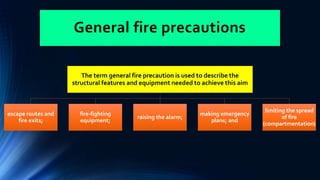
General fire precautions
The term general fire precaution is used to describe the
structural features and equipment needed to achieve this aim
escape routes and
fire exits;
fire-fighting
equipment;
raising the alarm;
making emergency
plans; and
limiting the spread
of fire
(compartmentation)
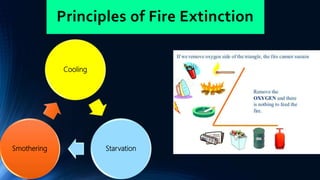
Principles of Fire Extinction
Cooling
Starvation
Smothering
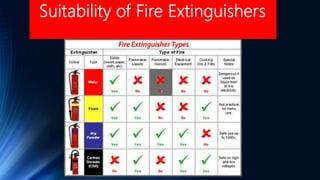
Suitability of Fire Extinguishers
Types of Extinguisher
The 4 most common fire extinguishers:
• All Purpose Water
• Carbon Dioxide
• Multi-Purpose Dry Chemical
• Dry Powder
Each kind of extinguisher has a specific use
Dry Chemical Powder (DCP)
OPERATION
1. Remove the Safety Pin.
2. Aim the base of the fire.
3. Squeeze the valve
4. From one side of fire Cover the
whole area by sweeping action.
Carbon Dioxide
METHOD OF OPERATION:
• Remove the safety pin and turn the
wheel in anti-clockwise direction
and direct the gas to the seat of fire
with the help of the discharge horn.
• We can control the flow of the gas
turning the wheel valve in clockwise
direction.
Foam type
METHOD OF OPERATION:
• Keep the extinguisher on the ground or platform
• Withdraw the branch pipe from its seat, swing back
the safety clip and press down the knob with the
palm.
• This action releases Co2 gas from the cartridge and
pressurizes the extinguisher body.
• Foam is then directed to fall onto the fire gently.
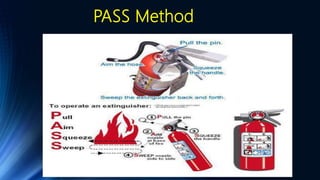
PASS Method
PULL
Aim
Squeeze
Sweep
Fire detection and alarm system
• A smoke detector is a device that senses smoke,
typically as an indicator of fire. This device issues a
signal to a fire alarm control panel as part of a fire
alarm system.
Smoke
detectors
with fire
alarms
• Manual call point is used to initiate an alarm signal.
• Under normal conditions push buttons will be in the
depressed position.
• In the case of a fire the glass cover is broken and the
push button released by a spring action which
actuates an alarm at the control panel through its
switching contacts.
• In addition to this, there will be an LED indicator on
the monitor module for visual indication to locate the
call point easily.
Manual call
points and
fire Alarm
Systems
Fire detection and alarm system
Fire Extinguishers
• The most common type of extinguishers used are the
Carbon-dioxide, Dry Powder (ABC) and Foam Types.
Fire Hydrants
• A fire hydrant is an active fire protection measure which is
provided with a source of water from a fire water tank to
enable firefighters to assist in extinguishing a fire and is
extended to all floors in the building.
What is an emergency?
Any (sudden) event that
disrupts the normal lives of
people or normal operations
of a business.
Because of its nature, there is
an urgent need for
immediate and coordinated
response by trained
personnel who must function
together in a team effort
Emergency Response Plan
Save life and property, lessen the
impact of emergencies, and ensure
business operational continuity.
Establish the roles and responsibilities
for personnel responding to incidents.
Establish the importance of the Incident
Command System.
Preparedness
A number of guidelines are in place to
minimize the impact of emergencies.
It is everyone’s responsibility to become
familiar with the guidelines and procedures
in place, and know what to do before,
during and after an emergency
Emergency Preparedness
Know your building’s Floor Plan and Exits
Routes.
Know the location of the emergency
response equipment (i.e. Fire
Extinguishers)and how to use it.
Attend required Emergency Preparedness, Fire
Extinguisher and other Safety training
Know how to Evacuate Safely and to respond to
medical emergencies
R.A.C.E for fire Emergencies
1. Rescue (get people out of immediate
danger)
2. Alarm (use code word, sound alarm)
3. Confine (close all doors)
4. Extinguish (if safe to do so)
Assembly Point
 Ensure you have a complete list of all the personnel working in the Office
including visitors
 In case of an “Evacuation Alarm”, immediately proceed to the “Assembly
Point”
 Take control at the “Assembly Point”
 Hold a “Roll Call” at the “Assembly Point”
 Ensure everybody is accounted for
Fire Prevention
• Keep sources of ignition and flammable substances apart
• Avoid accidental fires, eg make sure heaters cannot be
knocked over
• Ensure good housekeeping at all times, eg avoid build-up of
rubbish that could burn
• Keep fire exits and escape routes clearly marked and
unobstructed at all times
• Clean up flammable liquid leaks and spills immediately.
• Dispose of all waste promptly and properly.
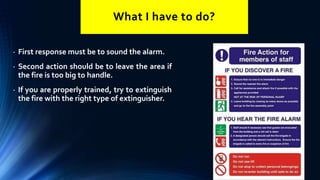
What I have to do?
• First response must be to sound the alarm.
• Second action should be to leave the area if
the fire is too big to handle.
• If you are properly trained, try to extinguish
the fire with the right type of extinguisher.
When NOT to Fight a Fire!
Remember to
keep an exit to
your back
Only fight a
fire in the
incipient stage
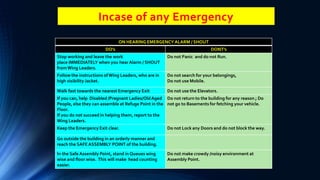
Incase of any Emergency
ON HEARING EMERGENCY ALARM / SHOUT
DO’s DONT’s
Stop working and leave the work
place IMMEDIATELY when you hear Alarm / SHOUT
fromWing Leaders.
Do not Panic and do not Run.
Follow the instructions of Wing Leaders, who are in
high visibility Jacket.
Do not search for your belongings,
Do not use Mobile.
Walk fast towards the nearest Emergency Exit Do not use the Elevators.
If you can, help Disabled /Pregnant Ladies/OldAged
People, else they can assemble at Refuge Point in the
Floor.
If you do not succeed in helping them, report to the
Wing Leaders.
Do not return to the building for any reason ; Do
not go to Basements for fetching your vehicle.
Keep the Emergency Exit clear. Do not Lock any Doors and do not block the way.
Go outside the building in an orderly manner and
reach the SAFE ASSEMBLY POINT of the building.
In the Safe Assembly Point, stand in Queues wing
wise and floor wise. This will make head counting
easier.
Do not make crowdy /noisy environment at
Assembly Point.
Emergency Procedures
In the Event of Fire
• Pull nearest alarm station
• Immediately exit the building
If you hear an alarm
DO NOT
assume it is a drill,
your life may depend on it!

Fire safety new.pptx

  • 1.
  • 2.
    What is fire? Fireis the rapid oxidation of a material in the exothermic chemical process of combustion, releasing heat, light, and various reaction products
  • 3.
    Chemistry Of Fire •Firesstart when a inflammable or a combustible material, in combination with a sufficient quantity oxygen is exposed to a source of heat for the fuel and is able to sustain a rate of rapid oxidation that produces a chain reaction. This is commonly called the fire tetrahedron.
  • 4.
    COMMON CAUSES OFFIRE sources of ignition: sources of fuel: sources of oxygen:
  • 5.
    Sources Of Ignition Defective electrical fittingsand defective or misuse of electrical apparatus Matches, Lighters, Candles and Smoking materials. Flame or sparks from a work process such as welding, cutting, grinding or the use of a hot air gun. Sources of frictional heat. Electrostatic discharges. Ovens, kilns, open hearths, furnaces or incinerators. Boilers, engines and other oil burning equipment. Portable heaters. Cooking equipment, including deep fat fryers. Arson
  • 6.
    Sources Of Fuel componentsof the structure itself such as some composite panels and timber; stored/in-use building products such as composite panels and timber; flammable liquids such as paints and varnishes; protective coverings; scaffold sheeting; volatile flammable substances such as paints, thinners; liquefied petroleum gas (LPG), eg bitumen boilers, temporary site
  • 7.
    sources of oxygen Themain source of oxygen for a fire is in the air around us. oxygen used in welding processes; oxidising agents
  • 8.
    Identify people mostat risk 1. those who work alone, eg security staff; 2. people who are in isolated areas, eg maintenance staff, staff on cranes and reach trucks; 3. people who are unfamiliar with the site, eg new sub-contractors or visitors; 4. people with language difficulties; 5. young people; 6. pregnant women; 7. disabled people; 8. other people in the vicinity of the premises; and 9. those occupying adjacent buildings who may be at risk from radiated heat/fire spread
  • 9.
  • 10.
    How fire spreads Three modesof fire spreads: Conduction Convection Radiation
  • 11.
    Classification of Fires Depending uponthe material involved in the combustion, fire are classified as CLASS A- Solids. Includes materials such as wood, plastic, and paper. CLASS B- Flammable Liquids. Examples: Oil, Paraffin, Petrol. CLASS C- Flammable Gases. Examples: Methane, Butane, Propane. CLASS D- Metals. Examples: Magnesium,Titanium, Aluminum. CLASS E- Electrical fires. CLASS F- Cooking oil and fat. Example: Grease fires.
  • 12.
    General fire precautions Theterm general fire precaution is used to describe the structural features and equipment needed to achieve this aim escape routes and fire exits; fire-fighting equipment; raising the alarm; making emergency plans; and limiting the spread of fire (compartmentation)
  • 13.
    Principles of FireExtinction Cooling Starvation Smothering
  • 14.
    Suitability of FireExtinguishers
  • 15.
    Types of Extinguisher The4 most common fire extinguishers: • All Purpose Water • Carbon Dioxide • Multi-Purpose Dry Chemical • Dry Powder Each kind of extinguisher has a specific use
  • 16.
    Dry Chemical Powder(DCP) OPERATION 1. Remove the Safety Pin. 2. Aim the base of the fire. 3. Squeeze the valve 4. From one side of fire Cover the whole area by sweeping action.
  • 17.
    Carbon Dioxide METHOD OFOPERATION: • Remove the safety pin and turn the wheel in anti-clockwise direction and direct the gas to the seat of fire with the help of the discharge horn. • We can control the flow of the gas turning the wheel valve in clockwise direction.
  • 18.
    Foam type METHOD OFOPERATION: • Keep the extinguisher on the ground or platform • Withdraw the branch pipe from its seat, swing back the safety clip and press down the knob with the palm. • This action releases Co2 gas from the cartridge and pressurizes the extinguisher body. • Foam is then directed to fall onto the fire gently.
  • 19.
  • 20.
  • 21.
  • 22.
  • 23.
  • 24.
    Fire detection andalarm system • A smoke detector is a device that senses smoke, typically as an indicator of fire. This device issues a signal to a fire alarm control panel as part of a fire alarm system. Smoke detectors with fire alarms • Manual call point is used to initiate an alarm signal. • Under normal conditions push buttons will be in the depressed position. • In the case of a fire the glass cover is broken and the push button released by a spring action which actuates an alarm at the control panel through its switching contacts. • In addition to this, there will be an LED indicator on the monitor module for visual indication to locate the call point easily. Manual call points and fire Alarm Systems
  • 25.
    Fire detection andalarm system Fire Extinguishers • The most common type of extinguishers used are the Carbon-dioxide, Dry Powder (ABC) and Foam Types. Fire Hydrants • A fire hydrant is an active fire protection measure which is provided with a source of water from a fire water tank to enable firefighters to assist in extinguishing a fire and is extended to all floors in the building.
  • 26.
    What is anemergency? Any (sudden) event that disrupts the normal lives of people or normal operations of a business. Because of its nature, there is an urgent need for immediate and coordinated response by trained personnel who must function together in a team effort
  • 27.
    Emergency Response Plan Savelife and property, lessen the impact of emergencies, and ensure business operational continuity. Establish the roles and responsibilities for personnel responding to incidents. Establish the importance of the Incident Command System.
  • 28.
    Preparedness A number ofguidelines are in place to minimize the impact of emergencies. It is everyone’s responsibility to become familiar with the guidelines and procedures in place, and know what to do before, during and after an emergency
  • 29.
    Emergency Preparedness Know yourbuilding’s Floor Plan and Exits Routes. Know the location of the emergency response equipment (i.e. Fire Extinguishers)and how to use it. Attend required Emergency Preparedness, Fire Extinguisher and other Safety training Know how to Evacuate Safely and to respond to medical emergencies
  • 30.
    R.A.C.E for fireEmergencies 1. Rescue (get people out of immediate danger) 2. Alarm (use code word, sound alarm) 3. Confine (close all doors) 4. Extinguish (if safe to do so)
  • 31.
    Assembly Point  Ensureyou have a complete list of all the personnel working in the Office including visitors  In case of an “Evacuation Alarm”, immediately proceed to the “Assembly Point”  Take control at the “Assembly Point”  Hold a “Roll Call” at the “Assembly Point”  Ensure everybody is accounted for
  • 32.
    Fire Prevention • Keepsources of ignition and flammable substances apart • Avoid accidental fires, eg make sure heaters cannot be knocked over • Ensure good housekeeping at all times, eg avoid build-up of rubbish that could burn • Keep fire exits and escape routes clearly marked and unobstructed at all times • Clean up flammable liquid leaks and spills immediately. • Dispose of all waste promptly and properly.
  • 33.
    What I haveto do? • First response must be to sound the alarm. • Second action should be to leave the area if the fire is too big to handle. • If you are properly trained, try to extinguish the fire with the right type of extinguisher.
  • 34.
    When NOT toFight a Fire! Remember to keep an exit to your back Only fight a fire in the incipient stage
  • 35.
    Incase of anyEmergency ON HEARING EMERGENCY ALARM / SHOUT DO’s DONT’s Stop working and leave the work place IMMEDIATELY when you hear Alarm / SHOUT fromWing Leaders. Do not Panic and do not Run. Follow the instructions of Wing Leaders, who are in high visibility Jacket. Do not search for your belongings, Do not use Mobile. Walk fast towards the nearest Emergency Exit Do not use the Elevators. If you can, help Disabled /Pregnant Ladies/OldAged People, else they can assemble at Refuge Point in the Floor. If you do not succeed in helping them, report to the Wing Leaders. Do not return to the building for any reason ; Do not go to Basements for fetching your vehicle. Keep the Emergency Exit clear. Do not Lock any Doors and do not block the way. Go outside the building in an orderly manner and reach the SAFE ASSEMBLY POINT of the building. In the Safe Assembly Point, stand in Queues wing wise and floor wise. This will make head counting easier. Do not make crowdy /noisy environment at Assembly Point.
  • 36.
    Emergency Procedures In theEvent of Fire • Pull nearest alarm station • Immediately exit the building If you hear an alarm DO NOT assume it is a drill, your life may depend on it!