
Presented By:
MUKUL TRIVEDI
(MT15CTM010)
SHUBHAM CHAUHAN
(MT15CTM016)
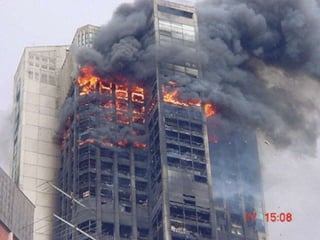
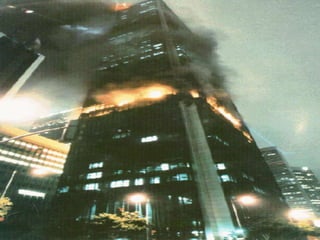
WHAT IS FIRE ?
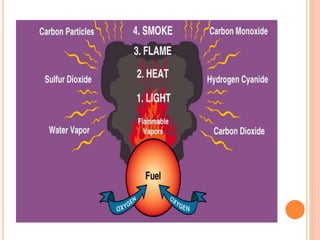
 Fire is a chemical reaction, in which
substance (fuel) combines with
oxygen.
 The reaction is exothermic and usually
associated with emission of heat, light,
various reaction products and smoke.
WHAT ELEMENTS ARE NEEDED TO START A
FIRE?
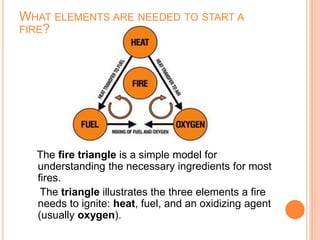
The fire triangle is a simple model for
understanding the necessary ingredients for most
fires.
The triangle illustrates the three elements a fire
needs to ignite: heat, fuel, and an oxidizing agent
(usually oxygen).



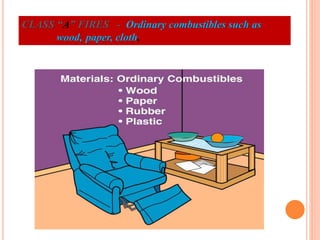
CLASS “A” FIRES - Ordinary combustibles such as
wood, paper, cloth.
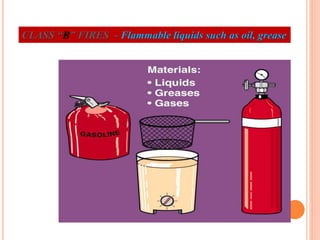
CLASS “B” FIRES - Flammable liquids such as oil, grease
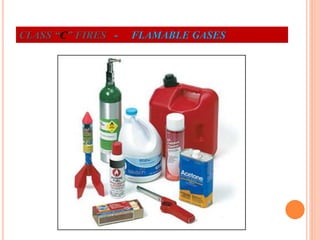
CLASS “C” FIRES - FLAMABLE GASES
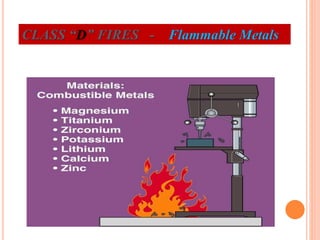
CLASS “D” FIRES - Flammable Metals
 Any fire involving an electrical equipment is in fact
be a fire of class A, B or C. The normal procedure in
such fires is to cut off the electricity and use an
extinguishing method appropriate to the burning
material. Special extinguishing agents which are
non-conductor of electricity and non-damaging to
the electrical equipment such as dry chemical
powders and carbon di-oxide should be used.
 According to latest concepts, the electrical fires do
not constitute a particular class.
ELECTRICAL FIRES
Major causes of fire
1.Kitchen fires from unattended cooking, such as frying,
boiling
2. Electrical systems that are overloaded, resulting in
hot wiring or connections, or failed components
3. Combustible storage areas with insufficient protection
Combustibles near equipment that generates heat,
flame, or sparks
4. Candles and other open flames
5.Smoking (Cigarettes, cigars, pipes, lighters, etc.)
6. Careless handling of naked fire
7.Equipment that generates heat and utilizes combustible
materials
8. Flammable liquids
9.Flammable solvents (and rags soaked with solvent)
placed in enclosed trash cans
10.Fireplace chimneys not properly or regularly cleaned
Cooking appliances - stoves, ovens
11.Heating appliances - fireplaces, wood burning stoves,
furnaces, boilers, portable heaters
12.Electrical wiring in poor condition
13.Leaking Batteries
14.Household appliances - clothes dryers, irons, hair
dryers, refrigerators, freezers
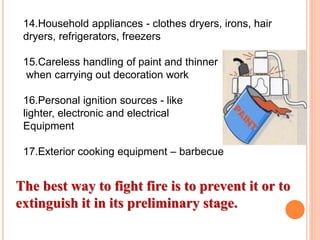
15.Careless handling of paint and thinner
when carrying out decoration work
16.Personal ignition sources - like
lighter, electronic and electrical
Equipment
17.Exterior cooking equipment – barbecue
The best way to fight fire is to prevent it or to
extinguish it in its preliminary stage.
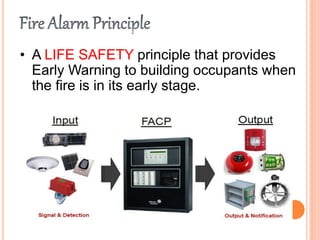
• A LIFE SAFETY principle that provides
Early Warning to building occupants when
the fire is in its early stage.
FIRE ALARM SYSTEM
 Fire Detection Devices: (Input / Initiation Devices)
 Devices which detect fire/smoke.
eg. Heat detectors, smoke detectors, flame detectors,
manual call points.
 Fire Alarm Devices: (Output / Notification Devices)
 Devices which alert people of the fire condition.
eg. Sounders, voice alams.
 Fire Circuit Devices: (Line Units)
 Devices with electrical functions related directly to the
detection / alarm circuit.
eg. Input output line units
DETECTION CATEGORIES
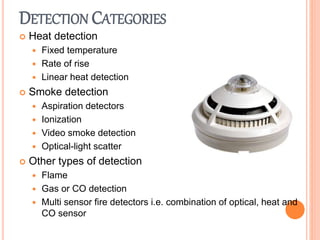
 Heat detection
 Fixed temperature
 Rate of rise
 Linear heat detection
 Smoke detection
 Aspiration detectors
 Ionization
 Video smoke detection
 Optical-light scatter
 Other types of detection
 Flame
 Gas or CO detection
 Multi sensor fire detectors i.e. combination of optical, heat and
CO sensor
HEAT DETECTION
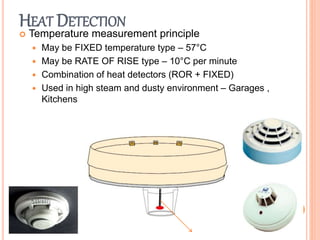
 Temperature measurement principle
 May be FIXED temperature type – 57°C
 May be RATE OF RISE type – 10°C per minute
 Combination of heat detectors (ROR + FIXED)
 Used in high steam and dusty environment – Garages ,
Kitchens
SMOKE DETECTION-IONIZATION PRINCIPLE
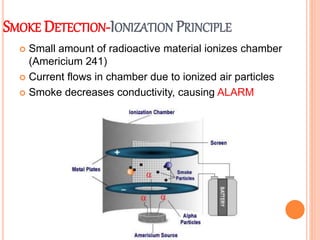
 Small amount of radioactive material ionizes chamber
(Americium 241)
 Current flows in chamber due to ionized air particles
 Smoke decreases conductivity, causing ALARM
SMOKE DETECTION-
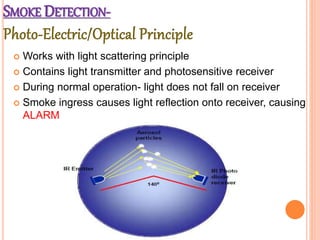
 Works with light scattering principle
 Contains light transmitter and photosensitive receiver
 During normal operation- light does not fall on receiver
 Smoke ingress causes light reflection onto receiver, causing
ALARM
WORKING OF SMOKE DETECTOR
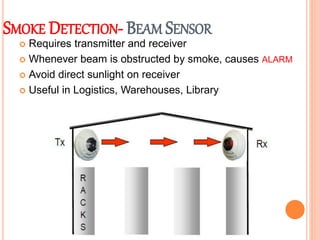
SMOKE DETECTION- BEAM SENSOR
 Requires transmitter and receiver
 Whenever beam is obstructed by smoke, causes ALARM
 Avoid direct sunlight on receiver
 Useful in Logistics, Warehouses, Library
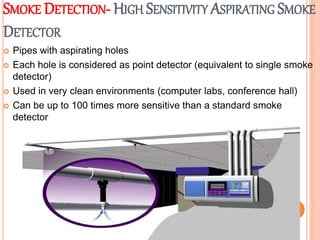
SMOKE DETECTION- HIGH SENSITIVITY ASPIRATING SMOKE
DETECTOR
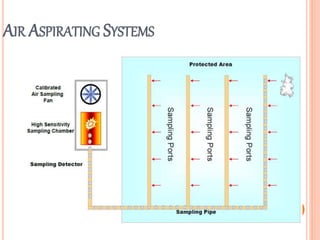
 Pipes with aspirating holes
 Each hole is considered as point detector (equivalent to single smoke
detector)
 Used in very clean environments (computer labs, conference hall)
 Can be up to 100 times more sensitive than a standard smoke
detector
AIR ASPIRATING SYSTEMS
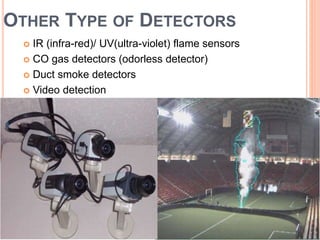
OTHER TYPE OF DETECTORS
 IR (infra-red)/ UV(ultra-violet) flame sensors
 CO gas detectors (odorless detector)
 Duct smoke detectors
 Video detection
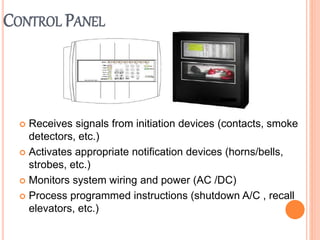
CONTROL PANEL
 Receives signals from initiation devices (contacts, smoke
detectors, etc.)
 Activates appropriate notification devices (horns/bells,
strobes, etc.)
 Monitors system wiring and power (AC /DC)
 Process programmed instructions (shutdown A/C , recall
elevators, etc.)
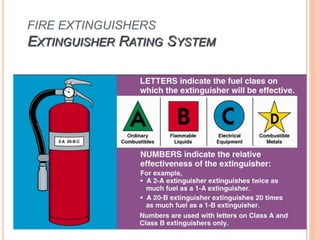
FIRE EXTINGUISHERS
EXTINGUISHER RATING SYSTEM
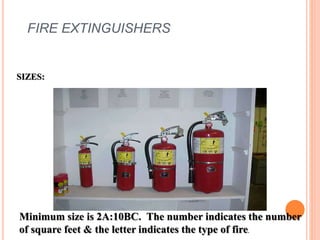
FIRE EXTINGUISHERS
SIZES:
Minimum size is 2A:10BC. The number indicates the number
of square feet & the letter indicates the type of fire.
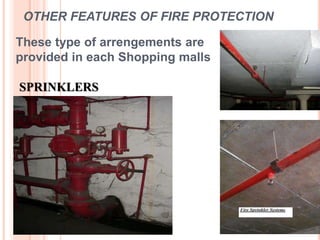
OTHER FEATURES OF FIRE PROTECTION
These type of arrengements are
provided in each Shopping malls
SPRINKLERS
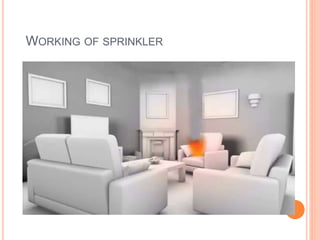
WORKING OF SPRINKLER
FIRE SUPPRESSION SYSTEM
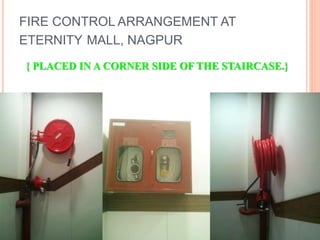
FIRE CONTROL ARRANGEMENT AT
ETERNITY MALL, NAGPUR
{ PLACED IN A CORNER SIDE OF THE STAIRCASE.}
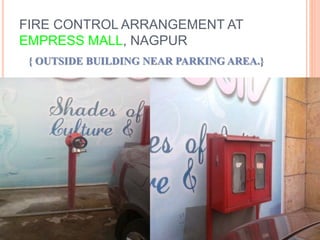
FIRE CONTROL ARRANGEMENT AT
EMPRESS MALL, NAGPUR
{ OUTSIDE BUILDING NEAR PARKING AREA.}
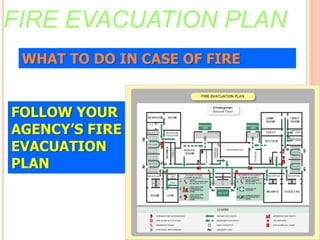
FIRE EVACUATION PLAN
WHAT TO DO IN CASE OF FIRE
FOLLOW YOUR
AGENCY’S FIRE
EVACUATION
PLAN
EVACUATION PLAN CONTD…
FIRE DRILLS…
A fire drill is a method of practicing the
evacuation of a building for a fire or
other emergency. Usually, the emergency system
sounds and the building is evacuated as though a
real fire had occurred.
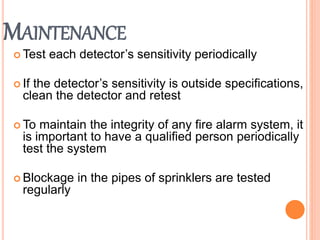
MAINTENANCE
 Test each detector’s sensitivity periodically
 If the detector’s sensitivity is outside specifications,
clean the detector and retest
 To maintain the integrity of any fire alarm system, it
is important to have a qualified person periodically
test the system
 Blockage in the pipes of sprinklers are tested
regularly
37
33
34
35
36
37
THE END!
THANK YOU FOR ATTENDING!

Fire safety arrangement

  • 1.
  • 2.
    WHAT IS FIRE?  Fire is a chemical reaction, in which substance (fuel) combines with oxygen.  The reaction is exothermic and usually associated with emission of heat, light, various reaction products and smoke.
  • 4.
    WHAT ELEMENTS ARENEEDED TO START A FIRE? The fire triangle is a simple model for understanding the necessary ingredients for most fires. The triangle illustrates the three elements a fire needs to ignite: heat, fuel, and an oxidizing agent (usually oxygen).
  • 5.
  • 6.
    CLASS “A” FIRES- Ordinary combustibles such as wood, paper, cloth.
  • 7.
    CLASS “B” FIRES- Flammable liquids such as oil, grease
  • 8.
    CLASS “C” FIRES- FLAMABLE GASES
  • 9.
    CLASS “D” FIRES- Flammable Metals
  • 10.
     Any fireinvolving an electrical equipment is in fact be a fire of class A, B or C. The normal procedure in such fires is to cut off the electricity and use an extinguishing method appropriate to the burning material. Special extinguishing agents which are non-conductor of electricity and non-damaging to the electrical equipment such as dry chemical powders and carbon di-oxide should be used.  According to latest concepts, the electrical fires do not constitute a particular class. ELECTRICAL FIRES
  • 12.
    Major causes offire 1.Kitchen fires from unattended cooking, such as frying, boiling 2. Electrical systems that are overloaded, resulting in hot wiring or connections, or failed components 3. Combustible storage areas with insufficient protection Combustibles near equipment that generates heat, flame, or sparks 4. Candles and other open flames 5.Smoking (Cigarettes, cigars, pipes, lighters, etc.) 6. Careless handling of naked fire
  • 13.
    7.Equipment that generatesheat and utilizes combustible materials 8. Flammable liquids 9.Flammable solvents (and rags soaked with solvent) placed in enclosed trash cans 10.Fireplace chimneys not properly or regularly cleaned Cooking appliances - stoves, ovens 11.Heating appliances - fireplaces, wood burning stoves, furnaces, boilers, portable heaters 12.Electrical wiring in poor condition 13.Leaking Batteries
  • 14.
    14.Household appliances -clothes dryers, irons, hair dryers, refrigerators, freezers 15.Careless handling of paint and thinner when carrying out decoration work 16.Personal ignition sources - like lighter, electronic and electrical Equipment 17.Exterior cooking equipment – barbecue The best way to fight fire is to prevent it or to extinguish it in its preliminary stage.
  • 15.
    • A LIFESAFETY principle that provides Early Warning to building occupants when the fire is in its early stage.
  • 16.
    FIRE ALARM SYSTEM Fire Detection Devices: (Input / Initiation Devices)  Devices which detect fire/smoke. eg. Heat detectors, smoke detectors, flame detectors, manual call points.  Fire Alarm Devices: (Output / Notification Devices)  Devices which alert people of the fire condition. eg. Sounders, voice alams.  Fire Circuit Devices: (Line Units)  Devices with electrical functions related directly to the detection / alarm circuit. eg. Input output line units
  • 17.
    DETECTION CATEGORIES  Heatdetection  Fixed temperature  Rate of rise  Linear heat detection  Smoke detection  Aspiration detectors  Ionization  Video smoke detection  Optical-light scatter  Other types of detection  Flame  Gas or CO detection  Multi sensor fire detectors i.e. combination of optical, heat and CO sensor
  • 18.
    HEAT DETECTION  Temperaturemeasurement principle  May be FIXED temperature type – 57°C  May be RATE OF RISE type – 10°C per minute  Combination of heat detectors (ROR + FIXED)  Used in high steam and dusty environment – Garages , Kitchens
  • 19.
    SMOKE DETECTION-IONIZATION PRINCIPLE Small amount of radioactive material ionizes chamber (Americium 241)  Current flows in chamber due to ionized air particles  Smoke decreases conductivity, causing ALARM
  • 20.
    SMOKE DETECTION-  Workswith light scattering principle  Contains light transmitter and photosensitive receiver  During normal operation- light does not fall on receiver  Smoke ingress causes light reflection onto receiver, causing ALARM
  • 21.
  • 22.
    SMOKE DETECTION- BEAMSENSOR  Requires transmitter and receiver  Whenever beam is obstructed by smoke, causes ALARM  Avoid direct sunlight on receiver  Useful in Logistics, Warehouses, Library
  • 23.
    SMOKE DETECTION- HIGHSENSITIVITY ASPIRATING SMOKE DETECTOR  Pipes with aspirating holes  Each hole is considered as point detector (equivalent to single smoke detector)  Used in very clean environments (computer labs, conference hall)  Can be up to 100 times more sensitive than a standard smoke detector
  • 24.
  • 25.
    OTHER TYPE OFDETECTORS  IR (infra-red)/ UV(ultra-violet) flame sensors  CO gas detectors (odorless detector)  Duct smoke detectors  Video detection
  • 26.
    CONTROL PANEL  Receivessignals from initiation devices (contacts, smoke detectors, etc.)  Activates appropriate notification devices (horns/bells, strobes, etc.)  Monitors system wiring and power (AC /DC)  Process programmed instructions (shutdown A/C , recall elevators, etc.)
  • 27.
  • 28.
    FIRE EXTINGUISHERS SIZES: Minimum sizeis 2A:10BC. The number indicates the number of square feet & the letter indicates the type of fire.
  • 29.
    OTHER FEATURES OFFIRE PROTECTION These type of arrengements are provided in each Shopping malls SPRINKLERS
  • 30.
  • 31.
  • 32.
    FIRE CONTROL ARRANGEMENTAT ETERNITY MALL, NAGPUR { PLACED IN A CORNER SIDE OF THE STAIRCASE.}
  • 33.
    FIRE CONTROL ARRANGEMENTAT EMPRESS MALL, NAGPUR { OUTSIDE BUILDING NEAR PARKING AREA.}
  • 34.
    FIRE EVACUATION PLAN WHATTO DO IN CASE OF FIRE FOLLOW YOUR AGENCY’S FIRE EVACUATION PLAN
  • 35.
    EVACUATION PLAN CONTD… FIREDRILLS… A fire drill is a method of practicing the evacuation of a building for a fire or other emergency. Usually, the emergency system sounds and the building is evacuated as though a real fire had occurred.
  • 36.
    MAINTENANCE  Test eachdetector’s sensitivity periodically  If the detector’s sensitivity is outside specifications, clean the detector and retest  To maintain the integrity of any fire alarm system, it is important to have a qualified person periodically test the system  Blockage in the pipes of sprinklers are tested regularly
  • 37.
  • 38.
  • 39.
  • 40.
  • 41.
  • 42.
  • 43.
    THE END! THANK YOUFOR ATTENDING!