 Basic concept of Fire Alarm and detection
System.
 Understand the principle of fire alarm and
detection system.
 Componenets of fire alarm and detection
system.
 Maintenance of fire alarm and detection
system.
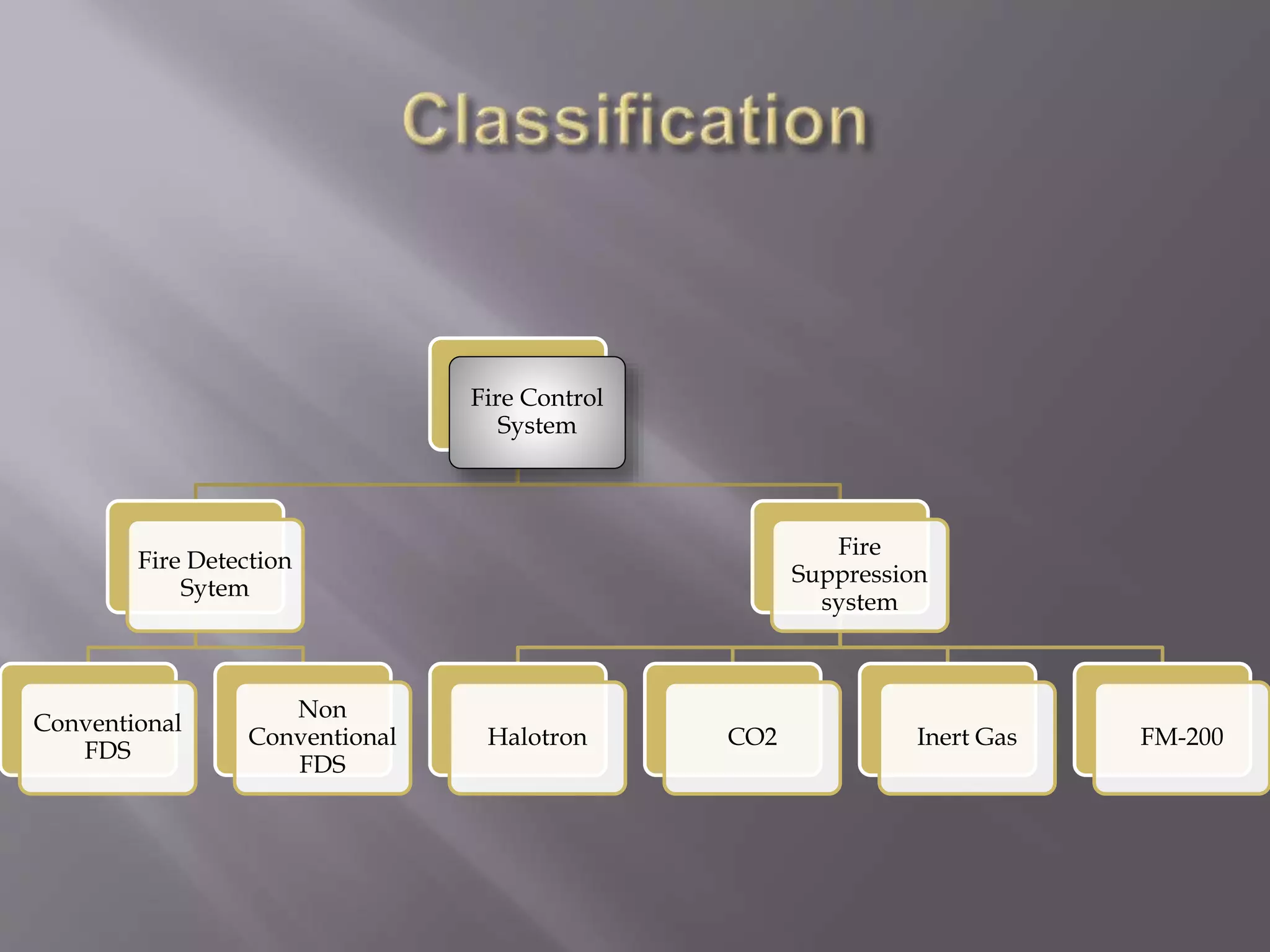
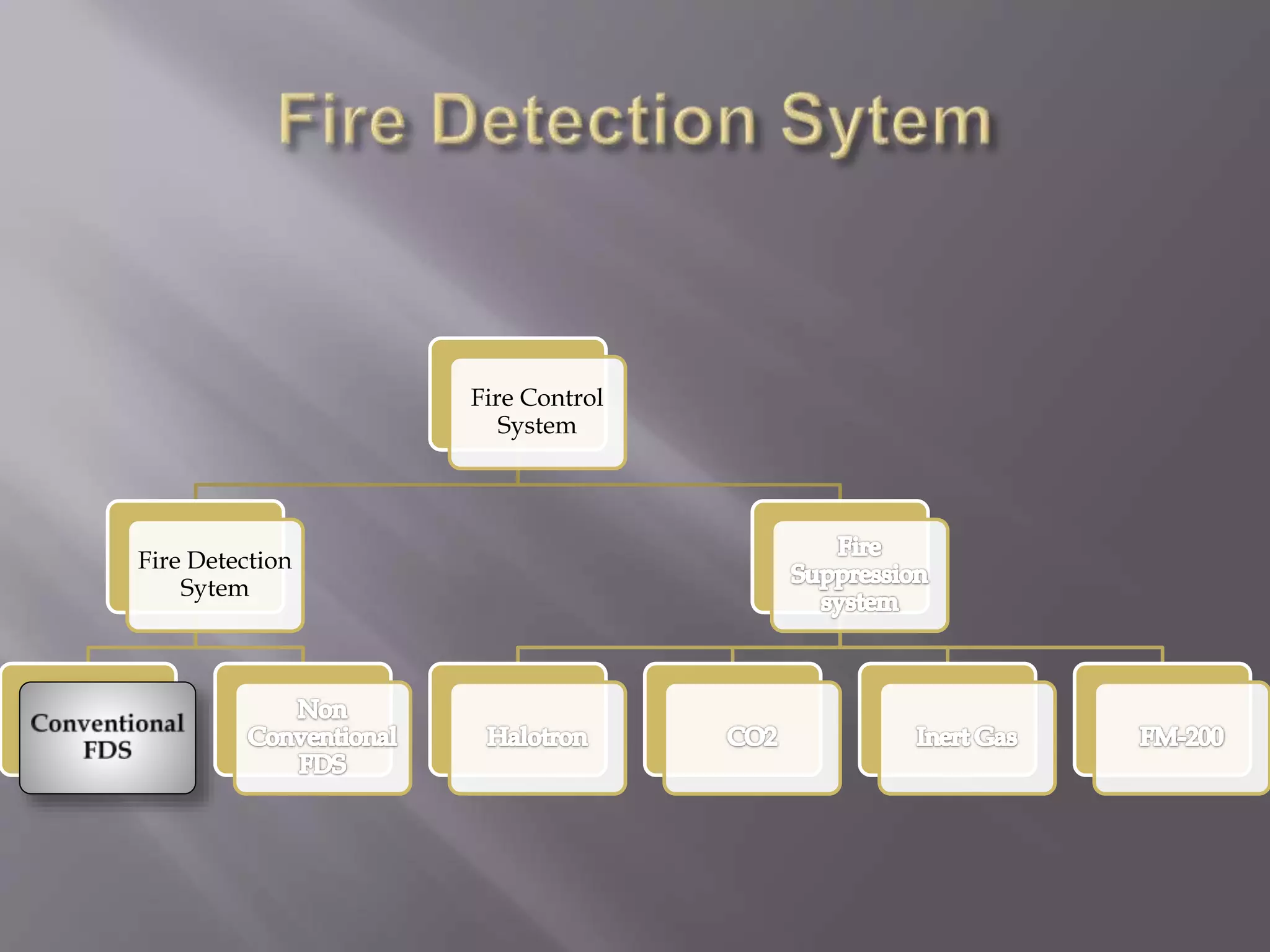
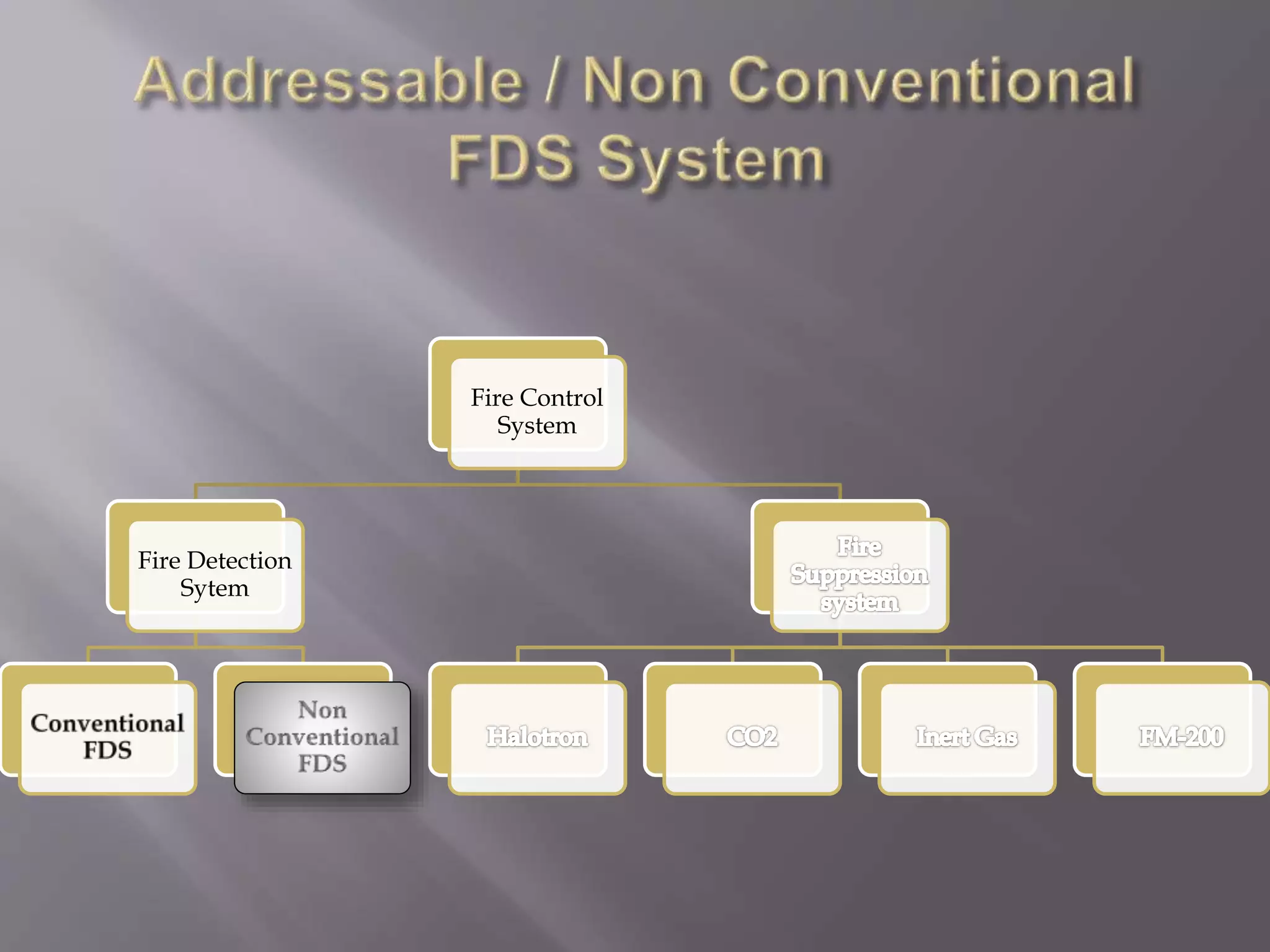
Fire Control
System
Fire Detection
Sytem
Conventional
FDS
Non
Conventional
FDS
Fire
Suppression
system
Halotron CO2 Inert Gas FM-200
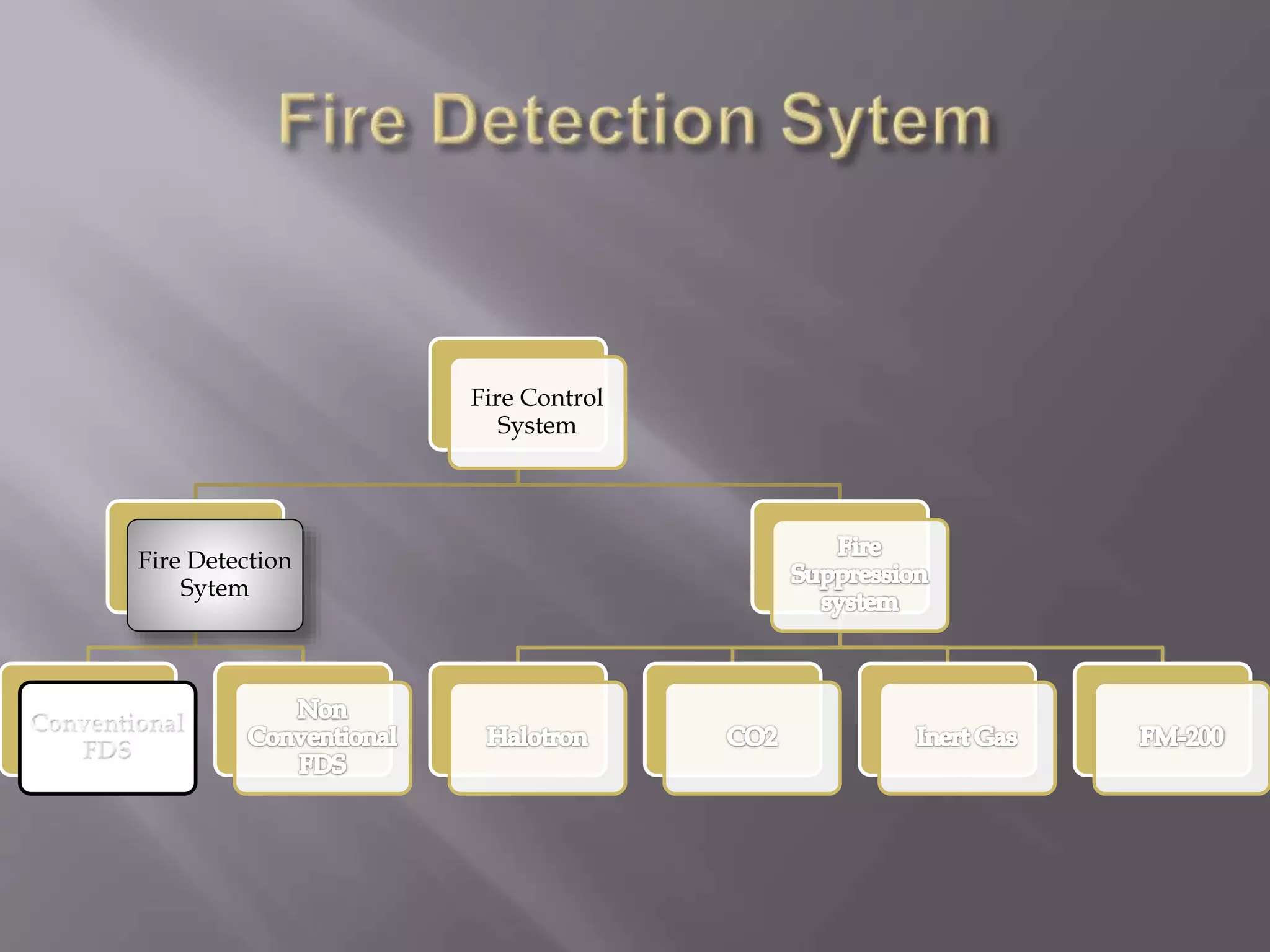
Fire Control
System
Fire Detection
Sytem
 Fire Alarm System is a system designed to
provide warning to the outbreak of fire so that
appropriate fire fighting action could be taken
before the situation gets out of control.
 An automatic fire alarm system is designed
to detect the presence of fire by monitoring
environmental changes associated with
combustion.
 There are two primary functions of fire
alarming system
 1. Detect fire or fire condition
 2. Give alarm in all parts of the buildng
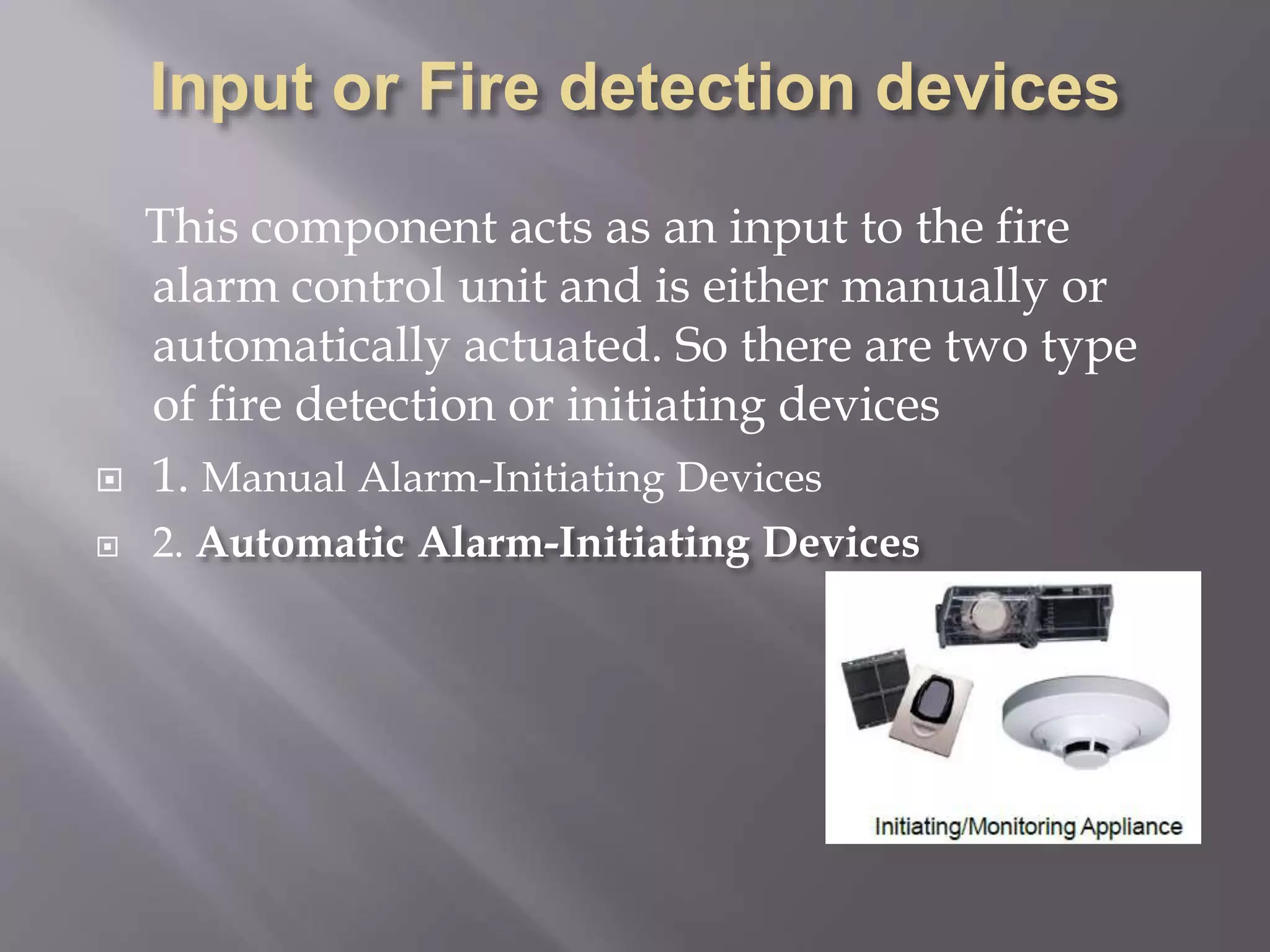
This component acts as an input to the fire
alarm control unit and is either manually or
automatically actuated. So there are two type
of fire detection or initiating devices
 1. Manual Alarm-Initiating Devices
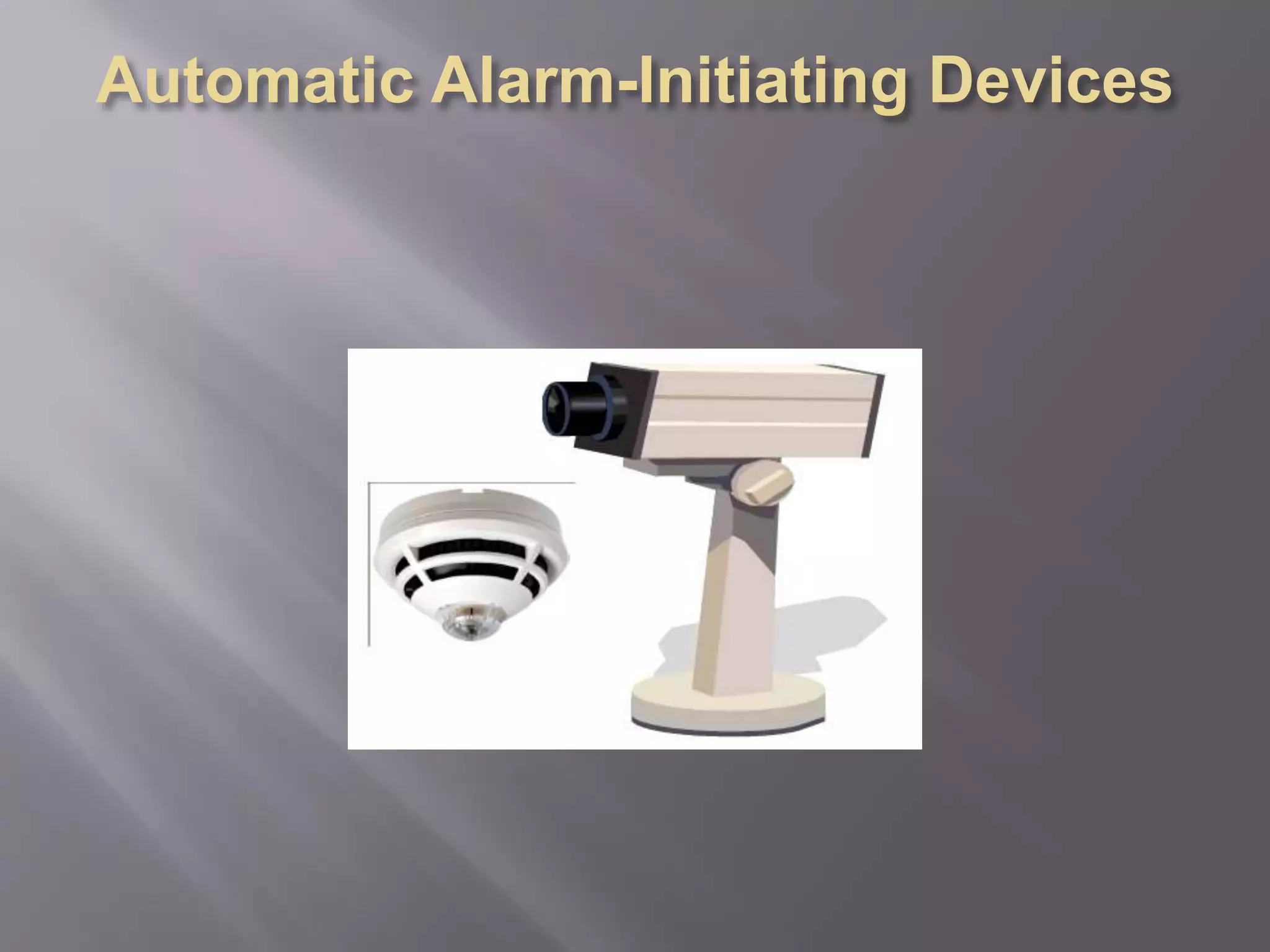
 2. Automatic Alarm-Initiating Devices
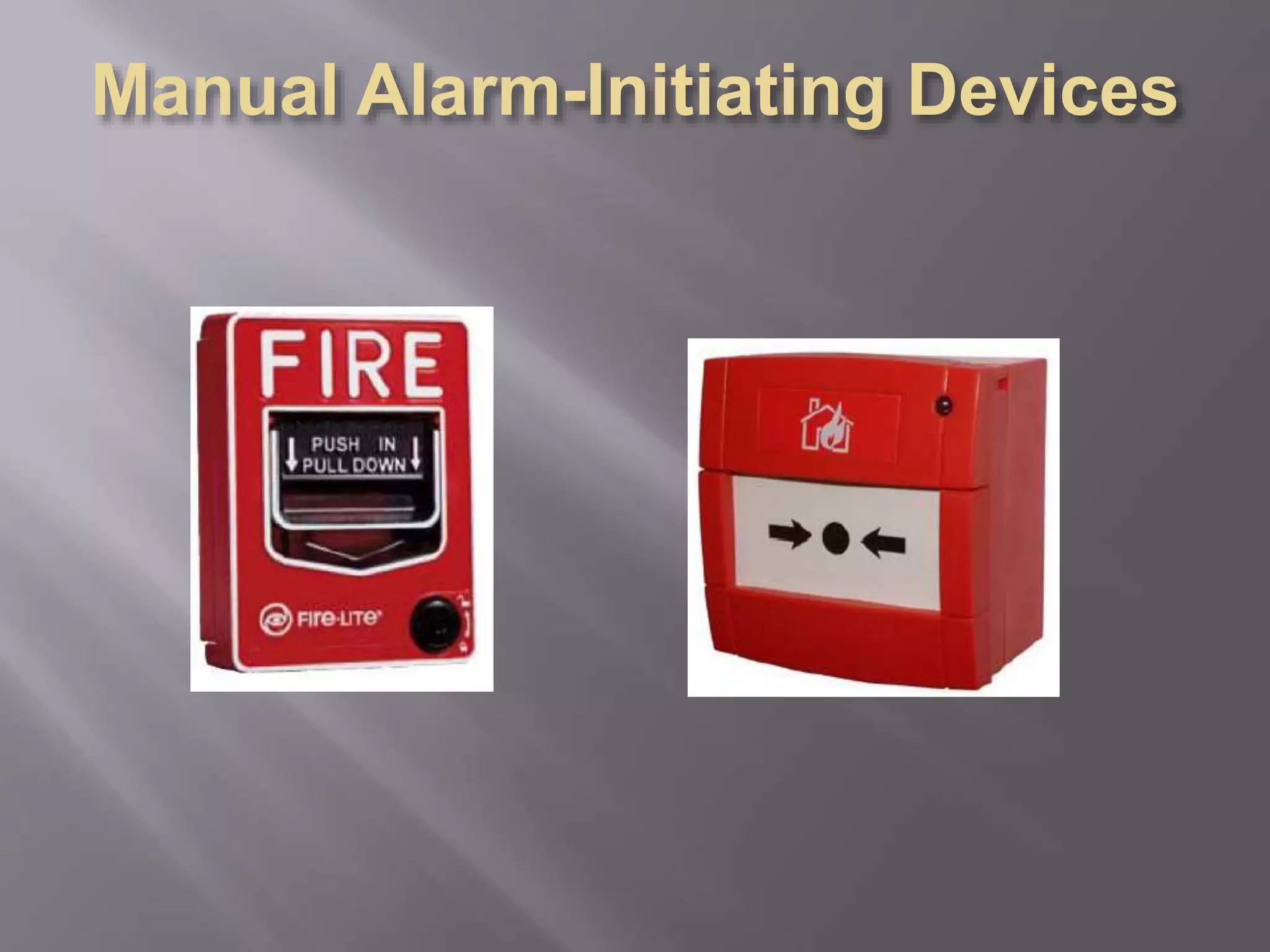
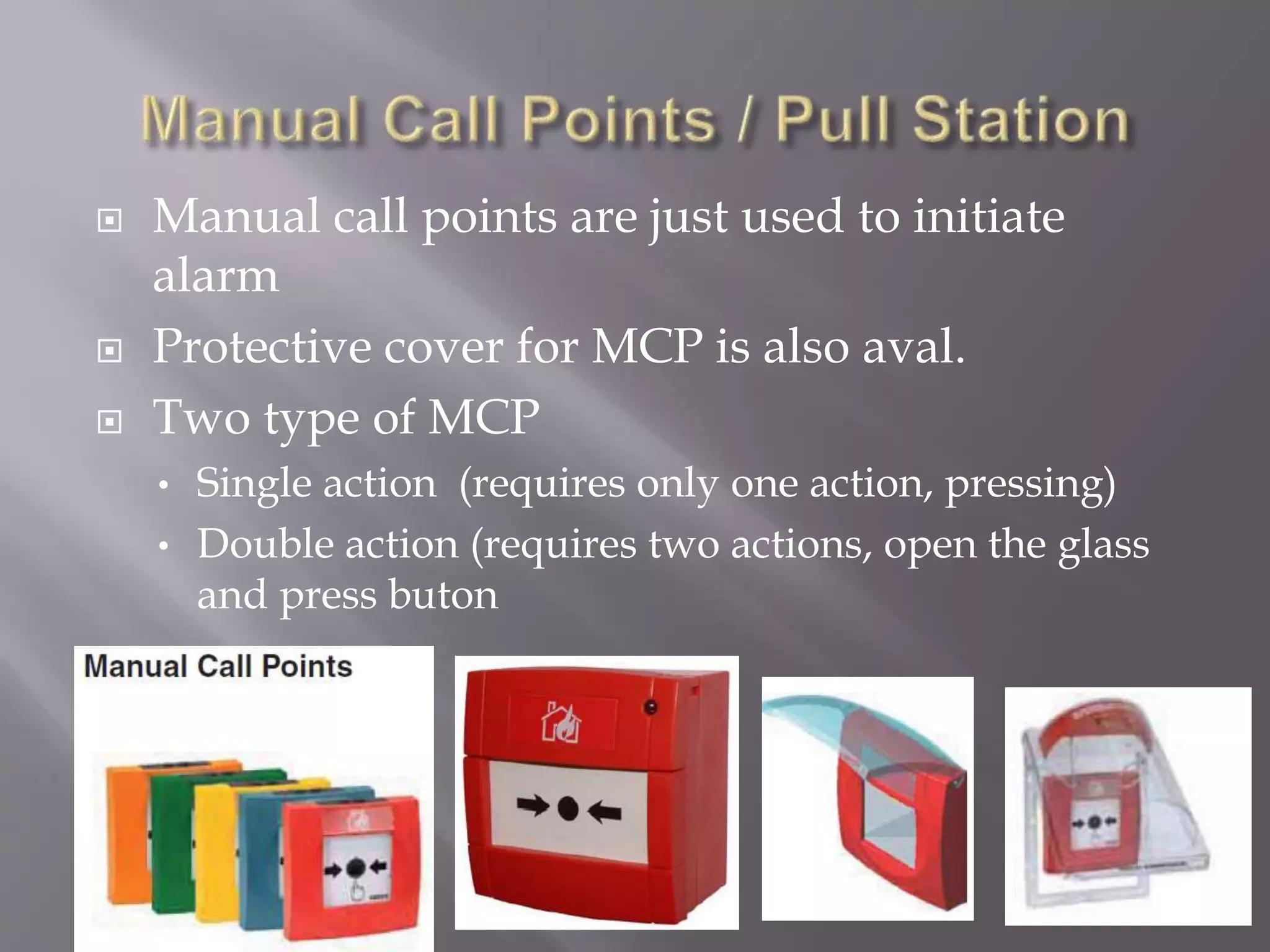
 Manual call points are just used to initiate
alarm
 Protective cover for MCP is also aval.
 Two type of MCP
• Single action (requires only one action, pressing)
• Double action (requires two actions, open the glass
and press buton
 Manual fire detection is the oldest method of detection.
In the simplest form, a person yelling can provide fire
warning.
 The advantage of manual alarm stations is that, upon
discovering the fire, they provide occupants with a
readily identifiable means to activate the building fire
alarm system.
 Outmoded “broken glass” pull stations
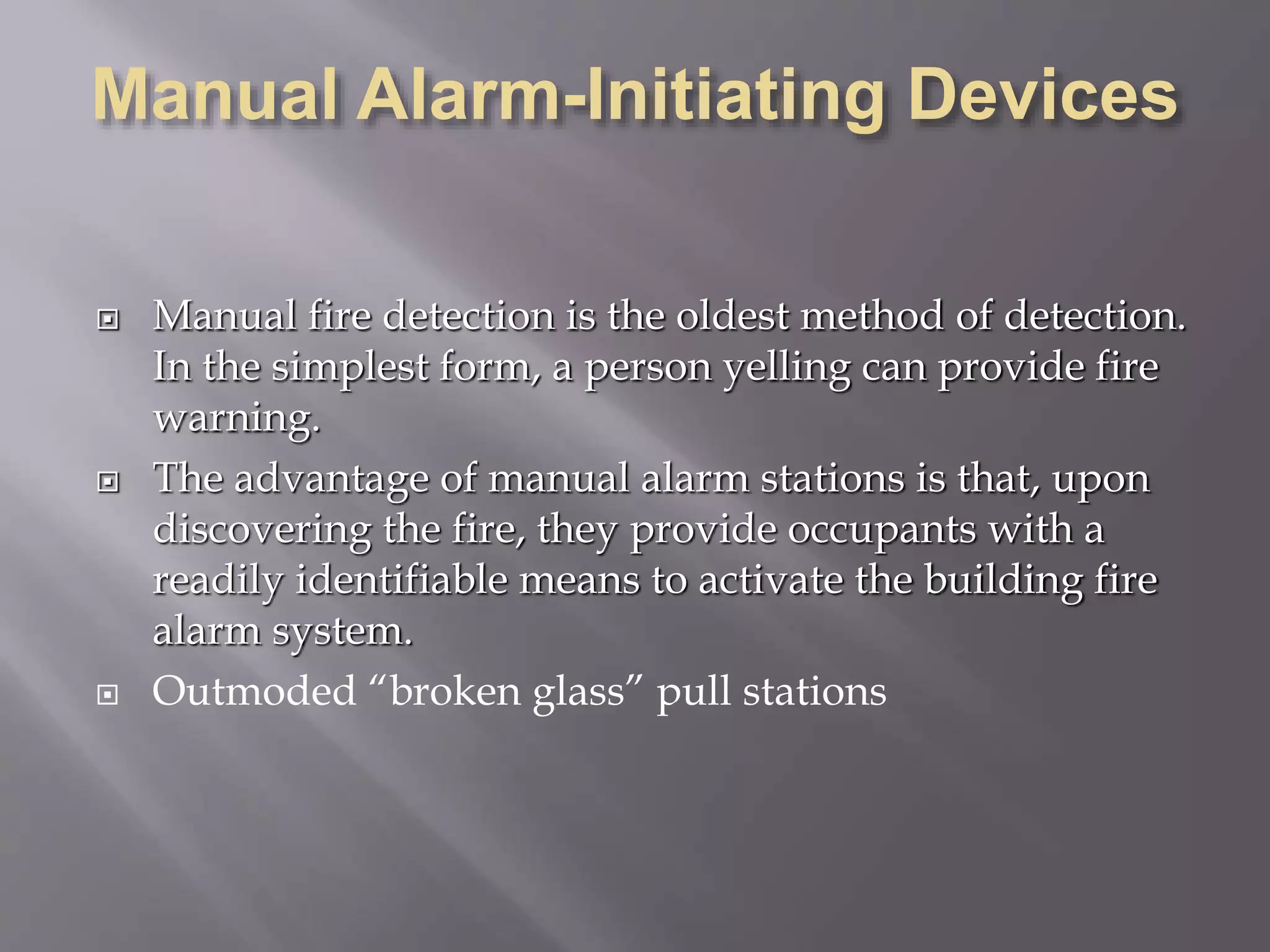
 When activated, it will immediately sound the
notification devices
 Pulling a lever outside of enclosure will
activate switch inside enclosure
 Four basic types
 Heat detectors
 Smoke detectors
 Fire-gas detectors
 Flame detectors
 It response to thermal energy
 Fixed temperature heat detectors (HD)
 Non restorable fixed temp HD
 Restorable fixed temp HD
 Rate-of-rise heat detector
 Combination of detectors
 Photoelectric smoke detector
 Ionization smoke detector
 Types
 Ultraviolet (UV)
 Infrared (IR)
 Monitors levels of gases released by
combustion
 Carbon dioxide
 Carbon monoxide
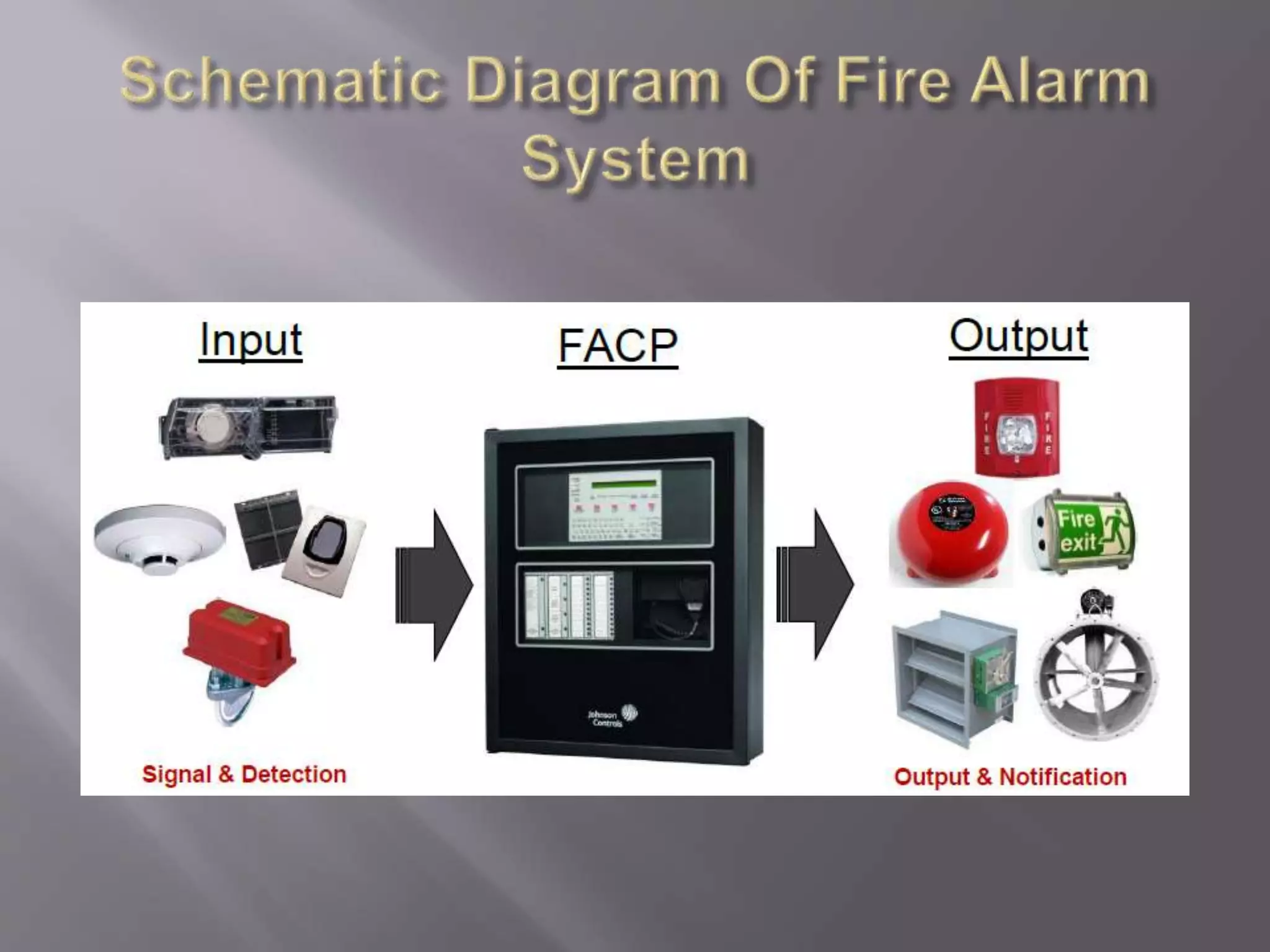
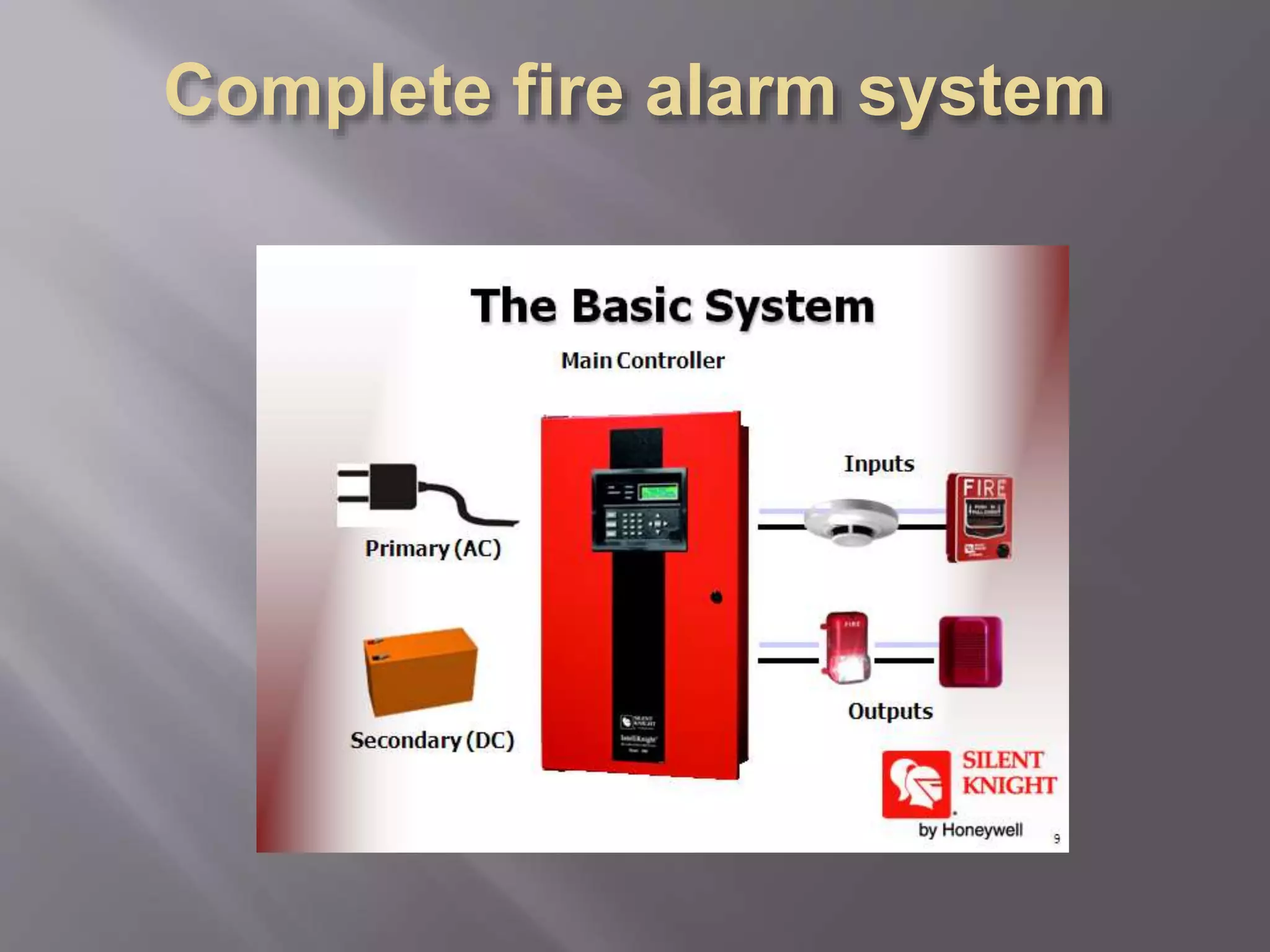
 It receives input from auto / manual fire alarm
devices
 Activate Notification devices
 Supply power to detection devices
 Supply power to notification appliances.
 Controls relays / devices connected to panel
 Display messages / fault / fault loc on it
display screen
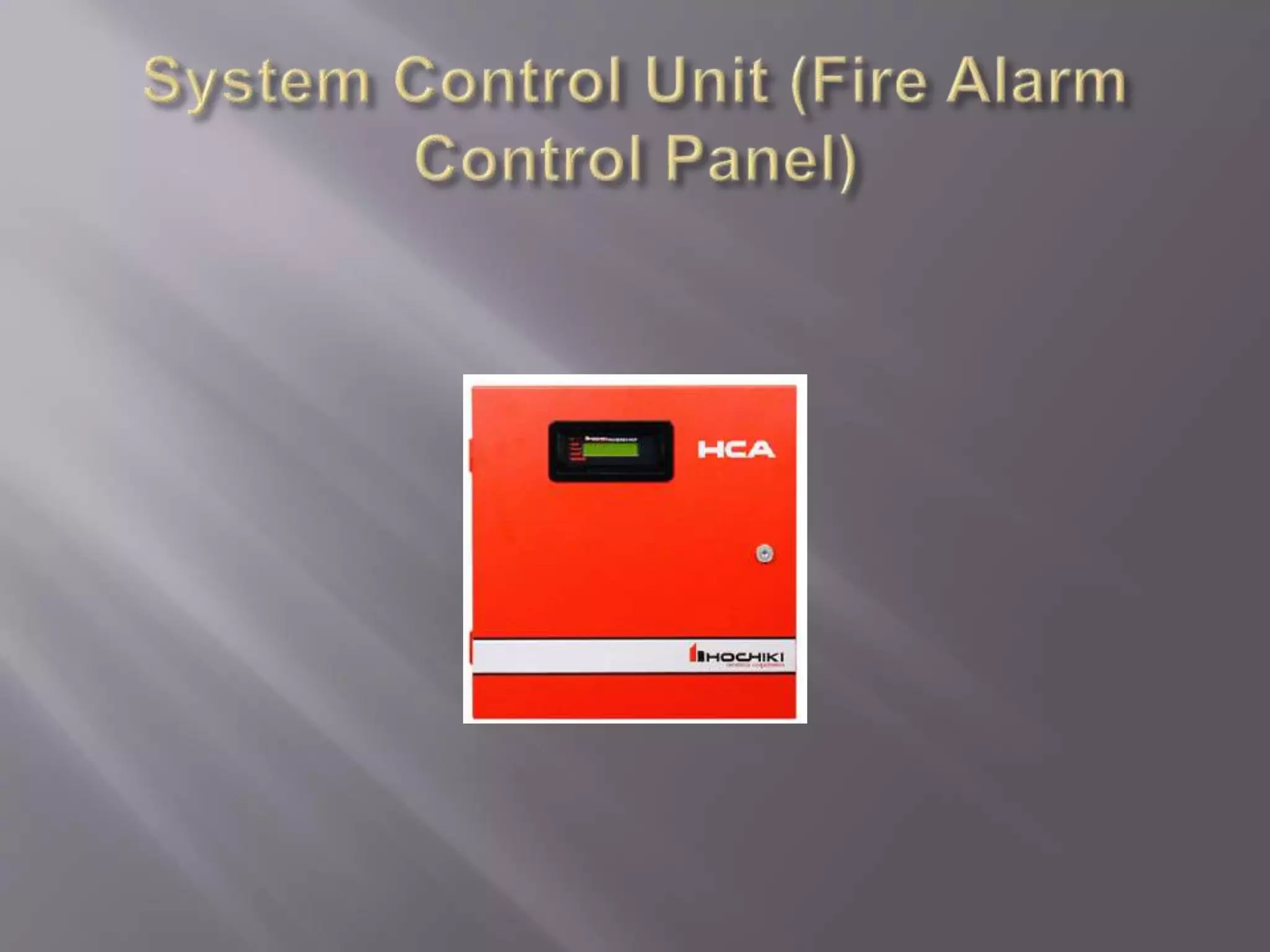
 The brains of the system
 Provides power to the system, monitors inputs
and controls outputs through various circuits
 Performs other functions as required by the
appropriate code
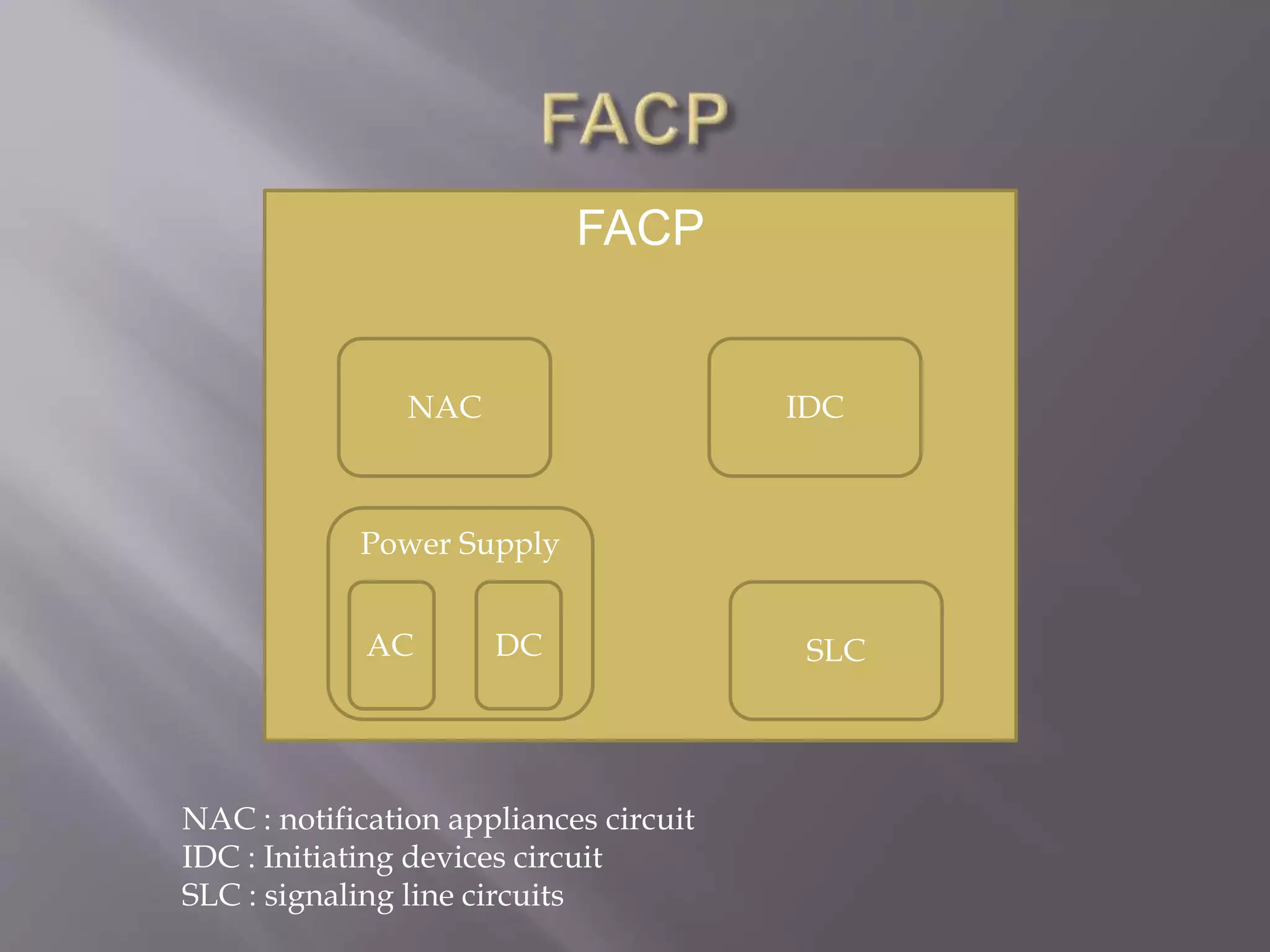
FACP
NAC
Power Supply
SLC
IDC
AC DC
NAC : notification appliances circuit
IDC : Initiating devices circuit
SLC : signaling line circuits
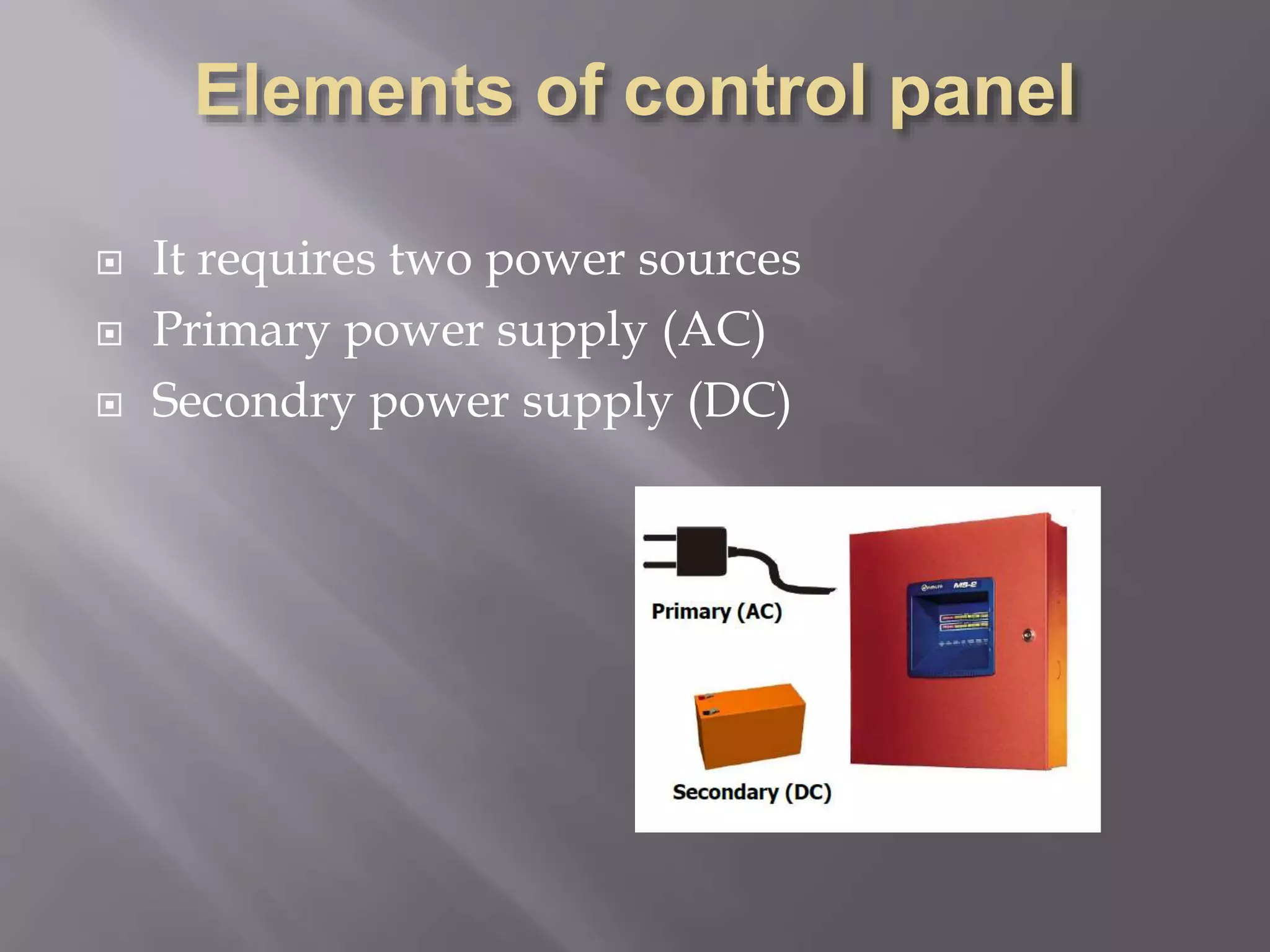
 It requires two power sources
 Primary power supply (AC)
 Secondry power supply (DC)
 This component uses energy supplied from the fire alarm
system or other stored energy source, to inform the
proximate persons of the need to take action, usually to
evacuate.
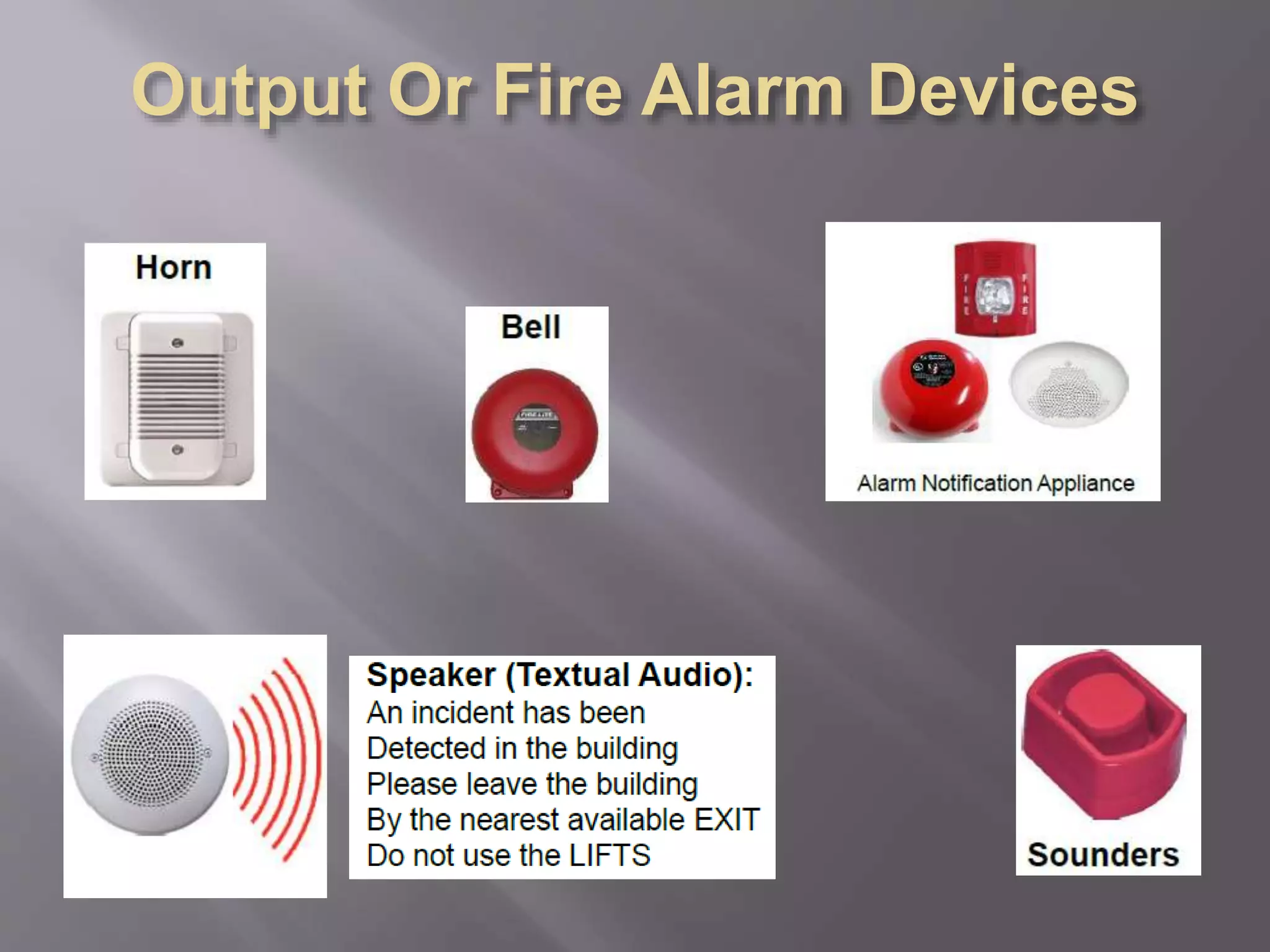
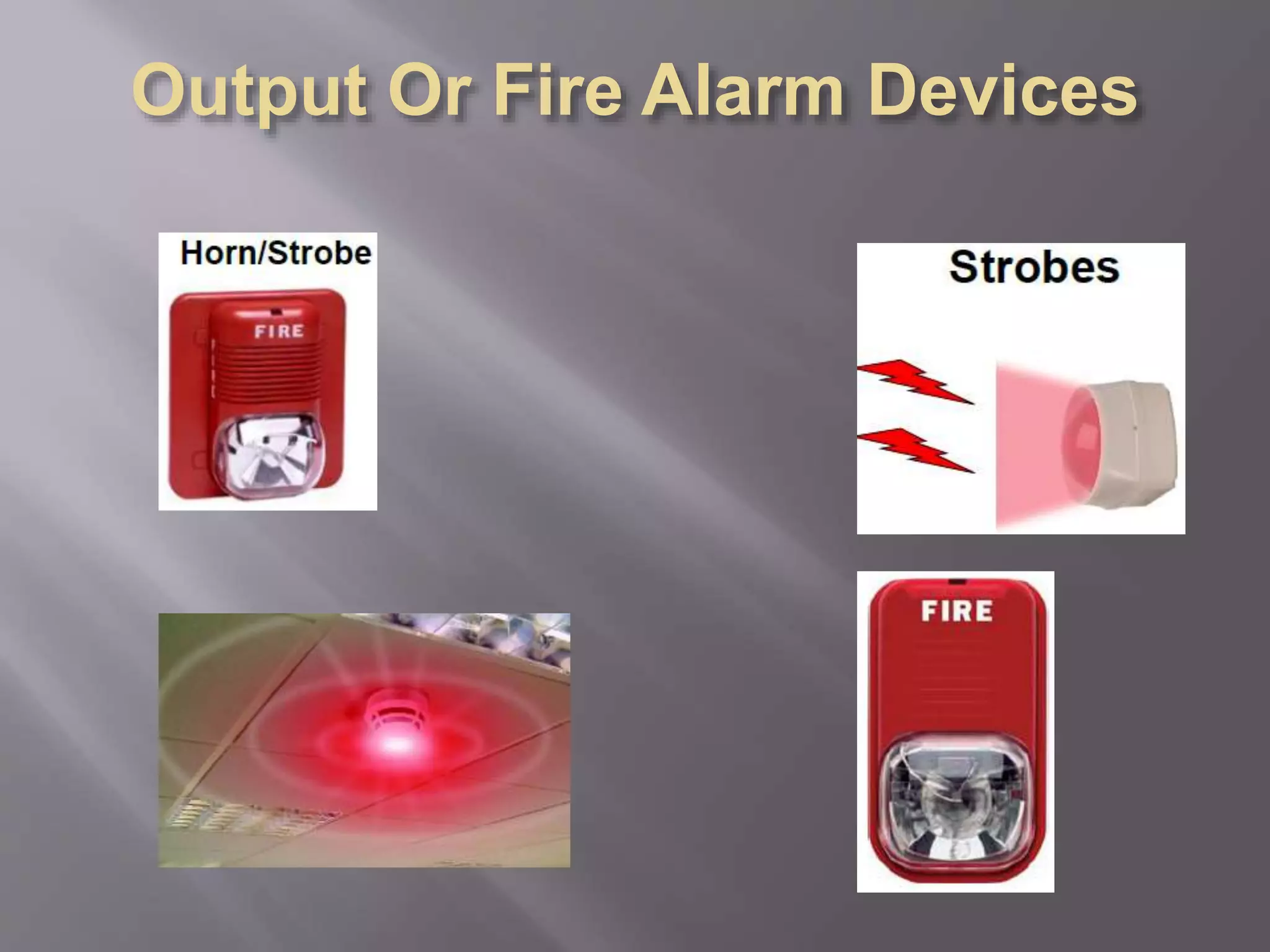
 Output or Notification appliances:
 bells,
 buzzers,
 horns,
 recorded voice messages,
 strobe lights ( high intense flash of short duration to get
more attention)
 speakers, and other warning appliances
 Audible Notification
 Audible notification has historically been used
as a notification of fire. The early notification
consisted primarily of bells or sirens. An
advantages of audible devices is that they have
a low power draw
 In order for audible devices to alert the
building occupants, the device must be loud
enough to be heard.
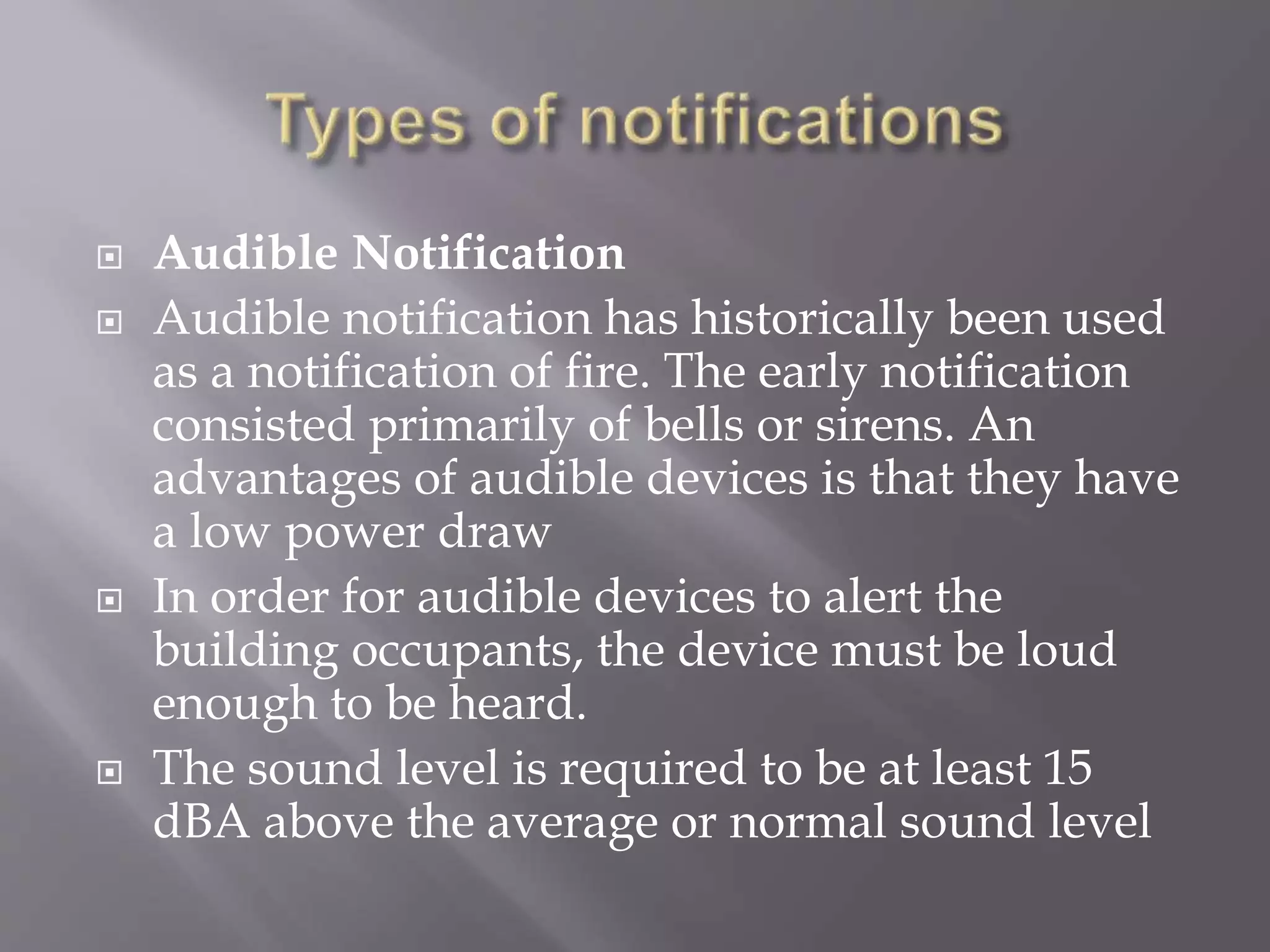
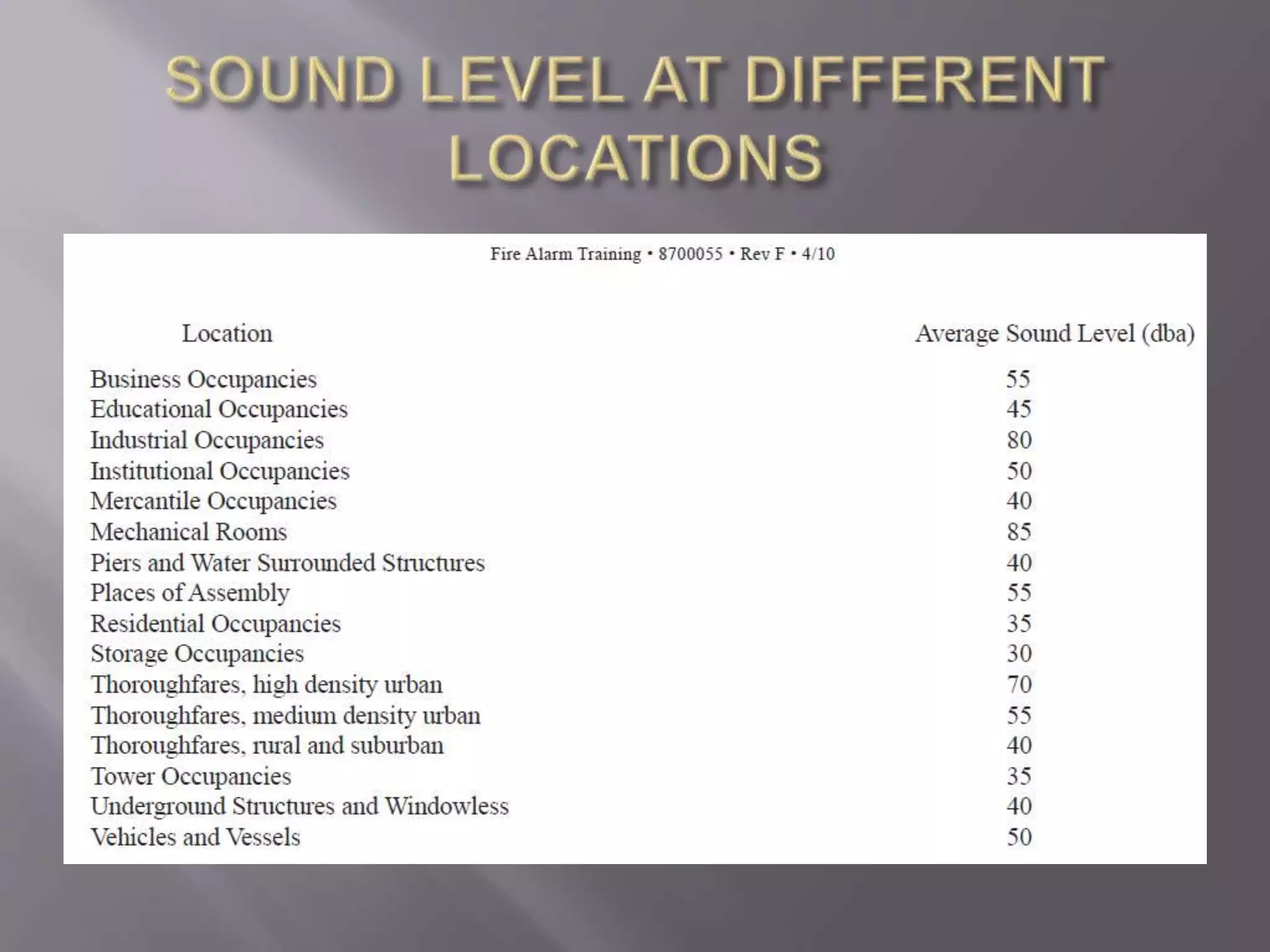
 The sound level is required to be at least 15
dBA above the average or normal sound level
 Strobes are required by the ADA in portions of
any building accessible to a hearing impaired
person.
 Areas such as conference rooms, restrooms,
hallways, routes of tours & the private office of
someone with a hearing disability are
examples.
Fire Control
System
Fire Detection
Sytem
 Such type of System do not indicate which
device is in alarm or trouble
 In this system it is extremely difficult to
pinpoint the exact loc of alarm or trouble.
Fire Control
System
Fire Detection
Sytem
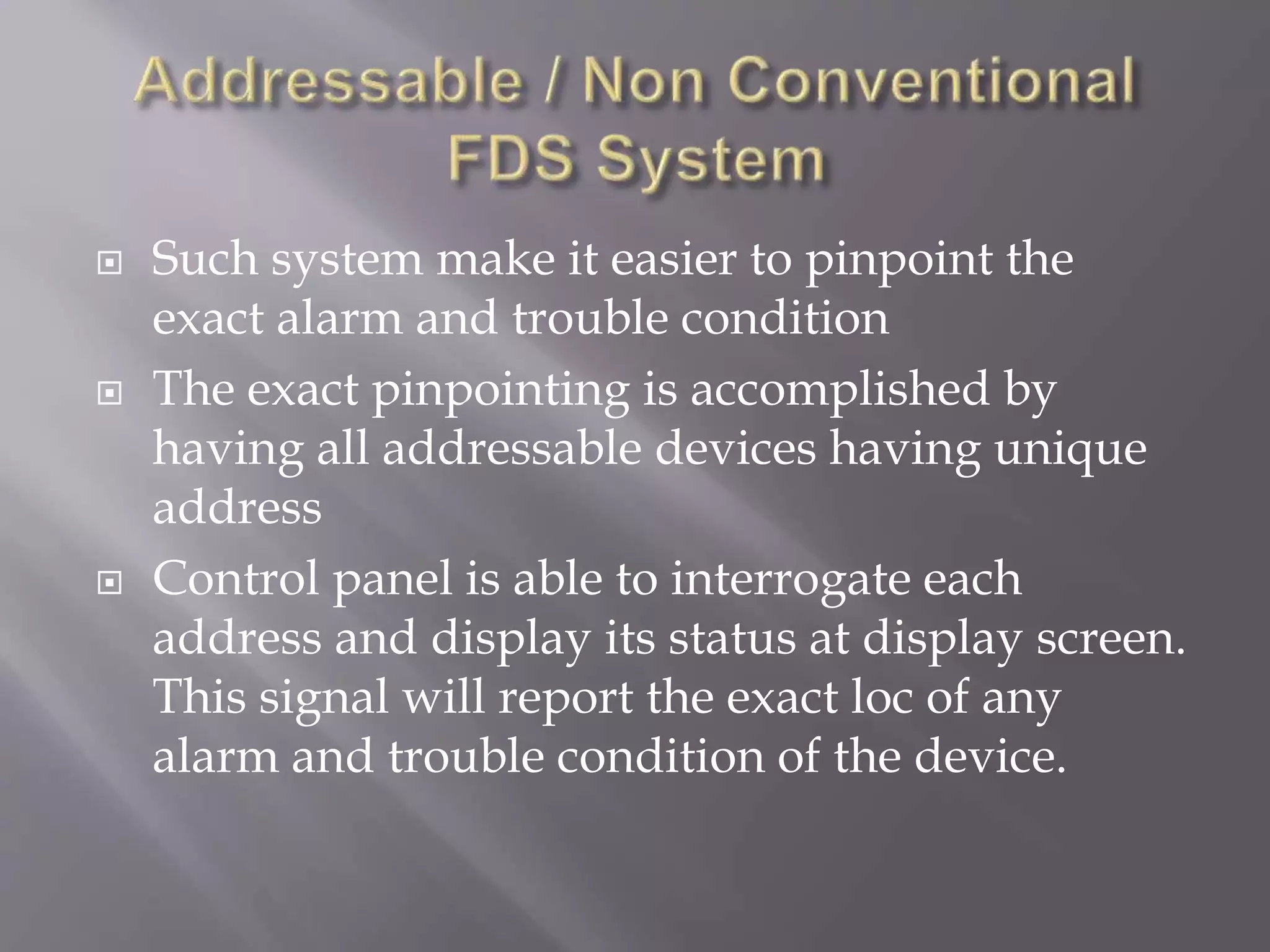
 Such system make it easier to pinpoint the
exact alarm and trouble condition
 The exact pinpointing is accomplished by
having all addressable devices having unique
address
 Control panel is able to interrogate each
address and display its status at display screen.
This signal will report the exact loc of any
alarm and trouble condition of the device.
 Awell maintained system is more reliable and efficient.
 Prolong the life span of your fire alarm system
 It ensures the safety of your life, your property and yur
business
 All types of extinguishers should be inspected at least
once a year to make sure it has proper pressure (gauge
in green or proper cartridge weight), has the correct
volume of extinguishing agent (tech weighs it),
 all external parts are serviceable. Often, dry chemical
and dry powder types are hit on the bottom with a
rubber mallet to make sure the powder is free-flowing,
which is called "fluffing" the powder.
 Keep the record
 Log all new activities / events shown on FACP
 Keep all records in secured cabneits for future ref on
maint / trouble shooting
 Weekly test of FACP
 Routine maint
 Assign / nominate a person for FACP
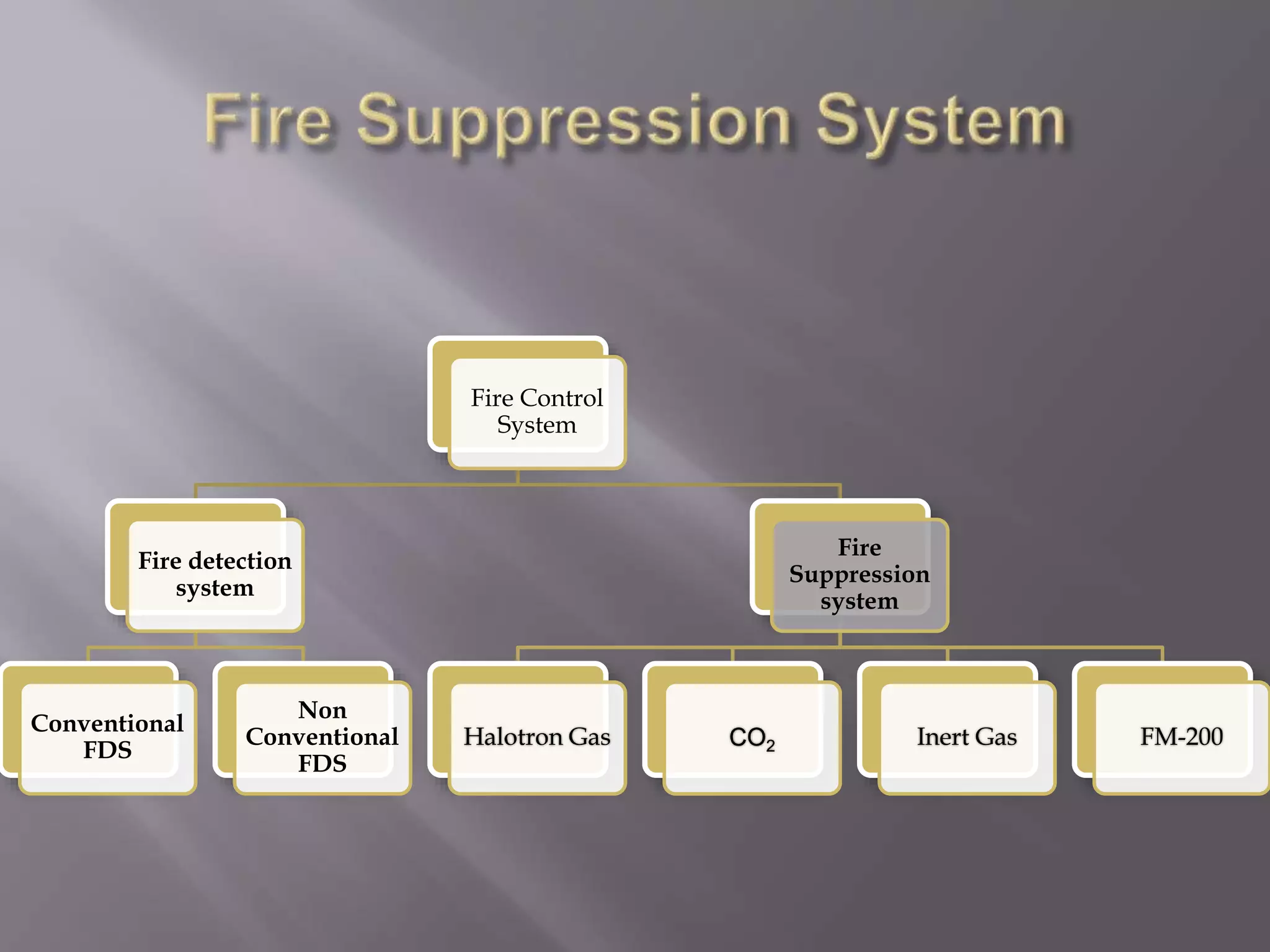
Fire Control
System
Fire detection
system
Conventional
FDS
Non
Conventional
FDS
Fire
Suppression
system
Halotron Gas CO2 Inert Gas FM-200
 It detects the fire
 It suppress the fire
 Also called flame extinguisher or simply
extinguisher.
 It is device used to extinguish or control the
fire.
 Hand-held cylindrical pressure vessel
containing an agent which can be discharged to
extinguish a fire.
 There are two types of fire extinguisher.
 1. stored pressure
 2. cartridge type.
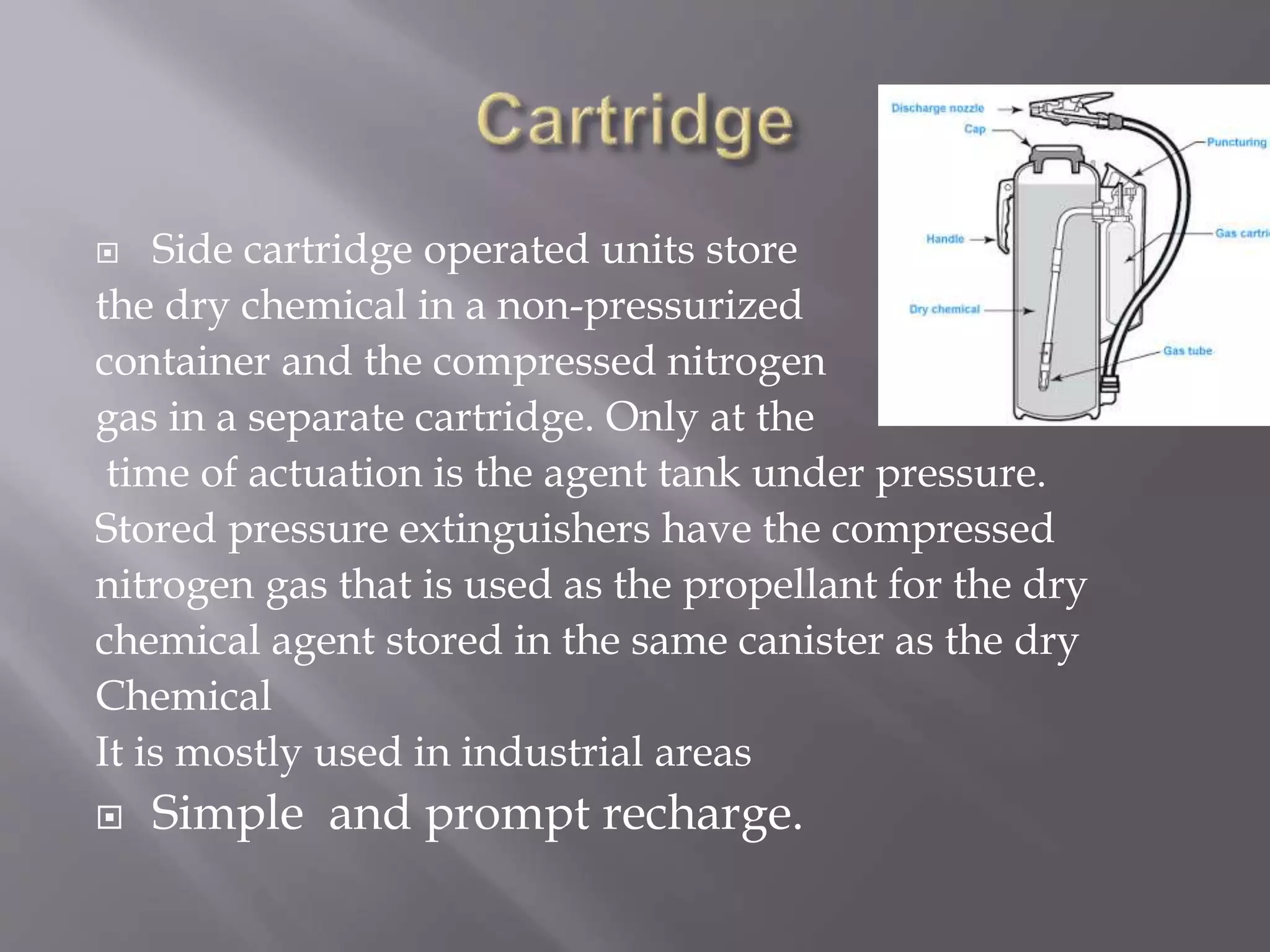
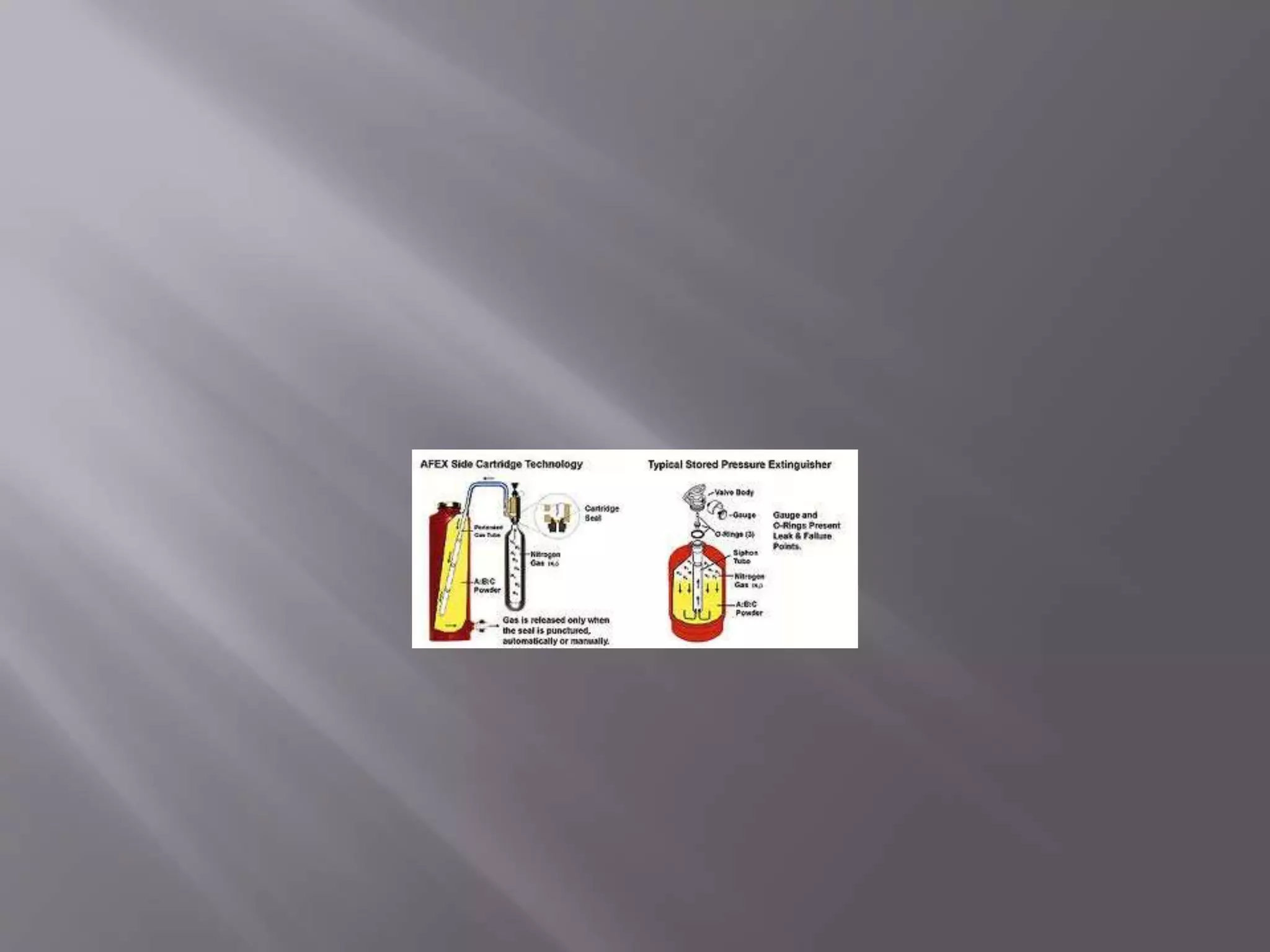
 Side cartridge operated units store
the dry chemical in a non-pressurized
container and the compressed nitrogen
gas in a separate cartridge. Only at the
time of actuation is the agent tank under pressure.
Stored pressure extinguishers have the compressed
nitrogen gas that is used as the propellant for the dry
chemical agent stored in the same canister as the dry
Chemical
It is mostly used in industrial areas
 Simple and prompt recharge.
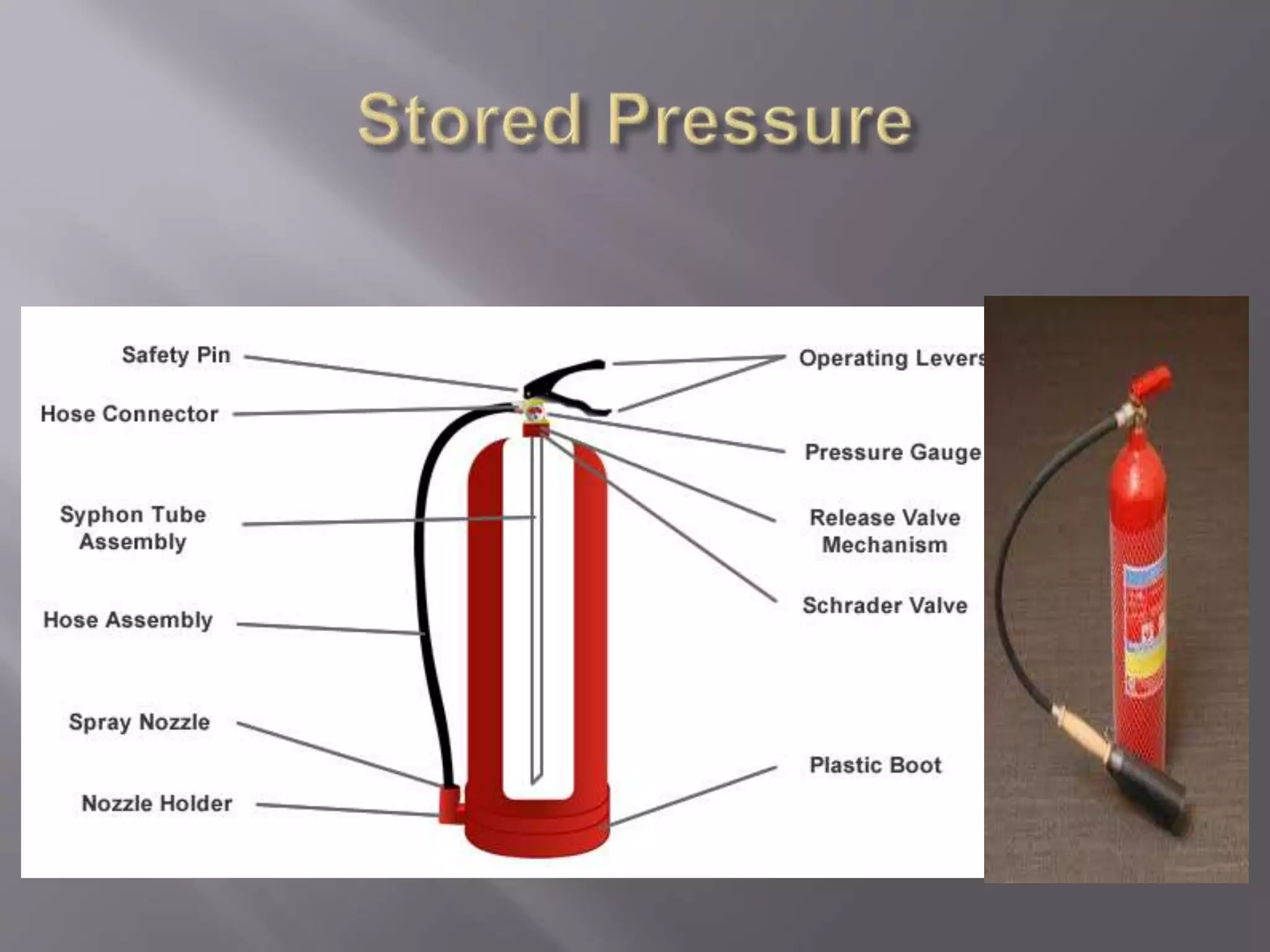
 In stored pressure units, the expellant is stored
in the same chamber as the firefighting agent
itself. Depending on the agent used, different
propellants are used. With dry chemical
extinguishers, nitrogen is typically used; water
and foam extinguishers typically use air.
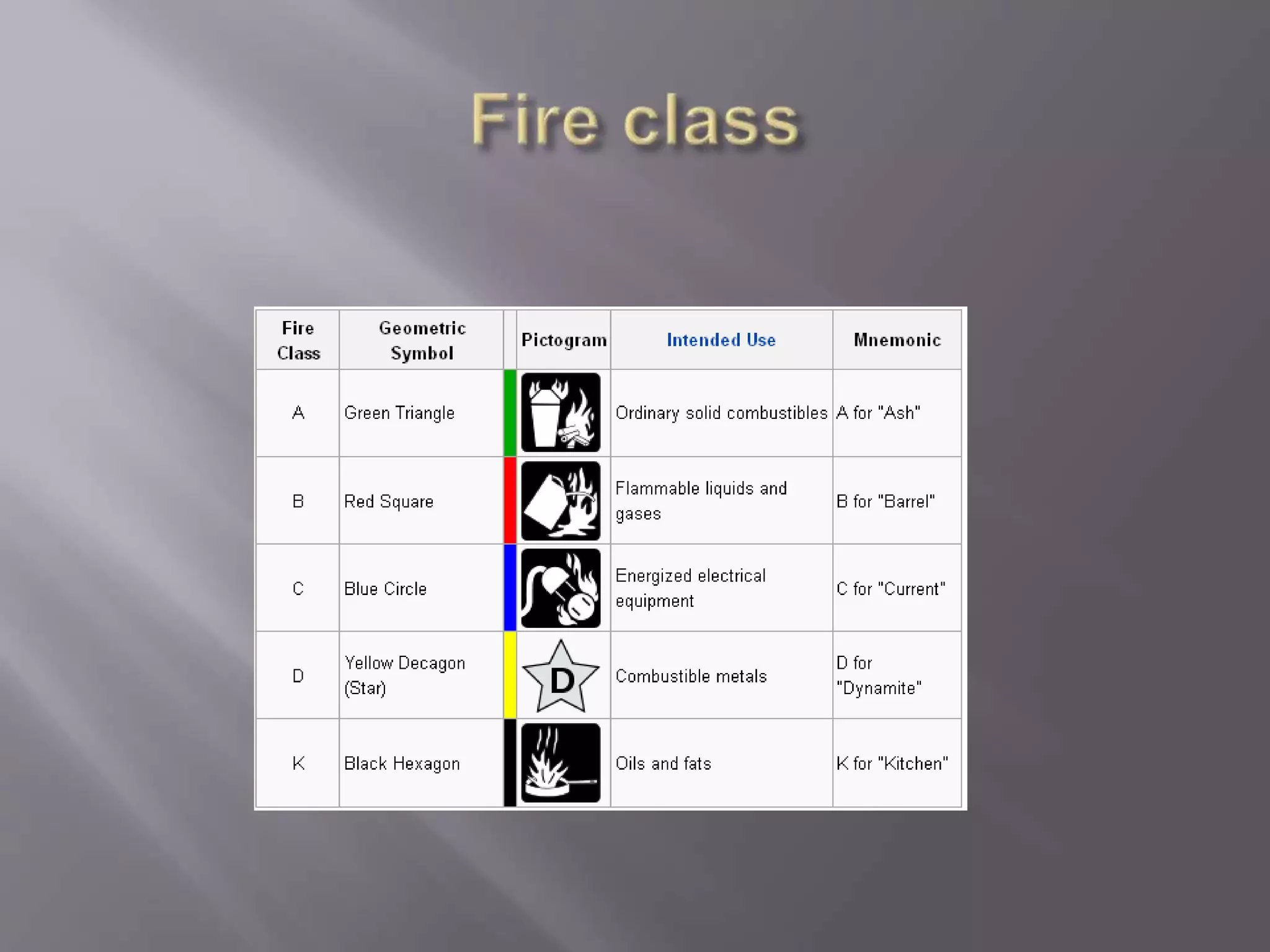
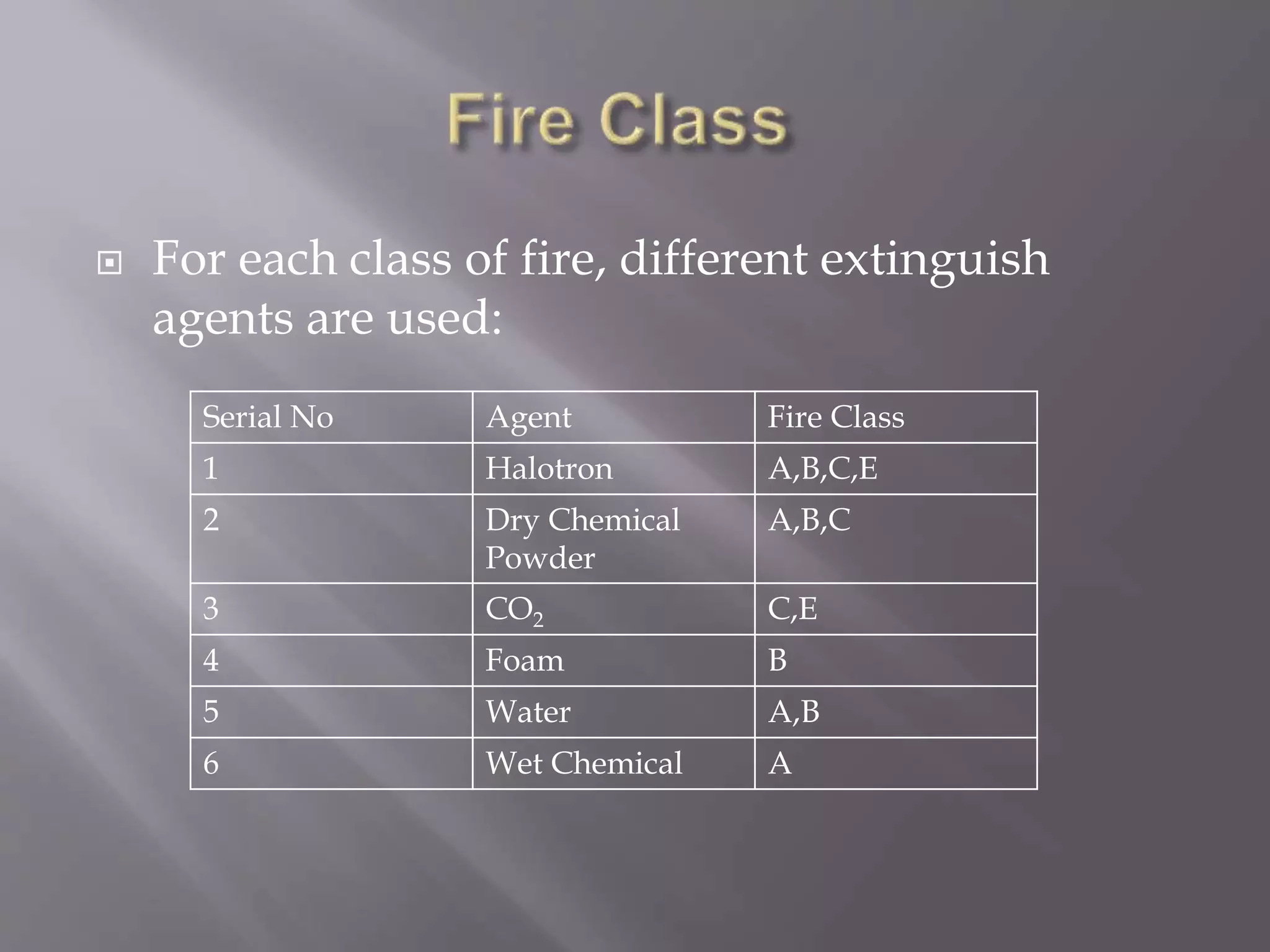
 For each class of fire, different extinguish
agents are used:
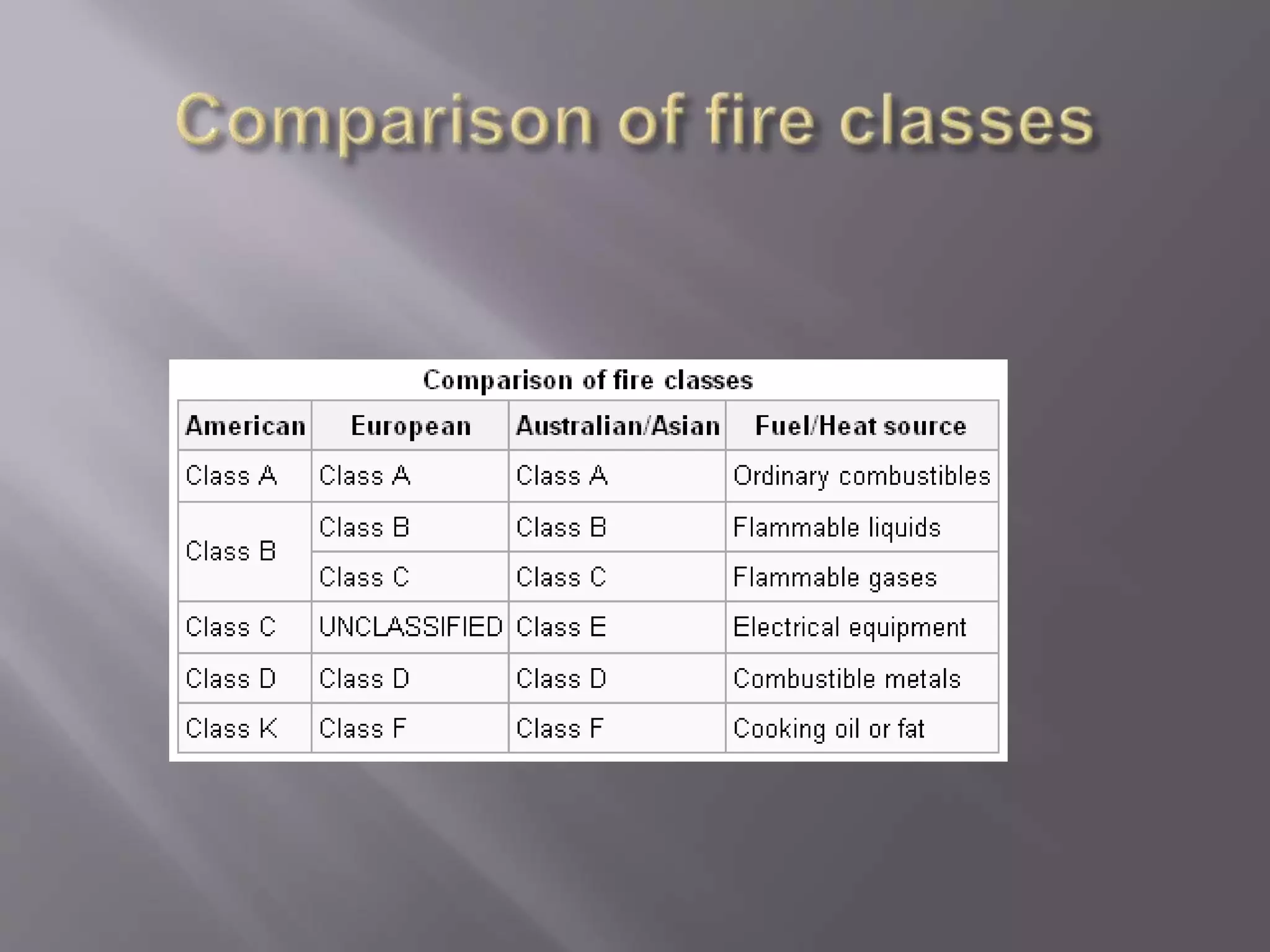
Serial No Agent Fire Class
1 Halotron A,B,C,E
2 Dry Chemical
Powder
A,B,C
3 CO2 C,E
4 Foam B
5 Water A,B
6 Wet Chemical A
 For each class of fire , the extinguishing agent is
different
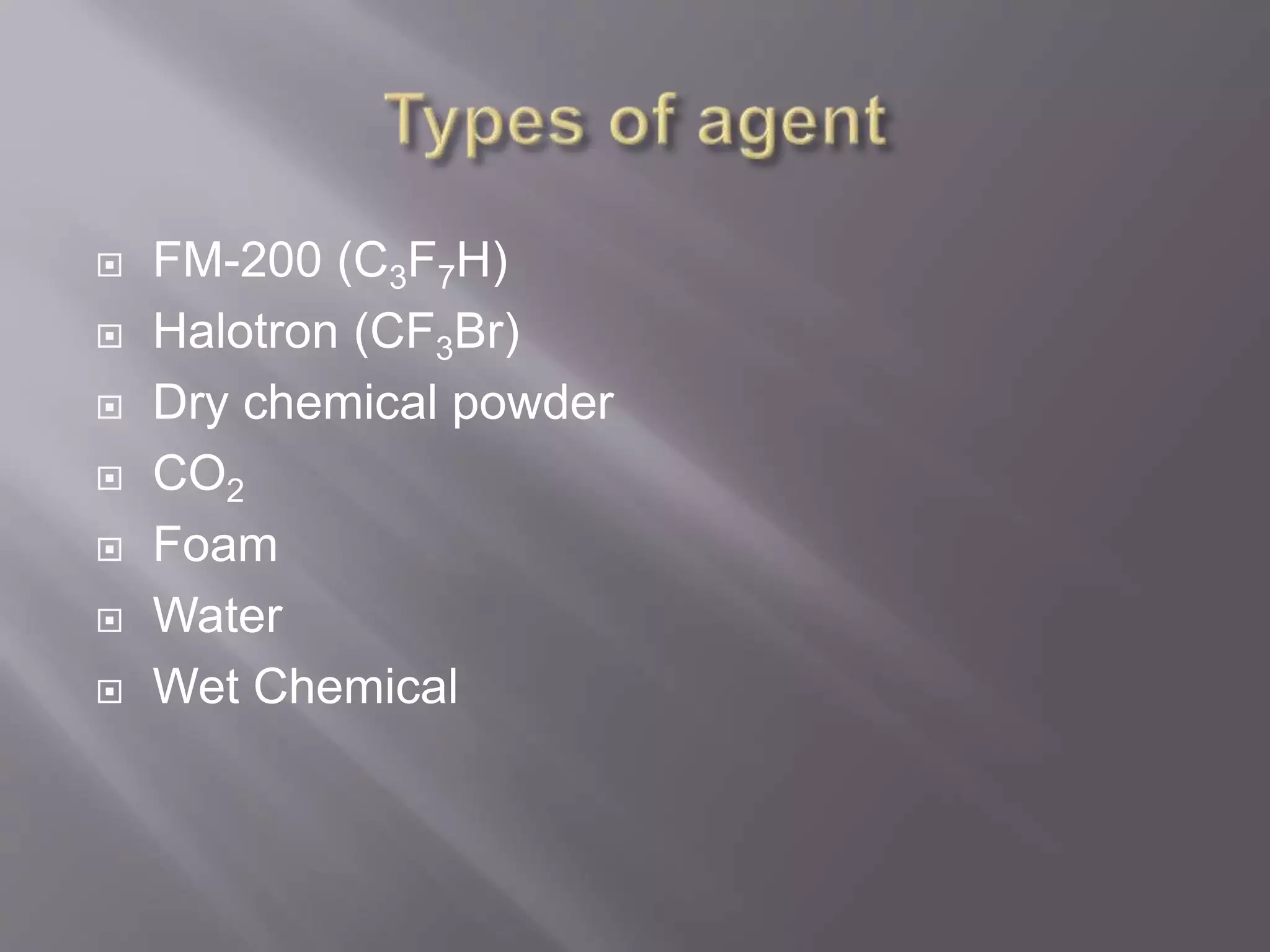
 FM-200 (C3F7H)
 Halotron (CF3Br)
 Dry chemical powder
 CO2
 Foam
 Water
 Wet Chemical
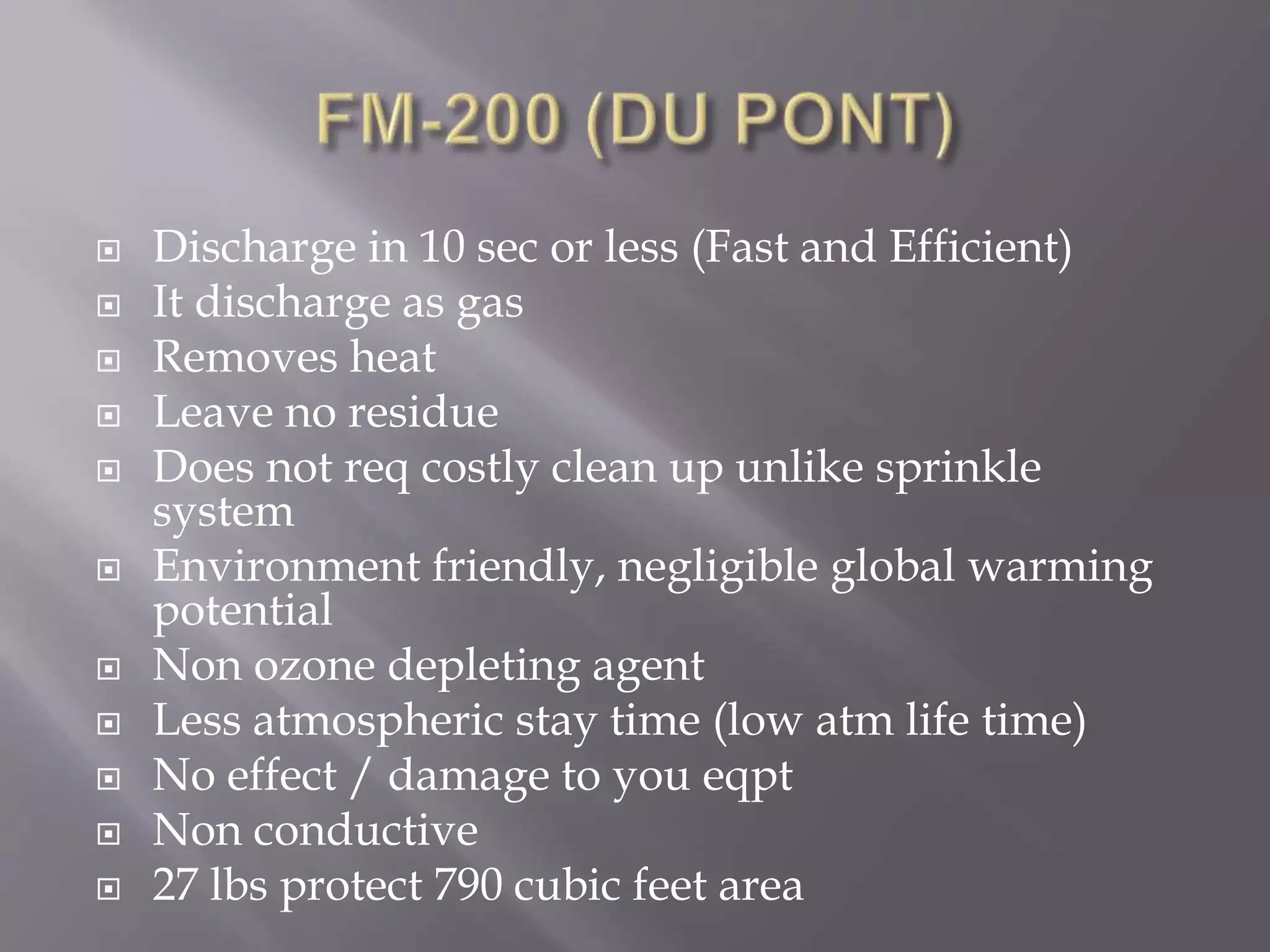
 Discharge in 10 sec or less (Fast and Efficient)
 It discharge as gas
 Removes heat
 Leave no residue
 Does not req costly clean up unlike sprinkle
system
 Environment friendly, negligible global warming
potential
 Non ozone depleting agent
 Less atmospheric stay time (low atm life time)
 No effect / damage to you eqpt
 Non conductive
 27 lbs protect 790 cubic feet area
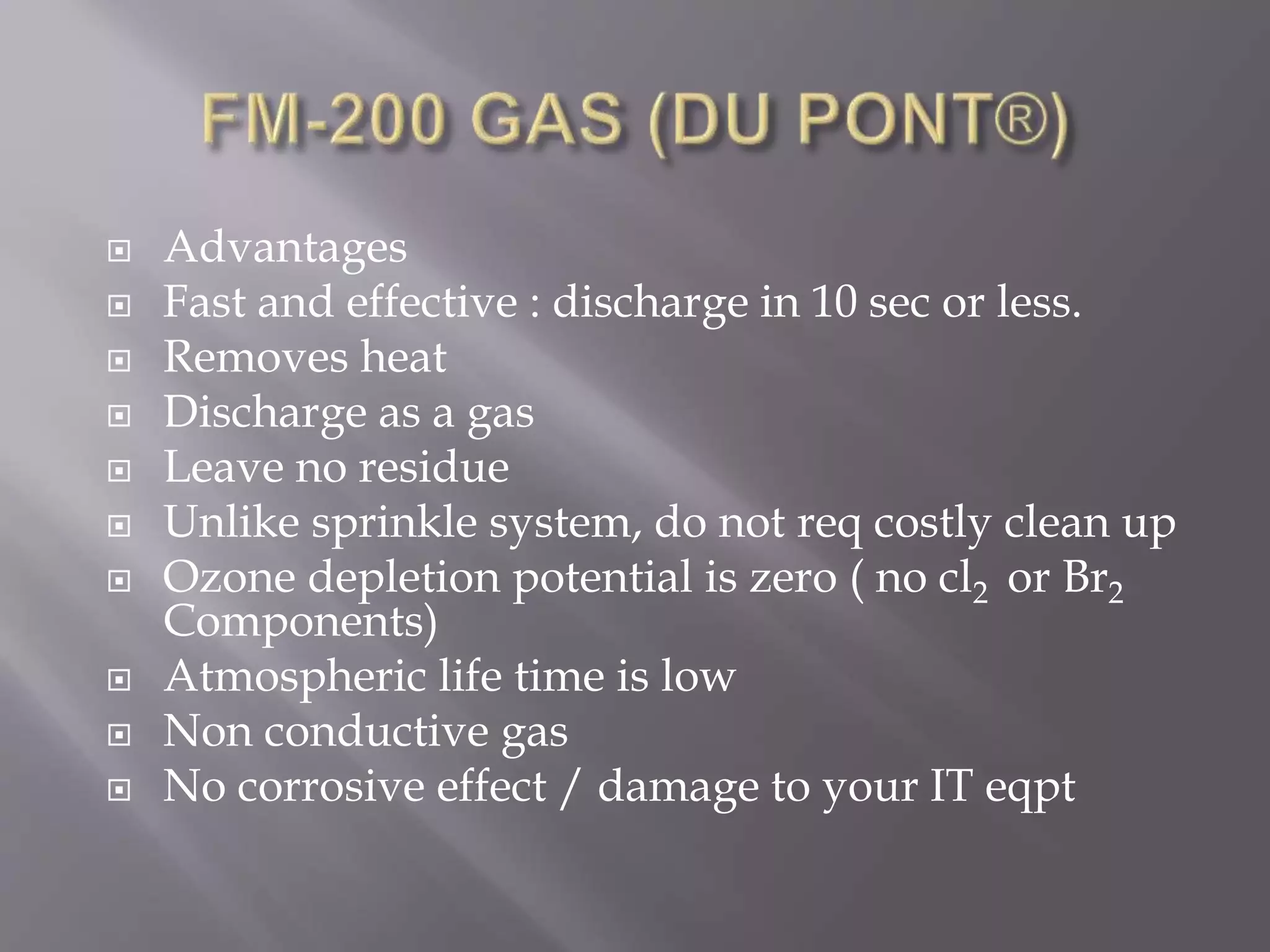
 Advantages
 Fast and effective : discharge in 10 sec or less.
 Removes heat
 Discharge as a gas
 Leave no residue
 Unlike sprinkle system, do not req costly clean up
 Ozone depletion potential is zero ( no cl2 or Br2
Components)
 Atmospheric life time is low
 Non conductive gas
 No corrosive effect / damage to your IT eqpt
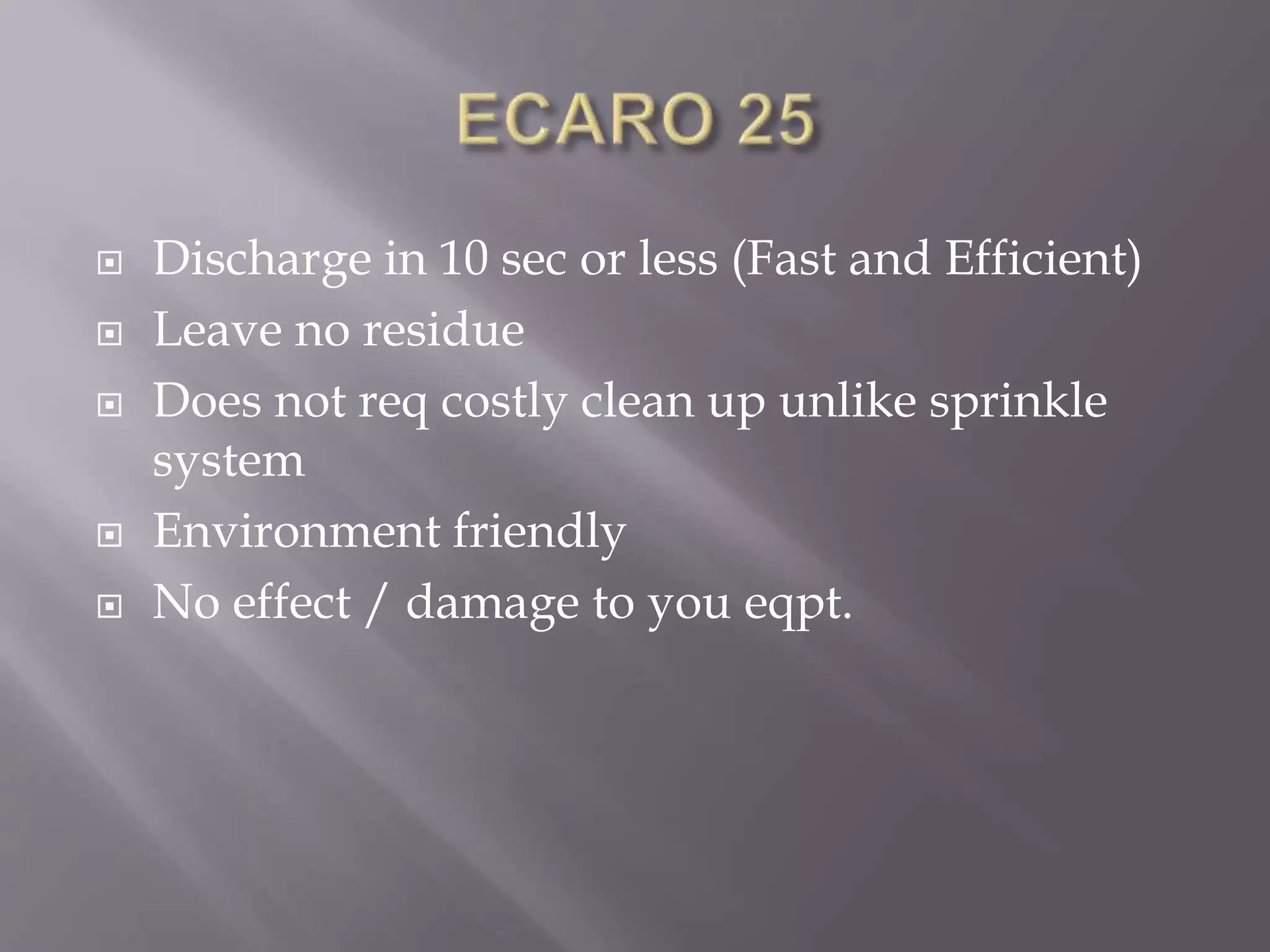
 Discharge in 10 sec or less (Fast and Efficient)
 Leave no residue
 Does not req costly clean up unlike sprinkle
system
 Environment friendly
 No effect / damage to you eqpt.
 Discharge in 10 sec or less (Fast and Efficient)
 Leave no residue
 Environment friendly
 Non conductive
 No effect / damage to you eqpt.
 Color less, odorless, electrically non conductive
fluid(replacement of water)that evaporates
rapidly
 Environment friendly, negligible global
warming potential
 No effect / damage to you eqpt
 Non ozone depleting agent
 Less atmospheric stay time (low atm life time)
 Powder
 Applied to electric , solid combustion.
 It prevents the chemical reactions and halts the
production of fire sustaining "free-radicals",
thus extinguishing the fire.
 Examples are Potassium chloride ,Potassium
bicarbonate, Sodium bicarbonate. Mono
ammonium phosphate, also known as "tri-
class", "multipurpose" or "ABC" dry chemical,
 Used on class A, B and C fires
 Applied to fuel fires
 form a frothy blanket or seal over the fuel,
preventing oxygen reaching it.
 AFFF (aqueous film forming foam)
 AR-AFFF (Alcohol-resistant aqueous film
forming foams)
 FFFP (film forming fluoroprotein)
 CAFS (compressed air foam system)
 Applied to solid combustion, flammable
liquids and gases
 APW (Air pressurized water) cools burning
material by absorbing heat from burning
material
 Used on class A, and B fires
 Used on solid combustion fire
 Wet Chemical extinguishes the fire by forming
a soapy foam blanket over the burning oil and
by cooling the oil below its ignition
temperature.
 Wet Chemical (potassium acetate, carbonate, or
citrate)
 Used on class A fires
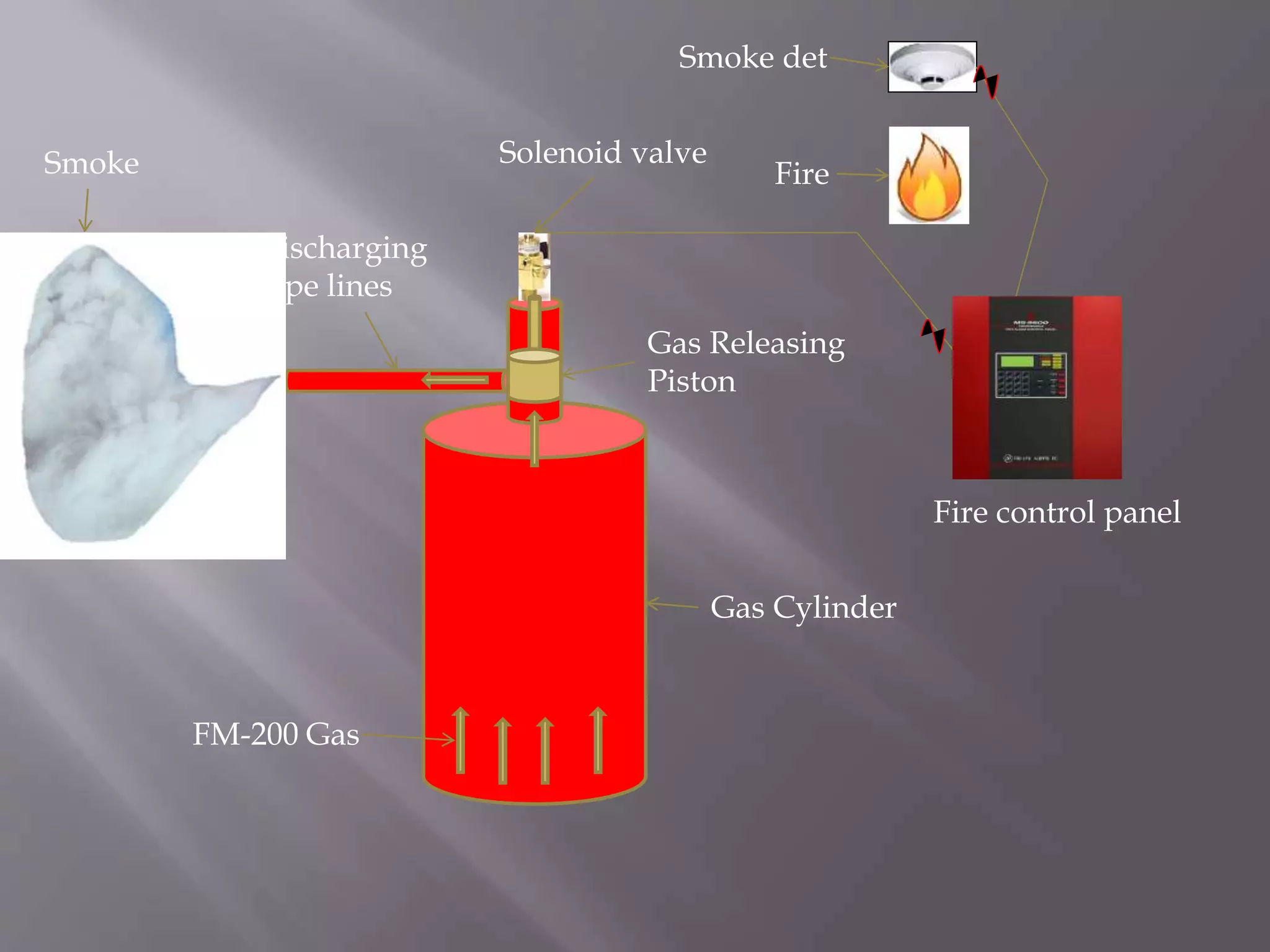
Smoke det
Discharging
pipe lines
FM-200 Gas
Gas Cylinder
Fire control panel
Fire
Gas Releasing
Piston
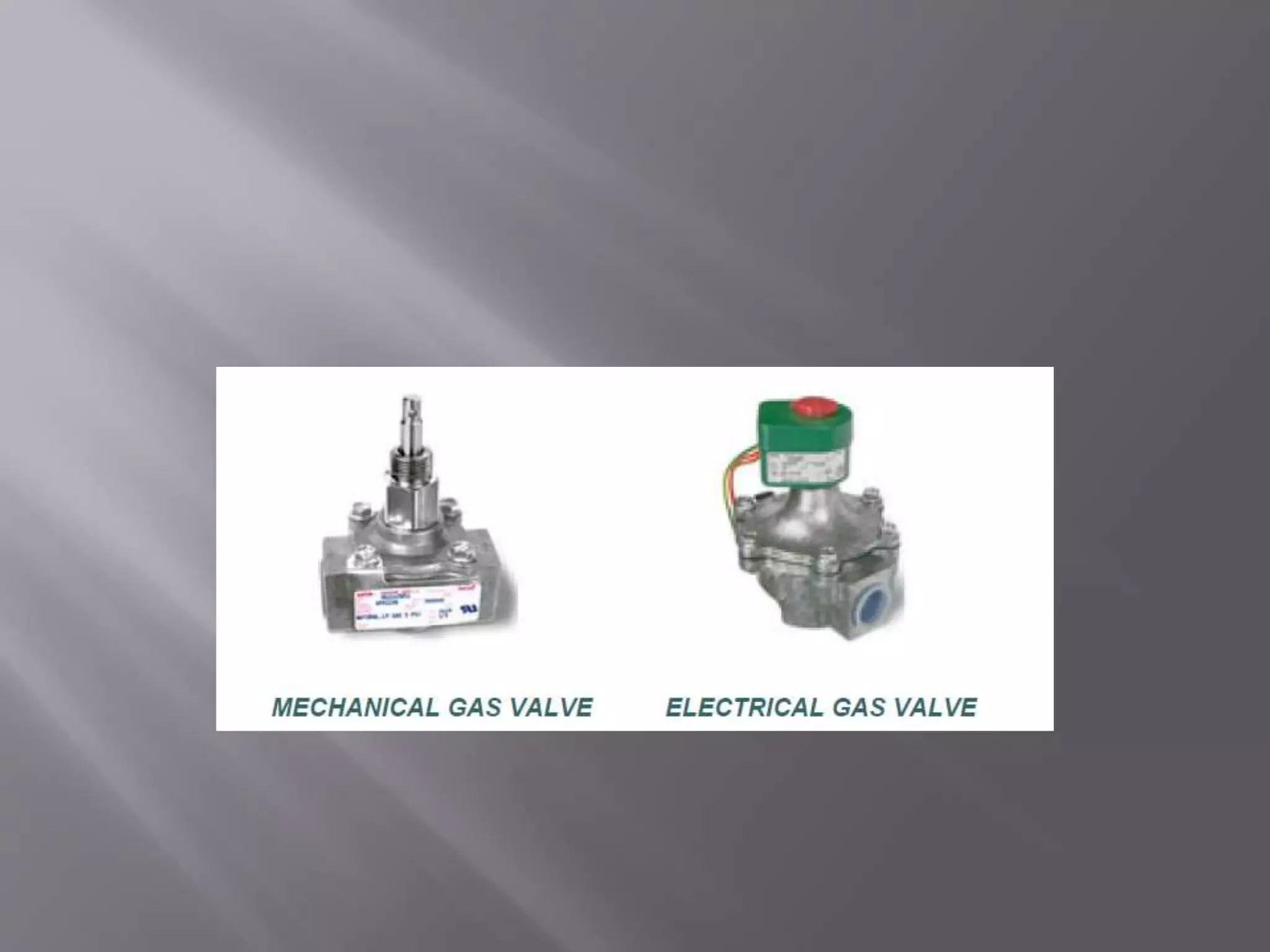
Smoke Solenoid valve
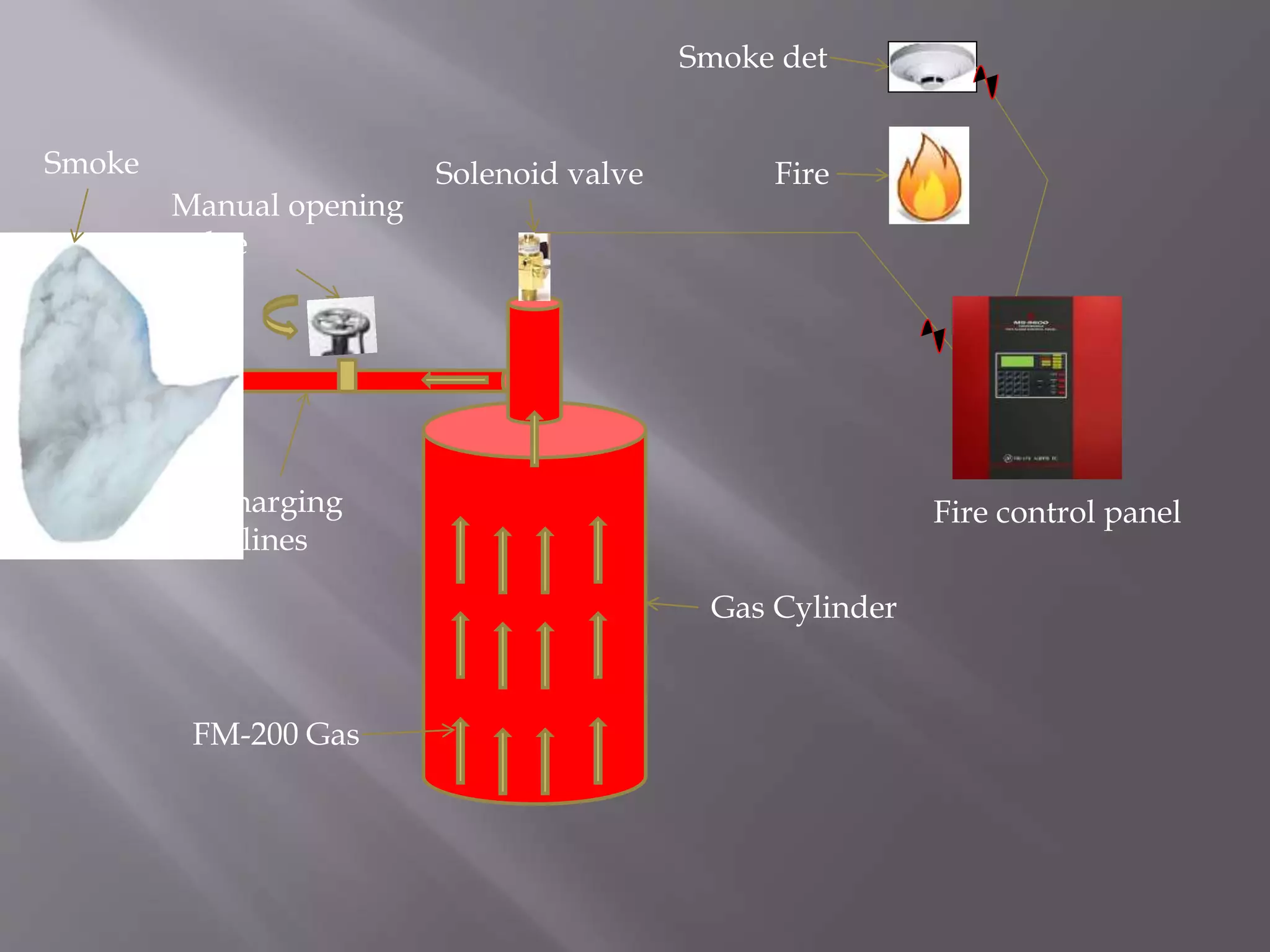
Smoke det
Discharging
pipe lines
FM-200 Gas
Gas Cylinder
Fire control panel
FireSmoke Solenoid valve
Manual opening
valve
 Fire protection associations are voluntary and
non profit organizations for promoting fire
fighting awareness and advancement.
 FPAP (Pakistan) : Fire Protection Association of
Pakistan
 NFPA (USA) : National Fire Protection
Association
 FPA (UK) : Fire Protection Association
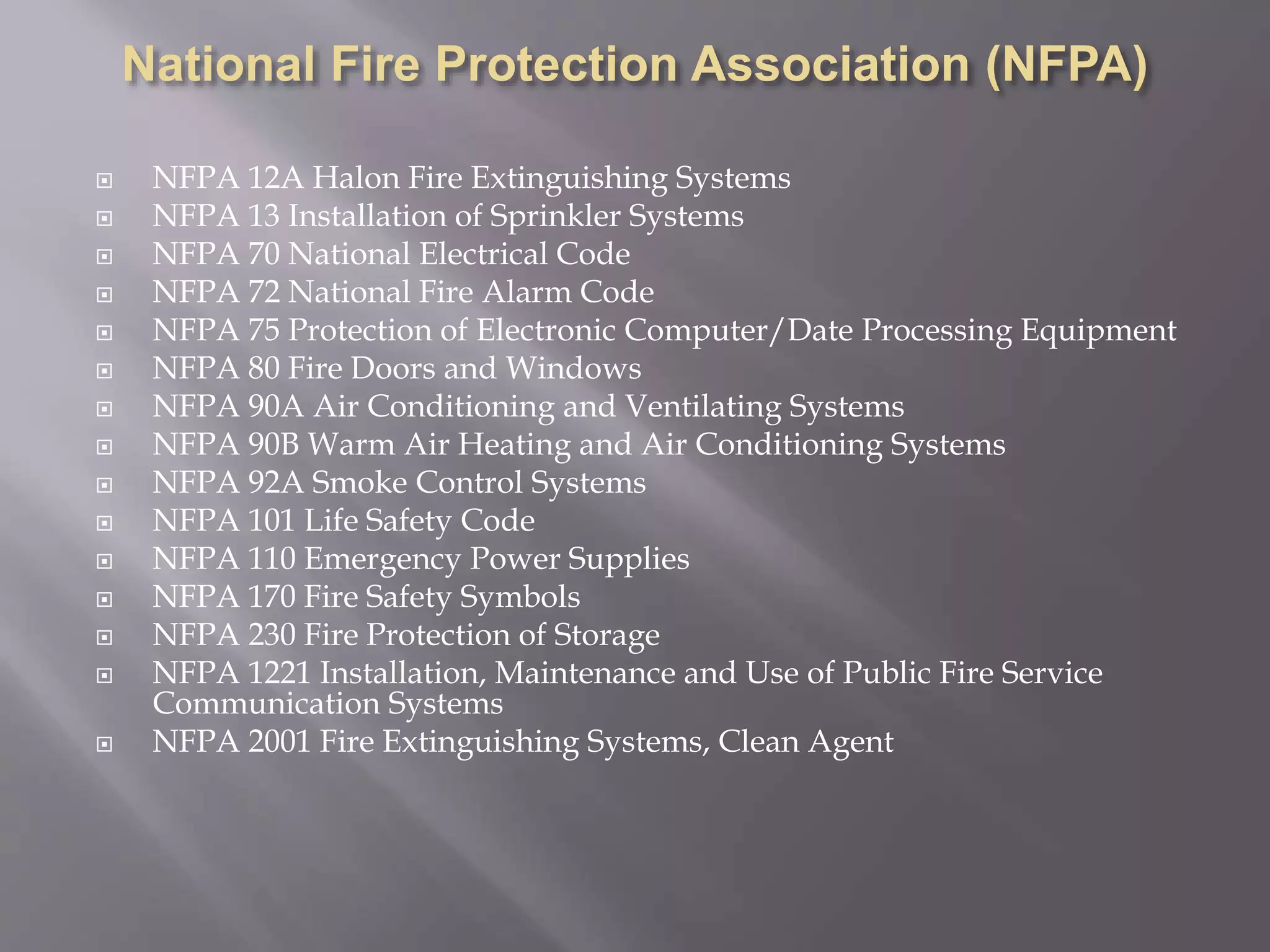
 NFPA 12A Halon Fire Extinguishing Systems
 NFPA 13 Installation of Sprinkler Systems
 NFPA 70 National Electrical Code
 NFPA 72 National Fire Alarm Code
 NFPA 75 Protection of Electronic Computer/Date Processing Equipment
 NFPA 80 Fire Doors and Windows
 NFPA 90A Air Conditioning and Ventilating Systems
 NFPA 90B Warm Air Heating and Air Conditioning Systems
 NFPA 92A Smoke Control Systems
 NFPA 101 Life Safety Code
 NFPA 110 Emergency Power Supplies
 NFPA 170 Fire Safety Symbols
 NFPA 230 Fire Protection of Storage
 NFPA 1221 Installation, Maintenance and Use of Public Fire Service
Communication Systems
 NFPA 2001 Fire Extinguishing Systems, Clean Agent
 Annunciator: A unit containing two or more indicator
lamps, alphanumeric displays, or other equivalent means
in which each indication provides status information
about a circuit, condition, or location.
 Automatic Fire Detectors: A device designed to detect the
presence of fire or the products of combustion. Including
but not limited to heat detectors, flame detectors, smoke
detectors.
 End Of Line Device: A device such as a resistor or diode
placed at the end of a class B circuit to maintain
supervision.
 Fire Alarm Control Unit [Panel]: A system component that
receives inputs from automatic and manual fire alarm
devices and may supply power to detection devices,
notification appliances and transfer condition of relays or
devices connected to the control unit.
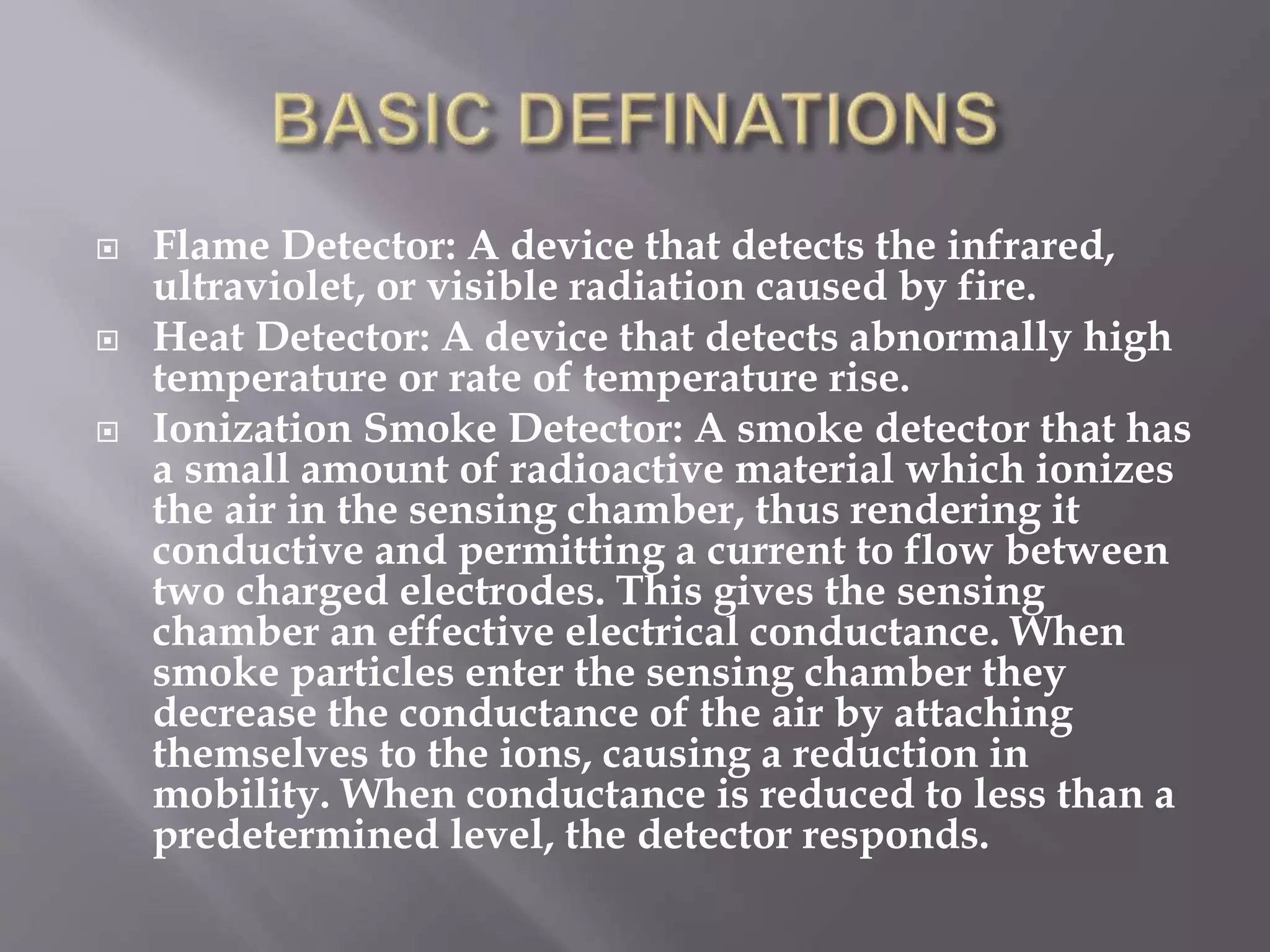
 Flame Detector: A device that detects the infrared,
ultraviolet, or visible radiation caused by fire.
 Heat Detector: A device that detects abnormally high
temperature or rate of temperature rise.
 Ionization Smoke Detector: A smoke detector that has
a small amount of radioactive material which ionizes
the air in the sensing chamber, thus rendering it
conductive and permitting a current to flow between
two charged electrodes. This gives the sensing
chamber an effective electrical conductance. When
smoke particles enter the sensing chamber they
decrease the conductance of the air by attaching
themselves to the ions, causing a reduction in
mobility. When conductance is reduced to less than a
predetermined level, the detector responds.
 Ionization Smoke Detector: A smoke detector
that has a small amount of radioactive material
which ionizes the air in the sensing chamber,
thus rendering it conductive and permitting a
current to flow between two charged electrodes.
This gives the sensing chamber an effective
electrical conductance. When smoke particles
enter the sensing chamber they decrease the
conductance of the air by attaching themselves to
the ions, causing a reduction in mobility. When
conductance is reduced to less than a
predetermined level, the detector responds.
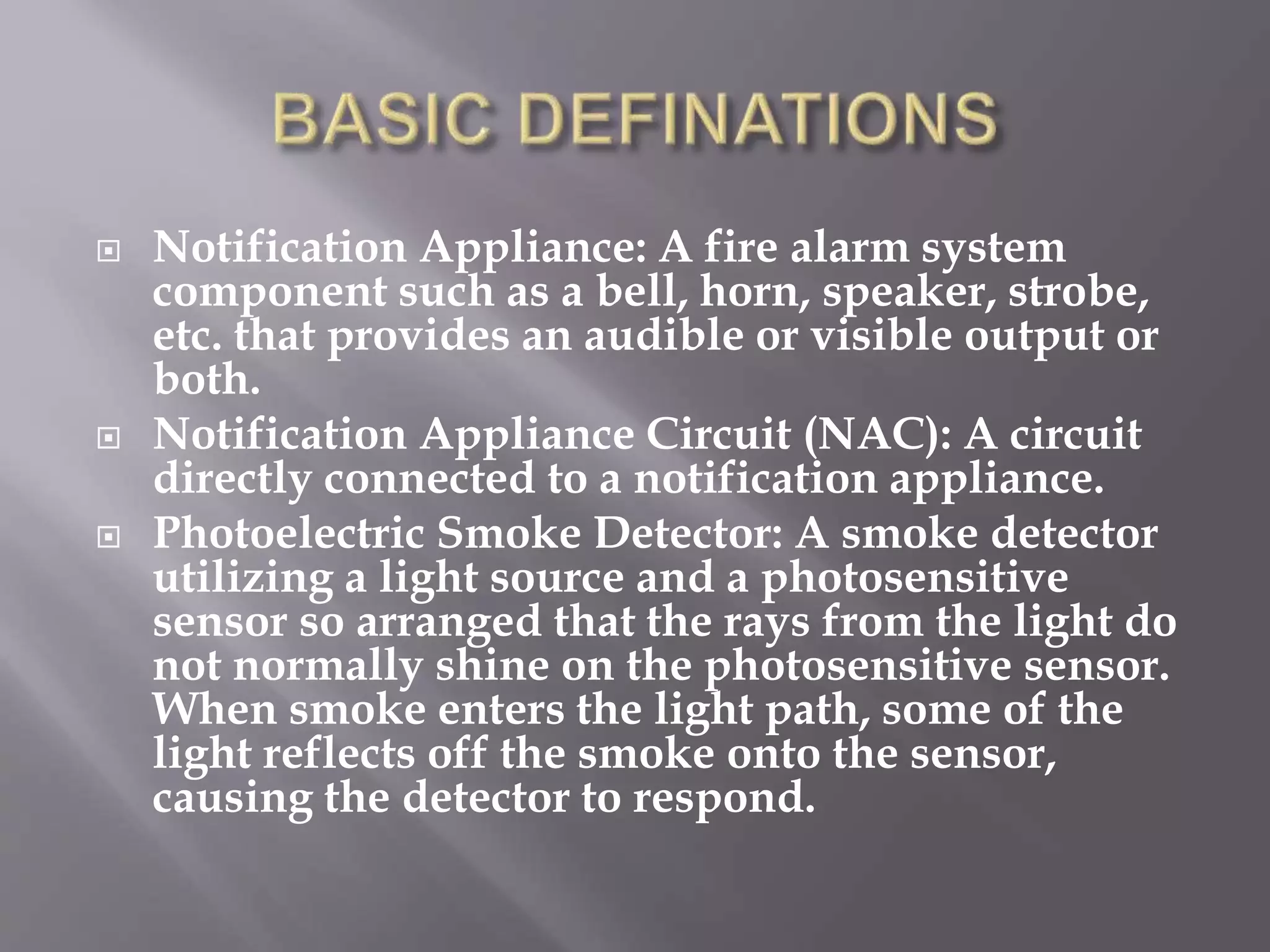
 Notification Appliance: A fire alarm system
component such as a bell, horn, speaker, strobe,
etc. that provides an audible or visible output or
both.
 Notification Appliance Circuit (NAC): A circuit
directly connected to a notification appliance.
 Photoelectric Smoke Detector: A smoke detector
utilizing a light source and a photosensitive
sensor so arranged that the rays from the light do
not normally shine on the photosensitive sensor.
When smoke enters the light path, some of the
light reflects off the smoke onto the sensor,
causing the detector to respond.
 Cross Zoning: for use in false alarm prone
areas, 2 x zones may be linked together so hat
an alarm will occur only if both zones trip
within a specific time period
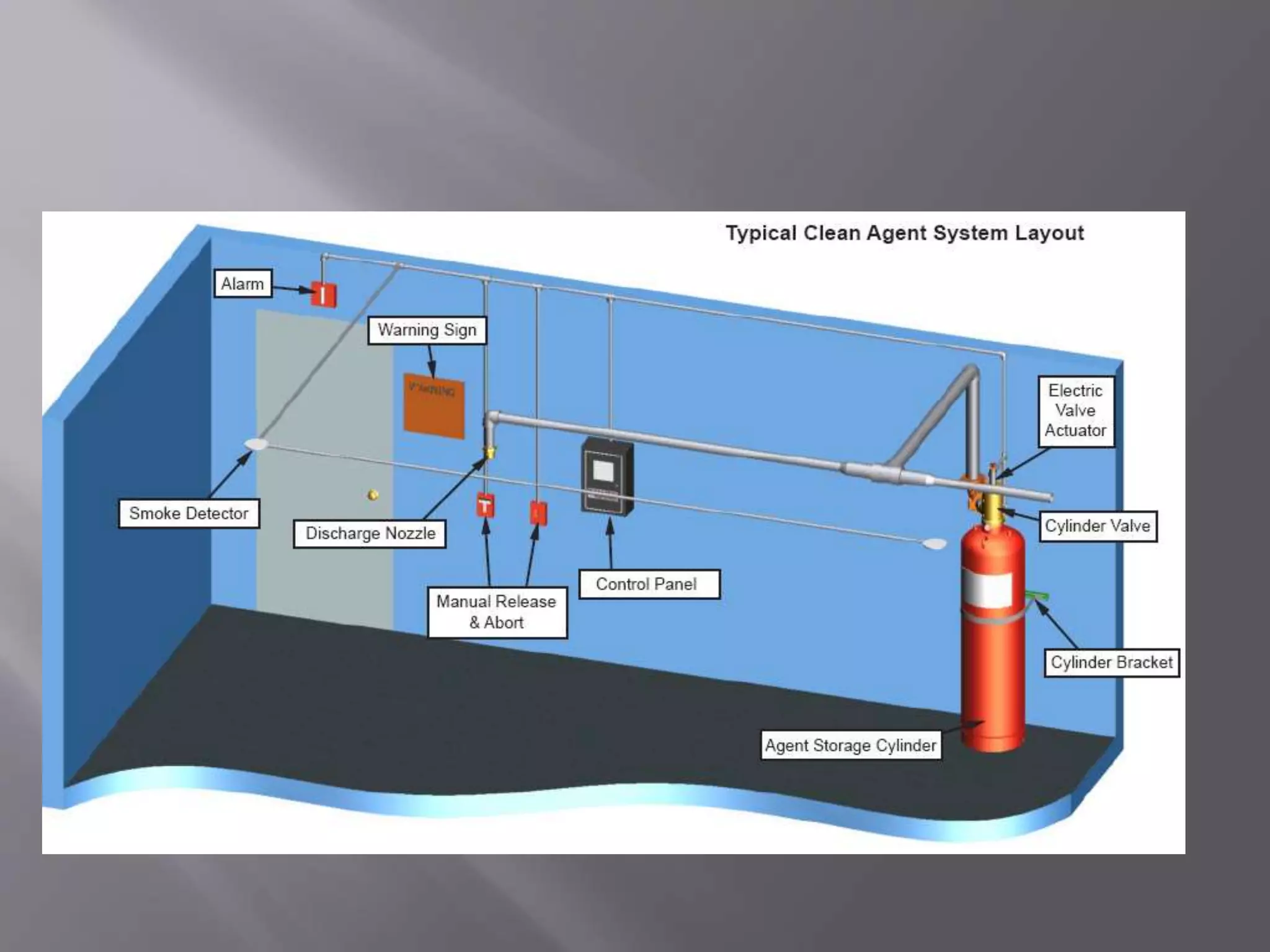
 Manual Release & abort switch : To release or
to stop the release of gas
Fire alarm , detection and suppression system

Fire alarm , detection and suppression system

  • 2.
     Basic conceptof Fire Alarm and detection System.  Understand the principle of fire alarm and detection system.  Componenets of fire alarm and detection system.  Maintenance of fire alarm and detection system.
  • 3.
  • 4.
  • 5.
     Fire AlarmSystem is a system designed to provide warning to the outbreak of fire so that appropriate fire fighting action could be taken before the situation gets out of control.  An automatic fire alarm system is designed to detect the presence of fire by monitoring environmental changes associated with combustion.
  • 6.
     There aretwo primary functions of fire alarming system  1. Detect fire or fire condition  2. Give alarm in all parts of the buildng
  • 8.
    This component actsas an input to the fire alarm control unit and is either manually or automatically actuated. So there are two type of fire detection or initiating devices  1. Manual Alarm-Initiating Devices  2. Automatic Alarm-Initiating Devices
  • 10.
     Manual callpoints are just used to initiate alarm  Protective cover for MCP is also aval.  Two type of MCP • Single action (requires only one action, pressing) • Double action (requires two actions, open the glass and press buton
  • 11.
     Manual firedetection is the oldest method of detection. In the simplest form, a person yelling can provide fire warning.  The advantage of manual alarm stations is that, upon discovering the fire, they provide occupants with a readily identifiable means to activate the building fire alarm system.  Outmoded “broken glass” pull stations
  • 12.
     When activated,it will immediately sound the notification devices  Pulling a lever outside of enclosure will activate switch inside enclosure
  • 14.
     Four basictypes  Heat detectors  Smoke detectors  Fire-gas detectors  Flame detectors
  • 15.
     It responseto thermal energy  Fixed temperature heat detectors (HD)  Non restorable fixed temp HD  Restorable fixed temp HD  Rate-of-rise heat detector  Combination of detectors
  • 16.
     Photoelectric smokedetector  Ionization smoke detector
  • 17.
     Types  Ultraviolet(UV)  Infrared (IR)
  • 18.
     Monitors levelsof gases released by combustion  Carbon dioxide  Carbon monoxide
  • 20.
     It receivesinput from auto / manual fire alarm devices  Activate Notification devices  Supply power to detection devices  Supply power to notification appliances.  Controls relays / devices connected to panel  Display messages / fault / fault loc on it display screen
  • 21.
     The brainsof the system  Provides power to the system, monitors inputs and controls outputs through various circuits  Performs other functions as required by the appropriate code
  • 22.
    FACP NAC Power Supply SLC IDC AC DC NAC: notification appliances circuit IDC : Initiating devices circuit SLC : signaling line circuits
  • 23.
     It requirestwo power sources  Primary power supply (AC)  Secondry power supply (DC)
  • 26.
     This componentuses energy supplied from the fire alarm system or other stored energy source, to inform the proximate persons of the need to take action, usually to evacuate.  Output or Notification appliances:  bells,  buzzers,  horns,  recorded voice messages,  strobe lights ( high intense flash of short duration to get more attention)  speakers, and other warning appliances
  • 27.
     Audible Notification Audible notification has historically been used as a notification of fire. The early notification consisted primarily of bells or sirens. An advantages of audible devices is that they have a low power draw  In order for audible devices to alert the building occupants, the device must be loud enough to be heard.  The sound level is required to be at least 15 dBA above the average or normal sound level
  • 29.
     Strobes arerequired by the ADA in portions of any building accessible to a hearing impaired person.  Areas such as conference rooms, restrooms, hallways, routes of tours & the private office of someone with a hearing disability are examples.
  • 31.
  • 32.
     Such typeof System do not indicate which device is in alarm or trouble  In this system it is extremely difficult to pinpoint the exact loc of alarm or trouble.
  • 33.
  • 34.
     Such systemmake it easier to pinpoint the exact alarm and trouble condition  The exact pinpointing is accomplished by having all addressable devices having unique address  Control panel is able to interrogate each address and display its status at display screen. This signal will report the exact loc of any alarm and trouble condition of the device.
  • 35.
     Awell maintainedsystem is more reliable and efficient.  Prolong the life span of your fire alarm system  It ensures the safety of your life, your property and yur business  All types of extinguishers should be inspected at least once a year to make sure it has proper pressure (gauge in green or proper cartridge weight), has the correct volume of extinguishing agent (tech weighs it),  all external parts are serviceable. Often, dry chemical and dry powder types are hit on the bottom with a rubber mallet to make sure the powder is free-flowing, which is called "fluffing" the powder.
  • 36.
     Keep therecord  Log all new activities / events shown on FACP  Keep all records in secured cabneits for future ref on maint / trouble shooting  Weekly test of FACP  Routine maint  Assign / nominate a person for FACP
  • 37.
  • 38.
     It detectsthe fire  It suppress the fire
  • 39.
     Also calledflame extinguisher or simply extinguisher.  It is device used to extinguish or control the fire.  Hand-held cylindrical pressure vessel containing an agent which can be discharged to extinguish a fire.  There are two types of fire extinguisher.  1. stored pressure  2. cartridge type.
  • 40.
     Side cartridgeoperated units store the dry chemical in a non-pressurized container and the compressed nitrogen gas in a separate cartridge. Only at the time of actuation is the agent tank under pressure. Stored pressure extinguishers have the compressed nitrogen gas that is used as the propellant for the dry chemical agent stored in the same canister as the dry Chemical It is mostly used in industrial areas  Simple and prompt recharge.
  • 42.
     In storedpressure units, the expellant is stored in the same chamber as the firefighting agent itself. Depending on the agent used, different propellants are used. With dry chemical extinguishers, nitrogen is typically used; water and foam extinguishers typically use air.
  • 46.
     For eachclass of fire, different extinguish agents are used: Serial No Agent Fire Class 1 Halotron A,B,C,E 2 Dry Chemical Powder A,B,C 3 CO2 C,E 4 Foam B 5 Water A,B 6 Wet Chemical A
  • 48.
     For eachclass of fire , the extinguishing agent is different
  • 49.
     FM-200 (C3F7H) Halotron (CF3Br)  Dry chemical powder  CO2  Foam  Water  Wet Chemical
  • 50.
     Discharge in10 sec or less (Fast and Efficient)  It discharge as gas  Removes heat  Leave no residue  Does not req costly clean up unlike sprinkle system  Environment friendly, negligible global warming potential  Non ozone depleting agent  Less atmospheric stay time (low atm life time)  No effect / damage to you eqpt  Non conductive  27 lbs protect 790 cubic feet area
  • 51.
     Advantages  Fastand effective : discharge in 10 sec or less.  Removes heat  Discharge as a gas  Leave no residue  Unlike sprinkle system, do not req costly clean up  Ozone depletion potential is zero ( no cl2 or Br2 Components)  Atmospheric life time is low  Non conductive gas  No corrosive effect / damage to your IT eqpt
  • 52.
     Discharge in10 sec or less (Fast and Efficient)  Leave no residue  Does not req costly clean up unlike sprinkle system  Environment friendly  No effect / damage to you eqpt.
  • 53.
     Discharge in10 sec or less (Fast and Efficient)  Leave no residue  Environment friendly  Non conductive  No effect / damage to you eqpt.
  • 54.
     Color less,odorless, electrically non conductive fluid(replacement of water)that evaporates rapidly  Environment friendly, negligible global warming potential  No effect / damage to you eqpt  Non ozone depleting agent  Less atmospheric stay time (low atm life time)
  • 55.
     Powder  Appliedto electric , solid combustion.  It prevents the chemical reactions and halts the production of fire sustaining "free-radicals", thus extinguishing the fire.  Examples are Potassium chloride ,Potassium bicarbonate, Sodium bicarbonate. Mono ammonium phosphate, also known as "tri- class", "multipurpose" or "ABC" dry chemical,  Used on class A, B and C fires
  • 56.
     Applied tofuel fires  form a frothy blanket or seal over the fuel, preventing oxygen reaching it.  AFFF (aqueous film forming foam)  AR-AFFF (Alcohol-resistant aqueous film forming foams)  FFFP (film forming fluoroprotein)  CAFS (compressed air foam system)
  • 58.
     Applied tosolid combustion, flammable liquids and gases  APW (Air pressurized water) cools burning material by absorbing heat from burning material  Used on class A, and B fires
  • 59.
     Used onsolid combustion fire  Wet Chemical extinguishes the fire by forming a soapy foam blanket over the burning oil and by cooling the oil below its ignition temperature.  Wet Chemical (potassium acetate, carbonate, or citrate)  Used on class A fires
  • 61.
    Smoke det Discharging pipe lines FM-200Gas Gas Cylinder Fire control panel Fire Gas Releasing Piston Smoke Solenoid valve
  • 62.
    Smoke det Discharging pipe lines FM-200Gas Gas Cylinder Fire control panel FireSmoke Solenoid valve Manual opening valve
  • 63.
     Fire protectionassociations are voluntary and non profit organizations for promoting fire fighting awareness and advancement.  FPAP (Pakistan) : Fire Protection Association of Pakistan  NFPA (USA) : National Fire Protection Association  FPA (UK) : Fire Protection Association
  • 64.
     NFPA 12AHalon Fire Extinguishing Systems  NFPA 13 Installation of Sprinkler Systems  NFPA 70 National Electrical Code  NFPA 72 National Fire Alarm Code  NFPA 75 Protection of Electronic Computer/Date Processing Equipment  NFPA 80 Fire Doors and Windows  NFPA 90A Air Conditioning and Ventilating Systems  NFPA 90B Warm Air Heating and Air Conditioning Systems  NFPA 92A Smoke Control Systems  NFPA 101 Life Safety Code  NFPA 110 Emergency Power Supplies  NFPA 170 Fire Safety Symbols  NFPA 230 Fire Protection of Storage  NFPA 1221 Installation, Maintenance and Use of Public Fire Service Communication Systems  NFPA 2001 Fire Extinguishing Systems, Clean Agent
  • 65.
     Annunciator: Aunit containing two or more indicator lamps, alphanumeric displays, or other equivalent means in which each indication provides status information about a circuit, condition, or location.  Automatic Fire Detectors: A device designed to detect the presence of fire or the products of combustion. Including but not limited to heat detectors, flame detectors, smoke detectors.  End Of Line Device: A device such as a resistor or diode placed at the end of a class B circuit to maintain supervision.  Fire Alarm Control Unit [Panel]: A system component that receives inputs from automatic and manual fire alarm devices and may supply power to detection devices, notification appliances and transfer condition of relays or devices connected to the control unit.
  • 66.
     Flame Detector:A device that detects the infrared, ultraviolet, or visible radiation caused by fire.  Heat Detector: A device that detects abnormally high temperature or rate of temperature rise.  Ionization Smoke Detector: A smoke detector that has a small amount of radioactive material which ionizes the air in the sensing chamber, thus rendering it conductive and permitting a current to flow between two charged electrodes. This gives the sensing chamber an effective electrical conductance. When smoke particles enter the sensing chamber they decrease the conductance of the air by attaching themselves to the ions, causing a reduction in mobility. When conductance is reduced to less than a predetermined level, the detector responds.
  • 67.
     Ionization SmokeDetector: A smoke detector that has a small amount of radioactive material which ionizes the air in the sensing chamber, thus rendering it conductive and permitting a current to flow between two charged electrodes. This gives the sensing chamber an effective electrical conductance. When smoke particles enter the sensing chamber they decrease the conductance of the air by attaching themselves to the ions, causing a reduction in mobility. When conductance is reduced to less than a predetermined level, the detector responds.
  • 68.
     Notification Appliance:A fire alarm system component such as a bell, horn, speaker, strobe, etc. that provides an audible or visible output or both.  Notification Appliance Circuit (NAC): A circuit directly connected to a notification appliance.  Photoelectric Smoke Detector: A smoke detector utilizing a light source and a photosensitive sensor so arranged that the rays from the light do not normally shine on the photosensitive sensor. When smoke enters the light path, some of the light reflects off the smoke onto the sensor, causing the detector to respond.
  • 69.
     Cross Zoning:for use in false alarm prone areas, 2 x zones may be linked together so hat an alarm will occur only if both zones trip within a specific time period  Manual Release & abort switch : To release or to stop the release of gas