BY: MAYANK JOSHI (HEUBACH COLOR)
• DEFINITION WITH EXAMPLE
• FIRE PREVENTION SYSTEM
• CAUSE OF FIRE
• EXAMPLE HOW TO PREVENT FIRE
• FIRE CONTROL METHOD
• FIRE PROTECTION EQUIPMENTS
• Flash Point : It is the lowest temperature at which a
liquid will give off enough flammable vapour at or
near its surface, such that its mixture with air can be
ignited by a spark or flame.
• Auto Ignition Temperature : It is the lowest
temperature at which a liquid will give off enough
flammable vapour at or near its surface, such that its
mixture with air will self ignite in the absence of
spark or flame.
SUBSTANCE DEG C
METHANOL 12
IBA 28
XYLENE 25
IPA 13
MONO CHLORO
BENZENE (MCB)
29.4
• Flammable Limits (Explosive Ranges) : The min concentration of a
particular combustible gas or vapour necessary to support its combustion
in air is defined as Lower Explosive Limit (LEL) for that gas. Below this level
the mixture is too lean to burn. The max concentration of a gas or vapour
that will burn in air is defined as the Upper Explosive Limit (UEL). Above
this level, the mixture is too rich to burn. The range between the LEL and
UEL is known as the flammable range for that gas or vapour. The Values
(i.e. upper & lower) expressed in percentage volume of fuel vapour in air,
is the range of concentration within which a particular vapour or gas
mixture with air will burn or explode when ignited.
Below LEL, the mixture is lean to burn & above UEL the mixture is too rich
to burn.
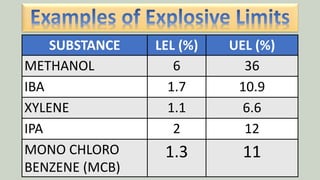
SUBSTANCE LEL (%) UEL (%)
METHANOL 6 36
IBA 1.7 10.9
XYLENE 1.1 6.6
IPA 2 12
MONO CHLORO
BENZENE (MCB)
1.3 11
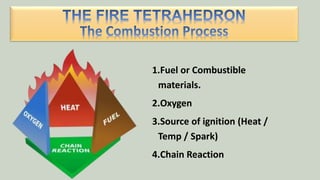
1.Fuel or Combustible
materials.
2.Oxygen
3.Source of ignition (Heat /
Temp / Spark)
4.Chain Reaction
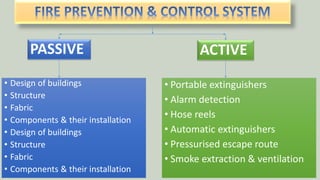
PASSIVE
• Design of buildings
• Structure
• Fabric
• Components & their installation
• Design of buildings
• Structure
• Fabric
• Components & their installation
ACTIVE
• Portable extinguishers
• Alarm detection
• Hose reels
• Automatic extinguishers
• Pressurised escape route
• Smoke extraction & ventilation
CAUSES %
• Electricity 23
• Smoking/Mobile 18
• Friction 10
• Over Head Material 08
• Hot Surface 07
• Burner Flame 07
• Combustion Spark 05
• Spontaneous Ignition 04
• Cutting & Welding 04
• Exposure 03
• Sabotage 03
• Chemical Action 01
• Good housekeeping habits are an important part of a safe workplace.
• Why is good housekeeping important?
• To reduce amounts of flammable and combustible materials.
• To reduce ignition hazards.
• To ensure safe emergency evacuation of occupants.
• To allow for quick emergency response
• Electrical Fire
• Electrical hazards are the cause of numerous workplace fires each year. Faulty
electrical equipment or misuse of equipment produces heat and sparks that serve
as ignition sources in the presence of flammable and combustible materials.
• Examples of common ignition hazards:
• overloading circuits
• use of unapproved electrical devices
• damaged or worn wiring
Method of Fire Control
The fire can extinguished by the following methods.
1. Fuel Control (Removal of combustible material)
2. Heat Control (Cooling effect)
3. Oxygen Control (Smothering / Blanketing)
4. Beating out (Breaking of chain reaction by hitting )
The controlling of fire depends on the characteristics of a
material, situation in which fire taken place, available
resources etc. are to be considered for extinguishing the fire.
DIFFERENT MATERIALS TO EXTINGUISH THE
FIRE
Water
Carbon Dioxide (CO2)
Inert gas like Nitrogen
Sand / Earth
Foam Compound
Protein Foam
AFFF (Aqueous Film Forming Foam)
ARFC (Alcohol Resistance Foam Compound)
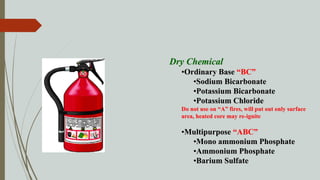
Dry Chemical
•Ordinary Base “BC”
•Sodium Bicarbonate
•Potassium Bicarbonate
•Potassium Chloride
Do not use on “A” fires, will put out only surface
area, heated core may re-ignite
•Multipurpose “ABC”
•Mono ammonium Phosphate
•Ammonium Phosphate
•Barium Sulfate
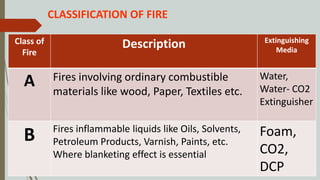
CLASSIFICATION OF FIRE
Class of
Fire
Description Extinguishing
Media
A Fires involving ordinary combustible
materials like wood, Paper, Textiles etc.
Water,
Water- CO2
Extinguisher
B Fires inflammable liquids like Oils, Solvents,
Petroleum Products, Varnish, Paints, etc.
Where blanketing effect is essential
Foam,
CO2,
DCP
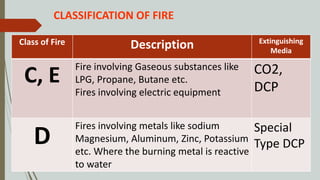
CLASSIFICATION OF FIRE
Class of Fire Description Extinguishing
Media
C, E
Fire involving Gaseous substances like
LPG, Propane, Butane etc.
Fires involving electric equipment
CO2,
DCP
D
Fires involving metals like sodium
Magnesium, Aluminum, Zinc, Potassium
etc. Where the burning metal is reactive
to water
Special
Type DCP
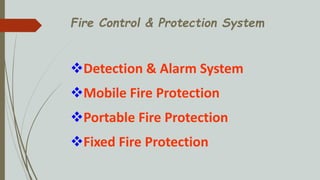
Fire Control & Protection System
Detection & Alarm System
Mobile Fire Protection
Portable Fire Protection
Fixed Fire Protection
Fire Protection
Detection & Alarm System
Heat Detector
Smoke detector
Flame Detector
Manual Call Point
Fire Protection
Mobile Fire Protection
 Different types of Fire Vehicles
 Fire Tender – Water,
Foam, CO2, DCP,
Multipurpose, Rescue
tender.
 Turn Table ladder
 Hydraulic Platform
Fire Protection
Portable Fire Protection
Fire Buckets
Fire Protection
Fire Extinguisher
Fire Protection
Fixed Fire Protection
Water Base Installation
 Manual : Fire Hydrant System
 Auto Sprinkler System
Non - Water Base Installation
 Foam Installation System
 CO2 Installation System
 DCP Installation System
Fire Protection
Fixed Fire Protection : Hydrant Line
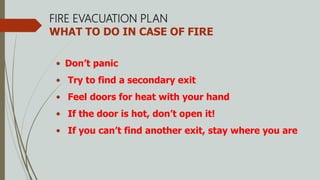
FIRE EVACUATION PLAN
WHAT TO DO IN CASE OF FIRE
• Don’t panic
• Try to find a secondary exit
• Feel doors for heat with your hand
• If the door is hot, don’t open it!
• If you can’t find another exit, stay where you are
THE END!

Fire prevention control

  • 1.
    BY: MAYANK JOSHI(HEUBACH COLOR)
  • 2.
    • DEFINITION WITHEXAMPLE • FIRE PREVENTION SYSTEM • CAUSE OF FIRE • EXAMPLE HOW TO PREVENT FIRE • FIRE CONTROL METHOD • FIRE PROTECTION EQUIPMENTS
  • 3.
    • Flash Point: It is the lowest temperature at which a liquid will give off enough flammable vapour at or near its surface, such that its mixture with air can be ignited by a spark or flame. • Auto Ignition Temperature : It is the lowest temperature at which a liquid will give off enough flammable vapour at or near its surface, such that its mixture with air will self ignite in the absence of spark or flame.
  • 4.
    SUBSTANCE DEG C METHANOL12 IBA 28 XYLENE 25 IPA 13 MONO CHLORO BENZENE (MCB) 29.4
  • 5.
    • Flammable Limits(Explosive Ranges) : The min concentration of a particular combustible gas or vapour necessary to support its combustion in air is defined as Lower Explosive Limit (LEL) for that gas. Below this level the mixture is too lean to burn. The max concentration of a gas or vapour that will burn in air is defined as the Upper Explosive Limit (UEL). Above this level, the mixture is too rich to burn. The range between the LEL and UEL is known as the flammable range for that gas or vapour. The Values (i.e. upper & lower) expressed in percentage volume of fuel vapour in air, is the range of concentration within which a particular vapour or gas mixture with air will burn or explode when ignited. Below LEL, the mixture is lean to burn & above UEL the mixture is too rich to burn.
  • 6.
    SUBSTANCE LEL (%)UEL (%) METHANOL 6 36 IBA 1.7 10.9 XYLENE 1.1 6.6 IPA 2 12 MONO CHLORO BENZENE (MCB) 1.3 11
  • 7.
    1.Fuel or Combustible materials. 2.Oxygen 3.Sourceof ignition (Heat / Temp / Spark) 4.Chain Reaction
  • 8.
    PASSIVE • Design ofbuildings • Structure • Fabric • Components & their installation • Design of buildings • Structure • Fabric • Components & their installation ACTIVE • Portable extinguishers • Alarm detection • Hose reels • Automatic extinguishers • Pressurised escape route • Smoke extraction & ventilation
  • 9.
    CAUSES % • Electricity23 • Smoking/Mobile 18 • Friction 10 • Over Head Material 08 • Hot Surface 07 • Burner Flame 07 • Combustion Spark 05 • Spontaneous Ignition 04 • Cutting & Welding 04 • Exposure 03 • Sabotage 03 • Chemical Action 01
  • 10.
    • Good housekeepinghabits are an important part of a safe workplace. • Why is good housekeeping important? • To reduce amounts of flammable and combustible materials. • To reduce ignition hazards. • To ensure safe emergency evacuation of occupants. • To allow for quick emergency response
  • 11.
    • Electrical Fire •Electrical hazards are the cause of numerous workplace fires each year. Faulty electrical equipment or misuse of equipment produces heat and sparks that serve as ignition sources in the presence of flammable and combustible materials. • Examples of common ignition hazards: • overloading circuits • use of unapproved electrical devices • damaged or worn wiring
  • 12.
    Method of FireControl The fire can extinguished by the following methods. 1. Fuel Control (Removal of combustible material) 2. Heat Control (Cooling effect) 3. Oxygen Control (Smothering / Blanketing) 4. Beating out (Breaking of chain reaction by hitting ) The controlling of fire depends on the characteristics of a material, situation in which fire taken place, available resources etc. are to be considered for extinguishing the fire.
  • 13.
    DIFFERENT MATERIALS TOEXTINGUISH THE FIRE Water Carbon Dioxide (CO2) Inert gas like Nitrogen Sand / Earth Foam Compound Protein Foam AFFF (Aqueous Film Forming Foam) ARFC (Alcohol Resistance Foam Compound)
  • 14.
    Dry Chemical •Ordinary Base“BC” •Sodium Bicarbonate •Potassium Bicarbonate •Potassium Chloride Do not use on “A” fires, will put out only surface area, heated core may re-ignite •Multipurpose “ABC” •Mono ammonium Phosphate •Ammonium Phosphate •Barium Sulfate
  • 15.
    CLASSIFICATION OF FIRE Classof Fire Description Extinguishing Media A Fires involving ordinary combustible materials like wood, Paper, Textiles etc. Water, Water- CO2 Extinguisher B Fires inflammable liquids like Oils, Solvents, Petroleum Products, Varnish, Paints, etc. Where blanketing effect is essential Foam, CO2, DCP
  • 16.
    CLASSIFICATION OF FIRE Classof Fire Description Extinguishing Media C, E Fire involving Gaseous substances like LPG, Propane, Butane etc. Fires involving electric equipment CO2, DCP D Fires involving metals like sodium Magnesium, Aluminum, Zinc, Potassium etc. Where the burning metal is reactive to water Special Type DCP
  • 17.
    Fire Control &Protection System Detection & Alarm System Mobile Fire Protection Portable Fire Protection Fixed Fire Protection
  • 18.
    Fire Protection Detection &Alarm System Heat Detector Smoke detector Flame Detector Manual Call Point
  • 19.
    Fire Protection Mobile FireProtection  Different types of Fire Vehicles  Fire Tender – Water, Foam, CO2, DCP, Multipurpose, Rescue tender.  Turn Table ladder  Hydraulic Platform
  • 20.
    Fire Protection Portable FireProtection Fire Buckets
  • 21.
  • 22.
    Fire Protection Fixed FireProtection Water Base Installation  Manual : Fire Hydrant System  Auto Sprinkler System Non - Water Base Installation  Foam Installation System  CO2 Installation System  DCP Installation System
  • 23.
    Fire Protection Fixed FireProtection : Hydrant Line
  • 24.
    FIRE EVACUATION PLAN WHATTO DO IN CASE OF FIRE • Don’t panic • Try to find a secondary exit • Feel doors for heat with your hand • If the door is hot, don’t open it! • If you can’t find another exit, stay where you are
  • 25.