Supply Chain Management
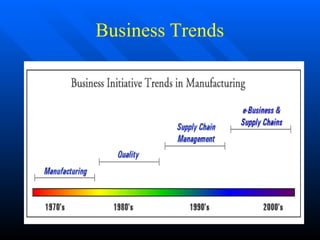
Business Trends
What is a Supply Chain ?
 All activities associated with the flow and
transformation of goods from raw materials to end
users.
 The term supply chain refers to the entire network
of companies that work together to design,
produce, deliver, and service products.
 A network of facilities including:
– Material flow from suppliers and their “upstream”
suppliers at all levels,
– Transformation of materials into semi-finished and
finished products (internal process)
– Distribution of products to customers and their
“downstream”customers at all levels.
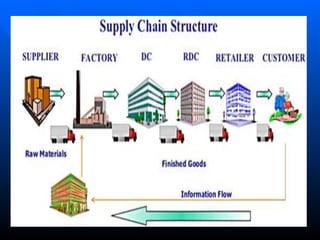
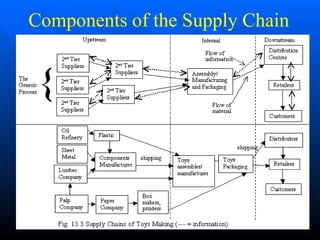
Components of the Supply Chain
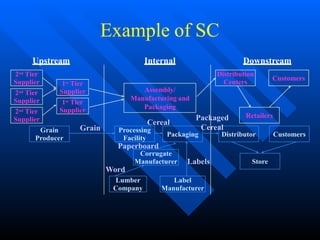
Example of SC
2nd Tier
Supplier
Upstream Internal Downstream
2nd Tier
Supplier
2nd Tier
Supplier
1st Tier
Supplier
1st Tier
Supplier
Assembly/
Manufacturing and
Packaging
Distribution
Centers
Retailers
Customers
Grain
Producer
Processing
Facility
Packaging Distributor
Store
Customers
Corrugate
Manufacturer
Lumber
Company
Label
Manufacturer
Grain
Cereal
Packaged
Cereal
Labels
Word
Paperboard
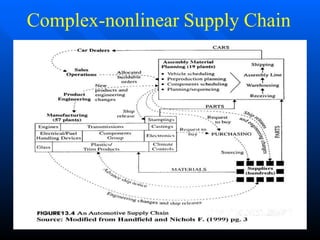
Complex-nonlinear Supply Chain
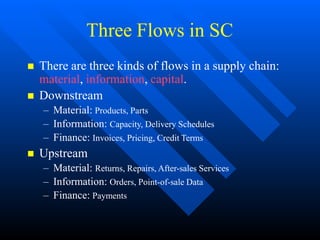
Three Flows in SC
 There are three kinds of flows in a supply chain:
material, information, capital.
 Downstream
– Material: Products, Parts
– Information: Capacity, Delivery Schedules
– Finance: Invoices, Pricing, Credit Terms
 Upstream
– Material: Returns, Repairs, After-sales Services
– Information: Orders, Point-of-sale Data
– Finance: Payments
Push vs. Pull in supply chains




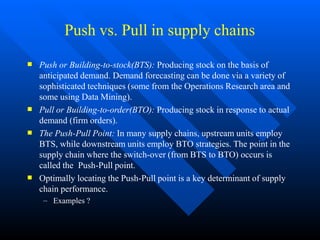
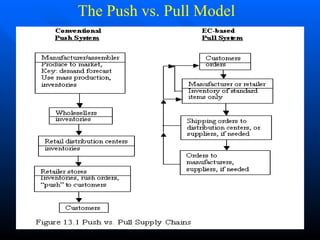
Push or Building-to-stock(BTS): Producing stock on the basis of
anticipated demand. Demand forecasting can be done via a variety of
sophisticated techniques (some from the Operations Research area and
some using Data Mining).
Pull or Building-to-order(BTO): Producing stock in response to actual
demand (firm orders).
The Push-Pull Point: In many supply chains, upstream units employ
BTS, while downstream units employ BTO strategies. The point in the
supply chain where the switch-over (from BTS to BTO) occurs is
called the Push-Pull point.
Optimally locating the Push-Pull point is a key determinant of supply
chain performance.
– Examples ?
The Push vs. Pull Model
Major Concepts
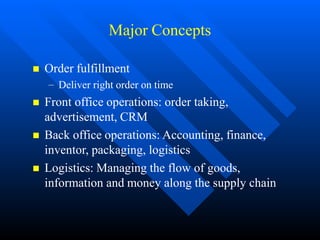
 Order fulfillment
– Deliver right order on time
 Front office operations: order taking,
advertisement, CRM
 Back office operations: Accounting, finance,
inventor, packaging, logistics
 Logistics: Managing the flow of goods,
information and money along the supply chain
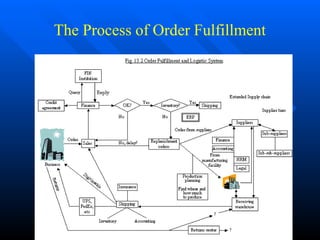
The Process of Order Fulfillment
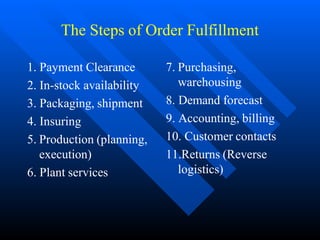
The Steps of Order Fulfillment
7. Purchasing,
warehousing
8. Demand forecast
9. Accounting, billing
10. Customer contacts
11.Returns (Reverse
logistics)
1. Payment Clearance
2. In-stock availability
3. Packaging, shipment
4. Insuring
5. Production (planning,
execution)
6. Plant services
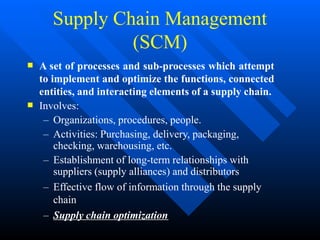
Supply Chain Management
(SCM)


A set of processes and sub-processes which attempt
to implement and optimize the functions, connected
entities, and interacting elements of a supply chain.
Involves:
– Organizations, procedures, people.
– Activities: Purchasing, delivery, packaging,
checking, warehousing, etc.
– Establishment of long-term relationships with
suppliers (supply alliances) and distributors
– Effective flow of information through the supply
chain
– Supply chain optimization
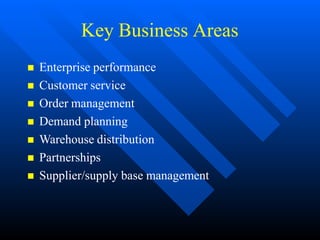
Key Business Areas
 Enterprise performance
 Customer service
 Order management
 Demand planning
 Warehouse distribution
 Partnerships
 Supplier/supply base management
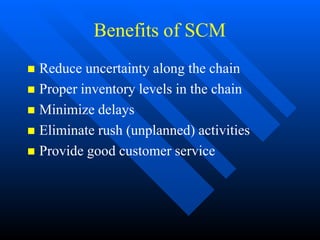
Benefits of SCM
 Reduce uncertainty along the chain
 Proper inventory levels in the chain
 Minimize delays
 Eliminate rush (unplanned) activities
 Provide good customer service
Global Supply Chain
 Can be very long
 Possible cross-border problems
 Need information technology support for:
– communication and collaboration
 Possible delays due to: customs, tax,
translations, politics
Problems along the Supply Chain
 Delays in production, distribution etc.
 Expensive Inventories
 Lack of partners’ coordination
 Uncertainties in deliveries
 Poor demand forecast
 Interference with production
 Poor quality
More Challenges
 Complexity of the supply chain network
– e.g. large numbers of suppliers and distributors
 Complexity in product structure and manufacturing
process
– How much product differentiation/ customization/
localization should be supported ?
– Where do you customize a product (upstream or
downstream) ?
 decentralized control/organizational "silos"
 increasing pressure for customer service and asset
utilization
Variability in the supply chain
 Demand variability
– Even the most sophisticated demand
forecasting tools often fail to anticipate demand
– Examples of demand variability problems ?
 Process variability
– Production unit downtimes
– Unexpected staff absences
 Supply variability
– e.g., late deliveries from suppliers
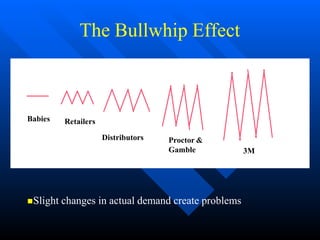
The Bullwhip Effect
Babies
Distributors Proctor &
Gamble 3M
Retailers
Slight changes in actual demand create problems
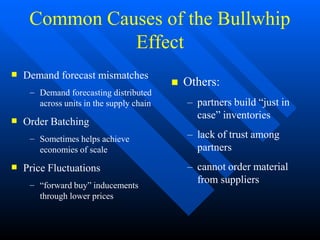
Common Causes of the Bullwhip
Effect
 Demand forecast mismatches
– Demand forecasting distributed
across units in the supply chain
 Order Batching
– Sometimes helps achieve
economies of scale
 Price Fluctuations
– “forward buy” inducements
through lower prices
 Others:
– partners build “just in
case” inventories
– lack of trust among
partners
– cannot order material
from suppliers
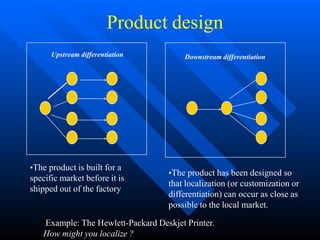
Product design
•The product has been designed so
that localization (or customization or
differentiation) can occur as close as
possible to the local market.
•The product is built for a
specific market before it is
shipped out of the factory
Upstream differentiation Downstream differentiation
Example: The Hewlett-Packard Deskjet Printer.
How might you localize ?
Technology in the SC



The internet and the web can be very effective
communication enhancers
Software includes demand forecasting tools and planning
tools to allow all SC members to coordinate their activities
and adjust their production levels.
Software can allow members to:
– review past performance
– monitor current performance
– predict future production levels of products.
Web SCM







Share information about consumer demand
Receive rapid notification of product design changes and
adjustments
Provides specs and drawings more efficiently.
Increase speed of processing transactions.
Reduce cost of handling transactions.
Reduce errors in entering transaction data
Share information about defect rates and types.
Example 1: Cisco
 Making use of the internet in its own supply chain.
 Products are manufactured by contract manufacturers
(CM)
 Integrated well with both its CM’s and its component
suppliers.
 Communicates a single forecast through both levels
of suppliers, reducing the bullwhip effect.
 Display their product and component requirements to
their entire chain.
Example 1: Benefits for Cisco
 Eliminated paper purchase orders and invoices
 Communicate engineering change orders
electronically to all partners
 90% of sales are made over the internet
 US$875 million annual internet savings (more
than 50% due to SC initiatives)
 Lead times reduced 75%
 Low manufacturing manpower requirements
despite rapid growth
 Cost reductions of 20%-28% every year.
Example 2: Dell
 Create “Virtual integration” : the entire supply chain
acts like a single integrated company.
– Upstream partners: contract manufacturers (CM)
and component suppliers
– Downstream partners/customers (most are
business corporations)
 Share information with suppliers on inventory levels.
 Maintain long-term relationships with key suppliers
for design collaboration.
Example 2: Benefits for Dell
 Dell and Suppliers work together as a
“Virtual Enterprise”
 BTO benefits (low inventory)
 Dynamic pricing: change prices rapidly in
response to demand and availability
 Strong links to corporate customers
Example 3: Covisint
 B2B Supply Chain Benefits
– Automated procurement
» lower procurement costs
» lower inventories
– Collaboration:
» complete visibility
» less bullwhip
– Efficient market
» More profits
– Sell unused capacity
Supply chain integration:
Benefits
 Tangible benefits
– Inventory reduction, personnel reduction,
productivity improvement, order management
improvement, financial cycle improvements.
 Intangible benefits
– Information visibility, new / improved
processes, customer responsiveness,
standardization, flexibility, globalization, and
business performance.
Evolution of Software Integration
 Completely Independent of each other
 MRP= Material Requirements Planning:
– Inventory, production
 MRPII=Manufacturing Requirements Planning
– more integrated, MRP+Finance+labor
 ERP=Enterprise Resources Planning
– All functional areas
 Extended ERP=Include suppliers, customers
MRP Core Concepts



Key questions:
– How much of an item is needed to meet demand? When?
– What parts and components are required? When?
– When to order parts and components?
Dependent demand
– production (or procurement) of parts and materials is directly
linked to demand for the final product.
Time-phased scheduling
– parts and components must be ordered in advance to
accommodate lead times between order placement and receipt.
Enterprise Resource Planning
(ERP)
 ERP = Integrating business processes and
activities in real time
 Solves many supply chain problems
 Necessary for medium to large corporations
 May be useful for SMEs too
 Need to interface with EC order taking system
 Manages all routine transactions in the
Enterprise
Post ERP (2nd Generation)
 1st generation - transaction processing
orientation
 2nd generation
– including decision making capabilities
– EC requires decision support
– EC requires business intelligence
 SCM software: Production Planning, Manpower
utilization, Profitability models, market analysis.
 Integration of SCM capabilities
 Other added functionalities: CRM, KM
ASP
 Leasing information systems application
 Back to the days of “time sharing”
 A risk prevention strategy
 Very popular with ERP (expensive,
cumbersome)
Supply chain optimization


Business objective: improve supply chain efficiency
(velocity ?), optimize operation of the supply chain
Metrics for efficiency - what do we optimize ?
– Define the problem in terms of decision variables
– Define an objective function in terms of the decision
variables. The goal would be to maximize or minimize
the value of this function, i.e., to find an allocation of
values to the decision variables such that the value of
this function is either maximized or minimized.
– Supply chain optimization is the continuous process of
seeking optimal allocations of values to decision
variables
Common optimization problems:
I
 Long-term planning (time-frame: several months/years):
– Questions:
» How much of each product type should I manufacture ? When ?
Where ? (Assumes a network of manufacturing centers with potential
duplication of manufacturing capability)
» How much should I keep in inventory (both for manufacturing inputs
and outputs) ? Where ? (Assumes a distributed network of
warehouses)
– Constraints:
» Capacity constraints (both manufacturing and inventory)
» Demand profile
» Process constraints (downtimes, planned outages)
» Supply variability
– Objectives: Profit/revenue maximization, maximizing asset
utilization, minimization of deviation from demand profile,
minimization of deviation from target inventory profile
Common optimization problems: II
 Medium-term planning/scheduling (time-frame: a few
months/weeks):
– Similar to long-term planning, but with scheduling constraints and
objectives added
 Unit scheduling/reactive scheduling:
– Questions:
» In what sequence should orders/jobs be manufactured ? Which job
should I process on a given production unit at a given point in time ?
Should I go into overtime ?
– Constraints:
» Capacity constraints
» Sequencing constraints
» Orders + deadlines
» Process constraints (downtimes etc.)
– Objectives: Minimize makespan (i.e., maximize asset utilization),
minimize deviation from order deadlines, maximize profit/revenue
Common optimization problems: III
 Shipping:
– How do I allocate orders to trucks ?
– What routes should trucks travel on ?
– How do I allocate truck to routes ?
Major classes of optimization
techniques:


From the field of operations research (OR)
– Linear programming
– Integer programming….
From the field of artificial intelligence (AI)
– Constraint programming
– Heuristic search techniques
Supply Chain Mgt. Software
 Includes demand forecasting tools and
planning capabilities to allow all supply
chain members to coordinate their activities
and adjust their production levels
 Firms offering SCM software:
– i2 Technologies RHYTHM
– Manugistics
Purchasing, Logistics & Support Software
 Enterprise Resource Planning (ERP) software is
designed to integrate manufacturing, finance,
distribution, and other internal business functions
into one information system
 Major ERP vendors include -
– Baan
– J.D. Edwards
– Oracle
– PeopleSoft
– SAP
B2B E-Commerce Software
 Designed to help companies build Web
sites that host:
– Catalog
– Marketplace and
– other commercial sales activities
 Major software packages include:
– Netscape - SellerXpert & ECXpert,
– OpenMarket Transact, IBM’s Websphere.
– MS Site Server, and Ariba
The end
Questions?

B-Supply Chain Management

  • 1.
  • 2.
  • 3.
    What is aSupply Chain ?  All activities associated with the flow and transformation of goods from raw materials to end users.  The term supply chain refers to the entire network of companies that work together to design, produce, deliver, and service products.  A network of facilities including: – Material flow from suppliers and their “upstream” suppliers at all levels, – Transformation of materials into semi-finished and finished products (internal process) – Distribution of products to customers and their “downstream”customers at all levels.
  • 5.
    Components of theSupply Chain
  • 6.
    Example of SC 2ndTier Supplier Upstream Internal Downstream 2nd Tier Supplier 2nd Tier Supplier 1st Tier Supplier 1st Tier Supplier Assembly/ Manufacturing and Packaging Distribution Centers Retailers Customers Grain Producer Processing Facility Packaging Distributor Store Customers Corrugate Manufacturer Lumber Company Label Manufacturer Grain Cereal Packaged Cereal Labels Word Paperboard
  • 7.
  • 8.
    Three Flows inSC  There are three kinds of flows in a supply chain: material, information, capital.  Downstream – Material: Products, Parts – Information: Capacity, Delivery Schedules – Finance: Invoices, Pricing, Credit Terms  Upstream – Material: Returns, Repairs, After-sales Services – Information: Orders, Point-of-sale Data – Finance: Payments
  • 9.
    Push vs. Pullin supply chains     Push or Building-to-stock(BTS): Producing stock on the basis of anticipated demand. Demand forecasting can be done via a variety of sophisticated techniques (some from the Operations Research area and some using Data Mining). Pull or Building-to-order(BTO): Producing stock in response to actual demand (firm orders). The Push-Pull Point: In many supply chains, upstream units employ BTS, while downstream units employ BTO strategies. The point in the supply chain where the switch-over (from BTS to BTO) occurs is called the Push-Pull point. Optimally locating the Push-Pull point is a key determinant of supply chain performance. – Examples ?
  • 10.
    The Push vs.Pull Model
  • 11.
    Major Concepts  Orderfulfillment – Deliver right order on time  Front office operations: order taking, advertisement, CRM  Back office operations: Accounting, finance, inventor, packaging, logistics  Logistics: Managing the flow of goods, information and money along the supply chain
  • 12.
    The Process ofOrder Fulfillment
  • 13.
    The Steps ofOrder Fulfillment 7. Purchasing, warehousing 8. Demand forecast 9. Accounting, billing 10. Customer contacts 11.Returns (Reverse logistics) 1. Payment Clearance 2. In-stock availability 3. Packaging, shipment 4. Insuring 5. Production (planning, execution) 6. Plant services
  • 14.
    Supply Chain Management (SCM)   Aset of processes and sub-processes which attempt to implement and optimize the functions, connected entities, and interacting elements of a supply chain. Involves: – Organizations, procedures, people. – Activities: Purchasing, delivery, packaging, checking, warehousing, etc. – Establishment of long-term relationships with suppliers (supply alliances) and distributors – Effective flow of information through the supply chain – Supply chain optimization
  • 15.
    Key Business Areas Enterprise performance  Customer service  Order management  Demand planning  Warehouse distribution  Partnerships  Supplier/supply base management
  • 16.
    Benefits of SCM Reduce uncertainty along the chain  Proper inventory levels in the chain  Minimize delays  Eliminate rush (unplanned) activities  Provide good customer service
  • 17.
    Global Supply Chain Can be very long  Possible cross-border problems  Need information technology support for: – communication and collaboration  Possible delays due to: customs, tax, translations, politics
  • 18.
    Problems along theSupply Chain  Delays in production, distribution etc.  Expensive Inventories  Lack of partners’ coordination  Uncertainties in deliveries  Poor demand forecast  Interference with production  Poor quality
  • 19.
    More Challenges  Complexityof the supply chain network – e.g. large numbers of suppliers and distributors  Complexity in product structure and manufacturing process – How much product differentiation/ customization/ localization should be supported ? – Where do you customize a product (upstream or downstream) ?  decentralized control/organizational "silos"  increasing pressure for customer service and asset utilization
  • 20.
    Variability in thesupply chain  Demand variability – Even the most sophisticated demand forecasting tools often fail to anticipate demand – Examples of demand variability problems ?  Process variability – Production unit downtimes – Unexpected staff absences  Supply variability – e.g., late deliveries from suppliers
  • 21.
    The Bullwhip Effect Babies DistributorsProctor & Gamble 3M Retailers Slight changes in actual demand create problems
  • 22.
    Common Causes ofthe Bullwhip Effect  Demand forecast mismatches – Demand forecasting distributed across units in the supply chain  Order Batching – Sometimes helps achieve economies of scale  Price Fluctuations – “forward buy” inducements through lower prices  Others: – partners build “just in case” inventories – lack of trust among partners – cannot order material from suppliers
  • 23.
    Product design •The producthas been designed so that localization (or customization or differentiation) can occur as close as possible to the local market. •The product is built for a specific market before it is shipped out of the factory Upstream differentiation Downstream differentiation Example: The Hewlett-Packard Deskjet Printer. How might you localize ?
  • 24.
    Technology in theSC    The internet and the web can be very effective communication enhancers Software includes demand forecasting tools and planning tools to allow all SC members to coordinate their activities and adjust their production levels. Software can allow members to: – review past performance – monitor current performance – predict future production levels of products.
  • 25.
    Web SCM        Share informationabout consumer demand Receive rapid notification of product design changes and adjustments Provides specs and drawings more efficiently. Increase speed of processing transactions. Reduce cost of handling transactions. Reduce errors in entering transaction data Share information about defect rates and types.
  • 26.
    Example 1: Cisco Making use of the internet in its own supply chain.  Products are manufactured by contract manufacturers (CM)  Integrated well with both its CM’s and its component suppliers.  Communicates a single forecast through both levels of suppliers, reducing the bullwhip effect.  Display their product and component requirements to their entire chain.
  • 27.
    Example 1: Benefitsfor Cisco  Eliminated paper purchase orders and invoices  Communicate engineering change orders electronically to all partners  90% of sales are made over the internet  US$875 million annual internet savings (more than 50% due to SC initiatives)  Lead times reduced 75%  Low manufacturing manpower requirements despite rapid growth  Cost reductions of 20%-28% every year.
  • 28.
    Example 2: Dell Create “Virtual integration” : the entire supply chain acts like a single integrated company. – Upstream partners: contract manufacturers (CM) and component suppliers – Downstream partners/customers (most are business corporations)  Share information with suppliers on inventory levels.  Maintain long-term relationships with key suppliers for design collaboration.
  • 29.
    Example 2: Benefitsfor Dell  Dell and Suppliers work together as a “Virtual Enterprise”  BTO benefits (low inventory)  Dynamic pricing: change prices rapidly in response to demand and availability  Strong links to corporate customers
  • 30.
    Example 3: Covisint B2B Supply Chain Benefits – Automated procurement » lower procurement costs » lower inventories – Collaboration: » complete visibility » less bullwhip – Efficient market » More profits – Sell unused capacity
  • 31.
    Supply chain integration: Benefits Tangible benefits – Inventory reduction, personnel reduction, productivity improvement, order management improvement, financial cycle improvements.  Intangible benefits – Information visibility, new / improved processes, customer responsiveness, standardization, flexibility, globalization, and business performance.
  • 32.
    Evolution of SoftwareIntegration  Completely Independent of each other  MRP= Material Requirements Planning: – Inventory, production  MRPII=Manufacturing Requirements Planning – more integrated, MRP+Finance+labor  ERP=Enterprise Resources Planning – All functional areas  Extended ERP=Include suppliers, customers
  • 33.
    MRP Core Concepts    Keyquestions: – How much of an item is needed to meet demand? When? – What parts and components are required? When? – When to order parts and components? Dependent demand – production (or procurement) of parts and materials is directly linked to demand for the final product. Time-phased scheduling – parts and components must be ordered in advance to accommodate lead times between order placement and receipt.
  • 34.
    Enterprise Resource Planning (ERP) ERP = Integrating business processes and activities in real time  Solves many supply chain problems  Necessary for medium to large corporations  May be useful for SMEs too  Need to interface with EC order taking system  Manages all routine transactions in the Enterprise
  • 35.
    Post ERP (2ndGeneration)  1st generation - transaction processing orientation  2nd generation – including decision making capabilities – EC requires decision support – EC requires business intelligence  SCM software: Production Planning, Manpower utilization, Profitability models, market analysis.  Integration of SCM capabilities  Other added functionalities: CRM, KM
  • 36.
    ASP  Leasing informationsystems application  Back to the days of “time sharing”  A risk prevention strategy  Very popular with ERP (expensive, cumbersome)
  • 37.
    Supply chain optimization   Businessobjective: improve supply chain efficiency (velocity ?), optimize operation of the supply chain Metrics for efficiency - what do we optimize ? – Define the problem in terms of decision variables – Define an objective function in terms of the decision variables. The goal would be to maximize or minimize the value of this function, i.e., to find an allocation of values to the decision variables such that the value of this function is either maximized or minimized. – Supply chain optimization is the continuous process of seeking optimal allocations of values to decision variables
  • 38.
    Common optimization problems: I Long-term planning (time-frame: several months/years): – Questions: » How much of each product type should I manufacture ? When ? Where ? (Assumes a network of manufacturing centers with potential duplication of manufacturing capability) » How much should I keep in inventory (both for manufacturing inputs and outputs) ? Where ? (Assumes a distributed network of warehouses) – Constraints: » Capacity constraints (both manufacturing and inventory) » Demand profile » Process constraints (downtimes, planned outages) » Supply variability – Objectives: Profit/revenue maximization, maximizing asset utilization, minimization of deviation from demand profile, minimization of deviation from target inventory profile
  • 39.
    Common optimization problems:II  Medium-term planning/scheduling (time-frame: a few months/weeks): – Similar to long-term planning, but with scheduling constraints and objectives added  Unit scheduling/reactive scheduling: – Questions: » In what sequence should orders/jobs be manufactured ? Which job should I process on a given production unit at a given point in time ? Should I go into overtime ? – Constraints: » Capacity constraints » Sequencing constraints » Orders + deadlines » Process constraints (downtimes etc.) – Objectives: Minimize makespan (i.e., maximize asset utilization), minimize deviation from order deadlines, maximize profit/revenue
  • 40.
    Common optimization problems:III  Shipping: – How do I allocate orders to trucks ? – What routes should trucks travel on ? – How do I allocate truck to routes ?
  • 41.
    Major classes ofoptimization techniques:   From the field of operations research (OR) – Linear programming – Integer programming…. From the field of artificial intelligence (AI) – Constraint programming – Heuristic search techniques
  • 42.
    Supply Chain Mgt.Software  Includes demand forecasting tools and planning capabilities to allow all supply chain members to coordinate their activities and adjust their production levels  Firms offering SCM software: – i2 Technologies RHYTHM – Manugistics
  • 43.
    Purchasing, Logistics &Support Software  Enterprise Resource Planning (ERP) software is designed to integrate manufacturing, finance, distribution, and other internal business functions into one information system  Major ERP vendors include - – Baan – J.D. Edwards – Oracle – PeopleSoft – SAP
  • 44.
    B2B E-Commerce Software Designed to help companies build Web sites that host: – Catalog – Marketplace and – other commercial sales activities  Major software packages include: – Netscape - SellerXpert & ECXpert, – OpenMarket Transact, IBM’s Websphere. – MS Site Server, and Ariba
  • 45.