Outline
• What is Supply chain , Supply Chain Management .
• Benefits of SCM,
• Practical Experiences of SCM.
• Disadvantages of SCM, Role of IT in SCM
• Paper Conclusion & Recommendations & Class Questions.
SCM Case Study
“How the Beauty Retailer Reduced Inventory Levels, While
Improving Customer Service “
Brief Info:
 A leader in global prestige retail since 1969 operates
approximately 2,300 stores in 33 countries worldwide,
 Make up, Skincare, nail care, bath and amazing smart
tools that make every women’s life easier and looking
great a reality.
 1st store UAE Festival City 1st March 2007
 KSA , Qatar & Bahrain , March 2007
 Dubai Mall Dec 2008
The Problem with SEPHORA
 High volume stores , allocation right product and
right time .
 Overflow in back stock room .
 Purchasing practices ( weekly & monthly )
 Lack visibility
 Longer time than targeted delivering time.
The Goal
 To ensure customer satisfaction by having the right
product, at the right location, at the right time, in order
to maintain high inventory stock percentages and
service levels.
Results from Applying Effective
SCM System
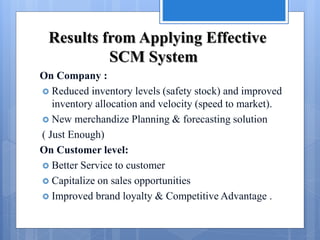
On Company :
 Reduced inventory levels (safety stock) and improved
inventory allocation and velocity (speed to market).
 New merchandize Planning & forecasting solution
( Just Enough)
On Customer level:
 Better Service to customer
 Capitalize on sales opportunities
 Improved brand loyalty & Competitive Advantage .
Recommendations to Retailers
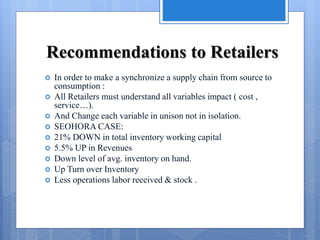
 In order to make a synchronize a supply chain from source to
consumption :
 All Retailers must understand all variables impact ( cost ,
service…).
 And Change each variable in unison not in isolation.
 SEOHORA CASE:
 21% DOWN in total inventory working capital
 5.5% UP in Revenues
 Down level of avg. inventory on hand.
 Up Turn over Inventory
 Less operations labor received & stock .
What is Supply Chain?
• Sequence of (decision making and execution) processes
and (material, information and money) flows that aim to
meet final customer requirements and take place within
and between different supply chain stages.
Supply Chain Management
• Oliver & Webber, 1982 defines SCM as inventory
management approach with an emphasis on the supply of
raw materials.
• Cooper & Ellram, 1993 described SCM as managing the
flow of materials and the associated flow of information.
• Lambert&Cooper, 2000 stresses the need for collaboration
among successive actors, from primary producer to final
consumers, to better satisfy consumer demand at lower
costs
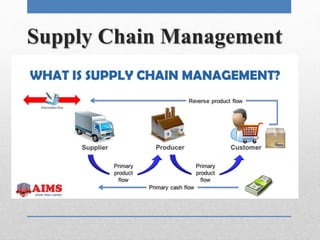
Supply Chain Management
• As the management of the flow of products and services ,
which begins from the origin of products and ends with the
products `s consumption at the end-user.
• The main objective of SCM is to monitor and relate
production, distribution , and shipment of products and
services.
• This can be done by companies with a very good and tight
hold over internal inventories, production, distribution,
internal productions and sales.
SCM Benefits
• Many companies are re-engineering and rationalising
their supply chain network to obtain these benefits.
• Implementing effective supply chain management using
powerful SCM solutions will allow businesses to
optimize the three key flows.
THREE MAIN BENEFITS OF SCM
 By optimizing product, information and financial flow,
Companies can proactively create and seize new market
opportunities and mitigate risks that can negatively
impact their entire business.
 With an Effective SCM system in place, enterprises can
comprehensively & continually assess their processes,
 Identify & Fill all the gaps, lower costs, competently
evolve with ever-evolving SC, & enable quicker decision
making.
Improved Product & Material Flow
• Time-to-Consumer
Time-to-consumer is a crucial indicator of product
flow efficiency
The less time it takes for goods to reach the end
customer, the more efficient the product flow with
Quality of delivered customer , supply & demand
balance , shipment options costs, & inventories.
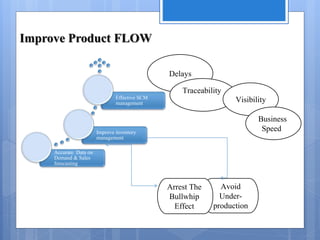
Improve Product FLOW
Accurate Data on
Demand & Sales
forecasting
Improve inventory
management
Effective SCM
management
Avoid
Under-
production
Arrest The
Bullwhip
Effect
Delays
Traceability
Visibility
Business
Speed
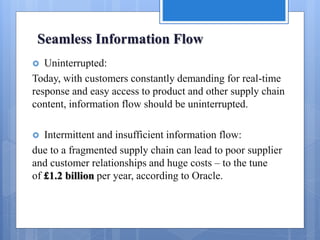
Seamless Information Flow
 Uninterrupted:
Today, with customers constantly demanding for real-time
response and easy access to product and other supply chain
content, information flow should be uninterrupted.
 Intermittent and insufficient information flow:
due to a fragmented supply chain can lead to poor supplier
and customer relationships and huge costs – to the tune
of £1.2 billion per year, according to Oracle.
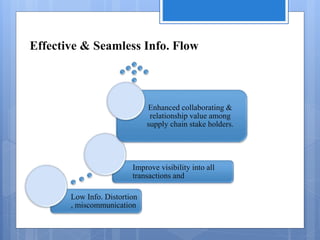
Effective & Seamless Info. Flow
Low Info. Distortion
, miscommunication
Improve visibility into all
transactions and
Enhanced collaborating &
relationship value among
supply chain stake holders.
Enchased Financial Flow
 Cash In & Cash Out
How to improve cash flow in the value chain, which involves
thousands of invoices and payments in a given year.
The unpredictability and variability of financial inflows and
outflows can add more complexity to the inherently complex
supply chain financial flow.
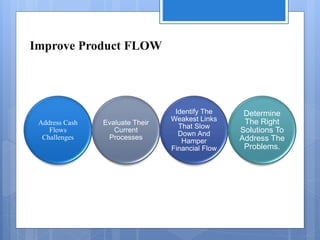
Improve Product FLOW
Address Cash
Flows
Challenges
Evaluate Their
Current
Processes
Identify The
Weakest Links
That Slow
Down And
Hamper
Financial Flow
Determine
The Right
Solutions To
Address The
Problems.
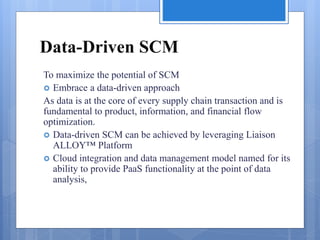
Data-Driven SCM
To maximize the potential of SCM
 Embrace a data-driven approach
As data is at the core of every supply chain transaction and is
fundamental to product, information, and financial flow
optimization.
 Data-driven SCM can be achieved by leveraging Liaison
ALLOY™ Platform
 Cloud integration and data management model named for its
ability to provide PaaS functionality at the point of data
analysis,
Conclusion
O Supply Chain network complexity is growing as further
technological advancements are underway such as
3D printing, “Urbanization`,” IOT, and Mobility.
O But with effective supply chain management in place
which consists of strategies and best practices for
integrating and coordinating all the functions,
activities, transactions, and people in the entire value
chain companies will be able to address and adapt to
ever-increasing complexities.
Recommendations
O Generally , Companies need to engage customers more in their
products by :
• Create a better understanding of market trends and customer insights throughout
the innovation process, as well as involving the customer directly in this process.
• Create & use platforms, companies can create digital consumer clinics. VR
Technology
O To totally maximize the benefits of SCM, companies should embrace
a data-driven approach to SCM using Liaison ALLOY Platform,
because data is the basic element in production, information, and
financial flow in the supply chain network.
Any
Question ?

Intro. to Supply Chain

  • 2.
    Outline • What isSupply chain , Supply Chain Management . • Benefits of SCM, • Practical Experiences of SCM. • Disadvantages of SCM, Role of IT in SCM • Paper Conclusion & Recommendations & Class Questions.
  • 3.
    SCM Case Study “Howthe Beauty Retailer Reduced Inventory Levels, While Improving Customer Service “ Brief Info:  A leader in global prestige retail since 1969 operates approximately 2,300 stores in 33 countries worldwide,  Make up, Skincare, nail care, bath and amazing smart tools that make every women’s life easier and looking great a reality.  1st store UAE Festival City 1st March 2007  KSA , Qatar & Bahrain , March 2007  Dubai Mall Dec 2008
  • 4.
    The Problem withSEPHORA  High volume stores , allocation right product and right time .  Overflow in back stock room .  Purchasing practices ( weekly & monthly )  Lack visibility  Longer time than targeted delivering time.
  • 5.
    The Goal  Toensure customer satisfaction by having the right product, at the right location, at the right time, in order to maintain high inventory stock percentages and service levels.
  • 6.
    Results from ApplyingEffective SCM System On Company :  Reduced inventory levels (safety stock) and improved inventory allocation and velocity (speed to market).  New merchandize Planning & forecasting solution ( Just Enough) On Customer level:  Better Service to customer  Capitalize on sales opportunities  Improved brand loyalty & Competitive Advantage .
  • 7.
    Recommendations to Retailers In order to make a synchronize a supply chain from source to consumption :  All Retailers must understand all variables impact ( cost , service…).  And Change each variable in unison not in isolation.  SEOHORA CASE:  21% DOWN in total inventory working capital  5.5% UP in Revenues  Down level of avg. inventory on hand.  Up Turn over Inventory  Less operations labor received & stock .
  • 8.
    What is SupplyChain? • Sequence of (decision making and execution) processes and (material, information and money) flows that aim to meet final customer requirements and take place within and between different supply chain stages.
  • 9.
    Supply Chain Management •Oliver & Webber, 1982 defines SCM as inventory management approach with an emphasis on the supply of raw materials. • Cooper & Ellram, 1993 described SCM as managing the flow of materials and the associated flow of information. • Lambert&Cooper, 2000 stresses the need for collaboration among successive actors, from primary producer to final consumers, to better satisfy consumer demand at lower costs
  • 10.
  • 11.
    Supply Chain Management •As the management of the flow of products and services , which begins from the origin of products and ends with the products `s consumption at the end-user. • The main objective of SCM is to monitor and relate production, distribution , and shipment of products and services. • This can be done by companies with a very good and tight hold over internal inventories, production, distribution, internal productions and sales.
  • 12.
    SCM Benefits • Manycompanies are re-engineering and rationalising their supply chain network to obtain these benefits. • Implementing effective supply chain management using powerful SCM solutions will allow businesses to optimize the three key flows.
  • 13.
    THREE MAIN BENEFITSOF SCM  By optimizing product, information and financial flow, Companies can proactively create and seize new market opportunities and mitigate risks that can negatively impact their entire business.  With an Effective SCM system in place, enterprises can comprehensively & continually assess their processes,  Identify & Fill all the gaps, lower costs, competently evolve with ever-evolving SC, & enable quicker decision making.
  • 14.
    Improved Product &Material Flow • Time-to-Consumer Time-to-consumer is a crucial indicator of product flow efficiency The less time it takes for goods to reach the end customer, the more efficient the product flow with Quality of delivered customer , supply & demand balance , shipment options costs, & inventories.
  • 15.
    Improve Product FLOW AccurateData on Demand & Sales forecasting Improve inventory management Effective SCM management Avoid Under- production Arrest The Bullwhip Effect Delays Traceability Visibility Business Speed
  • 16.
    Seamless Information Flow Uninterrupted: Today, with customers constantly demanding for real-time response and easy access to product and other supply chain content, information flow should be uninterrupted.  Intermittent and insufficient information flow: due to a fragmented supply chain can lead to poor supplier and customer relationships and huge costs – to the tune of £1.2 billion per year, according to Oracle.
  • 17.
    Effective & SeamlessInfo. Flow Low Info. Distortion , miscommunication Improve visibility into all transactions and Enhanced collaborating & relationship value among supply chain stake holders.
  • 18.
    Enchased Financial Flow Cash In & Cash Out How to improve cash flow in the value chain, which involves thousands of invoices and payments in a given year. The unpredictability and variability of financial inflows and outflows can add more complexity to the inherently complex supply chain financial flow.
  • 19.
    Improve Product FLOW AddressCash Flows Challenges Evaluate Their Current Processes Identify The Weakest Links That Slow Down And Hamper Financial Flow Determine The Right Solutions To Address The Problems.
  • 20.
    Data-Driven SCM To maximizethe potential of SCM  Embrace a data-driven approach As data is at the core of every supply chain transaction and is fundamental to product, information, and financial flow optimization.  Data-driven SCM can be achieved by leveraging Liaison ALLOY™ Platform  Cloud integration and data management model named for its ability to provide PaaS functionality at the point of data analysis,
  • 21.
    Conclusion O Supply Chainnetwork complexity is growing as further technological advancements are underway such as 3D printing, “Urbanization`,” IOT, and Mobility. O But with effective supply chain management in place which consists of strategies and best practices for integrating and coordinating all the functions, activities, transactions, and people in the entire value chain companies will be able to address and adapt to ever-increasing complexities.
  • 22.
    Recommendations O Generally ,Companies need to engage customers more in their products by : • Create a better understanding of market trends and customer insights throughout the innovation process, as well as involving the customer directly in this process. • Create & use platforms, companies can create digital consumer clinics. VR Technology O To totally maximize the benefits of SCM, companies should embrace a data-driven approach to SCM using Liaison ALLOY Platform, because data is the basic element in production, information, and financial flow in the supply chain network.
  • 23.