Non-Convectional Energy
Resources
Presentation by :-
Pankaj Kumar
Poras Sancheti
Ambrish Pote
Deepak Malche
Under the guidance of - Prof. Nilesh Varkute
FR. CONCEICAO RODRIGUES INSTITUTE OF TECHNOLOGY, VASHI
OCEAN THERMAL ENERGY
CONVERSION
WHAT IS OTEC ?
• The operation of otec is based on thermodynamic
principle.
• If a heat source is high temperature and a heat sink at
lower temperature, this temperature difference can be
utilized in a machine to convert it into mechanical
energy and thereby into electrical energy.
• In the otec system, the warm ocean surface is the heat
source and the deep colder water provides the sink.
OPEN (CLAUDE) CYCLE
OPEN (CLAUDE) CYCLE
• Open-cycle OTEC uses the tropical oceans' warm
surface water to make electricity.
• When warm seawater is placed in a low-pressure
container, it boils.
• The expanding steam drives a low-pressure turbine
attached to an electrical generator.
• The steam, which has left its salt behind in the low-
pressure container, is almost pure fresh water. It is
condensed back into a liquid by exposure to cold
temperatures from deep-ocean water.
CLOSED (ANDERSON) CYCLE
• Closed-cycle systems(Rankine) use fluid with a low-
boiling point, such as ammonia, to rotate a turbine to
generate electricity.
• Warm surface seawater is pumped through a heat
exchanger where the low-boiling-point fluid is
vaporized. The expanding vapor turns the turbo-
generator. Then, cold deep seawater is pumped
through a second heat exchanger which condenses the
vapor back into liquid, which is then recycled through
the system.
HYBRID CYCLE
ADVANTAGES
• Eco- friendly
• Minimal maintenance costs compared to other power
production plants
• The 41 °F (5 °C) cold seawater made available by an
OTEC system creates an opportunity to provide large
amounts of cooling to industries and homes near the
plant.
• Fresh water is the first by-product . A small 1 MW
OTEC is capable of producing some 4,500 cubic
meters of fresh water per day, enough to supply a
population of 20,000 with fresh water.
DISADVANTAGES
• OTEC produced electricity at present would cost
more than electricity generated from fossil fuels at
their current costs.
• OTEC plants must be located where a difference of
about 20º C occurs year round. Ocean depths must be
available fairly close to shore-based facilities for
economic
• No energy company will put money in this project
because it only had been tested in a very small scale.
• Construction of OTEC plants in coastal waters may
cause localized damage to marine ecosystems.
OTEC Plants Around the World
CASE STUDY
40 MW, OTEC PLANT AT KAHE POINT,
OAHU, HAWAII
Details of Sea around plant
OCEAN WAVE ENERGY
Introduction
Renewable energy technologies provide alternatives to
fossil-fueled power plants for the generation of
electricity, an essential step towards reducing our
nation’s dependence on fossil fuels.
One category of emerging renewable energy
technologies relates to OCEAN ENERGY.
Introduction
Among other types of renewable energy, oceans
contain energy in the form of
– Waves
– Tidal currents
Wave Energy
Where does wave energy originate?
– Differential warming of the earth causes pressure
differences in the atmosphere, which generate
winds
– As winds move across the surface of open bodies
of water, they transfer some of their energy to the
water and create waves
Wave Energy
The amount of energy transferred and the size of the
resulting wave depend on
– the wind speed
– the length of time for which the wind blows
– the distance over which the wind blows, or fetch
Therefore, coasts that have exposure to the prevailing
wind direction and that face long expanses of open
ocean have the greatest wave energy levels.
Wave Energy
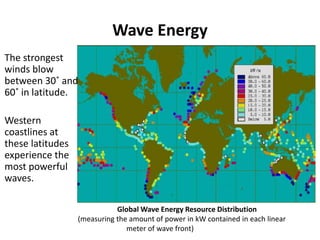
The strongest
winds blow
between 30˚ and
60˚ in latitude.
Western
coastlines at
these latitudes
experience the
most powerful
waves.
Global Wave Energy Resource Distribution
(measuring the amount of power in kW contained in each linear
meter of wave front)
Wave Energy
• The Electric Power Research Institute (EPRI)
estimates that the annual average incident wave
energy off of the U.S. coastline amounts to 2100
terawatt hours per year. (A terawatt equals a trillion
watts.)
• Harnessing 20% of that total energy at 50%
conversion efficiency would generate as much
electricity as conventional hydropower currently
provides – 7% of total U.S. electricity consumption,
or 270 terawatt hours per year.
How do we harness
wave energy?
In order to extract this energy, wave energy conversion
devices must create a system of reacting forces, in
which two or more bodies move relative to each
other, while at least one body interacts with the
waves.
There are many ways that such a system could be
configured.
Wave Energy Technologies
• Waves retain energy differently depending on water
depth
– Lose energy slowly in deep water
– Lose energy quickly as water becomes shallower
because of friction between the moving water
particles and the sea bed
• Wave energy conversion devices are designed for
optimal operation at a particular depth range
Wave Energy Technologies
Therefore, devices can be characterized in terms of
their placement or location.
– At the shoreline
– Near the shoreline
– Off-shore
One wave energy conversion system that has proven
successful at each of these locations is the
OSCILLATING WATER COLUMN.
Oscillating Water Column
An Oscillating Water Column (OWC) consists of a
partially submerged structure that opens to the
ocean below the water surface. This structure is
called a wave collector.
This design creates a water column in the central
chamber of the collector, with a volume of air
trapped above it.
Oscillating Water Column
• As a wave enters the
collector, the surface of the
water column rises and
compresses the volume of
air above it.
• The compressed air is
forced into an aperture at
the top of the chamber,
moving past a turbine.
• As the wave retreats, the air
is drawn back through the
turbine due to the reduced
pressure in the chamber.
Oscillating Water Column
The turning of the turbine
drives a generator,
producing electricity!
Oscillating Water Column
The type of turbine used is a key element to the
conversion efficiency of an OWC.
Traditional turbines function by gas or liquid flowing in
one direction and at a constant velocity. When the
flow is not always from the same direction or at a
constant velocity – such as in the OWC – traditional
turbines become ineffective.
Oscillating Water Column
Different types of turbines have been developed for the
OWC to address this problem.
The technologies have been demonstrated to work in a
number of locations, with varying degrees of
efficiency.
– Wavegen’s LIMPET
– Energetech’s Australia Wave Energy System
On-shore versus Off-shore
In spite of the success of this technology in an on-shore
application, most wave energy experts agree that off-
shore or near-shore devices offer greater potential
than shoreline devices.
On-shore technologies
Advantages
• Easier to access for
construction and
maintenance
• Less installment costs and
grid connection charges
• Could be incorporated into
harbor walls or water
breaks, performing a dual
service for the community
Disadvantages
• Limited number of suitable
sites / high competition for
use of the shoreline
• Environmental concerns for
on-shore devices may be
greater
• Much less energy available
to on-shore devices because
water depth usually
decreases closer to the
shore
Obstacles to Development
The greatest challenge is generating electricity from wave energy
at a cost that is acceptable to the market.
Currently, costs are high
– Lack of federal funding
• The Energy Policy Act of 2005 authorizes the
Department of Energy to conduct research,
development, demonstration, and commercial
application programs for ocean and wave energy
technologies
• Yet the President’s budgets have never appropriated
any funds for these activities, including 2008’s budget
Obstacles to Development
– Typically, technologies are being developed by small
companies with limited capital, increasing the chance of
failure with early prototypes. These failures may lead
potential investors to lose confidence in the technologies.
– Being relatively new technologies, they are unfamiliar to
licensing and resource agencies and costly to permit.
Conclusion
• There is a large supply of wave energy available
• The technology already exists for extraction of this
energy
• The technical challenges are solvable
• The problems lie in facilitating the testing and
development of the technology to make it more
affordable
– Need federal funding
– Need a regulatory process conducive for rapid deployment
of prototypes and research equipment
•The darkened regions shows the potential sites
CASE STUDYOkeanós Pelamis Wave Farm
Aguçadoura/ Póvoa de Varzim, Northern Portugal
Relative movement of parts due to Waves
TIDAL POWER
Tidal power, also called tidal energy, is
A form of hydropower that converts the
energy of tides into useful forms of
power, mainly electricity.
• Cause of tides: gravitational force of sun, moon and earth’s rotation
• Two tidal cycles per day: 12 hours, 25 minutes
• Tidal range – large at coastal regions with high depth gradient
• Water can be stored in an estuary during high tide
• Release during low tide, through turbines
BASICS
PLANT LOCATION
• Tidal mills built on inlets branching off tidal estuaries
• Average Tidal range : the higher, the better
• Feasibility of plant construction & basin closure
• Environmental consequences
THE TIDAL BARRAGE
It’s a huge dam built across a river estuary. When the tide goes in and out, the
water flows through tunnels in the dam.
• Tidal range has to be in excess of 5 meters for tidal power to be
feasible.
• The purpose of this dam or barrage is to let water flow through it
into the basin as the tide comes in. As the tide recedes, gates in the
barrage that contain turbines are opened, the hydrostatic head
causes the water to come through these gates, driving the turbines
and generating power.
• Power can be generated in both directions through the barrage but
this can affect efficiency and the economics of the project.
• Components of barrage
- Caissons
- Turbines
The LaRance Tidal Barrage Power Plant
TIDAL CURRENT TURBINES
• It makes use of kinetic energy
of moving water to power
turbines, in a similar way to
wind turbines that use wind
to power turbines.
• Operates during floods and
ebb tides.
• Consists of a gearbox, a rotor
and a generator.
• These three parts are
mounted on a support
structure.
DYNAMIC TIDAL POWER PLANT
• Dynamic Tidal Power Plant (DTP) is new and untested
method of tidal power generation. It would involve creating
large dam like structure extending from the coast straight to
the ocean with a perpendicular barrier at the far end forming a
large ‘T’ shape.
• A single dam can accommodate 8 GW (8000 MW) of installed
capacity.
POTENTIAL IN INDIA
• Two estuaries on the west coast : Gulf of Cambay & Gulf of Kutch
in Gujarat
• Gulf of Kutch potential estimated to be 900 MW; annual output of
1.6 TWh
• Potential of Gulf of Cambay : 7000 MW, basin area of 1970 sq-km,
annual output of 15 TWh
• Along east coast : Sunderbans in West Bengal
• 20 MW power estimated in regions of Dungaduani, Belladonna
Creek & Pitts Creek
TIDAL ENERGY ESTIMATED DEPLOYMENT in 2010
WORLDWIDE
Key :
EU + EFTA - European Union & European Free Trade Association
CIS - Ex-USSR countries
NAFTA - USA, Canada, Mexico
Asia - All Asian countries and Pacific islands excluding OECD Pacific,
Iran, Asian Republics of former USSR
Estimated
deployment in 2010
Estimated deployment
in 2010
TWh MW
WORLD-WIDE 0.586 261.4
EU + EFTA 0.544 240
NAFTA 0.03 17.8
ASIA 0.011 3.2
CIS 0.001 0.4
POTENTIAL
EXISTING PLANTS
Site Mean
Tidal
Range
(m)
Basin
(sq-km)
Installed
Capacity
(MW)
Approx
Output
(GWh/yr)
In
service
(year)
La Rance
(France)
8 17 240 540 1966
Kislaya Guba
(Russia)
2.4 2 0.4 - 1968
Jingxia (China) 7.1 2 3.2 11 1980-86
Annapolis Royal
(Canada)
6 6 17.8 30 1984
WORLD AT A GLANCE…..
ECONOMICS
• Characterized by high capital costs per MW of installed capacity
• High payback period
• Annual operation & maintenance costs are typically less than 0.5
% of initial capital
• Possible consumption of power locally & shorter construction
times for small schemes make them more economic compared to
large ones
• High capital costs & long construction time make tidal energy
sensitive to discount rates
• Non-energy benefits should be taken into account in assessing
potential schemes
Mumbai – A potential site for tidal
power plant

Ocean thermal energy conversion

  • 1.
    Non-Convectional Energy Resources Presentation by:- Pankaj Kumar Poras Sancheti Ambrish Pote Deepak Malche Under the guidance of - Prof. Nilesh Varkute FR. CONCEICAO RODRIGUES INSTITUTE OF TECHNOLOGY, VASHI
  • 2.
  • 3.
    WHAT IS OTEC? • The operation of otec is based on thermodynamic principle. • If a heat source is high temperature and a heat sink at lower temperature, this temperature difference can be utilized in a machine to convert it into mechanical energy and thereby into electrical energy. • In the otec system, the warm ocean surface is the heat source and the deep colder water provides the sink.
  • 4.
  • 5.
    OPEN (CLAUDE) CYCLE •Open-cycle OTEC uses the tropical oceans' warm surface water to make electricity. • When warm seawater is placed in a low-pressure container, it boils. • The expanding steam drives a low-pressure turbine attached to an electrical generator. • The steam, which has left its salt behind in the low- pressure container, is almost pure fresh water. It is condensed back into a liquid by exposure to cold temperatures from deep-ocean water.
  • 6.
  • 7.
    CLOSED (ANDERSON) CYCLE •Closed-cycle systems(Rankine) use fluid with a low- boiling point, such as ammonia, to rotate a turbine to generate electricity. • Warm surface seawater is pumped through a heat exchanger where the low-boiling-point fluid is vaporized. The expanding vapor turns the turbo- generator. Then, cold deep seawater is pumped through a second heat exchanger which condenses the vapor back into liquid, which is then recycled through the system.
  • 8.
  • 9.
    ADVANTAGES • Eco- friendly •Minimal maintenance costs compared to other power production plants • The 41 °F (5 °C) cold seawater made available by an OTEC system creates an opportunity to provide large amounts of cooling to industries and homes near the plant. • Fresh water is the first by-product . A small 1 MW OTEC is capable of producing some 4,500 cubic meters of fresh water per day, enough to supply a population of 20,000 with fresh water.
  • 10.
    DISADVANTAGES • OTEC producedelectricity at present would cost more than electricity generated from fossil fuels at their current costs. • OTEC plants must be located where a difference of about 20º C occurs year round. Ocean depths must be available fairly close to shore-based facilities for economic • No energy company will put money in this project because it only had been tested in a very small scale. • Construction of OTEC plants in coastal waters may cause localized damage to marine ecosystems.
  • 11.
    OTEC Plants Aroundthe World CASE STUDY
  • 12.
    40 MW, OTECPLANT AT KAHE POINT, OAHU, HAWAII
  • 13.
    Details of Seaaround plant
  • 14.
  • 15.
    Introduction Renewable energy technologiesprovide alternatives to fossil-fueled power plants for the generation of electricity, an essential step towards reducing our nation’s dependence on fossil fuels. One category of emerging renewable energy technologies relates to OCEAN ENERGY.
  • 16.
    Introduction Among other typesof renewable energy, oceans contain energy in the form of – Waves – Tidal currents
  • 17.
    Wave Energy Where doeswave energy originate? – Differential warming of the earth causes pressure differences in the atmosphere, which generate winds – As winds move across the surface of open bodies of water, they transfer some of their energy to the water and create waves
  • 18.
    Wave Energy The amountof energy transferred and the size of the resulting wave depend on – the wind speed – the length of time for which the wind blows – the distance over which the wind blows, or fetch Therefore, coasts that have exposure to the prevailing wind direction and that face long expanses of open ocean have the greatest wave energy levels.
  • 19.
    Wave Energy The strongest windsblow between 30˚ and 60˚ in latitude. Western coastlines at these latitudes experience the most powerful waves. Global Wave Energy Resource Distribution (measuring the amount of power in kW contained in each linear meter of wave front)
  • 20.
    Wave Energy • TheElectric Power Research Institute (EPRI) estimates that the annual average incident wave energy off of the U.S. coastline amounts to 2100 terawatt hours per year. (A terawatt equals a trillion watts.) • Harnessing 20% of that total energy at 50% conversion efficiency would generate as much electricity as conventional hydropower currently provides – 7% of total U.S. electricity consumption, or 270 terawatt hours per year.
  • 21.
    How do weharness wave energy? In order to extract this energy, wave energy conversion devices must create a system of reacting forces, in which two or more bodies move relative to each other, while at least one body interacts with the waves. There are many ways that such a system could be configured.
  • 22.
    Wave Energy Technologies •Waves retain energy differently depending on water depth – Lose energy slowly in deep water – Lose energy quickly as water becomes shallower because of friction between the moving water particles and the sea bed • Wave energy conversion devices are designed for optimal operation at a particular depth range
  • 23.
    Wave Energy Technologies Therefore,devices can be characterized in terms of their placement or location. – At the shoreline – Near the shoreline – Off-shore One wave energy conversion system that has proven successful at each of these locations is the OSCILLATING WATER COLUMN.
  • 24.
    Oscillating Water Column AnOscillating Water Column (OWC) consists of a partially submerged structure that opens to the ocean below the water surface. This structure is called a wave collector. This design creates a water column in the central chamber of the collector, with a volume of air trapped above it.
  • 25.
    Oscillating Water Column •As a wave enters the collector, the surface of the water column rises and compresses the volume of air above it. • The compressed air is forced into an aperture at the top of the chamber, moving past a turbine. • As the wave retreats, the air is drawn back through the turbine due to the reduced pressure in the chamber.
  • 26.
    Oscillating Water Column Theturning of the turbine drives a generator, producing electricity!
  • 27.
    Oscillating Water Column Thetype of turbine used is a key element to the conversion efficiency of an OWC. Traditional turbines function by gas or liquid flowing in one direction and at a constant velocity. When the flow is not always from the same direction or at a constant velocity – such as in the OWC – traditional turbines become ineffective.
  • 28.
    Oscillating Water Column Differenttypes of turbines have been developed for the OWC to address this problem. The technologies have been demonstrated to work in a number of locations, with varying degrees of efficiency. – Wavegen’s LIMPET – Energetech’s Australia Wave Energy System
  • 29.
    On-shore versus Off-shore Inspite of the success of this technology in an on-shore application, most wave energy experts agree that off- shore or near-shore devices offer greater potential than shoreline devices.
  • 30.
    On-shore technologies Advantages • Easierto access for construction and maintenance • Less installment costs and grid connection charges • Could be incorporated into harbor walls or water breaks, performing a dual service for the community Disadvantages • Limited number of suitable sites / high competition for use of the shoreline • Environmental concerns for on-shore devices may be greater • Much less energy available to on-shore devices because water depth usually decreases closer to the shore
  • 31.
    Obstacles to Development Thegreatest challenge is generating electricity from wave energy at a cost that is acceptable to the market. Currently, costs are high – Lack of federal funding • The Energy Policy Act of 2005 authorizes the Department of Energy to conduct research, development, demonstration, and commercial application programs for ocean and wave energy technologies • Yet the President’s budgets have never appropriated any funds for these activities, including 2008’s budget
  • 32.
    Obstacles to Development –Typically, technologies are being developed by small companies with limited capital, increasing the chance of failure with early prototypes. These failures may lead potential investors to lose confidence in the technologies. – Being relatively new technologies, they are unfamiliar to licensing and resource agencies and costly to permit.
  • 33.
    Conclusion • There isa large supply of wave energy available • The technology already exists for extraction of this energy • The technical challenges are solvable • The problems lie in facilitating the testing and development of the technology to make it more affordable – Need federal funding – Need a regulatory process conducive for rapid deployment of prototypes and research equipment
  • 34.
    •The darkened regionsshows the potential sites CASE STUDYOkeanós Pelamis Wave Farm Aguçadoura/ Póvoa de Varzim, Northern Portugal
  • 35.
    Relative movement ofparts due to Waves
  • 36.
    TIDAL POWER Tidal power,also called tidal energy, is A form of hydropower that converts the energy of tides into useful forms of power, mainly electricity.
  • 37.
    • Cause oftides: gravitational force of sun, moon and earth’s rotation • Two tidal cycles per day: 12 hours, 25 minutes • Tidal range – large at coastal regions with high depth gradient • Water can be stored in an estuary during high tide • Release during low tide, through turbines BASICS
  • 38.
    PLANT LOCATION • Tidalmills built on inlets branching off tidal estuaries • Average Tidal range : the higher, the better • Feasibility of plant construction & basin closure • Environmental consequences
  • 39.
    THE TIDAL BARRAGE It’sa huge dam built across a river estuary. When the tide goes in and out, the water flows through tunnels in the dam.
  • 40.
    • Tidal rangehas to be in excess of 5 meters for tidal power to be feasible. • The purpose of this dam or barrage is to let water flow through it into the basin as the tide comes in. As the tide recedes, gates in the barrage that contain turbines are opened, the hydrostatic head causes the water to come through these gates, driving the turbines and generating power. • Power can be generated in both directions through the barrage but this can affect efficiency and the economics of the project. • Components of barrage - Caissons - Turbines
  • 41.
    The LaRance TidalBarrage Power Plant
  • 42.
    TIDAL CURRENT TURBINES •It makes use of kinetic energy of moving water to power turbines, in a similar way to wind turbines that use wind to power turbines. • Operates during floods and ebb tides. • Consists of a gearbox, a rotor and a generator. • These three parts are mounted on a support structure.
  • 43.
    DYNAMIC TIDAL POWERPLANT • Dynamic Tidal Power Plant (DTP) is new and untested method of tidal power generation. It would involve creating large dam like structure extending from the coast straight to the ocean with a perpendicular barrier at the far end forming a large ‘T’ shape. • A single dam can accommodate 8 GW (8000 MW) of installed capacity.
  • 44.
    POTENTIAL IN INDIA •Two estuaries on the west coast : Gulf of Cambay & Gulf of Kutch in Gujarat • Gulf of Kutch potential estimated to be 900 MW; annual output of 1.6 TWh • Potential of Gulf of Cambay : 7000 MW, basin area of 1970 sq-km, annual output of 15 TWh • Along east coast : Sunderbans in West Bengal • 20 MW power estimated in regions of Dungaduani, Belladonna Creek & Pitts Creek
  • 45.
    TIDAL ENERGY ESTIMATEDDEPLOYMENT in 2010 WORLDWIDE Key : EU + EFTA - European Union & European Free Trade Association CIS - Ex-USSR countries NAFTA - USA, Canada, Mexico Asia - All Asian countries and Pacific islands excluding OECD Pacific, Iran, Asian Republics of former USSR Estimated deployment in 2010 Estimated deployment in 2010 TWh MW WORLD-WIDE 0.586 261.4 EU + EFTA 0.544 240 NAFTA 0.03 17.8 ASIA 0.011 3.2 CIS 0.001 0.4 POTENTIAL
  • 46.
    EXISTING PLANTS Site Mean Tidal Range (m) Basin (sq-km) Installed Capacity (MW) Approx Output (GWh/yr) In service (year) LaRance (France) 8 17 240 540 1966 Kislaya Guba (Russia) 2.4 2 0.4 - 1968 Jingxia (China) 7.1 2 3.2 11 1980-86 Annapolis Royal (Canada) 6 6 17.8 30 1984
  • 47.
    WORLD AT AGLANCE…..
  • 48.
    ECONOMICS • Characterized byhigh capital costs per MW of installed capacity • High payback period • Annual operation & maintenance costs are typically less than 0.5 % of initial capital • Possible consumption of power locally & shorter construction times for small schemes make them more economic compared to large ones • High capital costs & long construction time make tidal energy sensitive to discount rates • Non-energy benefits should be taken into account in assessing potential schemes
  • 49.
    Mumbai – Apotential site for tidal power plant