Presentation on
Supply Chain Management
Presented By
Ishwar R. Bulbule
Introduction
 All activities associated with the flow and transformation of goods from
raw materials to end users.
 The term supply chain refers to the entire network of companies that
work together to design, produce, deliver, and service products.
 “Design, planning, execution, control, and monitoring of supply chain
activities with the objective of creating net value, building a competitive
infrastructure, leveraging worldwide logistics, synchronizing supply with
demand and measuring performance globally”
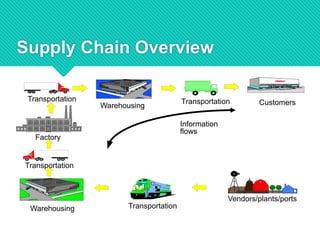
Supply Chain Overview
Warehousing
Warehousing
Transportation
Transportation
Vendors/plants/ports
Transportation
Factory
Transportation Customers
Information
flows
Supply Chain Flows
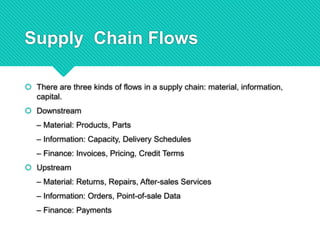
 There are three kinds of flows in a supply chain: material, information,
capital.
 Downstream
– Material: Products, Parts
– Information: Capacity, Delivery Schedules
– Finance: Invoices, Pricing, Credit Terms
 Upstream
– Material: Returns, Repairs, After-sales Services
– Information: Orders, Point-of-sale Data
– Finance: Payments
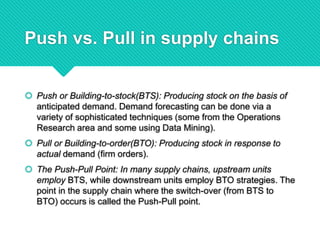
Push vs. Pull in supply chains
 Push or Building-to-stock(BTS): Producing stock on the basis of
anticipated demand. Demand forecasting can be done via a
variety of sophisticated techniques (some from the Operations
Research area and some using Data Mining).
 Pull or Building-to-order(BTO): Producing stock in response to
actual demand (firm orders).
 The Push-Pull Point: In many supply chains, upstream units
employ BTS, while downstream units employ BTO strategies. The
point in the supply chain where the switch-over (from BTS to
BTO) occurs is called the Push-Pull point.
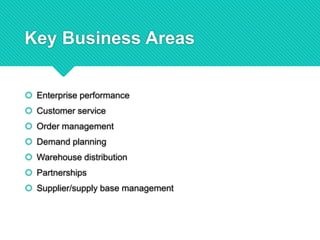
Key Business Areas
 Enterprise performance
 Customer service
 Order management
 Demand planning
 Warehouse distribution
 Partnerships
 Supplier/supply base management
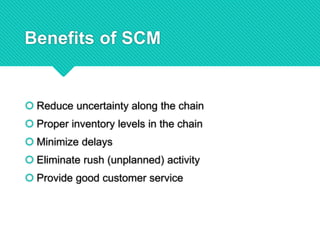
Benefits of SCM
 Reduce uncertainty along the chain
 Proper inventory levels in the chain
 Minimize delays
 Eliminate rush (unplanned) activity
 Provide good customer service
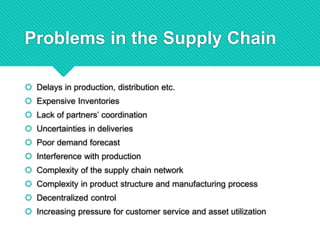
Problems in the Supply Chain
 Delays in production, distribution etc.
 Expensive Inventories
 Lack of partners’ coordination
 Uncertainties in deliveries
 Poor demand forecast
 Interference with production
 Complexity of the supply chain network
 Complexity in product structure and manufacturing process
 Decentralized control
 Increasing pressure for customer service and asset utilization
Technology in the SCM
 The internet and the web can be very effective communication
enhancers.
 Software includes demand forecasting tools and planning tools to
allow all SC members to coordinate their activities and adjust
their production levels.
 Software can allow members to:
– review past performance
– monitor current performance
– predict future production levels of products.
Conclusion
 Efficient supply chain management is crucial for the success of any small
scale manufacturing or large MNCs and can be the deciding factor
between a successful project and a project full of delays and claims.
 An effective supply management system is essential for managing
efficient material management to avoid material shortages,
misplacements, loss, and theft which might result in increases in crew
idle times, loss of productivity and delay of activities.

Supply Chain Management

  • 1.
    Presentation on Supply ChainManagement Presented By Ishwar R. Bulbule
  • 2.
    Introduction  All activitiesassociated with the flow and transformation of goods from raw materials to end users.  The term supply chain refers to the entire network of companies that work together to design, produce, deliver, and service products.  “Design, planning, execution, control, and monitoring of supply chain activities with the objective of creating net value, building a competitive infrastructure, leveraging worldwide logistics, synchronizing supply with demand and measuring performance globally”
  • 3.
  • 4.
    Supply Chain Flows There are three kinds of flows in a supply chain: material, information, capital.  Downstream – Material: Products, Parts – Information: Capacity, Delivery Schedules – Finance: Invoices, Pricing, Credit Terms  Upstream – Material: Returns, Repairs, After-sales Services – Information: Orders, Point-of-sale Data – Finance: Payments
  • 5.
    Push vs. Pullin supply chains  Push or Building-to-stock(BTS): Producing stock on the basis of anticipated demand. Demand forecasting can be done via a variety of sophisticated techniques (some from the Operations Research area and some using Data Mining).  Pull or Building-to-order(BTO): Producing stock in response to actual demand (firm orders).  The Push-Pull Point: In many supply chains, upstream units employ BTS, while downstream units employ BTO strategies. The point in the supply chain where the switch-over (from BTS to BTO) occurs is called the Push-Pull point.
  • 6.
    Key Business Areas Enterprise performance  Customer service  Order management  Demand planning  Warehouse distribution  Partnerships  Supplier/supply base management
  • 7.
    Benefits of SCM Reduce uncertainty along the chain  Proper inventory levels in the chain  Minimize delays  Eliminate rush (unplanned) activity  Provide good customer service
  • 8.
    Problems in theSupply Chain  Delays in production, distribution etc.  Expensive Inventories  Lack of partners’ coordination  Uncertainties in deliveries  Poor demand forecast  Interference with production  Complexity of the supply chain network  Complexity in product structure and manufacturing process  Decentralized control  Increasing pressure for customer service and asset utilization
  • 9.
    Technology in theSCM  The internet and the web can be very effective communication enhancers.  Software includes demand forecasting tools and planning tools to allow all SC members to coordinate their activities and adjust their production levels.  Software can allow members to: – review past performance – monitor current performance – predict future production levels of products.
  • 10.
    Conclusion  Efficient supplychain management is crucial for the success of any small scale manufacturing or large MNCs and can be the deciding factor between a successful project and a project full of delays and claims.  An effective supply management system is essential for managing efficient material management to avoid material shortages, misplacements, loss, and theft which might result in increases in crew idle times, loss of productivity and delay of activities.