Vortex Flow / Turbine
Fluid Sensor
-Pankaj Kumar (201179)
-Mayur Patil (201178)
Automobile Engineering
Use in Automobile
• Measure quantity of air going into IC engine.
• Electronically controlled engines (ECU)
• Petrol- Calculates Fuel injection in carburetor
• Diesel- Calculates Fuel injection in cylinder ports
Principle of Operation
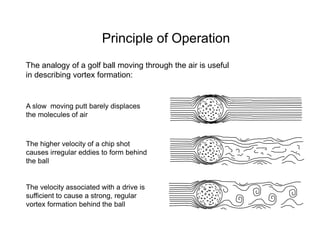
The analogy of a golf ball moving through the air is useful
in describing vortex formation:
A slow moving putt barely displaces
the molecules of air
The higher velocity of a chip shot
causes irregular eddies to form behind
the ball
The velocity associated with a drive is
sufficient to cause a strong, regular
vortex formation behind the ball
Principle of Operation
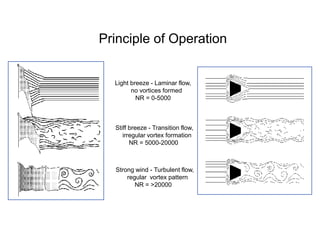
Light breeze - Laminar flow,
no vortices formed
NR = 0-5000
Stiff breeze - Transition flow,
irregular vortex formation
NR = 5000-20000
Strong wind - Turbulent flow,
regular vortex pattern
NR = >20000
Principle of Operation
When a flowing medium strikes a non-streamlined bluff object,
it separates, moves around the object and passes downstream.
At the point of contact with the object, vortex swirls separate from the
body on alternating sides. This separation causes a local increase
in pressure and a decrease in velocity on one side and a decrease
in pressure and an increase in velocity on the opposite side. The
alternating velocities generate alternating pressure forces on either side
of the bluff body. The frequency of these pressure changes is
proportional to velocity.
l
Principle of Operation
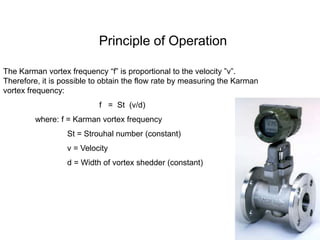
The Karman vortex frequency “f” is proportional to the velocity ”v”.
Therefore, it is possible to obtain the flow rate by measuring the Karman
vortex frequency:
f = St (v/d)
where: f = Karman vortex frequency
St = Strouhal number (constant)
v = Velocity
d = Width of vortex shedder (constant)
Vortex Flow meter Benefits
• Digital flow signal
– No zero drift
– Pulse output for totalizing
• Low installed cost
• Reliability
• Wide range ability
• Inherently Linear output
• Low pressure drop
• Liquid, steam, or gas applications
• Immune to density & viscosity changes
Vortex Flow meter Limitations
• Works over a particular velocity range.
• Requires specialization for different fluid flow
measurement
References
• Wikipedia
http://en.wikipedia.org/wiki/Air_flow_meter
• Yokogawa Corporation of America

Vortex Flow / Turbine Fluid Sensor

  • 1.
    Vortex Flow /Turbine Fluid Sensor -Pankaj Kumar (201179) -Mayur Patil (201178) Automobile Engineering
  • 3.
    Use in Automobile •Measure quantity of air going into IC engine. • Electronically controlled engines (ECU) • Petrol- Calculates Fuel injection in carburetor • Diesel- Calculates Fuel injection in cylinder ports
  • 4.
    Principle of Operation Theanalogy of a golf ball moving through the air is useful in describing vortex formation: A slow moving putt barely displaces the molecules of air The higher velocity of a chip shot causes irregular eddies to form behind the ball The velocity associated with a drive is sufficient to cause a strong, regular vortex formation behind the ball
  • 5.
    Principle of Operation Lightbreeze - Laminar flow, no vortices formed NR = 0-5000 Stiff breeze - Transition flow, irregular vortex formation NR = 5000-20000 Strong wind - Turbulent flow, regular vortex pattern NR = >20000
  • 6.
    Principle of Operation Whena flowing medium strikes a non-streamlined bluff object, it separates, moves around the object and passes downstream. At the point of contact with the object, vortex swirls separate from the body on alternating sides. This separation causes a local increase in pressure and a decrease in velocity on one side and a decrease in pressure and an increase in velocity on the opposite side. The alternating velocities generate alternating pressure forces on either side of the bluff body. The frequency of these pressure changes is proportional to velocity. l
  • 7.
    Principle of Operation TheKarman vortex frequency “f” is proportional to the velocity ”v”. Therefore, it is possible to obtain the flow rate by measuring the Karman vortex frequency: f = St (v/d) where: f = Karman vortex frequency St = Strouhal number (constant) v = Velocity d = Width of vortex shedder (constant)
  • 8.
    Vortex Flow meterBenefits • Digital flow signal – No zero drift – Pulse output for totalizing • Low installed cost • Reliability • Wide range ability • Inherently Linear output • Low pressure drop • Liquid, steam, or gas applications • Immune to density & viscosity changes
  • 9.
    Vortex Flow meterLimitations • Works over a particular velocity range. • Requires specialization for different fluid flow measurement
  • 10.