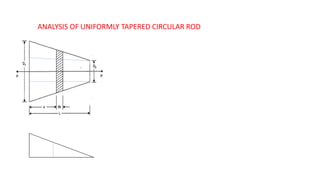
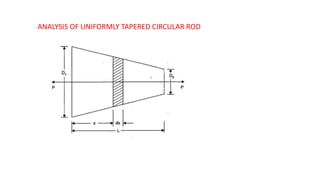
ANALYSIS OF UNIFORMLY TAPERED CIRCULAR ROD
P = Axial tensile load on the bar
L = Total length of the bar
E = Young's modulus.
D1= Diameter of rod at big end
D2= Diameter of rod at small end
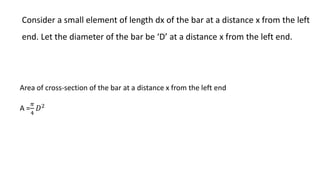
Consider a small element of length dx of the bar at a distance x from the left
end. Let the diameter of the bar be ‘D’ at a distance x from the left end.
Area of cross-section of the bar at a distance x from the left end
A =
𝜋
4
𝐷2
ANALYSIS OF UNIFORMLY TAPERED CIRCULAR ROD
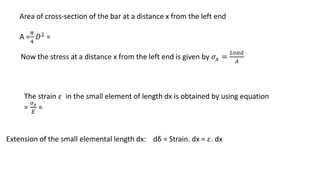
Now the stress at a distance x from the left end is given by 𝜎𝑥 =
𝐿𝑜𝑎𝑑
𝐴
The strain 𝜀 in the small element of length dx is obtained by using equation
=
𝜎 𝑥
𝐸
=
Extension of the small elemental length dx: dδ = Strain. dx = 𝜀. dx
Area of cross-section of the bar at a distance x from the left end
A =
𝜋
4
𝐷2
=
Total deformation=
ANALYSIS OF UNIFORMLY TAPERED CIRCULAR ROD
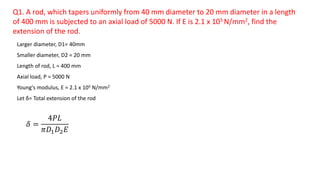
Q1. A rod, which tapers uniformly from 40 mm diameter to 20 mm diameter in a length
of 400 mm is subjected to an axial load of 5000 N. If E is 2.1 x 10⁵ N/mm2, find the
extension of the rod.
Larger diameter, D1= 40mm
Smaller diameter, D2 = 20 mm
Length of rod, L = 400 mm
Axial load, P = 5000 N
Young's modulus, E = 2.1 x 10⁵ N/mm2
Let δ= Total extension of the rod
𝛿 =
4𝑃𝐿
𝜋𝐷1 𝐷2 𝐸
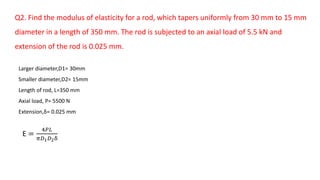
Q2. Find the modulus of elasticity for a rod, which tapers uniformly from 30 mm to 15 mm
diameter in a length of 350 mm. The rod is subjected to an axial load of 5.5 kN and
extension of the rod is 0.025 mm.
Larger diameter,D1= 30mm
Smaller diameter,D2= 15mm
Length of rod, L=350 mm
Axial load, P= 5500 N
Extension,δ= 0.025 mm
E =
4𝑃𝐿
𝜋𝐷1 𝐷2δ
ANALYSIS OF UNIFORMLY TAPERING RECTANGULAR BAR
p = Axial load on the bar
L = Length of bar
a = Width at bigger end
b = Width at smaller end
E = Young's modulus
t = Thickness of bar
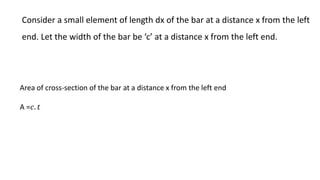
Consider a small element of length dx of the bar at a distance x from the left
end. Let the width of the bar be ‘c’ at a distance x from the left end.
Area of cross-section of the bar at a distance x from the left end
A =𝑐. 𝑡
ANALYSIS OF UNIFORMLY TAPERED CIRCULAR ROD
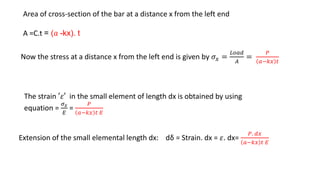
Now the stress at a distance x from the left end is given by 𝜎𝑥 =
𝐿𝑜𝑎𝑑
𝐴
=
𝑃
𝑎−𝑘𝑥 𝑡
The strain ′𝜀′ in the small element of length dx is obtained by using
equation =
𝜎 𝑥
𝐸
=
𝑃
𝑎−𝑘𝑥 𝑡 𝐸
Extension of the small elemental length dx: dδ = Strain. dx = 𝜀. dx=
𝑃. 𝑑𝑥
𝑎−𝑘𝑥 𝑡 𝐸
Area of cross-section of the bar at a distance x from the left end
A =C.t = (𝑎 -kx). t
Total deformation=
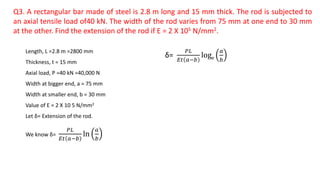
Q3. A rectangular bar made of steel is 2.8 m long and 15 mm thick. The rod is subjected to
an axial tensile load of40 kN. The width of the rod varies from 75 mm at one end to 30 mm
at the other. Find the extension of the rod if E = 2 X 10⁵ N/mm2.
Length, L =2.8 m =2800 mm
Thickness, t = 15 mm
Axial load, P =40 kN =40,000 N
Width at bigger end, a = 75 mm
Width at smaller end, b = 30 mm
Value of E = 2 X 10 5 N/mm2
Let δ= Extension of the rod.
We know δ=
𝑃𝐿
𝐸𝑡 𝑎−𝑏
ln
𝑎
𝑏
δ=
𝑃𝐿
𝐸𝑡 𝑎−𝑏
loge
𝑎
𝑏
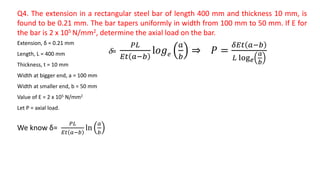
Q4. The extension in a rectangular steel bar of length 400 mm and thickness 10 mm, is
found to be 0.21 mm. The bar tapers uniformly in width from 100 mm to 50 mm. If E for
the bar is 2 x 10⁵ N/mm2, determine the axial load on the bar.
Extension, δ = 0.21 mm
Length, L = 400 mm
Thickness, t = 10 mm
Width at bigger end, a = 100 mm
Width at smaller end, b = 50 mm
Value of E = 2 x 10⁵ N/mm2
Let P = axial load.
We know δ=
𝑃𝐿
𝐸𝑡 𝑎−𝑏
ln
𝑎
𝑏
δ=
𝑃𝐿
𝐸𝑡 𝑎−𝑏
l𝑜𝑔 𝑒
𝑎
𝑏
⇒ 𝑃 =
𝛿𝐸𝑡 𝑎−𝑏
𝐿 log 𝑒
𝑎
𝑏
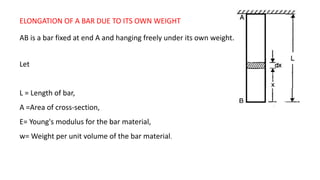
ELONGATION OF A BAR DUE TO ITS OWN WEIGHT
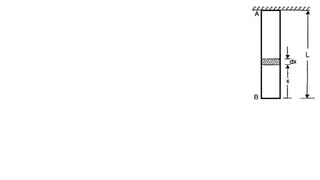
AB is a bar fixed at end A and hanging freely under its own weight.
Let
L = Length of bar,
A =Area of cross-section,
E= Young's modulus for the bar material,
w= Weight per unit volume of the bar material.
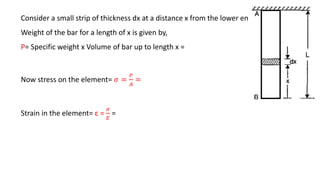
Consider a small strip of thickness dx at a distance x from the lower end.
Weight of the bar for a length of x is given by,
P= Specific weight x Volume of bar up to length x =
Now stress on the element= 𝜎 =
𝑃
𝐴
=
Strain in the element= ε =
𝜎
𝐸
=
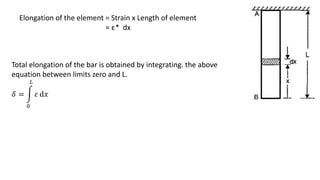
Elongation of the element = Strain x Length of element
= ε* dx
Total elongation of the bar is obtained by integrating. the above
equation between limits zero and L.
𝛿 =
0
𝐿
𝜀 ⅆ𝑥
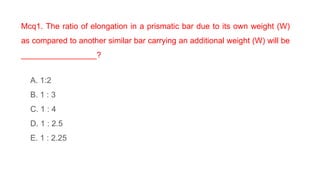
Mcq1. The ratio of elongation in a prismatic bar due to its own weight (W)
as compared to another similar bar carrying an additional weight (W) will be
_________________?
A. 1:2
B. 1 : 3
C. 1 : 4
D. 1 : 2.5
E. 1 : 2.25
Bars with variable cross sections subjected to axial loads

Bars with variable cross sections subjected to axial loads

  • 2.
    ANALYSIS OF UNIFORMLYTAPERED CIRCULAR ROD P = Axial tensile load on the bar L = Total length of the bar E = Young's modulus. D1= Diameter of rod at big end D2= Diameter of rod at small end
  • 3.
    Consider a smallelement of length dx of the bar at a distance x from the left end. Let the diameter of the bar be ‘D’ at a distance x from the left end. Area of cross-section of the bar at a distance x from the left end A = 𝜋 4 𝐷2
  • 4.
    ANALYSIS OF UNIFORMLYTAPERED CIRCULAR ROD
  • 6.
    ANALYSIS OF UNIFORMLYTAPERED CIRCULAR ROD
  • 8.
    Now the stressat a distance x from the left end is given by 𝜎𝑥 = 𝐿𝑜𝑎𝑑 𝐴 The strain 𝜀 in the small element of length dx is obtained by using equation = 𝜎 𝑥 𝐸 = Extension of the small elemental length dx: dδ = Strain. dx = 𝜀. dx Area of cross-section of the bar at a distance x from the left end A = 𝜋 4 𝐷2 =
  • 9.
  • 11.
    ANALYSIS OF UNIFORMLYTAPERED CIRCULAR ROD
  • 12.
    Q1. A rod,which tapers uniformly from 40 mm diameter to 20 mm diameter in a length of 400 mm is subjected to an axial load of 5000 N. If E is 2.1 x 10⁵ N/mm2, find the extension of the rod. Larger diameter, D1= 40mm Smaller diameter, D2 = 20 mm Length of rod, L = 400 mm Axial load, P = 5000 N Young's modulus, E = 2.1 x 10⁵ N/mm2 Let δ= Total extension of the rod 𝛿 = 4𝑃𝐿 𝜋𝐷1 𝐷2 𝐸
  • 13.
    Q2. Find themodulus of elasticity for a rod, which tapers uniformly from 30 mm to 15 mm diameter in a length of 350 mm. The rod is subjected to an axial load of 5.5 kN and extension of the rod is 0.025 mm. Larger diameter,D1= 30mm Smaller diameter,D2= 15mm Length of rod, L=350 mm Axial load, P= 5500 N Extension,δ= 0.025 mm E = 4𝑃𝐿 𝜋𝐷1 𝐷2δ
  • 14.
    ANALYSIS OF UNIFORMLYTAPERING RECTANGULAR BAR p = Axial load on the bar L = Length of bar a = Width at bigger end b = Width at smaller end E = Young's modulus t = Thickness of bar
  • 15.
    Consider a smallelement of length dx of the bar at a distance x from the left end. Let the width of the bar be ‘c’ at a distance x from the left end. Area of cross-section of the bar at a distance x from the left end A =𝑐. 𝑡
  • 16.
    ANALYSIS OF UNIFORMLYTAPERED CIRCULAR ROD
  • 17.
    Now the stressat a distance x from the left end is given by 𝜎𝑥 = 𝐿𝑜𝑎𝑑 𝐴 = 𝑃 𝑎−𝑘𝑥 𝑡 The strain ′𝜀′ in the small element of length dx is obtained by using equation = 𝜎 𝑥 𝐸 = 𝑃 𝑎−𝑘𝑥 𝑡 𝐸 Extension of the small elemental length dx: dδ = Strain. dx = 𝜀. dx= 𝑃. 𝑑𝑥 𝑎−𝑘𝑥 𝑡 𝐸 Area of cross-section of the bar at a distance x from the left end A =C.t = (𝑎 -kx). t
  • 18.
  • 19.
    Q3. A rectangularbar made of steel is 2.8 m long and 15 mm thick. The rod is subjected to an axial tensile load of40 kN. The width of the rod varies from 75 mm at one end to 30 mm at the other. Find the extension of the rod if E = 2 X 10⁵ N/mm2. Length, L =2.8 m =2800 mm Thickness, t = 15 mm Axial load, P =40 kN =40,000 N Width at bigger end, a = 75 mm Width at smaller end, b = 30 mm Value of E = 2 X 10 5 N/mm2 Let δ= Extension of the rod. We know δ= 𝑃𝐿 𝐸𝑡 𝑎−𝑏 ln 𝑎 𝑏 δ= 𝑃𝐿 𝐸𝑡 𝑎−𝑏 loge 𝑎 𝑏
  • 20.
    Q4. The extensionin a rectangular steel bar of length 400 mm and thickness 10 mm, is found to be 0.21 mm. The bar tapers uniformly in width from 100 mm to 50 mm. If E for the bar is 2 x 10⁵ N/mm2, determine the axial load on the bar. Extension, δ = 0.21 mm Length, L = 400 mm Thickness, t = 10 mm Width at bigger end, a = 100 mm Width at smaller end, b = 50 mm Value of E = 2 x 10⁵ N/mm2 Let P = axial load. We know δ= 𝑃𝐿 𝐸𝑡 𝑎−𝑏 ln 𝑎 𝑏 δ= 𝑃𝐿 𝐸𝑡 𝑎−𝑏 l𝑜𝑔 𝑒 𝑎 𝑏 ⇒ 𝑃 = 𝛿𝐸𝑡 𝑎−𝑏 𝐿 log 𝑒 𝑎 𝑏
  • 21.
    ELONGATION OF ABAR DUE TO ITS OWN WEIGHT AB is a bar fixed at end A and hanging freely under its own weight. Let L = Length of bar, A =Area of cross-section, E= Young's modulus for the bar material, w= Weight per unit volume of the bar material.
  • 22.
    Consider a smallstrip of thickness dx at a distance x from the lower end. Weight of the bar for a length of x is given by, P= Specific weight x Volume of bar up to length x = Now stress on the element= 𝜎 = 𝑃 𝐴 = Strain in the element= ε = 𝜎 𝐸 =
  • 23.
    Elongation of theelement = Strain x Length of element = ε* dx Total elongation of the bar is obtained by integrating. the above equation between limits zero and L. 𝛿 = 0 𝐿 𝜀 ⅆ𝑥
  • 25.
    Mcq1. The ratioof elongation in a prismatic bar due to its own weight (W) as compared to another similar bar carrying an additional weight (W) will be _________________? A. 1:2 B. 1 : 3 C. 1 : 4 D. 1 : 2.5 E. 1 : 2.25

Editor's Notes

  • #23 The above equation shows that stress. due to self weight in a bar is not uniform. It depends on x. The stress increases with the increase of x.