“Basic Elements of Automated
Systems”
Automated system:
• Automation is the technology by which a
process or procedure is accomplished without
human assistance
• In simple words, the replacement of human
operations by using computers
Basic elements:
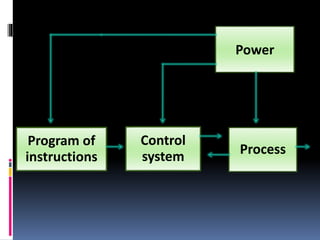
There are three basic elements of Automated
system:
• Power source
• Programmable command
• Control systems
Power
Program of
instructions
Control
system Process
Power source:
• An automated system is used to operate
some process and power is required to
drive the process as well as controls
• There are many sources of power available,
but the most commonly used power is
electricity
Electricity-
The Principal Power Source:
• Widely available at moderate cost
• Can be readily converted to alternative
forms, e.g., mechanical, thermal, light, etc.
• Low level power can be used for signal
transmission, data processing, and
communication
• Can be stored in long-life batteries
Power to Accomplish the Automated
Process:
• Power for the process:
 To drive the process itself
 To load and unload the work unit
 Transport between operations
• Power for automation:
 Controller unit
 Power to actuate the control signals
 Data acquisition and information processing
Programmable command:
• Set of commands that specify the sequence of
steps in the work cycle and the details of each
step
• Example: CNC part program
• During each step, there are one or more
activities involving changes in one or more
process parameters
Examples:
Temperature setting of a furnace
Axis position in a positioning system
Motor on or off
Control systems:
• The control element of the automated
system executes the program of
instructions
• The control system causes the process
to accomplish its defined function;
which for our purpose is to carry out
some manufacturing operation
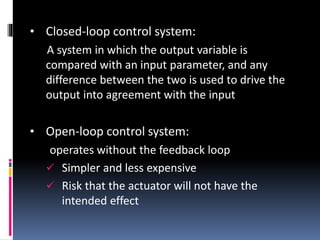
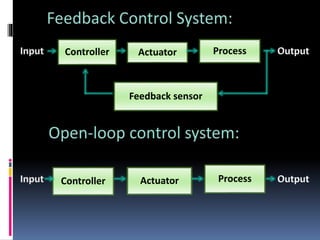
• Closed-loop control system:
A system in which the output variable is
compared with an input parameter, and any
difference between the two is used to drive the
output into agreement with the input
• Open-loop control system:
operates without the feedback loop
 Simpler and less expensive
 Risk that the actuator will not have the
intended effect
Process
Controller Actuator
Feedback sensor
Controller Process
Actuator
“Thank
you”

Basic Elements of Automated Systems.pptx

  • 1.
    “Basic Elements ofAutomated Systems”
  • 2.
    Automated system: • Automationis the technology by which a process or procedure is accomplished without human assistance • In simple words, the replacement of human operations by using computers
  • 3.
    Basic elements: There arethree basic elements of Automated system: • Power source • Programmable command • Control systems
  • 4.
  • 5.
    Power source: • Anautomated system is used to operate some process and power is required to drive the process as well as controls • There are many sources of power available, but the most commonly used power is electricity
  • 6.
    Electricity- The Principal PowerSource: • Widely available at moderate cost • Can be readily converted to alternative forms, e.g., mechanical, thermal, light, etc. • Low level power can be used for signal transmission, data processing, and communication • Can be stored in long-life batteries
  • 7.
    Power to Accomplishthe Automated Process: • Power for the process:  To drive the process itself  To load and unload the work unit  Transport between operations • Power for automation:  Controller unit  Power to actuate the control signals  Data acquisition and information processing
  • 8.
    Programmable command: • Setof commands that specify the sequence of steps in the work cycle and the details of each step • Example: CNC part program • During each step, there are one or more activities involving changes in one or more process parameters Examples: Temperature setting of a furnace Axis position in a positioning system Motor on or off
  • 9.
    Control systems: • Thecontrol element of the automated system executes the program of instructions • The control system causes the process to accomplish its defined function; which for our purpose is to carry out some manufacturing operation
  • 10.
    • Closed-loop controlsystem: A system in which the output variable is compared with an input parameter, and any difference between the two is used to drive the output into agreement with the input • Open-loop control system: operates without the feedback loop  Simpler and less expensive  Risk that the actuator will not have the intended effect
  • 11.
  • 12.