Prepared by: JOSEPH C. BARRERA, RSW
SOCIAL CHANGE &
DEVELOPMENT PERSPECTIVE
CONCEPTS
“There is nothing permanent except change.”
- Greek Philosophy
“Never doubt that a small of thoughful, committed citizens can change
the world; indeed, it's the only thing that ever has.”
- Margaret Mead
“I wish to do something great and wonderful, but I must start by doing
the little things like they were Great and Wonderful.”
- Albert Einstein
SOCIAL - the interaction of the individual or the
group,or the welfare of human beings as members of
society.
SOCIETY - is a network of social relationship.
CHANGE - To make different in some particular
- To become different
- Change is define as a variation from
previous note to present.
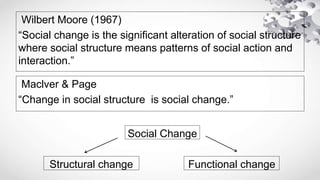
Wilbert Moore (1967)
“Social change is the significant alteration of social structure
where social structure means patterns of social action and
interaction.”
Maclver & Page
“Change in social structure is social change.”
Social Change
Functional changeStructural change
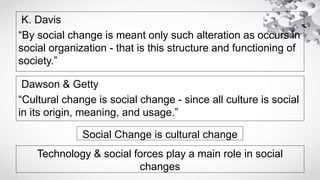
K. Davis
“By social change is meant only such alteration as occurs in
social organization - that is this structure and functioning of
society.”
Dawson & Getty
“Cultural change is social change - since all culture is social
in its origin, meaning, and usage.”
Social Change is cultural change
Technology & social forces play a main role in social
changes
• Significant alteration over time in behavior patterns and culture.
• Social change happens because we begin to act in new ways. It is
something we do, not just something we learn.
• The individual who is an active member of the society becomes
an agent or target of social change.
• Is a change or variation occured in the pattern & nature of society
and agencies.
• Is some change in social behavior & social structure.
• Social change means change in social structure.
• An alteration in the social order of a society.
• It may include changes in nature, social institutions, social
behaviours, or social relations.
Social Change
CHARACTERISTICS OF SOCIAL CHANGE
(Macionis, 1996)
 it happens everywhere, but the rate of change varies
from place to place
 Social change is sometimes intentional but often
unplanned
 Social change often generates controversy
 Social changes matter more than other do
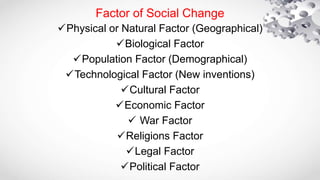
Physical or Natural Factor (Geographical)
Biological Factor
Population Factor (Demographical)
Technological Factor (New inventions)
Cultural Factor
Economic Factor
 War Factor
Religions Factor
Legal Factor
Political Factor
Factor of Social Change
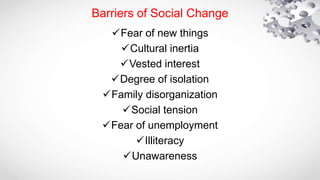
Fear of new things
Cultural inertia
Vested interest
Degree of isolation
Family disorganization
Social tension
Fear of unemployment
Illiteracy
Unawareness
Barriers of Social Change
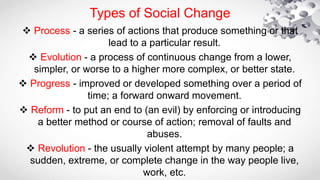
 Process - a series of actions that produce something or that
lead to a particular result.
 Evolution - a process of continuous change from a lower,
simpler, or worse to a higher more complex, or better state.
 Progress - improved or developed something over a period of
time; a forward onward movement.
 Reform - to put an end to (an evil) by enforcing or introducing
a better method or course of action; removal of faults and
abuses.
 Revolution - the usually violent attempt by many people; a
sudden, extreme, or complete change in the way people live,
work, etc.
Types of Social Change
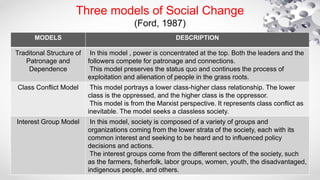
Three models of Social Change
(Ford, 1987)
MODELS DESCRIPTION
Traditonal Structure of
Patronage and
Dependence
In this model , power is concentrated at the top. Both the leaders and the
followers compete for patronage and connections.
This model preserves the status quo and continues the process of
exploitation and alienation of people in the grass roots.
Class Conflict Model This model portrays a lower class-higher class relationship. The lower
class is the oppressed, and the higher class is the oppressor.
This model is from the Marxist perspective. It represents class conflict as
inevitable. The model seeks a classless society.
Interest Group Model In this model, society is composed of a variety of groups and
organizations coming from the lower strata of the society, each with its
common interest and seeking to be heard and to influenced policy
decisions and actions.
The interest groups come from the different sectors of the society, such
as the farmers, fisherfolk, labor groups, women, youth, the disadvantaged,
indigenous people, and others.
1) Change in Experience of individual
2) Change in Attitude of Individual
3) Change in Thought Pattern of individual
4) Change in Social Interaction
5) Change in Social Relationship
6) Change in Social Structure
7) Social Change
Process of Social Change
Role of Education in Social Change
1. The promoting society for accepting social change
2. Provide conductive environment to social change
3. Evaluation of social change
4. Transmission of culture
5. Promoting unity & total integration at time of social
change
6. Maintaining human & social relations
7. Removing obstacles
8. Increasing the area of knowledge & developing the
critical thinking
For social workers
• Their assumptions about the nature of people,
societies processes and structures
• Their scope in explaining the phenomenon of
change
• Their implications for transformative actions
Development
A process towards a desirable state better than what
previously existed.
The purpose of development is to create an environment in
which all people can expand their capabilities and
opportunities can be enlarged for both present and future
generations (UNDP, 1994:13)
The process that creates growth, progress, positive change
or the addition of physical, economic, environmental, social
and demographic components.
The purpose of development is a rise in the level and
quality of life of the population, and the creation or
expansion of local regional income and employment
opportunities, without damaging the resources of the
environment.
Development is visible and useful, not necessarily
immediately, and includes aspect of quality change and the
creation of conditions for a continuation of that change.
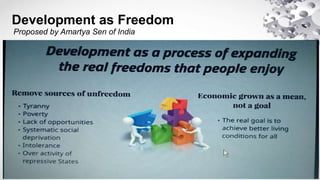
Development as Freedom
Proposed by Amartya Sen of India
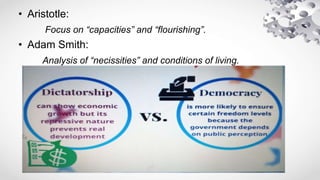
• Aristotle:
Focus on “capacities” and “flourishing”.
• Adam Smith:
Analysis of “necissities” and conditions of living.
• “Real development is not
simply increasing basic
incomes, rather it requires
mechanisms that enable the
exercise of freedom.” Amartya
Sen
• Development is a process of
expanding the freedom that
the people enjoys
• Freedoms are not only the
primary ends of development
they are also among its
principal means.
• Development requires the
removal of the major sources
of UNFREEDOM.
– Poverty
– Tyranny
– Poor economic
opportunities
– Social deprivation
– Neglect of public facilities
– Intolerance
• A process of planned social change designed to
promote the well-being of population as a whole
within the context of dynamic multifaceted
development process.
• Inclusive of economic development but emphasizes
the development of the society in totally that is in its
economic, political, social and cultural aspects.
• Social development requires decentralization of
power and decision making so that process of
planning at the grass root levels is made posible.
Social Development
Economic Development
• Improvement of the way endownments and goods and
services are used within/or/by the system, to generate
new goods and services in order to provide additional
consumption and/or investment possibilities to the
members of the system.
• Associated with the concept Economic Growth and is
increasing per capital income of the economic system.
PARTICIPATORY DEVELOPMENT
• seeks to engage local populations in development projects. (Wikipedia)
• is a process through which stakeholders can influence and share
control over development initiatives, and over the decisions and
resources that affect themselves. (ADB 1996)
• Empowering people to mobilize their own capacities , be social actors,
rather than passive subjects manage the resources, make decisions
and control the activities that affect their lives.(IIED)
• An educational and empowering process in which people, in
partnership with each other and those able to assist them, identify
problems and needs, mobilize resources and assume responsibility
themselves to plan, manage, control and asses the individual and
collective actions that they themselves decide upon (Brent 2005:3)
Sustainable Development
• Development that meets the needs of the present without
compromising the ability of future generations to meet
their own needs (UN)
• Aims to maintain economic advancement and progress
while protecting the long-term value of the environment; it
“provides a framework for the integration of environment
policies and development strategies” (UN Assembly)
Any questions?
Thanks for Listening

Social Change and Development Concepts

  • 1.
    Prepared by: JOSEPHC. BARRERA, RSW SOCIAL CHANGE & DEVELOPMENT PERSPECTIVE CONCEPTS
  • 2.
    “There is nothingpermanent except change.” - Greek Philosophy “Never doubt that a small of thoughful, committed citizens can change the world; indeed, it's the only thing that ever has.” - Margaret Mead “I wish to do something great and wonderful, but I must start by doing the little things like they were Great and Wonderful.” - Albert Einstein
  • 3.
    SOCIAL - theinteraction of the individual or the group,or the welfare of human beings as members of society. SOCIETY - is a network of social relationship. CHANGE - To make different in some particular - To become different - Change is define as a variation from previous note to present.
  • 4.
    Wilbert Moore (1967) “Socialchange is the significant alteration of social structure where social structure means patterns of social action and interaction.” Maclver & Page “Change in social structure is social change.” Social Change Functional changeStructural change
  • 5.
    K. Davis “By socialchange is meant only such alteration as occurs in social organization - that is this structure and functioning of society.” Dawson & Getty “Cultural change is social change - since all culture is social in its origin, meaning, and usage.” Social Change is cultural change Technology & social forces play a main role in social changes
  • 6.
    • Significant alterationover time in behavior patterns and culture. • Social change happens because we begin to act in new ways. It is something we do, not just something we learn. • The individual who is an active member of the society becomes an agent or target of social change. • Is a change or variation occured in the pattern & nature of society and agencies. • Is some change in social behavior & social structure. • Social change means change in social structure. • An alteration in the social order of a society. • It may include changes in nature, social institutions, social behaviours, or social relations. Social Change
  • 7.
    CHARACTERISTICS OF SOCIALCHANGE (Macionis, 1996)  it happens everywhere, but the rate of change varies from place to place  Social change is sometimes intentional but often unplanned  Social change often generates controversy  Social changes matter more than other do
  • 8.
    Physical or NaturalFactor (Geographical) Biological Factor Population Factor (Demographical) Technological Factor (New inventions) Cultural Factor Economic Factor  War Factor Religions Factor Legal Factor Political Factor Factor of Social Change
  • 9.
    Fear of newthings Cultural inertia Vested interest Degree of isolation Family disorganization Social tension Fear of unemployment Illiteracy Unawareness Barriers of Social Change
  • 10.
     Process -a series of actions that produce something or that lead to a particular result.  Evolution - a process of continuous change from a lower, simpler, or worse to a higher more complex, or better state.  Progress - improved or developed something over a period of time; a forward onward movement.  Reform - to put an end to (an evil) by enforcing or introducing a better method or course of action; removal of faults and abuses.  Revolution - the usually violent attempt by many people; a sudden, extreme, or complete change in the way people live, work, etc. Types of Social Change
  • 11.
    Three models ofSocial Change (Ford, 1987) MODELS DESCRIPTION Traditonal Structure of Patronage and Dependence In this model , power is concentrated at the top. Both the leaders and the followers compete for patronage and connections. This model preserves the status quo and continues the process of exploitation and alienation of people in the grass roots. Class Conflict Model This model portrays a lower class-higher class relationship. The lower class is the oppressed, and the higher class is the oppressor. This model is from the Marxist perspective. It represents class conflict as inevitable. The model seeks a classless society. Interest Group Model In this model, society is composed of a variety of groups and organizations coming from the lower strata of the society, each with its common interest and seeking to be heard and to influenced policy decisions and actions. The interest groups come from the different sectors of the society, such as the farmers, fisherfolk, labor groups, women, youth, the disadvantaged, indigenous people, and others.
  • 12.
    1) Change inExperience of individual 2) Change in Attitude of Individual 3) Change in Thought Pattern of individual 4) Change in Social Interaction 5) Change in Social Relationship 6) Change in Social Structure 7) Social Change Process of Social Change
  • 13.
    Role of Educationin Social Change 1. The promoting society for accepting social change 2. Provide conductive environment to social change 3. Evaluation of social change 4. Transmission of culture 5. Promoting unity & total integration at time of social change 6. Maintaining human & social relations 7. Removing obstacles 8. Increasing the area of knowledge & developing the critical thinking
  • 14.
    For social workers •Their assumptions about the nature of people, societies processes and structures • Their scope in explaining the phenomenon of change • Their implications for transformative actions
  • 15.
    Development A process towardsa desirable state better than what previously existed. The purpose of development is to create an environment in which all people can expand their capabilities and opportunities can be enlarged for both present and future generations (UNDP, 1994:13)
  • 16.
    The process thatcreates growth, progress, positive change or the addition of physical, economic, environmental, social and demographic components. The purpose of development is a rise in the level and quality of life of the population, and the creation or expansion of local regional income and employment opportunities, without damaging the resources of the environment. Development is visible and useful, not necessarily immediately, and includes aspect of quality change and the creation of conditions for a continuation of that change.
  • 17.
    Development as Freedom Proposedby Amartya Sen of India
  • 18.
    • Aristotle: Focus on“capacities” and “flourishing”. • Adam Smith: Analysis of “necissities” and conditions of living.
  • 19.
    • “Real developmentis not simply increasing basic incomes, rather it requires mechanisms that enable the exercise of freedom.” Amartya Sen • Development is a process of expanding the freedom that the people enjoys • Freedoms are not only the primary ends of development they are also among its principal means. • Development requires the removal of the major sources of UNFREEDOM. – Poverty – Tyranny – Poor economic opportunities – Social deprivation – Neglect of public facilities – Intolerance
  • 20.
    • A processof planned social change designed to promote the well-being of population as a whole within the context of dynamic multifaceted development process. • Inclusive of economic development but emphasizes the development of the society in totally that is in its economic, political, social and cultural aspects. • Social development requires decentralization of power and decision making so that process of planning at the grass root levels is made posible. Social Development
  • 21.
    Economic Development • Improvementof the way endownments and goods and services are used within/or/by the system, to generate new goods and services in order to provide additional consumption and/or investment possibilities to the members of the system. • Associated with the concept Economic Growth and is increasing per capital income of the economic system.
  • 22.
    PARTICIPATORY DEVELOPMENT • seeksto engage local populations in development projects. (Wikipedia) • is a process through which stakeholders can influence and share control over development initiatives, and over the decisions and resources that affect themselves. (ADB 1996) • Empowering people to mobilize their own capacities , be social actors, rather than passive subjects manage the resources, make decisions and control the activities that affect their lives.(IIED) • An educational and empowering process in which people, in partnership with each other and those able to assist them, identify problems and needs, mobilize resources and assume responsibility themselves to plan, manage, control and asses the individual and collective actions that they themselves decide upon (Brent 2005:3)
  • 23.
    Sustainable Development • Developmentthat meets the needs of the present without compromising the ability of future generations to meet their own needs (UN) • Aims to maintain economic advancement and progress while protecting the long-term value of the environment; it “provides a framework for the integration of environment policies and development strategies” (UN Assembly)
  • 24.