Group Dynamics 
& 
Team Building 
Dr. Z. Zayapragassarazan, PhD. 
Associate Professor of Educational Technology (Medical Education) 
Department of Medical Education 
JIPMER 
Puducherry-605006. 
E-mail: zprazan@yaho.co.in
Objectives 
At the end of this session the participants 
shall be able 
-to understand the concept of group 
dynamics and team work 
-to identify the factors facilitating or 
hindering group dynamics 
-appreciate the role played by different 
team members 
-to recognize the stages of development 
of a team
GGrroouupp 
A group is a collection of people with some 
ccoommmmoonn cchhaarraacctteerriissttiiccss oorr ppuurrppoossee
GGrroouupp DDyynnaammiiccss 
A group of two or more people interacting 
with each other in a manner that each 
person influences and is influenced by 
4 
each other person
The BBiiggggeesstt CChhaalllleennggee?? 
Getting People To 
5 
W____ T________!
The BBiiggggeesstt CChhaalllleennggee?? 
Getting People To 
6 
Work Together
EExxeerrcciissee-1 
CCoommmmuunniiccaattiioonn 
7
Communication EExxeerrcciissee - DDiissccuussssiioonn 
• How does the message change when it is 
conveyed from one person to another? 
• What were the weaknesses of the message 
itself hampering correct transfer? 
•• WWhhaatt wweerree tthhee wweeaakknneesssseess ooff tthhee ppeeooppllee 
transferring the message? 
• How can we communicate in a better & more 
effective way?
Communication EExxeerrcciissee – 
EEdduuccaattiioonnaall IImmpplliiccaattiioonnss 
• One-way communication is ineffective when two-way 
communication is needed. 
• Listening is just as effective as talking 
9 
• What we say is often not what people hear 
• It is difficult to describe visual pictures or objects
TTeeaamm BBuuiillddiinngg 
Team 
Two or more people working together to 
achieve a shared goal 
10 
Team Building 
The process of getting people to work 
together effectively to achieve a shared goal
Exercise-2 
Lost on the moon 
Group Dynamics-Team Building 
Time: 15 min 
5min for Individual Ranking 
10 min for Group Ranking
WWhhaatt ddiidd wwee lleeaarrnn?? 
• How were decisions made? 
• Who influenced the decisions and how? 
• How could better decisions have been made? 
• Did people listen to each other? if not why? 
• What roles did group members adopt? 
• How was conflict managed? 
• What kinds of behavior helped or hindered 
the group?
Exercise-3 
Broken square game 
Co-operation aanndd CCoo--oorrddiinnaattiioonn
DDiissccuussssiioonn 
• Different behaviors of team members 
• Feelings of people who succeeded/left 
out/sacrificed for group goal
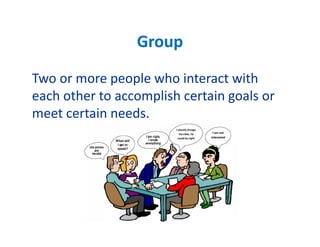
GGrroouupp 
Two or more people who interact with 
each other to accomplish certain goals or 
meet certain needs.
Existence of a group 
If a group exists the members: 
•Motivate to join. 
•Perceive the group as a unified unit 
of interacting people. 
••Contribute in various degrees. 
•Have agreements and disagreements, 
but finally a common outcome.
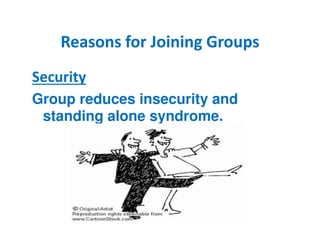
Reasons ffoorr JJooiinniinngg GGrroouuppss 
Security 
Group reduces insecurity and 
standing alone syndrome.
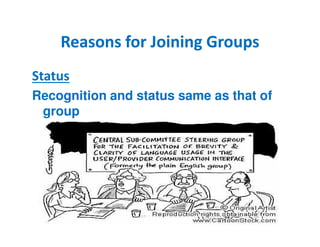
Reasons ffoorr JJooiinniinngg GGrroouuppss 
Status 
Recognition and status same as that of 
group
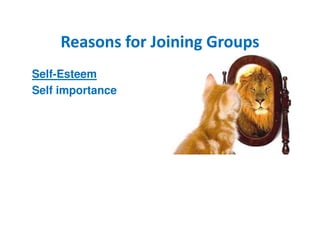
Reasons ffoorr JJooiinniinngg GGrroouuppss 
Self-Esteem 
Self importance
Reasons ffoorr JJooiinniinngg GGrroouuppss 
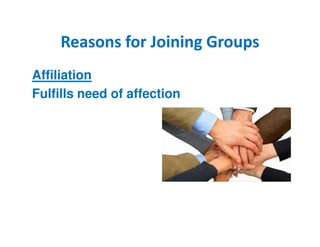
Affiliation 
Fulfills need of affection
Reasons ffoorr JJooiinniinngg GGrroouuppss 
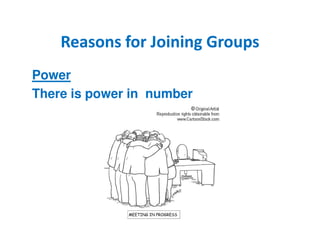
Power 
There is power in number
Reasons ffoorr JJooiinniinngg GGrroouuppss 
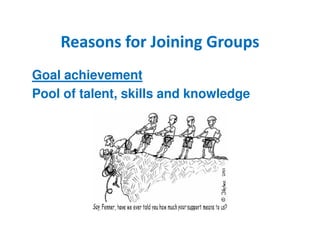
Goal achievement 
Pool of talent, skills and knowledge
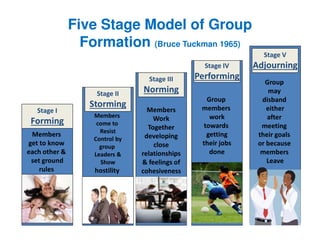
Five Stage Model of Group 
Formation (Bruce Tuckman 1965) 
Members 
come to 
Members 
Work 
Together 
Group 
members 
work 
towards 
Group 
may 
disband 
either 
after 
meeting 
Stage I 
Forming 
Stage II 
Storming 
Stage III 
Norming 
Stage IV 
Performing 
Stage V 
Adjourning 
Members 
get to know 
each other & 
set ground 
rules 
Resist 
Control by 
group 
Leaders & 
Show 
hostility 
developing 
close 
relationships 
& feelings of 
cohesiveness 
getting 
their jobs 
done 
their goals 
or because 
members 
Leave
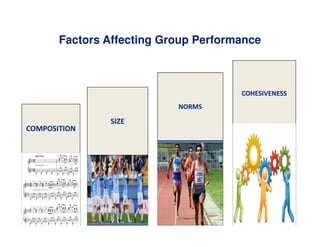
Factors Affecting Group Performance 
COMPOSITION 
SIZE 
NORMS 
COHESIVENESS
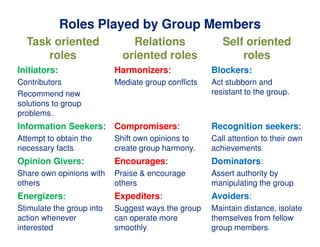
Roles Played by Group Members 
Task oriented 
roles 
Relations 
oriented roles 
Self oriented 
roles 
Initiators: 
Contributors 
Recommend new 
solutions to group 
problems. 
Harmonizers: 
Mediate group conflicts 
Blockers: 
Act stubborn and 
resistant to the group. 
Information Seekers: Compromisers: 
Recognition seekers: 
Attempt to obtain the 
Shift own opinions to 
necessary facts. 
create group harmony. 
Call attention to their own 
achievements. 
Opinion Givers: 
Share own opinions with 
others 
Encourages: 
Praise & encourage 
others 
Dominators: 
Assert authority by 
manipulating the group 
Energizers: 
Stimulate the group into 
action whenever 
interested 
Expediters: 
Suggest ways the group 
can operate more 
smoothly. 
Avoiders: 
Maintain distance, isolate 
themselves from fellow 
group members.
QQuueessttiioonnss
SSuummmmaarryy 
– A team is a group whose members work 
intensely with each other to achieve a specific, 
common goal or objective. 
– Understanding group dynamics helps to identify 
ppeerrssoonnaalliittiieess aanndd hheellppss iinn mmaakkiinngg aabbiilliittyy 
grouping 
– All teams are groups but not all groups are 
teams. 
• Teams often are difficult to form. 
• It takes time for members to learn how to work 
together. 
– TEAM- Together Everyone Achieves More
TTTThhhhaaaannnnkkkkssss

Group dynamics & team building

  • 1.
    Group Dynamics & Team Building Dr. Z. Zayapragassarazan, PhD. Associate Professor of Educational Technology (Medical Education) Department of Medical Education JIPMER Puducherry-605006. E-mail: zprazan@yaho.co.in
  • 2.
    Objectives At theend of this session the participants shall be able -to understand the concept of group dynamics and team work -to identify the factors facilitating or hindering group dynamics -appreciate the role played by different team members -to recognize the stages of development of a team
  • 3.
    GGrroouupp A groupis a collection of people with some ccoommmmoonn cchhaarraacctteerriissttiiccss oorr ppuurrppoossee
  • 4.
    GGrroouupp DDyynnaammiiccss Agroup of two or more people interacting with each other in a manner that each person influences and is influenced by 4 each other person
  • 5.
    The BBiiggggeesstt CChhaalllleennggee?? Getting People To 5 W____ T________!
  • 6.
    The BBiiggggeesstt CChhaalllleennggee?? Getting People To 6 Work Together
  • 7.
  • 8.
    Communication EExxeerrcciissee -DDiissccuussssiioonn • How does the message change when it is conveyed from one person to another? • What were the weaknesses of the message itself hampering correct transfer? •• WWhhaatt wweerree tthhee wweeaakknneesssseess ooff tthhee ppeeooppllee transferring the message? • How can we communicate in a better & more effective way?
  • 9.
    Communication EExxeerrcciissee – EEdduuccaattiioonnaall IImmpplliiccaattiioonnss • One-way communication is ineffective when two-way communication is needed. • Listening is just as effective as talking 9 • What we say is often not what people hear • It is difficult to describe visual pictures or objects
  • 10.
    TTeeaamm BBuuiillddiinngg Team Two or more people working together to achieve a shared goal 10 Team Building The process of getting people to work together effectively to achieve a shared goal
  • 11.
    Exercise-2 Lost onthe moon Group Dynamics-Team Building Time: 15 min 5min for Individual Ranking 10 min for Group Ranking
  • 12.
    WWhhaatt ddiidd wweelleeaarrnn?? • How were decisions made? • Who influenced the decisions and how? • How could better decisions have been made? • Did people listen to each other? if not why? • What roles did group members adopt? • How was conflict managed? • What kinds of behavior helped or hindered the group?
  • 13.
    Exercise-3 Broken squaregame Co-operation aanndd CCoo--oorrddiinnaattiioonn
  • 14.
    DDiissccuussssiioonn • Differentbehaviors of team members • Feelings of people who succeeded/left out/sacrificed for group goal
  • 15.
    GGrroouupp Two ormore people who interact with each other to accomplish certain goals or meet certain needs.
  • 16.
    Existence of agroup If a group exists the members: •Motivate to join. •Perceive the group as a unified unit of interacting people. ••Contribute in various degrees. •Have agreements and disagreements, but finally a common outcome.
  • 17.
    Reasons ffoorr JJooiinniinnggGGrroouuppss Security Group reduces insecurity and standing alone syndrome.
  • 18.
    Reasons ffoorr JJooiinniinnggGGrroouuppss Status Recognition and status same as that of group
  • 19.
    Reasons ffoorr JJooiinniinnggGGrroouuppss Self-Esteem Self importance
  • 20.
    Reasons ffoorr JJooiinniinnggGGrroouuppss Affiliation Fulfills need of affection
  • 21.
    Reasons ffoorr JJooiinniinnggGGrroouuppss Power There is power in number
  • 22.
    Reasons ffoorr JJooiinniinnggGGrroouuppss Goal achievement Pool of talent, skills and knowledge
  • 23.
    Five Stage Modelof Group Formation (Bruce Tuckman 1965) Members come to Members Work Together Group members work towards Group may disband either after meeting Stage I Forming Stage II Storming Stage III Norming Stage IV Performing Stage V Adjourning Members get to know each other & set ground rules Resist Control by group Leaders & Show hostility developing close relationships & feelings of cohesiveness getting their jobs done their goals or because members Leave
  • 24.
    Factors Affecting GroupPerformance COMPOSITION SIZE NORMS COHESIVENESS
  • 25.
    Roles Played byGroup Members Task oriented roles Relations oriented roles Self oriented roles Initiators: Contributors Recommend new solutions to group problems. Harmonizers: Mediate group conflicts Blockers: Act stubborn and resistant to the group. Information Seekers: Compromisers: Recognition seekers: Attempt to obtain the Shift own opinions to necessary facts. create group harmony. Call attention to their own achievements. Opinion Givers: Share own opinions with others Encourages: Praise & encourage others Dominators: Assert authority by manipulating the group Energizers: Stimulate the group into action whenever interested Expediters: Suggest ways the group can operate more smoothly. Avoiders: Maintain distance, isolate themselves from fellow group members.
  • 26.
  • 27.
    SSuummmmaarryy – Ateam is a group whose members work intensely with each other to achieve a specific, common goal or objective. – Understanding group dynamics helps to identify ppeerrssoonnaalliittiieess aanndd hheellppss iinn mmaakkiinngg aabbiilliittyy grouping – All teams are groups but not all groups are teams. • Teams often are difficult to form. • It takes time for members to learn how to work together. – TEAM- Together Everyone Achieves More
  • 28.