Understanding Politics
POL 102
BA Course (School Core undergraduate)
Fall Semester 2015
Dr. Azər Babayev
School of Public and International Affairs
(SPIA)
ADA University
POLITICAL IDEAS
AND IDEOLOGIES
• In the social-scientific sense, ideology is a coherent
set of ideas which provide a basis for organized
political action
• Central features:
1) Account of existing power relationships
2) A model of a defined future
3) An outline of how political change can and should be
brought about
• Competing definitions: Marxist, Liberal, Conservative
The nature of ideology
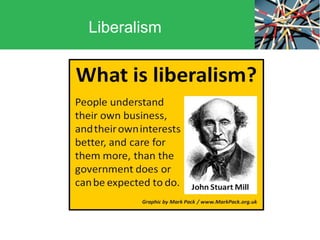
Liberalism
• Key ideas: individualism, freedom, reason, equality,
toleration, consent, constitutionalism
• Classical liberalism: a commitment to an extreme form of
individualism; belief in‘negative’ liberty
• Modern liberalism: characterized by a more sympathetic
attitude towards state intervention; a broader
‘positive’liberty which is linked to the personal
development and flourishing of the individual
Liberalism
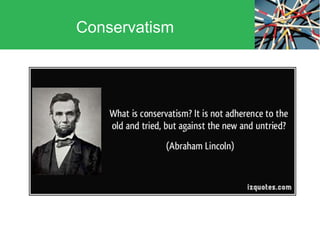
Conservatism
• Key ideas: tradition, pragmatism, human imperfection,
organicism, hierarchy, authority, property
• Paternalistic conservatism: often linked to the idea of
‘compassionate conservatism’ – consistent with ideas of
hierarchy and duty > Disraeli’s One-Nation principle
• The New Right: Can be traced back to 1970s – born out of
apparent failure of Keynesian social democracy and
concern about social breakdown
- Neoliberalism > economic strand
- Neoconservatism > social strand
Conservatism
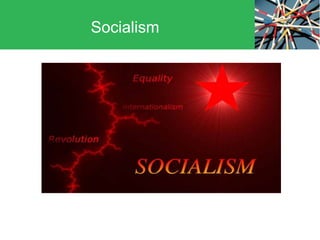
Socialism
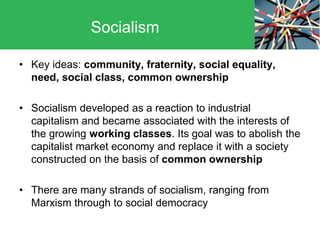
• Key ideas: community, fraternity, social equality,
need, social class, common ownership
• Socialism developed as a reaction to industrial
capitalism and became associated with the interests of
the growing working classes. Its goal was to abolish the
capitalist market economy and replace it with a society
constructed on the basis of common ownership
• There are many strands of socialism, ranging from
Marxism through to social democracy
Socialism
• Fascism
• Anarchism
• Green politics
• Cosmopolitanism
• Feminism
Other Ideological Traditions
• Fascism
• Anarchism
• Feminism
• Green politics
• Cosmopolitanism
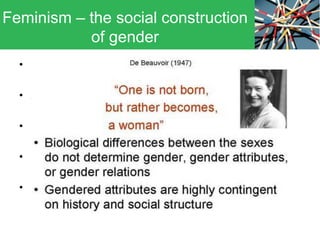
Feminism – the social construction
of gender
• Feminism > (critical) point of departure
– Politics > a male-centered and -dominated
practice and discipline
Feminism
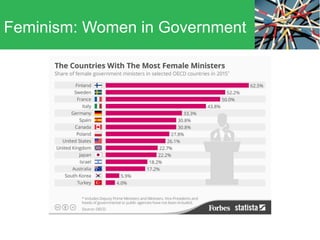
Feminism: Women in Government
• A typical feminist concern
– Observation
• Less than 10 % of the world’s heads of state are
women
– Question
• why is this the case and how might this affect the
structure and practice of politics
– Suggestion
• If we put on gendered lenses, we get quite a
different view of politics
Feminism - II
• What is ‘gender’?
– A set of socially constructed characteristics
describing what men and women ought to be
– Two ‘ideal types’ of characteristics
• Masculine characteristics > Strength, rationality,
independence, protector, and public
• Feminine characteristics > Weakness,
emotionality, relational, protected, and private
Feminism - III
• What is ‘gender’?
– Inequality of masculine and feminine
characteristics
• Assigning more positive value to masculine
characteristics than to feminine ones
• In politics, the states > often legitimated in terms of
masculine characteristics: striving for power and
autonomy, protecting its citizens form dangers
Feminism - IV
• Gender dualism in society
– Dividing necessary social activities between
men and women
• E.g., since women are associated with the private
sphere, seen as ‘natural’ to be ‘caregivers’
• Men’s association with the public space makes
them naturally ‘breadwinners’
– Feminism > Questioning the naturalness of
these dichotomized distinctions
• with consequences – for women, men, and for
politics
Feminism - V
• Relationship between knowledge and
power
– Knowledge has been created by men, and it
is about men
– Feminist focus on social relations, particularly
gender relations
• Seeing a political system constituted by socially
constructed gender hierarchies which contribute
to gender subordination
Feminism – Gender in Politics
• Relationship between knowledge and
power (II)
– Gender hierarchies at the center of
examination of politics
• To understand (at the micro-level) how the lives of
individuals (especially marginalized ones) affect
and are affected by politics
Feminism: Gender in Politics - II
• Liberal feminism
– Focus on the subordinate position of
women in politics & investigating the causes
of this subordination within a positivist
framework
• What might a state with more women in positions
of power look like?
• Whether there is a relationship between gender
inequality and state’s use of violence?
Feminism - Theories
• Critical feminism
– Focus on the ideational and material
manifestations of gendered identities and
gendered power in politics
– Emancipatory – to identify existing power
relations with the intention of changing them
Feminism - Theories
• Feminist constructivism
– Focus on the way that ideas about gender
shape and are shaped by global politics
– Gender as an institution/construct that
codifies power at every level of global politics
Feminism – Theories
• Postcolonialism
• Religious fundamentalism
• Asian values
• Beyond dualism
Non-western ideological trends
Thank you!
• Questions & comments?
Up next
• Politics and the State

Political ideologies

  • 1.
    Understanding Politics POL 102 BACourse (School Core undergraduate) Fall Semester 2015 Dr. Azər Babayev School of Public and International Affairs (SPIA) ADA University
  • 2.
  • 3.
    • In thesocial-scientific sense, ideology is a coherent set of ideas which provide a basis for organized political action • Central features: 1) Account of existing power relationships 2) A model of a defined future 3) An outline of how political change can and should be brought about • Competing definitions: Marxist, Liberal, Conservative The nature of ideology
  • 4.
  • 5.
    • Key ideas:individualism, freedom, reason, equality, toleration, consent, constitutionalism • Classical liberalism: a commitment to an extreme form of individualism; belief in‘negative’ liberty • Modern liberalism: characterized by a more sympathetic attitude towards state intervention; a broader ‘positive’liberty which is linked to the personal development and flourishing of the individual Liberalism
  • 6.
  • 7.
    • Key ideas:tradition, pragmatism, human imperfection, organicism, hierarchy, authority, property • Paternalistic conservatism: often linked to the idea of ‘compassionate conservatism’ – consistent with ideas of hierarchy and duty > Disraeli’s One-Nation principle • The New Right: Can be traced back to 1970s – born out of apparent failure of Keynesian social democracy and concern about social breakdown - Neoliberalism > economic strand - Neoconservatism > social strand Conservatism
  • 8.
  • 9.
    • Key ideas:community, fraternity, social equality, need, social class, common ownership • Socialism developed as a reaction to industrial capitalism and became associated with the interests of the growing working classes. Its goal was to abolish the capitalist market economy and replace it with a society constructed on the basis of common ownership • There are many strands of socialism, ranging from Marxism through to social democracy Socialism
  • 10.
    • Fascism • Anarchism •Green politics • Cosmopolitanism • Feminism Other Ideological Traditions
  • 11.
    • Fascism • Anarchism •Feminism • Green politics • Cosmopolitanism Feminism – the social construction of gender
  • 12.
    • Feminism >(critical) point of departure – Politics > a male-centered and -dominated practice and discipline Feminism
  • 13.
  • 14.
    • A typicalfeminist concern – Observation • Less than 10 % of the world’s heads of state are women – Question • why is this the case and how might this affect the structure and practice of politics – Suggestion • If we put on gendered lenses, we get quite a different view of politics Feminism - II
  • 15.
    • What is‘gender’? – A set of socially constructed characteristics describing what men and women ought to be – Two ‘ideal types’ of characteristics • Masculine characteristics > Strength, rationality, independence, protector, and public • Feminine characteristics > Weakness, emotionality, relational, protected, and private Feminism - III
  • 16.
    • What is‘gender’? – Inequality of masculine and feminine characteristics • Assigning more positive value to masculine characteristics than to feminine ones • In politics, the states > often legitimated in terms of masculine characteristics: striving for power and autonomy, protecting its citizens form dangers Feminism - IV
  • 17.
    • Gender dualismin society – Dividing necessary social activities between men and women • E.g., since women are associated with the private sphere, seen as ‘natural’ to be ‘caregivers’ • Men’s association with the public space makes them naturally ‘breadwinners’ – Feminism > Questioning the naturalness of these dichotomized distinctions • with consequences – for women, men, and for politics Feminism - V
  • 18.
    • Relationship betweenknowledge and power – Knowledge has been created by men, and it is about men – Feminist focus on social relations, particularly gender relations • Seeing a political system constituted by socially constructed gender hierarchies which contribute to gender subordination Feminism – Gender in Politics
  • 19.
    • Relationship betweenknowledge and power (II) – Gender hierarchies at the center of examination of politics • To understand (at the micro-level) how the lives of individuals (especially marginalized ones) affect and are affected by politics Feminism: Gender in Politics - II
  • 20.
    • Liberal feminism –Focus on the subordinate position of women in politics & investigating the causes of this subordination within a positivist framework • What might a state with more women in positions of power look like? • Whether there is a relationship between gender inequality and state’s use of violence? Feminism - Theories
  • 21.
    • Critical feminism –Focus on the ideational and material manifestations of gendered identities and gendered power in politics – Emancipatory – to identify existing power relations with the intention of changing them Feminism - Theories
  • 22.
    • Feminist constructivism –Focus on the way that ideas about gender shape and are shaped by global politics – Gender as an institution/construct that codifies power at every level of global politics Feminism – Theories
  • 23.
    • Postcolonialism • Religiousfundamentalism • Asian values • Beyond dualism Non-western ideological trends
  • 24.
  • 25.
    Up next • Politicsand the State