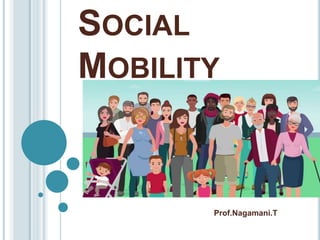
SOCIAL
MOBILITY
Prof.Nagamani.T
INTRODUCTION
 The term “social mobility” refers to how a person’s social
standing changes from one status to another.
 Social mobility is the extent to which people are able to
move between socio-economic strata during their lifetime
and between generations.
 Social mobility refers to the movement of individuals or
groups in social positions over time.
 Social mobility is the ability of the individual or group to move
from strata to strata is referred to as social mobility.
DEFINITION
Pitirim Sorokin - “any transition of an indi- vidual or
social object of value-anything that has been created
or modi- fied by human activity-from one social
position to another“
social mobility is the movement of individuals,
families, or groups through a system of
social hierarchy or stratification.
Social mobility refers to the shift in an individual’s social
status from one status to another. The shift can either
be higher, lower, inter-generational, or intra-
generational, and it cannot necessarily be determined
if the change is for good or bad.
TYPES OF SOCIAL MOBILITY
1. Horizontal mobility
2. Vertical mobility
3. Upward mobility
4. Downward mobility
5. Inter-generational mobility
6. Intra-generational mobility
HORIZONTAL MOBILITY
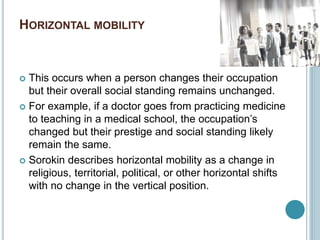
 This occurs when a person changes their occupation
but their overall social standing remains unchanged.
 For example, if a doctor goes from practicing medicine
to teaching in a medical school, the occupation’s
changed but their prestige and social standing likely
remain the same.
 Sorokin describes horizontal mobility as a change in
religious, territorial, political, or other horizontal shifts
with no change in the vertical position.
VERTICAL MOBILITY
 This refers to a change in the occupational,
political, or religious status of a person that
causes a change in their societal position.
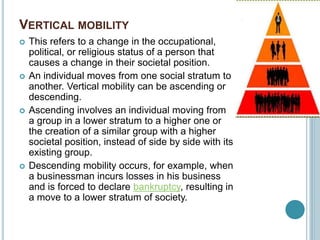
 An individual moves from one social stratum to
another. Vertical mobility can be ascending or
descending.
 Ascending involves an individual moving from
a group in a lower stratum to a higher one or
the creation of a similar group with a higher
societal position, instead of side by side with its
existing group.
 Descending mobility occurs, for example, when
a businessman incurs losses in his business
and is forced to declare bankruptcy, resulting in
a move to a lower stratum of society.
UPWARD MOBILITY
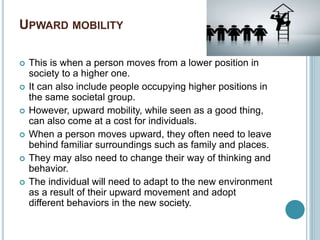
 This is when a person moves from a lower position in
society to a higher one.
 It can also include people occupying higher positions in
the same societal group.
 However, upward mobility, while seen as a good thing,
can also come at a cost for individuals.
 When a person moves upward, they often need to leave
behind familiar surroundings such as family and places.
 They may also need to change their way of thinking and
behavior.
 The individual will need to adapt to the new environment
as a result of their upward movement and adopt
different behaviors in the new society.
DOWNWARD MOBILITY
 Downward mobility takes place when a person moves
from a higher position in society to a lower one.
 It can occur when someone is caught performing
a wrongful act that can result in the loss of the position
they currently hold.
 Downward mobility can be extremely stressful for
people who face a rapid decline in their social status.
 They may find it hard to adapt to the new environment,
as it is not similar to the standard of living they are
used to.
 Downward mobility is an example of the extent to
which a society values equal opportunity and
structure.
INTER-GENERATIONAL MOBILITY
 Inter-generational mobility happens when the social position
changes from one generation to another.
 The change can be upward or downward.
 For example, a father worked in a factory while his son
received an education that allowed him to become a lawyer or
a doctor.
 Such societal change also causes the generation to adopt a
new way of living and thinking.
 Inter-generational mobility is affected by the differences in the
parents’ and their offspring’s upbringing, changes
in population, and changes in occupation.
INTRA-GENERATIONAL MOBILITY
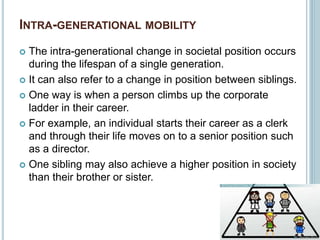
 The intra-generational change in societal position occurs
during the lifespan of a single generation.
 It can also refer to a change in position between siblings.
 One way is when a person climbs up the corporate
ladder in their career.
 For example, an individual starts their career as a clerk
and through their life moves on to a senior position such
as a director.
 One sibling may also achieve a higher position in society
than their brother or sister.
CAUSES OF SOCIAL MOBILITY
 Social class & poverty
 Education
 Caste
 Migration
 Occupation
 Social structure and system
IMPORTANCE OF SOCIAL MOBILITY
 Social mobility is the manifestation of the dynamic
nature of society.
 Societies are not static but changeful.
 Individuals who constitute the basic social units of
society are also moving up and down in the status
hierarchy.
(A) Positive Consequences, OR Importance OR Gains
of Social Mobility:
 Social Mobility Provides Opportunity for the
Expression of Individual Talents
 Acts as a Safety-Valve
 Social Justice
 Job Satisfaction
 Improvements in the Life-Styles
 Opportunity for Competition
 Reposes Confidence in the Established System
(B) Negative Consequences or Costs of Mobility:
1. Rising Expectation Leading to Dissatisfaction
and Frustration
2. An Open Class Society Or A Mobile Society
May Impose Penalties Also
3. Social Mobility Often Demands Geographic
Mobility
4. High Rate of Mental Illness is Associated with
Mobility
REFERENCES
 Social Mobility - Definition, Origin of the Concept, and
Types (corporatefinanceinstitute.com)
 Social mobility in India: Determinants and
recommendations for change | ORF (orfonline.org)
 social group | Britannica
 Social Mobility: Meaning, Types, Examples, Causes,
Factors, Importance (sociologygroup.com)
 Essay on Consequences and Importance of Social
Mobility (shareyouressays.com)
 Essay on Consequences and Importance of Social
Mobility (shareyouressays.com)

Social Mobility.pptx

  • 1.
  • 2.
    INTRODUCTION  The term“social mobility” refers to how a person’s social standing changes from one status to another.  Social mobility is the extent to which people are able to move between socio-economic strata during their lifetime and between generations.  Social mobility refers to the movement of individuals or groups in social positions over time.  Social mobility is the ability of the individual or group to move from strata to strata is referred to as social mobility.
  • 3.
    DEFINITION Pitirim Sorokin -“any transition of an indi- vidual or social object of value-anything that has been created or modi- fied by human activity-from one social position to another“ social mobility is the movement of individuals, families, or groups through a system of social hierarchy or stratification. Social mobility refers to the shift in an individual’s social status from one status to another. The shift can either be higher, lower, inter-generational, or intra- generational, and it cannot necessarily be determined if the change is for good or bad.
  • 4.
    TYPES OF SOCIALMOBILITY 1. Horizontal mobility 2. Vertical mobility 3. Upward mobility 4. Downward mobility 5. Inter-generational mobility 6. Intra-generational mobility
  • 5.
    HORIZONTAL MOBILITY  Thisoccurs when a person changes their occupation but their overall social standing remains unchanged.  For example, if a doctor goes from practicing medicine to teaching in a medical school, the occupation’s changed but their prestige and social standing likely remain the same.  Sorokin describes horizontal mobility as a change in religious, territorial, political, or other horizontal shifts with no change in the vertical position.
  • 6.
    VERTICAL MOBILITY  Thisrefers to a change in the occupational, political, or religious status of a person that causes a change in their societal position.  An individual moves from one social stratum to another. Vertical mobility can be ascending or descending.  Ascending involves an individual moving from a group in a lower stratum to a higher one or the creation of a similar group with a higher societal position, instead of side by side with its existing group.  Descending mobility occurs, for example, when a businessman incurs losses in his business and is forced to declare bankruptcy, resulting in a move to a lower stratum of society.
  • 7.
    UPWARD MOBILITY  Thisis when a person moves from a lower position in society to a higher one.  It can also include people occupying higher positions in the same societal group.  However, upward mobility, while seen as a good thing, can also come at a cost for individuals.  When a person moves upward, they often need to leave behind familiar surroundings such as family and places.  They may also need to change their way of thinking and behavior.  The individual will need to adapt to the new environment as a result of their upward movement and adopt different behaviors in the new society.
  • 8.
    DOWNWARD MOBILITY  Downwardmobility takes place when a person moves from a higher position in society to a lower one.  It can occur when someone is caught performing a wrongful act that can result in the loss of the position they currently hold.  Downward mobility can be extremely stressful for people who face a rapid decline in their social status.  They may find it hard to adapt to the new environment, as it is not similar to the standard of living they are used to.  Downward mobility is an example of the extent to which a society values equal opportunity and structure.
  • 9.
    INTER-GENERATIONAL MOBILITY  Inter-generationalmobility happens when the social position changes from one generation to another.  The change can be upward or downward.  For example, a father worked in a factory while his son received an education that allowed him to become a lawyer or a doctor.  Such societal change also causes the generation to adopt a new way of living and thinking.  Inter-generational mobility is affected by the differences in the parents’ and their offspring’s upbringing, changes in population, and changes in occupation.
  • 10.
    INTRA-GENERATIONAL MOBILITY  Theintra-generational change in societal position occurs during the lifespan of a single generation.  It can also refer to a change in position between siblings.  One way is when a person climbs up the corporate ladder in their career.  For example, an individual starts their career as a clerk and through their life moves on to a senior position such as a director.  One sibling may also achieve a higher position in society than their brother or sister.
  • 11.
    CAUSES OF SOCIALMOBILITY  Social class & poverty  Education  Caste  Migration  Occupation  Social structure and system
  • 12.
    IMPORTANCE OF SOCIALMOBILITY  Social mobility is the manifestation of the dynamic nature of society.  Societies are not static but changeful.  Individuals who constitute the basic social units of society are also moving up and down in the status hierarchy.
  • 13.
    (A) Positive Consequences,OR Importance OR Gains of Social Mobility:  Social Mobility Provides Opportunity for the Expression of Individual Talents  Acts as a Safety-Valve  Social Justice  Job Satisfaction  Improvements in the Life-Styles  Opportunity for Competition  Reposes Confidence in the Established System
  • 14.
    (B) Negative Consequencesor Costs of Mobility: 1. Rising Expectation Leading to Dissatisfaction and Frustration 2. An Open Class Society Or A Mobile Society May Impose Penalties Also 3. Social Mobility Often Demands Geographic Mobility 4. High Rate of Mental Illness is Associated with Mobility
  • 15.
    REFERENCES  Social Mobility- Definition, Origin of the Concept, and Types (corporatefinanceinstitute.com)  Social mobility in India: Determinants and recommendations for change | ORF (orfonline.org)  social group | Britannica  Social Mobility: Meaning, Types, Examples, Causes, Factors, Importance (sociologygroup.com)  Essay on Consequences and Importance of Social Mobility (shareyouressays.com)  Essay on Consequences and Importance of Social Mobility (shareyouressays.com)