














SOCIAL INTERACTION
& PROCESSES
Presented by:
Ms Manisha
Assistant Professor
Faculty of Nursing
SGT University, Gurugram
Ms Manisha
INTRODUCTION
• As members of society, people have
to act and behave in accordance with
some specific manner.
• They are always engaged in some sort of actions and
interactions in the society.
• When the actions of the individual or individuals are
influenced by the actions of other individual or
individuals in a society and he in turn is exposed to
their action that is called social interaction.
Ms Manisha
• Interaction or mutual activity is the
essence of social life.
• Interaction between individuals
and groups occurs in the form of
social process.
• Social processes refers to forms of
social interaction that occur again
and again.
Ms Manisha
INTRODUCTION (Contd…)
• Social Interaction refers to the process by which people
mutually or reciprocally influence one another’s attitudes,
feelings, and actions.
• There are three situations for social interaction:
1. Person-to-person (P to P)
2. Person-to-group (P to G)
3. Group-to-group (G to G)
Ms Manisha
SOCIAL INTERACTION : MEANING
SOCIAL INTERACTION : DEFINITION
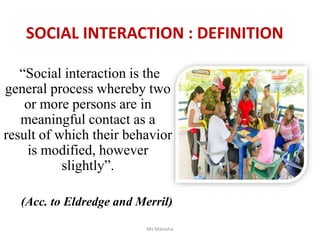
“Social interaction is the
general process whereby two
or more persons are in
meaningful contact as a
result of which their behavior
is modified, however
slightly”.
(Acc. to Eldredge and Merril)
Ms Manisha
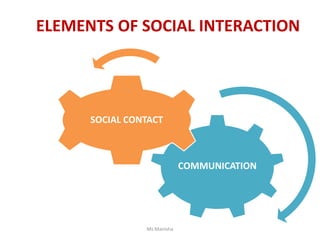
ELEMENTS OF SOCIAL INTERACTION
COMMUNICATION
SOCIAL CONTACT
Ms Manisha
SOCIAL PROCESSES : MEANING
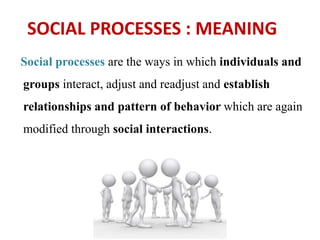
Social processes are the ways in which individuals and
groups interact, adjust and readjust and establish
relationships and pattern of behavior which are again
modified through social interactions.
Ms Manisha
SOCIAL PROCESSES : MEANING
The social processes means the characteristic ways in
which interactions occurs”.
Social processes means the various modes of
interaction between individuals or groups including
cooperation and conflict, social differentiation and
integration etc.
Ms Manisha
• Social Process – refers to the recurrent and patterned social
interactions or responses of individuals to one another
which have attained stability.
“The term social process refers to the repetitive form of
behaviour which are commonly found in social life”.
- Horton and Hunt
“ The social processes are merely the characteristic ways in
which interaction occurs”.
- A.W Green
Ms Manisha
SOCIAL PROCESSES : DEFINITION
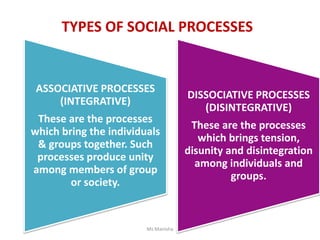
ASSOCIATIVE PROCESSES
(INTEGRATIVE)
These are the processes
which bring the individuals
& groups together. Such
processes produce unity
among members of group
or society.
DISSOCIATIVE PROCESSES
(DISINTEGRATIVE)
These are the processes
which brings tension,
disunity and disintegration
among individuals and
groups.
Ms Manisha
TYPES OF SOCIAL PROCESSES
TYPES OF SOCIAL PROCESSES (Contd…)
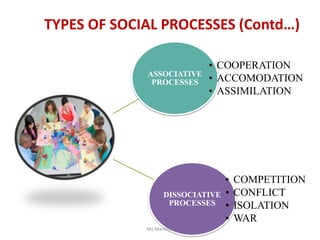
ASSOCIATIVE
PROCESSES
• COOPERATION
• ACCOMODATION
• ASSIMILATION
DISSOCIATIVE
PROCESSES
• COMPETITION
• CONFLICT
• ISOLATION
• WAR
Ms Manisha
Ms Manisha
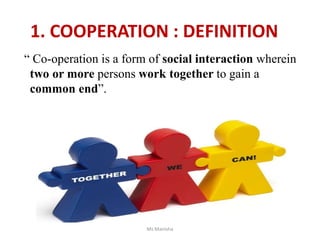
1. COOPERATION : DEFINITION
“ Co-operation is a form of social interaction wherein
two or more persons work together to gain a
common end”.
Ms Manisha
CHARACTERISTICS OF COOPERATION:
 It is an associative process.
 It is universal process
 It is boundless and has no limitation.
 It may be conscious or unconscious.
 It is continuous process.
 Two or more than two person involved.
 Common goal or end.
 Joint activities or efforts
Ms Manisha
TYPES OF COOPERATION:
• Informal cooperation- It is characterized as spontaneous
and involves mutual give and take. Examples : In
families, friends.
• Formal cooperation- It is characterized as a deliberate
contractual nature and prescribes the reciprocal rights
and obligations of members. Examples : Workplaces,
political parties, different countries.
Ms Manisha
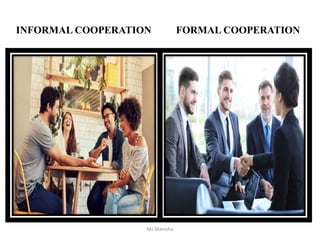
INFORMAL COOPERATION FORMAL COOPERATION
Ms Manisha
DIRECT
COOPERATION-
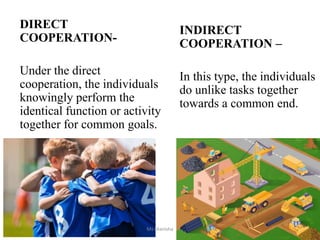
Under the direct
cooperation, the individuals
knowingly perform the
identical function or activity
together for common goals.
INDIRECT
COOPERATION –
In this type, the individuals
do unlike tasks together
towards a common end.
Ms Manisha
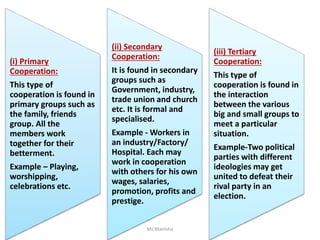
(i) Primary
Cooperation:
This type of
cooperation is found in
primary groups such as
the family, friends
group. All the
members work
together for their
betterment.
Example – Playing,
worshipping,
celebrations etc.
(ii) Secondary
Cooperation:
It is found in secondary
groups such as
Government, industry,
trade union and church
etc. It is formal and
specialised.
Example - Workers in
an industry/Factory/
Hospital. Each may
work in cooperation
with others for his own
wages, salaries,
promotion, profits and
prestige.
(iii) Tertiary
Cooperation:
This type of
cooperation is found in
the interaction
between the various
big and small groups to
meet a particular
situation.
Example-Two political
parties with different
ideologies may get
united to defeat their
rival party in an
election.
Ms Manisha
ACCOMMODATION
Ms Manisha
2. ACCOMMODATION
• It is a process of getting along inspite of differences.
• The term accommodation refers particularly to the
process in which man attains a sense of harmony with
his environment”.
• It is resolution of conflicts which generally means
adjusting oneself to the new environment.
Ms Manisha
DEFINITION : ACCOMMODATION
• The term refers to the process in which man attains
a sense of harmony with his environment.
(MacIver)
• Accommodation is a process of developing
temporary working agreements between conflicting
individuals and groups.
(Horton & Hunt)
Ms Manisha
Park and Burgess classified accommodation
in the following two categories:
Ms Manisha
i. Adjustment with New Natural Conditions
Ms Manisha
ii. Adjustment with New Social Conditions:
Ms Manisha
CHARACTERISTICS OF ACCOMMODATION:
 It is a universal process.
 It is a continuous process.
 It is the natural result of conflicts.
 It may be a conscious or an unconscious activity.
 It is used to reduce the conflict between persons or group as
an initial step towards assimilation.
 It may only provide a temporary solution.
 It is essential for peace & harmony in society.
Ms Manisha
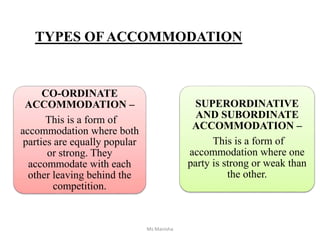
TYPES OF ACCOMMODATION
CO-ORDINATE
ACCOMMODATION –
This is a form of
accommodation where both
parties are equally popular
or strong. They
accommodate with each
other leaving behind the
competition.
SUPERORDINATIVE
AND SUBORDINATE
ACCOMMODATION –
This is a form of
accommodation where one
party is strong or weak than
the other.
Ms Manisha
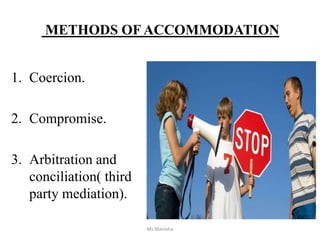
METHODS OF ACCOMMODATION
1. Coercion.
2. Compromise.
3. Arbitration and
conciliation( third
party mediation).
Ms Manisha
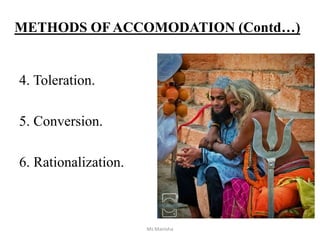
4. Toleration.
5. Conversion.
6. Rationalization.
Ms Manisha
METHODS OF ACCOMODATION (Contd…)
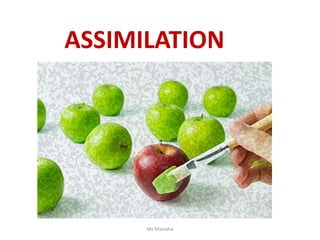
ASSIMILATION
Ms Manisha
3. ASSIMILATION
• It is the process by which an outsider,
immigrant or subordinate group become
indistinguishably integrated into the dominant
host society.
Ms Manisha
DEFINITION: ASSIMILATION
“ Assimilation is the fusion or blending of two
previously distinct group into one”.
or
“ Assimilation is the process whereby persons and
groups acquire the culture of another group.”
Ms Manisha
Ms Manisha
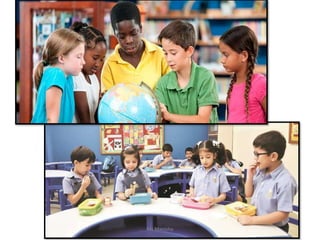
ANY EXAMPLES
Ms Manisha
Ms Manisha
Ms Manisha
Ms Manisha
FORMS AND LEVELS OFASSIMILATION
• The process of assimilation takes place mainly at
three levels:
Individual
Group
Culture
Ms Manisha
CHARACTERISTICS OF ASSIMILATION:
Positive or associative process
Universal process.
Slow and gradual process
Continuous process
Unconscious process
Two way process
Ms Manisha
TYPES OF ASSIMILATION
a) CULTURAL ASSIMILATION
b) STRUCTURAL ASSIMILATION
Ms Manisha
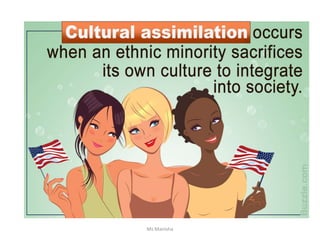
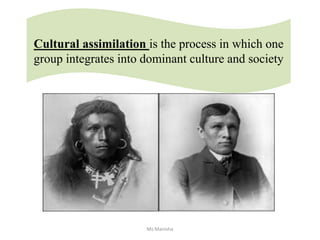
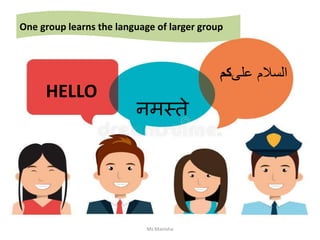
Cultural assimilation is the process in which one
group integrates into dominant culture and society
Ms Manisha
HELLO
नमस्ते
‫علی‬ ‫السالم‬
‫کم‬
Ms Manisha
One group learns the language of larger group
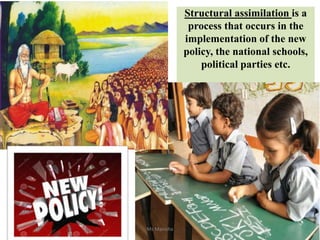
Structural assimilation is a
process that occurs in the
implementation of the new
policy, the national schools,
political parties etc.
Ms Manisha
4. COMPETITION
Ms Manisha
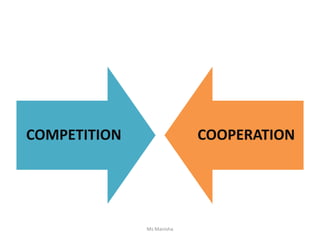
COMPETITION COOPERATION
Ms Manisha
WHY
COMPETITION
Ms Manisha
Ms Manisha
LIMITED REWARDS
Ms Manisha
COMPETITION : DEFINITION
“It is the struggle for possession of
rewards, which are limited in supply,
like goods, status ,power and love
anything”
-Horton & Hunt
“ The striving of two or more persons
for the same goal, which is limited
so that all can not share it”
- Biesanz
Ms Manisha
Ms Manisha
IMPORTANCE OF COMPETITION
Ms Manisha
CHARACTERISTICS OF COMPETITION
• Universal
• Impersonal or personal
• Continuous
• Dynamic
• Constructive or destructive
• Governed by norms, rules and regulations
• Found in all fields
• Sometimes results in negative results
Ms Manisha
TYPES OF COMPETITION
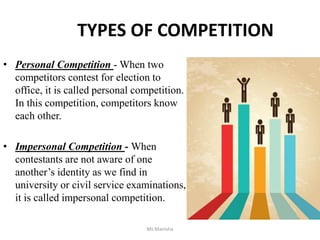
• Personal Competition - When two
competitors contest for election to
office, it is called personal competition.
In this competition, competitors know
each other.
• Impersonal Competition - When
contestants are not aware of one
another’s identity as we find in
university or civil service examinations,
it is called impersonal competition.
Ms Manisha
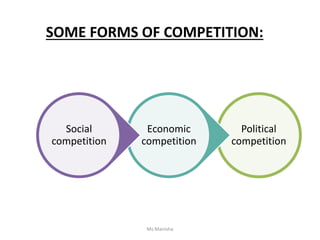
SOME FORMS OF COMPETITION:
Political
competition
Economic
competition
Social
competition
Ms Manisha
5. CONFLICT
Ms Manisha
It is a deliberate
attempt to oppose,
resist or coerce the
will of others
Ms Manisha
CONFLICT
Conflict is a form of emotionalized and violent
opposition
in which the major concern is to
overcome the opponent
as means of securing a given goal or reward.”
Ms Manisha
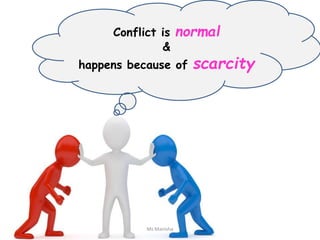
Conflict is normal
&
happens because of scarcity
Ms Manisha
DEFINITION : CONFLICT
“Conflict is the social process in which
individuals or groups seek their ends
by directly challenging the antagonist
by violence or threat of violence.”
(Gillin & Gillin)
“It is the deliberate attempt to oppose,
resist or coerce the will of another or
others.” (A.W. Green)
Ms Manisha
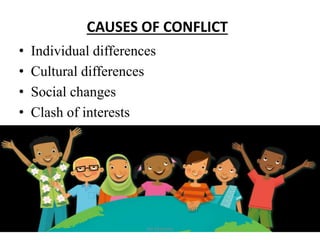
CAUSES OF CONFLICT
• Individual differences
• Cultural differences
• Social changes
• Clash of interests
Ms Manisha
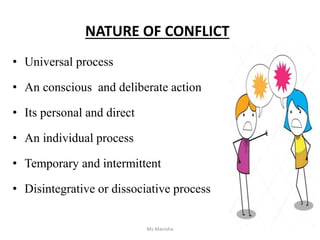
NATURE OF CONFLICT
• Universal process
• An conscious and deliberate action
• Its personal and direct
• An individual process
• Temporary and intermittent
• Disintegrative or dissociative process
Ms Manisha
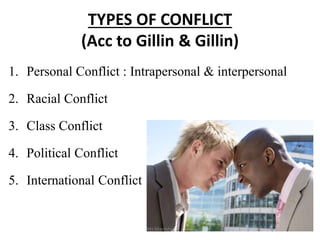
TYPES OF CONFLICT
(Acc to Gillin & Gillin)
1. Personal Conflict : Intrapersonal & interpersonal
2. Racial Conflict
3. Class Conflict
4. Political Conflict
5. International Conflict
Ms Manisha
Ms Manisha
Any examples
of
Conflict ????
Ms Manisha
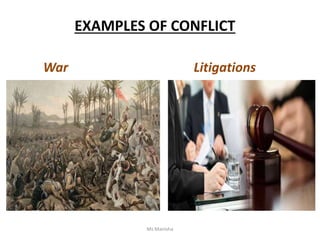
EXAMPLES OF CONFLICT
War Litigations
Ms Manisha
ISOLATION
Ms Manisha
6. ISOLATION
• Dissociative process
• Isolation is a state in which a person loses contact or
communication with society.
• Social isolation describes the absence of social
contacts with others.
Ms Manisha
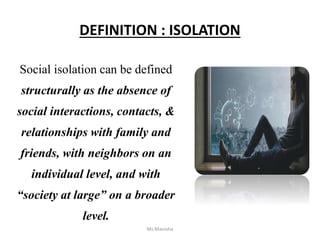
DEFINITION : ISOLATION
Social isolation can be defined
structurally as the absence of
social interactions, contacts, &
relationships with family and
friends, with neighbors on an
individual level, and with
“society at large” on a broader
level.
Ms Manisha
CAUSES OF ISOLATION
• Poverty
• Unemployment
• Lack of an adequate social support network
• Loss of loved ones
• Domestic violence
• Physical impairment
Ms Manisha
TYPES OF ISOLATION
voluntary &
involuntary
Spatial &
organic isolation
Ms Manisha
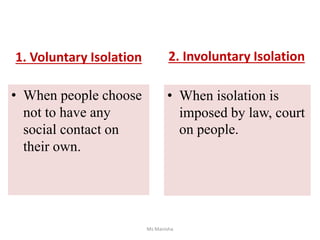
1. Voluntary Isolation
• When people choose
not to have any
social contact on
their own.
• When isolation is
imposed by law, court
on people.
Ms Manisha
2. Involuntary Isolation
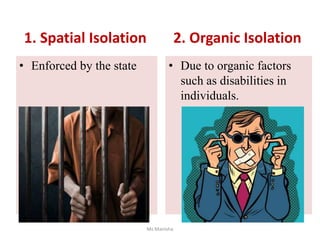
1. Spatial Isolation
• Enforced by the state • Due to organic factors
such as disabilities in
individuals.
Ms Manisha
2. Organic Isolation
Ms Manisha
Social processes
are the various
ways of interaction
that occur again
and again.
Ms Manisha

Social interactions and social processes

  • 1.
    SOCIAL INTERACTION & PROCESSES Presentedby: Ms Manisha Assistant Professor Faculty of Nursing SGT University, Gurugram Ms Manisha
  • 2.
    INTRODUCTION • As membersof society, people have to act and behave in accordance with some specific manner. • They are always engaged in some sort of actions and interactions in the society. • When the actions of the individual or individuals are influenced by the actions of other individual or individuals in a society and he in turn is exposed to their action that is called social interaction. Ms Manisha
  • 3.
    • Interaction ormutual activity is the essence of social life. • Interaction between individuals and groups occurs in the form of social process. • Social processes refers to forms of social interaction that occur again and again. Ms Manisha INTRODUCTION (Contd…)
  • 4.
    • Social Interactionrefers to the process by which people mutually or reciprocally influence one another’s attitudes, feelings, and actions. • There are three situations for social interaction: 1. Person-to-person (P to P) 2. Person-to-group (P to G) 3. Group-to-group (G to G) Ms Manisha SOCIAL INTERACTION : MEANING
  • 5.
    SOCIAL INTERACTION :DEFINITION “Social interaction is the general process whereby two or more persons are in meaningful contact as a result of which their behavior is modified, however slightly”. (Acc. to Eldredge and Merril) Ms Manisha
  • 6.
    ELEMENTS OF SOCIALINTERACTION COMMUNICATION SOCIAL CONTACT Ms Manisha
  • 7.
    SOCIAL PROCESSES :MEANING Social processes are the ways in which individuals and groups interact, adjust and readjust and establish relationships and pattern of behavior which are again modified through social interactions. Ms Manisha
  • 8.
    SOCIAL PROCESSES :MEANING The social processes means the characteristic ways in which interactions occurs”. Social processes means the various modes of interaction between individuals or groups including cooperation and conflict, social differentiation and integration etc. Ms Manisha
  • 9.
    • Social Process– refers to the recurrent and patterned social interactions or responses of individuals to one another which have attained stability. “The term social process refers to the repetitive form of behaviour which are commonly found in social life”. - Horton and Hunt “ The social processes are merely the characteristic ways in which interaction occurs”. - A.W Green Ms Manisha SOCIAL PROCESSES : DEFINITION
  • 10.
    ASSOCIATIVE PROCESSES (INTEGRATIVE) These arethe processes which bring the individuals & groups together. Such processes produce unity among members of group or society. DISSOCIATIVE PROCESSES (DISINTEGRATIVE) These are the processes which brings tension, disunity and disintegration among individuals and groups. Ms Manisha TYPES OF SOCIAL PROCESSES
  • 11.
    TYPES OF SOCIALPROCESSES (Contd…) ASSOCIATIVE PROCESSES • COOPERATION • ACCOMODATION • ASSIMILATION DISSOCIATIVE PROCESSES • COMPETITION • CONFLICT • ISOLATION • WAR Ms Manisha
  • 12.
  • 13.
    1. COOPERATION :DEFINITION “ Co-operation is a form of social interaction wherein two or more persons work together to gain a common end”. Ms Manisha
  • 14.
    CHARACTERISTICS OF COOPERATION: It is an associative process.  It is universal process  It is boundless and has no limitation.  It may be conscious or unconscious.  It is continuous process.  Two or more than two person involved.  Common goal or end.  Joint activities or efforts Ms Manisha
  • 15.
    TYPES OF COOPERATION: •Informal cooperation- It is characterized as spontaneous and involves mutual give and take. Examples : In families, friends. • Formal cooperation- It is characterized as a deliberate contractual nature and prescribes the reciprocal rights and obligations of members. Examples : Workplaces, political parties, different countries. Ms Manisha
  • 16.
    INFORMAL COOPERATION FORMALCOOPERATION Ms Manisha
  • 17.
    DIRECT COOPERATION- Under the direct cooperation,the individuals knowingly perform the identical function or activity together for common goals. INDIRECT COOPERATION – In this type, the individuals do unlike tasks together towards a common end. Ms Manisha
  • 18.
    (i) Primary Cooperation: This typeof cooperation is found in primary groups such as the family, friends group. All the members work together for their betterment. Example – Playing, worshipping, celebrations etc. (ii) Secondary Cooperation: It is found in secondary groups such as Government, industry, trade union and church etc. It is formal and specialised. Example - Workers in an industry/Factory/ Hospital. Each may work in cooperation with others for his own wages, salaries, promotion, profits and prestige. (iii) Tertiary Cooperation: This type of cooperation is found in the interaction between the various big and small groups to meet a particular situation. Example-Two political parties with different ideologies may get united to defeat their rival party in an election. Ms Manisha
  • 19.
  • 20.
    2. ACCOMMODATION • Itis a process of getting along inspite of differences. • The term accommodation refers particularly to the process in which man attains a sense of harmony with his environment”. • It is resolution of conflicts which generally means adjusting oneself to the new environment. Ms Manisha
  • 21.
    DEFINITION : ACCOMMODATION •The term refers to the process in which man attains a sense of harmony with his environment. (MacIver) • Accommodation is a process of developing temporary working agreements between conflicting individuals and groups. (Horton & Hunt) Ms Manisha
  • 22.
    Park and Burgessclassified accommodation in the following two categories: Ms Manisha
  • 23.
    i. Adjustment withNew Natural Conditions Ms Manisha
  • 24.
    ii. Adjustment withNew Social Conditions: Ms Manisha
  • 25.
    CHARACTERISTICS OF ACCOMMODATION: It is a universal process.  It is a continuous process.  It is the natural result of conflicts.  It may be a conscious or an unconscious activity.  It is used to reduce the conflict between persons or group as an initial step towards assimilation.  It may only provide a temporary solution.  It is essential for peace & harmony in society. Ms Manisha
  • 26.
    TYPES OF ACCOMMODATION CO-ORDINATE ACCOMMODATION– This is a form of accommodation where both parties are equally popular or strong. They accommodate with each other leaving behind the competition. SUPERORDINATIVE AND SUBORDINATE ACCOMMODATION – This is a form of accommodation where one party is strong or weak than the other. Ms Manisha
  • 27.
    METHODS OF ACCOMMODATION 1.Coercion. 2. Compromise. 3. Arbitration and conciliation( third party mediation). Ms Manisha
  • 28.
    4. Toleration. 5. Conversion. 6.Rationalization. Ms Manisha METHODS OF ACCOMODATION (Contd…)
  • 29.
  • 30.
    3. ASSIMILATION • Itis the process by which an outsider, immigrant or subordinate group become indistinguishably integrated into the dominant host society. Ms Manisha
  • 31.
    DEFINITION: ASSIMILATION “ Assimilationis the fusion or blending of two previously distinct group into one”. or “ Assimilation is the process whereby persons and groups acquire the culture of another group.” Ms Manisha
  • 32.
  • 33.
  • 34.
  • 35.
  • 36.
  • 37.
    FORMS AND LEVELSOFASSIMILATION • The process of assimilation takes place mainly at three levels: Individual Group Culture Ms Manisha
  • 38.
    CHARACTERISTICS OF ASSIMILATION: Positiveor associative process Universal process. Slow and gradual process Continuous process Unconscious process Two way process Ms Manisha
  • 39.
    TYPES OF ASSIMILATION a)CULTURAL ASSIMILATION b) STRUCTURAL ASSIMILATION Ms Manisha
  • 40.
    Cultural assimilation isthe process in which one group integrates into dominant culture and society Ms Manisha
  • 41.
  • 42.
    Structural assimilation isa process that occurs in the implementation of the new policy, the national schools, political parties etc. Ms Manisha
  • 43.
  • 44.
  • 45.
  • 46.
  • 47.
  • 48.
    COMPETITION : DEFINITION “Itis the struggle for possession of rewards, which are limited in supply, like goods, status ,power and love anything” -Horton & Hunt “ The striving of two or more persons for the same goal, which is limited so that all can not share it” - Biesanz Ms Manisha
  • 49.
  • 50.
  • 51.
    CHARACTERISTICS OF COMPETITION •Universal • Impersonal or personal • Continuous • Dynamic • Constructive or destructive • Governed by norms, rules and regulations • Found in all fields • Sometimes results in negative results Ms Manisha
  • 52.
    TYPES OF COMPETITION •Personal Competition - When two competitors contest for election to office, it is called personal competition. In this competition, competitors know each other. • Impersonal Competition - When contestants are not aware of one another’s identity as we find in university or civil service examinations, it is called impersonal competition. Ms Manisha
  • 53.
    SOME FORMS OFCOMPETITION: Political competition Economic competition Social competition Ms Manisha
  • 54.
  • 55.
    It is adeliberate attempt to oppose, resist or coerce the will of others Ms Manisha
  • 56.
    CONFLICT Conflict is aform of emotionalized and violent opposition in which the major concern is to overcome the opponent as means of securing a given goal or reward.” Ms Manisha
  • 57.
    Conflict is normal & happensbecause of scarcity Ms Manisha
  • 58.
    DEFINITION : CONFLICT “Conflictis the social process in which individuals or groups seek their ends by directly challenging the antagonist by violence or threat of violence.” (Gillin & Gillin) “It is the deliberate attempt to oppose, resist or coerce the will of another or others.” (A.W. Green) Ms Manisha
  • 59.
    CAUSES OF CONFLICT •Individual differences • Cultural differences • Social changes • Clash of interests Ms Manisha
  • 60.
    NATURE OF CONFLICT •Universal process • An conscious and deliberate action • Its personal and direct • An individual process • Temporary and intermittent • Disintegrative or dissociative process Ms Manisha
  • 61.
    TYPES OF CONFLICT (Accto Gillin & Gillin) 1. Personal Conflict : Intrapersonal & interpersonal 2. Racial Conflict 3. Class Conflict 4. Political Conflict 5. International Conflict Ms Manisha
  • 62.
  • 63.
  • 64.
    EXAMPLES OF CONFLICT WarLitigations Ms Manisha
  • 65.
  • 66.
    6. ISOLATION • Dissociativeprocess • Isolation is a state in which a person loses contact or communication with society. • Social isolation describes the absence of social contacts with others. Ms Manisha
  • 67.
    DEFINITION : ISOLATION Socialisolation can be defined structurally as the absence of social interactions, contacts, & relationships with family and friends, with neighbors on an individual level, and with “society at large” on a broader level. Ms Manisha
  • 68.
    CAUSES OF ISOLATION •Poverty • Unemployment • Lack of an adequate social support network • Loss of loved ones • Domestic violence • Physical impairment Ms Manisha
  • 69.
    TYPES OF ISOLATION voluntary& involuntary Spatial & organic isolation Ms Manisha
  • 70.
    1. Voluntary Isolation •When people choose not to have any social contact on their own. • When isolation is imposed by law, court on people. Ms Manisha 2. Involuntary Isolation
  • 71.
    1. Spatial Isolation •Enforced by the state • Due to organic factors such as disabilities in individuals. Ms Manisha 2. Organic Isolation
  • 72.
    Ms Manisha Social processes arethe various ways of interaction that occur again and again.
  • 73.

Editor's Notes

  • #25 Adjustment with New Social Conditions: In this case an individual who migrates to another cultural area he adopts the cultural conditions of that society. He learns the language, techniques of everyday social life, customs of marrying, patterns of interaction vari­ous norms and values of the new society. An individual faces a large number of problems in adjusting himself in the new culture. He has to learn the new roles and norms of the new society. This process of learning at this later stage is always slow. That is why the individual faces serious problems in adjustment with the new culture.
  • #35 When peoplle of very different religion, such as Catholicism and Hindu marry togethe
  • #43 structure is a process that occurs in the implementation of the New Economy Policy, the national schools, political parties like the National Front and the like.