Politics and Governance
Peejay Babao ‣ Kimverly Torres
Elections 1.
Parties and Party System
Civil Society and Social Movement2.
The Role of Church and Religion
3.
Extras: Peejay’s song and TASK SHEET
4.
What is Election ?
Election is the means by
which the people choose
their officials for definite
and fixed periods.
Elections 1.
History
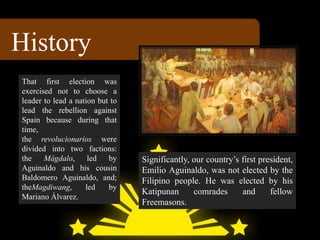
Significantly, our country’s first president,
Emilio Aguinaldo, was not elected by the
Filipino people. He was elected by his
Katipunan comrades and fellow
Freemasons.
That first election was
exercised not to choose a
leader to lead a nation but to
lead the rebellion against
Spain because during that
time,
the revolucionarios were
divided into two factions:
the Mágdalo, led by
Aguinaldo and his cousin
Baldomero Aguinaldo, and;
theMagdiwang, led by
Mariano Álvarez.
•Executive and senators elected at large.
•Existence of legislative districts and local
government units.
•Electorate: duly registered citizens 18 years
of age and above.
The Electoral System
The elections in the Philippines have several types.
The president, vice-president, and the senators are elected
for a six-year term, while the members of the House of
Representatives, governors, vice-governors, provincial
board members, mayors, vice-mayors, city/municipal
councilors, barangay officials are elected to serve for a
three-year term.
Every citizen 18 years old or above on Election Day, is a
resident of the Philippines for at least a year and for at least six
months on the place he is registering, and is not otherwise
disqualified by law, may vote. In order to actually vote, a
citizen has to register. The COMELEC has a registration period
for several months prior to the election. Those who are not
registered will not appear on the voters' list and is ineligible to
vote despite being qualified to do so.
Qualifications
Parties and Party System
Civil Society and Social Movement
2.
Political parties in the Philippines are of
diverse ideologies and are plentiful in
number. Most of these parties do not have
actual grassroots membership among
ordinary voters but rather that of political
figures and leaders.
politicalparties
What is a Political Party?
A group of people that is organized for
the purpose of winning government
power, by electoral or other means.
CHARACTERISTICS OF A
POLITICAL PARTY:
1. Has an organized structure with lines of authority
and power distribution.
2. Seek to attract popular support in the form of votes.
3. Seeks political power directly thru electoral method
4. Prepared to support a candidate and fight for
victory in an election. (to gain power)
PARTY MEMBERSHIP
1. For patronage
2. To get special treatment from the government
3. To enhance their own career
4. Economic benefit
5. Personal gratification
6. To have and to use an influence on the others
7. Ideological fulfillment
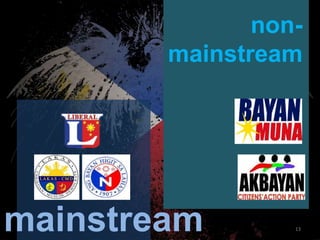
mainstream
non-
mainstream
13
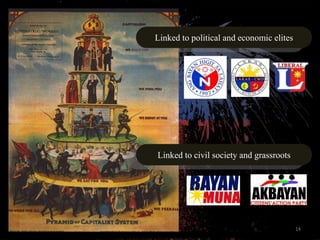
Linked to political and economic elites
Linked to civil society and grassroots
14
Politics and Governance
Thank you!

Politics and governance

  • 1.
    Politics and Governance PeejayBabao ‣ Kimverly Torres
  • 2.
    Elections 1. Parties andParty System Civil Society and Social Movement2. The Role of Church and Religion 3. Extras: Peejay’s song and TASK SHEET 4.
  • 3.
    What is Election? Election is the means by which the people choose their officials for definite and fixed periods. Elections 1.
  • 4.
    History Significantly, our country’sfirst president, Emilio Aguinaldo, was not elected by the Filipino people. He was elected by his Katipunan comrades and fellow Freemasons. That first election was exercised not to choose a leader to lead a nation but to lead the rebellion against Spain because during that time, the revolucionarios were divided into two factions: the Mágdalo, led by Aguinaldo and his cousin Baldomero Aguinaldo, and; theMagdiwang, led by Mariano Álvarez.
  • 5.
    •Executive and senatorselected at large. •Existence of legislative districts and local government units. •Electorate: duly registered citizens 18 years of age and above. The Electoral System
  • 6.
    The Electoral System Theelections in the Philippines have several types. The president, vice-president, and the senators are elected for a six-year term, while the members of the House of Representatives, governors, vice-governors, provincial board members, mayors, vice-mayors, city/municipal councilors, barangay officials are elected to serve for a three-year term.
  • 7.
    Every citizen 18years old or above on Election Day, is a resident of the Philippines for at least a year and for at least six months on the place he is registering, and is not otherwise disqualified by law, may vote. In order to actually vote, a citizen has to register. The COMELEC has a registration period for several months prior to the election. Those who are not registered will not appear on the voters' list and is ineligible to vote despite being qualified to do so. Qualifications
  • 8.
    Parties and PartySystem Civil Society and Social Movement 2.
  • 9.
    Political parties inthe Philippines are of diverse ideologies and are plentiful in number. Most of these parties do not have actual grassroots membership among ordinary voters but rather that of political figures and leaders. politicalparties
  • 10.
    What is aPolitical Party? A group of people that is organized for the purpose of winning government power, by electoral or other means.
  • 11.
    CHARACTERISTICS OF A POLITICALPARTY: 1. Has an organized structure with lines of authority and power distribution. 2. Seek to attract popular support in the form of votes. 3. Seeks political power directly thru electoral method 4. Prepared to support a candidate and fight for victory in an election. (to gain power)
  • 12.
    PARTY MEMBERSHIP 1. Forpatronage 2. To get special treatment from the government 3. To enhance their own career 4. Economic benefit 5. Personal gratification 6. To have and to use an influence on the others 7. Ideological fulfillment
  • 13.
  • 14.
    Linked to politicaland economic elites Linked to civil society and grassroots 14
  • 15.

Editor's Notes

  • #13 means formal attachment to a political party, usually involving the assumption of obligations to the party and receiving privileges from the party.