Power to the people….


        Prof. Lourdes Veneracion-Rallonza, PhD
        Department of Political Science
        Ateneo de Manila University
citizen participation in political processes

        arena of uncoerced collective action around
    shared interests, purposes and values. In theory, its
    institutional forms are distinct from those of the
    state, family and market. Civil society commonly
    embraces a diversity of spaces, actors and
    institutional forms, varying in their degree of
    formality, autonomy and power.
    (LSE, http://en.wikipedia.org/wiki/Civil_society )
    Traditional view: politics = formal structures of
    government
   Alternative perspective: interest group approach
         politics = government + citizen groups & their
    actions
                   = interaction of social groups

   Theoretical proponents:
    Bentley: group is the basic unit of all political life
    Latham: organized groups are structures of power;
              politics is the struggle of groups
    Truman: uniformities of behavior through these
    groups
   any group that, on the basis of one or more
    shared attitudes, makes certain claim upon
    other groups in society for the establishment,
    maintenance, or enhancement of forms of
    behavior that are implied by the shared
    attitudes
   organized organizations that engage in activity
    relative to governmental decisions
   organizations that attempt to influence public
    policy
   formal structure of organization
   articulation & aggregation of interests
   acting within the political system
   influencing external power
   representation of political interests
   Lobbying

        e.g. building public pressure using media
        organizing rallies & demonstrations
        forming alliances & coalitions
   non-membership organization formed for
    providing welfare and development
    services to the poor
   private, non-profit, legal, small, focused
   usually works with peoples’ organizations
    (Pos)
    fill a gap in the function of the government
   stimulating agent for community development
   creates opportunities for the politically
    marginalized to become active participants in
    the socio-political processes of society
playing as an intermediary mechanism between
  those who have power & those who have none:

1.    plays as an alternative institutional setting
  to political parties, articulating & aggregating
  socially relevant interests
2.    supplements government’s social delivery
  mechanisms
3.    privatizes policy implementation
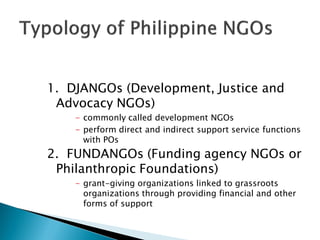
1. DJANGOs (Development, Justice and
 Advocacy NGOs)
    - commonly called development NGOs
    - perform direct and indirect support service functions
      with POs
2. FUNDANGOs (Funding agency NGOs or
 Philanthropic Foundations)
    - grant-giving organizations linked to grassroots
      organizations through providing financial and other
      forms of support
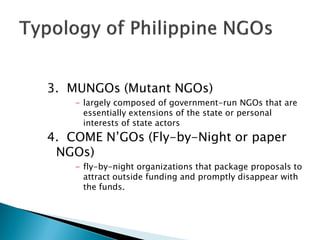
3. MUNGOs (Mutant NGOs)
    - largely composed of government-run NGOs that are
      essentially extensions of the state or personal
      interests of state actors
4. COME N’GOs (Fly-by-Night or paper
 NGOs)
    - fly-by-night organizations that package proposals to
      attract outside funding and promptly disappear with
      the funds.
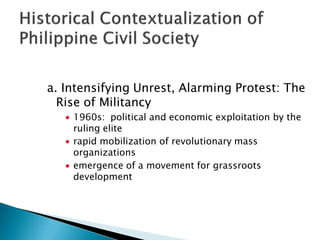
a. Intensifying Unrest, Alarming Protest: The
  Rise of Militancy
    1960s: political and economic exploitation by the
    ruling elite
    rapid mobilization of revolutionary mass
    organizations
    emergence of a movement for grassroots
    development
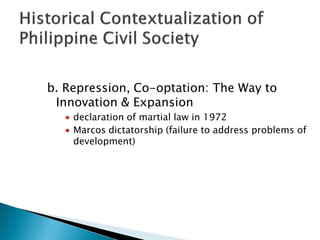
b. Repression, Co-optation: The Way to
 Innovation & Expansion
    declaration of martial law in 1972
    Marcos dictatorship (failure to address problems of
    development)
c. Assassination, Revolution: Towards
  Participation & Democratization
     Ninoy Aquino assassination (1983) - “2nd wave of
     activism”
      “People Power Revolution” (1986)
   • 1987 Constitution: encourages formation; support
     for regional NGOs; respect of their role; right to
     participate in decision making; consultation
     mechanisms
   • 1991 Local Government Code: NGOs as
     representatives of peoples’ interests
d. Democratization Movements
 ◦ EDSA Dos – 2001
 ◦ EDSA Tres (?)
 ◦ Anti-Charter Change
   5 areas for NGO participation in electoral
           processes
           1 advocacy for electoral reforms
           2 the raising of political consciousness
           3 advancement of the people’s platform or
    agenda in elections
           4 direct participation through the fielding
    of and campaigning for chosen candidates
           5 post-election activities
play an essential role in democratizing
  politics and governance
 facilitate participation of the people in the
  policy-making and execution process of
  government
 “key participant political force”
 role in enhancing democracy
 important institutional vehicles
 ability to influence
   As organizers: forming community & popular
    grassroots organization
   As advocates: mobilizing, articulating people’s
    interests, political demands, and institutional
    reforms
   As mediators: linking the powerful and
    disempowered strata of the society
   As deliverers: alternative mechanism for delivery of
    social services

Civil Society

  • 1.
    Power to thepeople…. Prof. Lourdes Veneracion-Rallonza, PhD Department of Political Science Ateneo de Manila University
  • 2.
    citizen participation inpolitical processes  arena of uncoerced collective action around shared interests, purposes and values. In theory, its institutional forms are distinct from those of the state, family and market. Civil society commonly embraces a diversity of spaces, actors and institutional forms, varying in their degree of formality, autonomy and power. (LSE, http://en.wikipedia.org/wiki/Civil_society )
  • 3.
    Traditional view: politics = formal structures of government  Alternative perspective: interest group approach politics = government + citizen groups & their actions = interaction of social groups  Theoretical proponents: Bentley: group is the basic unit of all political life Latham: organized groups are structures of power; politics is the struggle of groups Truman: uniformities of behavior through these groups
  • 4.
    any group that, on the basis of one or more shared attitudes, makes certain claim upon other groups in society for the establishment, maintenance, or enhancement of forms of behavior that are implied by the shared attitudes  organized organizations that engage in activity relative to governmental decisions  organizations that attempt to influence public policy
  • 5.
    formal structure of organization  articulation & aggregation of interests  acting within the political system  influencing external power  representation of political interests  Lobbying e.g. building public pressure using media organizing rallies & demonstrations forming alliances & coalitions
  • 6.
    non-membership organization formed for providing welfare and development services to the poor  private, non-profit, legal, small, focused  usually works with peoples’ organizations (Pos)
  • 7.
    fill a gap in the function of the government  stimulating agent for community development  creates opportunities for the politically marginalized to become active participants in the socio-political processes of society
  • 8.
    playing as anintermediary mechanism between those who have power & those who have none: 1. plays as an alternative institutional setting to political parties, articulating & aggregating socially relevant interests 2. supplements government’s social delivery mechanisms 3. privatizes policy implementation
  • 9.
    1. DJANGOs (Development,Justice and Advocacy NGOs) - commonly called development NGOs - perform direct and indirect support service functions with POs 2. FUNDANGOs (Funding agency NGOs or Philanthropic Foundations) - grant-giving organizations linked to grassroots organizations through providing financial and other forms of support
  • 10.
    3. MUNGOs (MutantNGOs) - largely composed of government-run NGOs that are essentially extensions of the state or personal interests of state actors 4. COME N’GOs (Fly-by-Night or paper NGOs) - fly-by-night organizations that package proposals to attract outside funding and promptly disappear with the funds.
  • 11.
    a. Intensifying Unrest,Alarming Protest: The Rise of Militancy 1960s: political and economic exploitation by the ruling elite rapid mobilization of revolutionary mass organizations emergence of a movement for grassroots development
  • 12.
    b. Repression, Co-optation:The Way to Innovation & Expansion declaration of martial law in 1972 Marcos dictatorship (failure to address problems of development)
  • 13.
    c. Assassination, Revolution:Towards Participation & Democratization Ninoy Aquino assassination (1983) - “2nd wave of activism” “People Power Revolution” (1986) • 1987 Constitution: encourages formation; support for regional NGOs; respect of their role; right to participate in decision making; consultation mechanisms • 1991 Local Government Code: NGOs as representatives of peoples’ interests
  • 14.
    d. Democratization Movements ◦ EDSA Dos – 2001 ◦ EDSA Tres (?) ◦ Anti-Charter Change
  • 15.
    5 areas for NGO participation in electoral processes 1 advocacy for electoral reforms 2 the raising of political consciousness 3 advancement of the people’s platform or agenda in elections 4 direct participation through the fielding of and campaigning for chosen candidates 5 post-election activities
  • 16.
    play an essentialrole in democratizing politics and governance  facilitate participation of the people in the policy-making and execution process of government  “key participant political force”  role in enhancing democracy  important institutional vehicles  ability to influence
  • 17.
    As organizers: forming community & popular grassroots organization  As advocates: mobilizing, articulating people’s interests, political demands, and institutional reforms  As mediators: linking the powerful and disempowered strata of the society  As deliverers: alternative mechanism for delivery of social services