
Organizational psychology:
Group Cohesion
A brief summary of an important topic related to teams
Kristian Svantorp
First, what is a group?
• Two or more people working together
• Two or more people who perceive themselves to be members of the same social category
(Turner)
• A dynamic whole based on interdependence rather than similarity. (Lewin)
• Etc…
• Forsyth summarizes:
Two or more individuals who are connected by and within social relationships.
Hogan believes it must be 3 or more, since the dynamics in a team with only 2 individuals are so much simpler
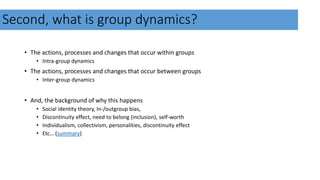
Second, what is group dynamics?
• The actions, processes and changes that occur within groups
• Intra-group dynamics
• The actions, processes and changes that occur between groups
• Inter-group dynamics
• And, the background of why this happens
• Social identity theory, In-/outgroup bias,
• Discontinuity effect, need to belong (inclusion), self-worth
• Individualism, collectivism, personalities, discontinuity effect
• Etc… (summary)
Then, Group Cohesion
How well does a group stick together, feel a unity, fit?
Forsyth: “Group Cohesion is the integrity, solidarity, social integration, unit and groupiness of a
group”
The glue that keeps a group together as a group. The motivation members have to stay in the group.
A minimum of stickiness is required for a group not to disintegrate, but cohesion can be a lot
stronger than just that.
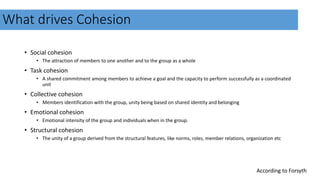
What drives Cohesion
• Social cohesion
• The attraction of members to one another and to the group as a whole
• Task cohesion
• A shared commitment among members to achieve a goal and the capacity to perform successfully as a coordinated
unit
• Collective cohesion
• Members identification with the group, unity being based on shared identity and belonging
• Emotional cohesion
• Emotional intensity of the group and individuals when in the group.
• Structural cohesion
• The unity of a group derived from the structural features, like norms, roles, member relations, organization etc
According to Forsyth
What drives Cohesion
In addition, some other drivers and aspects
• Stability
• Low turnover. Participate in the team over a longer duration, can switch roles within the team.
• Initiation process
• Hard to get in, be accepted? If so, it will increase cohesion between the included members
• Inter-group competition. Common enemy
• Especially if you have chosen groups yourselves. If not, it can also drive down cohesion
• Performance and success
• Nothing succeeds like success. When a group performs well, cohesion increases.
• Cohesion-performance relation is bidirectional. Cohesive groups perform better, but performance drives cohesion. The last is strongest
• Size
• If a group gets to big, it may reduce cohesion within the large group, due to the share number of relations
• Similarity
• Shared values, norms, beliefs
And why care about cohesion?
Cohesion is considered by many to be a key ingredient for group success, but it’s not that simple
• Cohesive groups usually outperforms less unified groups, but impact varies across teams and tasks
• Weakest in ad hoc teams, strong impact in sports, military and project groups. Less in production/service teams
• Enhances coordination between members.
• A shared and more consistent mental model of the task and what to achieve
• Not necessarily more productive than less unified groups, but less variance between the members
• Assignments with a lot of interdependencies between members will benefit from cohesion
• Culture that values productivity and efficiency makes cohesion and productivity positively related. Increased cohesion will increase
existing norms, make sure they’re right… (Langfred)
• Task cohesion and commitment to the groups goals are needed to increase productivity. The other cohesive drivers alone might not
be enough (Beal)
• Improved work environment, good morale and motivations
• Improved communication and coordination
How to increase cohesion - samples
• Group goals instead of individual
• Ensure commitment to tasks through early involvement
• Reduce the size of teams
• Reward teams and not persons for success (should maybe be balanced a bit however)
• Increase homogeneity in the teams (will have other “side effects” you might not consider good)
• Introduce competition with other groups
• Physical isolation from other groups (again, the side effects…)
• To reduce cohesion, flip the points made above
Building teams– by Curphy
• 7 steps/topics a team needs to go through sequentially
• The steps are
• Mission – Common direction, goals, performance standards
• Talent – individual suitability for this team, fit with the task, fit with the team culture
• Norms – clearly, consciously defined norms that fit the goal
• Buy-in – commitment to goals, norms etc
• Power – understand what you have and use it well
• Morale – Stick together, solve your issues (cohesion falls under this)
• Results - What to be accomplished

Group Cohesion - Summary

  • 1.
    Organizational psychology: Group Cohesion Abrief summary of an important topic related to teams Kristian Svantorp
  • 2.
    First, what isa group? • Two or more people working together • Two or more people who perceive themselves to be members of the same social category (Turner) • A dynamic whole based on interdependence rather than similarity. (Lewin) • Etc… • Forsyth summarizes: Two or more individuals who are connected by and within social relationships. Hogan believes it must be 3 or more, since the dynamics in a team with only 2 individuals are so much simpler
  • 3.
    Second, what isgroup dynamics? • The actions, processes and changes that occur within groups • Intra-group dynamics • The actions, processes and changes that occur between groups • Inter-group dynamics • And, the background of why this happens • Social identity theory, In-/outgroup bias, • Discontinuity effect, need to belong (inclusion), self-worth • Individualism, collectivism, personalities, discontinuity effect • Etc… (summary)
  • 4.
    Then, Group Cohesion Howwell does a group stick together, feel a unity, fit? Forsyth: “Group Cohesion is the integrity, solidarity, social integration, unit and groupiness of a group” The glue that keeps a group together as a group. The motivation members have to stay in the group. A minimum of stickiness is required for a group not to disintegrate, but cohesion can be a lot stronger than just that.
  • 5.
    What drives Cohesion •Social cohesion • The attraction of members to one another and to the group as a whole • Task cohesion • A shared commitment among members to achieve a goal and the capacity to perform successfully as a coordinated unit • Collective cohesion • Members identification with the group, unity being based on shared identity and belonging • Emotional cohesion • Emotional intensity of the group and individuals when in the group. • Structural cohesion • The unity of a group derived from the structural features, like norms, roles, member relations, organization etc According to Forsyth
  • 6.
    What drives Cohesion Inaddition, some other drivers and aspects • Stability • Low turnover. Participate in the team over a longer duration, can switch roles within the team. • Initiation process • Hard to get in, be accepted? If so, it will increase cohesion between the included members • Inter-group competition. Common enemy • Especially if you have chosen groups yourselves. If not, it can also drive down cohesion • Performance and success • Nothing succeeds like success. When a group performs well, cohesion increases. • Cohesion-performance relation is bidirectional. Cohesive groups perform better, but performance drives cohesion. The last is strongest • Size • If a group gets to big, it may reduce cohesion within the large group, due to the share number of relations • Similarity • Shared values, norms, beliefs
  • 7.
    And why careabout cohesion? Cohesion is considered by many to be a key ingredient for group success, but it’s not that simple • Cohesive groups usually outperforms less unified groups, but impact varies across teams and tasks • Weakest in ad hoc teams, strong impact in sports, military and project groups. Less in production/service teams • Enhances coordination between members. • A shared and more consistent mental model of the task and what to achieve • Not necessarily more productive than less unified groups, but less variance between the members • Assignments with a lot of interdependencies between members will benefit from cohesion • Culture that values productivity and efficiency makes cohesion and productivity positively related. Increased cohesion will increase existing norms, make sure they’re right… (Langfred) • Task cohesion and commitment to the groups goals are needed to increase productivity. The other cohesive drivers alone might not be enough (Beal) • Improved work environment, good morale and motivations • Improved communication and coordination
  • 8.
    How to increasecohesion - samples • Group goals instead of individual • Ensure commitment to tasks through early involvement • Reduce the size of teams • Reward teams and not persons for success (should maybe be balanced a bit however) • Increase homogeneity in the teams (will have other “side effects” you might not consider good) • Introduce competition with other groups • Physical isolation from other groups (again, the side effects…) • To reduce cohesion, flip the points made above
  • 9.
    Building teams– byCurphy • 7 steps/topics a team needs to go through sequentially • The steps are • Mission – Common direction, goals, performance standards • Talent – individual suitability for this team, fit with the task, fit with the team culture • Norms – clearly, consciously defined norms that fit the goal • Buy-in – commitment to goals, norms etc • Power – understand what you have and use it well • Morale – Stick together, solve your issues (cohesion falls under this) • Results - What to be accomplished

Editor's Notes