SUBMITTED BY-
SHANTANU ARORA
BC2018049
GROUP COHESIVENESS
Group
•A Group can be defined as a collection of individuals
working in face-to-face relationships to share
information and resources for a task to be achieved.
•The main function of a group is to exchange task-
related information and discuss task related issues.
What is group cohesiveness?
Group cohesiveness is the ability to think and act 'as one' if
the group is physically together or not.
A group is said to be in a state of cohesion when its members possess
bonds linking them to one another and to the group as a whole.
According to Stephen P Robbins, “Group cohesiveness is
the degree to which members are attracted to each other
and are motivated to stay in the group.”
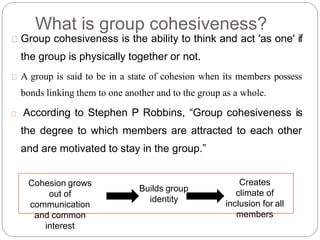
Cohesion grows
out of
communication
and common
interest
Builds group
identity
Creates
climate of
inclusion for all
members
Dimensions of group cohesiveness
Group Unity
Attraction
Team work
Group unity
Many theorists
results from a
believe that group cohesion
deep sense of “we-ness” or
belonging to a group as a whole.
By becoming enthusiastically involved in the efforts
of their group and by recognizing the similarities
that exist among group members, individuals
tend to develop a close connection with their
group and its members.
Attraction
According to Hogg (1992), group cohesiveness
typically develops from a depersonalized
attraction to group members based on their status
as group members, rather than a personal
attraction based on specific relationships.
Team work
Some theorists stress that cohesion comes from
group members’ commitment to work together to
complete their shared tasks and accomplish their
collective goals.
Members of task-oriented groups typically exhibit
great interdependence and
feelings of responsibility for
often
the
possess
group’s
outcomes.
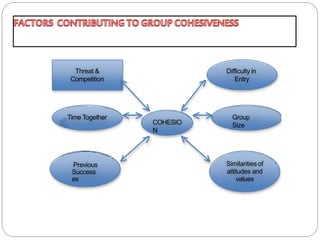
Threat &
Competition
COHESIO
N
Time Together
Previous
Success
es
Difficulty in
Entry
Group
Size
Similaritiesof
attitudes and
values
1. Threat & Competition
Whenever the common group goal is threatened,
cohesiveness increases.
Also, such cohesiveness increases the
importance of the goals.
When we fight for a goal, the goal gets the
highest priority.
Thus the threatening party will have less chance of
success when faced with a unified force.
2. Difficulty in Entry
Some groups are not easy to join. The members are very
carefully selected and the selected members feels a sense
of pride and accomplishment.
The more difficult it is to get into a group, the more cohesive
that group becomes.
The reason being that in exclusive and elite groups the
members are selected on the basis of certain
characteristics and these characteristics being common to
all add to the degree of liking and attraction towards each
other.
3. Time Together
It is quite natural that the more time people
spend together, the more they will get to
know each other and more tendency there
will be to get closer to each other, thus
strengthening the degree of cohesiveness.
In an organizational setting, people who work
near each other are more likely to spend
more time together.
4. Group Size
Since continuous and close interaction among
members is a fundamental necessity for
cohesiveness, it would be natural to assume that
large groups restrict the extent of communication
and interaction with each other, thus resulting in
reduction of degree of cohesiveness.
5. Previous Success
When a group achieves a meaningful goal, the
cohesiveness of the group increases because the
success is shared by all the members and each one
feels responsible for the achievement.
For example, when a sports team wins an important
game, every one in the team congratulates every
other member of the team for this success.
6. Similarity of Attitudes & Values
One of the strongest source of group
cohesiveness is the similarity in values, morals,
beliefs and code of conduct.
We enjoy the company of others who hold similar
opinions and characteristics as ourselves.
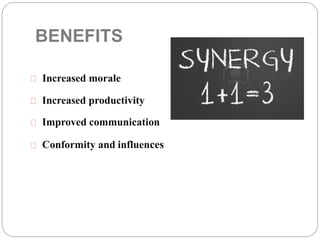
BENEFITS
Increased morale
Increased productivity
Improved communication
Conformity and influences
Disadvantages
Clash of personalities
Conflict of task
Breakdown in communication
Struggling for power
Frequent turnover of members
Disagreement
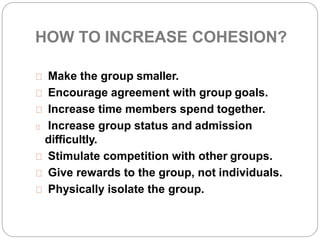
HOW TO INCREASE COHESION?
Make the group smaller.
Encourage agreement with group goals.
Increase time members spend together.
Increase group status and admission
difficultly.
Stimulate competition with other groups.
Give rewards to the group, not individuals.
Physically isolate the group.
HOW TO DECREASE COHESION?
Induce disagreement in group goals.
Increase membership heterogeneity.
Restrict interaction among members.
Increase group size.
Allocate reward to individuals rather than to a
group as a whole.
Remove physical isolation.
Introduce a dominating member
Conclusion
Group cohesion has been linked to a range of
positive and negative consequences.
People in cohesive groups are confronted with
powerful pressures to confirm to the group’s
goals, norms, and decisions.
Cohesiveness leads to the improvement in
productivity and efficiency of individuals as well
as groups.
REFERENCES
Udai Pareek’s Understanding Organizational
Behaviour 3rd edition
http://www.managementstudyhq.com/group-
cohesiveness.html
Google.co.in/search
http://www.tusculum.edu/faculty/home/tmcfarlan
d/ppt2/BUSN312-
McFarland/ch08_files/frame.htm
Group cohensiveness ppt by shantanu arora

Group cohensiveness ppt by shantanu arora

  • 1.
  • 2.
    Group •A Group canbe defined as a collection of individuals working in face-to-face relationships to share information and resources for a task to be achieved. •The main function of a group is to exchange task- related information and discuss task related issues.
  • 3.
    What is groupcohesiveness? Group cohesiveness is the ability to think and act 'as one' if the group is physically together or not. A group is said to be in a state of cohesion when its members possess bonds linking them to one another and to the group as a whole. According to Stephen P Robbins, “Group cohesiveness is the degree to which members are attracted to each other and are motivated to stay in the group.” Cohesion grows out of communication and common interest Builds group identity Creates climate of inclusion for all members
  • 4.
    Dimensions of groupcohesiveness Group Unity Attraction Team work
  • 5.
    Group unity Many theorists resultsfrom a believe that group cohesion deep sense of “we-ness” or belonging to a group as a whole. By becoming enthusiastically involved in the efforts of their group and by recognizing the similarities that exist among group members, individuals tend to develop a close connection with their group and its members.
  • 6.
    Attraction According to Hogg(1992), group cohesiveness typically develops from a depersonalized attraction to group members based on their status as group members, rather than a personal attraction based on specific relationships.
  • 7.
    Team work Some theoristsstress that cohesion comes from group members’ commitment to work together to complete their shared tasks and accomplish their collective goals. Members of task-oriented groups typically exhibit great interdependence and feelings of responsibility for often the possess group’s outcomes.
  • 8.
    Threat & Competition COHESIO N Time Together Previous Success es Difficultyin Entry Group Size Similaritiesof attitudes and values
  • 9.
    1. Threat &Competition Whenever the common group goal is threatened, cohesiveness increases. Also, such cohesiveness increases the importance of the goals. When we fight for a goal, the goal gets the highest priority. Thus the threatening party will have less chance of success when faced with a unified force.
  • 10.
    2. Difficulty inEntry Some groups are not easy to join. The members are very carefully selected and the selected members feels a sense of pride and accomplishment. The more difficult it is to get into a group, the more cohesive that group becomes. The reason being that in exclusive and elite groups the members are selected on the basis of certain characteristics and these characteristics being common to all add to the degree of liking and attraction towards each other.
  • 11.
    3. Time Together Itis quite natural that the more time people spend together, the more they will get to know each other and more tendency there will be to get closer to each other, thus strengthening the degree of cohesiveness. In an organizational setting, people who work near each other are more likely to spend more time together.
  • 12.
    4. Group Size Sincecontinuous and close interaction among members is a fundamental necessity for cohesiveness, it would be natural to assume that large groups restrict the extent of communication and interaction with each other, thus resulting in reduction of degree of cohesiveness.
  • 13.
    5. Previous Success Whena group achieves a meaningful goal, the cohesiveness of the group increases because the success is shared by all the members and each one feels responsible for the achievement. For example, when a sports team wins an important game, every one in the team congratulates every other member of the team for this success.
  • 14.
    6. Similarity ofAttitudes & Values One of the strongest source of group cohesiveness is the similarity in values, morals, beliefs and code of conduct. We enjoy the company of others who hold similar opinions and characteristics as ourselves.
  • 16.
    BENEFITS Increased morale Increased productivity Improvedcommunication Conformity and influences
  • 17.
    Disadvantages Clash of personalities Conflictof task Breakdown in communication Struggling for power Frequent turnover of members Disagreement
  • 18.
    HOW TO INCREASECOHESION? Make the group smaller. Encourage agreement with group goals. Increase time members spend together. Increase group status and admission difficultly. Stimulate competition with other groups. Give rewards to the group, not individuals. Physically isolate the group.
  • 19.
    HOW TO DECREASECOHESION? Induce disagreement in group goals. Increase membership heterogeneity. Restrict interaction among members. Increase group size. Allocate reward to individuals rather than to a group as a whole. Remove physical isolation. Introduce a dominating member
  • 20.
    Conclusion Group cohesion hasbeen linked to a range of positive and negative consequences. People in cohesive groups are confronted with powerful pressures to confirm to the group’s goals, norms, and decisions. Cohesiveness leads to the improvement in productivity and efficiency of individuals as well as groups.
  • 21.
    REFERENCES Udai Pareek’s UnderstandingOrganizational Behaviour 3rd edition http://www.managementstudyhq.com/group- cohesiveness.html Google.co.in/search http://www.tusculum.edu/faculty/home/tmcfarlan d/ppt2/BUSN312- McFarland/ch08_files/frame.htm