Team Leadership
Presented by
Merfat Angawi Mas’ud Adris Maryam Abdullah
Learning Outcomes
• 5 Determinants of effective team decisions
• Leader’s role in group decision
• 3 parts of effective meeting
Maryam Abdullah
• Group VR Team
• Teams Pros & Cons
• 3 Characteristics of effective teams
Merfat Angawi
• 3 Characteristics of effective teams
• 3 Types of teams
• Team leaders role in supporting creativity
Masu’d Adris
“
”
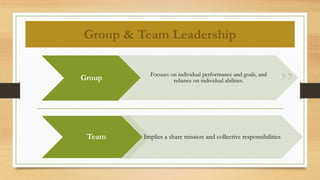
Group & Team Leadership
Group Focuses on individual performance and goals, and
reliance on individual abilities.
Team Implies a share mission and collective responsibilities
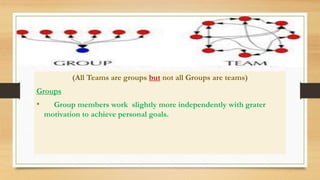
(All Teams are groups but not all Groups are teams)
Groups
• Group members work slightly more independently with grater
motivation to achieve personal goals.
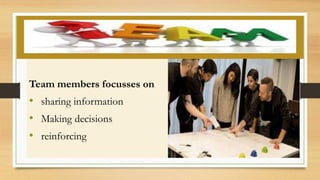
Team
Team members focusses on
• sharing information
• Making decisions
• reinforcing
Group VR Team
• Number of people who are connected
by some shared activity, interest, or
quality
• Un-specific common goal
• Specific roles and duties are not
assigned to individuals
• Members are independent
• May not know each other
• Number of person associated together
in work or activity
• Share a common cause or goal
• Specific tasks are assigned to each
individual
• Members are interdependent
• Are aware of each other’s weaknesses
Team Work
Involves working together to achieve
something beyond the capabilities of
individuals working alone
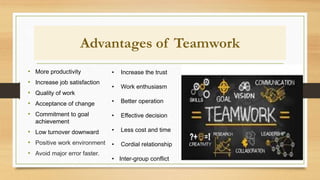
Advantages of Teamwork
• More productivity
• Increase job satisfaction
• Quality of work
• Acceptance of change
• Commitment to goal
achievement
• Low turnover downward
• Positive work environment
• Avoid major error faster.
• Increase the trust
• Work enthusiasm
• Better operation
• Effective decision
• Less cost and time
• Cordial relationship
• Inter-group conflict
Disadvantages of Teamwork
• Lack of competence
• Unwillingness of management
• Less training
• Non-cooperative attitude
• Trade union
• Universal participation
• Lack of trust
• Lack of educational and update
knowledge
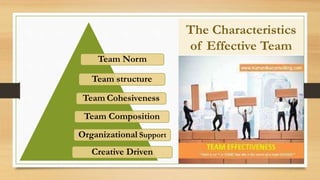
The Characteristics
of Effective Team
Team Norm
Team structure
Team Cohesiveness
Team Composition
Organizational Support
Creative Driven
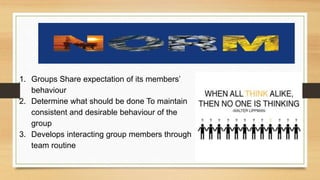
Team Norm
1. Groups Share expectation of its members’
behaviour
2. Determine what should be done To maintain
consistent and desirable behaviour of the
group
3. Develops interacting group members through
team routine
Implication for Managers
• Be aware of their group’s norms
• work toward maintaining and developing positive norms
• confront groups with negative norms and try to came up with
agreeable solutions
Managers should
 Leadership
 Problem solving and decision making
 Composition
 Conflict
Componenta of team Dynamic Team Structure
Team structure components affecting
 Behaviour
 Human relations
 Group performance
How Team Enforce Norms
To Ensure the group survival from
 Ridicule
 Ostracism
 Sabotage
 Physical abuse
Protecting themselves from
interference or harassment from
members of there groups
Componenta of
Team Dynamic Cohesiveness
Group cohesiveness should have
 Group members attractiveness and
closeness for themselves and the group.
 Cohesive group
 desirable group membership
Factors Influencing Cohesiveness
1. Objectives
2. Size
3. Homogeneity
4. Participation
5. Competition
6. Success
Weak factors law cohesiveness
Strong factors High cohesiveness
Will reflect on:
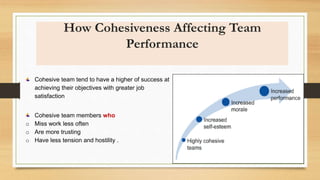
How Cohesiveness Affecting Team
Performance
Cohesive team tend to have a higher of success at
achieving their objectives with greater job
satisfaction
Cohesive team members who
o Miss work less often
o Are more trusting
o Have less tension and hostility .
Implication for Managers
 strive to develop cohesive
groups that accept their
level of productivity
 Participation helps develop
cohesiveness
 focus on inter-group
competition
Managers should
3 Characteristics of effectives Leadership teams
• Team composition
• Organizational support
• Creativity driven
Team composition
Attributes of a team
• Homogeneous or heterogeneous
• Demographic trait.
• Knowledge, skills and abilities to do
the work.
• Personality trait.
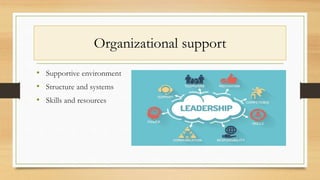
Organizational support
• Supportive environment
• Structure and systems
• Skills and resources
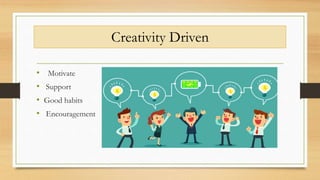
Creativity Driven
• Motivate
• Support
• Good habits
• Encouragement
3 Types of Team
1. Functional Team
2. Cross Functional team
3. Matrix team
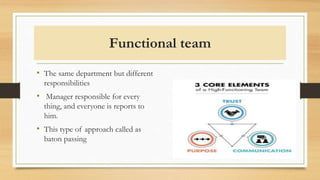
Functional team
• The same department but different
responsibilities
• Manager responsible for every
thing, and everyone is reports to
him.
• This type of approach called as
baton passing
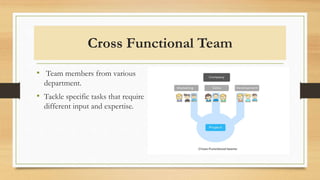
Cross Functional Team
• Team members from various
department.
• Tackle specific tasks that require
different input and expertise.
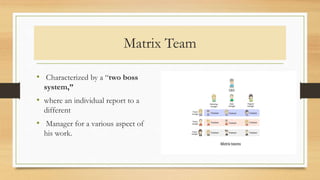
Matrix Team
• Characterized by a “two boss
system,”
• where an individual report to a
different
• Manager for a various aspect of
his work.
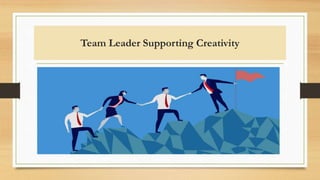
Team Leader Supporting Creativity
1. Regular Check-in on your Team
• Support your employee while
undertaking project
• Regular check-in will help to
identify critical problems if any.
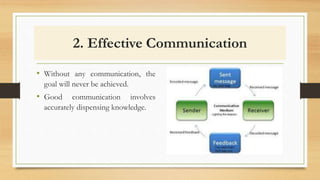
2. Effective Communication
• Without any communication, the
goal will never be achieved.
• Good communication involves
accurately dispensing knowledge.
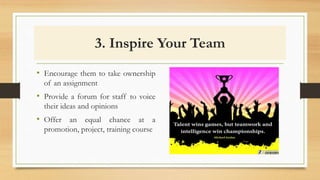
3. Inspire Your Team
• Encourage them to take ownership
of an assignment
• Provide a forum for staff to voice
their ideas and opinions
• Offer an equal chance at a
promotion, project, training course
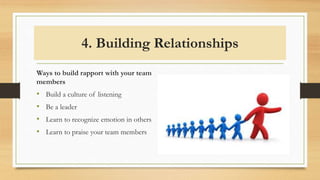
4. Building Relationships
Ways to build rapport with your team
members
• Build a culture of listening
• Be a leader
• Learn to recognize emotion in others
• Learn to praise your team members
Develop Skills
• Boost your team members morale
and secure their loyalty.
• Cohesive critical thinking
• learn to pitch your ideas
• Bounce ideas of others
• Dreaming practice
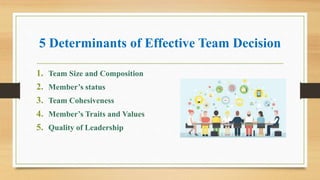
5 Determinants of Effective Team Decision
1. Team Size and Composition
2. Member’s status
3. Team Cohesiveness
4. Member’s Traits and Values
5. Quality of Leadership
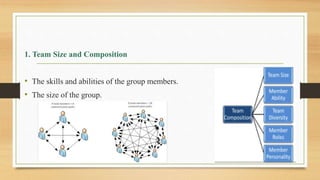
1. Team Size and Composition
• The skills and abilities of the group members.
• The size of the group.
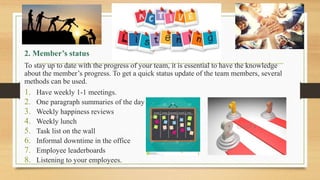
2. Member’s status
To stay up to date with the progress of your team, it is essential to have the knowledge
about the member’s progress. To get a quick status update of the team members, several
methods can be used.
1. Have weekly 1-1 meetings.
2. One paragraph summaries of the day
3. Weekly happiness reviews
4. Weekly lunch
5. Task list on the wall
6. Informal downtime in the office
7. Employee leaderboards
8. Listening to your employees.
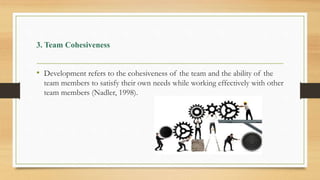
3. Team Cohesiveness
• Development refers to the cohesiveness of the team and the ability of the
team members to satisfy their own needs while working effectively with other
team members (Nadler, 1998).
3. Team Cohesiveness
• Team cohesion means when a team remains
united in order to achieve a common goal.
• In a cohesive team everyone feels like they have
contributed to the overall success of the group.
• Honest and Straightforward
• Shares the Load
• Reliable
• Fair
• Complements Others’ Skills
• Good Communication Skills
• Positive Attitude
4. Member’s Traits and Values
• Efficient Problem Solving Skills
• Effective Communication Skills
• Expert In Delegating Tasks
• Mediator
• Reward Achievements
• Integrity
• Respects Team Members
• Positive Attitude
• Decisive
5. Quality of Leadership
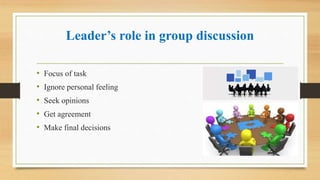
Leader’s role in group discussion
• Focus of task
• Ignore personal feeling
• Seek opinions
• Get agreement
• Make final decisions
Three parts of effective meetings
Step 1: Plan your meeting
• The agenda of meeting
• The meeting’s participants
• Date, time and venue of the meeting
Step 2: Manage the meeting
• Start on time
• Quickly review why the meeting has been called
• Assign someone to take notes.
• Encourage participation
• Use conflict management skills if required.
• Develop an action plan. As each agenda item is completed, create an action plan
that lists who is responsible for the task and the date by which it is to be done.
• End on time..
Step 3: Follow up
• Within 24 hours, write a synopsis (minutes) of the meeting, including
action items and assignments, and send it to the participants. (You may
assign this to the meeting’s recorder.)

Presentation

  • 3.
    Team Leadership Presented by MerfatAngawi Mas’ud Adris Maryam Abdullah
  • 4.
    Learning Outcomes • 5Determinants of effective team decisions • Leader’s role in group decision • 3 parts of effective meeting Maryam Abdullah • Group VR Team • Teams Pros & Cons • 3 Characteristics of effective teams Merfat Angawi • 3 Characteristics of effective teams • 3 Types of teams • Team leaders role in supporting creativity Masu’d Adris
  • 5.
    “ ” Group & TeamLeadership Group Focuses on individual performance and goals, and reliance on individual abilities. Team Implies a share mission and collective responsibilities
  • 6.
    (All Teams aregroups but not all Groups are teams) Groups • Group members work slightly more independently with grater motivation to achieve personal goals.
  • 7.
    Team Team members focusseson • sharing information • Making decisions • reinforcing
  • 8.
    Group VR Team •Number of people who are connected by some shared activity, interest, or quality • Un-specific common goal • Specific roles and duties are not assigned to individuals • Members are independent • May not know each other • Number of person associated together in work or activity • Share a common cause or goal • Specific tasks are assigned to each individual • Members are interdependent • Are aware of each other’s weaknesses
  • 9.
    Team Work Involves workingtogether to achieve something beyond the capabilities of individuals working alone
  • 10.
    Advantages of Teamwork •More productivity • Increase job satisfaction • Quality of work • Acceptance of change • Commitment to goal achievement • Low turnover downward • Positive work environment • Avoid major error faster. • Increase the trust • Work enthusiasm • Better operation • Effective decision • Less cost and time • Cordial relationship • Inter-group conflict
  • 11.
    Disadvantages of Teamwork •Lack of competence • Unwillingness of management • Less training • Non-cooperative attitude • Trade union • Universal participation • Lack of trust • Lack of educational and update knowledge
  • 12.
    The Characteristics of EffectiveTeam Team Norm Team structure Team Cohesiveness Team Composition Organizational Support Creative Driven
  • 13.
    Team Norm 1. GroupsShare expectation of its members’ behaviour 2. Determine what should be done To maintain consistent and desirable behaviour of the group 3. Develops interacting group members through team routine
  • 14.
    Implication for Managers •Be aware of their group’s norms • work toward maintaining and developing positive norms • confront groups with negative norms and try to came up with agreeable solutions Managers should
  • 15.
     Leadership  Problemsolving and decision making  Composition  Conflict Componenta of team Dynamic Team Structure
  • 16.
    Team structure componentsaffecting  Behaviour  Human relations  Group performance
  • 17.
    How Team EnforceNorms To Ensure the group survival from  Ridicule  Ostracism  Sabotage  Physical abuse Protecting themselves from interference or harassment from members of there groups
  • 18.
    Componenta of Team DynamicCohesiveness Group cohesiveness should have  Group members attractiveness and closeness for themselves and the group.  Cohesive group  desirable group membership
  • 19.
    Factors Influencing Cohesiveness 1.Objectives 2. Size 3. Homogeneity 4. Participation 5. Competition 6. Success Weak factors law cohesiveness Strong factors High cohesiveness Will reflect on:
  • 20.
    How Cohesiveness AffectingTeam Performance Cohesive team tend to have a higher of success at achieving their objectives with greater job satisfaction Cohesive team members who o Miss work less often o Are more trusting o Have less tension and hostility .
  • 21.
    Implication for Managers strive to develop cohesive groups that accept their level of productivity  Participation helps develop cohesiveness  focus on inter-group competition Managers should
  • 22.
    3 Characteristics ofeffectives Leadership teams • Team composition • Organizational support • Creativity driven
  • 23.
    Team composition Attributes ofa team • Homogeneous or heterogeneous • Demographic trait. • Knowledge, skills and abilities to do the work. • Personality trait.
  • 24.
    Organizational support • Supportiveenvironment • Structure and systems • Skills and resources
  • 25.
    Creativity Driven • Motivate •Support • Good habits • Encouragement
  • 26.
    3 Types ofTeam 1. Functional Team 2. Cross Functional team 3. Matrix team
  • 27.
    Functional team • Thesame department but different responsibilities • Manager responsible for every thing, and everyone is reports to him. • This type of approach called as baton passing
  • 28.
    Cross Functional Team •Team members from various department. • Tackle specific tasks that require different input and expertise.
  • 29.
    Matrix Team • Characterizedby a “two boss system,” • where an individual report to a different • Manager for a various aspect of his work.
  • 30.
  • 31.
    1. Regular Check-inon your Team • Support your employee while undertaking project • Regular check-in will help to identify critical problems if any.
  • 32.
    2. Effective Communication •Without any communication, the goal will never be achieved. • Good communication involves accurately dispensing knowledge.
  • 33.
    3. Inspire YourTeam • Encourage them to take ownership of an assignment • Provide a forum for staff to voice their ideas and opinions • Offer an equal chance at a promotion, project, training course
  • 34.
    4. Building Relationships Waysto build rapport with your team members • Build a culture of listening • Be a leader • Learn to recognize emotion in others • Learn to praise your team members
  • 35.
    Develop Skills • Boostyour team members morale and secure their loyalty. • Cohesive critical thinking • learn to pitch your ideas • Bounce ideas of others • Dreaming practice
  • 36.
    5 Determinants ofEffective Team Decision 1. Team Size and Composition 2. Member’s status 3. Team Cohesiveness 4. Member’s Traits and Values 5. Quality of Leadership
  • 37.
    1. Team Sizeand Composition • The skills and abilities of the group members. • The size of the group.
  • 38.
    2. Member’s status Tostay up to date with the progress of your team, it is essential to have the knowledge about the member’s progress. To get a quick status update of the team members, several methods can be used. 1. Have weekly 1-1 meetings. 2. One paragraph summaries of the day 3. Weekly happiness reviews 4. Weekly lunch 5. Task list on the wall 6. Informal downtime in the office 7. Employee leaderboards 8. Listening to your employees.
  • 39.
    3. Team Cohesiveness •Development refers to the cohesiveness of the team and the ability of the team members to satisfy their own needs while working effectively with other team members (Nadler, 1998).
  • 40.
    3. Team Cohesiveness •Team cohesion means when a team remains united in order to achieve a common goal. • In a cohesive team everyone feels like they have contributed to the overall success of the group.
  • 41.
    • Honest andStraightforward • Shares the Load • Reliable • Fair • Complements Others’ Skills • Good Communication Skills • Positive Attitude 4. Member’s Traits and Values
  • 42.
    • Efficient ProblemSolving Skills • Effective Communication Skills • Expert In Delegating Tasks • Mediator • Reward Achievements • Integrity • Respects Team Members • Positive Attitude • Decisive 5. Quality of Leadership
  • 43.
    Leader’s role ingroup discussion • Focus of task • Ignore personal feeling • Seek opinions • Get agreement • Make final decisions
  • 44.
    Three parts ofeffective meetings Step 1: Plan your meeting • The agenda of meeting • The meeting’s participants • Date, time and venue of the meeting
  • 45.
    Step 2: Managethe meeting • Start on time • Quickly review why the meeting has been called • Assign someone to take notes. • Encourage participation • Use conflict management skills if required. • Develop an action plan. As each agenda item is completed, create an action plan that lists who is responsible for the task and the date by which it is to be done. • End on time..
  • 46.
    Step 3: Followup • Within 24 hours, write a synopsis (minutes) of the meeting, including action items and assignments, and send it to the participants. (You may assign this to the meeting’s recorder.)