PSYCHOLOGY FOR SPORTS
PERFORMANCE.
Cohesion.
Aim & Objectives.
 Aim: By the end of this session student will
    Explain how cohesion can affect sports performance
     and how the coach can create effective team climate.
 Objectives: By the end of this session students will
    Define group cohesion.
    Describe task and social cohesion.
    Explain how the coaches role in creating a effect team
     climate.
Cohesion.
 ‘the total number of forces which act on members to
  remain in the group.’
                           (Festinger et al, 1950)
 These forces will tend to cover to areas:
   The attractiveness of the group to the individual members.
   The extent in which the member are willing to work
    together to achieve their goals.
 What are the positives to being a member of a team?
 Are there any disadvantages?
Task: Place the following team sports in order depending upon the level of
interaction (Cohesion) needed to be successful.

 Rowing (Eights)                          Bobsleigh (Fours)
 Golf team                                Cycling team
 Volleyball                               4 x 100m relay team
 Synchronised                             Cricket
  swimming team                             (Batting/fielding)
 Tennis doubles                           Curling.
Cohesion
 Athletes other report that cohesion is a form of
  satisfaction in their lives. However, it has been
  argued that cohesive teams are not always the
  most successful. Therefore, it has suggested that
  cohesion has two distinct aspects.
 Task cohesion & social cohesion.
 It is often said that task cohesion comes first.
   This is the degree to which members work together
    and are committed to achieve common goals, such as
    winning a match.
Cohesion.
 If the team is showing task cohesion frequently
 then social cohesion will follow.
   Is the degree to which group members like each other
    and get on well, trust and support each other.


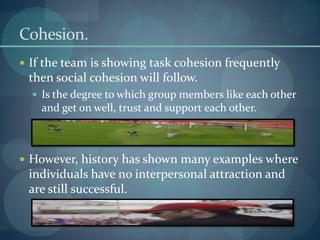
 However, history has shown many examples where
 individuals have no interpersonal attraction and
 are still successful.
Discussion.
 In pairs discuss which if any is more important for
 sporting success.


 From this discussion write down your overall
 answer.
Cohesion.
 In summary, cohesion is important in successful
 teams, and that task cohesion is more important
 than social cohesion.

 The definition that can be used to explain
 cohesion as a whole is
   ‘a dynamic process which is reflected in the tendency
    for a group to stick together and remain united in the
    pursuit of its goals and objections.
                            (Weinburg and Gould, (1995))
Creating an effective team climate.
 Team climate refers to how well the different
 players in a team get on with each other.
   The key to this is how well the players perceive the
    relationship with other players.
 The coach has the most important role in building
  an effective team climate, but first the coach has to
  assess team climate.
 The two common ways in assessing it are through
  the use of sociograms and questionnaires.
Team climate.
Questionnaire.              Sociograms

 The group                  These are used to find out
                              who like who and to prevent
  questionnaire looks at      people from getting left out
  how attractive the          or cliques forming.
  group is to member         They are done by asking
                              questions such as: Who do
  within the same group.      you get on with most when
 The more individuals        not at training?
                             The response from these
  are attracted to the        questions is then used to find
  group the higher levels     the more or loss popular in
  of team cohesion.           the group.
Task
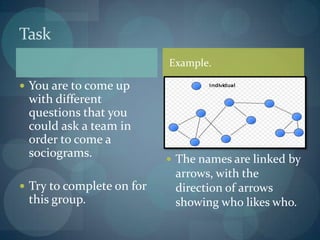
                           Example.

 You are to come up
 with different
 questions that you
 could ask a team in
 order to come a
 sociograms.                The names are linked by
                            arrows, with the
 Try to complete on for    direction of arrows
 this group.                showing who likes who.
Re-cap
 How do we define cohesion?
   What is task cohesion?
   What is social cohesion?
 What role does the coach play when creating an
  affective team climate.
 What is a sociogram?
Aim & Objectives.
 Aim: By the end of this session student will
    Explain how cohesion can affect sports performance
     and how the coach can create effective team climate.
 Objectives: By the end of this session students will
    Define group cohesion.
    Describe task and social cohesion.
    Explain how the coaches role in creating a effect team
     climate.
Next session.
 Cohesion:
   Factors affecting cohesion
   Relationship between cohesion and performance.

Cohesion.(2)

  • 1.
  • 2.
    Aim & Objectives. Aim: By the end of this session student will  Explain how cohesion can affect sports performance and how the coach can create effective team climate.  Objectives: By the end of this session students will  Define group cohesion.  Describe task and social cohesion.  Explain how the coaches role in creating a effect team climate.
  • 3.
    Cohesion.  ‘the totalnumber of forces which act on members to remain in the group.’ (Festinger et al, 1950)  These forces will tend to cover to areas:  The attractiveness of the group to the individual members.  The extent in which the member are willing to work together to achieve their goals.  What are the positives to being a member of a team?  Are there any disadvantages?
  • 4.
    Task: Place thefollowing team sports in order depending upon the level of interaction (Cohesion) needed to be successful.  Rowing (Eights)  Bobsleigh (Fours)  Golf team  Cycling team  Volleyball  4 x 100m relay team  Synchronised  Cricket swimming team (Batting/fielding)  Tennis doubles  Curling.
  • 5.
    Cohesion  Athletes otherreport that cohesion is a form of satisfaction in their lives. However, it has been argued that cohesive teams are not always the most successful. Therefore, it has suggested that cohesion has two distinct aspects.  Task cohesion & social cohesion.  It is often said that task cohesion comes first.  This is the degree to which members work together and are committed to achieve common goals, such as winning a match.
  • 6.
    Cohesion.  If theteam is showing task cohesion frequently then social cohesion will follow.  Is the degree to which group members like each other and get on well, trust and support each other.  However, history has shown many examples where individuals have no interpersonal attraction and are still successful.
  • 7.
    Discussion.  In pairsdiscuss which if any is more important for sporting success.  From this discussion write down your overall answer.
  • 8.
    Cohesion.  In summary,cohesion is important in successful teams, and that task cohesion is more important than social cohesion.  The definition that can be used to explain cohesion as a whole is  ‘a dynamic process which is reflected in the tendency for a group to stick together and remain united in the pursuit of its goals and objections. (Weinburg and Gould, (1995))
  • 9.
    Creating an effectiveteam climate.  Team climate refers to how well the different players in a team get on with each other.  The key to this is how well the players perceive the relationship with other players.  The coach has the most important role in building an effective team climate, but first the coach has to assess team climate.  The two common ways in assessing it are through the use of sociograms and questionnaires.
  • 10.
    Team climate. Questionnaire. Sociograms  The group  These are used to find out who like who and to prevent questionnaire looks at people from getting left out how attractive the or cliques forming. group is to member  They are done by asking questions such as: Who do within the same group. you get on with most when  The more individuals not at training?  The response from these are attracted to the questions is then used to find group the higher levels the more or loss popular in of team cohesion. the group.
  • 11.
    Task Example.  You are to come up with different questions that you could ask a team in order to come a sociograms.  The names are linked by arrows, with the  Try to complete on for direction of arrows this group. showing who likes who.
  • 12.
    Re-cap  How dowe define cohesion?  What is task cohesion?  What is social cohesion?  What role does the coach play when creating an affective team climate.  What is a sociogram?
  • 13.
    Aim & Objectives. Aim: By the end of this session student will  Explain how cohesion can affect sports performance and how the coach can create effective team climate.  Objectives: By the end of this session students will  Define group cohesion.  Describe task and social cohesion.  Explain how the coaches role in creating a effect team climate.
  • 14.
    Next session.  Cohesion:  Factors affecting cohesion  Relationship between cohesion and performance.