TOGETHER WE CAN
ACHIEVE MIRACLES
*Meaning of group
*Difference between group and
team
*Stages of group development
*Video of lagaan
*Different types of group
*Theories of group formation
* what makes team effective
summary
*A collection of individuals who have regular
contact and frequent interaction , mutual
influence and who work together to achieve a
common set of goals.
*A group refers to two or more people who
share a common meaning and come together
to achieve common objectives.
MEANING OF GROUP
*2 or more individual.
*Common goals .
*Interdependence
*Can be formal or informal.
*Recognition by others.
*Cooperation and coordination among the group
members.
BASIC FEATURES OF GROUP
*Any group of people
involved in similar activity
such as sport.
*Interdependence acts as a
crucial part in team
formation.
*They are formed for a
particular purpose and
can be short lived or long
lived.
*2 or more individuals who
share common goals or
objective.
*Interdependence doesnot
play that much important
role in a group.
*Groups exists as a matter
of fact like people of
same religion.
DIFFERENCE
*They are more formal as
their roles are well
defined in advance.
*All the team members
know about each other
that is there is effective
cooperation and
coordination among the
members.
*They are more informal as
the roles are not to be
defined here.
*Members of a group may
or may not have any
personal relationship with
their group members.
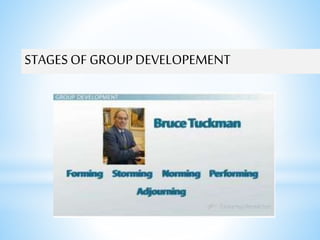
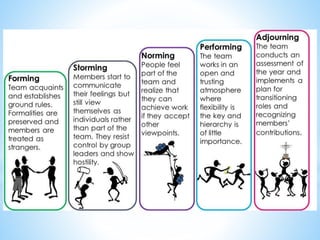
STAGESOF GROUPDEVELOPEMENT
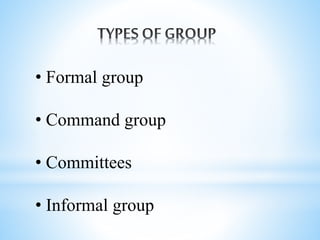
• Formal group
• Command group
• Committees
• Informal group
Formal group is a group which is defined by the
organizational structure. After planning, the
organization group the activities and put those under a
formal structure, deciding their goals and objectives
and strategies to achieve the same. Formal group
members report to their superiors and interact with
each other to achieve the common goals.
Usually a formal group comprises those whose nature
of job is more or less homogeneous.
This group is also known as task group. A task is
defined as cross-functional activities, carried out by
group members to accomplish a common goal. A team
represents the nature of a command group. A
command group can be formed by drawing members
from various formal groups. For example, to achieve
success in new product launches, organizations may
form a command group. Once the task is achieved,
group members may be sent back to their specific
formal groups.
To achieve results, organizations often form
permanent or temporary committees, drawing
members from various formal groups.
Committees also represent the presence of
cross-functional members. While for a
command group, goals may be specific, for
committees, it is varied. Such committees may
be permanent in nature.
Informal groups are the groups which are formed
within a formal organizational structure. Informal
group members primarily meet the social or affiliation
needs sharing their commons interests. It is developed
somewhat naturally among people. They are not as
rigid or as structured as other types of groups and are
not formed due to any type of organizational structure
or need. For example a group of individuals at work
that all like playing chess, they might get together at
lunch to do so from time to time.
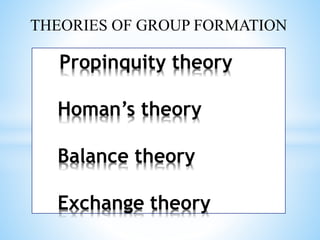
THEORIES OFGROUP FORMATION
Propinquity theory
Homan’s theory
Balance theory
Exchange theory
THEORIES OF GROUP FORMATION
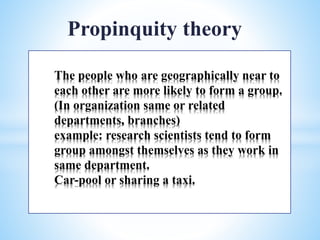
The people who are geographically near to
each other are more likely to form a group.
(In organization same or related
departments, branches)
example: research scientists tend to form
group amongst themselves as they work in
same department.
Car-pool or sharing a taxi.
Propinquity theory
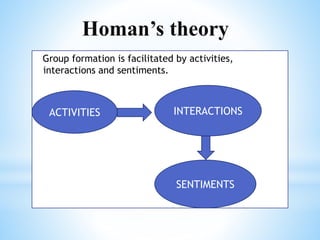
Group formation is facilitated by activities,
interactions and sentiments.
Homan’s theory
ACTIVITIES INTERACTIONS
SENTIMENTS
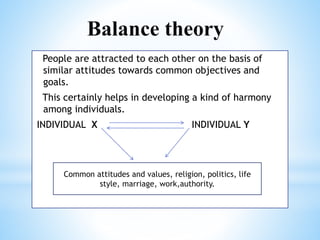
People are attracted to each other on the basis of
similar attitudes towards common objectives and
goals.
This certainly helps in developing a kind of harmony
among individuals.
INDIVIDUAL X INDIVIDUAL Y
Balance theory
Common attitudes and values, religion, politics, life
style, marriage, work,authority.
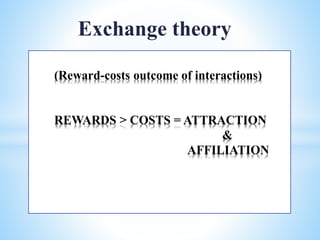
(Reward-costs outcome of interactions)
REWARDS > COSTS = ATTRACTION
&
AFFILIATION
Exchange theory
What makes a team effective
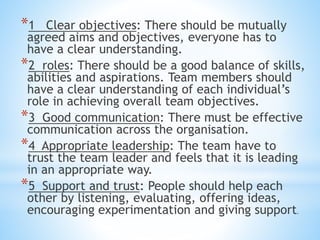
*1 Clear objectives: There should be mutually
agreed aims and objectives, everyone has to
have a clear understanding.
*2 roles: There should be a good balance of skills,
abilities and aspirations. Team members should
have a clear understanding of each individual’s
role in achieving overall team objectives.
*3 Good communication: There must be effective
communication across the organisation.
*4 Appropriate leadership: The team have to
trust the team leader and feels that it is leading
in an appropriate way.
*5 Support and trust: People should help each
other by listening, evaluating, offering ideas,
encouraging experimentation and giving support.
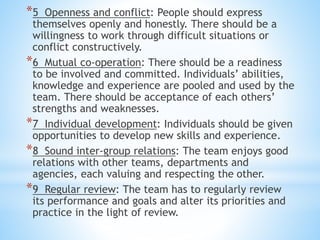
*5 Openness and conflict: People should express
themselves openly and honestly. There should be a
willingness to work through difficult situations or
conflict constructively.
*6 Mutual co-operation: There should be a readiness
to be involved and committed. Individuals’ abilities,
knowledge and experience are pooled and used by the
team. There should be acceptance of each others’
strengths and weaknesses.
*7 Individual development: Individuals should be given
opportunities to develop new skills and experience.
*8 Sound inter-group relations: The team enjoys good
relations with other teams, departments and
agencies, each valuing and respecting the other.
*9 Regular review: The team has to regularly review
its performance and goals and alter its priorities and
practice in the light of review.
Presented by:
Pooja Tayal
Saurabh Chaddha
Sachin Wadhwa
Udit Goel
Yaman Bharti
Jims college sector – 5 , Rohini , Delhi

Group and team dynamics

  • 1.
  • 4.
    *Meaning of group *Differencebetween group and team *Stages of group development *Video of lagaan *Different types of group *Theories of group formation * what makes team effective summary
  • 5.
    *A collection ofindividuals who have regular contact and frequent interaction , mutual influence and who work together to achieve a common set of goals. *A group refers to two or more people who share a common meaning and come together to achieve common objectives. MEANING OF GROUP
  • 6.
    *2 or moreindividual. *Common goals . *Interdependence *Can be formal or informal. *Recognition by others. *Cooperation and coordination among the group members. BASIC FEATURES OF GROUP
  • 7.
    *Any group ofpeople involved in similar activity such as sport. *Interdependence acts as a crucial part in team formation. *They are formed for a particular purpose and can be short lived or long lived. *2 or more individuals who share common goals or objective. *Interdependence doesnot play that much important role in a group. *Groups exists as a matter of fact like people of same religion. DIFFERENCE
  • 8.
    *They are moreformal as their roles are well defined in advance. *All the team members know about each other that is there is effective cooperation and coordination among the members. *They are more informal as the roles are not to be defined here. *Members of a group may or may not have any personal relationship with their group members.
  • 9.
  • 13.
    • Formal group •Command group • Committees • Informal group
  • 14.
    Formal group isa group which is defined by the organizational structure. After planning, the organization group the activities and put those under a formal structure, deciding their goals and objectives and strategies to achieve the same. Formal group members report to their superiors and interact with each other to achieve the common goals. Usually a formal group comprises those whose nature of job is more or less homogeneous.
  • 15.
    This group isalso known as task group. A task is defined as cross-functional activities, carried out by group members to accomplish a common goal. A team represents the nature of a command group. A command group can be formed by drawing members from various formal groups. For example, to achieve success in new product launches, organizations may form a command group. Once the task is achieved, group members may be sent back to their specific formal groups.
  • 16.
    To achieve results,organizations often form permanent or temporary committees, drawing members from various formal groups. Committees also represent the presence of cross-functional members. While for a command group, goals may be specific, for committees, it is varied. Such committees may be permanent in nature.
  • 17.
    Informal groups arethe groups which are formed within a formal organizational structure. Informal group members primarily meet the social or affiliation needs sharing their commons interests. It is developed somewhat naturally among people. They are not as rigid or as structured as other types of groups and are not formed due to any type of organizational structure or need. For example a group of individuals at work that all like playing chess, they might get together at lunch to do so from time to time.
  • 18.
  • 19.
    Propinquity theory Homan’s theory Balancetheory Exchange theory THEORIES OF GROUP FORMATION
  • 20.
    The people whoare geographically near to each other are more likely to form a group. (In organization same or related departments, branches) example: research scientists tend to form group amongst themselves as they work in same department. Car-pool or sharing a taxi. Propinquity theory
  • 21.
    Group formation isfacilitated by activities, interactions and sentiments. Homan’s theory ACTIVITIES INTERACTIONS SENTIMENTS
  • 22.
    People are attractedto each other on the basis of similar attitudes towards common objectives and goals. This certainly helps in developing a kind of harmony among individuals. INDIVIDUAL X INDIVIDUAL Y Balance theory Common attitudes and values, religion, politics, life style, marriage, work,authority.
  • 23.
    (Reward-costs outcome ofinteractions) REWARDS > COSTS = ATTRACTION & AFFILIATION Exchange theory
  • 24.
    What makes ateam effective
  • 25.
    *1 Clear objectives:There should be mutually agreed aims and objectives, everyone has to have a clear understanding. *2 roles: There should be a good balance of skills, abilities and aspirations. Team members should have a clear understanding of each individual’s role in achieving overall team objectives. *3 Good communication: There must be effective communication across the organisation. *4 Appropriate leadership: The team have to trust the team leader and feels that it is leading in an appropriate way. *5 Support and trust: People should help each other by listening, evaluating, offering ideas, encouraging experimentation and giving support.
  • 26.
    *5 Openness andconflict: People should express themselves openly and honestly. There should be a willingness to work through difficult situations or conflict constructively. *6 Mutual co-operation: There should be a readiness to be involved and committed. Individuals’ abilities, knowledge and experience are pooled and used by the team. There should be acceptance of each others’ strengths and weaknesses. *7 Individual development: Individuals should be given opportunities to develop new skills and experience. *8 Sound inter-group relations: The team enjoys good relations with other teams, departments and agencies, each valuing and respecting the other. *9 Regular review: The team has to regularly review its performance and goals and alter its priorities and practice in the light of review.
  • 27.
    Presented by: Pooja Tayal SaurabhChaddha Sachin Wadhwa Udit Goel Yaman Bharti Jims college sector – 5 , Rohini , Delhi