Cohesion and Development
Chapter 2
Group Cohesion




The concept of cohesion has been an
important factor in the study of group
behavior and its significance is often a
source of motivation for group leaders.
Cliches such as "Together We Stand,
Divided We Fall", "There is No I in Team",
or "Players Play, Teams Win" are often
used to show individuals the importance
of team cohesion.
Definitions of Group Cohesion


“a dynamic process that is reflected in the
tendency of a group to stick together and
remain united in the pursuit of its
instrumental objectives and/or for the
satisfaction of member needs”
What is Group Cohesion?


Group cohesion has been conceptualized in
many ways
 Cohesion = Attraction: (Festinger)
Members of cohesive groups tend to like
their fellow members
 Hogg: social attraction (depersonalized
liking for others in our group) vs. personal
attraction (liking for specific individuals)
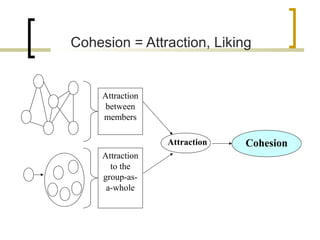
Cohesion = Attraction, Liking

Attraction
between
members
Attraction
Attraction
to the
group-asa-whole

Cohesion




1.
2.
3.
4.

Cohesion
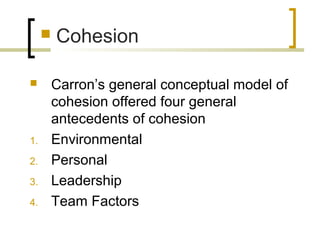
Carron’s general conceptual model of
cohesion offered four general
antecedents of cohesion
Environmental
Personal
Leadership
Team Factors








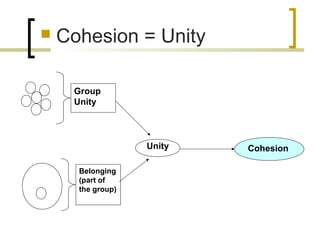
Cohesion = Unity

Cohesive groups stick together as
members “cohere” to one another &the
group
The group is unified; solidarity is high in
the group.
Members report feeling a sense of
belonging to the group


Cohesion = Unity
Group
Unity

Unity
Belonging
(part of
the group)

Cohesion
Cohesion = Teamwork






The combined activities of two of more
individuals who coordinate their efforts to
achieve goals
Collective efficacy: a high level of
confidence about success at the tasks the
group accepts
Esprit de corps: feeling of unity commitment,
confidence, and enthusiasm for the group
shared by most of all of the members
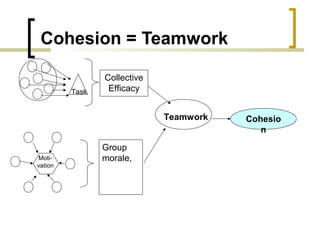
Cohesion = Teamwork
Task

Collective
Efficacy
Teamwork

Motivation

Group
morale,

Cohesio
n
Does Cohesion Develop Over Time?


Cohesion develops over time in a relatively
predictable pattern



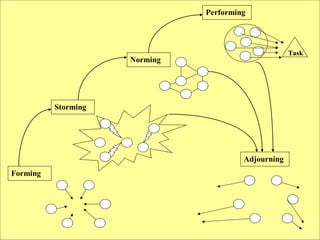
Tuckman's five-stage model of group
development






Orientation (forming) stage
Conflict (storming) stage
Structure development (norming) stage
Work (performing) stage
Dissolution (adjourning) stage (planned and
unplanned)
Performing

Task

Norming

Storming

Adjourning
Forming
Forming






First moments of a newly formed
group’s life
Often marked by tension, guarded
interchanges, and low levels of
interaction
People monitor their behaviour and
are tentative when expression
opinions
Storming






Tension increases in the storming
phase – over goals, procedures,
authority etc.
Conflict often causes fight or flight
responses
Conflict is a required element for
creating team cohesion
Norming






Group becomes more unified and
organized
Mutual trust and support increases
Rules, roles, and goals are established
Communication increases
Performing






Productivity is usually not instantaneous,
thus productivity must wait until the group
matures
Many groups get sidetracked by the
storming or norming phases
More mature groups spend less time
socializing, less time in conflict and need
less guidance than less mature teams
Adjourning




Either planned or spontaneous
Can be stressful for team members
If dissolution is unplanned, the final
group sessions may be filled with
animosity and apathy
What are the Consequences of Cohesion?


Cohesion tends to lead to:
 Increased member satisfaction
 Decreased employee turnover and stress



Cohesive groups can intensify emotional and social
processes. Such groups can:
 Be more emotionally demanding (e.g, the old
sergeant syndrome)
 Exert more conformity pressure on members
 Suffer from groupthink
 Respond with more hostility
Positive & Negative Consequences (cont’d)



The cohesion-performance relationship is bi-directional:
success increases a group’s cohesion and cohesive
groups tend to outperform less cohesive groups.
o The cohesion-performance relationship is strongest

when members are committed to the group's tasks.
Does Cohesion Develop Over Time?


Types of group development models


Successive-stage theories
Should Organizations Rely on Teams to
Enhance Productivity?


What is a team?
A specialized, relatively organized, task focused group
Features (same as any group):
 Interaction
 Interdependence
 Structure
 Goals
 Cohesion
Goal Setting




In order for employees to achieve their
true potential they must set themselves
targets
These targets are called “goals”
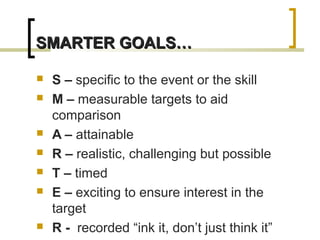
SMARTER GOALS…










S – specific to the event or the skill
M – measurable targets to aid
comparison
A – attainable
R – realistic, challenging but possible
T – timed
E – exciting to ensure interest in the
target
R - recorded “ink it, don’t just think it”

Cohesion development

  • 1.
  • 2.
    Group Cohesion   The conceptof cohesion has been an important factor in the study of group behavior and its significance is often a source of motivation for group leaders. Cliches such as "Together We Stand, Divided We Fall", "There is No I in Team", or "Players Play, Teams Win" are often used to show individuals the importance of team cohesion.
  • 3.
    Definitions of GroupCohesion  “a dynamic process that is reflected in the tendency of a group to stick together and remain united in the pursuit of its instrumental objectives and/or for the satisfaction of member needs”
  • 4.
    What is GroupCohesion?  Group cohesion has been conceptualized in many ways  Cohesion = Attraction: (Festinger) Members of cohesive groups tend to like their fellow members  Hogg: social attraction (depersonalized liking for others in our group) vs. personal attraction (liking for specific individuals)
  • 5.
    Cohesion = Attraction,Liking Attraction between members Attraction Attraction to the group-asa-whole Cohesion
  • 6.
      1. 2. 3. 4. Cohesion Carron’s general conceptualmodel of cohesion offered four general antecedents of cohesion Environmental Personal Leadership Team Factors
  • 7.
        Cohesion = Unity Cohesivegroups stick together as members “cohere” to one another &the group The group is unified; solidarity is high in the group. Members report feeling a sense of belonging to the group
  • 8.
  • 9.
    Cohesion = Teamwork    Thecombined activities of two of more individuals who coordinate their efforts to achieve goals Collective efficacy: a high level of confidence about success at the tasks the group accepts Esprit de corps: feeling of unity commitment, confidence, and enthusiasm for the group shared by most of all of the members
  • 10.
  • 11.
    Does Cohesion DevelopOver Time?  Cohesion develops over time in a relatively predictable pattern  Tuckman's five-stage model of group development      Orientation (forming) stage Conflict (storming) stage Structure development (norming) stage Work (performing) stage Dissolution (adjourning) stage (planned and unplanned)
  • 12.
  • 13.
    Forming    First moments ofa newly formed group’s life Often marked by tension, guarded interchanges, and low levels of interaction People monitor their behaviour and are tentative when expression opinions
  • 14.
    Storming    Tension increases inthe storming phase – over goals, procedures, authority etc. Conflict often causes fight or flight responses Conflict is a required element for creating team cohesion
  • 15.
    Norming     Group becomes moreunified and organized Mutual trust and support increases Rules, roles, and goals are established Communication increases
  • 16.
    Performing    Productivity is usuallynot instantaneous, thus productivity must wait until the group matures Many groups get sidetracked by the storming or norming phases More mature groups spend less time socializing, less time in conflict and need less guidance than less mature teams
  • 17.
    Adjourning    Either planned orspontaneous Can be stressful for team members If dissolution is unplanned, the final group sessions may be filled with animosity and apathy
  • 18.
    What are theConsequences of Cohesion?  Cohesion tends to lead to:  Increased member satisfaction  Decreased employee turnover and stress  Cohesive groups can intensify emotional and social processes. Such groups can:  Be more emotionally demanding (e.g, the old sergeant syndrome)  Exert more conformity pressure on members  Suffer from groupthink  Respond with more hostility
  • 19.
    Positive & NegativeConsequences (cont’d)  The cohesion-performance relationship is bi-directional: success increases a group’s cohesion and cohesive groups tend to outperform less cohesive groups. o The cohesion-performance relationship is strongest when members are committed to the group's tasks.
  • 20.
    Does Cohesion DevelopOver Time?  Types of group development models  Successive-stage theories
  • 21.
    Should Organizations Relyon Teams to Enhance Productivity?  What is a team? A specialized, relatively organized, task focused group Features (same as any group):  Interaction  Interdependence  Structure  Goals  Cohesion
  • 22.
    Goal Setting   In orderfor employees to achieve their true potential they must set themselves targets These targets are called “goals”
  • 23.
    SMARTER GOALS…        S –specific to the event or the skill M – measurable targets to aid comparison A – attainable R – realistic, challenging but possible T – timed E – exciting to ensure interest in the target R - recorded “ink it, don’t just think it”