05/24/13PPT brought to you by www.managementguru.net
1
Group DynamicsGroup Dynamics
An Interplay of Emotions
05/24/13PPT brought to you by www.managementguru.net
2
IntroductionIntroduction
Human Resource Management is all about
tackling the interplay between emotions
where lot of psychology is involved.
A discussion on Group Dynamics will be a
perfect choice for the better understanding
of Human Resource.
05/24/13PPT brought to you by www.managementguru.net
3
Case StudyCase Study
Sinking Boat Situation: Case Study
 On a dark summer night, seven persons are fighting for their lives on a
swamped and sinking boat on a black tropical sea. They are not alone, a big
shark was looming on the downside of the boat and more were yet to arrive
to give company. Now they are faced with a difficult choice which they
have to think over, overcoming the fear gutting their throat.
 Option 1: If they kick in unison, they may be able to fight the fierce current
and tides driving away from the shore and all make it to the safety.
 Option2: If they all stick together, they have an equal chance to survive or
drown.
 Option 3: If they split up, each doing it alone, one or two of the stronger
swimmers might make it to the safety, but the majority will certainly drown
or devoured by sharks.List the topics to be covered
05/24/13PPT brought to you by www.managementguru.net
4
Activate your BrainActivate your Brain
Questions you need to answer:
 1. Which alternative would you choose if you
were there?
 2. What kind of people would you want as
companions in such a situation? (In real life-
threatening situations, there will never be a
choice and everything will be chance
situations).Explain how all the individual topics
fit together
05/24/13PPT brought to you by www.managementguru.net
5
Core Activities of a GroupCore Activities of a Group
Any effective group has three core activities:
 1. Accomplishing its goals
 2. Maintaining itself internally
 3. Developing and changing in ways that
improves its effectiveness Let us now try to
understand the various dimensions of an
effective group that facilitate the above
mentioned three core elements to function
properly which provide a sense of direction to
the productive group.
05/24/13PPT brought to you by www.managementguru.net
6
Characteristics of a ProductiveCharacteristics of a Productive
Group-IGroup-I
 Group goals: Must be clearly understood · Be relevant to the needs of the group
members. Highlight the positive inter dependence of members. Evoke from every
member a high level of commitment to their accomplishment
 b) Communication: Must communicate their ideas and feelings accurately and
clearly. Effective two way communication is mandatory for interaction
 c) Participation and Leadership: All should participate and all should be listened to.
Share responsibilities that eases the burden. Increases the cohesiveness of the group
 d) Appropriate decision making procedure: Balance between time and member
resources. Flexible decision making to suit the needs of the situation
 e) Power and Influence:
 · Should be equal
 · Based on expertise, ability and access to information and not on authority ·
Coalitions must be formed between group members on the basis of mutual influence
and interdependencee an example
05/24/13PPT brought to you by www.managementguru.net
7
Characteristics of a ProductiveCharacteristics of a Productive
Group-IIGroup-II
 f) Conflicts:
· Are to be encouraged as they promote involvement in the group’s work,
improve quality and creativity in decision making.
· Minority opinions should be accepted and used
 g) Group Cohesion:
· Needs to be high
· Level of acceptance, support, and trust among the members decide how
cohesive the group is
 h) Problem Solving:
· Problems should be resolved with minimal energy and permanently
· Existence of problems must be found out quickly and solutions should
improve the effectiveness of group behavior
 i) Inter-personal effectiveness:
· Needs to be high
· It is a measure of how all the consequences of your behavior match your
intention.detail
05/24/13PPT brought to you by www.managementguru.net
8
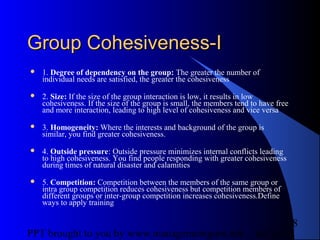
Group Cohesiveness-IGroup Cohesiveness-I
 1. Degree of dependency on the group: The greater the number of
individual needs are satisfied, the greater the cohesiveness
 2. Size: If the size of the group interaction is low, it results in low
cohesiveness. If the size of the group is small, the members tend to have free
and more interaction, leading to high level of cohesiveness and vice versa
 3. Homogeneity: Where the interests and background of the group is
similar, you find greater cohesiveness.
 4. Outside pressure: Outside pressure minimizes internal conflicts leading
to high cohesiveness. You find people responding with greater cohesiveness
during times of natural disaster and calamities
 5. Competition: Competition between the members of the same group or
intra group competition reduces cohesiveness but competition members of
different groups or inter-group competition increases cohesiveness.Define
ways to apply training
05/24/13PPT brought to you by www.managementguru.net
9
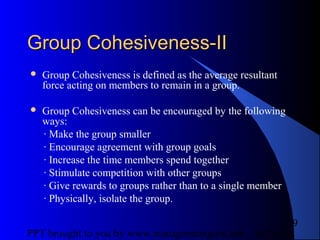
Group Cohesiveness-IIGroup Cohesiveness-II
 Group Cohesiveness is defined as the average resultant
force acting on members to remain in a group.
 Group Cohesiveness can be encouraged by the following
ways:
· Make the group smaller
· Encourage agreement with group goals
· Increase the time members spend together
· Stimulate competition with other groups
· Give rewards to groups rather than to a single member
· Physically, isolate the group.
05/24/13PPT brought to you by www.managementguru.net
9
Group Cohesiveness-IIGroup Cohesiveness-II
 Group Cohesiveness is defined as the average resultant
force acting on members to remain in a group.
 Group Cohesiveness can be encouraged by the following
ways:
· Make the group smaller
· Encourage agreement with group goals
· Increase the time members spend together
· Stimulate competition with other groups
· Give rewards to groups rather than to a single member
· Physically, isolate the group.

Group dynamics

  • 1.
    05/24/13PPT brought toyou by www.managementguru.net 1 Group DynamicsGroup Dynamics An Interplay of Emotions
  • 2.
    05/24/13PPT brought toyou by www.managementguru.net 2 IntroductionIntroduction Human Resource Management is all about tackling the interplay between emotions where lot of psychology is involved. A discussion on Group Dynamics will be a perfect choice for the better understanding of Human Resource.
  • 3.
    05/24/13PPT brought toyou by www.managementguru.net 3 Case StudyCase Study Sinking Boat Situation: Case Study  On a dark summer night, seven persons are fighting for their lives on a swamped and sinking boat on a black tropical sea. They are not alone, a big shark was looming on the downside of the boat and more were yet to arrive to give company. Now they are faced with a difficult choice which they have to think over, overcoming the fear gutting their throat.  Option 1: If they kick in unison, they may be able to fight the fierce current and tides driving away from the shore and all make it to the safety.  Option2: If they all stick together, they have an equal chance to survive or drown.  Option 3: If they split up, each doing it alone, one or two of the stronger swimmers might make it to the safety, but the majority will certainly drown or devoured by sharks.List the topics to be covered
  • 4.
    05/24/13PPT brought toyou by www.managementguru.net 4 Activate your BrainActivate your Brain Questions you need to answer:  1. Which alternative would you choose if you were there?  2. What kind of people would you want as companions in such a situation? (In real life- threatening situations, there will never be a choice and everything will be chance situations).Explain how all the individual topics fit together
  • 5.
    05/24/13PPT brought toyou by www.managementguru.net 5 Core Activities of a GroupCore Activities of a Group Any effective group has three core activities:  1. Accomplishing its goals  2. Maintaining itself internally  3. Developing and changing in ways that improves its effectiveness Let us now try to understand the various dimensions of an effective group that facilitate the above mentioned three core elements to function properly which provide a sense of direction to the productive group.
  • 6.
    05/24/13PPT brought toyou by www.managementguru.net 6 Characteristics of a ProductiveCharacteristics of a Productive Group-IGroup-I  Group goals: Must be clearly understood · Be relevant to the needs of the group members. Highlight the positive inter dependence of members. Evoke from every member a high level of commitment to their accomplishment  b) Communication: Must communicate their ideas and feelings accurately and clearly. Effective two way communication is mandatory for interaction  c) Participation and Leadership: All should participate and all should be listened to. Share responsibilities that eases the burden. Increases the cohesiveness of the group  d) Appropriate decision making procedure: Balance between time and member resources. Flexible decision making to suit the needs of the situation  e) Power and Influence:  · Should be equal  · Based on expertise, ability and access to information and not on authority · Coalitions must be formed between group members on the basis of mutual influence and interdependencee an example
  • 7.
    05/24/13PPT brought toyou by www.managementguru.net 7 Characteristics of a ProductiveCharacteristics of a Productive Group-IIGroup-II  f) Conflicts: · Are to be encouraged as they promote involvement in the group’s work, improve quality and creativity in decision making. · Minority opinions should be accepted and used  g) Group Cohesion: · Needs to be high · Level of acceptance, support, and trust among the members decide how cohesive the group is  h) Problem Solving: · Problems should be resolved with minimal energy and permanently · Existence of problems must be found out quickly and solutions should improve the effectiveness of group behavior  i) Inter-personal effectiveness: · Needs to be high · It is a measure of how all the consequences of your behavior match your intention.detail
  • 8.
    05/24/13PPT brought toyou by www.managementguru.net 8 Group Cohesiveness-IGroup Cohesiveness-I  1. Degree of dependency on the group: The greater the number of individual needs are satisfied, the greater the cohesiveness  2. Size: If the size of the group interaction is low, it results in low cohesiveness. If the size of the group is small, the members tend to have free and more interaction, leading to high level of cohesiveness and vice versa  3. Homogeneity: Where the interests and background of the group is similar, you find greater cohesiveness.  4. Outside pressure: Outside pressure minimizes internal conflicts leading to high cohesiveness. You find people responding with greater cohesiveness during times of natural disaster and calamities  5. Competition: Competition between the members of the same group or intra group competition reduces cohesiveness but competition members of different groups or inter-group competition increases cohesiveness.Define ways to apply training
  • 9.
    05/24/13PPT brought toyou by www.managementguru.net 9 Group Cohesiveness-IIGroup Cohesiveness-II  Group Cohesiveness is defined as the average resultant force acting on members to remain in a group.  Group Cohesiveness can be encouraged by the following ways: · Make the group smaller · Encourage agreement with group goals · Increase the time members spend together · Stimulate competition with other groups · Give rewards to groups rather than to a single member · Physically, isolate the group.
  • 10.
    05/24/13PPT brought toyou by www.managementguru.net 9 Group Cohesiveness-IIGroup Cohesiveness-II  Group Cohesiveness is defined as the average resultant force acting on members to remain in a group.  Group Cohesiveness can be encouraged by the following ways: · Make the group smaller · Encourage agreement with group goals · Increase the time members spend together · Stimulate competition with other groups · Give rewards to groups rather than to a single member · Physically, isolate the group.