www.humanikaconsulting.comSocial Psychology
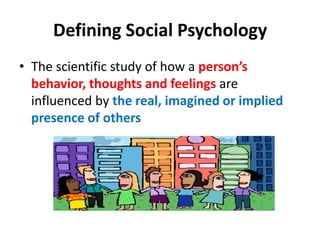
Defining Social PsychologyThe scientific study of how a person’s behavior, thoughts and feelings are influenced by the real, imagined or implied presence of others
What differentiates Social Psychology from other disciplines?Focus on social nature of 	the individual personTwo assertions:Person is influenced by 	social environmentIndividual actively construes social situations – we do not respond to environments as they are but as we interpret them to be
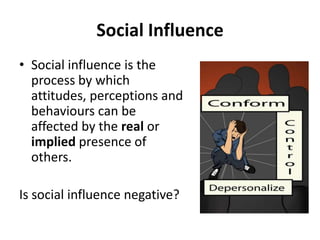
Defining Social PsychologySocial InfluenceThe ways in which a person’s behavior can be affected by the presence of othersSocial CognitionThe ways in which people think about other peopleSocial InteractionThe positive and negative aspects of people relating to othersSocial InfluenceSocial influence is the process by which attitudes, perceptions and behaviours can be affected by the real or implied presence of others.Is social influence negative?
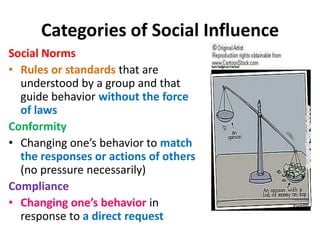
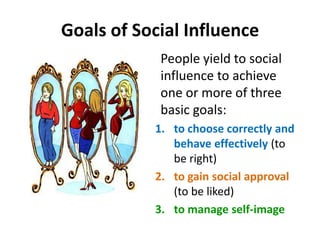
Categories of Social InfluenceSocial NormsRules or standards that are understood by a group and that guide behavior without the force of lawsConformity Changing one’s behavior to match the responses or actions of others (no pressure necessarily)ComplianceChanging one’s behavior in response to a direct requestGoals of Social Influence	People yield to social influence to achieve one or more of three basic goals: to choose correctly and behave effectively (to be right)to gain social approval (to be liked)to manage self-image
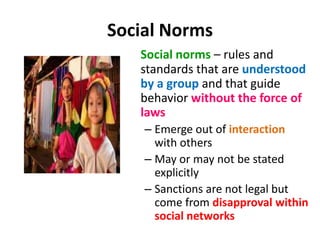
Social NormsSocial norms – rules and standards that are understood by a group and that guide behavior without the force of lawsEmerge out of interaction with othersMay or may not be stated explicitlySanctions are not legal but come from disapproval within social networks
What are examples of social norms in the Philippines?Can norms be maladaptive?
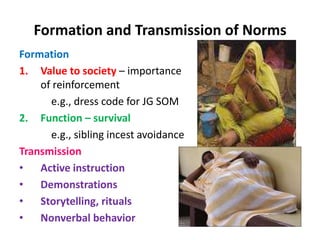
Formation and Transmission of NormsFormationValue to society – importance of reinforcement e.g., dress code for JG SOMFunction – survival e.g., sibling incest avoidanceTransmissionActive instructionDemonstrationsStorytelling, ritualsNonverbal behavior
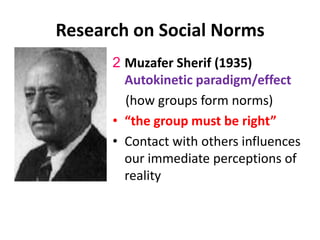
Research on Social NormsMuzafer Sherif (1935)Autokinetic paradigm/effect     (how groups form norms)“the group must be right”Contact with others influences our immediate perceptions of reality
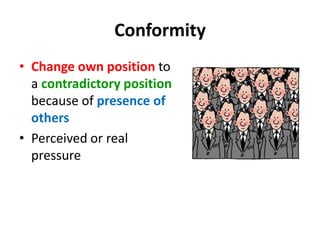
ConformityChange own position to a contradictory position because of presence of others Perceived or real pressure
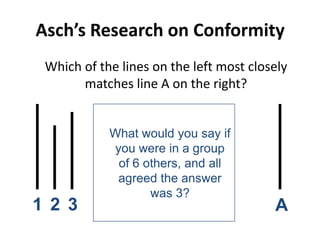
Asch’s Research on Conformity	Which of the lines on the left most closely matches line A on the right?	What would you say if you were in a group of 6 others, and all agreed the answer was 3? 123A
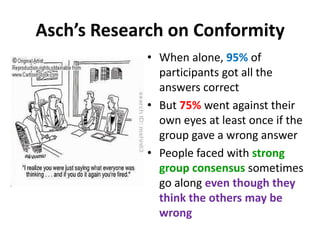
Asch’s Research on ConformityWhen alone, 95% of participants got all the answers correctBut 75% went against their own eyes at least once if the group gave a wrong answerPeople faced with strong group consensus sometimes go along even though they think the others may be wrong
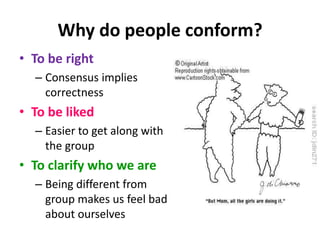
Why do people conform?To be right Consensus implies correctnessTo be likedEasier to get along with the groupTo clarify who we areBeing different from group makes us feel bad about ourselves
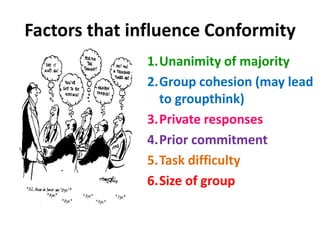
Factors that influence ConformityUnanimity of majorityGroup cohesion (may lead to groupthink)Private responsesPrior commitmentTask difficultySize of group
GroupthinkThinking that occurs when people place more importance on maintaining group cohesiveness than on assessing the facts of the problem with which the group is concerned
Characteristics of GroupthinkInvulnerabilityRationalizationLack of introspectionStereotypingPressureLack of disagreementSelf-deceptionInsularity
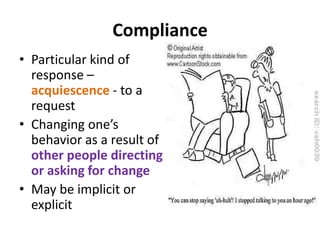
ComplianceParticular kind of response – acquiescence - to a requestChanging one’s behavior as a result of other people directing or asking for changeMay be implicit or explicit
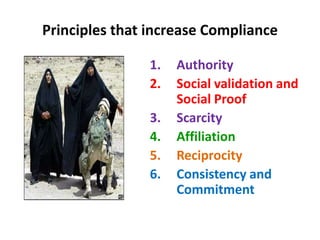
Principles that increase ComplianceAuthoritySocial validation and Social ProofScarcityAffiliationReciprocityConsistency and Commitment
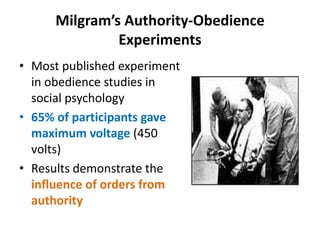
Milgram’s Authority-Obedience ExperimentsMost published experiment in obedience studies in social psychology65% of participants gave maximum voltage (450 volts)Results demonstrate the influence of orders from authority
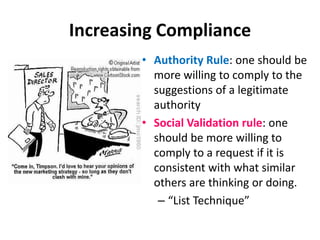
Increasing ComplianceAuthority Rule: one should be more willing to comply to the suggestions of a legitimate authoritySocial Validation rule: one should be more willing to comply to a request if it is consistent with what similar others are thinking or doing. “List Technique”
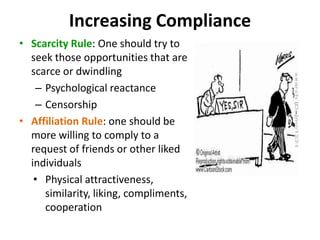
Increasing ComplianceScarcity Rule: One should try to seek those opportunities that are scarce or dwindlingPsychological reactanceCensorshipAffiliation Rule: one should be more willing to comply to a request of friends or other liked individualsPhysical attractiveness, similarity, liking, compliments, cooperation
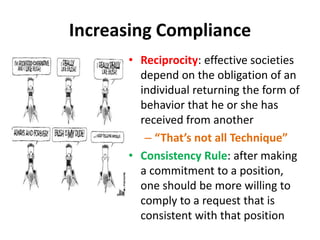
Increasing ComplianceReciprocity: effective societies depend on the obligation of an individual returning the form of behavior that he or she has received from another“That’s not all Technique”Consistency Rule: after making a commitment to a position, one should be more willing to comply to a request that is consistent with that position
Choose a current issue in the Philippines How is social influence played out in this particular issue?Cite negative and positiove consequences of social influence in relation to this issue 
Commitment TechniquesThe Foot-in-the-Door TechniqueThe Low-Ball TechniqueThe Bait and Switch TechniqueLabeling Technique
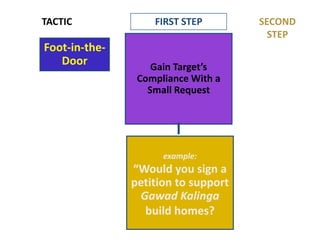
FIRST STEPSECOND STEPTACTICGain Target’s Compliance With a Small RequestFoot-in-the-Doorexample:“Would you sign a petition to support  Gawad Kalinga build homes?
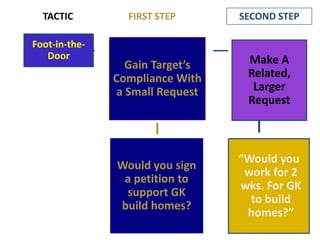
FIRST STEPSECOND STEPTACTICFoot-in-the-DoorGain Target’s Compliance With a Small RequestMake A Related, Larger RequestWould you sign a petition to support GK build homes?“Would you work for 2 wks. For GK to build homes?”
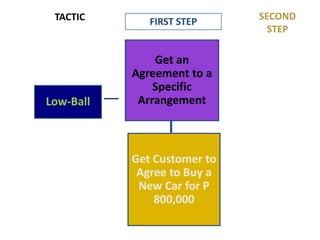
SECOND STEPTACTICFIRST STEPGet an Agreement to a Specific ArrangementLow-BallGet Customer to Agree to Buy a New Car for P 800,000
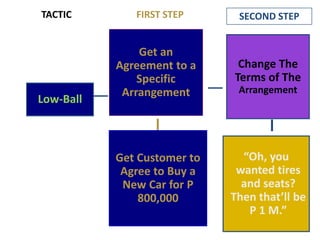
FIRST STEPTACTICSECOND STEPGet an Agreement to a Specific ArrangementChange The Terms of The ArrangementLow-BallGet Customer to Agree to Buy a New Car for P 800,000“Oh, you wanted tires and seats? Then that’ll be P 1 M.”
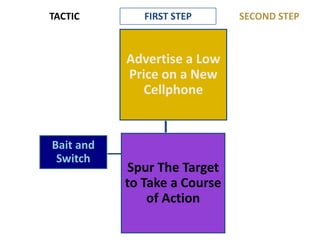
FIRST STEPSECOND STEPTACTICAdvertise a Low Price on a New CellphoneSpur The Target to Take a Course of ActionBait and Switch
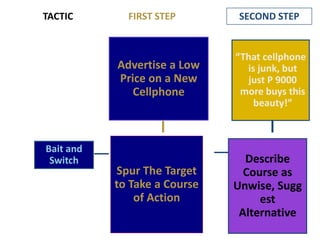
FIRST STEPTACTICSECOND STEPAdvertise a Low Price on a New Cellphone“That cellphone is junk, but just P 9000 more buys this beauty!”Spur The Target to Take a Course of ActionDescribe Course as Unwise, Suggest AlternativeBait and Switch
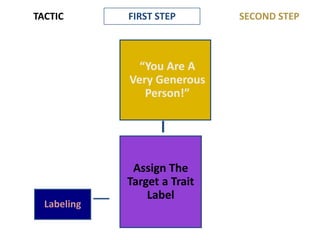
FIRST STEPSECOND STEPTACTIC“You Are A Very Generous Person!”Assign The Target a Trait LabelLabeling
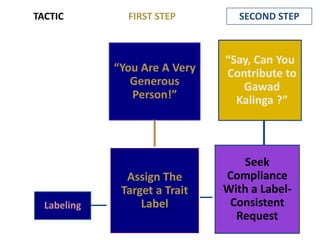
FIRST STEPTACTICSECOND STEP“Say, Can You Contribute to Gawad Kalinga ?”“You Are A Very Generous Person!”Seek Compliance With a Label- Consistent RequestAssign The Target a Trait LabelLabeling
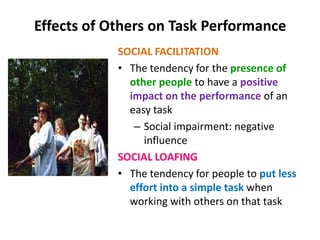
Effects of Others on Task PerformanceSOCIAL FACILITATIONThe tendency for the presence of other people to have a positive impact on the performance of an easy taskSocial impairment: negative influenceSOCIAL LOAFINGThe tendency for people to put less effort into a simple task when working with others on that task
BangunLingkunganLebihbaikuntukI N D O N E S I A
Social psychology
Social psychology

Social psychology

  • 1.
  • 2.
    Defining Social PsychologyThescientific study of how a person’s behavior, thoughts and feelings are influenced by the real, imagined or implied presence of others
  • 3.
    What differentiates SocialPsychology from other disciplines?Focus on social nature of the individual personTwo assertions:Person is influenced by social environmentIndividual actively construes social situations – we do not respond to environments as they are but as we interpret them to be
  • 4.
    Defining Social PsychologySocialInfluenceThe ways in which a person’s behavior can be affected by the presence of othersSocial CognitionThe ways in which people think about other peopleSocial InteractionThe positive and negative aspects of people relating to othersSocial InfluenceSocial influence is the process by which attitudes, perceptions and behaviours can be affected by the real or implied presence of others.Is social influence negative?
  • 5.
    Categories of SocialInfluenceSocial NormsRules or standards that are understood by a group and that guide behavior without the force of lawsConformity Changing one’s behavior to match the responses or actions of others (no pressure necessarily)ComplianceChanging one’s behavior in response to a direct requestGoals of Social Influence People yield to social influence to achieve one or more of three basic goals: to choose correctly and behave effectively (to be right)to gain social approval (to be liked)to manage self-image
  • 6.
    Social NormsSocial norms– rules and standards that are understood by a group and that guide behavior without the force of lawsEmerge out of interaction with othersMay or may not be stated explicitlySanctions are not legal but come from disapproval within social networks
  • 7.
    What are examplesof social norms in the Philippines?Can norms be maladaptive?
  • 8.
    Formation and Transmissionof NormsFormationValue to society – importance of reinforcement e.g., dress code for JG SOMFunction – survival e.g., sibling incest avoidanceTransmissionActive instructionDemonstrationsStorytelling, ritualsNonverbal behavior
  • 9.
    Research on SocialNormsMuzafer Sherif (1935)Autokinetic paradigm/effect (how groups form norms)“the group must be right”Contact with others influences our immediate perceptions of reality
  • 10.
    ConformityChange own positionto a contradictory position because of presence of others Perceived or real pressure
  • 11.
    Asch’s Research onConformity Which of the lines on the left most closely matches line A on the right? What would you say if you were in a group of 6 others, and all agreed the answer was 3? 123A
  • 12.
    Asch’s Research onConformityWhen alone, 95% of participants got all the answers correctBut 75% went against their own eyes at least once if the group gave a wrong answerPeople faced with strong group consensus sometimes go along even though they think the others may be wrong
  • 13.
    Why do peopleconform?To be right Consensus implies correctnessTo be likedEasier to get along with the groupTo clarify who we areBeing different from group makes us feel bad about ourselves
  • 14.
    Factors that influenceConformityUnanimity of majorityGroup cohesion (may lead to groupthink)Private responsesPrior commitmentTask difficultySize of group
  • 15.
    GroupthinkThinking that occurswhen people place more importance on maintaining group cohesiveness than on assessing the facts of the problem with which the group is concerned
  • 16.
    Characteristics of GroupthinkInvulnerabilityRationalizationLackof introspectionStereotypingPressureLack of disagreementSelf-deceptionInsularity
  • 17.
    ComplianceParticular kind ofresponse – acquiescence - to a requestChanging one’s behavior as a result of other people directing or asking for changeMay be implicit or explicit
  • 18.
    Principles that increaseComplianceAuthoritySocial validation and Social ProofScarcityAffiliationReciprocityConsistency and Commitment
  • 19.
    Milgram’s Authority-Obedience ExperimentsMostpublished experiment in obedience studies in social psychology65% of participants gave maximum voltage (450 volts)Results demonstrate the influence of orders from authority
  • 20.
    Increasing ComplianceAuthority Rule:one should be more willing to comply to the suggestions of a legitimate authoritySocial Validation rule: one should be more willing to comply to a request if it is consistent with what similar others are thinking or doing. “List Technique”
  • 21.
    Increasing ComplianceScarcity Rule:One should try to seek those opportunities that are scarce or dwindlingPsychological reactanceCensorshipAffiliation Rule: one should be more willing to comply to a request of friends or other liked individualsPhysical attractiveness, similarity, liking, compliments, cooperation
  • 22.
    Increasing ComplianceReciprocity: effectivesocieties depend on the obligation of an individual returning the form of behavior that he or she has received from another“That’s not all Technique”Consistency Rule: after making a commitment to a position, one should be more willing to comply to a request that is consistent with that position
  • 23.
    Choose a currentissue in the Philippines How is social influence played out in this particular issue?Cite negative and positiove consequences of social influence in relation to this issue 
  • 24.
    Commitment TechniquesThe Foot-in-the-DoorTechniqueThe Low-Ball TechniqueThe Bait and Switch TechniqueLabeling Technique
  • 25.
    FIRST STEPSECOND STEPTACTICGainTarget’s Compliance With a Small RequestFoot-in-the-Doorexample:“Would you sign a petition to support Gawad Kalinga build homes?
  • 26.
    FIRST STEPSECOND STEPTACTICFoot-in-the-DoorGainTarget’s Compliance With a Small RequestMake A Related, Larger RequestWould you sign a petition to support GK build homes?“Would you work for 2 wks. For GK to build homes?”
  • 27.
    SECOND STEPTACTICFIRST STEPGetan Agreement to a Specific ArrangementLow-BallGet Customer to Agree to Buy a New Car for P 800,000
  • 28.
    FIRST STEPTACTICSECOND STEPGetan Agreement to a Specific ArrangementChange The Terms of The ArrangementLow-BallGet Customer to Agree to Buy a New Car for P 800,000“Oh, you wanted tires and seats? Then that’ll be P 1 M.”
  • 29.
    FIRST STEPSECOND STEPTACTICAdvertisea Low Price on a New CellphoneSpur The Target to Take a Course of ActionBait and Switch
  • 30.
    FIRST STEPTACTICSECOND STEPAdvertisea Low Price on a New Cellphone“That cellphone is junk, but just P 9000 more buys this beauty!”Spur The Target to Take a Course of ActionDescribe Course as Unwise, Suggest AlternativeBait and Switch
  • 31.
    FIRST STEPSECOND STEPTACTIC“YouAre A Very Generous Person!”Assign The Target a Trait LabelLabeling
  • 32.
    FIRST STEPTACTICSECOND STEP“Say,Can You Contribute to Gawad Kalinga ?”“You Are A Very Generous Person!”Seek Compliance With a Label- Consistent RequestAssign The Target a Trait LabelLabeling
  • 33.
    Effects of Otherson Task PerformanceSOCIAL FACILITATIONThe tendency for the presence of other people to have a positive impact on the performance of an easy taskSocial impairment: negative influenceSOCIAL LOAFINGThe tendency for people to put less effort into a simple task when working with others on that task
  • 34.