Group Behaviour & Dynamics
Presented By: Bhoomi Ahuja
Context
• Group Behaviour
• Effectiveness Of Group
Behaviour
• Group Dynamics
• Effectiveness Of Group
Dynamics
Group Behaviour
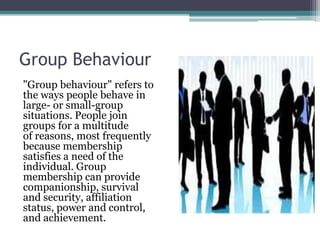
"Group behaviour" refers to
the ways people behave in
large- or small-group
situations. People join
groups for a multitude
of reasons, most frequently
because membership
satisfies a need of the
individual. Group
membership can provide
companionship, survival
and security, affiliation
status, power and control,
and achievement.
Effectiveness of Group Behaviour
A group’s effectiveness brings about organisational
effectiveness which is essential for growth and prosperity of
organisation. There are certain measures of group effectiveness.
They include:
(1) Productivity:
Higher the productivity effective is the group. Quality and
quantity of product speaks for group effectiveness.
(2) Attendance:
Each group member must attend the work regularly.
Absenteeism and high employee turnover speaks for laxity of
the group. Fair attendance makes the group effective.
(3) Job Satisfaction:
Job satisfaction motivates the group for hard work to make it
more effective. Management should take steps to ensure job
satisfaction of its employees.
(4) Attitude:
Attitude of group members towards work also is a
measure of group effectiveness and must be taken
seriously. Efforts must be made to develop and
nurture positive attitude of the group member.
(5) Employee Well-being:
Physiological and psychological welfare of the
employee keeps them fit. Efforts should be made
to assure the mental and physical fitness of the
employees to ensure group effectiveness.
(6) Learning:
Knowledge comes through learning i.e. education,
training, knowing things from fellow employee
and making one suitably knowledgeable and
skilled in working. This makes the group effective.
Knowledge is power.
(7) Retention:
Retaining the human resources makes the group
effective. Firing them very often leads to chaos
because every time a new person enters the group
disturbing the group cohesiveness having negative
effects.
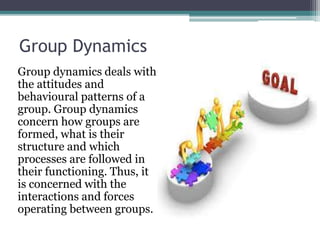
Group Dynamics
Group dynamics deals with
the attitudes and
behavioural patterns of a
group. Group dynamics
concern how groups are
formed, what is their
structure and which
processes are followed in
their functioning. Thus, it
is concerned with the
interactions and forces
operating between groups.
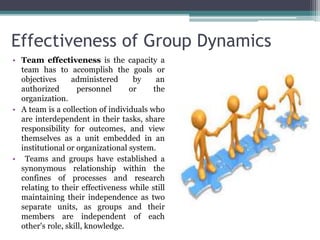
Effectiveness of Group Dynamics
• Team effectiveness is the capacity a
team has to accomplish the goals or
objectives administered by an
authorized personnel or the
organization.
• A team is a collection of individuals who
are interdependent in their tasks, share
responsibility for outcomes, and view
themselves as a unit embedded in an
institutional or organizational system.
• Teams and groups have established a
synonymous relationship within the
confines of processes and research
relating to their effectiveness while still
maintaining their independence as two
separate units, as groups and their
members are independent of each
other's role, skill, knowledge.
Eight Cs for Team Building
• Clear Expectations
• Commitment
• Competence
• Control
• Collaboration
• Communication
• Creativity
• Coordination
Group Norms
Group norms are the informal guidelines of
behaviour that provides some order & conformity
to group activities & operations. Theses rules are
expected to be followed by all group members.
These norms may include a code of dress for
meeting or being on time for the meetings and
behaving in a predictable manner both within and
outside the group meeting.
Group Roles
Ever work group, formal or informal, has various
roles that help the group to survive & achieve its
objectives. A role is a set behaviours that people
are expected to exhibit and perform because the
hold certain position & responsibilities, both in
formal organisation and in informal group.
Conclusion
Group plays an important role in any
organisation. A single person cannot handle
everything on his own with perfection thus this is
when group with its specialised people come into
picture. To bring in innovation and

Group behaviour n dynamics

  • 1.
    Group Behaviour &Dynamics Presented By: Bhoomi Ahuja
  • 2.
    Context • Group Behaviour •Effectiveness Of Group Behaviour • Group Dynamics • Effectiveness Of Group Dynamics
  • 3.
    Group Behaviour "Group behaviour"refers to the ways people behave in large- or small-group situations. People join groups for a multitude of reasons, most frequently because membership satisfies a need of the individual. Group membership can provide companionship, survival and security, affiliation status, power and control, and achievement.
  • 4.
    Effectiveness of GroupBehaviour A group’s effectiveness brings about organisational effectiveness which is essential for growth and prosperity of organisation. There are certain measures of group effectiveness. They include: (1) Productivity: Higher the productivity effective is the group. Quality and quantity of product speaks for group effectiveness. (2) Attendance: Each group member must attend the work regularly. Absenteeism and high employee turnover speaks for laxity of the group. Fair attendance makes the group effective. (3) Job Satisfaction: Job satisfaction motivates the group for hard work to make it more effective. Management should take steps to ensure job satisfaction of its employees.
  • 5.
    (4) Attitude: Attitude ofgroup members towards work also is a measure of group effectiveness and must be taken seriously. Efforts must be made to develop and nurture positive attitude of the group member. (5) Employee Well-being: Physiological and psychological welfare of the employee keeps them fit. Efforts should be made to assure the mental and physical fitness of the employees to ensure group effectiveness. (6) Learning: Knowledge comes through learning i.e. education, training, knowing things from fellow employee and making one suitably knowledgeable and skilled in working. This makes the group effective. Knowledge is power. (7) Retention: Retaining the human resources makes the group effective. Firing them very often leads to chaos because every time a new person enters the group disturbing the group cohesiveness having negative effects.
  • 6.
    Group Dynamics Group dynamicsdeals with the attitudes and behavioural patterns of a group. Group dynamics concern how groups are formed, what is their structure and which processes are followed in their functioning. Thus, it is concerned with the interactions and forces operating between groups.
  • 7.
    Effectiveness of GroupDynamics • Team effectiveness is the capacity a team has to accomplish the goals or objectives administered by an authorized personnel or the organization. • A team is a collection of individuals who are interdependent in their tasks, share responsibility for outcomes, and view themselves as a unit embedded in an institutional or organizational system. • Teams and groups have established a synonymous relationship within the confines of processes and research relating to their effectiveness while still maintaining their independence as two separate units, as groups and their members are independent of each other's role, skill, knowledge.
  • 8.
    Eight Cs forTeam Building • Clear Expectations • Commitment • Competence • Control • Collaboration • Communication • Creativity • Coordination
  • 9.
    Group Norms Group normsare the informal guidelines of behaviour that provides some order & conformity to group activities & operations. Theses rules are expected to be followed by all group members. These norms may include a code of dress for meeting or being on time for the meetings and behaving in a predictable manner both within and outside the group meeting.
  • 10.
    Group Roles Ever workgroup, formal or informal, has various roles that help the group to survive & achieve its objectives. A role is a set behaviours that people are expected to exhibit and perform because the hold certain position & responsibilities, both in formal organisation and in informal group.
  • 11.
    Conclusion Group plays animportant role in any organisation. A single person cannot handle everything on his own with perfection thus this is when group with its specialised people come into picture. To bring in innovation and