PRESTRESSED CONCRETE STRUCTURES
(ACEB46)
By
K TARUN KUMAR (IARE10143)
Department of Civil Engineering
Institute of Aeronautical Engineering
Basic Concept:
Reinforced Concrete:
 Prestressed concrete is basically concrete in which internal
stresses of a suitable magnitude and distribution are
introduced so that the stresses resulting from the external
loads are counteracted to a desired degree.
 The pre-compression applied (may be axial or eccentric)
will induce the compressive stress below the neutral axis or
as a whole of the beam c/s. Resulting either no tension or
compression.
Terminology:
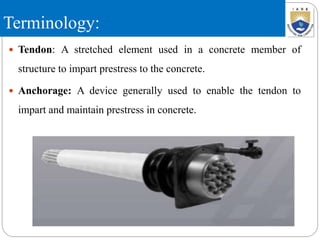
 Tendon: A stretched element used in a concrete member of
structure to impart prestress to the concrete.
 Anchorage: A device generally used to enable the tendon to
impart and maintain prestress in concrete.
Terminology:
 Pretensioning: A method of prestressing concrete in which the
tendons are tensioned before the concrete is placed. In this method,
the concrete is introduced by bond between steel and concrete.
 Post-tensioning: A method of prestressing concrete by tensioning
the tendons against hardened concrete. In this method, the prestress
is imparted to concrete by bearing.
 Limited or partial prestressing: The degree of prestress applied
to concrete with tensile stresses to a limited degree are permitted in
concrete under working loads.
Terminology:
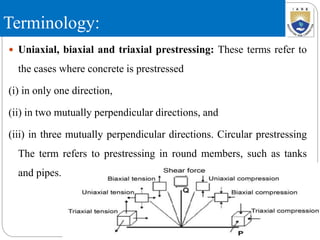
 Axial prestressing: Members in which the entire cross-section of
concrete has a uniform compressive prestress.
 Eccentric prestressing: A section at which the tendons are
eccentric to the centroid, resulting in a triangular or trapezoidal
compressive stress distribution.
Terminology:
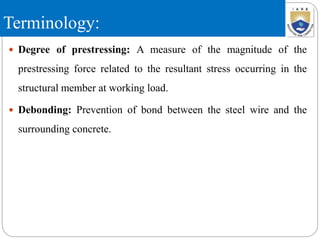
 Uniaxial, biaxial and triaxial prestressing: These terms refer to
the cases where concrete is prestressed
(i) in only one direction,
(ii) in two mutually perpendicular directions, and
(iii) in three mutually perpendicular directions. Circular prestressing
The term refers to prestressing in round members, such as tanks
and pipes.
Terminology:
 Degree of prestressing: A measure of the magnitude of the
prestressing force related to the resultant stress occurring in the
structural member at working load.
 Debonding: Prevention of bond between the steel wire and the
surrounding concrete.
Terminology:
 Cement
The cement used should be any of the following
(a) Ordinary Portland cement conforming to IS269
(b) Portland slag cement conforming to IS455. But the slag content
should not be more than 50%.
(c) Rapid hardening Portland cement conforming to IS8041.
(d) High strength ordinary Portland cement conforming to IS8112.
Terminology:
Concrete
 Prestress concrete requires concrete, which has a high compressive
strength reasonably early age with comparatively higher tensile
strength than ordinary concrete.
 Minimum cement content of 300 to 360 kg/m3 is prescribed
for the durability requirement. The water content should be as
low as possible.
Terminology:
Steel:
High tensile steel , tendons , strands or cables The steel used in prestress
shall be any one of the following:
(a) Plain hard-drawn steel wire conforming to IS1785 (Part-I & Part-III)
(b) Cold drawn indented wire conforming to IS6003
(c) High tensile steel wire bar conforming to IS2090
(d) Uncoated stress relived strand conforming to IS6006 High strength
steel contains: 0.7 to 0.8% carbons, 0.6% manganese, 0.1% silica
Terminology:
Necessity of high grade of concrete & steel:
 Higher the grade of concrete higher the bond strength which is vital
in pretensioned concrete, Also higher bearing strength which is
vital in post-tensioned concrete. Further creep & shrinkage losses
are minimum with high-grade concrete.
 Generally minimum M30 grade concrete is used for post-tensioned
& M40 grade concrete is used for pretensioned members.
Terminology:
For concrete, internal stresses are induced (usually, by means of
tensioned steel) for the following reasons:
 Higher the grade of concrete higher the bond strength which is vital
in pretensioned concrete, Also higher bearing strength which is
vital in post-tensioned concrete. Further creep & shrinkage losses
are minimum with high-grade concrete.
 Generally minimum M30 grade concrete is used for post-tensioned
& M40 grade concrete is used for pretensioned members.
Terminology:
Forms of Prestressing Steel:
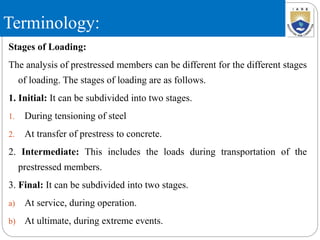
Wires: Prestressing wire is a single unit made of steel.
Strands: Two, three or seven wires are wound to form a prestressing
strand.
Terminology:
Stages of Loading:
The analysis of prestressed members can be different for the different stages
of loading. The stages of loading are as follows.
1. Initial: It can be subdivided into two stages.
1. During tensioning of steel
2. At transfer of prestress to concrete.
2. Intermediate: This includes the loads during transportation of the
prestressed members.
3. Final: It can be subdivided into two stages.
a) At service, during operation.
b) At ultimate, during extreme events.
THE END

PRESTRESSED CONCRETE STRUCTURES

  • 1.
    PRESTRESSED CONCRETE STRUCTURES (ACEB46) By KTARUN KUMAR (IARE10143) Department of Civil Engineering Institute of Aeronautical Engineering
  • 2.
    Basic Concept: Reinforced Concrete: Prestressed concrete is basically concrete in which internal stresses of a suitable magnitude and distribution are introduced so that the stresses resulting from the external loads are counteracted to a desired degree.  The pre-compression applied (may be axial or eccentric) will induce the compressive stress below the neutral axis or as a whole of the beam c/s. Resulting either no tension or compression.
  • 3.
    Terminology:  Tendon: Astretched element used in a concrete member of structure to impart prestress to the concrete.  Anchorage: A device generally used to enable the tendon to impart and maintain prestress in concrete.
  • 4.
    Terminology:  Pretensioning: Amethod of prestressing concrete in which the tendons are tensioned before the concrete is placed. In this method, the concrete is introduced by bond between steel and concrete.  Post-tensioning: A method of prestressing concrete by tensioning the tendons against hardened concrete. In this method, the prestress is imparted to concrete by bearing.  Limited or partial prestressing: The degree of prestress applied to concrete with tensile stresses to a limited degree are permitted in concrete under working loads.
  • 5.
    Terminology:  Axial prestressing:Members in which the entire cross-section of concrete has a uniform compressive prestress.  Eccentric prestressing: A section at which the tendons are eccentric to the centroid, resulting in a triangular or trapezoidal compressive stress distribution.
  • 6.
    Terminology:  Uniaxial, biaxialand triaxial prestressing: These terms refer to the cases where concrete is prestressed (i) in only one direction, (ii) in two mutually perpendicular directions, and (iii) in three mutually perpendicular directions. Circular prestressing The term refers to prestressing in round members, such as tanks and pipes.
  • 7.
    Terminology:  Degree ofprestressing: A measure of the magnitude of the prestressing force related to the resultant stress occurring in the structural member at working load.  Debonding: Prevention of bond between the steel wire and the surrounding concrete.
  • 8.
    Terminology:  Cement The cementused should be any of the following (a) Ordinary Portland cement conforming to IS269 (b) Portland slag cement conforming to IS455. But the slag content should not be more than 50%. (c) Rapid hardening Portland cement conforming to IS8041. (d) High strength ordinary Portland cement conforming to IS8112.
  • 9.
    Terminology: Concrete  Prestress concreterequires concrete, which has a high compressive strength reasonably early age with comparatively higher tensile strength than ordinary concrete.  Minimum cement content of 300 to 360 kg/m3 is prescribed for the durability requirement. The water content should be as low as possible.
  • 10.
    Terminology: Steel: High tensile steel, tendons , strands or cables The steel used in prestress shall be any one of the following: (a) Plain hard-drawn steel wire conforming to IS1785 (Part-I & Part-III) (b) Cold drawn indented wire conforming to IS6003 (c) High tensile steel wire bar conforming to IS2090 (d) Uncoated stress relived strand conforming to IS6006 High strength steel contains: 0.7 to 0.8% carbons, 0.6% manganese, 0.1% silica
  • 11.
    Terminology: Necessity of highgrade of concrete & steel:  Higher the grade of concrete higher the bond strength which is vital in pretensioned concrete, Also higher bearing strength which is vital in post-tensioned concrete. Further creep & shrinkage losses are minimum with high-grade concrete.  Generally minimum M30 grade concrete is used for post-tensioned & M40 grade concrete is used for pretensioned members.
  • 12.
    Terminology: For concrete, internalstresses are induced (usually, by means of tensioned steel) for the following reasons:  Higher the grade of concrete higher the bond strength which is vital in pretensioned concrete, Also higher bearing strength which is vital in post-tensioned concrete. Further creep & shrinkage losses are minimum with high-grade concrete.  Generally minimum M30 grade concrete is used for post-tensioned & M40 grade concrete is used for pretensioned members.
  • 13.
    Terminology: Forms of PrestressingSteel: Wires: Prestressing wire is a single unit made of steel. Strands: Two, three or seven wires are wound to form a prestressing strand.
  • 14.
    Terminology: Stages of Loading: Theanalysis of prestressed members can be different for the different stages of loading. The stages of loading are as follows. 1. Initial: It can be subdivided into two stages. 1. During tensioning of steel 2. At transfer of prestress to concrete. 2. Intermediate: This includes the loads during transportation of the prestressed members. 3. Final: It can be subdivided into two stages. a) At service, during operation. b) At ultimate, during extreme events.
  • 15.