BUILDING MATERIALS
CONSTRUCTION PLANNING
Classification of stones :
• Construction planning is a fundamental and challenging 
activity  in  the  management  and  execution  of 
construction projects.
  
• The term rock is commonly defined as a hard mass of   
mineral  matter  having,  as  a  rule,  no  definite  external 
form.
• The word stone is applied indiscriminately to all classes  
of hard rocks.
Description of Classes:
    Rocks are classified as follows:
1. According to geological origin- 
             Igneous, Sedimentary and Metamorphic
2.   According to the physical form-
            Stratified, Unstratified and Foliated.
3.   According to their chemical composition–
            Silicious, Argillaceous and Calcerous.
GEOLOGICAL CLASSIFICATION:
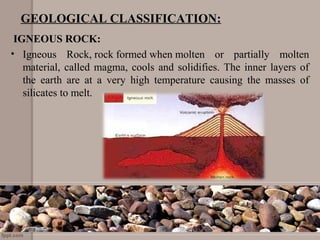
IGNEOUS ROCK:
• Igneous  Rock, rock formed when molten  or  partially  molten 
material, called magma, cools and solidifies. The inner layers of 
the  earth  are  at  a  very  high  temperature  causing  the  masses  of 
silicates to melt. 
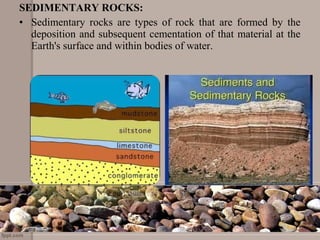
SEDIMENTARY ROCKS:
• Sedimentary  rocks  are  types  of  rock  that  are  formed  by  the 
deposition and subsequent cementation of that material at the 
Earth's surface and within bodies of water.
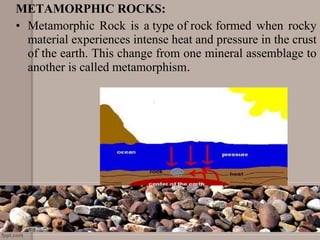
METAMORPHIC ROCKS:
• Metamorphic Rock is a type of rock formed when rocky 
material experiences intense heat and pressure in the crust 
of the earth. This change from one mineral assemblage to 
another is called metamorphism.
Physical Classification of Rocks:
Based on the structure, the rocks may be
classified as:
1. Stratified rocks
2.  Unstratified rocks
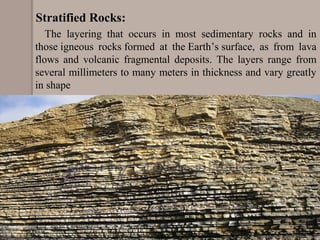
        The  layering  that  occurs  in  most  sedimentary  rocks  and  in 
those igneous  rocks formed  at  the Earth’s surface,  as  from  lava 
flows  and  volcanic  fragmental  deposits.  The  layers  range  from 
several millimeters to many meters in thickness and vary greatly 
in shape
Stratified Rocks:
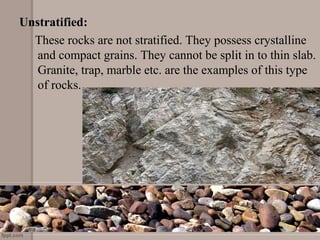
Unstratified:
   These rocks are not stratified. They possess crystalline 
and compact grains. They cannot be split in to thin slab. 
Granite, trap, marble etc. are the examples of this type 
of rocks.
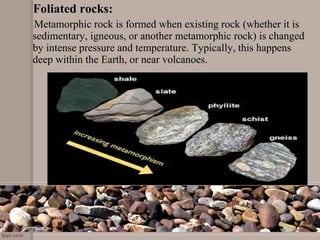
Foliated rocks:
     Metamorphic rock is formed when existing rock (whether it is 
sedimentary, igneous, or another metamorphic rock) is changed 
by intense pressure and temperature. Typically, this happens 
deep within the Earth, or near volcanoes. 
Stone Quarrying:
• The  word quarry can  also  include  the  underground 
quarrying for stone.
• A quarry is  a  place  from  which dimension 
stone, rock, construction  aggregate, riprap, sand, gravel, 
or slate has been excavated from the ground.
•   A  quarry  is  the  same  thing  as  an open-pit  mine from 
which minerals are extracted.
• Quarrying of stone is completely different from mine. 
• Mine belongs to underground operation only whereas 
quarry  is  carried  out  on  exposed  surface  of  natural 
rocks.
• Stone quarrying is generally done at hilly areas where 
large quantity of stone is available.
Site Selection for Quarrying of Stones:
    The quarry should be selected based on some conditions 
as follows.
• The  site  should  be  near  to  human  living  areas  where 
labor and tools are always available, required materials 
also should be available.
• At  least  one  of  type  transportation  facilities  (road  or 
railway or port or all) should be available.
• Good quality and quantity of stone should be available.
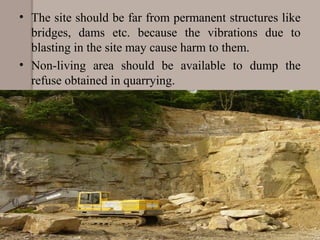
• The site should be far from permanent structures like 
bridges,  dams  etc.  because  the  vibrations  due  to 
blasting in the site may cause harm to them.
• Non-living  area  should  be  available  to  dump  the 
refuse obtained in quarrying.
Methods of Quarrying of Stones
Quarrying can be done by three methods as follows:
1. Hand tools
2. Machine quarrying
3. Blasting
Quarrying of Stones using hand tools:
Wedge method:
In these methods, blocks of rocks are broken loose from their
natural outcrops by men using hand tools:
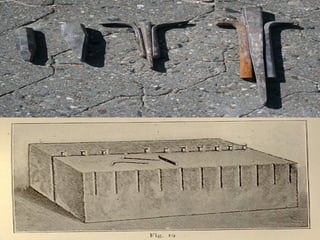
• It is consists digging a few holes at carefully selected places on
the rock. These holes are dug either manually using chisels and
hammers by the skilled workers.
• Or, in major quarrying, these holes may be drilled by special
machines called hammer drills.
• Once the hole is ready, a steel wedge is inserted in between two
steel strips or feathers. This is done with all the holes drilled in a
sequence.
• Such firmly inserted wedges are then struck with hammer
almost simultaneously. This process develops cracks along the
lines joining the holes.
• After that, long iron bars are inserted in the holes and cracks,
and then the blocks of the rocks are pushed forward onto the
free face of a quarry.
Quarrying of Stones using Machines:
Channeling Method:
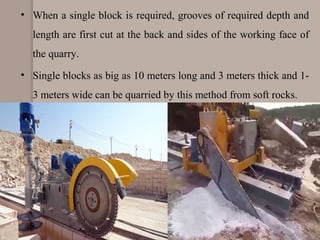
• In this method of quarrying involves the use of big machines
called Channelizers which have reciprocating cutting tools and are
power driven.
• When single large blocks of costly stones like marbles and
limestones are required, this method is most suitable.
• The channelizer can cut a groove as deep as 3 m, as wide as 5 cm
and as long as 3 m, or even more.
• When a single block is required, grooves of required depth and
length are first cut at the back and sides of the working face of
the quarry.
• Single blocks as big as 10 meters long and 3 meters thick and 1-
3 meters wide can be quarried by this method from soft rocks.
Quarrying of Stones by Blasting:
• This method consists of using explosives for breaking stones
from very hard rocks.
• It has been observed that quarrying of granites, basalts, traps,
quartzites, and sandstones by wedging and other methods is
very laborious and costly.
• These hard rocks, however, can be loosened economically and
easily by using explosives.
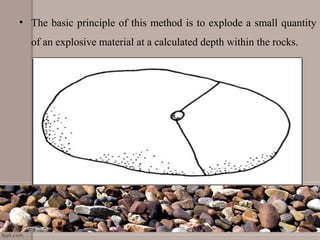
• The basic principle of this method is to explode a small quantity
of an explosive material at a calculated depth within the rocks.
• The force generated due to this explosion is sufficient
only to create cracks and loosen blocks of good size.
• Blasting for quarrying for stones may be quite
different from blasting for road clearance.
• In the latter case, the size of the broken stone is of not
much consequence.
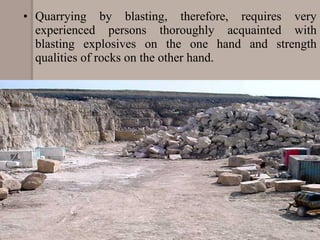
• Quarrying by blasting, therefore, requires very
experienced persons thoroughly acquainted with
blasting explosives on the one hand and strength
qualities of rocks on the other hand.
Precautions in blasting:
1. The blasting should not be carried out in late evening (or) early
morning.
2. The danger zone should be marked with red flag.
3. Explosive should be stored and handled carefully.
4. First aid should be made available.
5. Detonators and explosives should not be carried together
A detonator, frequently a blasting cap, is a device used
to trigger an explosive device.
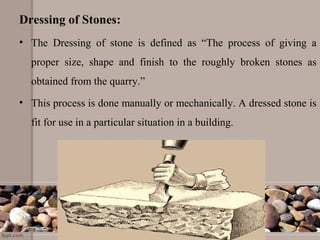
Dressing of Stones:
• The Dressing of stone is defined as “The process of giving a
proper size, shape and finish to the roughly broken stones as
obtained from the quarry.”
• This process is done manually or mechanically. A dressed stone is
fit for use in a particular situation in a building.
• Stones obtained from the quarries are very rough and irregular in
shape and quite bulky in size and weight.
Various objectives of dressing are below:
(a) To reduce the size of the big blocks of stones so that they are
converted to easily lift-able pieces. This reduction in size is
generally carried out at the quarry itself because that saves a lot of
transportation cost.
b) To give a proper shape to the stone. It is known that stones
can be used at different places in the building, e.g. in
foundations, in walls, in arches or for flooring, each situation
will require a proper shape.
(c) To obtain an appealing finish. In a residential building,
stones are used not only because of their extra strength,
hardness, and durability but also because of their aesthetic
value.
Stone surfaces can be made very decorative and of appealing
appearance which will last for a considerable time. A stone
house has its distinct individuality in a city of concrete
structures.
Methods / Types of Dressing of Stones:
• As said earlier, dressing of stone can be done both manually as
well as mechanically.
• Manually, skilled stone-smiths can work wonders on the suitable
type of stones with chisels and hammers and abrasives.
• Mechanically, machines can cut the stone to any desired size and
shape. Their surfaces can be made extra smooth by polishing
through machines.
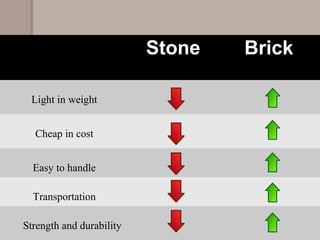
Stone Brick
Light in weight
Cheap in cost
Easy to handle
Transportation
Strength and durability
COMPOSITION OF BRICK EARTH:
• Bricks are defined as artificially moulded clay blocks, with
mass of natural clay with uniform size and shape.
• The bricks are suitably dried and burnt to attain strength,
durability etc. to made them useful for construction works.
• As per IS: 2117-1375, the clay or mixture of clay selected
should preferably confirm to the following chemical
composition for good results.
Requirements of good brick earth:
• It should be homogenous and contain desired proportions of
ingredients(clay, silt, silica etc.)
• It should be free from pebbles etc.
• It should also free from lumps of lime or nodulus of kankar.
• It must be free from alkaline salts and chlorides.
• It should not contain vegetable and organic matters.
Ingrediants used in the preparation of bricks:
1. Silica
2. Alumina
3. Lime
4. Iron oxide
5. Magnesia
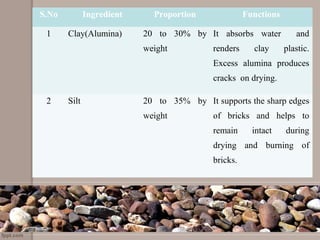
S.No Ingredient Proportion Functions
1 Clay(Alumina) 20 to 30% by
weight
It absorbs water and
renders clay plastic.
Excess alumina produces
cracks on drying.
2 Silt 20 to 35% by
weight
It supports the sharp edges
of bricks and helps to
remain intact during
drying and burning of
bricks.
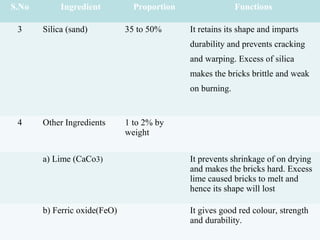
S.No Ingredient Proportion Functions
3 Silica (sand) 35 to 50% It retains its shape and imparts
durability and prevents cracking
and warping. Excess of silica
makes the bricks brittle and weak
on burning.
4 Other Ingredients 1 to 2% by
weight
a) Lime (CaCo3) It prevents shrinkage of on drying
and makes the bricks hard. Excess
lime caused bricks to melt and
hence its shape will lost
b) Ferric oxide(FeO) It gives good red colour, strength
and durability.
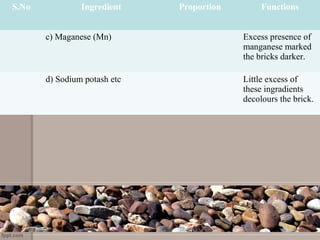
S.No Ingredient Proportion Functions
c) Maganese (Mn) Excess presence of
manganese marked
the bricks darker.
d) Sodium potash etc Little excess of
these ingradients
decolours the brick.
MANUFACTURE OF BRICKS:
The process of manufacturing of bricks:
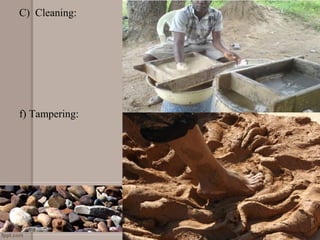
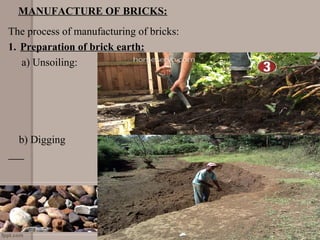
1. Preparation of brick earth:
a) Unsoiling:
b) Digging
C) Cleaning:
f) Tampering:
2) MOULDING OF BRICKS:
Giving the required shape to the prepared brick earth is known as
moulding of bricks. There are two different ways of moulding.
a) Hand moulding:
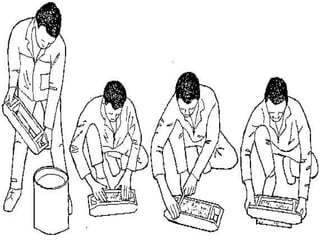
i) Ground moulding:
• This method is adopted when a large and level area of land is
available for the purpose.
• The area of land on which moulding is to be done is levelled,
plastered smooth and sprinkled over with sand.
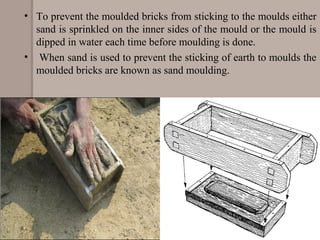
• To prevent the moulded bricks from sticking to the moulds either
sand is sprinkled on the inner sides of the mould or the mould is
dipped in water each time before moulding is done.
• When sand is used to prevent the sticking of earth to moulds the
moulded bricks are known as sand moulding.
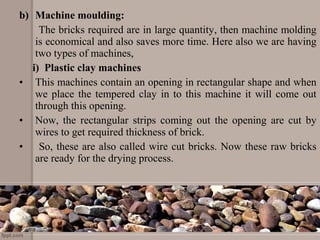
ii) Table moulding:
• In it the moulder carries out the moulding of brick on a table.
• He does so while standing by the side of the table. He moulds
bricks on boards known as stock boards.
• Stock boards are of the same size as the moulds and have a
projection for the frog.
• Sand is sprinkled inside the mould and on the stock board. The
mould is placed to fit the stock board and then filled with earth.
• Sufficient quantity of earth is dashed into the mould pressed hard
and the surplus earth is removed with a strike or a thin wire.
b) Machine moulding:
The bricks required are in large quantity, then machine molding
is economical and also saves more time. Here also we are having
two types of machines,
i) Plastic clay machines
• This machines contain an opening in rectangular shape and when
we place the tempered clay in to this machine it will come out
through this opening.
• Now, the rectangular strips coming out the opening are cut by
wires to get required thickness of brick.
• So, these are also called wire cut bricks. Now these raw bricks
are ready for the drying process.
ii) Dry press machines:
• Dry clay machines are more time saving machines.
• We can put the blended clay into these machines directly without
tempering.
• Means tempering is also done in this machine by adding some
water.
• When the required stiffness is obtained the clay is placed in mold
and pressed hard and well-shaped bricks are delivered.
• These are called pressed bricks and these do not require drying
they may directly sent to burning process.
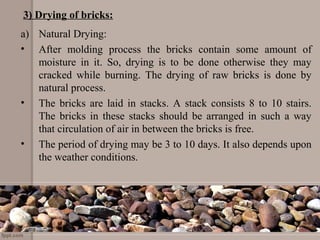
3) Drying of bricks:
a) Natural Drying:
• After molding process the bricks contain some amount of
moisture in it. So, drying is to be done otherwise they may
cracked while burning. The drying of raw bricks is done by
natural process.
• The bricks are laid in stacks. A stack consists 8 to 10 stairs.
The bricks in these stacks should be arranged in such a way
that circulation of air in between the bricks is free.
• The period of drying may be 3 to 10 days. It also depends upon
the weather conditions.
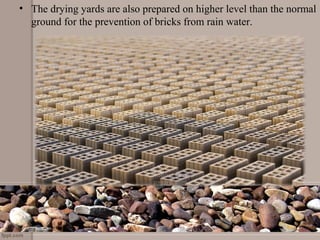
• The drying yards are also prepared on higher level than the normal
ground for the prevention of bricks from rain water.
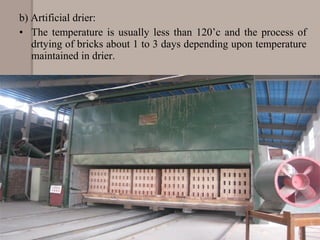
b) Artificial drier:
• The temperature is usually less than 120’c and the process of
drtying of bricks about 1 to 3 days depending upon temperature
maintained in drier.
BURNING OF BRICKS:
The functions of burning of bricks:
1. It imparts hardness and strenght to bricks.
2. It makes dense and durable to bricks.
Note:
1. The bricks are to be burnt properly to achieve strength and
durability.
2. If the bricks are over burnt, they will be brittle and hence
break easily.
3. If the bricks are un burnt, they will be soft and hence can not
carry loads.
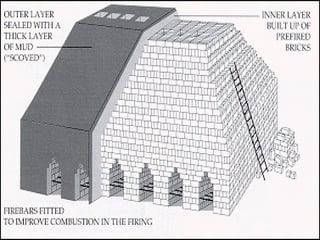
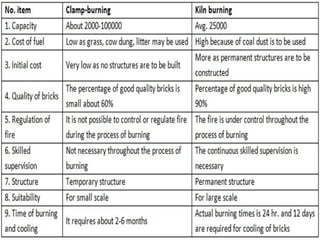
Clamp burning:
A clamp is a stock of raw bricks protected temperarly
around the sides and top to minimise the loss of heat and
arranged so that it will burn.
Procedure:
• These spaces around each brick are finger width, that is, 2 to 2.5
cm wide.
• This is designed to facilitate the passage of air under the brick
clamp to allow for the even combustion of the fuel.
• Bricks are "set" (loaded onto the base) up to 40 layers high.
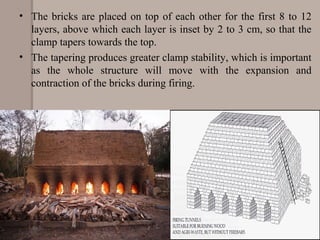
• The bricks are placed on top of each other for the first 8 to 12
layers, above which each layer is inset by 2 to 3 cm, so that the
clamp tapers towards the top.
• The tapering produces greater clamp stability, which is important
as the whole structure will move with the expansion and
contraction of the bricks during firing.
Advantages:
• By burning and cooling of bricks produced are tough and strong.
• It is cheap and economical.
• No, skilled labour and supervision are required.
• The clamp is not liable to injury from high wind or rain.
Disadvantages:
• Its is very slow process and it is not suited for large quantity.
• It is not possible to regulate fire in clamps.
• The quality of bricks is not uniform. The bricks near the bottom
are over burnt and those rear sides are top and unburnt.
Kiln’s burning:
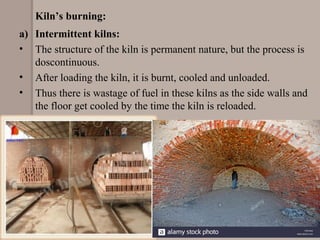
a) Intermittent kilns:
• The structure of the kiln is permanent nature, but the process is
doscontinuous.
• After loading the kiln, it is burnt, cooled and unloaded.
• Thus there is wastage of fuel in these kilns as the side walls and
the floor get cooled by the time the kiln is reloaded.
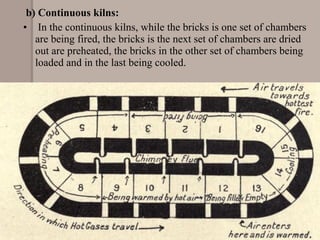
b) Continuous kilns:
• In the continuous kilns, while the bricks is one set of chambers
are being fired, the bricks is the next set of chambers are dried
out are preheated, the bricks in the other set of chambers being
loaded and in the last being cooled.
Introduction and classification of rocks

Introduction and classification of rocks

  • 1.
  • 2.
    Classification of stones: • Construction planning is a fundamental and challenging  activity  in  the  management  and  execution  of  construction projects.    • The term rock is commonly defined as a hard mass of    mineral  matter  having,  as  a  rule,  no  definite  external  form. • The word stone is applied indiscriminately to all classes   of hard rocks.
  • 3.
    Description of Classes:     Rocks are classified as follows: 1.According to geological origin-               Igneous, Sedimentary and Metamorphic 2.   According to the physical form-             Stratified, Unstratified and Foliated. 3.   According to their chemical composition–             Silicious, Argillaceous and Calcerous.
  • 4.
    GEOLOGICAL CLASSIFICATION: IGNEOUS ROCK: •Igneous  Rock, rock formed when molten  or  partially  molten  material, called magma, cools and solidifies. The inner layers of  the  earth  are  at  a  very  high  temperature  causing  the  masses  of  silicates to melt. 
  • 5.
    SEDIMENTARY ROCKS: • Sedimentary rocks  are  types  of  rock  that  are  formed  by  the  deposition and subsequent cementation of that material at the  Earth's surface and within bodies of water.
  • 6.
  • 7.
    Physical Classification ofRocks: Based on the structure, the rocks may be classified as: 1. Stratified rocks 2.  Unstratified rocks
  • 8.
           The  layering  that  occurs  in  most  sedimentary  rocks  and  in  those igneous  rocks formed  at  the Earth’s surface,  as  from  lava  flows  and  volcanic  fragmental  deposits.  The  layers  range  from  several millimeters to many meters in thickness and vary greatly  in shape Stratified Rocks:
  • 9.
  • 10.
  • 11.
    Stone Quarrying: • The word quarry can  also  include  the  underground  quarrying for stone. • A quarry is  a  place  from  which dimension  stone, rock, construction  aggregate, riprap, sand, gravel,  or slate has been excavated from the ground. •   A  quarry  is  the  same  thing  as  an open-pit  mine from  which minerals are extracted.
  • 12.
    • Quarrying of stone is completely different from mine.  • Mine belongs to underground operation only whereas  quarry is  carried  out  on  exposed  surface  of  natural  rocks. • Stone quarrying is generally done at hilly areas where  large quantity of stone is available.
  • 14.
    Site Selection forQuarrying of Stones:     The quarry should be selected based on some conditions  as follows. • The  site  should  be  near  to  human  living  areas  where  labor and tools are always available, required materials  also should be available. • At  least  one  of  type  transportation  facilities  (road  or  railway or port or all) should be available. • Good quality and quantity of stone should be available.
  • 15.
    • The site should be far from permanent structures like  bridges,  dams etc.  because  the  vibrations  due  to  blasting in the site may cause harm to them. • Non-living  area  should  be  available  to  dump  the  refuse obtained in quarrying.
  • 16.
    Methods of Quarryingof Stones Quarrying can be done by three methods as follows: 1. Hand tools 2. Machine quarrying 3. Blasting
  • 17.
    Quarrying of Stonesusing hand tools: Wedge method: In these methods, blocks of rocks are broken loose from their natural outcrops by men using hand tools: • It is consists digging a few holes at carefully selected places on the rock. These holes are dug either manually using chisels and hammers by the skilled workers. • Or, in major quarrying, these holes may be drilled by special machines called hammer drills. • Once the hole is ready, a steel wedge is inserted in between two steel strips or feathers. This is done with all the holes drilled in a sequence.
  • 19.
    • Such firmlyinserted wedges are then struck with hammer almost simultaneously. This process develops cracks along the lines joining the holes. • After that, long iron bars are inserted in the holes and cracks, and then the blocks of the rocks are pushed forward onto the free face of a quarry.
  • 20.
    Quarrying of Stonesusing Machines: Channeling Method: • In this method of quarrying involves the use of big machines called Channelizers which have reciprocating cutting tools and are power driven. • When single large blocks of costly stones like marbles and limestones are required, this method is most suitable. • The channelizer can cut a groove as deep as 3 m, as wide as 5 cm and as long as 3 m, or even more.
  • 21.
    • When asingle block is required, grooves of required depth and length are first cut at the back and sides of the working face of the quarry. • Single blocks as big as 10 meters long and 3 meters thick and 1- 3 meters wide can be quarried by this method from soft rocks.
  • 22.
    Quarrying of Stonesby Blasting: • This method consists of using explosives for breaking stones from very hard rocks. • It has been observed that quarrying of granites, basalts, traps, quartzites, and sandstones by wedging and other methods is very laborious and costly. • These hard rocks, however, can be loosened economically and easily by using explosives.
  • 23.
    • The basicprinciple of this method is to explode a small quantity of an explosive material at a calculated depth within the rocks.
  • 24.
    • The forcegenerated due to this explosion is sufficient only to create cracks and loosen blocks of good size. • Blasting for quarrying for stones may be quite different from blasting for road clearance. • In the latter case, the size of the broken stone is of not much consequence.
  • 25.
    • Quarrying byblasting, therefore, requires very experienced persons thoroughly acquainted with blasting explosives on the one hand and strength qualities of rocks on the other hand.
  • 26.
    Precautions in blasting: 1.The blasting should not be carried out in late evening (or) early morning. 2. The danger zone should be marked with red flag. 3. Explosive should be stored and handled carefully. 4. First aid should be made available. 5. Detonators and explosives should not be carried together A detonator, frequently a blasting cap, is a device used to trigger an explosive device.
  • 27.
    Dressing of Stones: •The Dressing of stone is defined as “The process of giving a proper size, shape and finish to the roughly broken stones as obtained from the quarry.” • This process is done manually or mechanically. A dressed stone is fit for use in a particular situation in a building.
  • 28.
    • Stones obtainedfrom the quarries are very rough and irregular in shape and quite bulky in size and weight. Various objectives of dressing are below: (a) To reduce the size of the big blocks of stones so that they are converted to easily lift-able pieces. This reduction in size is generally carried out at the quarry itself because that saves a lot of transportation cost.
  • 29.
    b) To givea proper shape to the stone. It is known that stones can be used at different places in the building, e.g. in foundations, in walls, in arches or for flooring, each situation will require a proper shape. (c) To obtain an appealing finish. In a residential building, stones are used not only because of their extra strength, hardness, and durability but also because of their aesthetic value. Stone surfaces can be made very decorative and of appealing appearance which will last for a considerable time. A stone house has its distinct individuality in a city of concrete structures.
  • 30.
    Methods / Typesof Dressing of Stones: • As said earlier, dressing of stone can be done both manually as well as mechanically. • Manually, skilled stone-smiths can work wonders on the suitable type of stones with chisels and hammers and abrasives. • Mechanically, machines can cut the stone to any desired size and shape. Their surfaces can be made extra smooth by polishing through machines.
  • 31.
    Stone Brick Light inweight Cheap in cost Easy to handle Transportation Strength and durability
  • 32.
    COMPOSITION OF BRICKEARTH: • Bricks are defined as artificially moulded clay blocks, with mass of natural clay with uniform size and shape. • The bricks are suitably dried and burnt to attain strength, durability etc. to made them useful for construction works. • As per IS: 2117-1375, the clay or mixture of clay selected should preferably confirm to the following chemical composition for good results.
  • 33.
    Requirements of goodbrick earth: • It should be homogenous and contain desired proportions of ingredients(clay, silt, silica etc.) • It should be free from pebbles etc. • It should also free from lumps of lime or nodulus of kankar. • It must be free from alkaline salts and chlorides. • It should not contain vegetable and organic matters.
  • 34.
    Ingrediants used inthe preparation of bricks: 1. Silica 2. Alumina 3. Lime 4. Iron oxide 5. Magnesia
  • 35.
    S.No Ingredient ProportionFunctions 1 Clay(Alumina) 20 to 30% by weight It absorbs water and renders clay plastic. Excess alumina produces cracks on drying. 2 Silt 20 to 35% by weight It supports the sharp edges of bricks and helps to remain intact during drying and burning of bricks.
  • 36.
    S.No Ingredient ProportionFunctions 3 Silica (sand) 35 to 50% It retains its shape and imparts durability and prevents cracking and warping. Excess of silica makes the bricks brittle and weak on burning. 4 Other Ingredients 1 to 2% by weight a) Lime (CaCo3) It prevents shrinkage of on drying and makes the bricks hard. Excess lime caused bricks to melt and hence its shape will lost b) Ferric oxide(FeO) It gives good red colour, strength and durability.
  • 37.
    S.No Ingredient ProportionFunctions c) Maganese (Mn) Excess presence of manganese marked the bricks darker. d) Sodium potash etc Little excess of these ingradients decolours the brick.
  • 38.
    MANUFACTURE OF BRICKS: Theprocess of manufacturing of bricks: 1. Preparation of brick earth: a) Unsoiling: b) Digging
  • 39.
  • 40.
    2) MOULDING OFBRICKS: Giving the required shape to the prepared brick earth is known as moulding of bricks. There are two different ways of moulding. a) Hand moulding: i) Ground moulding: • This method is adopted when a large and level area of land is available for the purpose. • The area of land on which moulding is to be done is levelled, plastered smooth and sprinkled over with sand.
  • 41.
    • To preventthe moulded bricks from sticking to the moulds either sand is sprinkled on the inner sides of the mould or the mould is dipped in water each time before moulding is done. • When sand is used to prevent the sticking of earth to moulds the moulded bricks are known as sand moulding.
  • 43.
    ii) Table moulding: •In it the moulder carries out the moulding of brick on a table. • He does so while standing by the side of the table. He moulds bricks on boards known as stock boards. • Stock boards are of the same size as the moulds and have a projection for the frog. • Sand is sprinkled inside the mould and on the stock board. The mould is placed to fit the stock board and then filled with earth. • Sufficient quantity of earth is dashed into the mould pressed hard and the surplus earth is removed with a strike or a thin wire.
  • 45.
    b) Machine moulding: Thebricks required are in large quantity, then machine molding is economical and also saves more time. Here also we are having two types of machines, i) Plastic clay machines • This machines contain an opening in rectangular shape and when we place the tempered clay in to this machine it will come out through this opening. • Now, the rectangular strips coming out the opening are cut by wires to get required thickness of brick. • So, these are also called wire cut bricks. Now these raw bricks are ready for the drying process.
  • 47.
    ii) Dry pressmachines: • Dry clay machines are more time saving machines. • We can put the blended clay into these machines directly without tempering. • Means tempering is also done in this machine by adding some water. • When the required stiffness is obtained the clay is placed in mold and pressed hard and well-shaped bricks are delivered. • These are called pressed bricks and these do not require drying they may directly sent to burning process.
  • 48.
    3) Drying ofbricks: a) Natural Drying: • After molding process the bricks contain some amount of moisture in it. So, drying is to be done otherwise they may cracked while burning. The drying of raw bricks is done by natural process. • The bricks are laid in stacks. A stack consists 8 to 10 stairs. The bricks in these stacks should be arranged in such a way that circulation of air in between the bricks is free. • The period of drying may be 3 to 10 days. It also depends upon the weather conditions.
  • 49.
    • The dryingyards are also prepared on higher level than the normal ground for the prevention of bricks from rain water.
  • 50.
    b) Artificial drier: •The temperature is usually less than 120’c and the process of drtying of bricks about 1 to 3 days depending upon temperature maintained in drier.
  • 51.
    BURNING OF BRICKS: Thefunctions of burning of bricks: 1. It imparts hardness and strenght to bricks. 2. It makes dense and durable to bricks. Note: 1. The bricks are to be burnt properly to achieve strength and durability. 2. If the bricks are over burnt, they will be brittle and hence break easily. 3. If the bricks are un burnt, they will be soft and hence can not carry loads.
  • 52.
    Clamp burning: A clampis a stock of raw bricks protected temperarly around the sides and top to minimise the loss of heat and arranged so that it will burn. Procedure: • These spaces around each brick are finger width, that is, 2 to 2.5 cm wide. • This is designed to facilitate the passage of air under the brick clamp to allow for the even combustion of the fuel. • Bricks are "set" (loaded onto the base) up to 40 layers high.
  • 53.
    • The bricksare placed on top of each other for the first 8 to 12 layers, above which each layer is inset by 2 to 3 cm, so that the clamp tapers towards the top. • The tapering produces greater clamp stability, which is important as the whole structure will move with the expansion and contraction of the bricks during firing.
  • 55.
    Advantages: • By burningand cooling of bricks produced are tough and strong. • It is cheap and economical. • No, skilled labour and supervision are required. • The clamp is not liable to injury from high wind or rain. Disadvantages: • Its is very slow process and it is not suited for large quantity. • It is not possible to regulate fire in clamps. • The quality of bricks is not uniform. The bricks near the bottom are over burnt and those rear sides are top and unburnt.
  • 56.
    Kiln’s burning: a) Intermittentkilns: • The structure of the kiln is permanent nature, but the process is doscontinuous. • After loading the kiln, it is burnt, cooled and unloaded. • Thus there is wastage of fuel in these kilns as the side walls and the floor get cooled by the time the kiln is reloaded.
  • 57.
    b) Continuous kilns: •In the continuous kilns, while the bricks is one set of chambers are being fired, the bricks is the next set of chambers are dried out are preheated, the bricks in the other set of chambers being loaded and in the last being cooled.