Types of admixtures for soil
stabilization and their requirements
Cement stabilization methods and
there applications at site
Bitumen application methods at site
Lime stabilization methods
Water retentive
chemicals
Special stabilizers
Miscellaneous
chemicals
Calcium chloride and sodium
chloride
Cement, Bitumen, lime (CaO)
Molasses, water proofers,
aggregants, dispersants
Mostly used as dust palliatives
Deliquescent and hygroscopic- absorbs
and holds moisture
Reduce and evaporation of soil water by
lowering vapour pressure and increasing
surface tension
Reduce loss of strength of fine soils in
soaking
Small increase max-density
Facilitates compaction
Chief disadvantage is washable
0.5% of calcium chloride is spreaded at road surface
at the rate of 0.25-0.50 kg per square metre
Flake calcium chloride is spread and throughly mixed
at an approximately 0.25kg per square metre per 2.5cm
thick of compacted soil
Similar to calcium chloride
Electrolyte and crystallising agent
Forms dense hard mat with stabilized
surface
Checks tendency for the formation of
shrinkage speed
Can not be used as surface application
Can be applied to the soil by plant mix
and mix insitu
 soil type
Cement
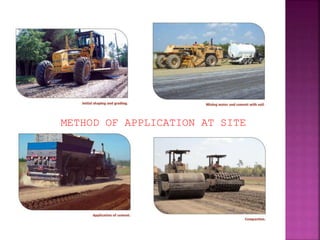
Pulverisation and mixing
Compaction
curing
For more information
http://www.cement.org/think-harder-concrete-
/paving/soil-cement
METHOD OF APPLICATION AT SITE
CEMENT MODIFIED SOIL(CMS)
CEMENT TREATED BASE(CBS)
FULL DEPTH RECLAMATION(FDR)
For more information
http://www.cement.org/think-harder-concrete-
/paving/soil-cement
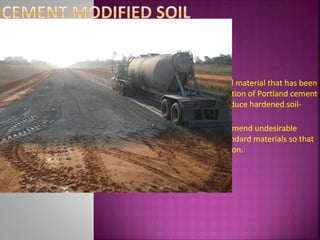
A cement-modified soil (CMS) is a soil material that has been
treated with a relatively small proportion of Portland cement
– less cement than is required to produce hardened soil-
cement.
The objective of the treatment is to amend undesirable
properties of problem soils or substandard materials so that
they are suitable for use in construction.
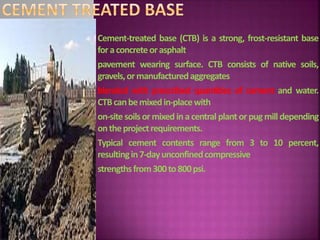
Cement-treated base (CTB) is a strong, frost-resistant base
foraconcreteorasphalt
pavement wearing surface. CTB consists of native soils,
gravels,ormanufacturedaggregates
blended with prescribed quantities of cement and water.
CTBcanbemixedin-placewith
on-site soils or mixedin a central plantor pug mill depending
ontheprojectrequirements.
Typical cement contents range from 3 to 10 percent,
resultingin7-dayunconfinedcompressive
strengthsfrom300to800psi.
Full-depth reclamation (FDR)with cement is
a stabilizing pavement solution in which a
deteriorated asphalt pavement and the
underlying base materials are pulverized
then mixed with cement and water to form
a cement-treated stabilized base course. An
FDR road can be completed with either an
asphalt or concrete surface layer.
Posses adhesive, impermeable properties
Soluble in carbon disulphate
Fluid consistency easily applicable at site by heating
Mainly used in road and air field
Classification
Asphalts -naturally occurs(cut back, emulsion)
Rapid curing
Medium curing
Slow curing(road oils)
Tars- obtained by condensation process by the
destructive distillation of organic materials such as coal,
lignite, peat, wood and oil
Soil –Bitumen: used for cohessive soils for water
proof
Maximum size Less than 1/3rd the
compacted thickness of
stabilized soil layer
Passing 4.75mm More than 50%
Passing 425micron sieve 35-100%
Passing 75micron sieve 10-50%
Liquid limit Less than 40%
Plasticity index Less than 8%
Gradation and plasticity requirements
best suited for soil bitumen
used for cohessionless soils such sands, gravels,
crushed aggregate which are mixed with bitumen
For this the condition is more than 12% of the
material should not pass through 75 micron sieve
In case wind blown sand this may be increased up to
25%
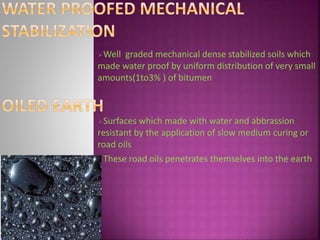
Well graded mechanical dense stabilized soils which
made water proof by uniform distribution of very small
amounts(1to3% ) of bitumen
Surfaces which made with water and abbrassion
resistant by the application of slow medium curing or
road oils
These road oils penetrates themselves into the earth
Lime is available in two forms
Quick lime
Hydrated or slaked lime
Quick lime is more efficient generally hydrated lime is
used hence it is safe to handle
Lime is used to treat sub base and base and sub grades
Very successful in clayey soils in water logged areas
Improves durability of mud plaster in low cost houses built
with un burnt bricks
The percent lime required for stabilisation
can be found by penetration resistant
considerations
Amount of lime varies from 2 to 10% of
the soil weight
Molasses
From sugarcane industry
Lignin from paper industry
Ground nut husk and oil cake etc.,
Can be used for stabilisation
•Natural and artificial resigns and other chemicals like
alkyl chlorosilanes, siconates, fatty amines and fatty
quaternary ammonium salts
•Being naturally water repellent these maintain
cohesion in fine soils in presence of excess of water
•The quantity required is about 1 to 2%
The treatment of soil with aggregants results in
reduction of max-compacted dry density ,in an
increase in OMC and permeability hence this
type of admixtures can be used in active anti
seepage elements
Used for improving drainage or controlling
erosion or for frost heave reduction
The soil strength is improved
Used for flocculation of fine grained soils
Such anionic polyelectrolyte, copolymer
mallets, and corboxylated cellulose
http://alchemypolymers.com/
These are salts of alkali metals such as
sodium hexametaphospate
Removal of a mono valent exchangeable
ion of soil
Increases fluidity of soil water system
hence it will attains maximum dry density at
lower OMC
After drying water absorption is greatly
reduced
Compressibility, permeability, frost
sussecptabilty can be decreased
 http://nbmcw.com/articles/case-studies/28479-a-
study-on-soil-stabilization-through-innovative-
material-for-construction-of-rural-roads.html
 http://www.cement.org/think-harder-concrete-
/paving/soil-cement
 Soil engineering in theory and practice
By Alam singh
GROUND IMPROVEMENT TECHNIQUES (Soil cement stabilization)

GROUND IMPROVEMENT TECHNIQUES (Soil cement stabilization)

  • 2.
    Types of admixturesfor soil stabilization and their requirements Cement stabilization methods and there applications at site Bitumen application methods at site Lime stabilization methods
  • 3.
    Water retentive chemicals Special stabilizers Miscellaneous chemicals Calciumchloride and sodium chloride Cement, Bitumen, lime (CaO) Molasses, water proofers, aggregants, dispersants
  • 4.
    Mostly used asdust palliatives Deliquescent and hygroscopic- absorbs and holds moisture Reduce and evaporation of soil water by lowering vapour pressure and increasing surface tension Reduce loss of strength of fine soils in soaking Small increase max-density Facilitates compaction Chief disadvantage is washable
  • 5.
    0.5% of calciumchloride is spreaded at road surface at the rate of 0.25-0.50 kg per square metre Flake calcium chloride is spread and throughly mixed at an approximately 0.25kg per square metre per 2.5cm thick of compacted soil
  • 6.
    Similar to calciumchloride Electrolyte and crystallising agent Forms dense hard mat with stabilized surface Checks tendency for the formation of shrinkage speed Can not be used as surface application Can be applied to the soil by plant mix and mix insitu
  • 7.
     soil type Cement Pulverisationand mixing Compaction curing For more information http://www.cement.org/think-harder-concrete- /paving/soil-cement
  • 8.
  • 9.
    CEMENT MODIFIED SOIL(CMS) CEMENTTREATED BASE(CBS) FULL DEPTH RECLAMATION(FDR) For more information http://www.cement.org/think-harder-concrete- /paving/soil-cement
  • 10.
    A cement-modified soil(CMS) is a soil material that has been treated with a relatively small proportion of Portland cement – less cement than is required to produce hardened soil- cement. The objective of the treatment is to amend undesirable properties of problem soils or substandard materials so that they are suitable for use in construction.
  • 12.
    Cement-treated base (CTB)is a strong, frost-resistant base foraconcreteorasphalt pavement wearing surface. CTB consists of native soils, gravels,ormanufacturedaggregates blended with prescribed quantities of cement and water. CTBcanbemixedin-placewith on-site soils or mixedin a central plantor pug mill depending ontheprojectrequirements. Typical cement contents range from 3 to 10 percent, resultingin7-dayunconfinedcompressive strengthsfrom300to800psi.
  • 13.
    Full-depth reclamation (FDR)withcement is a stabilizing pavement solution in which a deteriorated asphalt pavement and the underlying base materials are pulverized then mixed with cement and water to form a cement-treated stabilized base course. An FDR road can be completed with either an asphalt or concrete surface layer.
  • 15.
    Posses adhesive, impermeableproperties Soluble in carbon disulphate Fluid consistency easily applicable at site by heating Mainly used in road and air field Classification Asphalts -naturally occurs(cut back, emulsion) Rapid curing Medium curing Slow curing(road oils) Tars- obtained by condensation process by the destructive distillation of organic materials such as coal, lignite, peat, wood and oil
  • 17.
    Soil –Bitumen: usedfor cohessive soils for water proof Maximum size Less than 1/3rd the compacted thickness of stabilized soil layer Passing 4.75mm More than 50% Passing 425micron sieve 35-100% Passing 75micron sieve 10-50% Liquid limit Less than 40% Plasticity index Less than 8% Gradation and plasticity requirements best suited for soil bitumen
  • 18.
    used for cohessionlesssoils such sands, gravels, crushed aggregate which are mixed with bitumen For this the condition is more than 12% of the material should not pass through 75 micron sieve In case wind blown sand this may be increased up to 25%
  • 19.
    Well graded mechanicaldense stabilized soils which made water proof by uniform distribution of very small amounts(1to3% ) of bitumen Surfaces which made with water and abbrassion resistant by the application of slow medium curing or road oils These road oils penetrates themselves into the earth
  • 20.
    Lime is availablein two forms Quick lime Hydrated or slaked lime Quick lime is more efficient generally hydrated lime is used hence it is safe to handle Lime is used to treat sub base and base and sub grades Very successful in clayey soils in water logged areas Improves durability of mud plaster in low cost houses built with un burnt bricks
  • 21.
    The percent limerequired for stabilisation can be found by penetration resistant considerations Amount of lime varies from 2 to 10% of the soil weight
  • 22.
    Molasses From sugarcane industry Ligninfrom paper industry Ground nut husk and oil cake etc., Can be used for stabilisation
  • 23.
    •Natural and artificialresigns and other chemicals like alkyl chlorosilanes, siconates, fatty amines and fatty quaternary ammonium salts •Being naturally water repellent these maintain cohesion in fine soils in presence of excess of water •The quantity required is about 1 to 2%
  • 24.
    The treatment ofsoil with aggregants results in reduction of max-compacted dry density ,in an increase in OMC and permeability hence this type of admixtures can be used in active anti seepage elements Used for improving drainage or controlling erosion or for frost heave reduction The soil strength is improved Used for flocculation of fine grained soils Such anionic polyelectrolyte, copolymer mallets, and corboxylated cellulose
  • 25.
  • 26.
    These are saltsof alkali metals such as sodium hexametaphospate Removal of a mono valent exchangeable ion of soil Increases fluidity of soil water system hence it will attains maximum dry density at lower OMC After drying water absorption is greatly reduced Compressibility, permeability, frost sussecptabilty can be decreased
  • 27.