DEPARTMENT OF
CIVIL ENGINEERING
Underwater Repair
Er. Ramprasad Kumawat
M.Tech
Methods of Underwater Repair of
Concrete Structures
• Underwater concrete structures are prone to
damage due to many reasons.
• There are some methods which are specially
adapted to repair these damages.
• Care should be taken to ensure that the
damaged area is not contaminated before the
application of the repair material.
• The material used for the repair should be
compatible with its underwater usage while
placing as well as curing.
• The different methods which are used to
repair the underwater structures are as
follows:
• Surface spalling repair
• Large scale repair
• Preplaced aggregate concrete
• Injection technique
• Guniting or shotcrete method
• Steel sleeve repairing technique
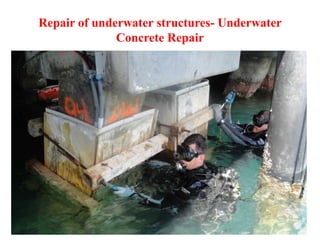
Repair of underwater structures- Underwater
Concrete Repair
1. Surface Spalling Repair
• The cover provided for the concrete structures
can spall off due to the accidental damages.
• To prevent the future corrosion of the
reinforcement in the concrete, the damaged
area must be repaired or replaced.
• The areas which are already slightly
deteriorated with time, will be prone to severe
and dangerous damage in a short period of
time, especially in the splash zones.
• Before starting the repairing procedures, the
damaged area must be cleared off of the
marine growth and the loose concrete.
• After the damaged area is cleared, the
boundary of the spalled area should be cut to a
depth of about 10-20mm depending on the
amount of damage done.
• The splash zones are repaired by the
application of the cementations mortar and in
case of small damage area, the epoxy mortar
can be utilized.
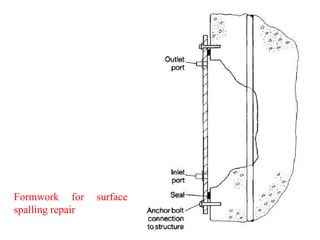
• For large area of damage, formwork should be
used to hold the repair material in its place
which could delay the enhancement work.
• Epoxy mortar cannot be used for this area
because after it hardens, it forms smooth
surface which leads to the bond being weak.
Formwork for surface
spalling repair
2. Large Scale Repair
• This type of repair is used when the damages
is caused by:
• Structural overloading,
• Fire,
• Ship impact, or
• Reinforcement corrosion especially in the
splash zone
• The repair method and the material selection
should be done carefully when a large area of
damage has to be restored because the
shrinkage and bleeding may lead to a leakage
path at the top of parent concrete and the repair
material surface.
• When repairing materials possess high
thickness, thermal cracking may develop due
to rise of temperature even though surrounding
water decline the temperature rise.
• Additionally the repair of reinforcement is
often required because of distortion and
corrosion of reinforcement.
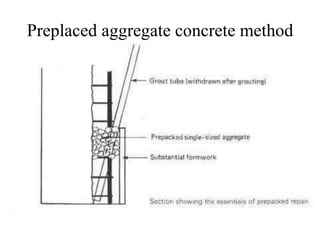
3.Preplaced Aggregate Concrete
• In this type of repair, formwork is installed in
the area to be repaired and a well graded
aggregate is compacted in it.
• Before placing the grout in the aggregate, it is
ensured that the aggregate is cleaned with the
help of freshwater.
• Then, specific grout is injected into the base of
the well compacted aggregate in the formwork.
Preplaced aggregate concrete method
• The water and voids which are present in the
aggregate are expelled out by the grout.
• The formwork which is placed at the damaged
area, should be grout proof to avoid the
leakage.
• Furthermore, there should be proper venting so
as to help the voids and sir to escape.
• It is of great significance that the aggregates
fill the formwork till the top of damage region.
• If the grouting is done in the area where
aggregate is not present, then the grout will
shrink and will lead to the development
of cracks.
• It is recommended that, vibration is not to be
applied during injection to prevent the washing
out of grout.
4. Injection Technique
• This type of repair is similar to the procedure
used for repairing the dry structures where
injection of cementations grout or resin can be
employed to repair cracks and or voids.
• The selection for the material depends on the
void or crack size and also on the possibility of
the predicted displacement of the member in
the future.
• Epoxy resin is employed for a crack width of
0.1mm Cement grout is used when the crack
width is greater than few millimeters.
If the crack width is less than 0.1mm, injection is
not necessary.
• There are two methods of injection that
include:
• Pressure injection
• Gravity feed.
• If there is evidence of corrosion in the
reinforcement, complete repairing should be
recommended instead of injection methods.
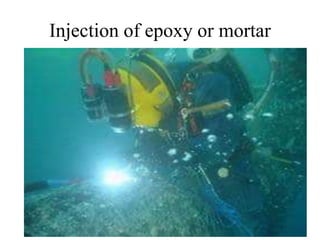
Injection of epoxy or mortar
5. Guniting or Shotcrete Method
• This type of repair is used when large surface
area or beams or columns are encased.
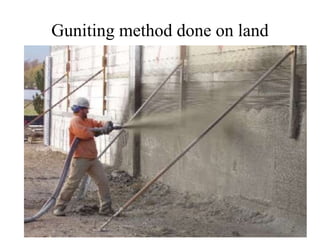
• Dry processing is employed in this method
where dry mix is transferred by a hose and
water is added to the dry mix at the nozzle.
• Guniting method is actually not suitable for the
repair of underwater concrete structures but it
can be utilized in slash zones or tidal zones, if
rapid setting additives are employed.
• The maximum thickness of shotcrete is limited
to 50mm but in case of thick layer, a second
layer can be placed.
• The success of this technique depends on skill
of the man handling the nozzle and experience
in
• Adjusting addition of water
• Pressure of water
• Thickness uniformity
Guniting method done on land
6. Steel Sleeve Repairing Technique
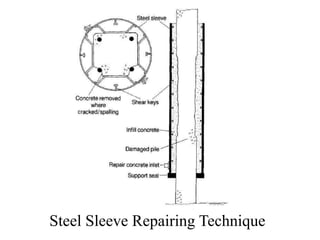
• This type of repair employs a steel sleeve
which is used around a pile or column.
• Then the space between the sleeve
and pile or column is filled with mortar or
concrete.
• The steel sleeve should be designed such that
there should be enough space for further
reinforcement corrosion.
• The sleeve should extend and exceed the
damaged length of the pile/column from both
top and bottom and should bear the respective
forces if the bars are ineffective due to
corrosion.
Steel Sleeve Repairing Technique
• THANKS!
• Gmail: ramkumawat001@gmail.com

Underwater Repair (RR&S)

  • 1.
    DEPARTMENT OF CIVIL ENGINEERING UnderwaterRepair Er. Ramprasad Kumawat M.Tech
  • 2.
    Methods of UnderwaterRepair of Concrete Structures • Underwater concrete structures are prone to damage due to many reasons. • There are some methods which are specially adapted to repair these damages. • Care should be taken to ensure that the damaged area is not contaminated before the application of the repair material. • The material used for the repair should be compatible with its underwater usage while placing as well as curing.
  • 3.
    • The differentmethods which are used to repair the underwater structures are as follows: • Surface spalling repair • Large scale repair • Preplaced aggregate concrete • Injection technique • Guniting or shotcrete method • Steel sleeve repairing technique
  • 4.
    Repair of underwaterstructures- Underwater Concrete Repair
  • 5.
    1. Surface SpallingRepair • The cover provided for the concrete structures can spall off due to the accidental damages. • To prevent the future corrosion of the reinforcement in the concrete, the damaged area must be repaired or replaced. • The areas which are already slightly deteriorated with time, will be prone to severe and dangerous damage in a short period of time, especially in the splash zones.
  • 6.
    • Before startingthe repairing procedures, the damaged area must be cleared off of the marine growth and the loose concrete. • After the damaged area is cleared, the boundary of the spalled area should be cut to a depth of about 10-20mm depending on the amount of damage done. • The splash zones are repaired by the application of the cementations mortar and in case of small damage area, the epoxy mortar can be utilized.
  • 7.
    • For largearea of damage, formwork should be used to hold the repair material in its place which could delay the enhancement work. • Epoxy mortar cannot be used for this area because after it hardens, it forms smooth surface which leads to the bond being weak.
  • 8.
  • 9.
    2. Large ScaleRepair • This type of repair is used when the damages is caused by: • Structural overloading, • Fire, • Ship impact, or • Reinforcement corrosion especially in the splash zone
  • 10.
    • The repairmethod and the material selection should be done carefully when a large area of damage has to be restored because the shrinkage and bleeding may lead to a leakage path at the top of parent concrete and the repair material surface.
  • 11.
    • When repairingmaterials possess high thickness, thermal cracking may develop due to rise of temperature even though surrounding water decline the temperature rise. • Additionally the repair of reinforcement is often required because of distortion and corrosion of reinforcement.
  • 12.
    3.Preplaced Aggregate Concrete •In this type of repair, formwork is installed in the area to be repaired and a well graded aggregate is compacted in it. • Before placing the grout in the aggregate, it is ensured that the aggregate is cleaned with the help of freshwater. • Then, specific grout is injected into the base of the well compacted aggregate in the formwork.
  • 13.
  • 14.
    • The waterand voids which are present in the aggregate are expelled out by the grout. • The formwork which is placed at the damaged area, should be grout proof to avoid the leakage. • Furthermore, there should be proper venting so as to help the voids and sir to escape.
  • 15.
    • It isof great significance that the aggregates fill the formwork till the top of damage region. • If the grouting is done in the area where aggregate is not present, then the grout will shrink and will lead to the development of cracks. • It is recommended that, vibration is not to be applied during injection to prevent the washing out of grout.
  • 16.
    4. Injection Technique •This type of repair is similar to the procedure used for repairing the dry structures where injection of cementations grout or resin can be employed to repair cracks and or voids. • The selection for the material depends on the void or crack size and also on the possibility of the predicted displacement of the member in the future.
  • 17.
    • Epoxy resinis employed for a crack width of 0.1mm Cement grout is used when the crack width is greater than few millimeters. If the crack width is less than 0.1mm, injection is not necessary.
  • 18.
    • There aretwo methods of injection that include: • Pressure injection • Gravity feed. • If there is evidence of corrosion in the reinforcement, complete repairing should be recommended instead of injection methods.
  • 19.
  • 20.
    5. Guniting orShotcrete Method • This type of repair is used when large surface area or beams or columns are encased. • Dry processing is employed in this method where dry mix is transferred by a hose and water is added to the dry mix at the nozzle.
  • 21.
    • Guniting methodis actually not suitable for the repair of underwater concrete structures but it can be utilized in slash zones or tidal zones, if rapid setting additives are employed. • The maximum thickness of shotcrete is limited to 50mm but in case of thick layer, a second layer can be placed.
  • 22.
    • The successof this technique depends on skill of the man handling the nozzle and experience in • Adjusting addition of water • Pressure of water • Thickness uniformity
  • 23.
  • 24.
    6. Steel SleeveRepairing Technique • This type of repair employs a steel sleeve which is used around a pile or column. • Then the space between the sleeve and pile or column is filled with mortar or concrete. • The steel sleeve should be designed such that there should be enough space for further reinforcement corrosion.
  • 25.
    • The sleeveshould extend and exceed the damaged length of the pile/column from both top and bottom and should bear the respective forces if the bars are ineffective due to corrosion.
  • 26.
  • 27.
    • THANKS! • Gmail:ramkumawat001@gmail.com