GROUP MEMBER NAME
 Hamza Sial
 Zubair
 Tasmia
 Aroosha
 Wasiq
 Tabish
GREEN HOUSE EFFECT
Progressive warming up of the earth surface due to high concentration of manmade
carbon dioxide in the atmosphere. The effect of this is to warm the Earth's surface and
the lower atmosphere.
The natural outcome is warner atmosphere
 100 years ago CO2 -275ppm
 In the year 2007 - 375ppm
 In the year 2040 - 450ppm
EXAMPLE :
Burning fossil fuels like coal and oil puts more carbon dioxide into our atmosphere
SOURCES OF GREENHOUSE EFFECT
 The largest source of greenhouse gas emissions from human activities in the
United States is from burning fossil fuels for electricity, heat, and transportation.
SOURCE OF GREENHOUSE EFFECT
EFFECT OF GREENHOUSE EFFECT
 Some of the infrared radiation from the Sun passes through the atmosphere, but
most is absorbed and re-emitted in all directions by greenhouse gas molecules
and clouds.
 warm the Earth's surface and the lower atmosphere.
 carbon dioxide, methane, nitrous oxide, hydrochlorofluorocarbons (HCFCs),
 hydrofluorocarbons (HFCs) and ozone in the lower atmosphere.
EXAMPLE
 If you open the door of a car that has been
left parked in the sun for a couple of hours,
you'll notice that the temperature inside
the car is much warmer than the
temperature outside.
 This is because the windows of the car
allow the sunlight to enter.
CONTROL OF GREENHOUSE EFFECT
 Save energy at home. Much of our electricity and heat are powered by coal, oil
and gas.
 Walk, bike, or take public transport.
 Eat more vegetables.
 Throw away less food.
 Reduce, reuse, repair & recycle.
 Change your home's source of energy.
 Switch to an electric vehicle.
 Install solar lights.
 Use energy-saving light bulbs.
GREENHOUSE GASES
 Greenhouse gases are gases in Earth's atmosphere that trap heat. They let
sunlight pass through the atmosphere, but they prevent the heat that the sunlight
brings from leaving the atmosphere.
 EXAMPLE :
Water vapour is the most abundant greenhouse gas. It increases as the
earth's atmosphere warms but unlike CO2, which can remain in the earth's
atmosphere for centuries, water vapour persists for a few days.
MAJOR GREENHOUSE GASE
 The gases with the properties of greenhouse are known as green house gases.
 Some gases in earth atmosphere for example greenhouse gases include :
 carbon dioxide
 methane
 nitrous oxide
 Various synthetic chemicals.
 Carbon dioxide is widely reported as the most important anthropogenic
greenhouse gas because it currently accounts for the greatest portion of the
warming associated with human activities.
MAJOR GREENHOUSE GASES
SOURCE OF GREENHOUSE GASES
 Sources of Greenhouse Gas Emissions :
• Overview.
• Electricity.
• Transportation.
• Industry.
• Commercial/ Residential.
• Agriculture.
• Land Use/ Forestry.
CAUSES GREENHOUSE EFFECT
 Human Activity Is the Cause of Increased Greenhouse Gas Concentrations.
 Over the last century, burning of fossil fuels like coal and oil has increased the
concentration of atmospheric carbon dioxide (CO2).
 The coal or oil burning process combines carbon with oxygen in the air to make
CO2.
CONTROL OF GREENHOUSE EFFECT
 Carbon market
 Reduction of the use of CFC
 Water logging should be avoided
 Alternate source of energy to be used
 Advanced and efficient technologies for reducing emission from fossil fuels.
MAJOR CAUSE GREENHOUSE GASES
EFFECT GREENHOUSE GASES
 The flooding of coastal cities
 the desertification of fertile areas
 the melting of glacial masses
 The proliferation of devastating hurricanes are just some of the main
consequences.
GLOBEL WARMING
 Global warming is the long-term heating of Earth's surface observed since the pre-
industrial period (between 1850 and 1900) due to human activities, primarily fossil fuel
burning, which increases heat-trapping greenhouse gas levels in Earth's atmosphere.
 EXAMPLE :
• Ocean heat content is increasing.
• Air temperature over ocean is increasing.
• Sea surface temperature is increasing.
• Global sea level is rising.
• Humidity is increasing.
SOURCE OF GLOBEL WARMING
 Global warming is an aspect of climate change, referring to the long-term rise of
the planet's temperatures. It is caused by increased concentrations of greenhouse
gases in the atmosphere, mainly from human activities such as burning fossil
fuels, and farming.
CAUSES OF GLOBEL WARMING
 Generating power. Generating electricity and heat by burning fossil fuels causes a
large chunk of global emissions.
 Manufacturing goods.
 Cutting down forests.
 Using transportation.
 Producing food.
 Powering buildings.
 Consuming too much.
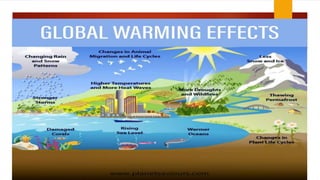
EFFECT GLOBAL WARMING
 The effects of global warming can be seen and felt across the planet.
 Global warming, the gradual heating of Earth's surface, oceans and atmosphere, is
caused by human activity.
 Primarily the burning of fossil fuels that pump carbon dioxide (CO2), methane
and other greenhouse gases into the atmosphere.
 Already, the consequences of global warming are measurable and visible.
 Warmer temperatures over time are changing weather patterns and disrupting.
 This poses many risks to human beings and all other forms of life on Earth.
Global warmig and climate changes
 The temperature of an object is determine by a balance between incoming and outgoing energy .
 Global warming” refers to the long-term warming of the planet.
 Global temperature shows a well-documented rise since the early 20th century and most notably
since the late 1970s.
 Worldwide since 1880, the average surface temperature has risen about 1°C (about 2°F).
 is on top of about an additional 0.15°C of warming from between 1750 and 1880.
 Climate change” encompasses global warming, but refers to the broader range of changes that are
happening to our planet .
 These include rising sea levels; shrinking mountain glaciers; accelerating ice melt.
 These are all consequences of warming people burning fossil fuels and putting out heat-trapping
gases into the air.
Option for reducing CO2
 Dr.Klaus and his synthetic trees
 Johan H Martins theory of phytoplankton
growth in ocean .
 Injection of CO2 into underground strate or
deep ocean water.
Presentation4.pptx

Presentation4.pptx

  • 2.
    GROUP MEMBER NAME Hamza Sial  Zubair  Tasmia  Aroosha  Wasiq  Tabish
  • 4.
    GREEN HOUSE EFFECT Progressivewarming up of the earth surface due to high concentration of manmade carbon dioxide in the atmosphere. The effect of this is to warm the Earth's surface and the lower atmosphere. The natural outcome is warner atmosphere  100 years ago CO2 -275ppm  In the year 2007 - 375ppm  In the year 2040 - 450ppm EXAMPLE : Burning fossil fuels like coal and oil puts more carbon dioxide into our atmosphere
  • 5.
    SOURCES OF GREENHOUSEEFFECT  The largest source of greenhouse gas emissions from human activities in the United States is from burning fossil fuels for electricity, heat, and transportation.
  • 6.
  • 7.
    EFFECT OF GREENHOUSEEFFECT  Some of the infrared radiation from the Sun passes through the atmosphere, but most is absorbed and re-emitted in all directions by greenhouse gas molecules and clouds.  warm the Earth's surface and the lower atmosphere.  carbon dioxide, methane, nitrous oxide, hydrochlorofluorocarbons (HCFCs),  hydrofluorocarbons (HFCs) and ozone in the lower atmosphere.
  • 8.
    EXAMPLE  If youopen the door of a car that has been left parked in the sun for a couple of hours, you'll notice that the temperature inside the car is much warmer than the temperature outside.  This is because the windows of the car allow the sunlight to enter.
  • 9.
    CONTROL OF GREENHOUSEEFFECT  Save energy at home. Much of our electricity and heat are powered by coal, oil and gas.  Walk, bike, or take public transport.  Eat more vegetables.  Throw away less food.  Reduce, reuse, repair & recycle.  Change your home's source of energy.  Switch to an electric vehicle.  Install solar lights.  Use energy-saving light bulbs.
  • 10.
    GREENHOUSE GASES  Greenhousegases are gases in Earth's atmosphere that trap heat. They let sunlight pass through the atmosphere, but they prevent the heat that the sunlight brings from leaving the atmosphere.  EXAMPLE : Water vapour is the most abundant greenhouse gas. It increases as the earth's atmosphere warms but unlike CO2, which can remain in the earth's atmosphere for centuries, water vapour persists for a few days.
  • 11.
    MAJOR GREENHOUSE GASE The gases with the properties of greenhouse are known as green house gases.  Some gases in earth atmosphere for example greenhouse gases include :  carbon dioxide  methane  nitrous oxide  Various synthetic chemicals.  Carbon dioxide is widely reported as the most important anthropogenic greenhouse gas because it currently accounts for the greatest portion of the warming associated with human activities.
  • 12.
  • 13.
    SOURCE OF GREENHOUSEGASES  Sources of Greenhouse Gas Emissions : • Overview. • Electricity. • Transportation. • Industry. • Commercial/ Residential. • Agriculture. • Land Use/ Forestry.
  • 14.
    CAUSES GREENHOUSE EFFECT Human Activity Is the Cause of Increased Greenhouse Gas Concentrations.  Over the last century, burning of fossil fuels like coal and oil has increased the concentration of atmospheric carbon dioxide (CO2).  The coal or oil burning process combines carbon with oxygen in the air to make CO2.
  • 15.
    CONTROL OF GREENHOUSEEFFECT  Carbon market  Reduction of the use of CFC  Water logging should be avoided  Alternate source of energy to be used  Advanced and efficient technologies for reducing emission from fossil fuels.
  • 16.
  • 17.
    EFFECT GREENHOUSE GASES The flooding of coastal cities  the desertification of fertile areas  the melting of glacial masses  The proliferation of devastating hurricanes are just some of the main consequences.
  • 18.
    GLOBEL WARMING  Globalwarming is the long-term heating of Earth's surface observed since the pre- industrial period (between 1850 and 1900) due to human activities, primarily fossil fuel burning, which increases heat-trapping greenhouse gas levels in Earth's atmosphere.  EXAMPLE : • Ocean heat content is increasing. • Air temperature over ocean is increasing. • Sea surface temperature is increasing. • Global sea level is rising. • Humidity is increasing.
  • 19.
    SOURCE OF GLOBELWARMING  Global warming is an aspect of climate change, referring to the long-term rise of the planet's temperatures. It is caused by increased concentrations of greenhouse gases in the atmosphere, mainly from human activities such as burning fossil fuels, and farming.
  • 20.
    CAUSES OF GLOBELWARMING  Generating power. Generating electricity and heat by burning fossil fuels causes a large chunk of global emissions.  Manufacturing goods.  Cutting down forests.  Using transportation.  Producing food.  Powering buildings.  Consuming too much.
  • 21.
    EFFECT GLOBAL WARMING The effects of global warming can be seen and felt across the planet.  Global warming, the gradual heating of Earth's surface, oceans and atmosphere, is caused by human activity.  Primarily the burning of fossil fuels that pump carbon dioxide (CO2), methane and other greenhouse gases into the atmosphere.  Already, the consequences of global warming are measurable and visible.  Warmer temperatures over time are changing weather patterns and disrupting.  This poses many risks to human beings and all other forms of life on Earth.
  • 23.
    Global warmig andclimate changes  The temperature of an object is determine by a balance between incoming and outgoing energy .  Global warming” refers to the long-term warming of the planet.  Global temperature shows a well-documented rise since the early 20th century and most notably since the late 1970s.  Worldwide since 1880, the average surface temperature has risen about 1°C (about 2°F).  is on top of about an additional 0.15°C of warming from between 1750 and 1880.  Climate change” encompasses global warming, but refers to the broader range of changes that are happening to our planet .  These include rising sea levels; shrinking mountain glaciers; accelerating ice melt.  These are all consequences of warming people burning fossil fuels and putting out heat-trapping gases into the air.
  • 25.
    Option for reducingCO2  Dr.Klaus and his synthetic trees  Johan H Martins theory of phytoplankton growth in ocean .  Injection of CO2 into underground strate or deep ocean water.