CAREER POINT UNIVERSITY
ALANIYA , KOTA
Minor 2nd Assignment
on
New Energy Sources – ‘GREEN HOUSE EFFECT’
Subject – Power Engineering
Submitted To Submitted By
Mr. Kamal Arora Rahnuma Khilji
Uid-K11622
Course-B.tech 5th Semester
Branch-Electrical Engineering
CONTENTS
1. What is Green House Effect
2. Green House Gases
3. Causes of Green Houuse Effect
4. Effect of Green House Effect
5. Global Warming
6. Causes of Global Warming
7. Effect of Global Warming
8. Difference Between Green House Effect And Global Warming
9. Prevention of Green House Effect And Global Warming
10. Conclusion
11. Reference
WHAT IS GREEN HOUSE EFFECT
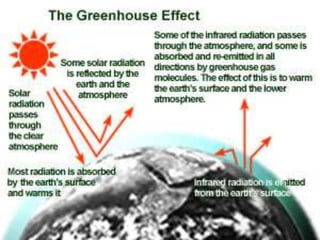
1. Solar radiation absorbed by earth’s surface.
2. Earth gives off infrared radiation.
3. Greenhouse gases absorb some of the Earth’s infrared
radiation.
4. Greenhouse gases (water and CO2) give off infrared
radiation in all directions.
5. Earth absorbs downward directed infrared radiation.
Result : warmer surface temperature
GREEN HOUSE GASES
The primary greenhouse gases include:
•carbon dioxide
•methane
•nitrogen oxides, and
•fluorinated gases
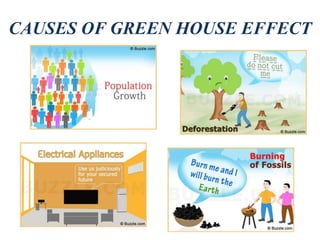
CAUSES OF GREEN HOUSE EFFECT
WHY GREEN HOUSE EFFECT
INCREASES
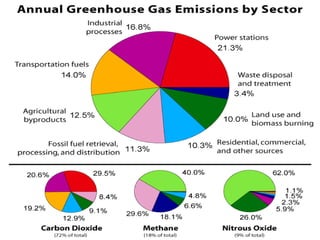
1. CARBON DIOXIDE is added to the atmosphere when people burn
coal, oil (gasoline), and natural gas FOSSIL FUELS, for transportation,
factories, and electricity.
2. Deforestation, or the clearing of forests, also increases the amount of
CARBON DIOXIDE in the air because in photosynthesis plants take in
carbon dioxide and remove it from the atmosphere, they make oxygen.
3. Volcanoes, fires, and respiration (breathing) also add CO2 to the
atmosphere.
4. Methane is produced when garbage is buried in landfills, from animal
waste (poop), and from other natural sources.
5. As temperatures increase, evaporation increases which adds water
vapor.
EFFECT OF GREEN HOUSE
EFFECT
•The Greenhouse gases gather in the Earth's atmosphere and trap in
the Sun's rays which heat up the Earth to cause Global Warming.
•Life on earth depends on energy from the sun. About 30 percent of
the sunlight that beams toward Earth is deflected by the outer
atmosphere and scattered back into space. The rest reaches the
planet's surface and is reflected upward again as a type of slow-
moving energy called infrared radiation.
•The heat caused by infrared radiation is absorbed by "greenhouse
gases" such as water vapor, carbon dioxide, ozone and methane,
which slows its escape from the atmosphere.
•Although greenhouse gases make up only about 1 percent of the
Earth's atmosphere, they regulate our climate by trapping heat and
holding it in a kind of warm-air blanket that surrounds the planet.
GLOBAL WARMING
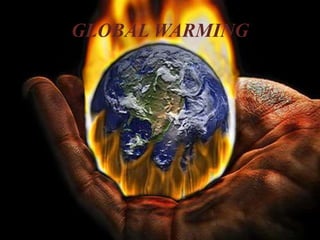
GLOBAL WARMING
Global warming is the gradual heating of Earth's
surface, oceans and atmosphere. Scientists have
documented the rise in average temperatures
worldwide since the late 1800s. Earth's average
temperature has risen by 1.4 degrees Fahrenheit (0.8
degrees Celsius) over the past century, according to
the Environmental Protection Agency (EPA)
CAUSES OF GLOBAL WARMING
Man Made Causes:-
Human-caused global warming occurs when human
activity introduces too much of certain types of gas
into the atmosphere. More of this gas equals more
warming. The atmospheric gases primarily responsible
for the greenhouse effect are known as "greenhouse
gases" and include water vapor, carbon dioxide (CO2),
methane (CH4) and nitrous oxide (N2O). The most
prevalent greenhouse gas is CO2.
CAUSES OF GLOBAL WARMING
Natural Causes:-
Some atmospheric CO2 is natural. For example, before the
Industrial Revolution, there were about 280 parts per
million (ppm) of CO2 in the atmosphere, and during most
of the past 800,000 years, CO2 fluctuated between about
180 ppm during ice ages and 280 ppm during interglacial
warm periods. Since the Industrial Revolution, though, the
amount of CO2 has dramatically increased. Currently, the
increase is 100 times faster than that when the last ice age
ended, according to the National Oceanic and
Atmospheric Administration (NOAA).
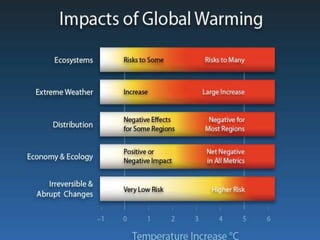
EFFECTS OF GLOBAL WARMING
Some of the effects of global warming include
increased melting of land ice, faster rises in sea level
and increased temperature averages. It also increases
the demand for energy and contributes to extreme
weather conditions.
Positive effects of global warming include fewer
deaths in winter due to cold weather, lower costs of
energy for heating homes and other buildings, and
better agricultural production. Additionally, warmer
temperatures facilitate sea transportation in the
northern parts of the Earth
DIFFERENCE BETWEEN GLOBAL
WARMING AND GREEN HOUSE EFFECT
Global warming is the increase in Earth's near-surface
air and ocean temperatures.
The greenhouse effect is when water and carbon
dioxide absorb outgoing infrared radiation, increasing
the planet's temperature.
PREVENTION OF GREEN HOUSE
EFFECT
•Reduce, Reuse, Recycle
•Use Less Heat and Air Conditioning
•Replace Your Light Bulbs
•Drive Less and Drive Smart
•Buy Energy-Efficient Products
•Use Less Hot Water
•Plant a Tree
• Get a Report Card from Your Utility Company
•Encourage Others to Conserve
PREVENTION OF GLOBAL
WARMING
•Uses of Solar Energy
• Use Electric or Hybrid Car
•Plant Trees At Home
•Save Clean Water
•Avoid Lighting at Day Time
• Make High Roofs
•Reduce Trash At Home
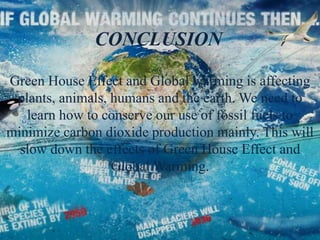
CONCLUSION
Green House Effect and Global warming is affecting
plants, animals, humans and the earth. We need to
learn how to conserve our use of fossil fuels to
minimize carbon dioxide production mainly. This will
slow down the effects of Green House Effect and
Global Warming.
REFERENCE
•Book of Generation Of Electrical Power
•Various sites
Power engineering assignment

Power engineering assignment

  • 1.
    CAREER POINT UNIVERSITY ALANIYA, KOTA Minor 2nd Assignment on New Energy Sources – ‘GREEN HOUSE EFFECT’ Subject – Power Engineering Submitted To Submitted By Mr. Kamal Arora Rahnuma Khilji Uid-K11622 Course-B.tech 5th Semester Branch-Electrical Engineering
  • 2.
    CONTENTS 1. What isGreen House Effect 2. Green House Gases 3. Causes of Green Houuse Effect 4. Effect of Green House Effect 5. Global Warming 6. Causes of Global Warming 7. Effect of Global Warming 8. Difference Between Green House Effect And Global Warming 9. Prevention of Green House Effect And Global Warming 10. Conclusion 11. Reference
  • 4.
    WHAT IS GREENHOUSE EFFECT 1. Solar radiation absorbed by earth’s surface. 2. Earth gives off infrared radiation. 3. Greenhouse gases absorb some of the Earth’s infrared radiation. 4. Greenhouse gases (water and CO2) give off infrared radiation in all directions. 5. Earth absorbs downward directed infrared radiation. Result : warmer surface temperature
  • 5.
    GREEN HOUSE GASES Theprimary greenhouse gases include: •carbon dioxide •methane •nitrogen oxides, and •fluorinated gases
  • 6.
    CAUSES OF GREENHOUSE EFFECT
  • 7.
    WHY GREEN HOUSEEFFECT INCREASES 1. CARBON DIOXIDE is added to the atmosphere when people burn coal, oil (gasoline), and natural gas FOSSIL FUELS, for transportation, factories, and electricity. 2. Deforestation, or the clearing of forests, also increases the amount of CARBON DIOXIDE in the air because in photosynthesis plants take in carbon dioxide and remove it from the atmosphere, they make oxygen. 3. Volcanoes, fires, and respiration (breathing) also add CO2 to the atmosphere. 4. Methane is produced when garbage is buried in landfills, from animal waste (poop), and from other natural sources. 5. As temperatures increase, evaporation increases which adds water vapor.
  • 9.
    EFFECT OF GREENHOUSE EFFECT •The Greenhouse gases gather in the Earth's atmosphere and trap in the Sun's rays which heat up the Earth to cause Global Warming. •Life on earth depends on energy from the sun. About 30 percent of the sunlight that beams toward Earth is deflected by the outer atmosphere and scattered back into space. The rest reaches the planet's surface and is reflected upward again as a type of slow- moving energy called infrared radiation. •The heat caused by infrared radiation is absorbed by "greenhouse gases" such as water vapor, carbon dioxide, ozone and methane, which slows its escape from the atmosphere. •Although greenhouse gases make up only about 1 percent of the Earth's atmosphere, they regulate our climate by trapping heat and holding it in a kind of warm-air blanket that surrounds the planet.
  • 10.
  • 11.
    GLOBAL WARMING Global warmingis the gradual heating of Earth's surface, oceans and atmosphere. Scientists have documented the rise in average temperatures worldwide since the late 1800s. Earth's average temperature has risen by 1.4 degrees Fahrenheit (0.8 degrees Celsius) over the past century, according to the Environmental Protection Agency (EPA)
  • 12.
    CAUSES OF GLOBALWARMING Man Made Causes:- Human-caused global warming occurs when human activity introduces too much of certain types of gas into the atmosphere. More of this gas equals more warming. The atmospheric gases primarily responsible for the greenhouse effect are known as "greenhouse gases" and include water vapor, carbon dioxide (CO2), methane (CH4) and nitrous oxide (N2O). The most prevalent greenhouse gas is CO2.
  • 13.
    CAUSES OF GLOBALWARMING Natural Causes:- Some atmospheric CO2 is natural. For example, before the Industrial Revolution, there were about 280 parts per million (ppm) of CO2 in the atmosphere, and during most of the past 800,000 years, CO2 fluctuated between about 180 ppm during ice ages and 280 ppm during interglacial warm periods. Since the Industrial Revolution, though, the amount of CO2 has dramatically increased. Currently, the increase is 100 times faster than that when the last ice age ended, according to the National Oceanic and Atmospheric Administration (NOAA).
  • 15.
    EFFECTS OF GLOBALWARMING Some of the effects of global warming include increased melting of land ice, faster rises in sea level and increased temperature averages. It also increases the demand for energy and contributes to extreme weather conditions. Positive effects of global warming include fewer deaths in winter due to cold weather, lower costs of energy for heating homes and other buildings, and better agricultural production. Additionally, warmer temperatures facilitate sea transportation in the northern parts of the Earth
  • 16.
    DIFFERENCE BETWEEN GLOBAL WARMINGAND GREEN HOUSE EFFECT Global warming is the increase in Earth's near-surface air and ocean temperatures. The greenhouse effect is when water and carbon dioxide absorb outgoing infrared radiation, increasing the planet's temperature.
  • 17.
    PREVENTION OF GREENHOUSE EFFECT •Reduce, Reuse, Recycle •Use Less Heat and Air Conditioning •Replace Your Light Bulbs •Drive Less and Drive Smart •Buy Energy-Efficient Products •Use Less Hot Water •Plant a Tree • Get a Report Card from Your Utility Company •Encourage Others to Conserve
  • 18.
    PREVENTION OF GLOBAL WARMING •Usesof Solar Energy • Use Electric or Hybrid Car •Plant Trees At Home •Save Clean Water •Avoid Lighting at Day Time • Make High Roofs •Reduce Trash At Home
  • 19.
    CONCLUSION Green House Effectand Global warming is affecting plants, animals, humans and the earth. We need to learn how to conserve our use of fossil fuels to minimize carbon dioxide production mainly. This will slow down the effects of Green House Effect and Global Warming.
  • 20.
    REFERENCE •Book of GenerationOf Electrical Power •Various sites