GREECEGREECE
TRADITIONAL FOLK COSTUMESTRADITIONAL FOLK COSTUMES
PELOPONNESEPELOPONNESE
TRADITIONAL COSTUMESTRADITIONAL COSTUMES
Queen Amalia - King OttoQueen Amalia - King Otto
(19(19thth
c.)c.)
Amalia’s costumeAmalia’s costume
This ladies’ famous costume was introduced by
Queen Amalia in the 19th
c. It used to be her
daily garment and she imposed it on the ladies
of the Royal Court.
The costume was then spread to all the urban
centers of Greece as a costume for the
festivities.
This ladies’ costume consists
of a gossamer silk shirt
with fine gold embroidery,
a precious pleated silk
dress with wide sleeves in
a variety of colors, and a
velvet short jacket, all
trimmed with gold braid
and embroidery. The
costume is completed with
a red fez, and silk tassel.
The neck and chest are
decorated with rows of
pearls and a precious
brooch.
MEN’S COSTUMEMEN’S COSTUME
EVZONE:EVZONE: guardian of therdian of the Palace,Palace,
now guardian of thenow guardian of the Parliament.Parliament.
This men’s costume
consists of a white shirt
with very broad sleeves,
white elastic trousers,
knee bands and a kind
of a very flared skirt
(fοustanella) with 400
pleats. The length of
the skirt is 50 cm. 
EVZONEEVZONE
Yesterday and TodayYesterday and Today
PAIR OFPAIR OF
ARCADIANSARCADIANS
Husband with hisHusband with his
WifeWife
15th century.15th century.
Traditional costumes ofTraditional costumes of
ServoServo,, ArcadiaArcadia
TSAKONIA (eastern Arcadia)TSAKONIA (eastern Arcadia)
MELANA - TYROSMELANA - TYROS
This women’s costume is worn onThis women’s costume is worn on
the east coast of Arcadia,the east coast of Arcadia,
Tsakonia, one of the most historicTsakonia, one of the most historic
places in the Peloponnese. Theplaces in the Peloponnese. The
place has been inhabited sinceplace has been inhabited since
prehistoric times. The Tsakonianprehistoric times. The Tsakonian
dialect (still alive) is the closestdialect (still alive) is the closest
language to the ancient Greek one.language to the ancient Greek one.
The dance of this region, theThe dance of this region, the
Tsakonikos Dance, is one of theTsakonikos Dance, is one of the
oldest and similar to the ancientoldest and similar to the ancient
Greek dances.Greek dances.
TSAKONIKOS DANCE (5/4)TSAKONIKOS DANCE (5/4)
(Mother, I told you not to get me(Mother, I told you not to get me
married to an old man…)married to an old man…)
DOLIANA-ARCADIADOLIANA-ARCADIA
Men’s costumeMen’s costume
The man wears a blackThe man wears a black
headscarf tied at the backheadscarf tied at the back
of the head.of the head. The dress isThe dress is
woven on the loom in greywoven on the loom in grey
with black stripes.with black stripes.
Underneath, he wearsUnderneath, he wears
trousers with knee bandstrousers with knee bands
((ggοοnataresnatares) and the special) and the special
kind of shoes that arekind of shoes that are
calledcalled tsarouhia.tsarouhia.
NESTANI-ARCADIANESTANI-ARCADIA
People who participate in the event are dressed in
traditional costumes and they hold tsipianitiki
(shepherd’s) crook which is adorned on the top with
flowers, lilacs, and other plants of the Greek earth,
such as wild celery (agrioselino).
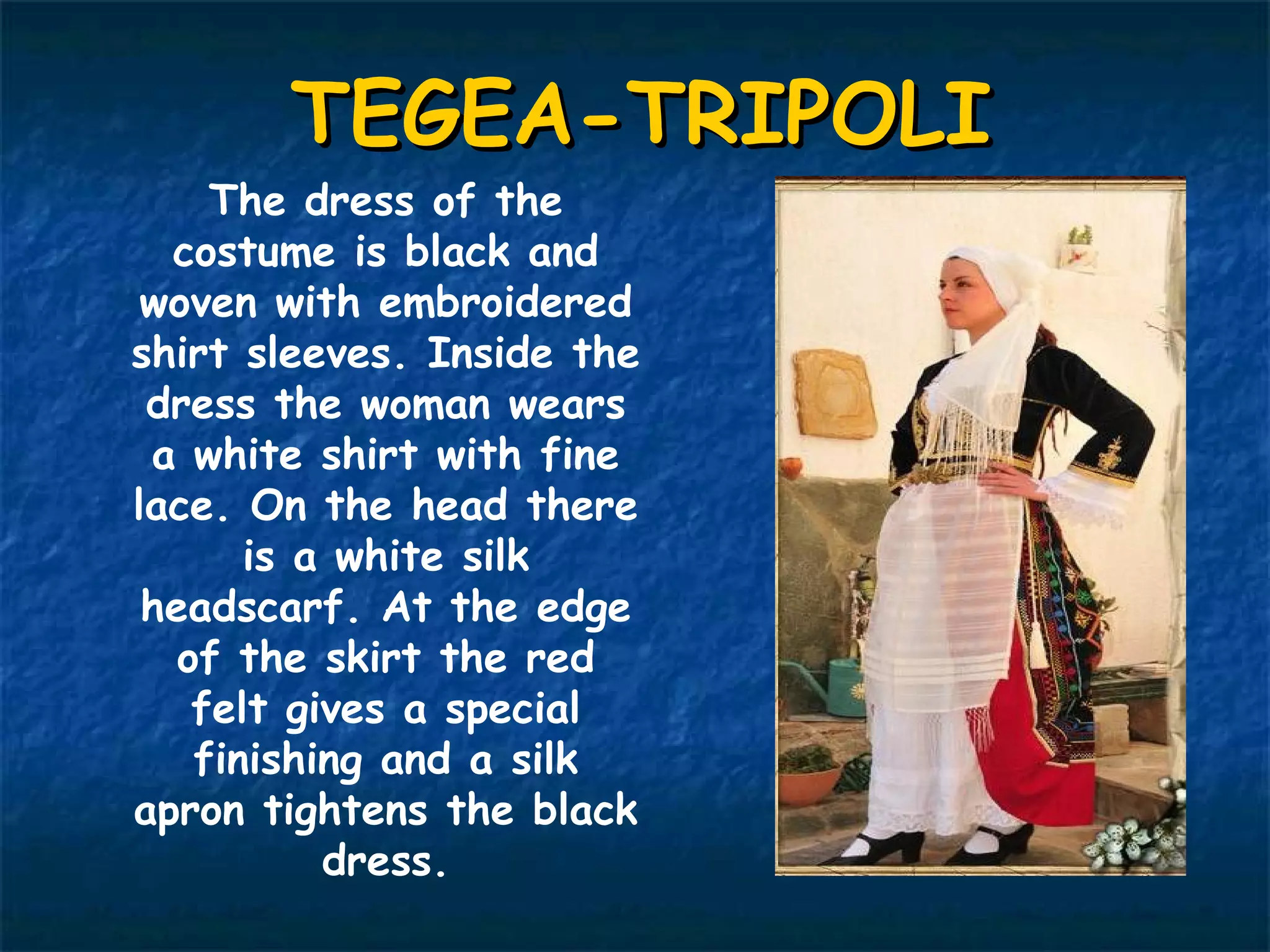
TEGEA-TRIPOLITEGEA-TRIPOLI
The dress of the
costume is black and
woven with embroidered
shirt sleeves. Inside the
dress the woman wears
a white shirt with fine
lace. On the head there
is a white silk
headscarf. At the edge
of the skirt the red
felt gives a special
finishing and a silk
apron tightens the black
dress.
Traditional folk costumesTraditional folk costumes
(of every day life)(of every day life)
THE LOOMTHE LOOM
The history of the loomThe history of the loom
The loom is a machine which was used for weaving clothes in older
times. It was widely used in the pre-industrial era and later,
mainly in rural areas, played a major role in the domestic
economy, since it has been the primary means of weaving and
textiles. After the industrial revolution, the old classic,
wooden, and moved by muscle power loom, was replaced by a
mechanical one. Today it has almost disappeared, as the
weaving process has been automated and the loom has been
replaced by the industrial textile machine.
KALAMATAKALAMATA
(south-west Peloponnese)(south-west Peloponnese)
The women’s costume
of Kalamata is one of
the most elegant and
exquisite costumes of
all over Greece. The
dominant colors of
those costumes are
white, yellow and
black, combined with
gold embroidery and
gold jewelry.
.
MANI (southern Peloponnese)MANI (southern Peloponnese)
Women’s costumeWomen’s costume forfor the upper classthe upper class
MANI-MANI-Ceremonial costumeCeremonial costume
The ceremonial women’s costume consists
of: 
• A long white shirt with embroidered bodice
and sleeves. 
• A sleeveless dress of dark-colored woolen
cloth with deep cut of the bodice and a
skirt that falls in folds, the outer part of
which is decorated with a very wide cotton
band of red color, while the inner part,
namely the hem, is decorated with a narrow
red band. 
• Around the waist: a striped belt. 
• For the head: Two headscarves-one of
blue color and a silk one that is called bolia.
MManiani
Men’sMen’s costumecostume
The Maniatis-the man of Mani-
looks like a pirate. On his head
he wears a black strapped
headscarf. He wears a shirt
with colored embroidery on the
sleeves and over it a short red
or black vest. He also wears
dark blue breeches with black
trousers and tsarouhia without
tassel. This attire was used in
pirate raids.
ARGOLIDA (eastern Peloponnese)ARGOLIDA (eastern Peloponnese)
Women’s costumeWomen’s costume
The women wear white
headscarves tied
behind the head. The
dresses are pale yellow
with lace on the
bodice, on the edge of
the sleeves and on the
hem. Over the dress
there are a black vest
and a yellowish oval
shaped apron with lace
on the edges.
CORINTHCORINTH (north-east Peloponnese)(north-east Peloponnese)
Bridal gownBridal gown
The bridal costume consists of: 
• A white cotton shirt with
embroidered sleeves and hem. 
• A short fitted front with
embroidered sleeves, too.
• A neckline with gold embroidery. 
• A white apron embroidered with
multicolored geometrical
patterns. 
• A red belt. 
• An open outer short garment
made of thick weft-knitted cloth,
decorated with multicolored
cording. 
• For the head: a headscarf
(bolia), embroidered
with multicolored geometrical
CORINTHCORINTH
The villager’s costume (horikos)The villager’s costume (horikos)
This long shirt is the
every-day-life
costume of the old
Arvanites.It is the
ancestor of the
special men’s skirt
(foustanella).
Underneath he wears
trousers, gonatares
under the knees and
tsarouhia.
 
Finishing touchFinishing touch
The differences between the similar
kinds of the traditional costumes
demonstrate the origin of a genus or the
social status or the economical power of the
family or even the personal story of a
woman (mourning).
That's why the diversity of our
traditional costumes marks the unique path
of culture in the Greek history.

Presentation of folk costumes - Greece

  • 1.
    GREECEGREECE TRADITIONAL FOLK COSTUMESTRADITIONALFOLK COSTUMES PELOPONNESEPELOPONNESE
  • 2.
    TRADITIONAL COSTUMESTRADITIONAL COSTUMES QueenAmalia - King OttoQueen Amalia - King Otto (19(19thth c.)c.)
  • 3.
    Amalia’s costumeAmalia’s costume Thisladies’ famous costume was introduced by Queen Amalia in the 19th c. It used to be her daily garment and she imposed it on the ladies of the Royal Court. The costume was then spread to all the urban centers of Greece as a costume for the festivities.
  • 4.
    This ladies’ costumeconsists of a gossamer silk shirt with fine gold embroidery, a precious pleated silk dress with wide sleeves in a variety of colors, and a velvet short jacket, all trimmed with gold braid and embroidery. The costume is completed with a red fez, and silk tassel. The neck and chest are decorated with rows of pearls and a precious brooch.
  • 5.
    MEN’S COSTUMEMEN’S COSTUME EVZONE:EVZONE:guardian of therdian of the Palace,Palace, now guardian of thenow guardian of the Parliament.Parliament. This men’s costume consists of a white shirt with very broad sleeves, white elastic trousers, knee bands and a kind of a very flared skirt (fοustanella) with 400 pleats. The length of the skirt is 50 cm. 
  • 6.
  • 7.
    PAIR OFPAIR OF ARCADIANSARCADIANS Husbandwith hisHusband with his WifeWife 15th century.15th century.
  • 8.
    Traditional costumes ofTraditionalcostumes of ServoServo,, ArcadiaArcadia
  • 9.
    TSAKONIA (eastern Arcadia)TSAKONIA(eastern Arcadia) MELANA - TYROSMELANA - TYROS This women’s costume is worn onThis women’s costume is worn on the east coast of Arcadia,the east coast of Arcadia, Tsakonia, one of the most historicTsakonia, one of the most historic places in the Peloponnese. Theplaces in the Peloponnese. The place has been inhabited sinceplace has been inhabited since prehistoric times. The Tsakonianprehistoric times. The Tsakonian dialect (still alive) is the closestdialect (still alive) is the closest language to the ancient Greek one.language to the ancient Greek one. The dance of this region, theThe dance of this region, the Tsakonikos Dance, is one of theTsakonikos Dance, is one of the oldest and similar to the ancientoldest and similar to the ancient Greek dances.Greek dances.
  • 10.
    TSAKONIKOS DANCE (5/4)TSAKONIKOSDANCE (5/4) (Mother, I told you not to get me(Mother, I told you not to get me married to an old man…)married to an old man…)
  • 11.
    DOLIANA-ARCADIADOLIANA-ARCADIA Men’s costumeMen’s costume Theman wears a blackThe man wears a black headscarf tied at the backheadscarf tied at the back of the head.of the head. The dress isThe dress is woven on the loom in greywoven on the loom in grey with black stripes.with black stripes. Underneath, he wearsUnderneath, he wears trousers with knee bandstrousers with knee bands ((ggοοnataresnatares) and the special) and the special kind of shoes that arekind of shoes that are calledcalled tsarouhia.tsarouhia.
  • 12.
    NESTANI-ARCADIANESTANI-ARCADIA People who participatein the event are dressed in traditional costumes and they hold tsipianitiki (shepherd’s) crook which is adorned on the top with flowers, lilacs, and other plants of the Greek earth, such as wild celery (agrioselino).
  • 13.
    TEGEA-TRIPOLITEGEA-TRIPOLI The dress ofthe costume is black and woven with embroidered shirt sleeves. Inside the dress the woman wears a white shirt with fine lace. On the head there is a white silk headscarf. At the edge of the skirt the red felt gives a special finishing and a silk apron tightens the black dress.
  • 14.
    Traditional folk costumesTraditionalfolk costumes (of every day life)(of every day life)
  • 15.
  • 16.
    The history ofthe loomThe history of the loom The loom is a machine which was used for weaving clothes in older times. It was widely used in the pre-industrial era and later, mainly in rural areas, played a major role in the domestic economy, since it has been the primary means of weaving and textiles. After the industrial revolution, the old classic, wooden, and moved by muscle power loom, was replaced by a mechanical one. Today it has almost disappeared, as the weaving process has been automated and the loom has been replaced by the industrial textile machine.
  • 17.
    KALAMATAKALAMATA (south-west Peloponnese)(south-west Peloponnese) Thewomen’s costume of Kalamata is one of the most elegant and exquisite costumes of all over Greece. The dominant colors of those costumes are white, yellow and black, combined with gold embroidery and gold jewelry. .
  • 18.
    MANI (southern Peloponnese)MANI(southern Peloponnese) Women’s costumeWomen’s costume forfor the upper classthe upper class
  • 19.
    MANI-MANI-Ceremonial costumeCeremonial costume Theceremonial women’s costume consists of:  • A long white shirt with embroidered bodice and sleeves.  • A sleeveless dress of dark-colored woolen cloth with deep cut of the bodice and a skirt that falls in folds, the outer part of which is decorated with a very wide cotton band of red color, while the inner part, namely the hem, is decorated with a narrow red band.  • Around the waist: a striped belt.  • For the head: Two headscarves-one of blue color and a silk one that is called bolia.
  • 20.
    MManiani Men’sMen’s costumecostume The Maniatis-theman of Mani- looks like a pirate. On his head he wears a black strapped headscarf. He wears a shirt with colored embroidery on the sleeves and over it a short red or black vest. He also wears dark blue breeches with black trousers and tsarouhia without tassel. This attire was used in pirate raids.
  • 21.
    ARGOLIDA (eastern Peloponnese)ARGOLIDA(eastern Peloponnese) Women’s costumeWomen’s costume The women wear white headscarves tied behind the head. The dresses are pale yellow with lace on the bodice, on the edge of the sleeves and on the hem. Over the dress there are a black vest and a yellowish oval shaped apron with lace on the edges.
  • 22.
    CORINTHCORINTH (north-east Peloponnese)(north-eastPeloponnese) Bridal gownBridal gown The bridal costume consists of:  • A white cotton shirt with embroidered sleeves and hem.  • A short fitted front with embroidered sleeves, too. • A neckline with gold embroidery.  • A white apron embroidered with multicolored geometrical patterns.  • A red belt.  • An open outer short garment made of thick weft-knitted cloth, decorated with multicolored cording.  • For the head: a headscarf (bolia), embroidered with multicolored geometrical
  • 23.
    CORINTHCORINTH The villager’s costume(horikos)The villager’s costume (horikos) This long shirt is the every-day-life costume of the old Arvanites.It is the ancestor of the special men’s skirt (foustanella). Underneath he wears trousers, gonatares under the knees and tsarouhia.  
  • 24.
    Finishing touchFinishing touch Thedifferences between the similar kinds of the traditional costumes demonstrate the origin of a genus or the social status or the economical power of the family or even the personal story of a woman (mourning). That's why the diversity of our traditional costumes marks the unique path of culture in the Greek history.