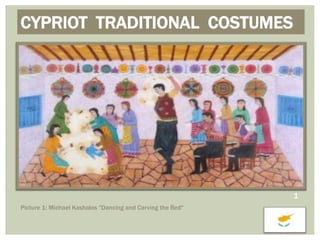
Picture 1: Michael Kashalos "Dancing and Carving the Bed"
CYPRIOT TRADITIONAL COSTUMES
1
GENERAL INFORMATIONS
• Cypriot costumes are an integral component of the
traditional culture of Cyprus. Each one is distinctive
of a group of people who lived on this East of
Mediterranean island, and who, despite their
idiosyncrasies, maintained a uniform identity,
keeping alive the consciousness of their common
origin and history.
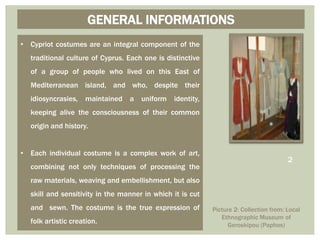
• Each individual costume is a complex work of art,
combining not only techniques of processing the
raw materials, weaving and embellishment, but also
skill and sensitivity in the manner in which it is cut
and sewn. The costume is the true expression of
folk artistic creation.
Picture 2: Collection from: Local
Ethnographic Museum of
Geroskipou (Paphos)
2
• There are nevertheless, local variations, both in the kind of costume and in its
details: in the color of the cloth, the combination of its partial elements, the
cut, decoration and in its accessories.
• Like Cypriot folk art in general, the costumes are characterized by a
conservatism, though this in no way detracts from their diversity and charm.
• In a more or less egalitarian society, such as that of Cyprus until the early
decades of the present century, the costumes worn by men and women gave
their wearers a sense of security, confidence and ease.
GENERAL INFORMATIONS
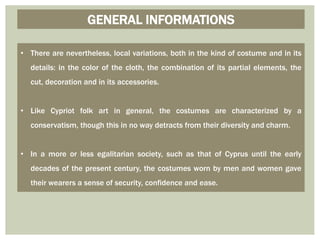
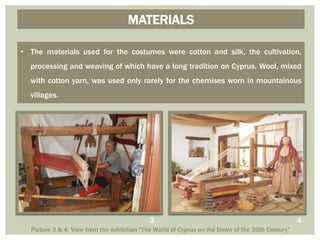
• The materials used for the costumes were cotton and silk, the cultivation,
processing and weaving of which have a long tradition on Cyprus. Wool, mixed
with cotton yarn, was used only rarely for the chemises worn in mountainous
villages.
MATERIALS
Picture 3 & 4: View from the exhibition "The World of Cyprus on the Dawn of the 20th Century"
43
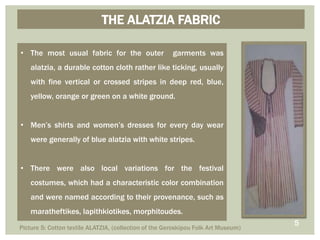
• The most usual fabric for the outer garments was
alatzia, a durable cotton cloth rather like ticking, usually
with fine vertical or crossed stripes in deep red, blue,
yellow, orange or green on a white ground.
• Men’s shirts and women’s dresses for every day wear
were generally of blue alatzia with white stripes.
• There were also local variations for the festival
costumes, which had a characteristic color combination
and were named according to their provenance, such as
maratheftikes, lapithkiotikes, morphitoudes.
THE ALATZIA FABRIC
5
Picture 5: Cotton textile ALATZIA, (collection of the Geroskipou Folk Art Museum)
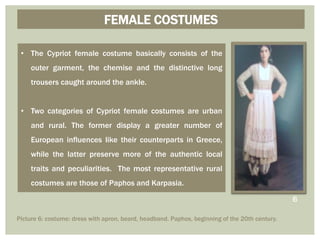
• The Cypriot female costume basically consists of the
outer garment, the chemise and the distinctive long
trousers caught around the ankle.
• Two categories of Cypriot female costumes are urban
and rural. The former display a greater number of
European influences like their counterparts in Greece,
while the latter preserve more of the authentic local
traits and peculiarities. The most representative rural
costumes are those of Paphos and Karpasia.
FEMALE COSTUMES
6
Picture 6: costume: dress with apron, beard, headband. Paphos, beginning of the 20th century.
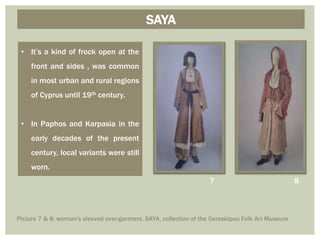
• It’s a kind of frock open at the
front and sides , was common
in most urban and rural regions
of Cyprus until 19th century.
• In Paphos and Karpasia in the
early decades of the present
century, local variants were still
worn.
SAYA
87
Picture 7 & 8: woman's sleeved over-garment, SAYA, collection of the Geroskipou Folk Art Museum
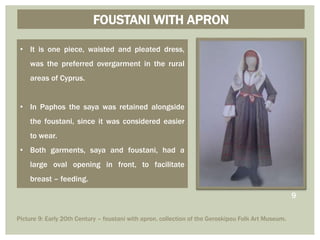
• It is one piece, waisted and pleated dress,
was the preferred overgarment in the rural
areas of Cyprus.
• In Paphos the saya was retained alongside
the foustani, since it was considered easier
to wear.
• Both garments, saya and foustani, had a
large oval opening in front, to facilitate
breast – feeding.
FOUSTANI WITH APRON
9
Picture 9: Early 20th Century – foustani with apron, collection of the Geroskipou Folk Art Museum.
LOCAL VARIATIONS
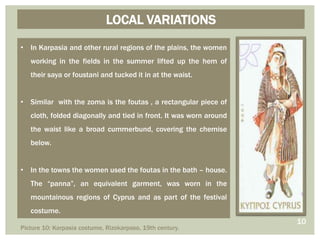
• In Karpasia and other rural regions of the plains, the women
working in the fields in the summer lifted up the hem of
their saya or foustani and tucked it in at the waist.
• Similar with the zoma is the foutas , a rectangular piece of
cloth, folded diagonally and tied in front. It was worn around
the waist like a broad cummerbund, covering the chemise
below.
• In the towns the women used the foutas in the bath – house.
The “panna”, an equivalent garment, was worn in the
mountainous regions of Cyprus and as part of the festival
costume.
10
Picture 10: Karpasia costume, Rizokarpaso, 19th century.
BRIDAL COSTUMES
• In contrast to the urban costume, which frequently
became a criterion of social class, a relative uniformity
is observed in the rural world.
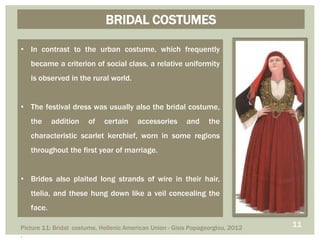
• The festival dress was usually also the bridal costume,
the addition of certain accessories and the
characteristic scarlet kerchief, worn in some regions
throughout the first year of marriage.
• Brides also plaited long strands of wire in their hair,
ttelia, and these hung down like a veil concealing the
face.
11Picture 11: Bridal costume, Hellenic American Union - Gisis Papageorgiou, 2012
.
THE HEADRESS
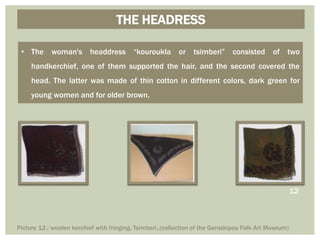
• The woman's headdress “kouroukla or tsimberi” consisted of two
handkerchief, one of them supported the hair, and the second covered the
head. The latter was made of thin cotton in different colors, dark green for
young women and for older brown.
Picture 12.: woolen kerchief with fringing, Tsimberi.,(collection of the Geroskipou Folk Art Museum)
12
THE SHOES
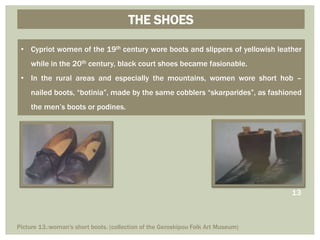
• Cypriot women of the 19th century wore boots and slippers of yellowish leather
while in the 20th century, black court shoes became fasionable.
• In the rural areas and especially the mountains, women wore short hob –
nailed boots, “botinia”, made by the same cobblers “skarparides”, as fashioned
the men’s boots or podines.
Picture 13.:woman's short boots. (collection of the Geroskipou Folk Art Museum)
13
OTHER ACCESSORIES - JEWELLERY
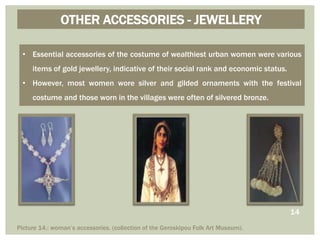
• Essential accessories of the costume of wealthiest urban women were various
items of gold jewellery, indicative of their social rank and economic status.
• However, most women wore silver and gilded ornaments with the festival
costume and those worn in the villages were often of silvered bronze.
Picture 14.: woman’s accessories. (collection of the Geroskipou Folk Art Museum).
14
MALE COSTUMES
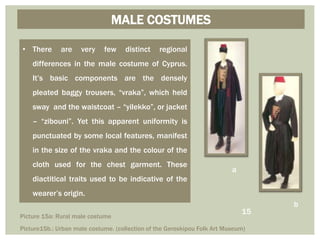
• There are very few distinct regional
differences in the male costume of Cyprus.
It’s basic components are the densely
pleated baggy trousers, “vraka”, which held
sway and the waistcoat – “yilekko”, or jacket
– “zibouni”. Yet this apparent uniformity is
punctuated by some local features, manifest
in the size of the vraka and the colour of the
cloth used for the chest garment. These
diactitical traits used to be indicative of the
wearer’s origin.
15
Picture15b.: Urban male costume. (collection of the Geroskipou Folk Art Museum)
Picture 15a: Rural male costume
b
a
THE VRAKA
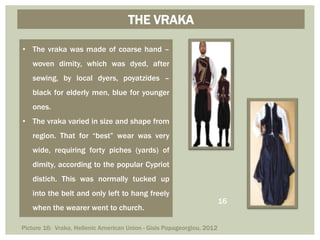
• The vraka was made of coarse hand –
woven dimity, which was dyed, after
sewing, by local dyers, poyatzides –
black for elderly men, blue for younger
ones.
• The vraka varied in size and shape from
region. That for “best” wear was very
wide, requiring forty piches (yards) of
dimity, according to the popular Cypriot
distich. This was normally tucked up
into the belt and only left to hang freely
when the wearer went to church.
Picture 16: Vraka, Hellenic American Union - Gisis Papageorgiou, 2012
16
THE CHEMISE OR SHIRT
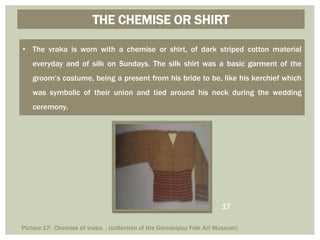
• The vraka is worn with a chemise or shirt, of dark striped cotton material
everyday and of silk on Sundays. The silk shirt was a basic garment of the
groom’s costume, being a present from his bride to be, like his kerchief which
was symbolic of their union and tied around his neck during the wedding
ceremony.
Picture 17: Chemise of vraka. . (collection of the Geroskipou Folk Art Museum)
17
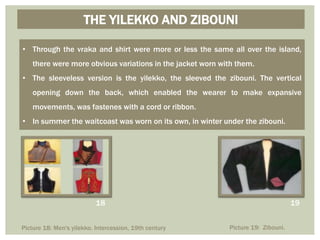
THE YILEKKO AND ZIBOUNI
• Through the vraka and shirt were more or less the same all over the island,
there were more obvious variations in the jacket worn with them.
• The sleeveless version is the yilekko, the sleeved the zibouni. The vertical
opening down the back, which enabled the wearer to make expansive
movements, was fastenes with a cord or ribbon.
• In summer the waitcoast was worn on its own, in winter under the zibouni.
Picture 18: Men's yilekko. Intercession, 19th century Picture 19: Zibouni.
18 19
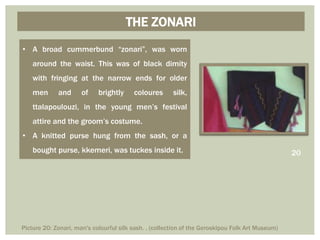
THE ZONARI
• A broad cummerbund “zonari”, was worn
around the waist. This was of black dimity
with fringing at the narrow ends for older
men and of brightly coloures silk,
ttalapoulouzi, in the young men’s festival
attire and the groom’s costume.
• A knitted purse hung from the sash, or a
bought purse, kkemeri, was tuckes inside it. 20
Picture 20: Zonari, man's colourful silk sash. . (collection of the Geroskipou Folk Art Museum)
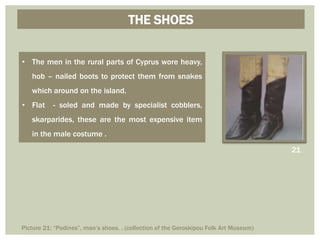
THE SHOES
• The men in the rural parts of Cyprus wore heavy,
hob – nailed boots to protect them from snakes
which around on the island.
• Flat - soled and made by specialist cobblers,
skarparides, these are the most expensive item
in the male costume .
21
Picture 21: “Podines”, man’s shoes. . (collection of the Geroskipou Folk Art Museum)
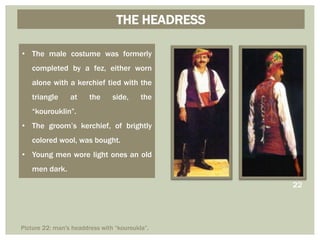
THE HEADRESS
• The male costume was formerly
completed by a fez, either worn
alone with a kerchief tied with the
triangle at the side, the
“kourouklin”.
• The groom’s kerchief, of brightly
colored wool, was bought.
• Young men wore light ones an old
men dark.
22
Picture 22: man's headdress with “kouroukla”.
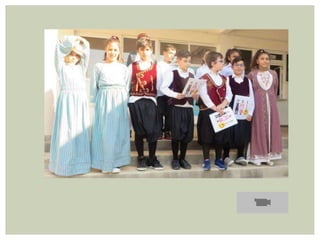
Paintings of our students
Εθνικό Ιστορικό Μουσείο Αθήνας & Πολιτιστικό Ίδρυμα Τραπέζης Κύπρου (1999). Οι Κυπριακές Φορεσιές
του Εθνικού Ιστορικού Μουσείου. Μια αναδρομή στον κόσμο της Κύπρου την αυγή του 20ου αιώνα.
Αθήνα: Παραγωγή Εκδόσεις ΚΑΠΟΝ.
ΕλληνοΑμερικανική Ένωση, Πολιτιστικό Κέντρο Λαϊκής Τράπεζας, Σύνδεσμος Σχεδιαστών Μόδας Κύπρου
(2012). Βeyond Dress Codes. Από την Παραδοσιακή φορεσιά στη σύγχρονη μόδα. Λευκωσία: Cassoulides
Masterprinters/Lithocare.
Karageorghis, V. & Des Gagniers, J. (1974). La Céramique Chypriote de Style Figuré. Roma: Edizioni dell’
Ateneo.
Παπαγεωργίου Γήσης, Ελληνικές Παραδοσιακές Φορεσιές: Κύπρος, τόμος 5, Αθήνα: Ελληνοαμερικανική
Ένωση, 2012.
Σοφοκλέους, Γ. (2002). Παράθυρο στην Κύπρος μας. Λαογραφική-Πολιτιστική Ανθολογία. Τόμος 1ος. Έτος
Α'. Λάρνακα: Mags Press.
Yπηρεσία Ερευνών, Μελετών και Εκδόσεων Βουλής των Αντιπροσώπων (2006). Ο λαϊκός πολιτισμός και η
έκφρασή του στη σύγχρονη δημιουργία. Λευκωσία.
References
Image number Source
6, 10, 18, 19,
22,
Παπαδημητρίου, Ε. Η Λαϊκή Τέχνη της Κύπρου, Μουσείο Λαϊκής Τέχνης –Εταιρεία
Κυπριακών Σπουδών, (1999), (2η έκδοση). Λευκωσία: Imprinta Ltd.
11, 16 Παπαγεωργίου, Γ., Ελληνικές Παραδοσιακές Φορεσιές: Κύπρος, τόμος 5,
Αθήνα: Ελληνοαμερικανική Ένωση, 2012.
2, 5, 7, 8, 9, 12,
13, 14 15, 17,
20, 21
Χατζηκυριάκος, Σ. Ιστορική και Λοαγραφική μελέτη – Γεροσκήπου. Λευκωσία, 2000.
3, 4 Απόψεις από την έκθεση «Ο Κόσμος της Κύπρου την αυγή του 20ούαιώνα».
Ημερολόγιο 2001. Τράπεζα Κύπρου.
https://plus.google.com/photos/100866203430931692843/albums/5191226561
091096769?banner=pwa&gpsrc=pwrd1#photos/100866203430931692843/albu
ms/5191226561091096769?banner=pwa&gpsrc=pwrd1
1 Κκάσιαλος, Μ. Βιογραφικο και παρουσίαση έργων - Dancing and Carving the Bed
http://users.sch.gr/olpaizi/autosch/joomla15/index.php/dokimanter/texnh-
menou/2501-theofilos-kkasialos-duo-laikoi-zografoi
Source table of pictures
https://www.youtube.com/watch?v=Hwg4a
akR944

Cyprus traditional costumes

  • 1.
    Picture 1: MichaelKashalos "Dancing and Carving the Bed" CYPRIOT TRADITIONAL COSTUMES 1
  • 2.
    GENERAL INFORMATIONS • Cypriotcostumes are an integral component of the traditional culture of Cyprus. Each one is distinctive of a group of people who lived on this East of Mediterranean island, and who, despite their idiosyncrasies, maintained a uniform identity, keeping alive the consciousness of their common origin and history. • Each individual costume is a complex work of art, combining not only techniques of processing the raw materials, weaving and embellishment, but also skill and sensitivity in the manner in which it is cut and sewn. The costume is the true expression of folk artistic creation. Picture 2: Collection from: Local Ethnographic Museum of Geroskipou (Paphos) 2
  • 3.
    • There arenevertheless, local variations, both in the kind of costume and in its details: in the color of the cloth, the combination of its partial elements, the cut, decoration and in its accessories. • Like Cypriot folk art in general, the costumes are characterized by a conservatism, though this in no way detracts from their diversity and charm. • In a more or less egalitarian society, such as that of Cyprus until the early decades of the present century, the costumes worn by men and women gave their wearers a sense of security, confidence and ease. GENERAL INFORMATIONS
  • 4.
    • The materialsused for the costumes were cotton and silk, the cultivation, processing and weaving of which have a long tradition on Cyprus. Wool, mixed with cotton yarn, was used only rarely for the chemises worn in mountainous villages. MATERIALS Picture 3 & 4: View from the exhibition "The World of Cyprus on the Dawn of the 20th Century" 43
  • 5.
    • The mostusual fabric for the outer garments was alatzia, a durable cotton cloth rather like ticking, usually with fine vertical or crossed stripes in deep red, blue, yellow, orange or green on a white ground. • Men’s shirts and women’s dresses for every day wear were generally of blue alatzia with white stripes. • There were also local variations for the festival costumes, which had a characteristic color combination and were named according to their provenance, such as maratheftikes, lapithkiotikes, morphitoudes. THE ALATZIA FABRIC 5 Picture 5: Cotton textile ALATZIA, (collection of the Geroskipou Folk Art Museum)
  • 6.
    • The Cypriotfemale costume basically consists of the outer garment, the chemise and the distinctive long trousers caught around the ankle. • Two categories of Cypriot female costumes are urban and rural. The former display a greater number of European influences like their counterparts in Greece, while the latter preserve more of the authentic local traits and peculiarities. The most representative rural costumes are those of Paphos and Karpasia. FEMALE COSTUMES 6 Picture 6: costume: dress with apron, beard, headband. Paphos, beginning of the 20th century.
  • 7.
    • It’s akind of frock open at the front and sides , was common in most urban and rural regions of Cyprus until 19th century. • In Paphos and Karpasia in the early decades of the present century, local variants were still worn. SAYA 87 Picture 7 & 8: woman's sleeved over-garment, SAYA, collection of the Geroskipou Folk Art Museum
  • 8.
    • It isone piece, waisted and pleated dress, was the preferred overgarment in the rural areas of Cyprus. • In Paphos the saya was retained alongside the foustani, since it was considered easier to wear. • Both garments, saya and foustani, had a large oval opening in front, to facilitate breast – feeding. FOUSTANI WITH APRON 9 Picture 9: Early 20th Century – foustani with apron, collection of the Geroskipou Folk Art Museum.
  • 9.
    LOCAL VARIATIONS • InKarpasia and other rural regions of the plains, the women working in the fields in the summer lifted up the hem of their saya or foustani and tucked it in at the waist. • Similar with the zoma is the foutas , a rectangular piece of cloth, folded diagonally and tied in front. It was worn around the waist like a broad cummerbund, covering the chemise below. • In the towns the women used the foutas in the bath – house. The “panna”, an equivalent garment, was worn in the mountainous regions of Cyprus and as part of the festival costume. 10 Picture 10: Karpasia costume, Rizokarpaso, 19th century.
  • 10.
    BRIDAL COSTUMES • Incontrast to the urban costume, which frequently became a criterion of social class, a relative uniformity is observed in the rural world. • The festival dress was usually also the bridal costume, the addition of certain accessories and the characteristic scarlet kerchief, worn in some regions throughout the first year of marriage. • Brides also plaited long strands of wire in their hair, ttelia, and these hung down like a veil concealing the face. 11Picture 11: Bridal costume, Hellenic American Union - Gisis Papageorgiou, 2012 .
  • 11.
    THE HEADRESS • Thewoman's headdress “kouroukla or tsimberi” consisted of two handkerchief, one of them supported the hair, and the second covered the head. The latter was made of thin cotton in different colors, dark green for young women and for older brown. Picture 12.: woolen kerchief with fringing, Tsimberi.,(collection of the Geroskipou Folk Art Museum) 12
  • 12.
    THE SHOES • Cypriotwomen of the 19th century wore boots and slippers of yellowish leather while in the 20th century, black court shoes became fasionable. • In the rural areas and especially the mountains, women wore short hob – nailed boots, “botinia”, made by the same cobblers “skarparides”, as fashioned the men’s boots or podines. Picture 13.:woman's short boots. (collection of the Geroskipou Folk Art Museum) 13
  • 13.
    OTHER ACCESSORIES -JEWELLERY • Essential accessories of the costume of wealthiest urban women were various items of gold jewellery, indicative of their social rank and economic status. • However, most women wore silver and gilded ornaments with the festival costume and those worn in the villages were often of silvered bronze. Picture 14.: woman’s accessories. (collection of the Geroskipou Folk Art Museum). 14
  • 14.
    MALE COSTUMES • Thereare very few distinct regional differences in the male costume of Cyprus. It’s basic components are the densely pleated baggy trousers, “vraka”, which held sway and the waistcoat – “yilekko”, or jacket – “zibouni”. Yet this apparent uniformity is punctuated by some local features, manifest in the size of the vraka and the colour of the cloth used for the chest garment. These diactitical traits used to be indicative of the wearer’s origin. 15 Picture15b.: Urban male costume. (collection of the Geroskipou Folk Art Museum) Picture 15a: Rural male costume b a
  • 15.
    THE VRAKA • Thevraka was made of coarse hand – woven dimity, which was dyed, after sewing, by local dyers, poyatzides – black for elderly men, blue for younger ones. • The vraka varied in size and shape from region. That for “best” wear was very wide, requiring forty piches (yards) of dimity, according to the popular Cypriot distich. This was normally tucked up into the belt and only left to hang freely when the wearer went to church. Picture 16: Vraka, Hellenic American Union - Gisis Papageorgiou, 2012 16
  • 16.
    THE CHEMISE ORSHIRT • The vraka is worn with a chemise or shirt, of dark striped cotton material everyday and of silk on Sundays. The silk shirt was a basic garment of the groom’s costume, being a present from his bride to be, like his kerchief which was symbolic of their union and tied around his neck during the wedding ceremony. Picture 17: Chemise of vraka. . (collection of the Geroskipou Folk Art Museum) 17
  • 17.
    THE YILEKKO ANDZIBOUNI • Through the vraka and shirt were more or less the same all over the island, there were more obvious variations in the jacket worn with them. • The sleeveless version is the yilekko, the sleeved the zibouni. The vertical opening down the back, which enabled the wearer to make expansive movements, was fastenes with a cord or ribbon. • In summer the waitcoast was worn on its own, in winter under the zibouni. Picture 18: Men's yilekko. Intercession, 19th century Picture 19: Zibouni. 18 19
  • 18.
    THE ZONARI • Abroad cummerbund “zonari”, was worn around the waist. This was of black dimity with fringing at the narrow ends for older men and of brightly coloures silk, ttalapoulouzi, in the young men’s festival attire and the groom’s costume. • A knitted purse hung from the sash, or a bought purse, kkemeri, was tuckes inside it. 20 Picture 20: Zonari, man's colourful silk sash. . (collection of the Geroskipou Folk Art Museum)
  • 19.
    THE SHOES • Themen in the rural parts of Cyprus wore heavy, hob – nailed boots to protect them from snakes which around on the island. • Flat - soled and made by specialist cobblers, skarparides, these are the most expensive item in the male costume . 21 Picture 21: “Podines”, man’s shoes. . (collection of the Geroskipou Folk Art Museum)
  • 20.
    THE HEADRESS • Themale costume was formerly completed by a fez, either worn alone with a kerchief tied with the triangle at the side, the “kourouklin”. • The groom’s kerchief, of brightly colored wool, was bought. • Young men wore light ones an old men dark. 22 Picture 22: man's headdress with “kouroukla”.
  • 21.
  • 22.
    Εθνικό Ιστορικό ΜουσείοΑθήνας & Πολιτιστικό Ίδρυμα Τραπέζης Κύπρου (1999). Οι Κυπριακές Φορεσιές του Εθνικού Ιστορικού Μουσείου. Μια αναδρομή στον κόσμο της Κύπρου την αυγή του 20ου αιώνα. Αθήνα: Παραγωγή Εκδόσεις ΚΑΠΟΝ. ΕλληνοΑμερικανική Ένωση, Πολιτιστικό Κέντρο Λαϊκής Τράπεζας, Σύνδεσμος Σχεδιαστών Μόδας Κύπρου (2012). Βeyond Dress Codes. Από την Παραδοσιακή φορεσιά στη σύγχρονη μόδα. Λευκωσία: Cassoulides Masterprinters/Lithocare. Karageorghis, V. & Des Gagniers, J. (1974). La Céramique Chypriote de Style Figuré. Roma: Edizioni dell’ Ateneo. Παπαγεωργίου Γήσης, Ελληνικές Παραδοσιακές Φορεσιές: Κύπρος, τόμος 5, Αθήνα: Ελληνοαμερικανική Ένωση, 2012. Σοφοκλέους, Γ. (2002). Παράθυρο στην Κύπρος μας. Λαογραφική-Πολιτιστική Ανθολογία. Τόμος 1ος. Έτος Α'. Λάρνακα: Mags Press. Yπηρεσία Ερευνών, Μελετών και Εκδόσεων Βουλής των Αντιπροσώπων (2006). Ο λαϊκός πολιτισμός και η έκφρασή του στη σύγχρονη δημιουργία. Λευκωσία. References
  • 23.
    Image number Source 6,10, 18, 19, 22, Παπαδημητρίου, Ε. Η Λαϊκή Τέχνη της Κύπρου, Μουσείο Λαϊκής Τέχνης –Εταιρεία Κυπριακών Σπουδών, (1999), (2η έκδοση). Λευκωσία: Imprinta Ltd. 11, 16 Παπαγεωργίου, Γ., Ελληνικές Παραδοσιακές Φορεσιές: Κύπρος, τόμος 5, Αθήνα: Ελληνοαμερικανική Ένωση, 2012. 2, 5, 7, 8, 9, 12, 13, 14 15, 17, 20, 21 Χατζηκυριάκος, Σ. Ιστορική και Λοαγραφική μελέτη – Γεροσκήπου. Λευκωσία, 2000. 3, 4 Απόψεις από την έκθεση «Ο Κόσμος της Κύπρου την αυγή του 20ούαιώνα». Ημερολόγιο 2001. Τράπεζα Κύπρου. https://plus.google.com/photos/100866203430931692843/albums/5191226561 091096769?banner=pwa&gpsrc=pwrd1#photos/100866203430931692843/albu ms/5191226561091096769?banner=pwa&gpsrc=pwrd1 1 Κκάσιαλος, Μ. Βιογραφικο και παρουσίαση έργων - Dancing and Carving the Bed http://users.sch.gr/olpaizi/autosch/joomla15/index.php/dokimanter/texnh- menou/2501-theofilos-kkasialos-duo-laikoi-zografoi Source table of pictures
  • 25.