ANCIENT
GREECE
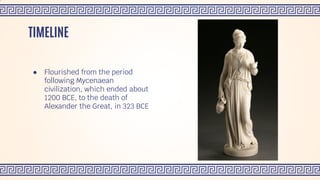
● Flourished from the period
following Mycenaean
civilization, which ended about
1200 BCE, to the death of
Alexander the Great, in 323 BCE
TIMELINE
● Existed in the Northeastern
Mediterranean civilization
● Made important contributions to
philosophy, mathematics,
astronomy, and medicine
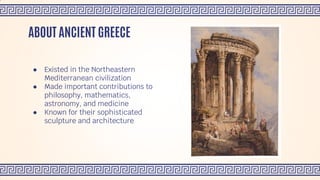
● Known for their sophisticated
sculpture and architecture
ABOUT ANCIENT GREECE
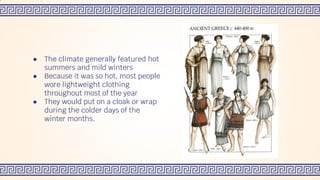
● The climate generally featured hot
summers and mild winters
● Because it was so hot, most people
wore lightweight clothing
throughout most of the year
● They would put on a cloak or wrap
during the colder days of the
winter months.
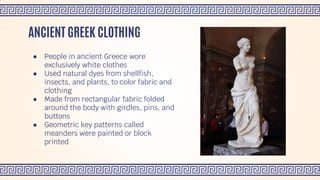
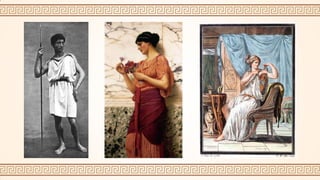
● People in ancient Greece wore
exclusively white clothes
● Used natural dyes from shellfish,
insects, and plants, to color fabric and
clothing
● Made from rectangular fabric folded
around the body with girdles, pins, and
buttons
● Geometric key patterns called
meanders were painted or block
printed
ANCIENT GREEK CLOTHING
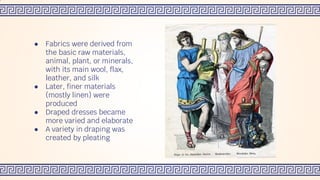
● Fabrics were derived from
the basic raw materials,
animal, plant, or minerals,
with its main wool, flax,
leather, and silk
● Later, finer materials
(mostly linen) were
produced
● Draped dresses became
more varied and elaborate
● A variety in draping was
created by pleating
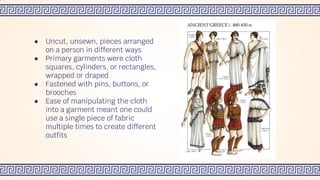
● Uncut, unsewn, pieces arranged
on a person in different ways
● Primary garments were cloth
squares, cylinders, or rectangles,
wrapped or draped
● Fastened with pins, buttons, or
brooches
● Ease of manipulating the cloth
into a garment meant one could
use a single piece of fabric
multiple times to create different
outfits
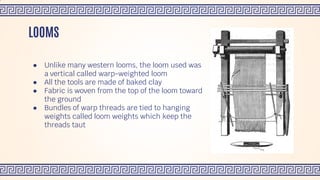
● Unlike many western looms, the loom used was
a vertical called warp-weighted loom
● All the tools are made of baked clay
● Fabric is woven from the top of the loom toward
the ground
● Bundles of warp threads are tied to hanging
weights called loom weights which keep the
threads taut
LOOMS
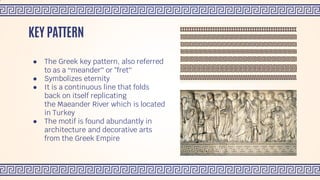
● The Greek key pattern, also referred
to as a “meander” or "fret”
● Symbolizes eternity
● It is a continuous line that folds
back on itself replicating
the Maeander River which is located
in Turkey
● The motif is found abundantly in
architecture and decorative arts
from the Greek Empire
KEY PATTERN
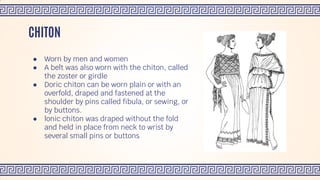
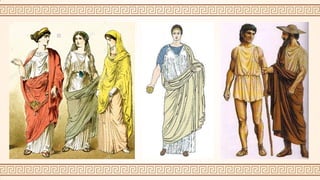
● Worn by men and women
● A belt was also worn with the chiton, called
the zoster or girdle
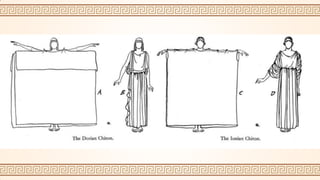
● Doric chiton can be worn plain or with an
overfold, draped and fastened at the
shoulder by pins called fibula, or sewing, or
by buttons.
● lonic chiton was draped without the fold
and held in place from neck to wrist by
several small pins or buttons
CHITON
● People were made up of Dorians and
Ionians; tribes who migrated from the
north into Greece during the
Mycenaean Era
● Unlike the austere and militaristic
Dorians, the Ionians are renowned
for their love of philosophy, art,
democracy, and pleasure
● The Peloponnese was Dorian while the
Attica Peninsula and the western coast
of Asia Minor were populated by
Ionians
DORIANS AND IONIANS
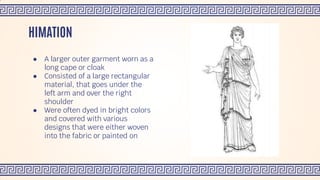
● A larger outer garment worn as a
long cape or cloak
● Consisted of a large rectangular
material, that goes under the
left arm and over the right
shoulder
● Were often dyed in bright colors
and covered with various
designs that were either woven
into the fabric or painted on
HIMATION
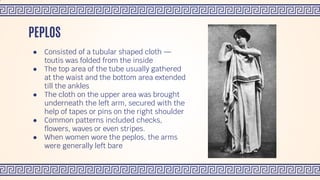
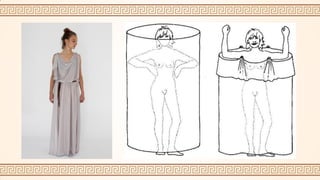
● Consisted of a tubular shaped cloth —
toutis was folded from the inside
● The top area of the tube usually gathered
at the waist and the bottom area extended
till the ankles
● The cloth on the upper area was brought
underneath the left arm, secured with the
help of tapes or pins on the right shoulder
● Common patterns included checks,
flowers, waves or even stripes.
● When women wore the peplos, the arms
were generally left bare
PEPLOS
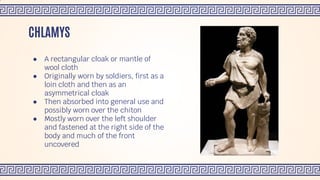
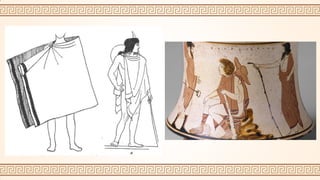
● A rectangular cloak or mantle of
wool cloth
● Originally worn by soldiers, first as a
loin cloth and then as an
asymmetrical cloak
● Then absorbed into general use and
possibly worn over the chiton
● Mostly worn over the left shoulder
and fastened at the right side of the
body and much of the front
uncovered
CHLAMYS
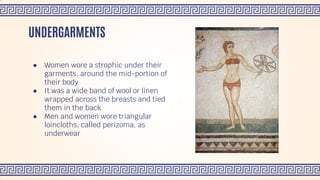
● Women wore a strophic under their
garments, around the mid-portion of
their body
● It was a wide band of wool or linen
wrapped across the breasts and tied
them in the back
● Men and women wore triangular
loincloths, called perizoma, as
underwear
UNDERGARMENTS
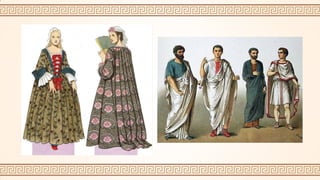
● Clothing of the Greeks influenced the fashion sense of the Romans
● Pleating techniques of himation, were later used in Europe during the
Renaissance for the capes and cloaks
● Ease of use and unisex aspect of Greek clothing made it instantly
appealing to neighboring civilizations
● Garments were easily adaptable to various climates and cultures
● The basic forms of these clothes still function as models in fashion over
2,000 years after they were first created
GREEK INFLUENCE
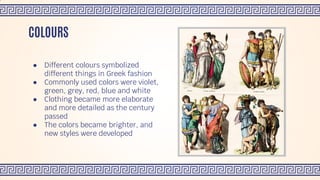
● Different colours symbolized
different things in Greek fashion
● Commonly used colors were violet,
green, grey, red, blue and white
● Clothing became more elaborate
and more detailed as the century
passed
● The colors became brighter, and
new styles were developed
COLOURS
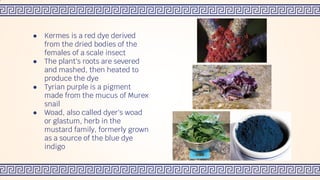
● Kermes is a red dye derived
from the dried bodies of the
females of a scale insect
● The plant's roots are severed
and mashed, then heated to
produce the dye
● Tyrian purple is a pigment
made from the mucus of Murex
snail
● Woad, also called dyer's woad
or glastum, herb in the
mustard family, formerly grown
as a source of the blue dye
indigo
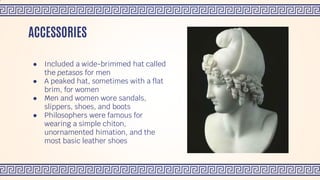
● Included a wide-brimmed hat called
the petasos for men
● A peaked hat, sometimes with a flat
brim, for women
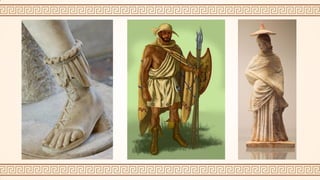
● Men and women wore sandals,
slippers, shoes, and boots
● Philosophers were famous for
wearing a simple chiton,
unornamented himation, and the
most basic leather shoes
ACCESSORIES
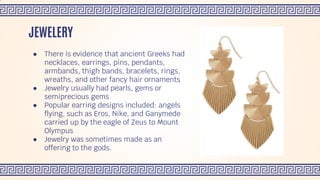
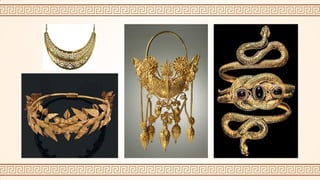
● There is evidence that ancient Greeks had
necklaces, earrings, pins, pendants,
armbands, thigh bands, bracelets, rings,
wreaths, and other fancy hair ornaments
● Jewelry usually had pearls, gems or
semiprecious gems
● Popular earring designs included: angels
flying, such as Eros, Nike, and Ganymede
carried up by the eagle of Zeus to Mount
Olympus
● Jewelry was sometimes made as an
offering to the gods.
JEWELERY
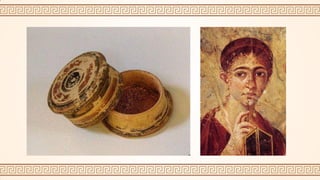
● Pale or light skin was considered a status symbol for women
● Women used honey and olive oil to improve their skin
● They often used substances as a substitute for cosmetics for enhancing
their looks
● Dark powder was dusted over the eyebrows and red powder was used
over their lips
● Kohl was used to mark the eyes.
● Red, which was applied to lips, came from the ore ochre(natural clay)
● Henna was painted on nails and hands
● For a time, even connected eyebrows (the "unibrow") was in vogue
MAKE-UP
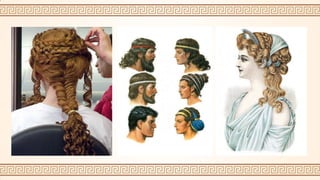
● Hairstyles also changed over time
● In the early days of Greece, men normally wore their hair short
and grew beards
● During the Hellenistic era, beards went out of style
● Long hair was typical for Greek women; only slave women would
wear their hair short
● Women curled and braided their hair in early Greece
● Later the style was to tie their hair back or put it up into a bun
● Blonde hair was highly prized and people without blonde hair
used a wash to make it appear blonde
HAIR-DO
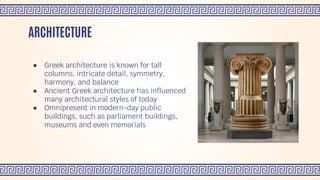
● Greek architecture is known for tall
columns, intricate detail, symmetry,
harmony, and balance
● Ancient Greek architecture has influenced
many architectural styles of today
● Omnipresent in modern-day public
buildings, such as parliament buildings,
museums and even memorials
ARCHITECTURE
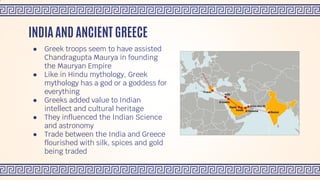
● Greek troops seem to have assisted
Chandragupta Maurya in founding
the Mauryan Empire
● Like in Hindu mythology, Greek
mythology has a god or a goddess for
everything
● Greeks added value to Indian
intellect and cultural heritage
● They influenced the Indian Science
and astronomy
● Trade between the India and Greece
flourished with silk, spices and gold
being traded
INDIA AND ANCIENT GREECE
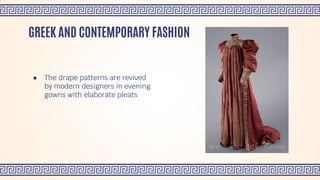
● The drape patterns are revived
by modern designers in evening
gowns with elaborate pleats
GREEK AND CONTEMPORARY FASHION
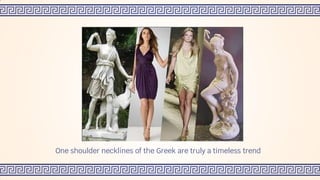
One shoulder necklines of the Greek are truly a timeless trend
● Possibly the most
recognizable logos that
use a Greek Ancient motif
is the brand Versace
● The logo of Versace is the
head of a Greek
mythological creature
called Medousa
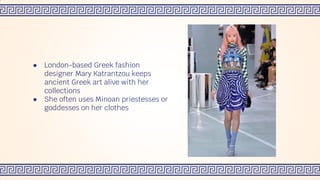
● London-based Greek fashion
designer Mary Katrantzou keeps
ancient Greek art alive with her
collections
● She often uses Minoan priestesses or
goddesses on her clothes
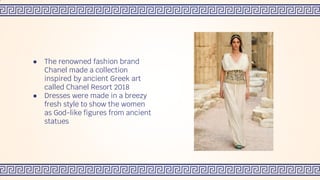
● The renowned fashion brand
Chanel made a collection
inspired by ancient Greek art
called Chanel Resort 2018
● Dresses were made in a breezy
fresh style to show the women
as God-like figures from ancient
statues

Ancient Greece.pdf

  • 1.
  • 2.
    ● Flourished fromthe period following Mycenaean civilization, which ended about 1200 BCE, to the death of Alexander the Great, in 323 BCE TIMELINE
  • 3.
    ● Existed inthe Northeastern Mediterranean civilization ● Made important contributions to philosophy, mathematics, astronomy, and medicine ● Known for their sophisticated sculpture and architecture ABOUT ANCIENT GREECE
  • 4.
    ● The climategenerally featured hot summers and mild winters ● Because it was so hot, most people wore lightweight clothing throughout most of the year ● They would put on a cloak or wrap during the colder days of the winter months.
  • 5.
    ● People inancient Greece wore exclusively white clothes ● Used natural dyes from shellfish, insects, and plants, to color fabric and clothing ● Made from rectangular fabric folded around the body with girdles, pins, and buttons ● Geometric key patterns called meanders were painted or block printed ANCIENT GREEK CLOTHING
  • 6.
    ● Fabrics werederived from the basic raw materials, animal, plant, or minerals, with its main wool, flax, leather, and silk ● Later, finer materials (mostly linen) were produced ● Draped dresses became more varied and elaborate ● A variety in draping was created by pleating
  • 7.
    ● Uncut, unsewn,pieces arranged on a person in different ways ● Primary garments were cloth squares, cylinders, or rectangles, wrapped or draped ● Fastened with pins, buttons, or brooches ● Ease of manipulating the cloth into a garment meant one could use a single piece of fabric multiple times to create different outfits
  • 8.
    ● Unlike manywestern looms, the loom used was a vertical called warp-weighted loom ● All the tools are made of baked clay ● Fabric is woven from the top of the loom toward the ground ● Bundles of warp threads are tied to hanging weights called loom weights which keep the threads taut LOOMS
  • 9.
    ● The Greekkey pattern, also referred to as a “meander” or "fret” ● Symbolizes eternity ● It is a continuous line that folds back on itself replicating the Maeander River which is located in Turkey ● The motif is found abundantly in architecture and decorative arts from the Greek Empire KEY PATTERN
  • 10.
    ● Worn bymen and women ● A belt was also worn with the chiton, called the zoster or girdle ● Doric chiton can be worn plain or with an overfold, draped and fastened at the shoulder by pins called fibula, or sewing, or by buttons. ● lonic chiton was draped without the fold and held in place from neck to wrist by several small pins or buttons CHITON
  • 13.
    ● People weremade up of Dorians and Ionians; tribes who migrated from the north into Greece during the Mycenaean Era ● Unlike the austere and militaristic Dorians, the Ionians are renowned for their love of philosophy, art, democracy, and pleasure ● The Peloponnese was Dorian while the Attica Peninsula and the western coast of Asia Minor were populated by Ionians DORIANS AND IONIANS
  • 14.
    ● A largerouter garment worn as a long cape or cloak ● Consisted of a large rectangular material, that goes under the left arm and over the right shoulder ● Were often dyed in bright colors and covered with various designs that were either woven into the fabric or painted on HIMATION
  • 16.
    ● Consisted ofa tubular shaped cloth — toutis was folded from the inside ● The top area of the tube usually gathered at the waist and the bottom area extended till the ankles ● The cloth on the upper area was brought underneath the left arm, secured with the help of tapes or pins on the right shoulder ● Common patterns included checks, flowers, waves or even stripes. ● When women wore the peplos, the arms were generally left bare PEPLOS
  • 18.
    ● A rectangularcloak or mantle of wool cloth ● Originally worn by soldiers, first as a loin cloth and then as an asymmetrical cloak ● Then absorbed into general use and possibly worn over the chiton ● Mostly worn over the left shoulder and fastened at the right side of the body and much of the front uncovered CHLAMYS
  • 20.
    ● Women worea strophic under their garments, around the mid-portion of their body ● It was a wide band of wool or linen wrapped across the breasts and tied them in the back ● Men and women wore triangular loincloths, called perizoma, as underwear UNDERGARMENTS
  • 21.
    ● Clothing ofthe Greeks influenced the fashion sense of the Romans ● Pleating techniques of himation, were later used in Europe during the Renaissance for the capes and cloaks ● Ease of use and unisex aspect of Greek clothing made it instantly appealing to neighboring civilizations ● Garments were easily adaptable to various climates and cultures ● The basic forms of these clothes still function as models in fashion over 2,000 years after they were first created GREEK INFLUENCE
  • 23.
    ● Different colourssymbolized different things in Greek fashion ● Commonly used colors were violet, green, grey, red, blue and white ● Clothing became more elaborate and more detailed as the century passed ● The colors became brighter, and new styles were developed COLOURS
  • 24.
    ● Kermes isa red dye derived from the dried bodies of the females of a scale insect ● The plant's roots are severed and mashed, then heated to produce the dye ● Tyrian purple is a pigment made from the mucus of Murex snail ● Woad, also called dyer's woad or glastum, herb in the mustard family, formerly grown as a source of the blue dye indigo
  • 25.
    ● Included awide-brimmed hat called the petasos for men ● A peaked hat, sometimes with a flat brim, for women ● Men and women wore sandals, slippers, shoes, and boots ● Philosophers were famous for wearing a simple chiton, unornamented himation, and the most basic leather shoes ACCESSORIES
  • 27.
    ● There isevidence that ancient Greeks had necklaces, earrings, pins, pendants, armbands, thigh bands, bracelets, rings, wreaths, and other fancy hair ornaments ● Jewelry usually had pearls, gems or semiprecious gems ● Popular earring designs included: angels flying, such as Eros, Nike, and Ganymede carried up by the eagle of Zeus to Mount Olympus ● Jewelry was sometimes made as an offering to the gods. JEWELERY
  • 29.
    ● Pale orlight skin was considered a status symbol for women ● Women used honey and olive oil to improve their skin ● They often used substances as a substitute for cosmetics for enhancing their looks ● Dark powder was dusted over the eyebrows and red powder was used over their lips ● Kohl was used to mark the eyes. ● Red, which was applied to lips, came from the ore ochre(natural clay) ● Henna was painted on nails and hands ● For a time, even connected eyebrows (the "unibrow") was in vogue MAKE-UP
  • 31.
    ● Hairstyles alsochanged over time ● In the early days of Greece, men normally wore their hair short and grew beards ● During the Hellenistic era, beards went out of style ● Long hair was typical for Greek women; only slave women would wear their hair short ● Women curled and braided their hair in early Greece ● Later the style was to tie their hair back or put it up into a bun ● Blonde hair was highly prized and people without blonde hair used a wash to make it appear blonde HAIR-DO
  • 33.
    ● Greek architectureis known for tall columns, intricate detail, symmetry, harmony, and balance ● Ancient Greek architecture has influenced many architectural styles of today ● Omnipresent in modern-day public buildings, such as parliament buildings, museums and even memorials ARCHITECTURE
  • 34.
    ● Greek troopsseem to have assisted Chandragupta Maurya in founding the Mauryan Empire ● Like in Hindu mythology, Greek mythology has a god or a goddess for everything ● Greeks added value to Indian intellect and cultural heritage ● They influenced the Indian Science and astronomy ● Trade between the India and Greece flourished with silk, spices and gold being traded INDIA AND ANCIENT GREECE
  • 35.
    ● The drapepatterns are revived by modern designers in evening gowns with elaborate pleats GREEK AND CONTEMPORARY FASHION
  • 36.
    One shoulder necklinesof the Greek are truly a timeless trend
  • 37.
    ● Possibly themost recognizable logos that use a Greek Ancient motif is the brand Versace ● The logo of Versace is the head of a Greek mythological creature called Medousa
  • 38.
    ● London-based Greekfashion designer Mary Katrantzou keeps ancient Greek art alive with her collections ● She often uses Minoan priestesses or goddesses on her clothes
  • 39.
    ● The renownedfashion brand Chanel made a collection inspired by ancient Greek art called Chanel Resort 2018 ● Dresses were made in a breezy fresh style to show the women as God-like figures from ancient statues