COMENIUS MULTILATERAL PARTNERSHIP 
EUROPEAN MULTIGUIDE 
2012-2014 
Booklet promoting 
local and regional tourism 
of the countries participating 
in Comenius Programme 
This project has been funded with support from the European Commission. This 
publication reflects the views only of the author, and the Commission cannot be held 
responsible for any use which may be made of the information contained therein.
2
3 
Bulgaria ………...……..4-5 
Greece …..….....……..6-7 
France ……….…..…….8-9 
Lithuania ……..…...10-11 
Poland……….……...12-13 
Portugal…….….…...14-15 
Romania……..….….16-17 
Turkey ………..….….18-19 
The contents:
4 
B 
U 
L 
G 
A 
R 
I 
A 
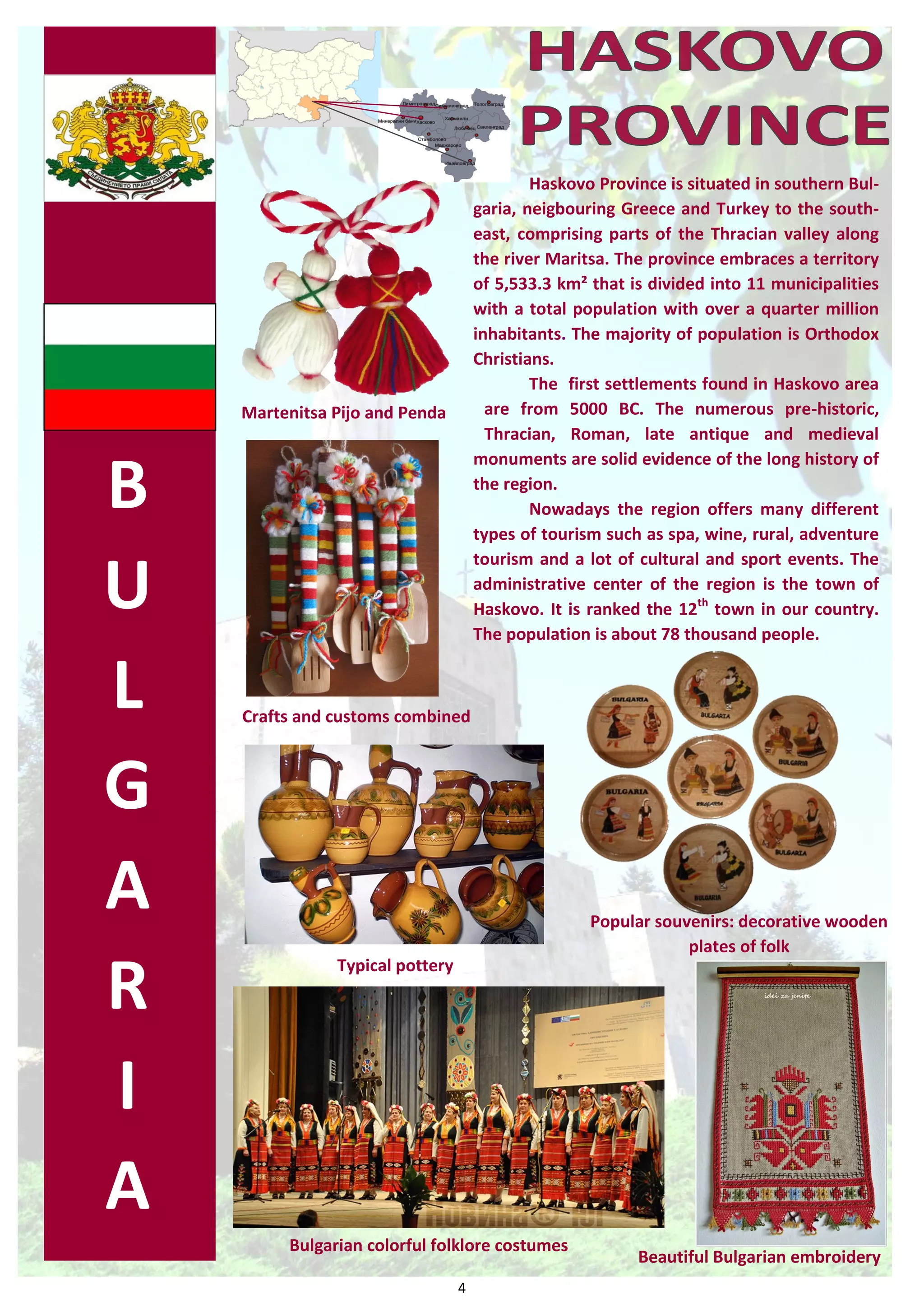
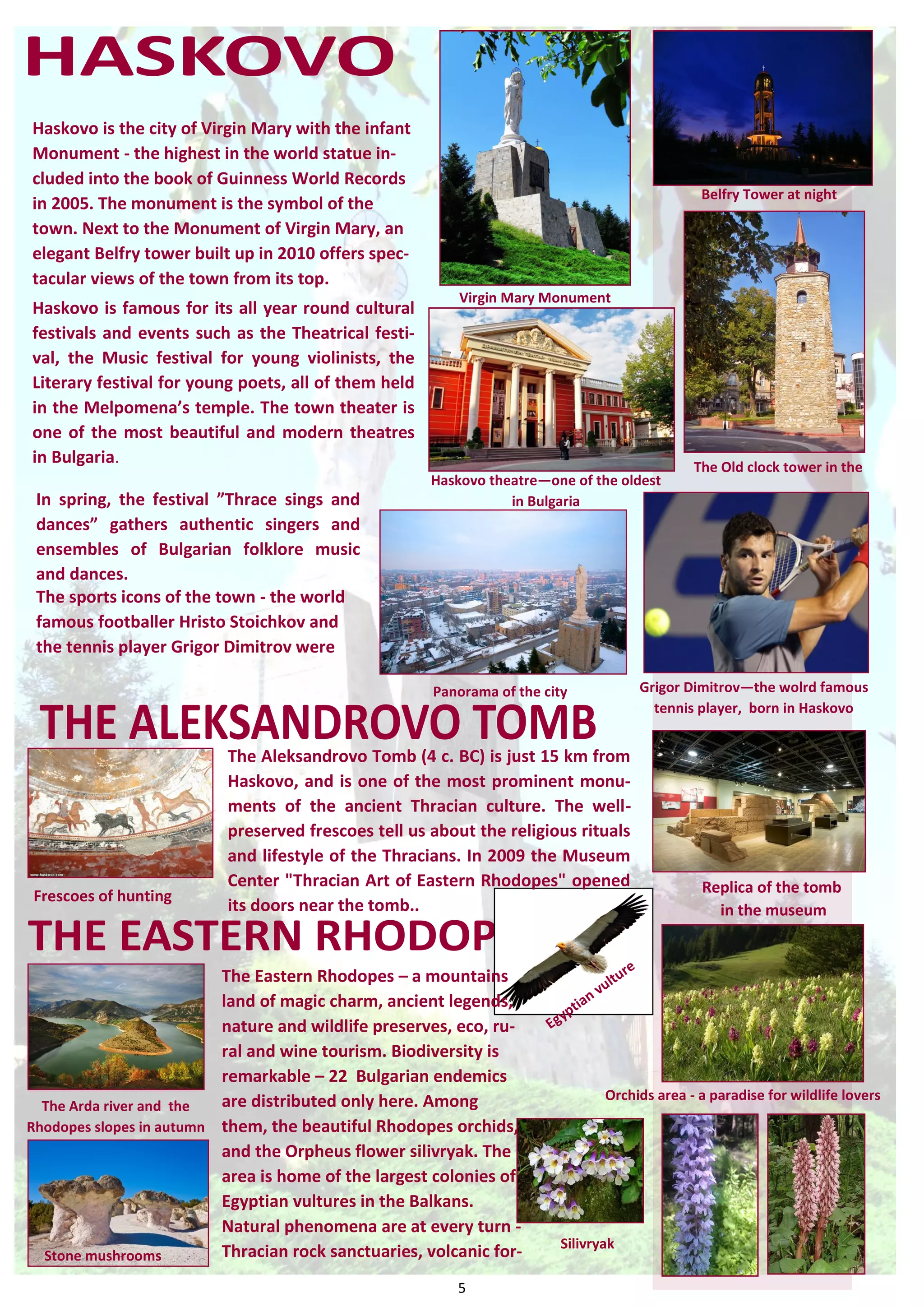
Haskovo Province is situated in southern Bul- garia, neigbouring Greece and Turkey to the south- east, comprising parts of the Thracian valley along the river Maritsa. The province embraces a territory of 5,533.3 km² that is divided into 11 municipalities with a total population with over a quarter million inhabitants. The majority of population is Orthodox Christians. 
The first settlements found in Haskovo area are from 5000 BC. The numerous pre-historic, Thracian, Roman, late antique and medieval monuments are solid evidence of the long history of the region. 
Nowadays the region offers many different types of tourism such as spa, wine, rural, adventure tourism and a lot of cultural and sport events. The administrative center of the region is the town of Haskovo. It is ranked the 12th town in our country. The population is about 78 thousand people. 
Beautiful Bulgarian embroidery 
Bulgarian colorful folklore costumes 
Popular souvenirs: decorative wooden plates of folk 
Typical pottery 
Crafts and customs combined 
Martenitsa Pijo and Penda
5 
Virgin Mary Monument 
Belfry Tower at night 
The Old clock tower in the 
Haskovo theatre—one of the oldest in Bulgaria 
Grigor Dimitrov—the wolrd famous tennis player, born in Haskovo 
Panorama of the city 
Orchids area - a paradise for wildlife lovers 
Silivryak 
Stone mushrooms 
The Arda river and the Rhodopes slopes in autumn 
Egyptian vulture 
Frescoes of hunting 
Replica of the tomb 
in the museum 
Haskovo is the city of Virgin Mary with the infant Monument - the highest in the world statue in- cluded into the book of Guinness World Records in 2005. The monument is the symbol of the town. Next to the Monument of Virgin Mary, an elegant Belfry tower built up in 2010 offers spec- tacular views of the town from its top. 
Haskovo is famous for its all year round cultural festivals and events such as the Theatrical festi- val, the Music festival for young violinists, the Literary festival for young poets, all of them held in the Melpomena’s temple. The town theater is one of the most beautiful and modern theatres in Bulgaria. 
The Aleksandrovo Tomb (4 c. BC) is just 15 km from Haskovo, and is one of the most prominent monu- ments of the ancient Thracian culture. The well- preserved frescoes tell us about the religious rituals and lifestyle of the Thracians. In 2009 the Museum Center "Thracian Art of Eastern Rhodopes" opened its doors near the tomb.. 
The Eastern Rhodopes – a mountains land of magic charm, ancient legends, nature and wildlife preserves, eco, ru- ral and wine tourism. Biodiversity is remarkable – 22 Bulgarian endemics are distributed only here. Among them, the beautiful Rhodopes orchids, and the Orpheus flower silivryak. The area is home of the largest colonies of Egyptian vultures in the Balkans. 
Natural phenomena are at every turn - Thracian rock sanctuaries, volcanic for- 
In spring, the festival ”Thrace sings and dances” gathers authentic singers and ensembles of Bulgarian folklore music and dances. 
The sports icons of the town - the world famous footballer Hristo Stoichkov and the tennis player Grigor Dimitrov were
6 
Naours’ caves 
PICARDY 
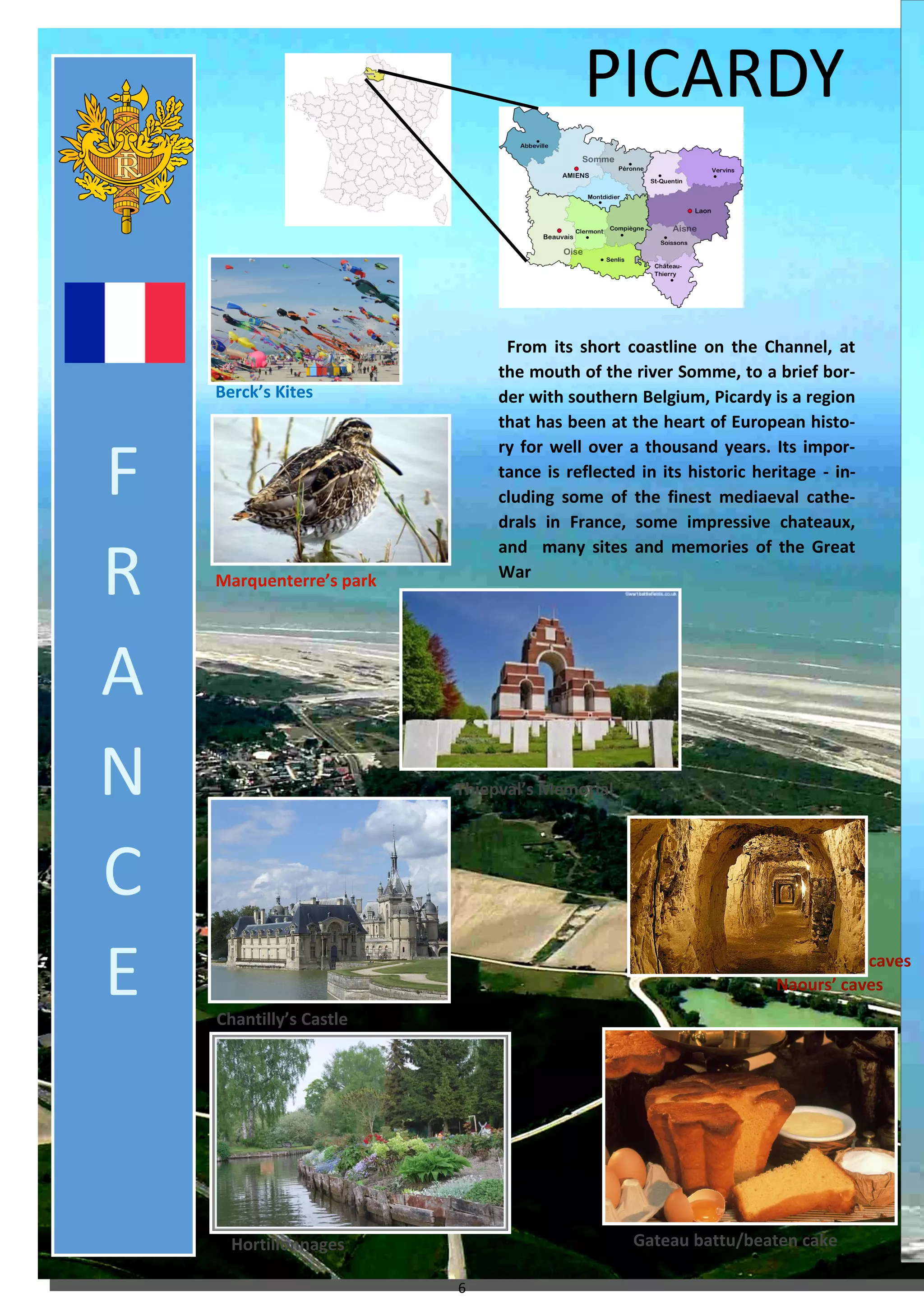
From its short coastline on the Channel, at the mouth of the river Somme, to a brief bor- der with southern Belgium, Picardy is a region that has been at the heart of European histo- ry for well over a thousand years. Its impor- tance is reflected in its historic heritage - in- cluding some of the finest mediaeval cathe- drals in France, some impressive chateaux, and many sites and memories of the Great War 
Berck’s Kites 
Marquenterre’s park 
Chantilly’s Castle 
Hortillonnages 
Gateau battu/beaten cake 
Naours’ caves 
Thiepval’s Memorial 
F 
R 
A 
N 
C 
E
7 
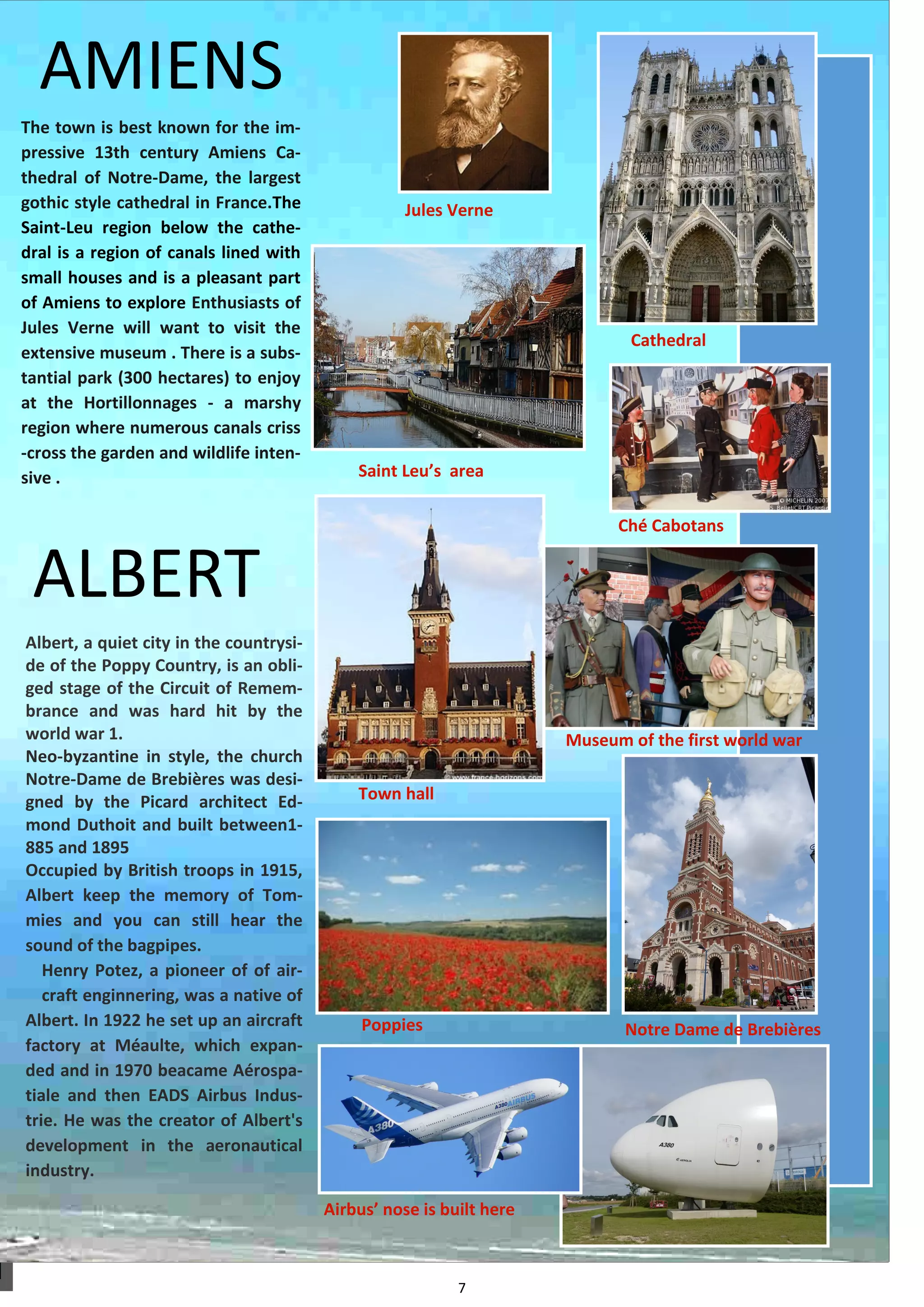
The town is best known for the im- pressive 13th century Amiens Ca- thedral of Notre-Dame, the largest gothic style cathedral in France.The Saint-Leu region below the cathe- dral is a region of canals lined with small houses and is a pleasant part of Amiens to explore Enthusiasts of Jules Verne will want to visit the extensive museum . There is a subs- tantial park (300 hectares) to enjoy at the Hortillonnages - a marshy region where numerous canals criss-cross the garden and wildlife inten- sive . 
AMIENS 
ALBERT 
Albert, a quiet city in the countrysi- de of the Poppy Country, is an obli- ged stage of the Circuit of Remem- brance and was hard hit by the world war 1. 
Neo-byzantine in style, the church Notre-Dame de Brebières was desi- gned by the Picard architect Ed- mond Duthoit and built between1- 885 and 1895 
Occupied by British troops in 1915, Albert keep the memory of Tom- mies and you can still hear the sound of the bagpipes. 
Henry Potez, a pioneer of of air- craft enginnering, was a native of Albert. In 1922 he set up an aircraft factory at Méaulte, which expan- ded and in 1970 beacame Aérospa- tiale and then EADS Airbus Indus- trie. He was the creator of Albert's development in the aeronautical industry. 
Poppies 
Airbus’ nose is built here 
Notre Dame de Brebières 
Museum of the first world war 
Town hall 
Ché Cabotans 
Saint Leu’s area 
Cathedral 
Jules Verne
8 
Arcadia is a mountainous land of rivers, running 
streams, deep gorges, ancient classic antiquities 
Frankish forts, Byzantine churches and monaster-ies, 
traditional villages . 
Arcadia has become a universal symbol of pas-toral 
simplicity and was presented as the sponta-neous 
result of life lived naturally, uncorrupted by 
civilization. Today the name of Arcadia applies to 
The Cultural Center where meetings and 
exhibitions take place 
Aghios Vasilios metropolitan church at 
the homonym square 
TRIPOLIS (ARCADIA ) 
G 
R 
E 
E 
C 
E 
Tripolis is a city of about 37,000 inhabitants . It 
is the capital of the regional unit of Arcadia 
and the centre of the municipality of Tripolis. 
It is in the middle of a valley surrounded by 
Artemisio, Parthenio and Maenalo mountains. 
It is the administrative, economic, commercial 
and transportation center of central and south 
Peloponnese. 
Areos central square with the 
Judicial Mansion and the statue 
of Theodoros Kolokotronis. 
The Archeological Museum housed in a 
building designed by Ernst Ziller . It in-cludes 
findings from the surrounding 
area, covering the period from the 
Mycenaean times up to 2nd century A.D. 
What to see in Tripolis 
Malliaropoulio 
theatre (1905)
9 
Activities throughout Arcadia 
Heading north for about 1.5 Km from Kapsia village of the region of Mantinea in the Pelopon- nese, we come across Kapsia Caves which accounts as one of the 10 most significant caves across Greece 
Visit ancient Olympia where the Olympic idea was born nearly 3,000 years ago. 
Ski at the top of Ostrakina, in Maenalo. It has 6 ski runs, 3 sliding lifts, chalet, ski and snowboard schools 
Rafting and kayak in the region of ancient Gortyna, in the bridge of Atsiholos and in the rivers Lousios and Ladonas. 
Souvlaki Rooster with hylopites pasta Moussakas 
From simple grilled foods and vegetable dishes to rich layered casseroles and delicate pastries, Greek food is a wonderful mix of dishes that appeals to all tastes. 
Traditional embroideries 
Lets dance 
Astros. Swimming in the in- dented beaches with the deep blue waters. 
Ancient theatre of Mantineia and St Fotini church one of the weirdest churches .How many rhythms and styles can it stand? Classical architecture, Greek, with pediments. Byzantine ele- ments, tiles, stones, marbles, mud, cor- nerstones... all put together! 
NIKOS GATSOS (8 December 1911, Asea Tripolis- 12 May 1992, Athens) GREEK POET, TRANSLATOR AND LYRICIST.
10 
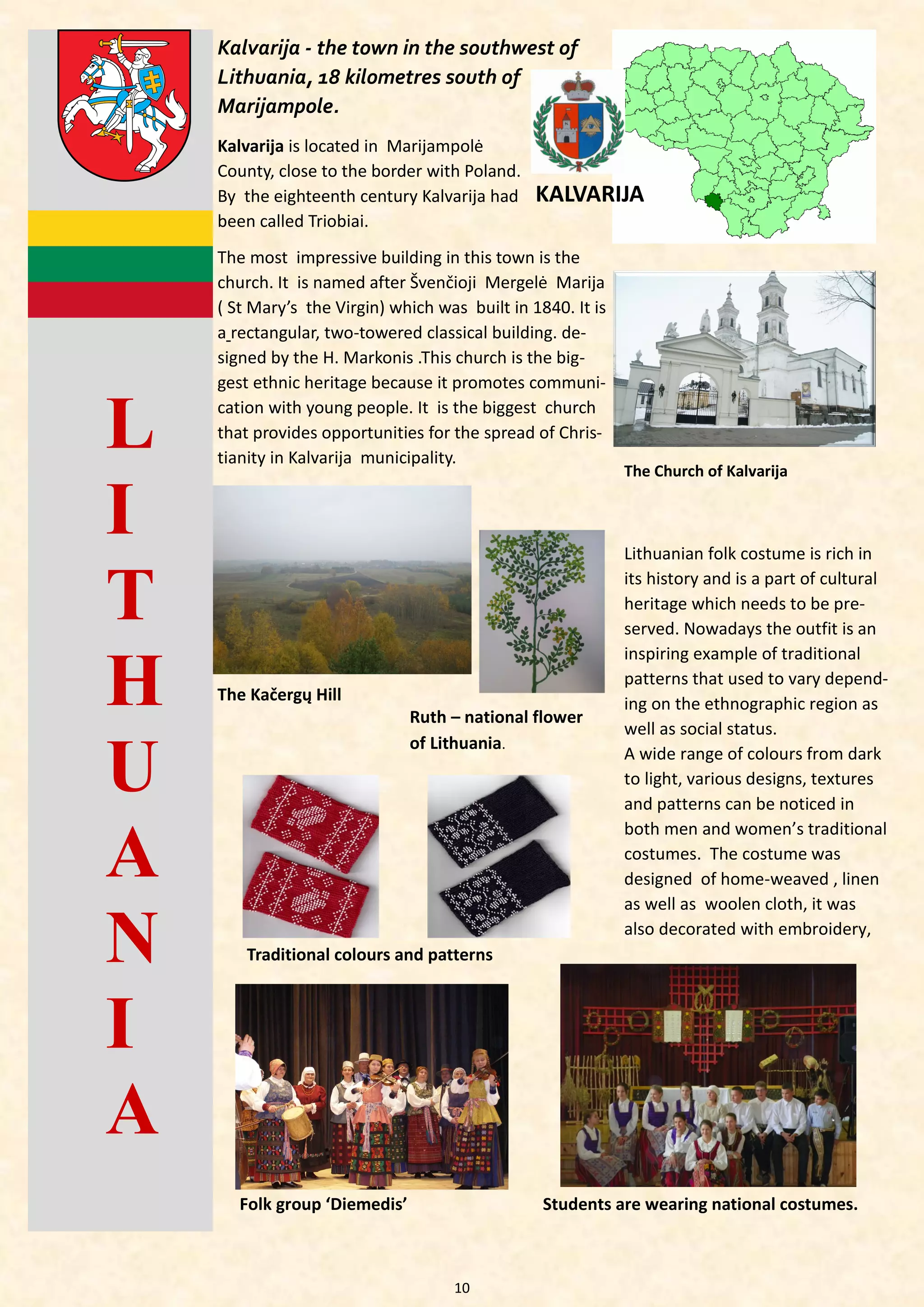
The most impressive building in this town is the church. It is named after Švenčioji Mergelė Marija ( St Mary’s the Virgin) which was built in 1840. It is a rectangular, two-towered classical building. de- signed by the H. Markonis .This church is the big- gest ethnic heritage because it promotes communi- cation with young people. It is the biggest church that provides opportunities for the spread of Chris- tianity in Kalvarija municipality. 
LITHUANIA 
KALVARIJA 
Kalvarija - the town in the southwest of Lithuania, 18 kilometres south of Marijampole. 
Kalvarija is located in Marijampolė County, close to the border with Poland. By the eighteenth century Kalvarija had been called Triobiai. 
The Church of Kalvarija 
The Kačergų Hill 
Lithuanian folk costume is rich in its history and is a part of cultural heritage which needs to be pre- served. Nowadays the outfit is an inspiring example of traditional patterns that used to vary depend- ing on the ethnographic region as well as social status. 
A wide range of colours from dark to light, various designs, textures and patterns can be noticed in both men and women’s traditional costumes. The costume was designed of home-weaved , linen as well as woolen cloth, it was also decorated with embroidery, 
Traditional colours and patterns 
Ruth – national flower of Lithuania. 
Folk group ‘Diemedis’ 
Students are wearing national costumes.
11 
Marijampole is a county centre in the south of Lithuania. There are many famous places and amazing buildings which could be visited by every tourist. There are spectacular museums too, and also the city has a picturesque landscape 
A Monument In Basanavicius Square 
Town park 
Museum of Eth- nography 
FAMOUS PEOPLE OF THE REGION 
Suvalkija region has always been known for famous and well educated 
Egidijus Bavykinas is a well known op- era singer in Lithuania. He was born in 1977 in a small village Jungenai close to Kalvarija. Today he performs different roles in Kaunas Music thea- tre. 
Born in 1959 Antanas Lastauskas in Islandziu village is a famous craftsman of wood work, in particular, cross-crafting. He lives in Kalvarija and is an active partici- pant in various exhibitions, fairs, competitions not only in Lithuania, but also abroad.He carves pillar type crosses, wooden monuments. One of his mas- terpieces is situated in the churchyard of Kalvarijos church and is devoted to those who had been de- ported. 
LANDSCAPE 
Town center 
Autumn 
Summer 
Winter 
Spring 
River Šešupė 
Suvalkija region 
Sunrise
12 
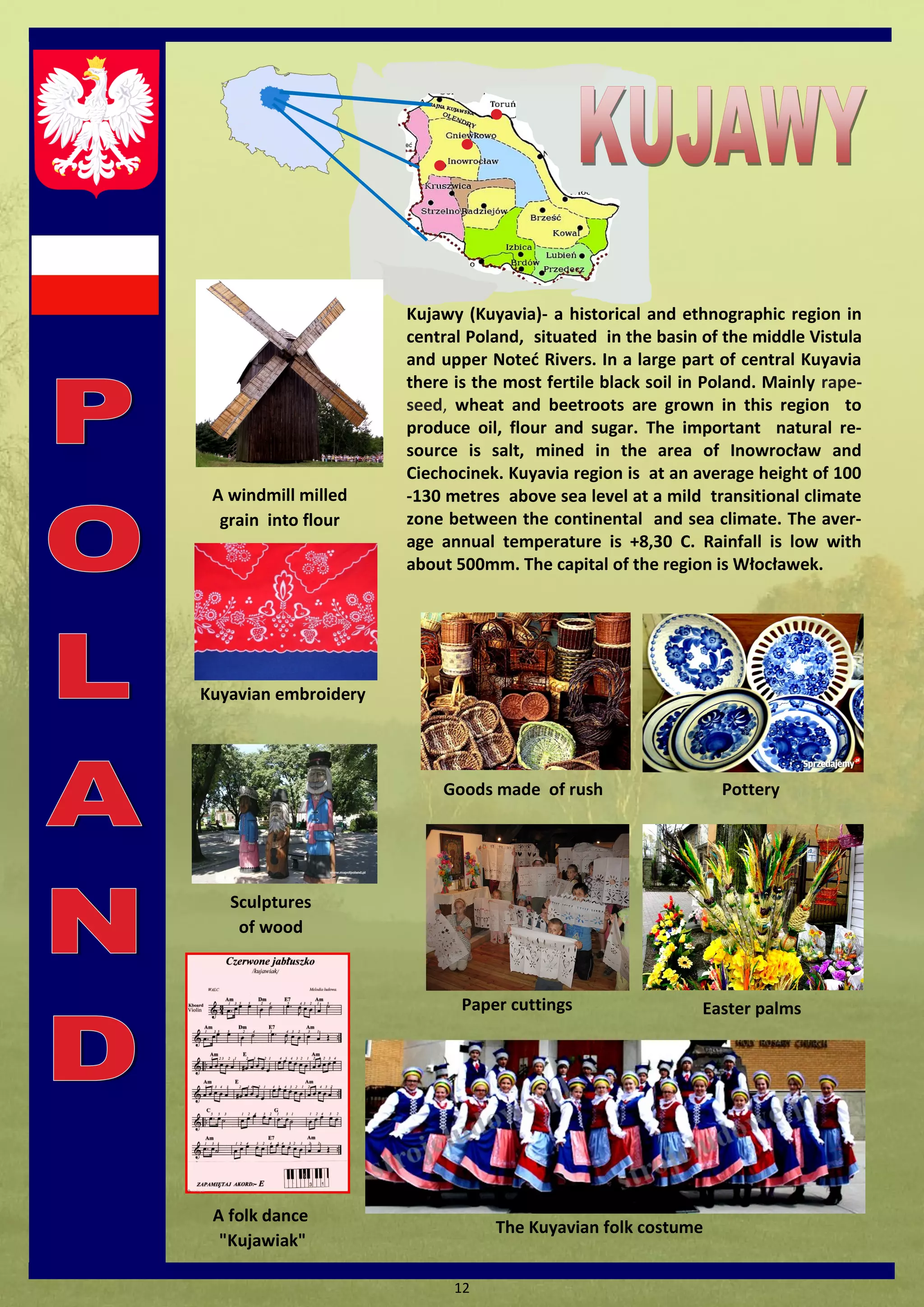
The Kuyavian folk costume 
A folk dance "Kujawiak" 
Pottery 
A windmill milled grain into flour 
Kuyavian embroidery 
Goods made of rush 
Paper cuttings 
Easter palms 
Sculptures of wood 
Kujawy (Kuyavia)- a historical and ethnographic region in central Poland, situated in the basin of the middle Vistula and upper Noted Rivers. In a large part of central Kuyavia there is the most fertile black soil in Poland. Mainly rape- seed, wheat and beetroots are grown in this region to produce oil, flour and sugar. The important natural re- source is salt, mined in the area of Inowrocław and Ciechocinek. Kuyavia region is at an average height of 100-130 metres above sea level at a mild transitional climate zone between the continental and sea climate. The aver- age annual temperature is +8,30 C. Rainfall is low with about 500mm. The capital of the region is Włocławek.
13 
One of the oldest towns in Poland. In ancient times the amber rout ran across it. About 75 thousand inhabitants live in the town. There is a rich resource of salt which had been mined since ancient times but now the mine is closed for safety reasons. Thanks to the healing qualities of the salt Inowrocław is a spa and health resort with many spa build- ings. There is a park called Solanki with Pope’s gardens and graduation towers with salty water. It is also an industrial town with a major railway junction. There are Roman, Gothic and Neo-Roman churches. 
The town was founded in 1233. It has been on UNESCO World Heritage Site since 1997 
Panorama of the town from the River Vistula side 
The salt mine 
Graduation towers 
Fertile soil 
A monument of Duke Władysław Biały (Ladislav the White) 
Beautiful landscape 
A town situated in two geo- graphical regions: Kuyavia and Pomerania. One of the oldest towns in Poland with over 200 thousand inhabitants. It is the second town in Poland, besides Kraków, with the biggest amount of Gothic architecture. The Mar- ket Square and Town Hall are the examples of the most beautiful places in Poland. Toruo is a big academic, cultural, industrial centre. Famous astronomer, Nicolaus Copernicus was born here. 
Nicolaus Copernicus, a famous astrono- mer born in Toruo. 
An astronomical observatory near Toruo 
Solanki Health Resort 
Romanesque Church 
The town was founded in 10th century. It used to be the capital of Gniewkowo Principality. It is inhabited by about 7.5 thousand people. The town is surrounded by a large forest and very fertile lands. There are some significant historical monuments such as St. Nicholas and St. Con- stance Church from 14th century and the City Hall.
14 
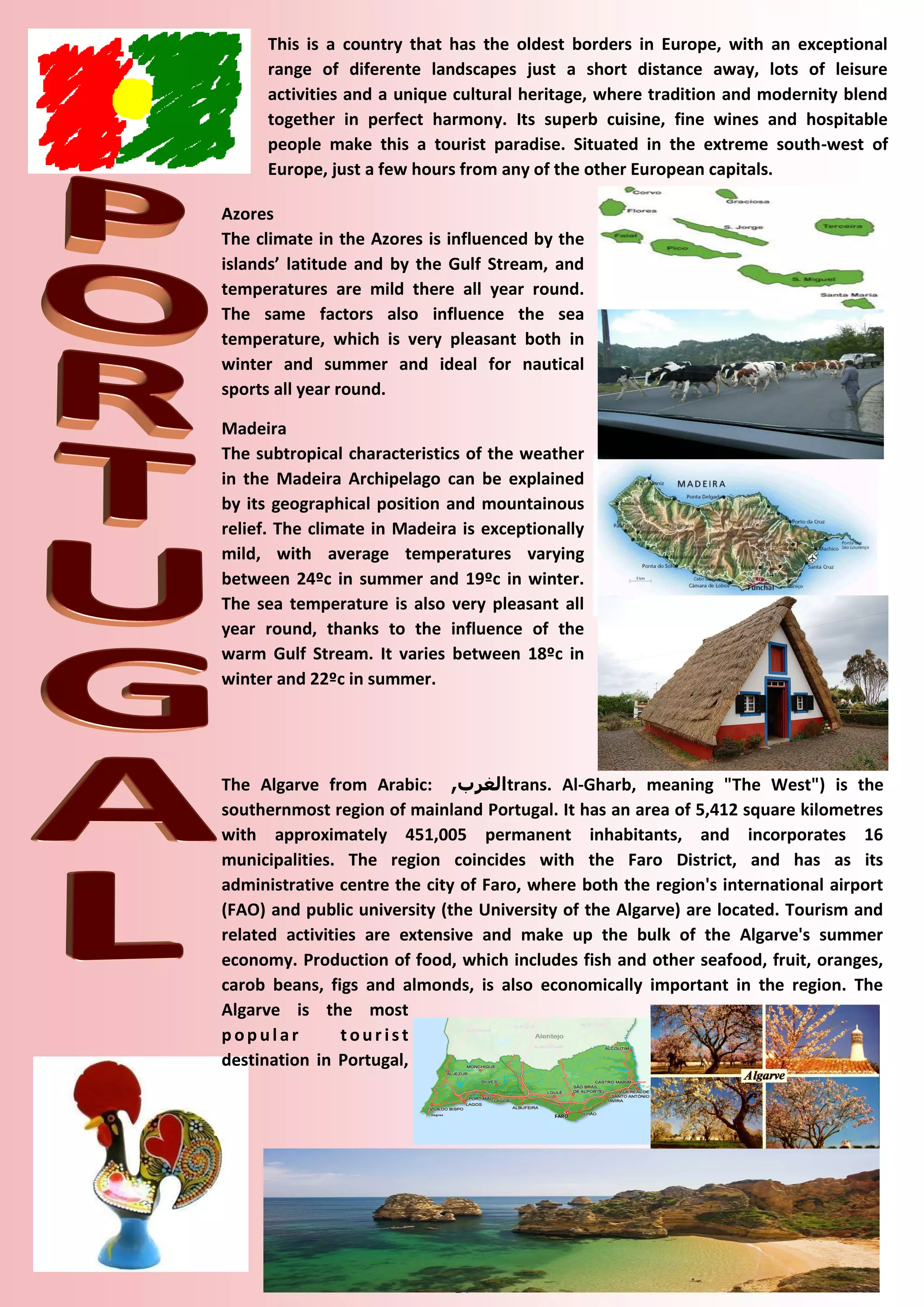
This is a country that has the oldest borders in Europe, with an exceptional range of diferente landscapes just a short distance away, lots of leisure activities and a unique cultural heritage, where tradition and modernity blend together in perfect harmony. Its superb cuisine, fine wines and hospitable people make this a tourist paradise. Situated in the extreme south-west of Europe, just a few hours from any of the other European capitals. 
Azores 
The climate in the Azores is influenced by the islands’ latitude and by the Gulf Stream, and temperatures are mild there all year round. The same factors also influence the sea temperature, which is very pleasant both in winter and summer and ideal for nautical sports all year round. 
Madeira 
The subtropical characteristics of the weather in the Madeira Archipelago can be explained by its geographical position and mountainous relief. The climate in Madeira is exceptionally mild, with average temperatures varying between 24ºc in summer and 19ºc in winter. The sea temperature is also very pleasant all year round, thanks to the influence of the warm Gulf Stream. It varies between 18ºc in winter and 22ºc in summer. 
The Algarve from Arabic: الغرب , trans. Al-Gharb, meaning "The West") is the southernmost region of mainland Portugal. It has an area of 5,412 square kilometres with approximately 451,005 permanent inhabitants, and incorporates 16 municipalities. The region coincides with the Faro District, and has as its administrative centre the city of Faro, where both the region's international airport (FAO) and public university (the University of the Algarve) are located. Tourism and related activities are extensive and make up the bulk of the Algarve's summer economy. Production of food, which includes fish and other seafood, fruit, oranges, carob beans, figs and almonds, is also economically important in the region. The Algarve is the most popular tourist destination in Portugal,
15 
Lisbon (Lisboa) is one of the oldest cities in the world, and the oldest city in Western Europe, predating other modern European capitals such as London, Paris and Rome by hundreds of years. Julius Caesar made it a municipium called Felicitas Julia, adding to the name Olissipo. Ruled by a series of Germanic tribes from the 5th century, it was captured by the Moors in the 8th century. In 1147, the Crusaders under Afonso Henriques reconquered the city and since then it has been a major political, economic and cultural centre. 
Fado ("destiny, fate") is a music genre which can be traced to the 1820s in Portugal, but probably with much earlier origins. Fado historian and scholar Rui Vieira Nery states that "the only reliable information on the history of Fado was orally transmitted and goes back to the 1820s and 1830s at best. But even that information was frequently modified within the generational transmission process that made it reach us today."[1] In popular belief, fado is a form of music characterized by mournful tunes and lyrics, often about the sea or the life of the poor, and infused with a characteristic sentiment of resignation, fatefulness and melancholia (loosely captured by the word saudade, or "longing"). However, although the origins are difficult to trace, today fado is regarded, by many, as simply a form of song which can be about anything, but must follow a certain structure. The music is usually linked to the Portuguese word saudade which symbolizes the feeling of loss (a permanent, irreparable loss and its consequent lifelong damage). Famous singers of fado include Amália Rodrigues, Dulce Pontes, 
Fernando Pessoa, born Fernando António Nogueira Pessoa (June 13, 1888 – November 30, 1935), was a Portuguese poet, writer, literary critic, translator, publisher and philosopher, described as one of the most significant literary figures of the 20th century and one of the greatest poets in the Portuguese language. He also wrote in and translated from English and French. 
Portuguese discoveries is the name given to the intensive maritime exploration by the Portuguese during the 15th and 16th centuries. Portuguese sailors were at the vanguard of European overseas exploration, discovering and mapping the coasts of Africa, Asia and Brazil, in what become known as the Age of Discovery. Methodical expeditions started in 1419 along West Africa's coast under the sponsorship of prince Henry the Navigator, with Bartolomeu Dias reaching the Cape of Good Hope and entering the Indian Ocean in 1488. Ten years later, Vasco da Gama led the first fleet around Africa to India, arriving in Calicut and starting a maritime route from Portugal to India. Soon, after reaching Brazil, explorations proceed to southeast Asia, having reached Japan in 1542. 
Belém Tower (Torre de Belém), pronounced: *ˈtoʁ(ɨ) dɨ bɨˈlɐ̃ȷ̃]) or the Tower of St Vincent is a fortified tower located in the civil parish of Santa Maria de Belém in the municipality of Lisbon, Portugal. It is a UNESCO World Heritage Site (along with the nearby Jerónimos Monastery) because of the significant role it played in the Portuguese maritime discoveries of the era of the Age of Discoveries. The tower was commissioned by King John II to be part of a defense system at the mouth of the Tagus river and a ceremonial gateway to Lisbon.
16 
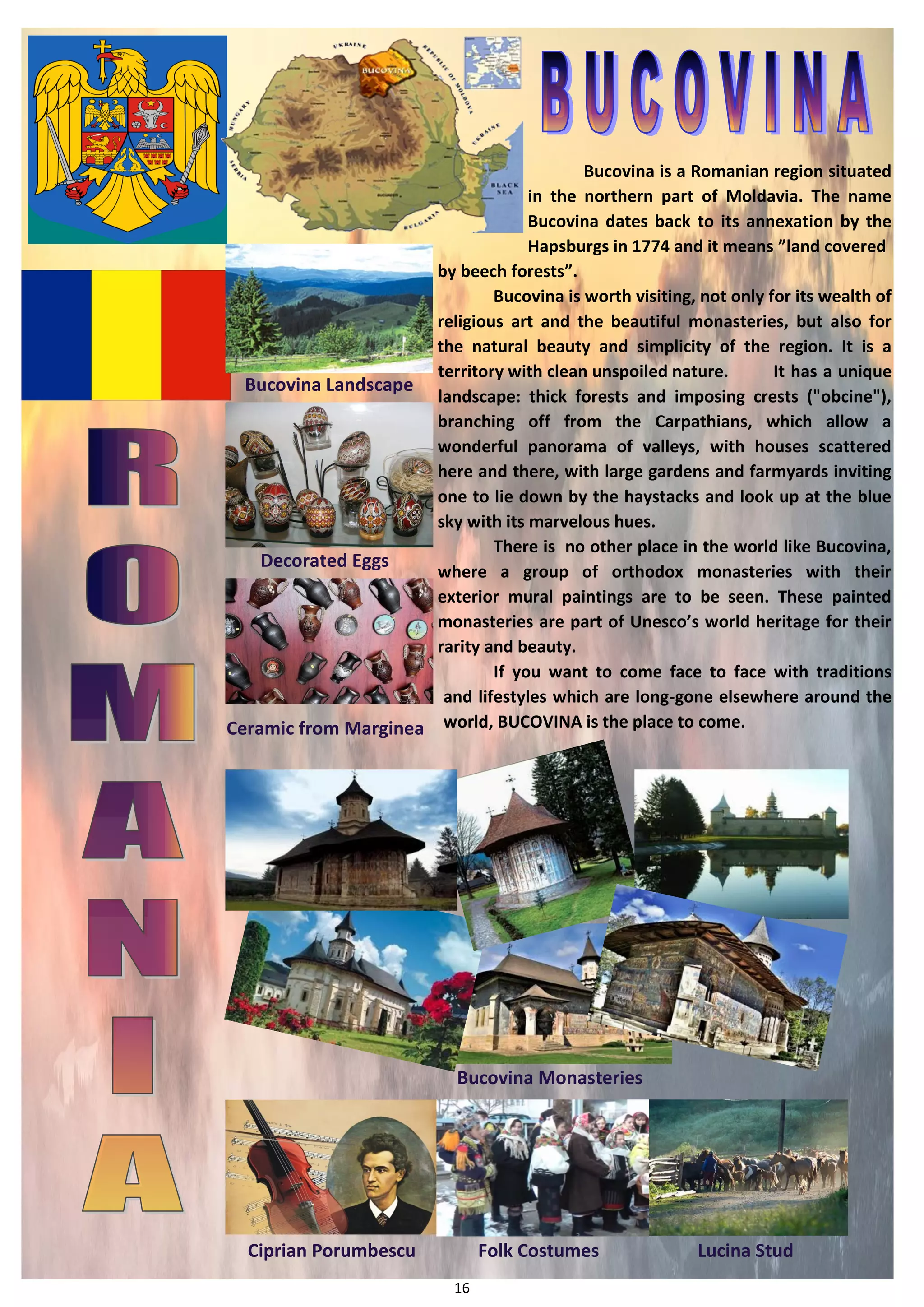
Bucovina is a Romanian region situated in the northern part of Moldavia. The name Bucovina dates back to its annexation by the Hapsburgs in 1774 and it means ”land covered 
by beech forests”. 
Bucovina is worth visiting, not only for its wealth of religious art and the beautiful monasteries, but also for the natural beauty and simplicity of the region. It is a territory with clean unspoiled nature. It has a unique landscape: thick forests and imposing crests ("obcine"), branching off from the Carpathians, which allow a wonderful panorama of valleys, with houses scattered here and there, with large gardens and farmyards inviting one to lie down by the haystacks and look up at the blue sky with its marvelous hues. 
There is no other place in the world like Bucovina, where a group of orthodox monasteries with their exterior mural paintings are to be seen. These painted monasteries are part of Unesco’s world heritage for their rarity and beauty. 
If you want to come face to face with traditions and lifestyles which are long-gone elsewhere around the world, BUCOVINA is the place to come. 
Bucovina Landscape 
Decorated Eggs 
Ceramic from Marginea 
Bucovina Monasteries 
Ciprian Porumbescu 
Folk Costumes 
Lucina Stud
17 
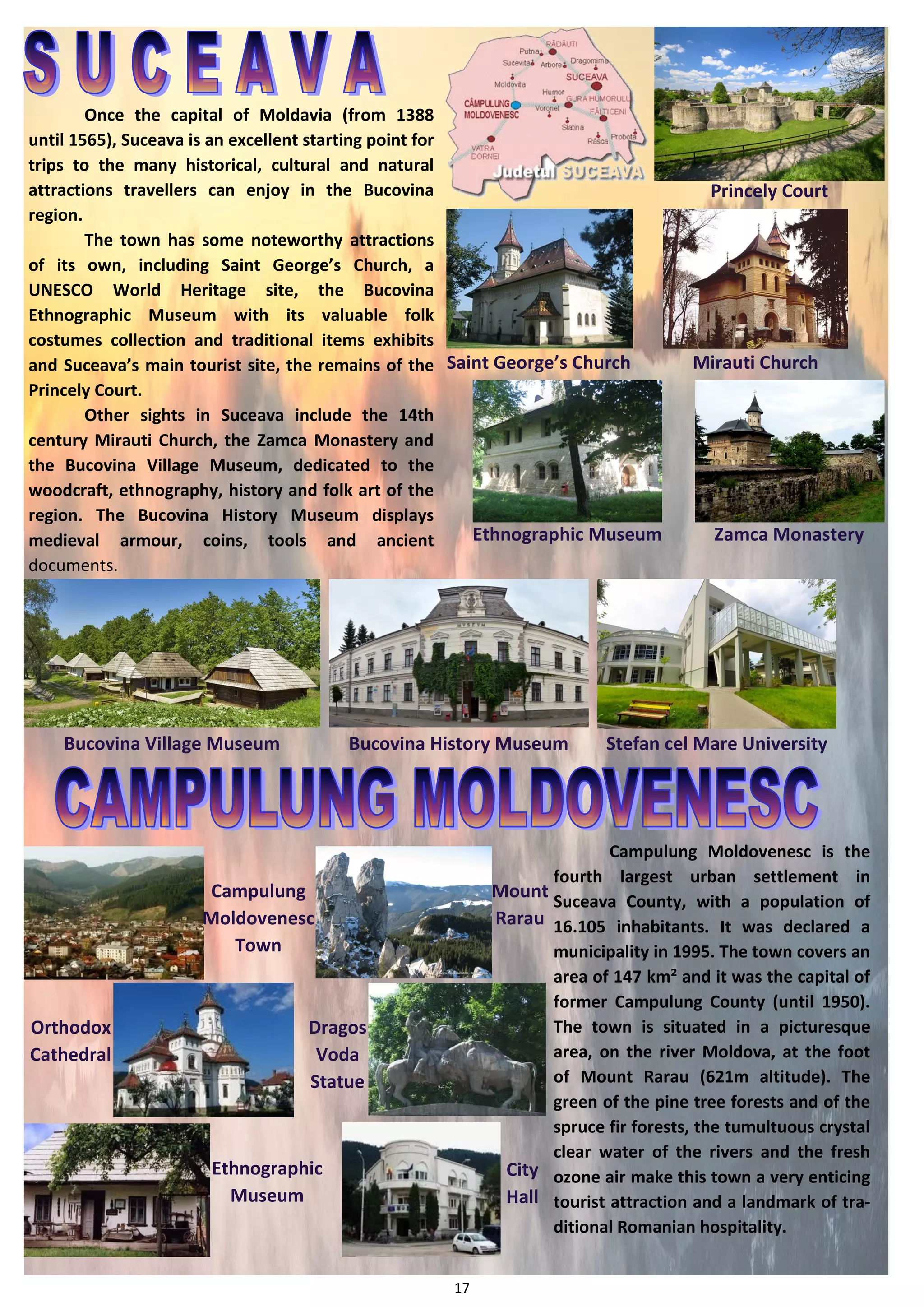
Saint George’s Church 
Ethnographic Museum 
Princely Court 
Mirauti Church 
Zamca Monastery 
Bucovina Village Museum 
Bucovina History Museum 
Stefan cel Mare University 
Dragos 
Voda 
Statue 
Orthodox 
Cathedral 
Mount 
Rarau 
Campulung Moldovenesc is the fourth largest urban settlement in Suceava County, with a population of 16.105 inhabitants. It was declared a municipality in 1995. The town covers an area of 147 km² and it was the capital of former Campulung County (until 1950). The town is situated in a picturesque area, on the river Moldova, at the foot of Mount Rarau (621m altitude). The green of the pine tree forests and of the spruce fir forests, the tumultuous crystal clear water of the rivers and the fresh ozone air make this town a very enticing tourist attraction and a landmark of tra- ditional Romanian hospitality. 
City 
Hall 
Ethnographic 
Museum 
Campulung 
Moldovenesc Town 
Once the capital of Moldavia (from 1388 until 1565), Suceava is an excellent starting point for trips to the many historical, cultural and natural attractions travellers can enjoy in the Bucovina region. 
The town has some noteworthy attractions of its own, including Saint George’s Church, a UNESCO World Heritage site, the Bucovina Ethnographic Museum with its valuable folk costumes collection and traditional items exhibits and Suceava’s main tourist site, the remains of the Princely Court. 
Other sights in Suceava include the 14th century Mirauti Church, the Zamca Monastery and the Bucovina Village Museum, dedicated to the woodcraft, ethnography, history and folk art of the region. The Bucovina History Museum displays medieval armour, coins, tools and ancient documents.
18 
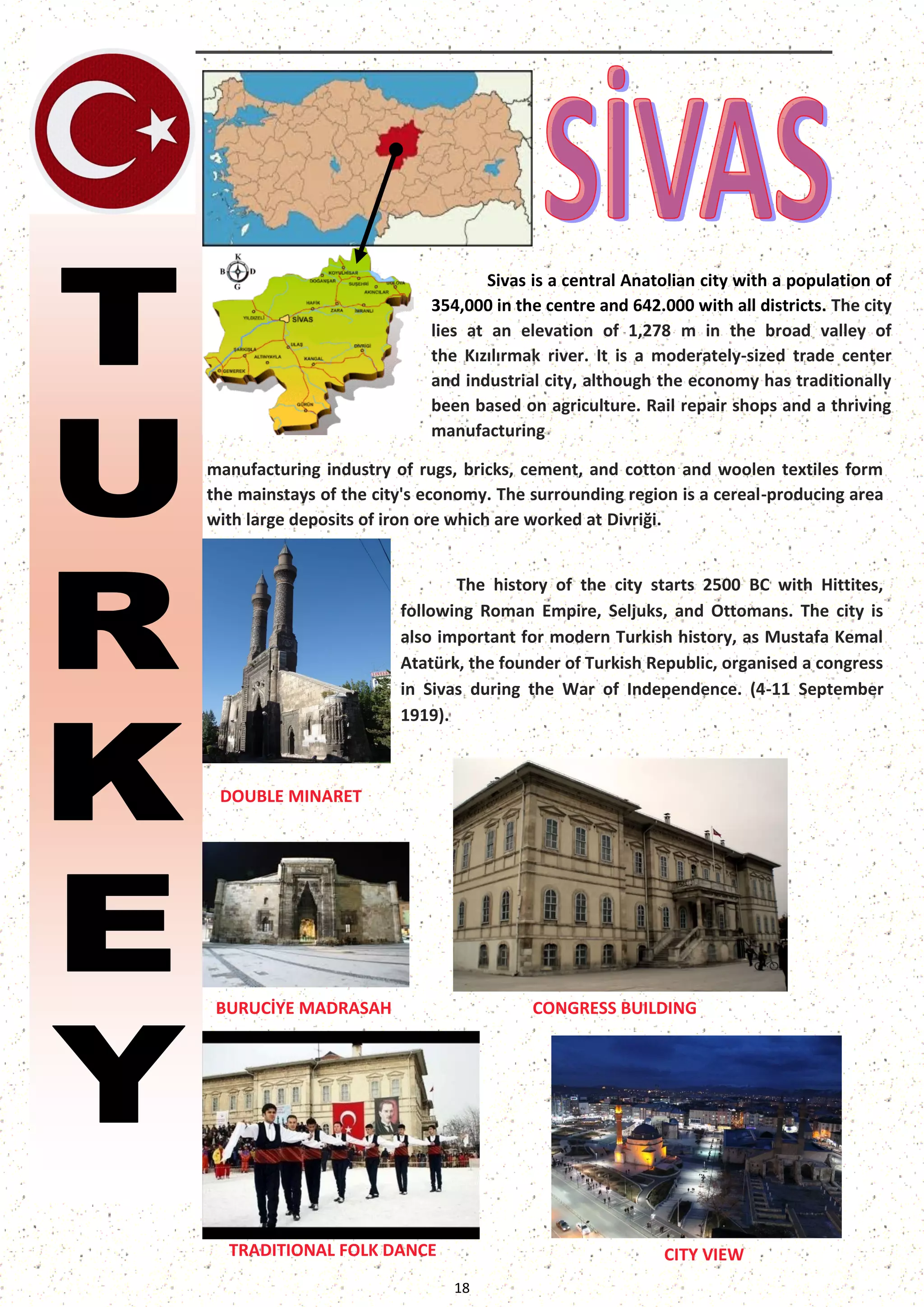
The history of the city starts 2500 BC with Hittites, following Roman Empire, Seljuks, and Ottomans. The city is also important for modern Turkish history, as Mustafa Kemal Atatürk, the founder of Turkish Republic, organised a congress in Sivas during the War of Independence. (4-11 September 1919). 
Sivas is a central Anatolian city with a population of 354,000 in the centre and 642.000 with all districts. The city lies at an elevation of 1,278 m in the broad valley of the Kızılırmak river. It is a moderately-sized trade center and industrial city, although the economy has traditionally been based on agriculture. Rail repair shops and a thriving manufacturing 
manufacturing industry of rugs, bricks, cement, and cotton and woolen textiles form the mainstays of the city's economy. The surrounding region is a cereal-producing area with large deposits of iron ore which are worked at Divriği. 
DOUBLE MINARET 
CONGRESS BUILDING 
CITY VIEW 
BURUCİYE MADRASAH 
TRADITIONAL FOLK DANCE
19 
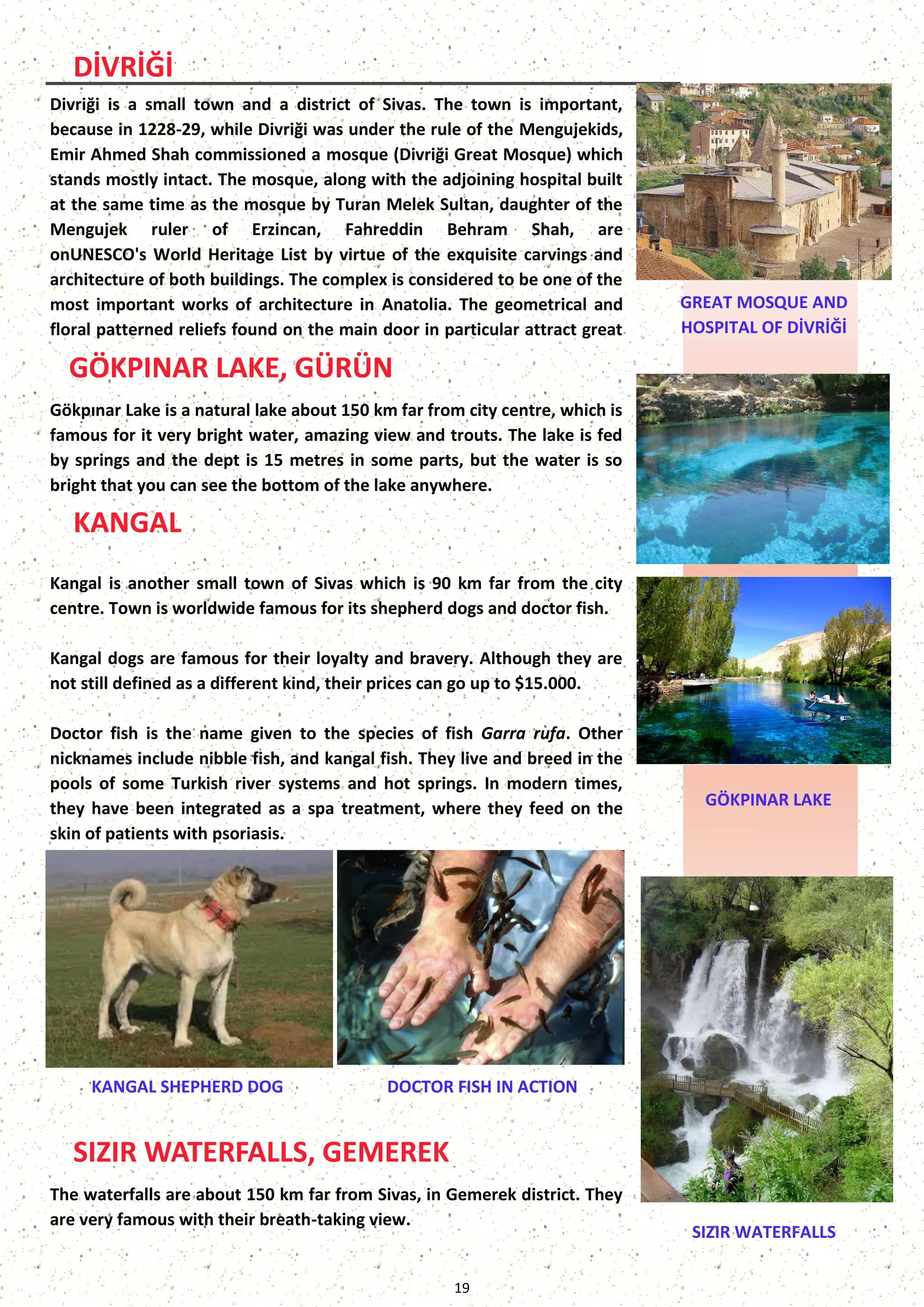
DİVRİĞİ 
Divriği is a small town and a district of Sivas. The town is important, because in 1228-29, while Divriği was under the rule of the Mengujekids, Emir Ahmed Shah commissioned a mosque (Divriği Great Mosque) which stands mostly intact. The mosque, along with the adjoining hospital built at the same time as the mosque by Turan Melek Sultan, daughter of the Mengujek ruler of Erzincan, Fahreddin Behram Shah, are onUNESCO's World Heritage List by virtue of the exquisite carvings and architecture of both buildings. The complex is considered to be one of the most important works of architecture in Anatolia. The geometrical and floral patterned reliefs found on the main door in particular attract great 
GREAT MOSQUE AND HOSPITAL OF DİVRİĞİ 
Gökpınar Lake is a natural lake about 150 km far from city centre, which is famous for it very bright water, amazing view and trouts. The lake is fed by springs and the dept is 15 metres in some parts, but the water is so bright that you can see the bottom of the lake anywhere. 
GÖKPINAR LAKE, GÜRÜN 
GÖKPINAR LAKE 
Kangal is another small town of Sivas which is 90 km far from the city centre. Town is worldwide famous for its shepherd dogs and doctor fish. 
Kangal dogs are famous for their loyalty and bravery. Although they are not still defined as a different kind, their prices can go up to $15.000. 
Doctor fish is the name given to the species of fish Garra rufa. Other nicknames include nibble fish, and kangal fish. They live and breed in the pools of some Turkish river systems and hot springs. In modern times, they have been integrated as a spa treatment, where they feed on the skin of patients with psoriasis. 
KANGAL 
SIZIR WATERFALLS, GEMEREK 
The waterfalls are about 150 km far from Sivas, in Gemerek district. They are very famous with their breath-taking view. 
SIZIR WATERFALLS 
DOCTOR FISH IN ACTION 
KANGAL SHEPHERD DOG
20 
Romania (coordinator) - School ”George Voevidca” Campulung Moldovenesc Students from Vth, VIth, VIIth and VIII thgrade, Teachers: Lăcrămioara Băcanu, Georgeta Anca Tudose, Daniela Stanciu, Oltea Nistor, Marcela Norocel, Anca Luminiţa Sfarghiu, Anca Călinescu, Andrea Erzsebet Smadici 
Bulgaria - Sredno obshtoobrazovatelno uchilishte "Vasil Levski" Students: Vanya Kavaldzhieva – 6b class, Viktor Mollov – 6b class, Nedyalko Boydev – 7a class, Hristo Doychev – 7a class, and students from the English club, Teachers: Iliyana Panayotova – school project coordinator, teacher of English, editor, Diyana Atanasova – teacher of ITC 
France - Collège Pierre et Marie Curie Students: Célia Statek, Coralie Boutillier, Jeanne Rivičre, Meyrine Gamand, Clément Brunet, Dylan Polleux, Ryan Dufaux, Raquel De Jesus, Tavarčs, Dayanna Deloubričre, Emilien Rouvillain, Audrey Bideaux, teacher: Gabrielle Riviere Greece - 7th Primary School of Tripoli Eleni Siountri and her students, 5th grade (E2) and Antonios Terzis, headmaster. 
Lithuania - Kalvarija Gymnasium, Kalvarija Students from grades 2c,8c,7c, Ib, IV, III., Asta Liukaitienë (English teacher), Giedrë Guzavičienë ( English teacher, project coordinator), 
Poland - Szkoła Podstawowa nr 1 im. Wojska Polskiego w Gniewkowie Students of class VId, Va,Vb, Vc, Vd, Małgorzata Nowicka - deputy head teacher, Grażyna Czachorowska-Szczupak - IT and Maths teacher, Lidia Zimna - coordinator and English teacher 
Portugal - Escola Básica de Alvor (EB1 de Alvor) 
Teachers: Graça Salvador, Simão Oliveira, Students: 5º A 
Turkey - Kongre İlköğretim Okulu 
Serdar ÖZBEY (TEACHER)RÄąfat ÖZDAMAR(TEACHER), Taha TÜRKER (STUDENT) 4TH GRADE; Selin Gökçe GİRAY (STUDENT) 4TH GRADE, Bora Can KARTAL (STUDENT) 4TH GRADE, Nisanur KAYA (STUDENT) 4TH GRADE 
This product, booklet European Multiguide promoting local and regional tourism was made with the collaboration of all partners. 
It was issued and printed in Poland, by Szkoła Podstawowa nr1, Gniewkowo. 
The participating partner schools:

EUROPEAN MULTIGUID Booklet - 2014

  • 1.
    COMENIUS MULTILATERAL PARTNERSHIP EUROPEAN MULTIGUIDE 2012-2014 Booklet promoting local and regional tourism of the countries participating in Comenius Programme This project has been funded with support from the European Commission. This publication reflects the views only of the author, and the Commission cannot be held responsible for any use which may be made of the information contained therein.
  • 2.
  • 3.
    3 Bulgaria ………...……..4-5 Greece …..….....……..6-7 France ……….…..…….8-9 Lithuania ……..…...10-11 Poland……….……...12-13 Portugal…….….…...14-15 Romania……..….….16-17 Turkey ………..….….18-19 The contents:
  • 4.
    4 B U L G A R I A Haskovo Province is situated in southern Bul- garia, neigbouring Greece and Turkey to the south- east, comprising parts of the Thracian valley along the river Maritsa. The province embraces a territory of 5,533.3 km² that is divided into 11 municipalities with a total population with over a quarter million inhabitants. The majority of population is Orthodox Christians. The first settlements found in Haskovo area are from 5000 BC. The numerous pre-historic, Thracian, Roman, late antique and medieval monuments are solid evidence of the long history of the region. Nowadays the region offers many different types of tourism such as spa, wine, rural, adventure tourism and a lot of cultural and sport events. The administrative center of the region is the town of Haskovo. It is ranked the 12th town in our country. The population is about 78 thousand people. Beautiful Bulgarian embroidery Bulgarian colorful folklore costumes Popular souvenirs: decorative wooden plates of folk Typical pottery Crafts and customs combined Martenitsa Pijo and Penda
  • 5.
    5 Virgin MaryMonument Belfry Tower at night The Old clock tower in the Haskovo theatre—one of the oldest in Bulgaria Grigor Dimitrov—the wolrd famous tennis player, born in Haskovo Panorama of the city Orchids area - a paradise for wildlife lovers Silivryak Stone mushrooms The Arda river and the Rhodopes slopes in autumn Egyptian vulture Frescoes of hunting Replica of the tomb in the museum Haskovo is the city of Virgin Mary with the infant Monument - the highest in the world statue in- cluded into the book of Guinness World Records in 2005. The monument is the symbol of the town. Next to the Monument of Virgin Mary, an elegant Belfry tower built up in 2010 offers spec- tacular views of the town from its top. Haskovo is famous for its all year round cultural festivals and events such as the Theatrical festi- val, the Music festival for young violinists, the Literary festival for young poets, all of them held in the Melpomena’s temple. The town theater is one of the most beautiful and modern theatres in Bulgaria. The Aleksandrovo Tomb (4 c. BC) is just 15 km from Haskovo, and is one of the most prominent monu- ments of the ancient Thracian culture. The well- preserved frescoes tell us about the religious rituals and lifestyle of the Thracians. In 2009 the Museum Center "Thracian Art of Eastern Rhodopes" opened its doors near the tomb.. The Eastern Rhodopes – a mountains land of magic charm, ancient legends, nature and wildlife preserves, eco, ru- ral and wine tourism. Biodiversity is remarkable – 22 Bulgarian endemics are distributed only here. Among them, the beautiful Rhodopes orchids, and the Orpheus flower silivryak. The area is home of the largest colonies of Egyptian vultures in the Balkans. Natural phenomena are at every turn - Thracian rock sanctuaries, volcanic for- In spring, the festival ”Thrace sings and dances” gathers authentic singers and ensembles of Bulgarian folklore music and dances. The sports icons of the town - the world famous footballer Hristo Stoichkov and the tennis player Grigor Dimitrov were
  • 6.
    6 Naours’ caves PICARDY From its short coastline on the Channel, at the mouth of the river Somme, to a brief bor- der with southern Belgium, Picardy is a region that has been at the heart of European histo- ry for well over a thousand years. Its impor- tance is reflected in its historic heritage - in- cluding some of the finest mediaeval cathe- drals in France, some impressive chateaux, and many sites and memories of the Great War Berck’s Kites Marquenterre’s park Chantilly’s Castle Hortillonnages Gateau battu/beaten cake Naours’ caves Thiepval’s Memorial F R A N C E
  • 7.
    7 The townis best known for the im- pressive 13th century Amiens Ca- thedral of Notre-Dame, the largest gothic style cathedral in France.The Saint-Leu region below the cathe- dral is a region of canals lined with small houses and is a pleasant part of Amiens to explore Enthusiasts of Jules Verne will want to visit the extensive museum . There is a subs- tantial park (300 hectares) to enjoy at the Hortillonnages - a marshy region where numerous canals criss-cross the garden and wildlife inten- sive . AMIENS ALBERT Albert, a quiet city in the countrysi- de of the Poppy Country, is an obli- ged stage of the Circuit of Remem- brance and was hard hit by the world war 1. Neo-byzantine in style, the church Notre-Dame de Brebières was desi- gned by the Picard architect Ed- mond Duthoit and built between1- 885 and 1895 Occupied by British troops in 1915, Albert keep the memory of Tom- mies and you can still hear the sound of the bagpipes. Henry Potez, a pioneer of of air- craft enginnering, was a native of Albert. In 1922 he set up an aircraft factory at Méaulte, which expan- ded and in 1970 beacame Aérospa- tiale and then EADS Airbus Indus- trie. He was the creator of Albert's development in the aeronautical industry. Poppies Airbus’ nose is built here Notre Dame de Brebières Museum of the first world war Town hall Ché Cabotans Saint Leu’s area Cathedral Jules Verne
  • 8.
    8 Arcadia isa mountainous land of rivers, running streams, deep gorges, ancient classic antiquities Frankish forts, Byzantine churches and monaster-ies, traditional villages . Arcadia has become a universal symbol of pas-toral simplicity and was presented as the sponta-neous result of life lived naturally, uncorrupted by civilization. Today the name of Arcadia applies to The Cultural Center where meetings and exhibitions take place Aghios Vasilios metropolitan church at the homonym square TRIPOLIS (ARCADIA ) G R E E C E Tripolis is a city of about 37,000 inhabitants . It is the capital of the regional unit of Arcadia and the centre of the municipality of Tripolis. It is in the middle of a valley surrounded by Artemisio, Parthenio and Maenalo mountains. It is the administrative, economic, commercial and transportation center of central and south Peloponnese. Areos central square with the Judicial Mansion and the statue of Theodoros Kolokotronis. The Archeological Museum housed in a building designed by Ernst Ziller . It in-cludes findings from the surrounding area, covering the period from the Mycenaean times up to 2nd century A.D. What to see in Tripolis Malliaropoulio theatre (1905)
  • 9.
    9 Activities throughoutArcadia Heading north for about 1.5 Km from Kapsia village of the region of Mantinea in the Pelopon- nese, we come across Kapsia Caves which accounts as one of the 10 most significant caves across Greece Visit ancient Olympia where the Olympic idea was born nearly 3,000 years ago. Ski at the top of Ostrakina, in Maenalo. It has 6 ski runs, 3 sliding lifts, chalet, ski and snowboard schools Rafting and kayak in the region of ancient Gortyna, in the bridge of Atsiholos and in the rivers Lousios and Ladonas. Souvlaki Rooster with hylopites pasta Moussakas From simple grilled foods and vegetable dishes to rich layered casseroles and delicate pastries, Greek food is a wonderful mix of dishes that appeals to all tastes. Traditional embroideries Lets dance Astros. Swimming in the in- dented beaches with the deep blue waters. Ancient theatre of Mantineia and St Fotini church one of the weirdest churches .How many rhythms and styles can it stand? Classical architecture, Greek, with pediments. Byzantine ele- ments, tiles, stones, marbles, mud, cor- nerstones... all put together! NIKOS GATSOS (8 December 1911, Asea Tripolis- 12 May 1992, Athens) GREEK POET, TRANSLATOR AND LYRICIST.
  • 10.
    10 The mostimpressive building in this town is the church. It is named after Švenčioji Mergelė Marija ( St Mary’s the Virgin) which was built in 1840. It is a rectangular, two-towered classical building. de- signed by the H. Markonis .This church is the big- gest ethnic heritage because it promotes communi- cation with young people. It is the biggest church that provides opportunities for the spread of Chris- tianity in Kalvarija municipality. LITHUANIA KALVARIJA Kalvarija - the town in the southwest of Lithuania, 18 kilometres south of Marijampole. Kalvarija is located in Marijampolė County, close to the border with Poland. By the eighteenth century Kalvarija had been called Triobiai. The Church of Kalvarija The Kačergų Hill Lithuanian folk costume is rich in its history and is a part of cultural heritage which needs to be pre- served. Nowadays the outfit is an inspiring example of traditional patterns that used to vary depend- ing on the ethnographic region as well as social status. A wide range of colours from dark to light, various designs, textures and patterns can be noticed in both men and women’s traditional costumes. The costume was designed of home-weaved , linen as well as woolen cloth, it was also decorated with embroidery, Traditional colours and patterns Ruth – national flower of Lithuania. Folk group ‘Diemedis’ Students are wearing national costumes.
  • 11.
    11 Marijampole isa county centre in the south of Lithuania. There are many famous places and amazing buildings which could be visited by every tourist. There are spectacular museums too, and also the city has a picturesque landscape A Monument In Basanavicius Square Town park Museum of Eth- nography FAMOUS PEOPLE OF THE REGION Suvalkija region has always been known for famous and well educated Egidijus Bavykinas is a well known op- era singer in Lithuania. He was born in 1977 in a small village Jungenai close to Kalvarija. Today he performs different roles in Kaunas Music thea- tre. Born in 1959 Antanas Lastauskas in Islandziu village is a famous craftsman of wood work, in particular, cross-crafting. He lives in Kalvarija and is an active partici- pant in various exhibitions, fairs, competitions not only in Lithuania, but also abroad.He carves pillar type crosses, wooden monuments. One of his mas- terpieces is situated in the churchyard of Kalvarijos church and is devoted to those who had been de- ported. LANDSCAPE Town center Autumn Summer Winter Spring River Šešupė Suvalkija region Sunrise
  • 12.
    12 The Kuyavianfolk costume A folk dance "Kujawiak" Pottery A windmill milled grain into flour Kuyavian embroidery Goods made of rush Paper cuttings Easter palms Sculptures of wood Kujawy (Kuyavia)- a historical and ethnographic region in central Poland, situated in the basin of the middle Vistula and upper Noted Rivers. In a large part of central Kuyavia there is the most fertile black soil in Poland. Mainly rape- seed, wheat and beetroots are grown in this region to produce oil, flour and sugar. The important natural re- source is salt, mined in the area of Inowrocław and Ciechocinek. Kuyavia region is at an average height of 100-130 metres above sea level at a mild transitional climate zone between the continental and sea climate. The aver- age annual temperature is +8,30 C. Rainfall is low with about 500mm. The capital of the region is Włocławek.
  • 13.
    13 One ofthe oldest towns in Poland. In ancient times the amber rout ran across it. About 75 thousand inhabitants live in the town. There is a rich resource of salt which had been mined since ancient times but now the mine is closed for safety reasons. Thanks to the healing qualities of the salt Inowrocław is a spa and health resort with many spa build- ings. There is a park called Solanki with Pope’s gardens and graduation towers with salty water. It is also an industrial town with a major railway junction. There are Roman, Gothic and Neo-Roman churches. The town was founded in 1233. It has been on UNESCO World Heritage Site since 1997 Panorama of the town from the River Vistula side The salt mine Graduation towers Fertile soil A monument of Duke Władysław Biały (Ladislav the White) Beautiful landscape A town situated in two geo- graphical regions: Kuyavia and Pomerania. One of the oldest towns in Poland with over 200 thousand inhabitants. It is the second town in Poland, besides Kraków, with the biggest amount of Gothic architecture. The Mar- ket Square and Town Hall are the examples of the most beautiful places in Poland. Toruo is a big academic, cultural, industrial centre. Famous astronomer, Nicolaus Copernicus was born here. Nicolaus Copernicus, a famous astrono- mer born in Toruo. An astronomical observatory near Toruo Solanki Health Resort Romanesque Church The town was founded in 10th century. It used to be the capital of Gniewkowo Principality. It is inhabited by about 7.5 thousand people. The town is surrounded by a large forest and very fertile lands. There are some significant historical monuments such as St. Nicholas and St. Con- stance Church from 14th century and the City Hall.
  • 14.
    14 This isa country that has the oldest borders in Europe, with an exceptional range of diferente landscapes just a short distance away, lots of leisure activities and a unique cultural heritage, where tradition and modernity blend together in perfect harmony. Its superb cuisine, fine wines and hospitable people make this a tourist paradise. Situated in the extreme south-west of Europe, just a few hours from any of the other European capitals. Azores The climate in the Azores is influenced by the islands’ latitude and by the Gulf Stream, and temperatures are mild there all year round. The same factors also influence the sea temperature, which is very pleasant both in winter and summer and ideal for nautical sports all year round. Madeira The subtropical characteristics of the weather in the Madeira Archipelago can be explained by its geographical position and mountainous relief. The climate in Madeira is exceptionally mild, with average temperatures varying between 24ºc in summer and 19ºc in winter. The sea temperature is also very pleasant all year round, thanks to the influence of the warm Gulf Stream. It varies between 18ºc in winter and 22ºc in summer. The Algarve from Arabic: الغرب , trans. Al-Gharb, meaning "The West") is the southernmost region of mainland Portugal. It has an area of 5,412 square kilometres with approximately 451,005 permanent inhabitants, and incorporates 16 municipalities. The region coincides with the Faro District, and has as its administrative centre the city of Faro, where both the region's international airport (FAO) and public university (the University of the Algarve) are located. Tourism and related activities are extensive and make up the bulk of the Algarve's summer economy. Production of food, which includes fish and other seafood, fruit, oranges, carob beans, figs and almonds, is also economically important in the region. The Algarve is the most popular tourist destination in Portugal,
  • 15.
    15 Lisbon (Lisboa)is one of the oldest cities in the world, and the oldest city in Western Europe, predating other modern European capitals such as London, Paris and Rome by hundreds of years. Julius Caesar made it a municipium called Felicitas Julia, adding to the name Olissipo. Ruled by a series of Germanic tribes from the 5th century, it was captured by the Moors in the 8th century. In 1147, the Crusaders under Afonso Henriques reconquered the city and since then it has been a major political, economic and cultural centre. Fado ("destiny, fate") is a music genre which can be traced to the 1820s in Portugal, but probably with much earlier origins. Fado historian and scholar Rui Vieira Nery states that "the only reliable information on the history of Fado was orally transmitted and goes back to the 1820s and 1830s at best. But even that information was frequently modified within the generational transmission process that made it reach us today."[1] In popular belief, fado is a form of music characterized by mournful tunes and lyrics, often about the sea or the life of the poor, and infused with a characteristic sentiment of resignation, fatefulness and melancholia (loosely captured by the word saudade, or "longing"). However, although the origins are difficult to trace, today fado is regarded, by many, as simply a form of song which can be about anything, but must follow a certain structure. The music is usually linked to the Portuguese word saudade which symbolizes the feeling of loss (a permanent, irreparable loss and its consequent lifelong damage). Famous singers of fado include Amália Rodrigues, Dulce Pontes, Fernando Pessoa, born Fernando António Nogueira Pessoa (June 13, 1888 – November 30, 1935), was a Portuguese poet, writer, literary critic, translator, publisher and philosopher, described as one of the most significant literary figures of the 20th century and one of the greatest poets in the Portuguese language. He also wrote in and translated from English and French. Portuguese discoveries is the name given to the intensive maritime exploration by the Portuguese during the 15th and 16th centuries. Portuguese sailors were at the vanguard of European overseas exploration, discovering and mapping the coasts of Africa, Asia and Brazil, in what become known as the Age of Discovery. Methodical expeditions started in 1419 along West Africa's coast under the sponsorship of prince Henry the Navigator, with Bartolomeu Dias reaching the Cape of Good Hope and entering the Indian Ocean in 1488. Ten years later, Vasco da Gama led the first fleet around Africa to India, arriving in Calicut and starting a maritime route from Portugal to India. Soon, after reaching Brazil, explorations proceed to southeast Asia, having reached Japan in 1542. Belém Tower (Torre de Belém), pronounced: *ˈtoʁ(ɨ) dɨ bɨˈlɐ̃ȷ̃]) or the Tower of St Vincent is a fortified tower located in the civil parish of Santa Maria de Belém in the municipality of Lisbon, Portugal. It is a UNESCO World Heritage Site (along with the nearby Jerónimos Monastery) because of the significant role it played in the Portuguese maritime discoveries of the era of the Age of Discoveries. The tower was commissioned by King John II to be part of a defense system at the mouth of the Tagus river and a ceremonial gateway to Lisbon.
  • 16.
    16 Bucovina isa Romanian region situated in the northern part of Moldavia. The name Bucovina dates back to its annexation by the Hapsburgs in 1774 and it means ”land covered by beech forests”. Bucovina is worth visiting, not only for its wealth of religious art and the beautiful monasteries, but also for the natural beauty and simplicity of the region. It is a territory with clean unspoiled nature. It has a unique landscape: thick forests and imposing crests ("obcine"), branching off from the Carpathians, which allow a wonderful panorama of valleys, with houses scattered here and there, with large gardens and farmyards inviting one to lie down by the haystacks and look up at the blue sky with its marvelous hues. There is no other place in the world like Bucovina, where a group of orthodox monasteries with their exterior mural paintings are to be seen. These painted monasteries are part of Unesco’s world heritage for their rarity and beauty. If you want to come face to face with traditions and lifestyles which are long-gone elsewhere around the world, BUCOVINA is the place to come. Bucovina Landscape Decorated Eggs Ceramic from Marginea Bucovina Monasteries Ciprian Porumbescu Folk Costumes Lucina Stud
  • 17.
    17 Saint George’sChurch Ethnographic Museum Princely Court Mirauti Church Zamca Monastery Bucovina Village Museum Bucovina History Museum Stefan cel Mare University Dragos Voda Statue Orthodox Cathedral Mount Rarau Campulung Moldovenesc is the fourth largest urban settlement in Suceava County, with a population of 16.105 inhabitants. It was declared a municipality in 1995. The town covers an area of 147 km² and it was the capital of former Campulung County (until 1950). The town is situated in a picturesque area, on the river Moldova, at the foot of Mount Rarau (621m altitude). The green of the pine tree forests and of the spruce fir forests, the tumultuous crystal clear water of the rivers and the fresh ozone air make this town a very enticing tourist attraction and a landmark of tra- ditional Romanian hospitality. City Hall Ethnographic Museum Campulung Moldovenesc Town Once the capital of Moldavia (from 1388 until 1565), Suceava is an excellent starting point for trips to the many historical, cultural and natural attractions travellers can enjoy in the Bucovina region. The town has some noteworthy attractions of its own, including Saint George’s Church, a UNESCO World Heritage site, the Bucovina Ethnographic Museum with its valuable folk costumes collection and traditional items exhibits and Suceava’s main tourist site, the remains of the Princely Court. Other sights in Suceava include the 14th century Mirauti Church, the Zamca Monastery and the Bucovina Village Museum, dedicated to the woodcraft, ethnography, history and folk art of the region. The Bucovina History Museum displays medieval armour, coins, tools and ancient documents.
  • 18.
    18 The historyof the city starts 2500 BC with Hittites, following Roman Empire, Seljuks, and Ottomans. The city is also important for modern Turkish history, as Mustafa Kemal Atatürk, the founder of Turkish Republic, organised a congress in Sivas during the War of Independence. (4-11 September 1919). Sivas is a central Anatolian city with a population of 354,000 in the centre and 642.000 with all districts. The city lies at an elevation of 1,278 m in the broad valley of the Kızılırmak river. It is a moderately-sized trade center and industrial city, although the economy has traditionally been based on agriculture. Rail repair shops and a thriving manufacturing manufacturing industry of rugs, bricks, cement, and cotton and woolen textiles form the mainstays of the city's economy. The surrounding region is a cereal-producing area with large deposits of iron ore which are worked at Divriği. DOUBLE MINARET CONGRESS BUILDING CITY VIEW BURUCİYE MADRASAH TRADITIONAL FOLK DANCE
  • 19.
    19 DİVRİĞİ Divriğiis a small town and a district of Sivas. The town is important, because in 1228-29, while Divriği was under the rule of the Mengujekids, Emir Ahmed Shah commissioned a mosque (Divriği Great Mosque) which stands mostly intact. The mosque, along with the adjoining hospital built at the same time as the mosque by Turan Melek Sultan, daughter of the Mengujek ruler of Erzincan, Fahreddin Behram Shah, are onUNESCO's World Heritage List by virtue of the exquisite carvings and architecture of both buildings. The complex is considered to be one of the most important works of architecture in Anatolia. The geometrical and floral patterned reliefs found on the main door in particular attract great GREAT MOSQUE AND HOSPITAL OF DİVRİĞİ Gökpınar Lake is a natural lake about 150 km far from city centre, which is famous for it very bright water, amazing view and trouts. The lake is fed by springs and the dept is 15 metres in some parts, but the water is so bright that you can see the bottom of the lake anywhere. GÖKPINAR LAKE, GÜRÜN GÖKPINAR LAKE Kangal is another small town of Sivas which is 90 km far from the city centre. Town is worldwide famous for its shepherd dogs and doctor fish. Kangal dogs are famous for their loyalty and bravery. Although they are not still defined as a different kind, their prices can go up to $15.000. Doctor fish is the name given to the species of fish Garra rufa. Other nicknames include nibble fish, and kangal fish. They live and breed in the pools of some Turkish river systems and hot springs. In modern times, they have been integrated as a spa treatment, where they feed on the skin of patients with psoriasis. KANGAL SIZIR WATERFALLS, GEMEREK The waterfalls are about 150 km far from Sivas, in Gemerek district. They are very famous with their breath-taking view. SIZIR WATERFALLS DOCTOR FISH IN ACTION KANGAL SHEPHERD DOG
  • 20.
    20 Romania (coordinator)- School ”George Voevidca” Campulung Moldovenesc Students from Vth, VIth, VIIth and VIII thgrade, Teachers: Lăcrămioara Băcanu, Georgeta Anca Tudose, Daniela Stanciu, Oltea Nistor, Marcela Norocel, Anca Luminiţa Sfarghiu, Anca Călinescu, Andrea Erzsebet Smadici Bulgaria - Sredno obshtoobrazovatelno uchilishte "Vasil Levski" Students: Vanya Kavaldzhieva – 6b class, Viktor Mollov – 6b class, Nedyalko Boydev – 7a class, Hristo Doychev – 7a class, and students from the English club, Teachers: Iliyana Panayotova – school project coordinator, teacher of English, editor, Diyana Atanasova – teacher of ITC France - Collège Pierre et Marie Curie Students: Célia Statek, Coralie Boutillier, Jeanne Rivičre, Meyrine Gamand, Clément Brunet, Dylan Polleux, Ryan Dufaux, Raquel De Jesus, Tavarčs, Dayanna Deloubričre, Emilien Rouvillain, Audrey Bideaux, teacher: Gabrielle Riviere Greece - 7th Primary School of Tripoli Eleni Siountri and her students, 5th grade (E2) and Antonios Terzis, headmaster. Lithuania - Kalvarija Gymnasium, Kalvarija Students from grades 2c,8c,7c, Ib, IV, III., Asta Liukaitienë (English teacher), Giedrë Guzavičienë ( English teacher, project coordinator), Poland - Szkoła Podstawowa nr 1 im. Wojska Polskiego w Gniewkowie Students of class VId, Va,Vb, Vc, Vd, Małgorzata Nowicka - deputy head teacher, Grażyna Czachorowska-Szczupak - IT and Maths teacher, Lidia Zimna - coordinator and English teacher Portugal - Escola Básica de Alvor (EB1 de Alvor) Teachers: Graça Salvador, Simão Oliveira, Students: 5º A Turkey - Kongre İlköğretim Okulu Serdar ÖZBEY (TEACHER)RÄąfat ÖZDAMAR(TEACHER), Taha TÜRKER (STUDENT) 4TH GRADE; Selin Gökçe GİRAY (STUDENT) 4TH GRADE, Bora Can KARTAL (STUDENT) 4TH GRADE, Nisanur KAYA (STUDENT) 4TH GRADE This product, booklet European Multiguide promoting local and regional tourism was made with the collaboration of all partners. It was issued and printed in Poland, by Szkoła Podstawowa nr1, Gniewkowo. The participating partner schools: