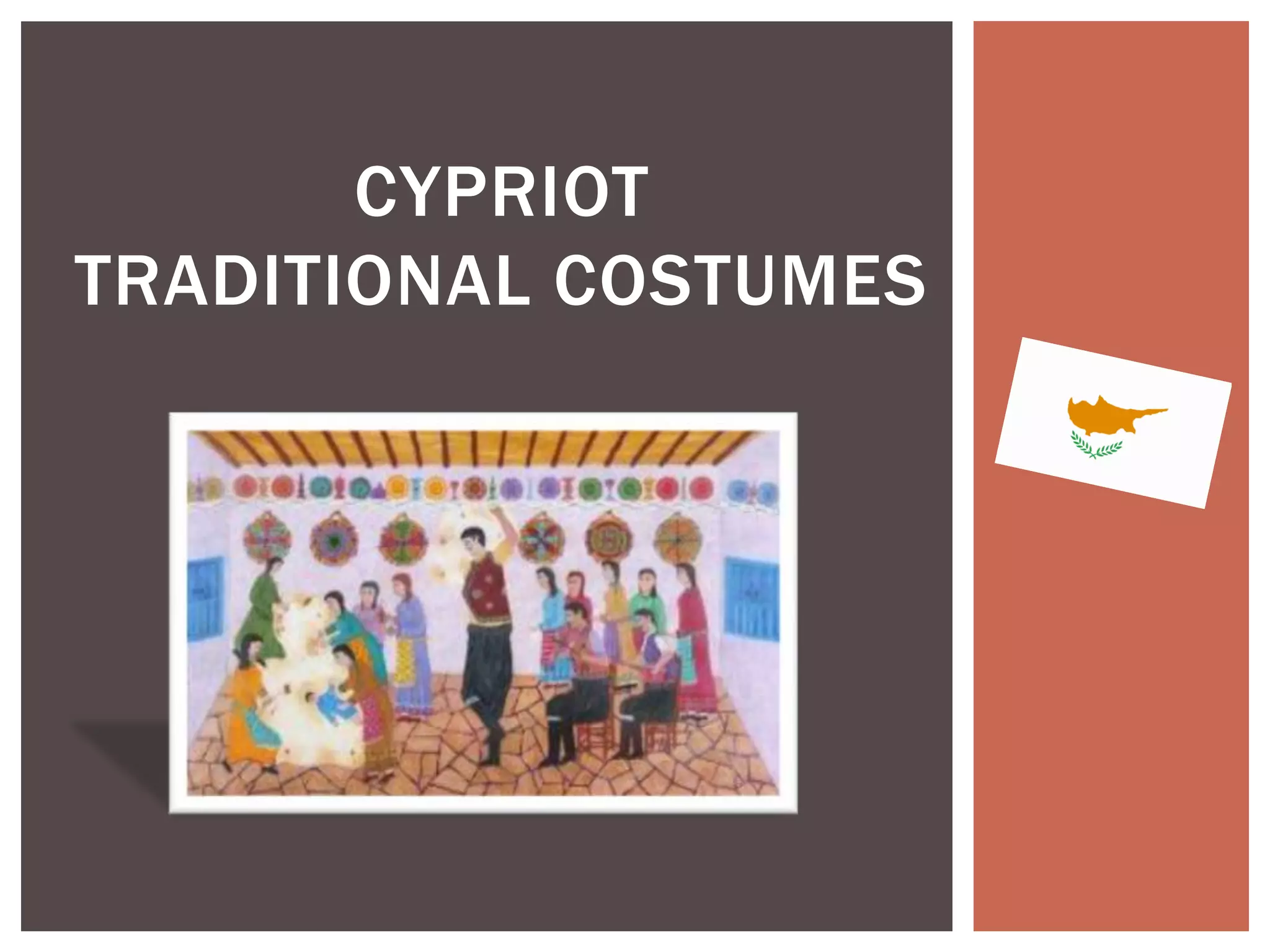
CYPRIOT
TRADITIONAL COSTUMES
 Cypriot costumes are an integral component of the traditional
culture of Cyprus. Each one is distinctive of a group of people
who lived on this east Mediterranean island, and who, despite
their idiosyncracies, maintained a uniform identity, keeping alive
the consciousness of their common origin and history.
 Study of the different types of Cypriot costume reveals the
island’s relations with neighbouring and far-off lands, through
trade or conquest. The costumes bespeak the Cypriot people’s
ability to assimilate foreigh traits and to re-create them in its
own way, consistent with its own tradition.
 Each individual costume is a complex work of art, combining not
only techniques of processing the raw materials, weaving and
embellishment, but also skill and sensitivity in the manner in
which it is cut and sewn. The costume is the true expression of
folk artistic creation.
GENERAL INFORMATION
 Compared with the costumes of the wider Greek world, those
of Cyprus are simpler and display a greater degree of
uniformity, on account of the island’s limited size. There
are, nevertheless, local variations, both in the kind of
costume and in its details: in the color of the cloth, the
combination of its partial elements, the cut, decoration and in
its accessories.
 Like Cypriot folk art in general, the costumes are
characterized by a conservatism, though this in no way
detracts from their diversity and charm.
 In a more or less egalitarian society, such as that of Cyprus
until the early decades of the present century, the costumes
worn by men and women gave their wearers a sense of
security, confidence and ease.
GENERAL INFORMATION
 The materials used for the costumes were cotton and silk, the
cultivation, processing and weaving of which have a long
tradition on Cyprus. Wool, mixed with cotton yarn, was used
only rarely for the chemises worn in mountainous villages.
THE MATERIALS
 The most usual fabric for the outer garments
was alatziá, a durable cotton cloth rather like
ticking, usually with fine vertical or crossed
stripes in deep red, blue, yellow, orange or
green on a white ground. Men’s shirts and
women’s dresses for everyday wear were
generally of blue alatziá with white stripes.
Black was substituted for blue in the cloth used
for the jackets of elderly men, while those of
younger men were of standard red-striped
alatziá zimpounísimi.
 There were also local variations for the festival
costumes, which had a characteristic colour
combination and were named according to their
provenance, such as
marathéftikes, morphitoúdes, lapithkiótikes
inter alia.
THE ALATZIÁ FABRIC
 The Cypriot female costume
basically consists of the outer
garment, the chemise and the
distinctive long pantaloons
caught around the ankle.
 Two general categories of
Cypriot female costumes can be
distinguished: urban and rural.
The former display a greater
number of European
influences, like their
counterparts in Greece, while
the latter preserve more of the
authentic local traits and
peculiarities. The most
representative rural costumes
are those of Karpasia and
Paphos, of the
interior, mesaritiki, and the
mountains, oreini.
FEMALE COSTUMES
The 'saya', a kind of frock
open at the front and
sides, was common in most
urban and rural regions of
Cyprus until the 19th
century. Local variants were
still worn in the remoter
parts of Karpasia and
Paphos in the early decades
of the present century.
From the 19th century
onwards the saya was
gradually replaced in the
towns by the short fitted
jacket and skirt.
THE SAYÁ
COSTUMES OF KARPASIA, "SAYA". LATE 19TH CENTURY.
COLLECTION OF THE CYPRUS FOLK ART MUSEUM.
THE DOUPLETTI
Costume of Karpasia, "saya'" with "douple'tti".
Late 19th Century.
Collection of the Cyprus Folk Art Museum.
A peculiar local garment in Karpasia, the north-
east part of Cyprus, is the doupletti, a
white, densely pleated skirt, cast double over the
shoulders like a cape; the standing collar, which is
actually the skirt waistband, is embroidered in
white with coloured beads. This skirt was
originally part of the bridal costume, worn with
the sa'rka.
The 'foustani', a one-
piece, waisted and pleated
dress, was the preferred over-
garment in the rural areas of
Cyprus, particularly the plain and
the mountains, well into the
1950s, which decade was a
turning point for modernization in
the countryside. The festival
foustani was worn with an
embroidered apron, the everyday
one with a plain. In Paphos the
saya' was retained alongside the
fousta'ni, since it was considered
easier to wear. Both
garments, saya and foustani, had
a large oval opening in front, the
trachilia' or dickey, to facilitate
breast-feeding.
THE FOUSTÁNI WITH APRON
COSTUME OF THE
MESSAORIAS, " FOUSTA'NI".
EARLY 20TH CENTURY.
COLLECTION OF THE CYPRUS
FOLK ART MUSEUM.
THE FOUSTÁNI
 In Karpasia and other rural regions
of the plains, the women working in
the fields in the summer lifted up
the hem of their saya' or fousta'ni
and tucked it in at the waist. Some
just wore the chemise and zoma, a
sash improvised from a diagonally
folded dark kerchief, tied round the
waist with the pointed end behind.
 Analogous with the zoma is the
foutas, a rectangular piece of
cloth, folded diagonally and tied in
front. It was worn round the waist
like a broad cummerbund, covering
the chemise below.
 In the towns the women used the
foutas in the bath-house. The
pa'nna, an equivalent garment, was
worn in the mountainous regions of
Cyprus and as part of the festival
costume.
LOCAL VARIATIONS
From the second half of the
19th century, in Nicosia (the
capital of the island) and the
other towns, as in the urban
areas of Greece, variations
of the so-called Amalia
costume came into vogue.
This type of dress diffused to
the extensive rural
settlements of Cyprus too. It
comprises a wide silk skirt, a
short fitted jacket with
sleeves, the sarka, which had
a large opening on the
chest, a fez and kerchief.
Characteristic of the Cypriot
version of the pan-Hellenic
Amalia costume is the
sattakrouta fabric from
Nicosia, dyed with plant
substances in shades of
yellow, orange, green and
earth colours.
THE AMALIA COSTUME-THE URBAN
kerchief
sarka
silk skirt
chemise
 The best sarkes were produced in
Nicosia, whose seamstresses and
tailors had a high reputation. The
latter sewed and embroidered the
fine costumes, women's
sarkes, men's waistcoats and short
jackets worn all over Cyprus. Local
cloth was used, though black woollen
felt, tsoufa, or velvet was purchased
for "best-wear". The embroidery was
executed in over-sewn metal
wire, ttelia, or silk thread .
 The luxurious pure silk chemise worn
under the sarka is visible on the
chest and the sleeves. Both the large
frontal opening, trachilia or
dickey, and the long maniketta or
cuffs are embellished with delicate
silk crochet lace, pipilla.
THE AMALIA COSTUME-THE URBAN
 In contrast to the urban
costume, which frequently became a
criterion of social class, a relative
uniformity is observed in the rural
world. The festival dress was usually
also the bridal costume, the addition
of certain accessories and the
characteristic scarlet kerchief, worn
in some regions throughout the first
year of marriage, being the only
features distinguishing the bride
from the other female guests. Brides
also plaited long strands of
wire, ttelia, in their hair, and these
hung down like a veil concealing the
face. In some regions, such as
Karpasia and the Morphou
area, there was a special bridal
headdress, which only a few women
in the community knew how to
arrange.
BRIDAL COSTUMES
 The most popular bridal costume in
Karpasia was a local version of the urban
Amalia costume: It consists of a multi-
pleated cotton skirt dyed dark red with
pine bark, routzietti, worn with a short
jacket, sa'rka. Rare local examples of the
sa'rka have survived from Karpasia.
These are made of white cotton
fabric, lavishly embellished with applique
decoration and coloured beads.
 The entire chest was covered with
jewellery; the mirmidi, the cross with the
doudounia and corals, the necklace, the
kertanes and other pieces. The belt
around the waist is fastened with a silver
buckle. The headdress is particularly
striking: the scarlet kerchief, skepi, is
held on the forehead with a frontlet of
three successive ribbons in red, yellow
and green. Affixed to the headdress is a
silver ornament, the splinga, from which
chains, coins and coloured beads hang
down the sides of the bride's face.
THE KARPASIAN BRIDAL COSTUME
 The female headdress which prevailed not only in the rural but also in the
urban world was the kouroukla, a square kerchief of fine cotton in different
colours; crimson, 'kraseti' (bordeaux), dark green for young women and
brown for older ones.
 Young girls were psiloskoufomenes, that is they wore the kerchief tied high
on the head to expose the brow, since, according to a Cypriot rhyming
couplet, those who wore the headdress low, chamiloskoufomenes were
"shamed". The hair was parted in the middle and plaited into two long
braids. Old women, widows and those in mourning wore a black
kerchief, under which they placed a second dark-coloured headsquare, the
kouroukla, which covered the hair, forehead and ears like a snood, and was
known as the skoufoma.
THE HEADDRESS
 The floral designs on the borders
are applied with wooden stamps
by special craftsmen known as
mandila'rides. The "best"
kerchiefs are edged with crochet
trim, pipilla, in various
patterns, such as
yasemoudin, foulin, kamaroudin
etc., named after the basic
motif. The kerchief was folded
diagonally, the triangle
behind, and the two loose ends
turned back and tied high up at
the side so that their lace edging
was displayed. A silver kerchief
pin, 'karfitsa tou mandiliou', a
flower of crocheted silk, or real
flower was placed in the bow.
MANDILARIDES
 The wealthy bourgeoise ladies wore the singular polychrome silk
kerchiefs known as koilaniotika. These were tie-dyed with plant
colorants in vivid hues, predominantly vermilion, kraseti, gold and
green. The technique was exclusive to the village of Koilani and
these highly-prized kerchiefs were exported, mainly to Kastellorizo.
 In the mountainous villages of the Troodos, the women wore a
woollen kerchief with fringing, krossia, the tsemberi. Embroidered
in one corner of the festival or bridal kerchief was a
bird, generically called peacock, pagoni, or a flower, which could be
seen on the triangle behind.
THE HEADDRESS
Town-dwelling women of the
19th century wore boots
and slippers of yellowish
leather while in the 20th
century black court shoes
became fashionable. In the
rural areas, and especially
the mountains, women wore
short hob-nailed
boots, potinia, made by the
same
cobblers, skarparides, as
fashioned the men's boots
or podines.
Cypriot women rarely wore
hose; in keeping with the
strict moral code
observed, the long
pantaloons covered even
the soles of the feet.
THE SHOES
 Essential accessories of the costume of the wealthiest urban
women were various items of gold jewellery, indicative of their
social rank and economic status. However, most women wore
silver and gilded ornaments with the festival costume, and those
worn in the villages were often of silvered bronze.
OTHER ACCESSORIES
 The commonest articles were pins, splidzies, worn in the
headscarf or on the chest, rows of chains upon the
chest, mirmidia, from which hung tiny Turkish
coins, pparaoudkia, and gems of coral or glass, necklaces -
kertanedes and skalettes - various crosses, such as the
trifourenos with tiny filigree spheres and
coral, earrings, bracelets and finger rings.
JEWELLERY
 Some bridal costumes included a
velvet belt ernbroidered with metallic
thread, fastened with a silver
buckle, poukles. The broad sash worn
by women in the towns had silk-
embroidered ends and two
large, shiny metal buckles at the
front.
 Cypriot jewellery was wrought by local
goldsmiths in Nicosia and was
embellished with filigree
trifoureni, pierced, hammered and
cast decoration.
JEWELLERY
 There are very few
distinct regional
differences in the male
costume of Cyprus. Its
basic components are
the densely pleated
baggy
trousers, vra'ka, which
held sway in all the
C,reek islands, and the
waistcoat, yilekko, or
jacket, zibouni. Yet this
apparent uniformity is
punctuated by some
local features, manifest
in the size of the vraka
and the colour of the
cloth used for the chest
garment. These
diacritical traits used to
be indicative of the
wearer's origin.
MALE COSTUMES
Rural male costume Urban male costume
 The vra'ka was made of coarse
hand-woven dimity, which was
dyed, after sewing, by local
dyers, poyatzides; black for
elderly men, blue for younger
ones. The vraka varied in size and
shape from region to region. That
for "best" wear was very
wide, requiring forty piches
(yards) of dimity, according to the
popular Cypriot distich. The
bustle, sella, which hung
behind, was densely
pleated, prosiasma. This was
normally tucked up into the belt
and only left to hang freely when
the wearer went to church. In
Oreini Nicosia, the vra'ka, known
here as tsiatta'lin, was
appreciably narrower than in
other regions. White cotton
underpants were worn
underneath.
THE VRAKA
 The vra'ka is worn with a chemise
or shirt, of dark striped cotton
material everyday and of silk on
Sundays. The silk shirt was a basic
garment of the groom's
costume, being a present from his
bride-to-be, like his kerchief which
was symbolic of their union and
tied around his neck during the
wedding ceremony. The cut of the
shirt, the manner in which it was
sewn and embellished, varied
according to region. That of the
Mesaoria is particularly
elaborate, being made of highly-
prized taisto silk with a shoulder
piece and traversa in front, cut on
the cross and trimmed with tucks
and European lace. The sleeves
are voluminous, with cuffs and
poma'niko, that is a triangular
inset to the under-arm seam to
facilitate freedom of movement.
THE CHEMISE OR SHIRT
In many districts, including the
Mesaoria, men also wore a vest next to the
skin. This was of hand-woven cotton and
embroidered in those places visible beneath
the shirt, such as the neck opening and the
cuffs. In rural areas a knitted vest of home-
spun wool was worn in winter.
 Though the vra'ka and shirt were
more or less the same all over
the island, there were more
obvious variations in the jacket
worn with them. This garment is
short, fitted, straight or crossed
over and fastened. The sleeve-
less version is the yilekko, the
sleeved the zibouni or zibouna.
The vertical opening down the
back, which enabled the wearer
to make expansive
movements, was fastened with a
cord or ribbon. The yilekka and
zibounia worn in country
districts were of the same cotton
alatzia' as the female over-
garment. In summer the
waistcoat was worn on its
own, in winter under the zibouni.
THE YILEKKO AND ZIBOUNI
yilekko
zibouni
 The edges, back and pocket of the festival waistcoat were
embroidered, in contrast to the everyday version which was quite
plain. The oldest zibouni in Karpasia, the perikos, was embelished
with white loom-embroidery with coloured "stones", petrou'des, very
similar to that on the women's festival saye's (A. Pieridou, op.
cit., p.28). Jackets for Sunday wear in this region had a cross-over
fastening and were thus known as stavrote's. Wile the zibou'nia and
yile'kka worn in the rural areas were made in the villages, the
sklavou'nika worn in the towns were sewn by professional tailors in
Nicosia. They were of ready-made woollen cloth and elaborately
decorated with embroidery of over-sewn twisted cotton thread.
There were even waiscoats of velvet and the famous sattakrou'ta
silk, with which the Nicosian ladies made their skirts.
 The groom's yilekkozi'bouna was usually made of dark velvet with
brightly coloured applique designs of birds and animals on the
back, such as confronting lions, a symbol of virility.
THE DECORATION
 A broad
cummerbund, zona'ri, was worn
around the waist. This was of
black dimity with fringing at the
narrow ends for older men and
of brightly coloured
silk, ttalapoulou'zi, in the young
men's festival attire and the
groom's costume. A knitted
purse hung from the sash, or a
bought purse, kkeme'ri, was
tucked inside it.
THE ZONARI
 All year round, the men in the rural parts of Cyprus wore heavy, hob-
nailed boots to protect them from snakes which abound on the
island. Flat-soled and made by specialist
cobblers, skarpa'rides, these are the most expensive item in the
male costume. In the town men wore European-style
boots, frangopodi'nes, or shoes, ska'rpes. In some districts the
groom wore leather slippers with a bow, syriane's. The knitted
cotton or woollen socks worn with the boots or shoes were attached
to the bottom, podina'ria, of the baggy trousers with laces.
THE SHOES
 The male costume was
formerly completed by a
fez, either worn alone of with
a kerchief tied with the
triangle at the side, the
kouroukli'n. The male
headdress was later
simplified and only the
kerchief remained. The
groom's kerchief, of brightly
coloured wool, was bought.
The edges were trimmed with
crochet lace, pipi'lla, or fine
fringing. The everyday
kerchiefs were just the same
as the kourou'kles worn by
the women, with stamped
designs; young men wore light
ones, old men dark. The
farmers of the plain wore a
straw hat.
THE HEADDRESS
 The male costume was
complemented by a simple
parure of silver ornaments; a
watch and chain, chains and
finger rings. Greek officials
wore rings with a seal on the
bezel and ancients stones.
OTHER ACCESSORIES
Most of the text used for the creation of this presentation was
taken from the book:
Papademetriou E. (1991),“CYPRUS TRADITIONAL
COSTUMES”, Folk Art Museum of the Society of Cypriot
Studies”, Athens.
The pictures used were taken from the above book, the picture
collection of the Cyprus Handicraft Service and from the
internet.
THANK YOU!
BIBLIOGRAPHY

Cypriot traditional costumes

  • 1.
  • 2.
     Cypriot costumesare an integral component of the traditional culture of Cyprus. Each one is distinctive of a group of people who lived on this east Mediterranean island, and who, despite their idiosyncracies, maintained a uniform identity, keeping alive the consciousness of their common origin and history.  Study of the different types of Cypriot costume reveals the island’s relations with neighbouring and far-off lands, through trade or conquest. The costumes bespeak the Cypriot people’s ability to assimilate foreigh traits and to re-create them in its own way, consistent with its own tradition.  Each individual costume is a complex work of art, combining not only techniques of processing the raw materials, weaving and embellishment, but also skill and sensitivity in the manner in which it is cut and sewn. The costume is the true expression of folk artistic creation. GENERAL INFORMATION
  • 3.
     Compared withthe costumes of the wider Greek world, those of Cyprus are simpler and display a greater degree of uniformity, on account of the island’s limited size. There are, nevertheless, local variations, both in the kind of costume and in its details: in the color of the cloth, the combination of its partial elements, the cut, decoration and in its accessories.  Like Cypriot folk art in general, the costumes are characterized by a conservatism, though this in no way detracts from their diversity and charm.  In a more or less egalitarian society, such as that of Cyprus until the early decades of the present century, the costumes worn by men and women gave their wearers a sense of security, confidence and ease. GENERAL INFORMATION
  • 4.
     The materialsused for the costumes were cotton and silk, the cultivation, processing and weaving of which have a long tradition on Cyprus. Wool, mixed with cotton yarn, was used only rarely for the chemises worn in mountainous villages. THE MATERIALS
  • 5.
     The mostusual fabric for the outer garments was alatziá, a durable cotton cloth rather like ticking, usually with fine vertical or crossed stripes in deep red, blue, yellow, orange or green on a white ground. Men’s shirts and women’s dresses for everyday wear were generally of blue alatziá with white stripes. Black was substituted for blue in the cloth used for the jackets of elderly men, while those of younger men were of standard red-striped alatziá zimpounísimi.  There were also local variations for the festival costumes, which had a characteristic colour combination and were named according to their provenance, such as marathéftikes, morphitoúdes, lapithkiótikes inter alia. THE ALATZIÁ FABRIC
  • 6.
     The Cypriotfemale costume basically consists of the outer garment, the chemise and the distinctive long pantaloons caught around the ankle.  Two general categories of Cypriot female costumes can be distinguished: urban and rural. The former display a greater number of European influences, like their counterparts in Greece, while the latter preserve more of the authentic local traits and peculiarities. The most representative rural costumes are those of Karpasia and Paphos, of the interior, mesaritiki, and the mountains, oreini. FEMALE COSTUMES
  • 7.
    The 'saya', akind of frock open at the front and sides, was common in most urban and rural regions of Cyprus until the 19th century. Local variants were still worn in the remoter parts of Karpasia and Paphos in the early decades of the present century. From the 19th century onwards the saya was gradually replaced in the towns by the short fitted jacket and skirt. THE SAYÁ
  • 8.
    COSTUMES OF KARPASIA,"SAYA". LATE 19TH CENTURY. COLLECTION OF THE CYPRUS FOLK ART MUSEUM.
  • 9.
    THE DOUPLETTI Costume ofKarpasia, "saya'" with "douple'tti". Late 19th Century. Collection of the Cyprus Folk Art Museum. A peculiar local garment in Karpasia, the north- east part of Cyprus, is the doupletti, a white, densely pleated skirt, cast double over the shoulders like a cape; the standing collar, which is actually the skirt waistband, is embroidered in white with coloured beads. This skirt was originally part of the bridal costume, worn with the sa'rka.
  • 10.
    The 'foustani', aone- piece, waisted and pleated dress, was the preferred over- garment in the rural areas of Cyprus, particularly the plain and the mountains, well into the 1950s, which decade was a turning point for modernization in the countryside. The festival foustani was worn with an embroidered apron, the everyday one with a plain. In Paphos the saya' was retained alongside the fousta'ni, since it was considered easier to wear. Both garments, saya and foustani, had a large oval opening in front, the trachilia' or dickey, to facilitate breast-feeding. THE FOUSTÁNI WITH APRON
  • 11.
    COSTUME OF THE MESSAORIAS," FOUSTA'NI". EARLY 20TH CENTURY. COLLECTION OF THE CYPRUS FOLK ART MUSEUM. THE FOUSTÁNI
  • 12.
     In Karpasiaand other rural regions of the plains, the women working in the fields in the summer lifted up the hem of their saya' or fousta'ni and tucked it in at the waist. Some just wore the chemise and zoma, a sash improvised from a diagonally folded dark kerchief, tied round the waist with the pointed end behind.  Analogous with the zoma is the foutas, a rectangular piece of cloth, folded diagonally and tied in front. It was worn round the waist like a broad cummerbund, covering the chemise below.  In the towns the women used the foutas in the bath-house. The pa'nna, an equivalent garment, was worn in the mountainous regions of Cyprus and as part of the festival costume. LOCAL VARIATIONS
  • 13.
    From the secondhalf of the 19th century, in Nicosia (the capital of the island) and the other towns, as in the urban areas of Greece, variations of the so-called Amalia costume came into vogue. This type of dress diffused to the extensive rural settlements of Cyprus too. It comprises a wide silk skirt, a short fitted jacket with sleeves, the sarka, which had a large opening on the chest, a fez and kerchief. Characteristic of the Cypriot version of the pan-Hellenic Amalia costume is the sattakrouta fabric from Nicosia, dyed with plant substances in shades of yellow, orange, green and earth colours. THE AMALIA COSTUME-THE URBAN kerchief sarka silk skirt chemise
  • 14.
     The bestsarkes were produced in Nicosia, whose seamstresses and tailors had a high reputation. The latter sewed and embroidered the fine costumes, women's sarkes, men's waistcoats and short jackets worn all over Cyprus. Local cloth was used, though black woollen felt, tsoufa, or velvet was purchased for "best-wear". The embroidery was executed in over-sewn metal wire, ttelia, or silk thread .  The luxurious pure silk chemise worn under the sarka is visible on the chest and the sleeves. Both the large frontal opening, trachilia or dickey, and the long maniketta or cuffs are embellished with delicate silk crochet lace, pipilla. THE AMALIA COSTUME-THE URBAN
  • 15.
     In contrastto the urban costume, which frequently became a criterion of social class, a relative uniformity is observed in the rural world. The festival dress was usually also the bridal costume, the addition of certain accessories and the characteristic scarlet kerchief, worn in some regions throughout the first year of marriage, being the only features distinguishing the bride from the other female guests. Brides also plaited long strands of wire, ttelia, in their hair, and these hung down like a veil concealing the face. In some regions, such as Karpasia and the Morphou area, there was a special bridal headdress, which only a few women in the community knew how to arrange. BRIDAL COSTUMES
  • 16.
     The mostpopular bridal costume in Karpasia was a local version of the urban Amalia costume: It consists of a multi- pleated cotton skirt dyed dark red with pine bark, routzietti, worn with a short jacket, sa'rka. Rare local examples of the sa'rka have survived from Karpasia. These are made of white cotton fabric, lavishly embellished with applique decoration and coloured beads.  The entire chest was covered with jewellery; the mirmidi, the cross with the doudounia and corals, the necklace, the kertanes and other pieces. The belt around the waist is fastened with a silver buckle. The headdress is particularly striking: the scarlet kerchief, skepi, is held on the forehead with a frontlet of three successive ribbons in red, yellow and green. Affixed to the headdress is a silver ornament, the splinga, from which chains, coins and coloured beads hang down the sides of the bride's face. THE KARPASIAN BRIDAL COSTUME
  • 17.
     The femaleheaddress which prevailed not only in the rural but also in the urban world was the kouroukla, a square kerchief of fine cotton in different colours; crimson, 'kraseti' (bordeaux), dark green for young women and brown for older ones.  Young girls were psiloskoufomenes, that is they wore the kerchief tied high on the head to expose the brow, since, according to a Cypriot rhyming couplet, those who wore the headdress low, chamiloskoufomenes were "shamed". The hair was parted in the middle and plaited into two long braids. Old women, widows and those in mourning wore a black kerchief, under which they placed a second dark-coloured headsquare, the kouroukla, which covered the hair, forehead and ears like a snood, and was known as the skoufoma. THE HEADDRESS
  • 18.
     The floraldesigns on the borders are applied with wooden stamps by special craftsmen known as mandila'rides. The "best" kerchiefs are edged with crochet trim, pipilla, in various patterns, such as yasemoudin, foulin, kamaroudin etc., named after the basic motif. The kerchief was folded diagonally, the triangle behind, and the two loose ends turned back and tied high up at the side so that their lace edging was displayed. A silver kerchief pin, 'karfitsa tou mandiliou', a flower of crocheted silk, or real flower was placed in the bow. MANDILARIDES
  • 19.
     The wealthybourgeoise ladies wore the singular polychrome silk kerchiefs known as koilaniotika. These were tie-dyed with plant colorants in vivid hues, predominantly vermilion, kraseti, gold and green. The technique was exclusive to the village of Koilani and these highly-prized kerchiefs were exported, mainly to Kastellorizo.  In the mountainous villages of the Troodos, the women wore a woollen kerchief with fringing, krossia, the tsemberi. Embroidered in one corner of the festival or bridal kerchief was a bird, generically called peacock, pagoni, or a flower, which could be seen on the triangle behind. THE HEADDRESS
  • 20.
    Town-dwelling women ofthe 19th century wore boots and slippers of yellowish leather while in the 20th century black court shoes became fashionable. In the rural areas, and especially the mountains, women wore short hob-nailed boots, potinia, made by the same cobblers, skarparides, as fashioned the men's boots or podines. Cypriot women rarely wore hose; in keeping with the strict moral code observed, the long pantaloons covered even the soles of the feet. THE SHOES
  • 21.
     Essential accessoriesof the costume of the wealthiest urban women were various items of gold jewellery, indicative of their social rank and economic status. However, most women wore silver and gilded ornaments with the festival costume, and those worn in the villages were often of silvered bronze. OTHER ACCESSORIES
  • 22.
     The commonestarticles were pins, splidzies, worn in the headscarf or on the chest, rows of chains upon the chest, mirmidia, from which hung tiny Turkish coins, pparaoudkia, and gems of coral or glass, necklaces - kertanedes and skalettes - various crosses, such as the trifourenos with tiny filigree spheres and coral, earrings, bracelets and finger rings. JEWELLERY
  • 23.
     Some bridalcostumes included a velvet belt ernbroidered with metallic thread, fastened with a silver buckle, poukles. The broad sash worn by women in the towns had silk- embroidered ends and two large, shiny metal buckles at the front.  Cypriot jewellery was wrought by local goldsmiths in Nicosia and was embellished with filigree trifoureni, pierced, hammered and cast decoration. JEWELLERY
  • 24.
     There arevery few distinct regional differences in the male costume of Cyprus. Its basic components are the densely pleated baggy trousers, vra'ka, which held sway in all the C,reek islands, and the waistcoat, yilekko, or jacket, zibouni. Yet this apparent uniformity is punctuated by some local features, manifest in the size of the vraka and the colour of the cloth used for the chest garment. These diacritical traits used to be indicative of the wearer's origin. MALE COSTUMES Rural male costume Urban male costume
  • 25.
     The vra'kawas made of coarse hand-woven dimity, which was dyed, after sewing, by local dyers, poyatzides; black for elderly men, blue for younger ones. The vraka varied in size and shape from region to region. That for "best" wear was very wide, requiring forty piches (yards) of dimity, according to the popular Cypriot distich. The bustle, sella, which hung behind, was densely pleated, prosiasma. This was normally tucked up into the belt and only left to hang freely when the wearer went to church. In Oreini Nicosia, the vra'ka, known here as tsiatta'lin, was appreciably narrower than in other regions. White cotton underpants were worn underneath. THE VRAKA
  • 26.
     The vra'kais worn with a chemise or shirt, of dark striped cotton material everyday and of silk on Sundays. The silk shirt was a basic garment of the groom's costume, being a present from his bride-to-be, like his kerchief which was symbolic of their union and tied around his neck during the wedding ceremony. The cut of the shirt, the manner in which it was sewn and embellished, varied according to region. That of the Mesaoria is particularly elaborate, being made of highly- prized taisto silk with a shoulder piece and traversa in front, cut on the cross and trimmed with tucks and European lace. The sleeves are voluminous, with cuffs and poma'niko, that is a triangular inset to the under-arm seam to facilitate freedom of movement. THE CHEMISE OR SHIRT In many districts, including the Mesaoria, men also wore a vest next to the skin. This was of hand-woven cotton and embroidered in those places visible beneath the shirt, such as the neck opening and the cuffs. In rural areas a knitted vest of home- spun wool was worn in winter.
  • 27.
     Though thevra'ka and shirt were more or less the same all over the island, there were more obvious variations in the jacket worn with them. This garment is short, fitted, straight or crossed over and fastened. The sleeve- less version is the yilekko, the sleeved the zibouni or zibouna. The vertical opening down the back, which enabled the wearer to make expansive movements, was fastened with a cord or ribbon. The yilekka and zibounia worn in country districts were of the same cotton alatzia' as the female over- garment. In summer the waistcoat was worn on its own, in winter under the zibouni. THE YILEKKO AND ZIBOUNI yilekko zibouni
  • 28.
     The edges,back and pocket of the festival waistcoat were embroidered, in contrast to the everyday version which was quite plain. The oldest zibouni in Karpasia, the perikos, was embelished with white loom-embroidery with coloured "stones", petrou'des, very similar to that on the women's festival saye's (A. Pieridou, op. cit., p.28). Jackets for Sunday wear in this region had a cross-over fastening and were thus known as stavrote's. Wile the zibou'nia and yile'kka worn in the rural areas were made in the villages, the sklavou'nika worn in the towns were sewn by professional tailors in Nicosia. They were of ready-made woollen cloth and elaborately decorated with embroidery of over-sewn twisted cotton thread. There were even waiscoats of velvet and the famous sattakrou'ta silk, with which the Nicosian ladies made their skirts.  The groom's yilekkozi'bouna was usually made of dark velvet with brightly coloured applique designs of birds and animals on the back, such as confronting lions, a symbol of virility. THE DECORATION
  • 29.
     A broad cummerbund,zona'ri, was worn around the waist. This was of black dimity with fringing at the narrow ends for older men and of brightly coloured silk, ttalapoulou'zi, in the young men's festival attire and the groom's costume. A knitted purse hung from the sash, or a bought purse, kkeme'ri, was tucked inside it. THE ZONARI
  • 30.
     All yearround, the men in the rural parts of Cyprus wore heavy, hob- nailed boots to protect them from snakes which abound on the island. Flat-soled and made by specialist cobblers, skarpa'rides, these are the most expensive item in the male costume. In the town men wore European-style boots, frangopodi'nes, or shoes, ska'rpes. In some districts the groom wore leather slippers with a bow, syriane's. The knitted cotton or woollen socks worn with the boots or shoes were attached to the bottom, podina'ria, of the baggy trousers with laces. THE SHOES
  • 31.
     The malecostume was formerly completed by a fez, either worn alone of with a kerchief tied with the triangle at the side, the kouroukli'n. The male headdress was later simplified and only the kerchief remained. The groom's kerchief, of brightly coloured wool, was bought. The edges were trimmed with crochet lace, pipi'lla, or fine fringing. The everyday kerchiefs were just the same as the kourou'kles worn by the women, with stamped designs; young men wore light ones, old men dark. The farmers of the plain wore a straw hat. THE HEADDRESS
  • 32.
     The malecostume was complemented by a simple parure of silver ornaments; a watch and chain, chains and finger rings. Greek officials wore rings with a seal on the bezel and ancients stones. OTHER ACCESSORIES
  • 33.
    Most of thetext used for the creation of this presentation was taken from the book: Papademetriou E. (1991),“CYPRUS TRADITIONAL COSTUMES”, Folk Art Museum of the Society of Cypriot Studies”, Athens. The pictures used were taken from the above book, the picture collection of the Cyprus Handicraft Service and from the internet. THANK YOU! BIBLIOGRAPHY