Spanish 3 Grammatical Concepts
           Nicholas Arce
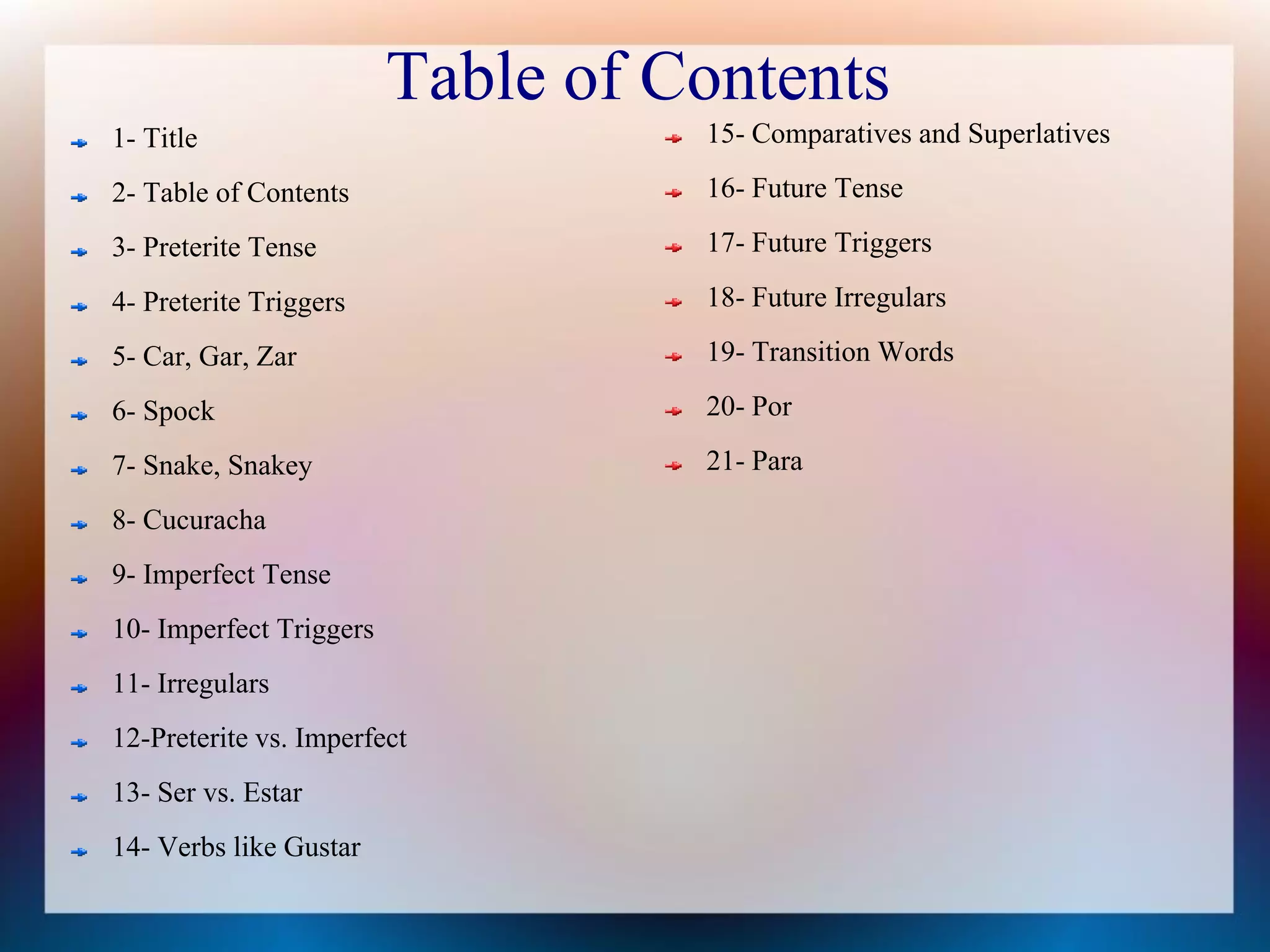
Table of Contents
1- Title                           15- Comparatives and Superlatives

2- Table of Contents               16- Future Tense

3- Preterite Tense                 17- Future Triggers

4- Preterite Triggers              18- Future Irregulars

5- Car, Gar, Zar                   19- Transition Words

6- Spock                           20- Por

7- Snake, Snakey                   21- Para

8- Cucuracha
9- Imperfect Tense
10- Imperfect Triggers
11- Irregulars
12-Preterite vs. Imperfect
13- Ser vs. Estar
14- Verbs like Gustar
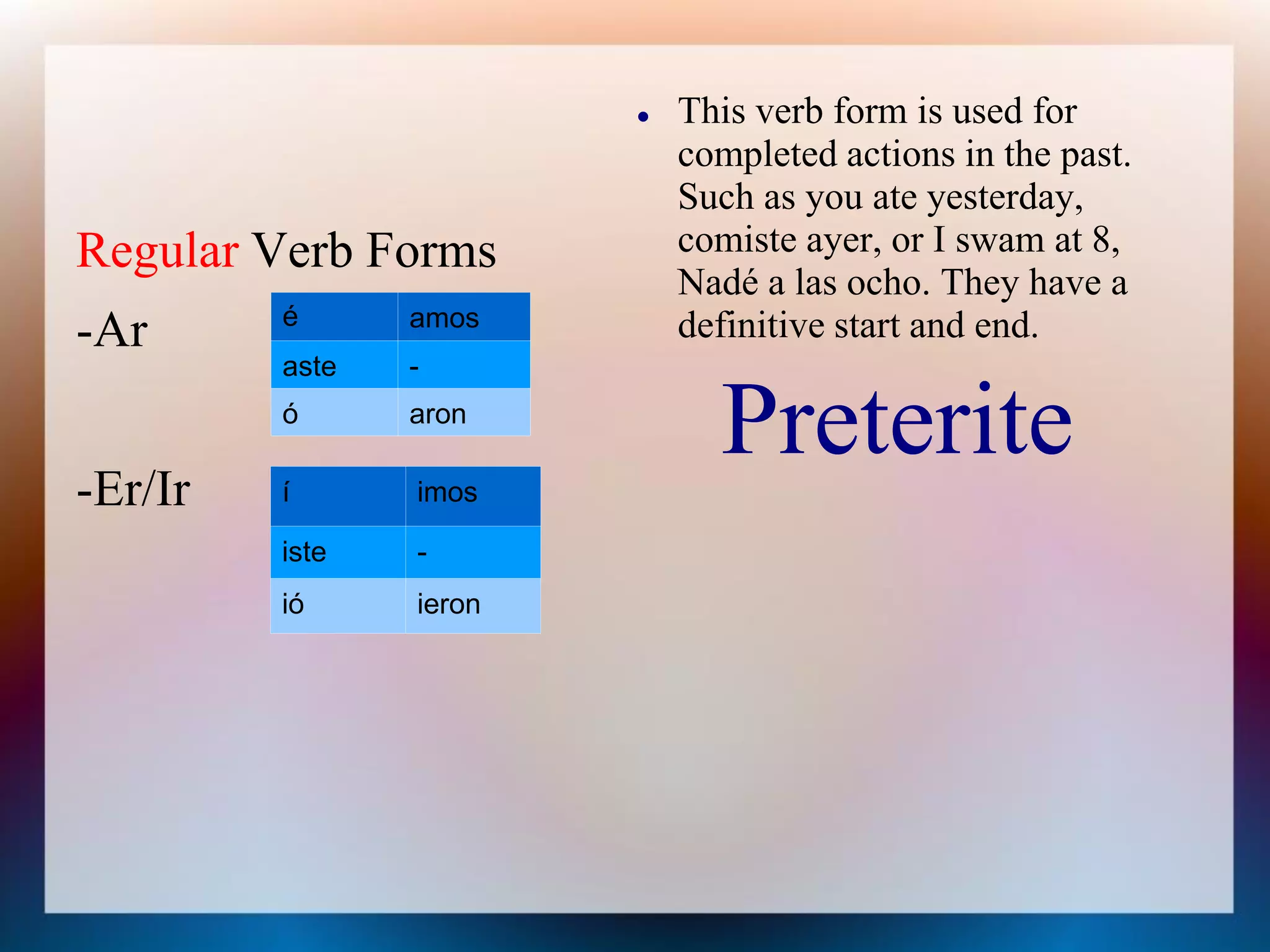
   This verb form is used for
                            completed actions in the past.
                            Such as you ate yesterday,
Regular Verb Forms          comiste ayer, or I swam at 8,
                            Nadé a las ocho. They have a
         é      amos        definitive start and end.
-Ar
         aste   -
         ó      aron
                              Preterite
-Er/Ir   í      imos

         iste   -
         ió     ieron
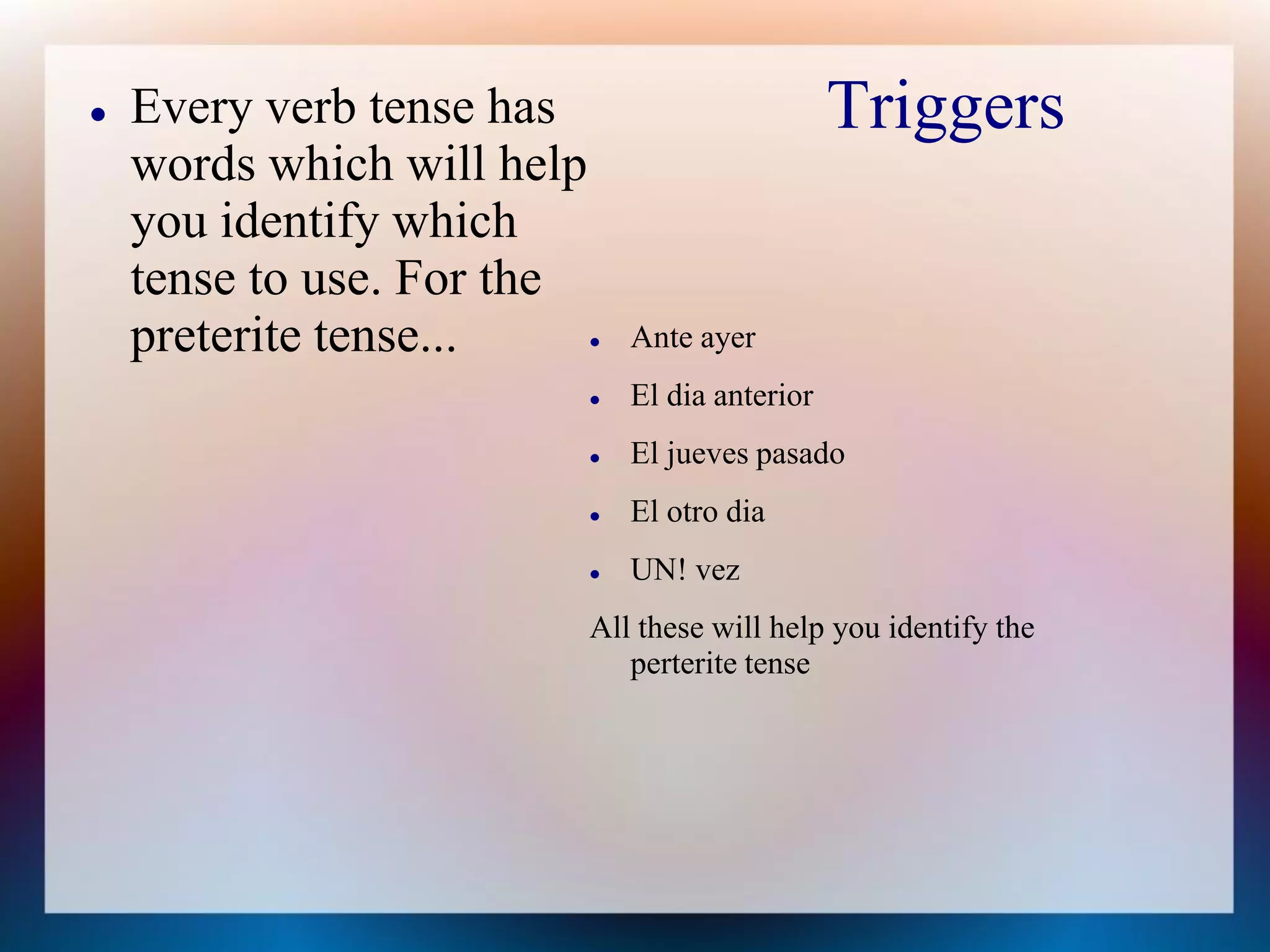
   Every verb tense has                          Triggers
    words which will help
    you identify which
    tense to use. For the
    preterite tense...         Ante ayer
                               El dia anterior
                               El jueves pasado
                               El otro dia
                               UN! vez
                            All these will help you identify the
                               perterite tense
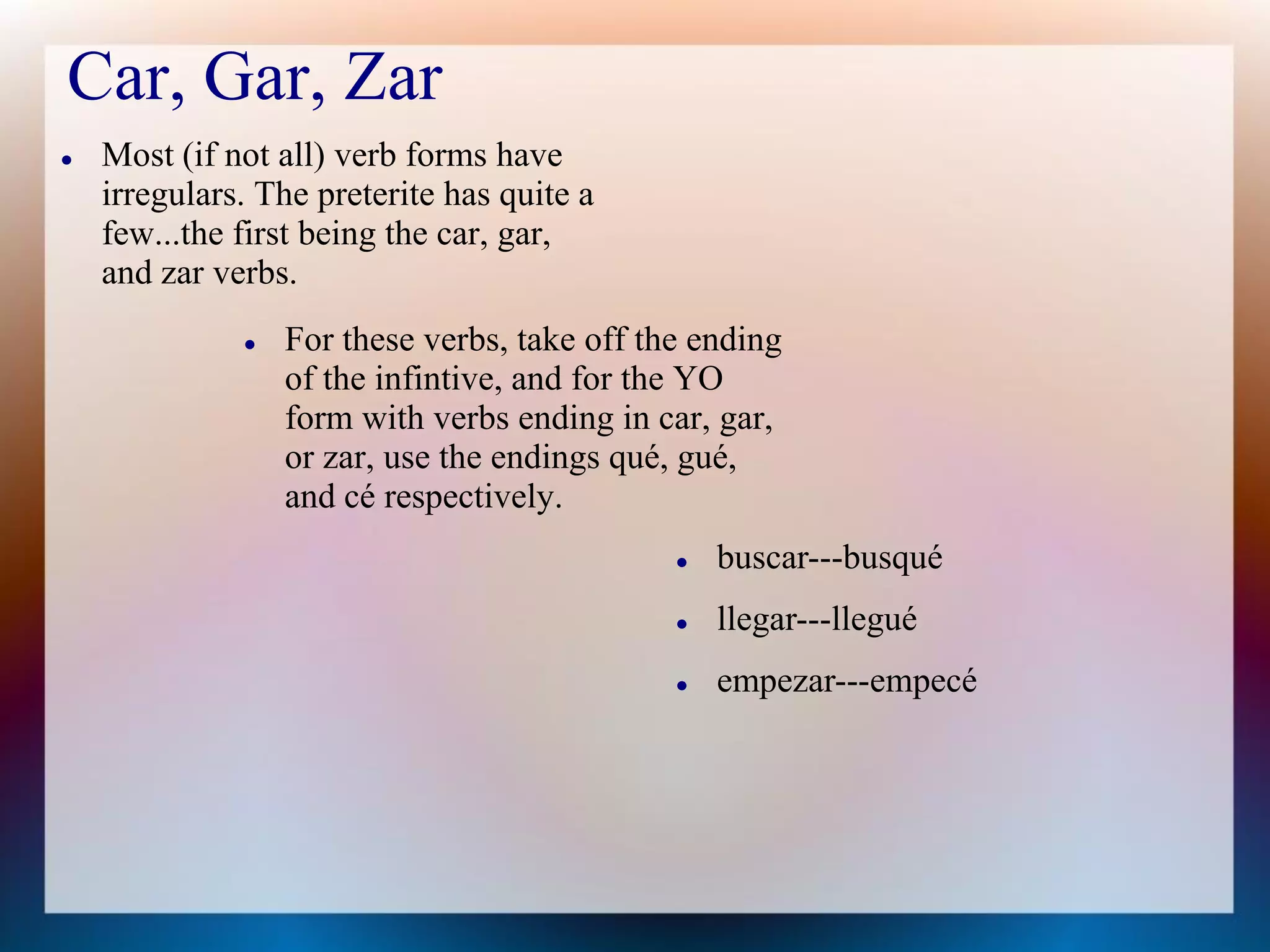
Car, Gar, Zar
   Most (if not all) verb forms have
    irregulars. The preterite has quite a
    few...the first being the car, gar,
    and zar verbs.
                 For these verbs, take off the ending
                  of the infintive, and for the YO
                  form with verbs ending in car, gar,
                  or zar, use the endings qué, gué,
                  and cé respectively.
                                                 buscar---busqué
                                                 llegar---llegué
                                                 empezar---empecé
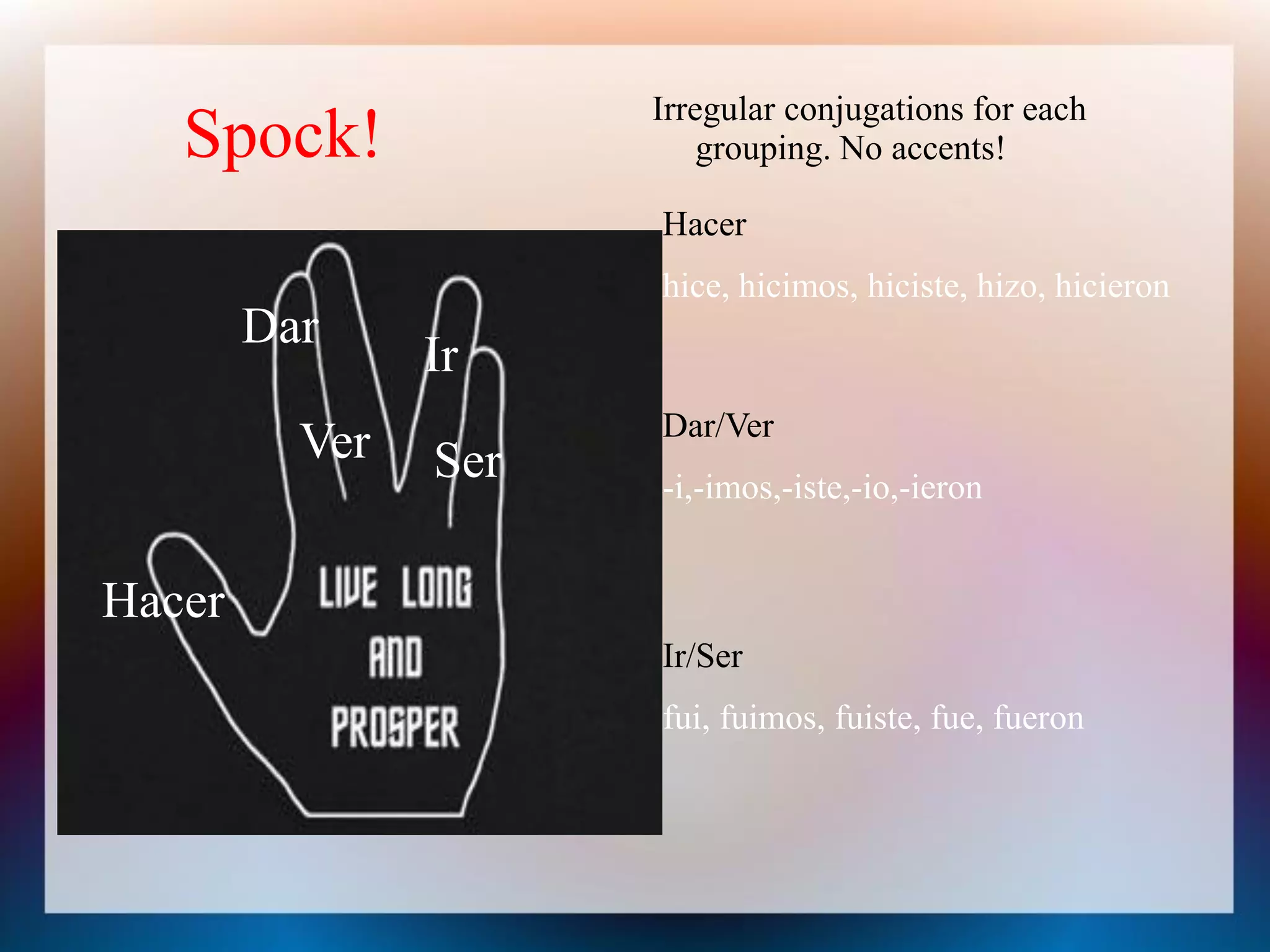
Irregular conjugations for each
   Spock!                 grouping. No accents!

                      Hacer
                      hice, hicimos, hiciste, hizo, hicieron
        Dar
                Ir
                      Dar/Ver
          Ver   Ser   -i,-imos,-iste,-io,-ieron


Hacer
                      Ir/Ser
                      fui, fuimos, fuiste, fue, fueron
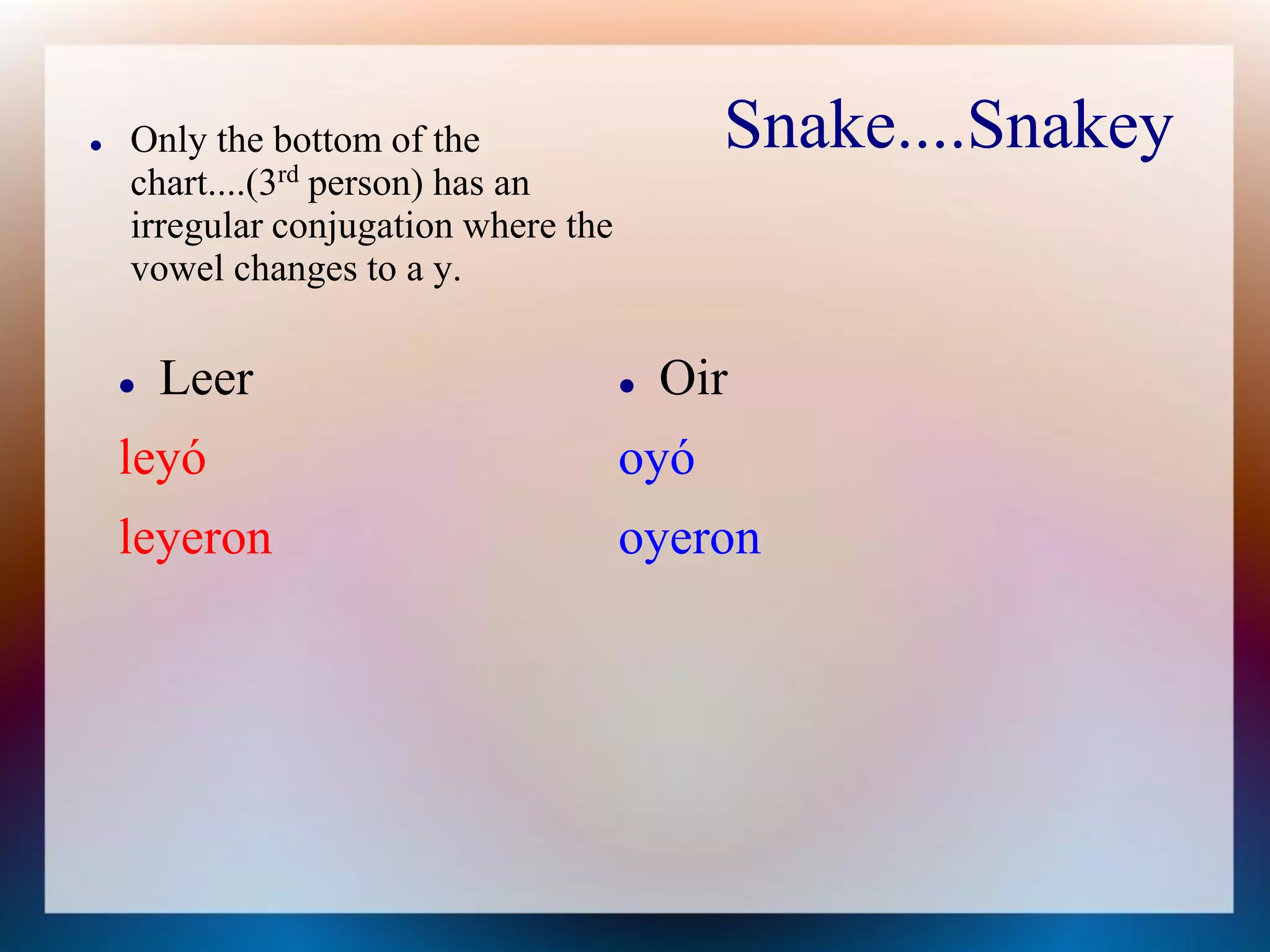
   Only the bottom of the                  Snake....Snakey
    chart....(3rd person) has an
    irregular conjugation where the
    vowel changes to a y.

       Leer                             Oir
    leyó                              oyó
    leyeron                           oyeron
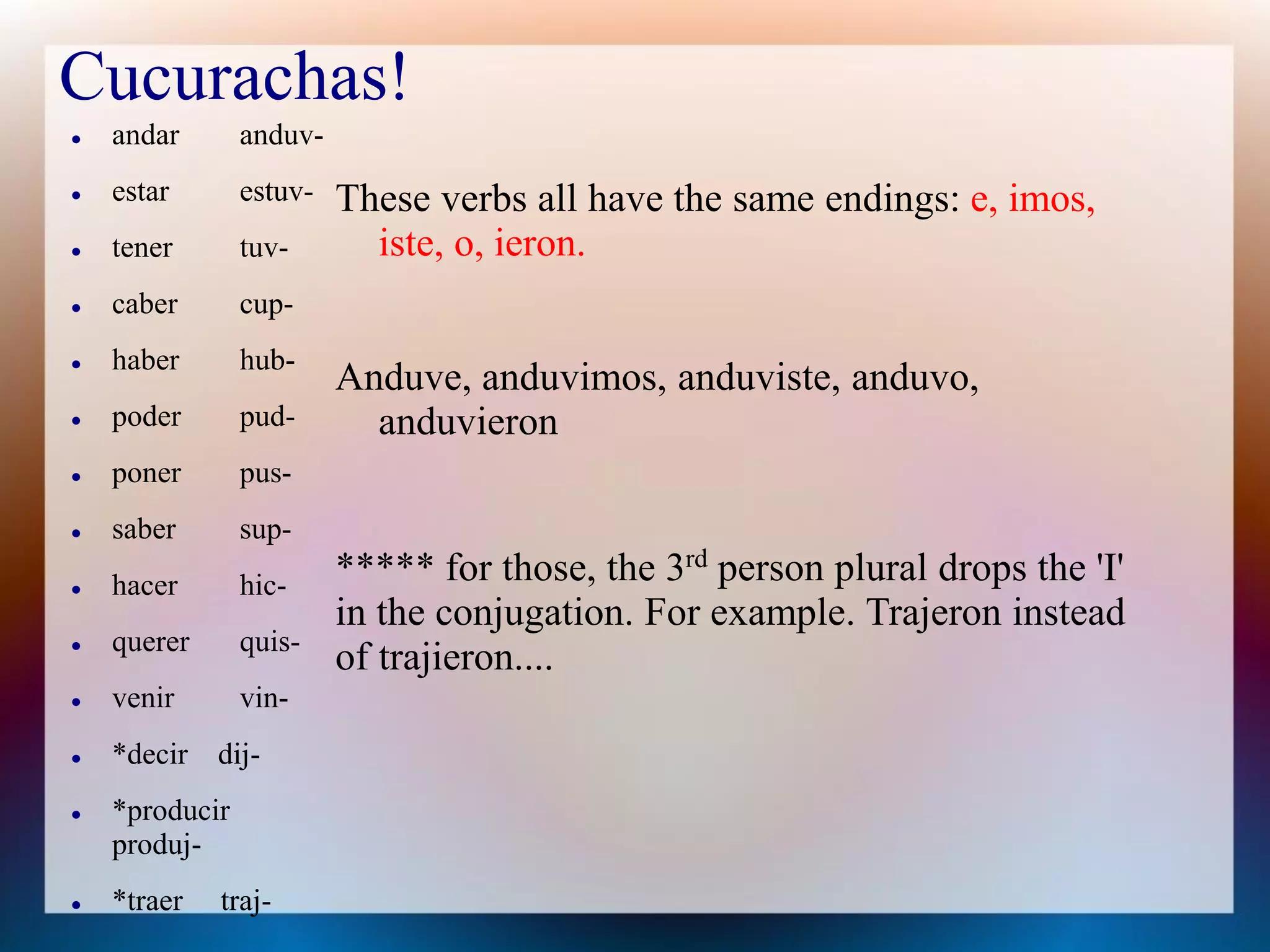
Cucurachas!
   andar       anduv-
   estar       estuv-   These verbs all have the same endings: e, imos,
   tener       tuv-       iste, o, ieron.
   caber       cup-
   haber       hub-
                         Anduve, anduvimos, anduviste, anduvo,
   poder       pud-       anduvieron
   poner       pus-
   saber       sup-
   hacer       hic-     ***** for those, the 3rd person plural drops the 'I'
                         in the conjugation. For example. Trajeron instead
   querer      quis-
                         of trajieron....
   venir       vin-
   *decir dij-
   *producir
    produj-
   *traer   traj-
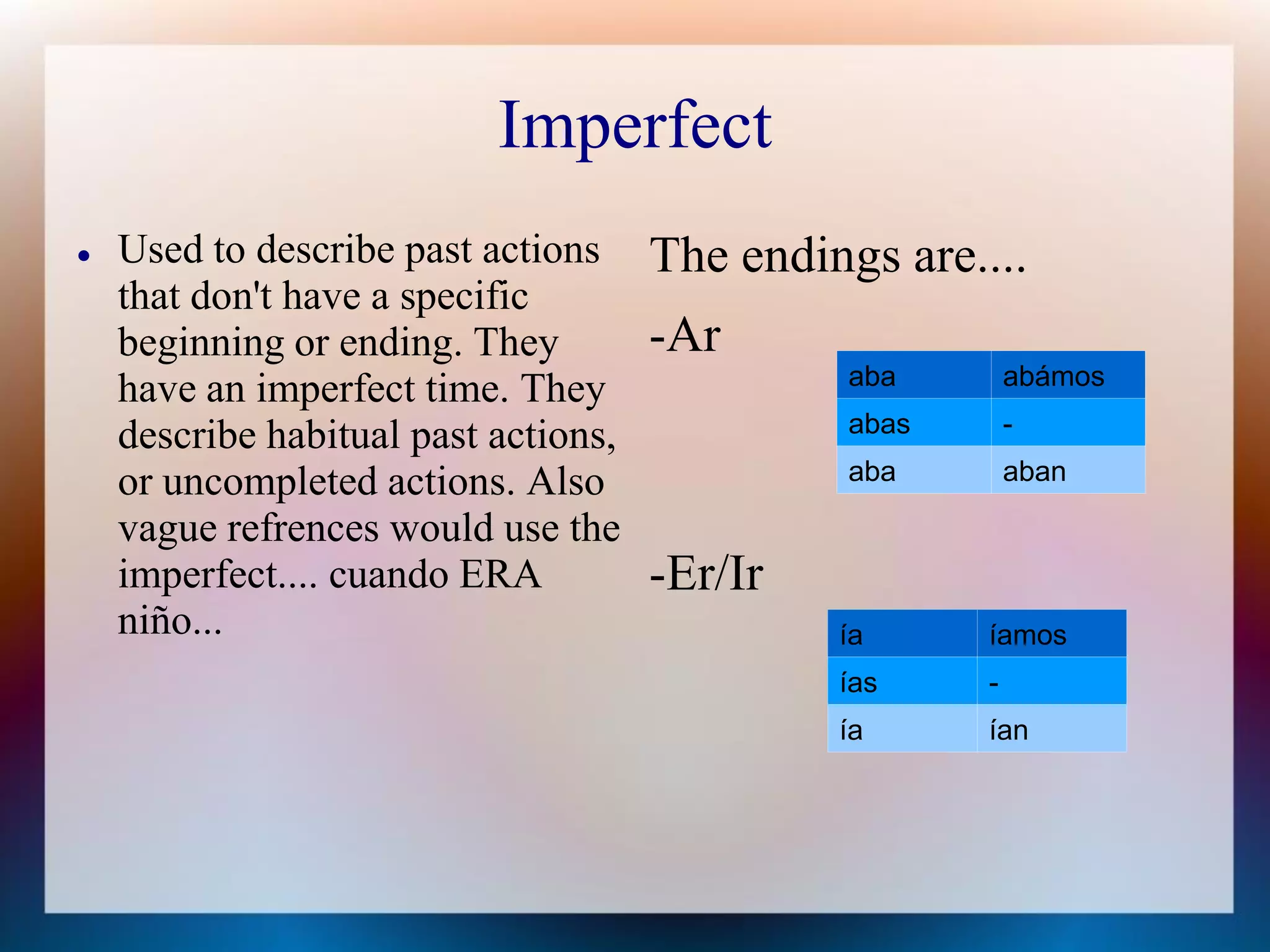
Imperfect
   Used to describe past actions     The endings are....
    that don't have a specific
    beginning or ending. They         -Ar
                                                aba        abámos
    have an imperfect time. They
                                                abas       -
    describe habitual past actions,
    or uncompleted actions. Also                aba        aban

    vague refrences would use the
    imperfect.... cuando ERA          -Er/Ir
    niño...                                    ía      íamos
                                               ías     -
                                               ía      ían
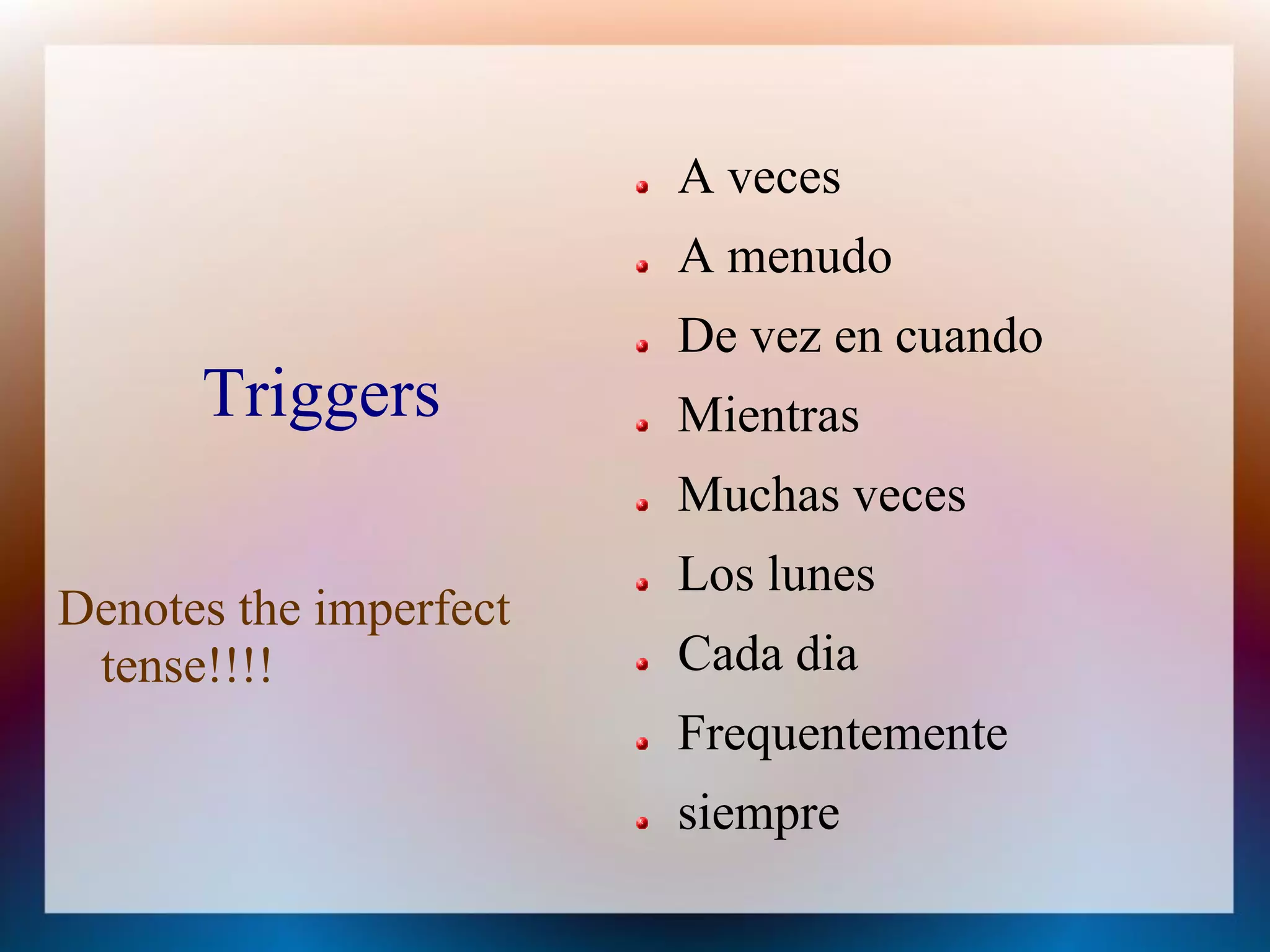
A veces
                        A menudo
                        De vez en cuando
      Triggers          Mientras
                        Muchas veces
                        Los lunes
Denotes the imperfect
 tense!!!!              Cada dia
                        Frequentemente
                        siempre
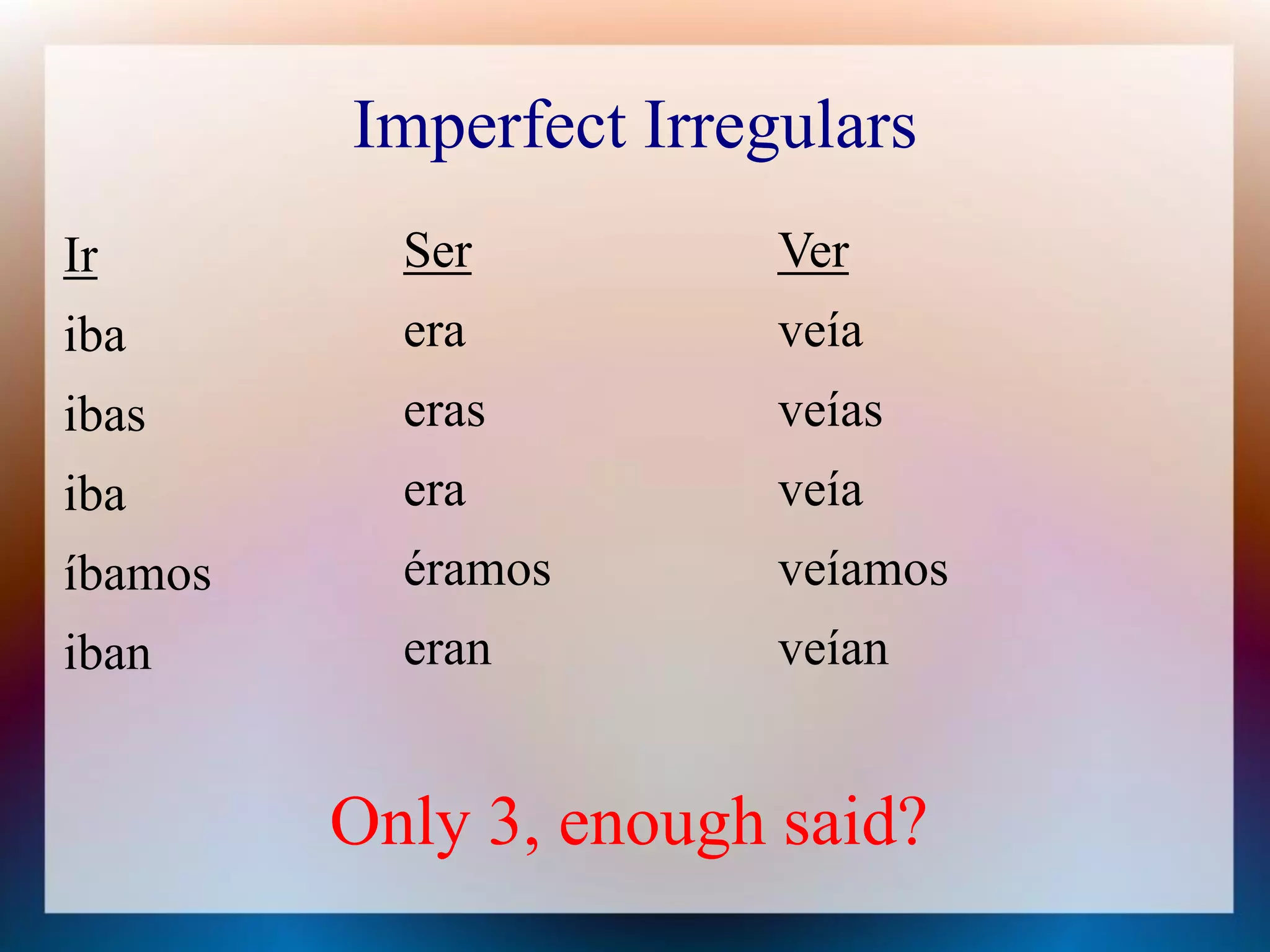
Imperfect Irregulars
Ir         Ser          Ver
iba        era          veía
ibas       eras         veías
iba        era          veía
íbamos     éramos       veíamos
iban       eran         veían


         Only 3, enough said?
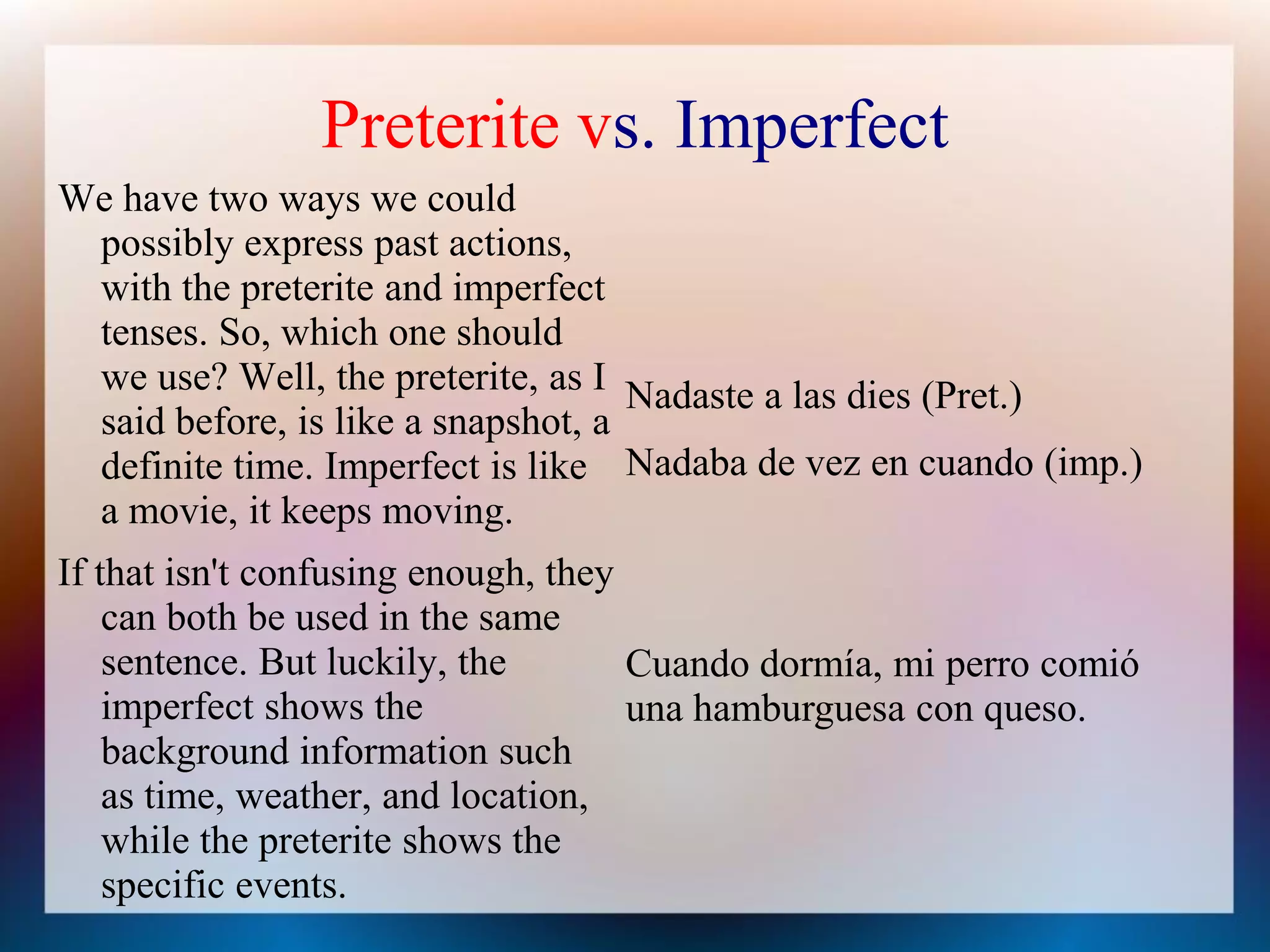
Preterite vs. Imperfect
We have two ways we could
 possibly express past actions,
 with the preterite and imperfect
 tenses. So, which one should
 we use? Well, the preterite, as I Nadaste a las dies (Pret.)
 said before, is like a snapshot, a
 definite time. Imperfect is like Nadaba de vez en cuando (imp.)
 a movie, it keeps moving.
If that isn't confusing enough, they
    can both be used in the same
    sentence. But luckily, the       Cuando dormía, mi perro comió
    imperfect shows the              una hamburguesa con queso.
    background information such
    as time, weather, and location,
    while the preterite shows the
    specific events.
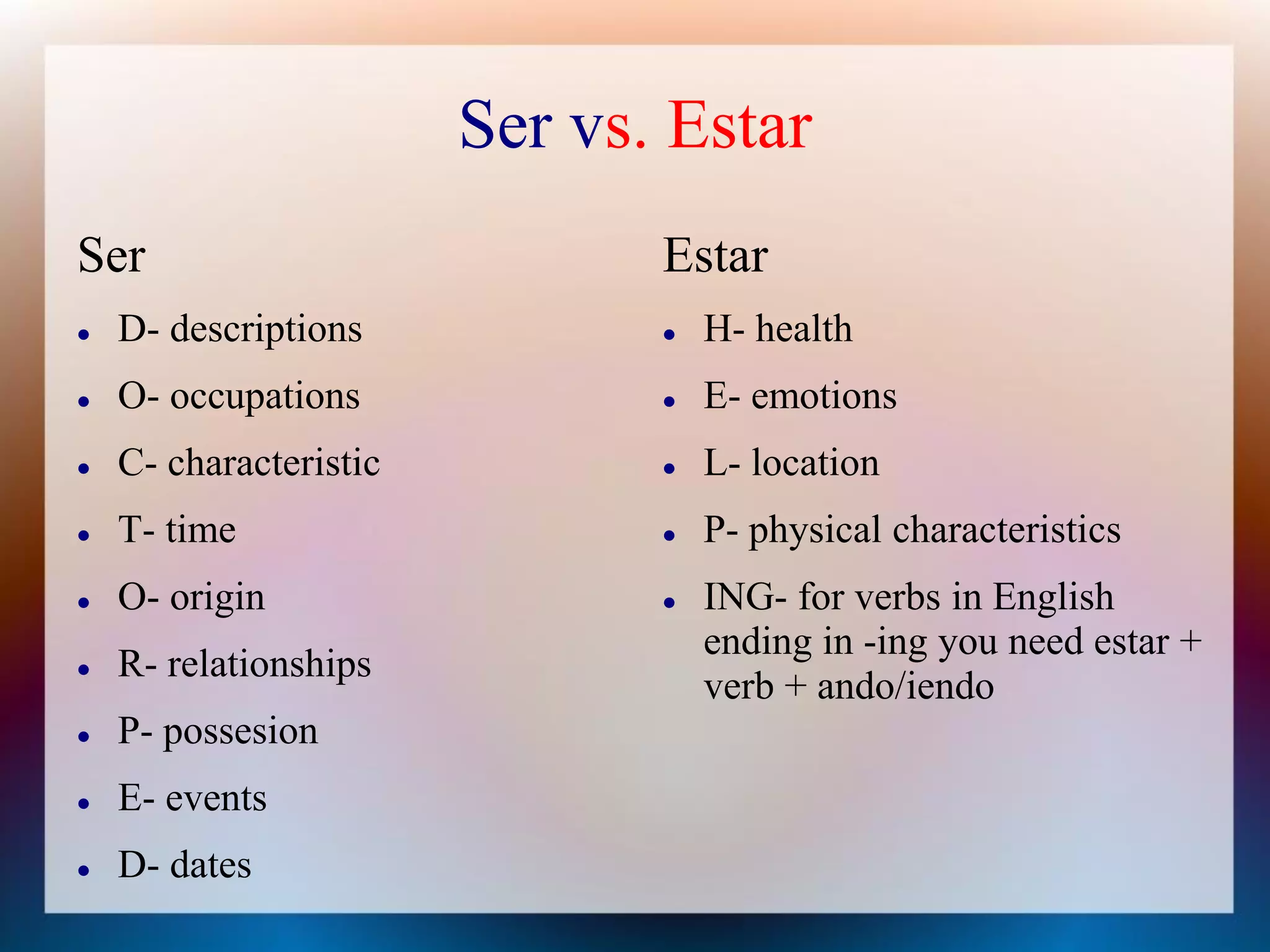
Ser vs. Estar
Ser                            Estar
   D- descriptions               H- health
   O- occupations                E- emotions
   C- characteristic             L- location
   T- time                       P- physical characteristics
   O- origin                     ING- for verbs in English
                                   ending in -ing you need estar +
   R- relationships
                                   verb + ando/iendo
   P- possesion
   E- events
   D- dates
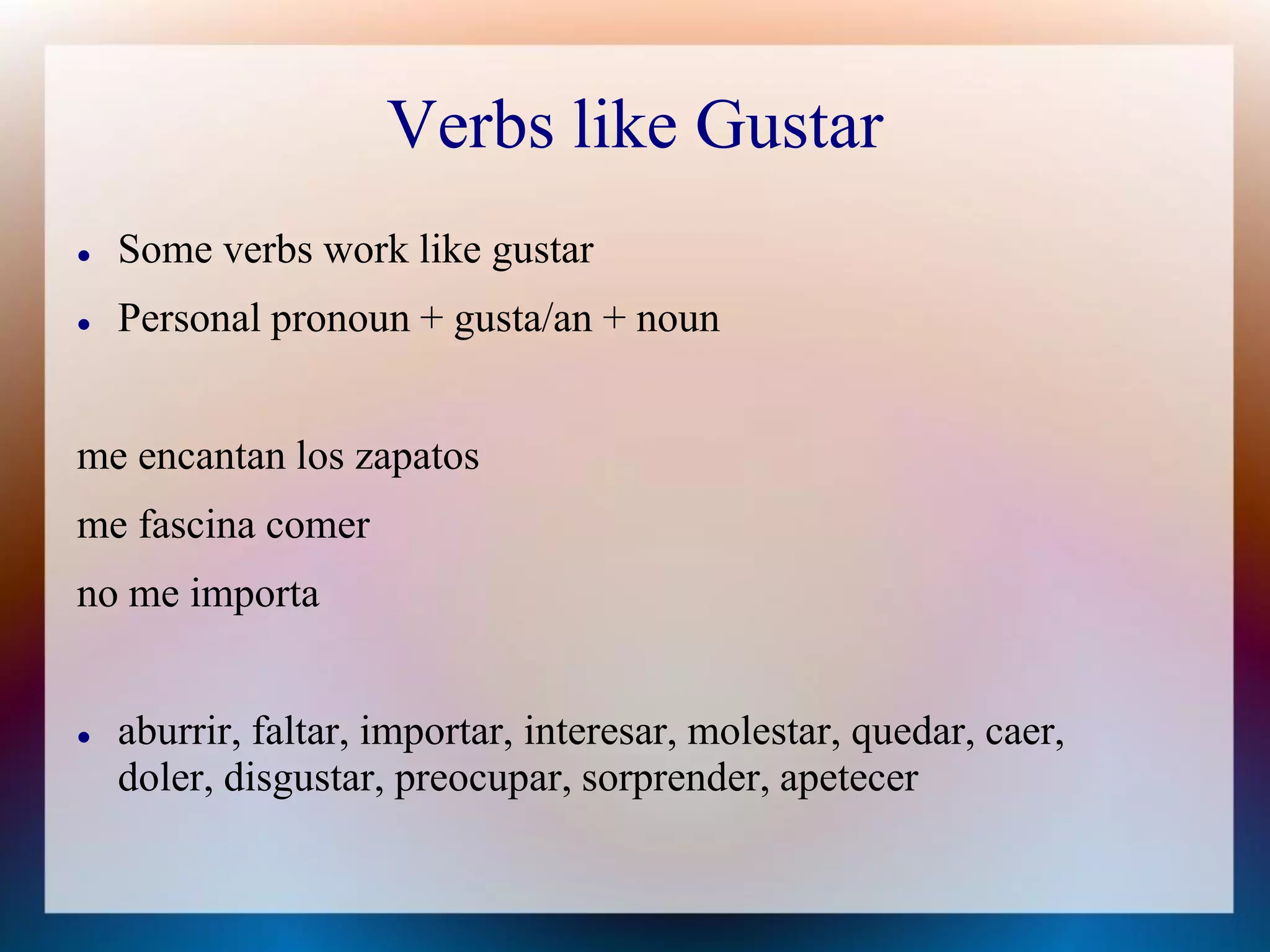
Verbs like Gustar
   Some verbs work like gustar
   Personal pronoun + gusta/an + noun


me encantan los zapatos
me fascina comer
no me importa


   aburrir, faltar, importar, interesar, molestar, quedar, caer,
    doler, disgustar, preocupar, sorprender, apetecer
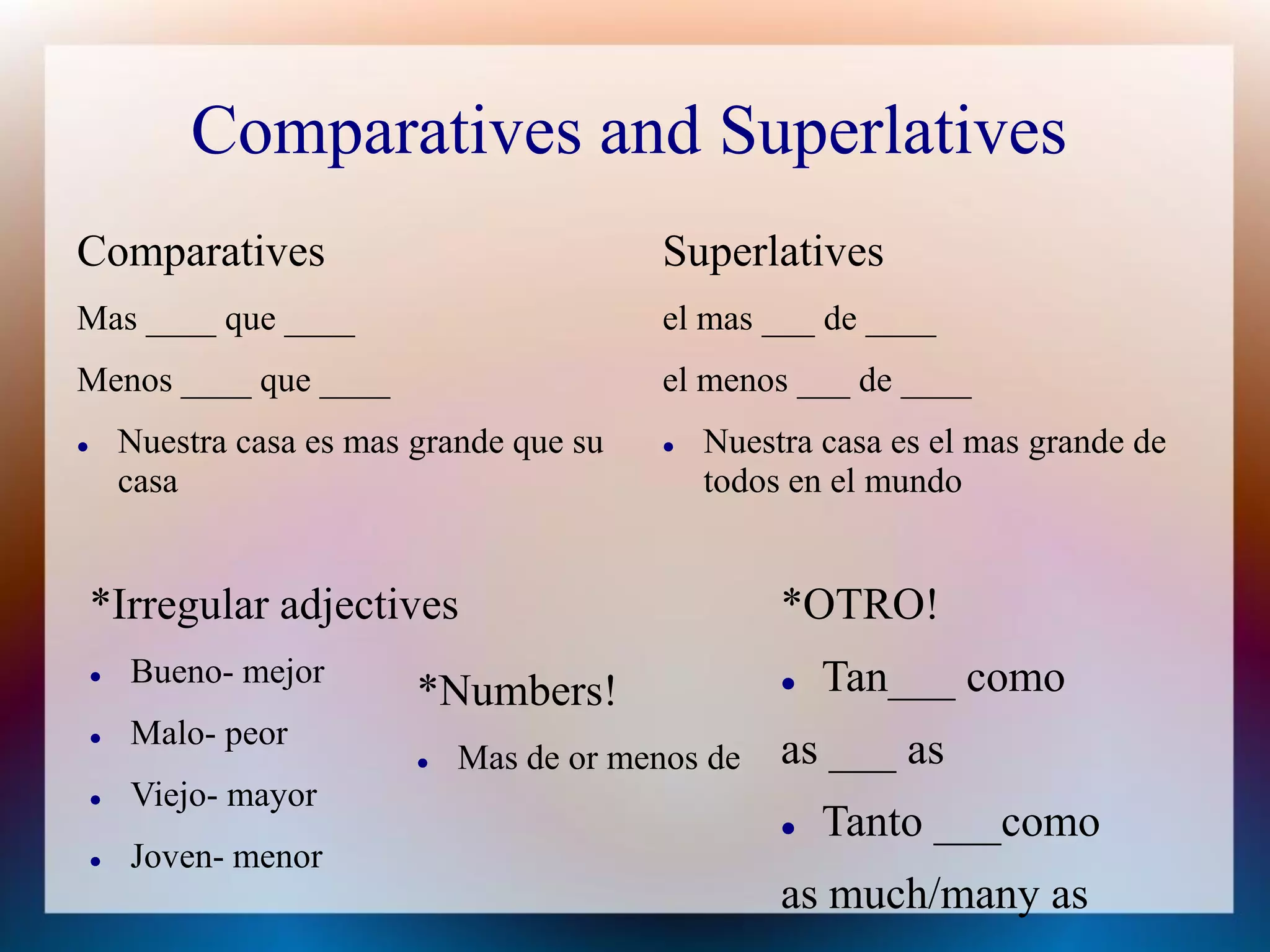
Comparatives and Superlatives
Comparatives                                 Superlatives
Mas ____ que ____                            el mas ___ de ____
Menos ____ que ____                          el menos ___ de ____
       Nuestra casa es mas grande que su       Nuestra casa es el mas grande de
        casa                                     todos en el mundo


    *Irregular adjectives                             *OTRO!
       Bueno- mejor                                     Tan___ como
                            *Numbers!
       Malo- peor
                               Mas de or menos de    as ___ as
       Viejo- mayor
                                                         Tanto ___como
       Joven- menor
                                                      as much/many as
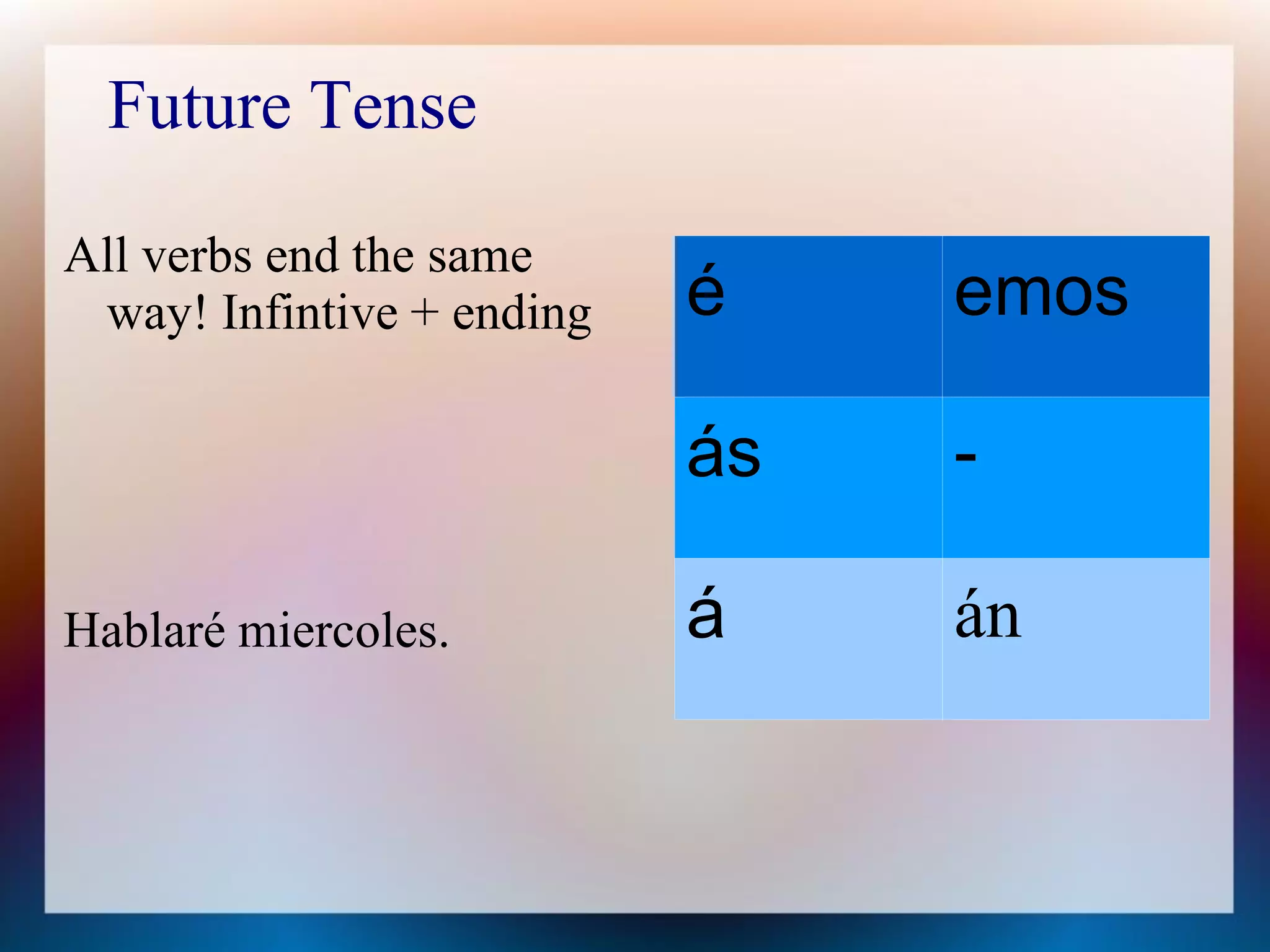
Future Tense

All verbs end the same
 way! Infintive + ending   é    emos

                           ás   -

Hablaré miercoles.         á    án
Triggers
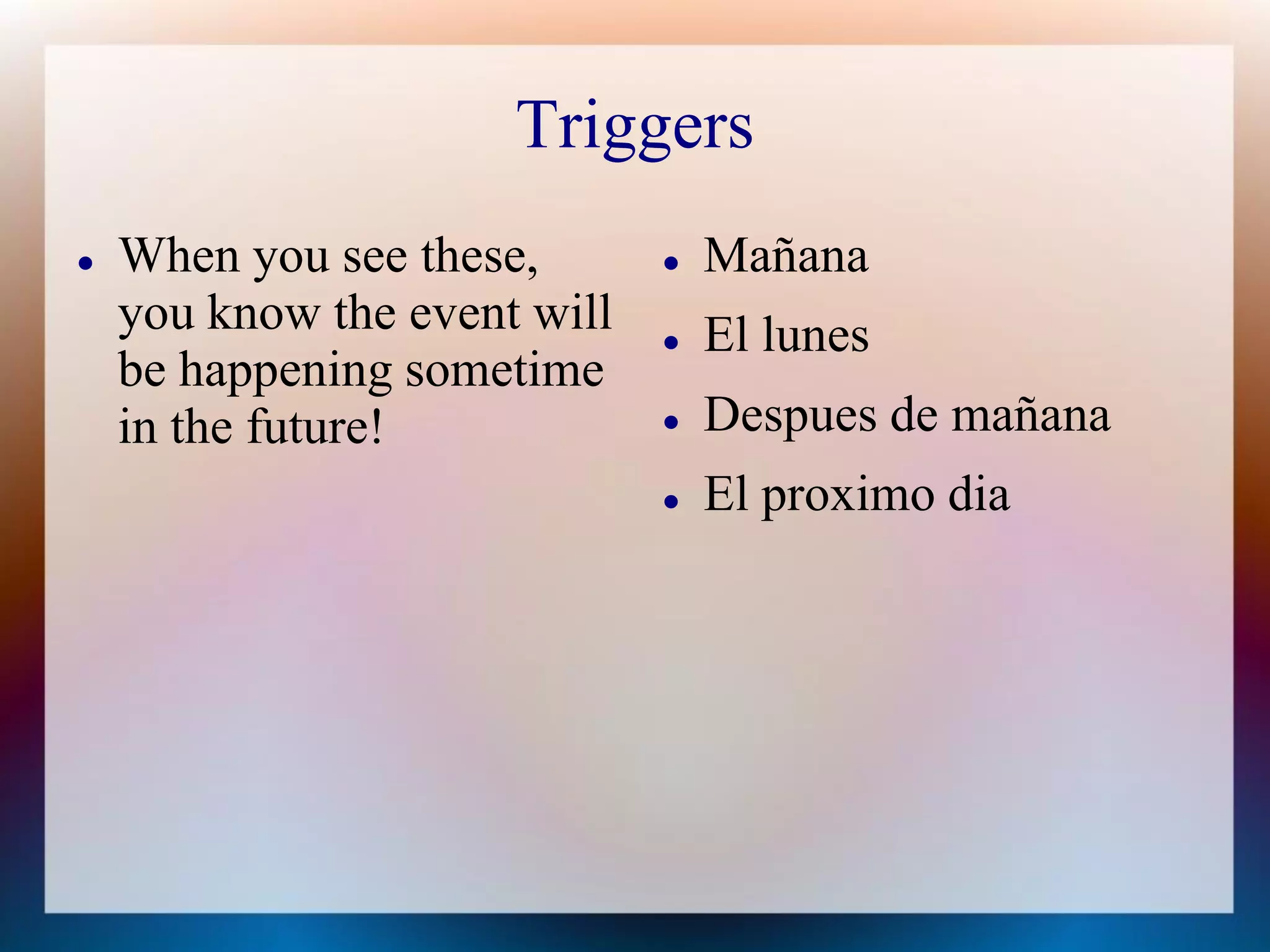
   When you see these,          Mañana
    you know the event will      El lunes
    be happening sometime
    in the future!               Despues de mañana
                                 El proximo dia
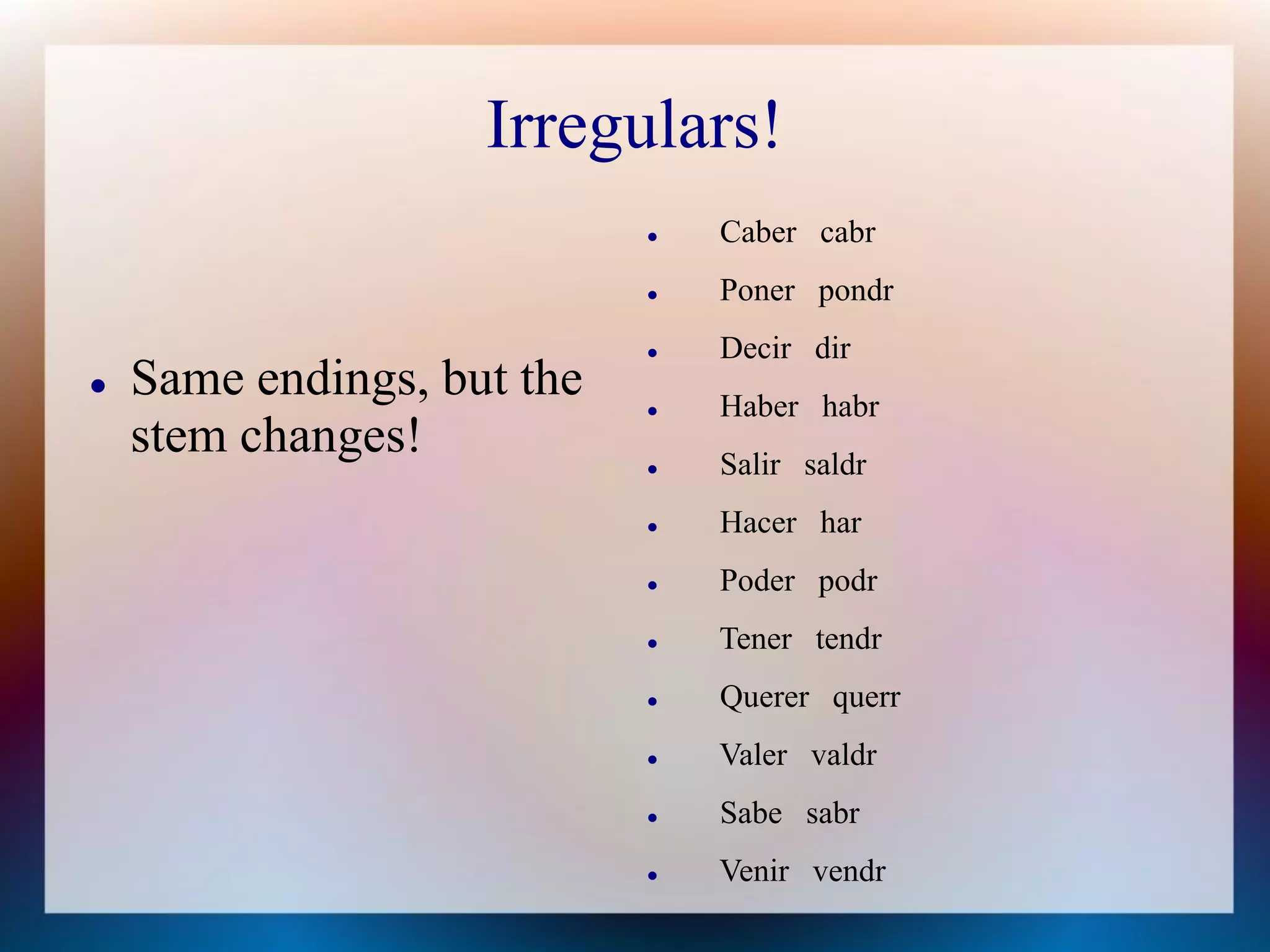
Irregulars!
                               Caber cabr
                               Poner pondr
                               Decir dir
   Same endings, but the      Haber habr
    stem changes!              Salir saldr
                               Hacer har
                               Poder podr
                               Tener tendr
                               Querer querr
                               Valer valdr
                               Sabe sabr
                               Venir vendr
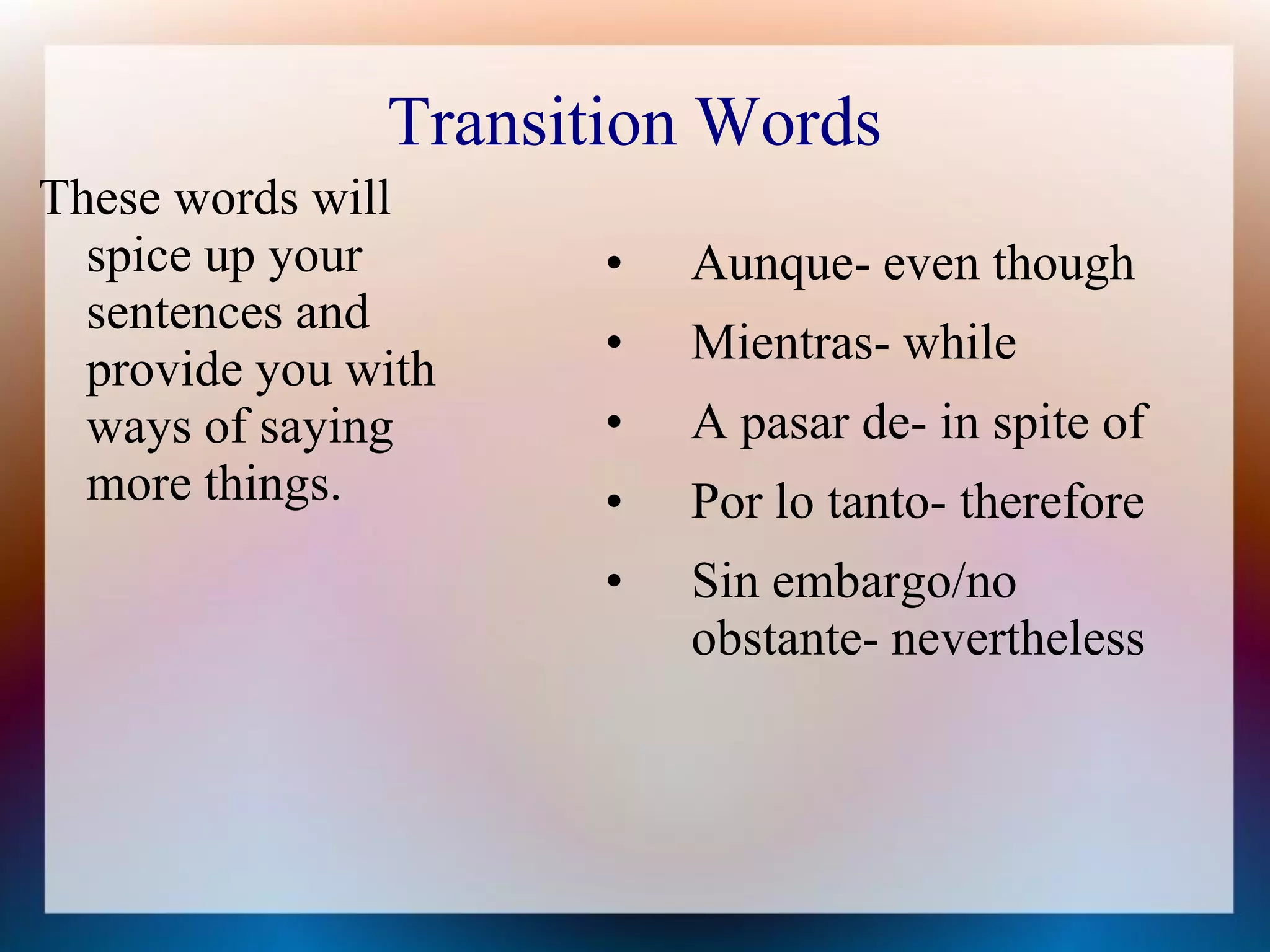
Transition Words
These words will
  spice up your       •   Aunque- even though
  sentences and
                      •   Mientras- while
  provide you with
  ways of saying      •   A pasar de- in spite of
  more things.        •   Por lo tanto- therefore
                      •   Sin embargo/no
                          obstante- nevertheless
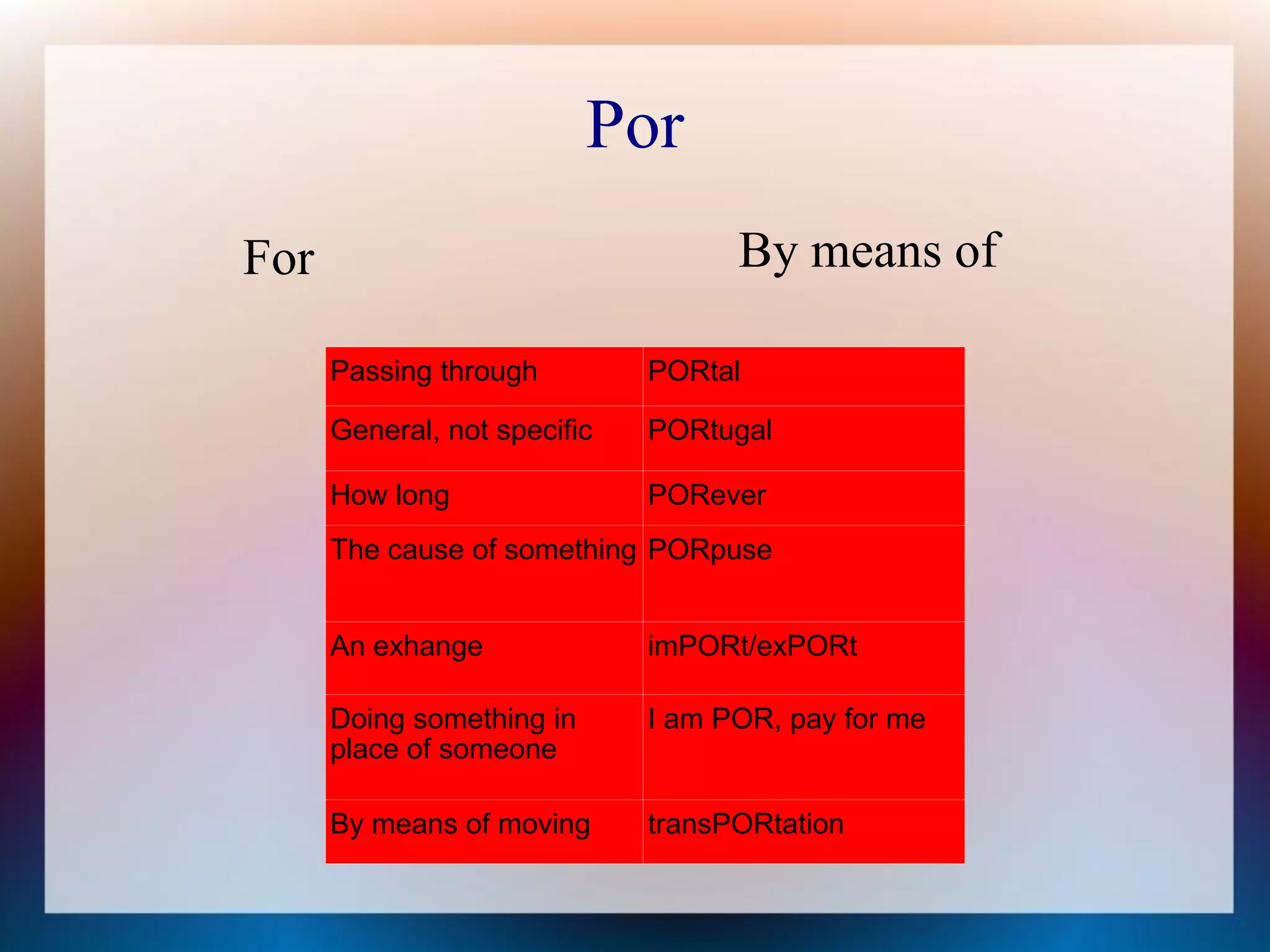
Por
For                                 By means of

      Passing through         PORtal

      General, not specific   PORtugal

      How long                PORever
      The cause of something PORpuse


      An exhange              imPORt/exPORt

      Doing something in      I am POR, pay for me
      place of someone

      By means of moving      transPORtation
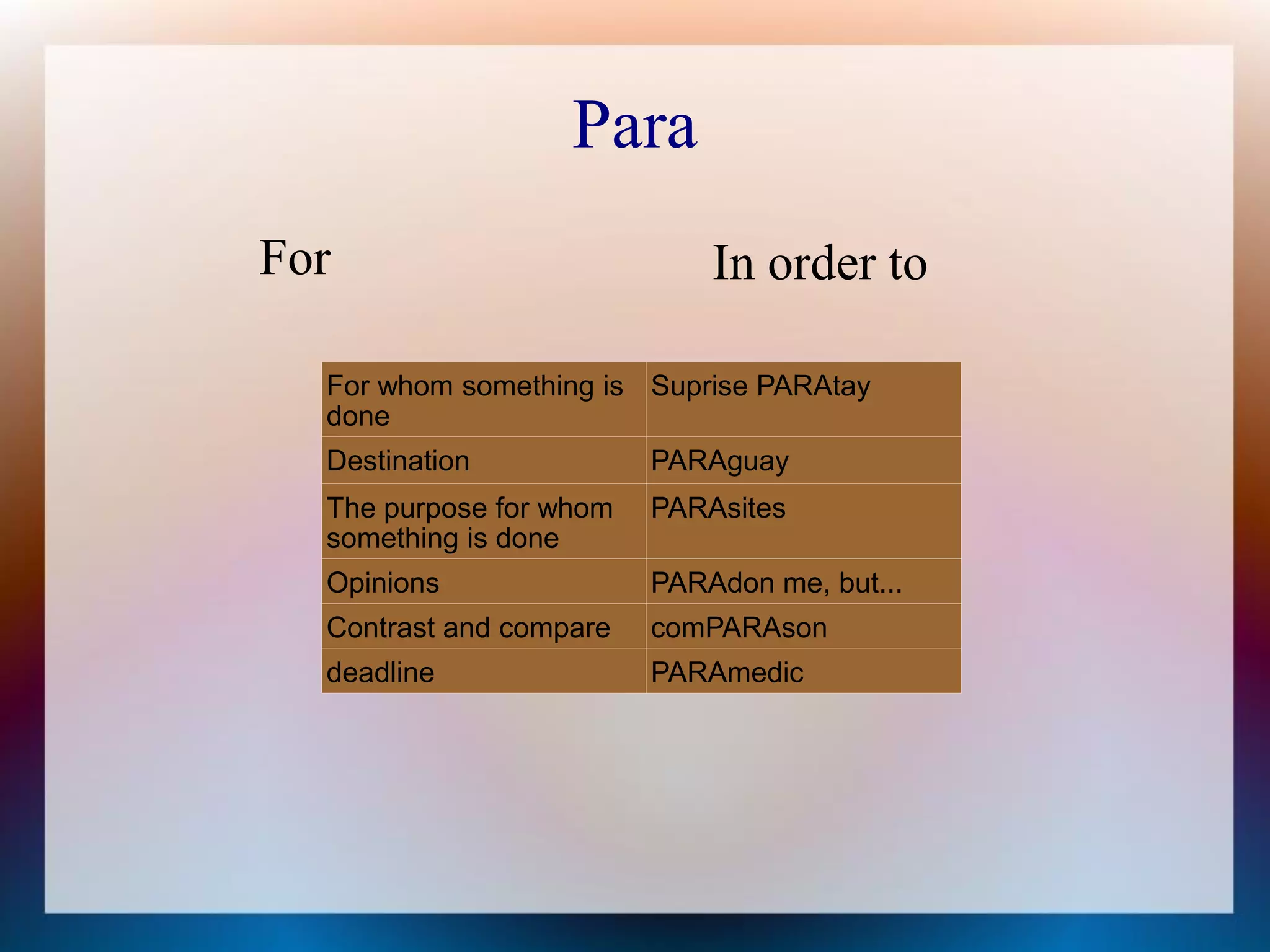
Para
For                          In order to

  For whom something is Suprise PARAtay
  done
  Destination            PARAguay
  The purpose for whom   PARAsites
  something is done
  Opinions               PARAdon me, but...
  Contrast and compare   comPARAson
  deadline               PARAmedic

Spanish 3 Grammar Notebook Nicholas

  • 1.
    Spanish 3 GrammaticalConcepts Nicholas Arce
  • 2.
    Table of Contents 1-Title 15- Comparatives and Superlatives 2- Table of Contents 16- Future Tense 3- Preterite Tense 17- Future Triggers 4- Preterite Triggers 18- Future Irregulars 5- Car, Gar, Zar 19- Transition Words 6- Spock 20- Por 7- Snake, Snakey 21- Para 8- Cucuracha 9- Imperfect Tense 10- Imperfect Triggers 11- Irregulars 12-Preterite vs. Imperfect 13- Ser vs. Estar 14- Verbs like Gustar
  • 3.
    This verb form is used for completed actions in the past. Such as you ate yesterday, Regular Verb Forms comiste ayer, or I swam at 8, Nadé a las ocho. They have a é amos definitive start and end. -Ar aste - ó aron Preterite -Er/Ir í imos iste - ió ieron
  • 4.
    Every verb tense has Triggers words which will help you identify which tense to use. For the preterite tense...  Ante ayer  El dia anterior  El jueves pasado  El otro dia  UN! vez All these will help you identify the perterite tense
  • 5.
    Car, Gar, Zar  Most (if not all) verb forms have irregulars. The preterite has quite a few...the first being the car, gar, and zar verbs.  For these verbs, take off the ending of the infintive, and for the YO form with verbs ending in car, gar, or zar, use the endings qué, gué, and cé respectively.  buscar---busqué  llegar---llegué  empezar---empecé
  • 6.
    Irregular conjugations foreach Spock! grouping. No accents! Hacer hice, hicimos, hiciste, hizo, hicieron Dar Ir Dar/Ver Ver Ser -i,-imos,-iste,-io,-ieron Hacer Ir/Ser fui, fuimos, fuiste, fue, fueron
  • 7.
    Only the bottom of the Snake....Snakey chart....(3rd person) has an irregular conjugation where the vowel changes to a y.  Leer  Oir leyó oyó leyeron oyeron
  • 8.
    Cucurachas!  andar anduv-  estar estuv- These verbs all have the same endings: e, imos,  tener tuv- iste, o, ieron.  caber cup-  haber hub- Anduve, anduvimos, anduviste, anduvo,  poder pud- anduvieron  poner pus-  saber sup-  hacer hic- ***** for those, the 3rd person plural drops the 'I' in the conjugation. For example. Trajeron instead  querer quis- of trajieron....  venir vin-  *decir dij-  *producir produj-  *traer traj-
  • 9.
    Imperfect  Used to describe past actions The endings are.... that don't have a specific beginning or ending. They -Ar aba abámos have an imperfect time. They abas - describe habitual past actions, or uncompleted actions. Also aba aban vague refrences would use the imperfect.... cuando ERA -Er/Ir niño... ía íamos ías - ía ían
  • 10.
    A veces A menudo De vez en cuando Triggers Mientras Muchas veces Los lunes Denotes the imperfect tense!!!! Cada dia Frequentemente siempre
  • 11.
    Imperfect Irregulars Ir Ser Ver iba era veía ibas eras veías iba era veía íbamos éramos veíamos iban eran veían Only 3, enough said?
  • 12.
    Preterite vs. Imperfect Wehave two ways we could possibly express past actions, with the preterite and imperfect tenses. So, which one should we use? Well, the preterite, as I Nadaste a las dies (Pret.) said before, is like a snapshot, a definite time. Imperfect is like Nadaba de vez en cuando (imp.) a movie, it keeps moving. If that isn't confusing enough, they can both be used in the same sentence. But luckily, the Cuando dormía, mi perro comió imperfect shows the una hamburguesa con queso. background information such as time, weather, and location, while the preterite shows the specific events.
  • 13.
    Ser vs. Estar Ser Estar  D- descriptions  H- health  O- occupations  E- emotions  C- characteristic  L- location  T- time  P- physical characteristics  O- origin  ING- for verbs in English ending in -ing you need estar +  R- relationships verb + ando/iendo  P- possesion  E- events  D- dates
  • 14.
    Verbs like Gustar  Some verbs work like gustar  Personal pronoun + gusta/an + noun me encantan los zapatos me fascina comer no me importa  aburrir, faltar, importar, interesar, molestar, quedar, caer, doler, disgustar, preocupar, sorprender, apetecer
  • 15.
    Comparatives and Superlatives Comparatives Superlatives Mas ____ que ____ el mas ___ de ____ Menos ____ que ____ el menos ___ de ____  Nuestra casa es mas grande que su  Nuestra casa es el mas grande de casa todos en el mundo *Irregular adjectives *OTRO!  Bueno- mejor  Tan___ como *Numbers!  Malo- peor  Mas de or menos de as ___ as  Viejo- mayor  Tanto ___como  Joven- menor as much/many as
  • 16.
    Future Tense All verbsend the same way! Infintive + ending é emos ás - Hablaré miercoles. á án
  • 17.
    Triggers  When you see these,  Mañana you know the event will  El lunes be happening sometime in the future!  Despues de mañana  El proximo dia
  • 18.
    Irregulars!  Caber cabr  Poner pondr  Decir dir  Same endings, but the  Haber habr stem changes!  Salir saldr  Hacer har  Poder podr  Tener tendr  Querer querr  Valer valdr  Sabe sabr  Venir vendr
  • 19.
    Transition Words These wordswill spice up your • Aunque- even though sentences and • Mientras- while provide you with ways of saying • A pasar de- in spite of more things. • Por lo tanto- therefore • Sin embargo/no obstante- nevertheless
  • 20.
    Por For By means of Passing through PORtal General, not specific PORtugal How long PORever The cause of something PORpuse An exhange imPORt/exPORt Doing something in I am POR, pay for me place of someone By means of moving transPORtation
  • 21.
    Para For In order to For whom something is Suprise PARAtay done Destination PARAguay The purpose for whom PARAsites something is done Opinions PARAdon me, but... Contrast and compare comPARAson deadline PARAmedic